Pipetting Radioactive or Hazardous Materials
By Dr. Zubair Khalid, DVM, MS, PhD ·

Pipetting radioactive or hazardous materials is the controlled transfer of radioisotope-labeled reagents, toxic chemicals, or infectious stocks into tubes, wells, and reaction mixtures without exposing the operator, contaminating the workspace, or corrupting the experiment. In a molecular biology lab this skill is exercised every time you aliquot an [α-³²P]dCTP stock for a random priming reaction, dispense phenol into a phase-lock tube, or set up a serial dilution of a chemoattractant. Done well, it takes minutes and leaves no trace. Done badly, it produces contaminated pipettes, contaminated benches, unknown personal doses, and experiment-ruining cross-contamination.
This article walks through pipetting radioactive materials safety from first principles to bench execution. You will learn how to choose the right pipette and tip for the hazard, how to pipette with a technique that protects both you and your data, how to verify the result with surveys and wipe tests, and how to recognize and fix the mistakes that most often cause contamination events. A full run of a typical hazardous pipetting task, such as preparing ten ³²P-labeled labeling reactions from a master stock, takes about 15 to 30 minutes of hands-on time from gowning to final survey. The elapsed time can be longer if decay-in-storage waste handling or liquid scintillation counting of wipe tests is included, because those steps run on the isotope's schedule, not yours.
Principle
Pipetting a hazardous liquid is a risk trade between three competing demands.
The first demand is operator protection. Every hand-pipetting step creates a small aerosol at the tip and a small chance of a droplet contacting skin or entering the pipette body. With radioisotopes, the exposure can be external (radiation from the vial reaching your hand) or internal (ingestion, inhalation of aerosols, or absorption through broken skin). Internal contamination is the more serious concern for most molecular biology isotopes because it delivers dose continuously until the material decays or is cleared. The governing philosophy of radiation protection is ALARA, which stands for As Low As Reasonably Achievable. Under ALARA, every pipetting operation should be arranged to minimize time near the source, maximize distance from it, and use shielding appropriate to the isotope. The US Nuclear Regulatory Commission enforces occupational dose limits for licensed materials, and individual institutions set investigation levels well below those limits, so your institutional radiation safety office is the practical authority on what "safe" means at your bench.
The second demand is sample integrity. Radioactive and hazardous stocks are often expensive, of defined specific activity, and used in tiny amounts. A pipetting error of even a few percent propagates through a labeling reaction and changes the specific activity of your probe, which changes band intensities on an autoradiograph in ways you cannot correct after the fact. Precise pipetting technique and a properly calibrated pipette are therefore not cosmetic concerns. They are part of the analytical validity of the experiment.
The third demand is containment of the hazard itself. Pipettes are the single most common vector of contamination in isotope labs because liquid can wick into the shaft, sit inside the barrel, and be carried to the next task. The design goal of safe pipetting is to keep the hazardous material confined to a disposable barrier tip and a clearly defined work zone, so that at the end of the job the entire hazard can be removed as waste in one motion.
These three demands explain the standard architecture of a hazardous pipetting setup: shielded or ventilated workspace, barrier or positive-displacement tips, dedicated pipettes, absorbent bench protection, and a verification step at the end.
Know Your Hazard Before You Pick Up a Pipette
The correct technique depends on which of four hazard classes the material belongs to. Assess this before the pipette comes out of the drawer.
Radionuclides used in molecular biology
Most bench work involves beta emitters and a few gamma emitters. The properties that matter for pipetting are energy, half-life, and detection method.
- Hydrogen-3 (tritium) is a very low-energy beta emitter with a half-life of about 12.3 years. It cannot be detected with a standard Geiger-Mueller survey meter and must be assayed by liquid scintillation counting of a wipe sample. Because it is undetectable in real time, contamination control depends entirely on procedure and wipe testing.
- Carbon-14 is a low-energy beta emitter with a half-life of about 5,730 years. It is detectable by wipe test and, at activity levels used on the bench, weakly by some thin-window survey meters.
- Phosphorus-32 is a high-energy beta emitter with a half-life of about 14.3 days. It is easily detected with a Geiger-Mueller meter, produces a measurable dose rate at close range, and generates bremsstrahlung x-rays when beta particles strike high-atomic-number materials such as lead. Acrylic (lucite) shielding is the correct choice for ³²P. Lead shielding alone is the wrong choice because of bremsstrahlung production.
- Sulfur-35 is a low-energy beta emitter with a half-life of about 87 days. It is used in metabolic labeling and sequencing applications. Detection is by wipe test or a sensitive meter.
- Iodine-125 is a low-energy gamma and x-ray emitter with a half-life of about 60 days. It is used in radioimmunoassays and nucleic acid labeling. Because volatilization of free iodine is a real risk, work involving ¹²⁵I in an open form requires ventilation controls and thyroid monitoring set up through your radiation safety program.
The physical half-life also determines how long a contaminated item must be segregated if decay-in-storage is your disposal route. For ³²P, ten half-lives is roughly 5 months. For ³²S it is roughly 3 years. For tritium and carbon-14, decay-in-storage is impractical, and material must go out through a licensed waste channel instead.
Safety note. Never handle an open radionuclide stock without wearing the personal protective equipment your license requires, typically a lab coat, safety glasses, and two pairs of nitrile gloves, plus any additional dosimetry assigned by your radiation safety office. Finger rings or wrist badges are used for higher-energy isotopes such as ³²P.
Corrosive and toxic chemicals
Phenol, chloroform, formamide, β-mercaptoethanol, and concentrated acids are staples of nucleic acid work. Pipetting them shares most contamination-control logic with radioisotopes, with two differences. First, volatile toxic chemicals should be pipetted inside a certified chemical fume hood rather than on the open bench, because inhalation is the dominant route of exposure. Second, splash exposure to eyes and skin is the acute risk, so face shields or goggles and compatible gloves matter as much as pipetting technique. Nitrile gloves are a poor barrier to chloroform and phenol for any prolonged contact. Double-gloving with heavier protection or using laminate gloves for handling the stock bottle is the standard precaution. Your institution's chemical hygiene plan, prepared under the Occupational Safety and Health Administration laboratory standard, defines the specific requirements.
Biohazardous materials
Pipetting infectious cultures, viral stocks, or human-derived samples adds aerosol exposure and needle-free inoculation risks. Biosafety guidance from the CDC and NIH in their laboratory biosafety manual directs the use of certified Class II biosafety cabinets for open manipulation of BSL-2 and higher materials, barrier tips to prevent aspiration into the pipette shaft, and disinfectant placed inside the cabinet work surface before any liquid handling begins. Air-displacement pipettes must never be used inside a biosafety cabinet in a way that disturbs the laminar airflow across open cultures. Hold the pipette at an angle and keep tube openings shielded by the cabinet's sash height and airflow pattern.
Chemically hazardous but nonvolatile materials
Detergents, denaturants such as guanidinium thiocyanate, ethidium bromide, and SYBR-class nucleic acid dyes are the everyday hazards of a molecular biology bench. These are handled with splash protection, barrier tips, and routine decontamination, and the pipetting technique is otherwise identical to ordinary work.
Materials and Equipment
Prepare everything before opening the hazardous stock. Once you begin, you should never need to walk across the room wearing contaminated gloves.
| Item | Specification or working example | Purpose |
|---|---|---|
| Air-displacement pipette set | P10, P20, P100, P1000, dedicated to the isotope room or hood | Routine small-volume transfers |
| Positive-displacement pipette | Capillary piston type, 10 to 100 µL range | Viscous, volatile, or high-hazard liquids where aerosol exclusion matters |
| Barrier (filtered) tips | Aerosol-resistant filter tips matched to each pipette | Prevent liquid and aerosols from entering the shaft |
| Acrylic shielding | Minimum thickness set by your radiation safety office for the isotope in use | Secondary barrier for ³²P and other medium-energy betas |
| Absorbent bench cover | Plastic-backed absorbent paper, placed plastic side up | Contains drips, disposable as radioactive waste |
| Secondary containment | Unbreakable trays with absorbent lining | Holds stock vials and reaction tubes during transfers |
| Survey meter | Geiger-Mueller pancake probe for ³²P and ³⁵S, sodium iodide probe for ¹²⁵I | Real-time contamination check |
| Wipe test supplies | Filter paper smears, vials, liquid scintillation cocktail | Detects removable contamination, required for ³H and ¹⁴C |
| Personal protective equipment | Lab coat, safety glasses, two pairs nitrile gloves, dosimetry as assigned | Operator protection |
| Decontamination supplies | Detergent (for example, commercial radiac wash), decontamination gel or spray for ³²P, appropriate chemical neutralizers | Emergency and routine decontamination |
| Sharps and waste containers | Isotope-specific shielded liquid and solid waste containers | Segregated disposal at the point of generation |
| Tube racks and labels | Isotope-labeled, chemical-resistant racks | Prevents mix-ups between hot and cold runs |
A representative stock that a molecular biologist aliquots with this technique is [α-³²P]dCTP supplied at 10 mCi/mL with a specific activity around 3,000 Ci/mmol. A single labeling reaction typically consumes 1 to 5 µL of such stock. That small volume, high activity combination is exactly why technique and calibration matter. Your pipette error at 1 µL on a P20 can be several percent if the pipette is out of calibration, and each percent changes the specific activity of your probe directly.
Safety note. Liquid scintillation cocktail is itself a chemical hazard and a mixed waste stream. Use biodegradable cocktails where your waste program permits, and keep all cocktail vials in the isotope waste pathway, not the ordinary chemical waste stream.
Pre-Job Setup: Pipetting Radioactive Materials Safety Step by Step
The steps below cover setup through completion. Read them all before you start. The reason for each critical step is stated so you can adapt the sequence to your own protocol without losing the protective logic.
- Plan the whole procedure on paper first. Write out every transfer you will make, the volumes, and the tube order. Reason: every minute a radioactive stock is open is dose and contamination opportunity, and a written plan lets you complete the work in one continuous session with minimal handling time, which is the time leg of ALARA.
- Confirm training and authorization. Verify that you are an authorized user for the isotope and quantity in your institution's license records and that your dosimetry is current. Reason: licensed material may only be used by trained, authorized individuals, and your survey and dose records are only meaningful if your monitoring is active.
- Clear and prepare the work zone. Remove all unnecessary items. Lay fresh absorbent bench paper, plastic side up, over the work area. Place a lined secondary tray at the center. Reason: a clutter-free zone shortens reach distances, keeps transfer paths short, and makes a survey at the end meaningful, because any contamination you find is yours rather than leftover from earlier work.
- Set up shielding appropriate to the isotope. For ³²P, position acrylic shielding between the stock vial and your torso and work with the vial behind the shield whenever it is open. Reason: distance and acrylic shielding reduce both whole-body and extremity dose. Lead is used for gamma emitters such as ¹²⁵I but produces bremsstrahlung with beta emitters, so it is the wrong shielding material for ³²P.
- Check your survey meter against its own background and a check source. Turn the meter on, confirm the battery indicator, measure background in the work area, and verify response with the lab's sealed check source if one is assigned. Reason: a survey meter that is off, dead, or uncalibrated provides false assurance. This check takes 30 seconds and can be the difference between catching a spill in real time and discovering it at the end-of-day survey.
- Don PPE in the correct order. Lab coat, safety glasses, then two pairs of nitrile gloves. Assign one hand as the "clean" hand that touches only the stock vial exterior and equipment, and one hand as the "hot" hand that touches only tips and open containers. Reason: two gloves protect against perforation of the outer glove, and the clean-hand, hot-hand discipline is the single most effective behavioral control against spreading contamination to door handles, pipette adjusters, and your face.
- Stock the work zone with all consumables. Tips in their boxes with the lid openable one-handed, tubes pre-labeled and racked, waste containers open and positioned, decontamination supplies at hand. Reason: once gloves are contaminated you cannot open drawers, press elevator buttons, or pick up your phone. Anything you need mid-job must already be inside the zone.
- Bring the stock out with containment. Carry the radioactive stock in its original shielded container or a lined secondary tray directly to the work zone. Keep the vial closed until the moment of withdrawal. Reason: transport in secondary containment prevents a dropped vial from becoming a spill event, and minimizing open-vial time reduces both dose and volatilization where relevant.
Pipetting Technique for Hazardous Materials
The mechanical skill of pipetting is the same for radioactive, chemical, and biohazardous work. What changes is the consequence of every droplet. Practice the following motions with a harmless dye until they are automatic before you do them with a hot stock.
Holding and moving the pipette
Hold the pipette vertically or near-vertically whenever liquid is in the tip. Tilting an air-displacement pipette while it holds liquid lets the liquid run toward the shaft and into the nosepiece, where it contaminates the piston region. With a hot stock, a contaminated nosepiece is an item that must be decontaminated or disposed of and, worse, a source of carryover into your next sample.
Move the pipette slowly. Fast motions create aerosols and droplet甩, and with ³²P a droplet flung off a tip can land more than a meter away. Every hazardous pipetting action should be performed inside the lined secondary tray so that even a dropped droplet is contained.
Aspiration
- Press the plunger to the first stop with your thumb, keeping a steady, controlled pressure.
- Place the tip just below the liquid surface, no deeper than 2 to 3 mm for small volumes. Reason: deeper immersion wets the outside of the tip, and that external film is a contamination and carryover source with hot or toxic liquids.
- Release the plunger smoothly and slowly. Reason: fast release pulls liquid up the inside of the tip, causes bubbles, and increases aerosol generation at the liquid surface. With air-displacement pipettes, rapid aspiration of volatile liquids also causes the trapped air cushion to expand and drip.
- Pause for a beat at full aspiration, then withdraw the tip and touch it against the inside wall of the source vial to dislodge external droplets. With radioactive stocks, that touch-wipe transfers a droplet back into the source rather than onto your tray.
Dispensing
- Bring the tip to the receiving tube and rest the tip tip against the inside wall, above the liquid line if liquid is already present.
- Press the plunger smoothly to the first stop, pause one to two seconds, then press to the second stop to blow out the residual volume. Reason: the pause allows the film of liquid on the tip wall to drain, which is the dominant error at small volumes. The blow-out stroke recovers the residual that air-displacement pipettes leave behind.
- Withdrawable tip touching the liquid you are dispensing into, release the plunger fully only after the tip is out of the liquid or above it. Reason: releasing the plunger while the tip is submerged pulls receiving liquid back into the tip, which both contaminates the pipette and creates a carryover error.
- Eject the tip into the shielded, lined waste container with the ejector button, never by pulling it with your gloved fingers. Reason: the ejector keeps your fingers off the contaminated tip, which is the contact point for almost every glove contamination event in an isotope lab.
Reverse pipetting and positive displacement
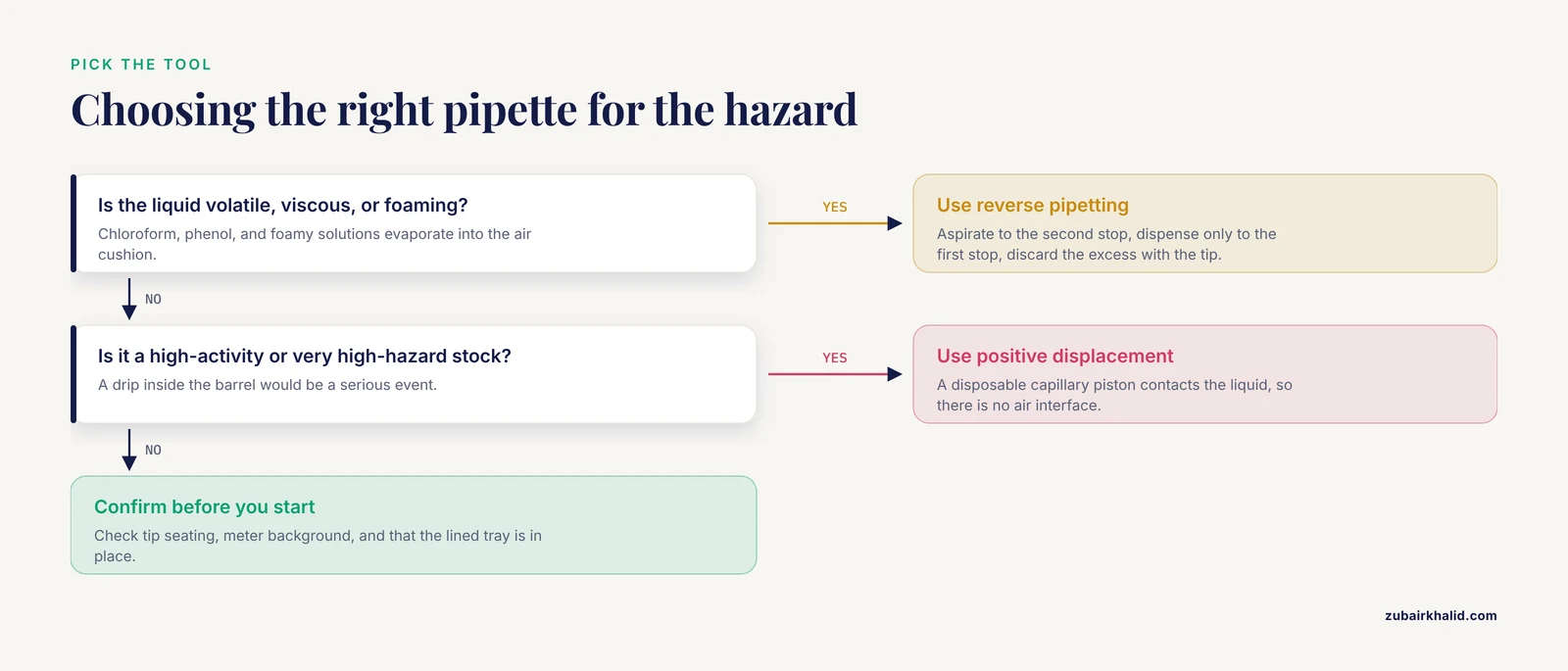
For volatile, viscous, or foaming hazardous liquids, reverse pipetting improves accuracy. Press to the second stop, aspirate, then dispense only to the first stop, leaving excess liquid in the tip. The excess is discarded with the tip. This keeps a cushion of liquid in the tip that prevents volatile liquids such as chloroform from evaporating into the air cushion of an air-displacement pipette, which is the mechanism behind the classic chloroform drip error.
For the highest-hazard liquids, use a positive-displacement pipette. In this design, the piston is a disposable capillary plunger that directly contacts the liquid, so there is no air interface. Volatile liquids cannot evaporate into the barrel, aerosols cannot travel up the shaft, and viscous liquids are dispensed accurately regardless of temperature or vapor pressure. For phenol:chloroform extractions and for high-activity ³²P stocks where a drip inside the barrel would be a serious event, positive displacement is the professional default.
Keeping stock handling minimal
Whenever the protocol permits, make a working aliquot rather than repeatedly opening the master stock. For example, for a series of labeling reactions, pipette the calculated total volume of [α-³²P]dCTP plus water into one pre-chilled microtube first, then dispense from that single tube into the individual reactions. Reason: the master stock stays closed, the open time drops from ten openings to two, and the dose and contamination risk fall accordingly. This is one of the highest-yield pipetting radioactive materials safety tips in routine practice.
Safety note. Pre-chilling radioactive nucleotide stocks and keeping them on ice reduces volatilization but does not eliminate it. Open cold stocks inside the shielded tray and close them immediately after withdrawal.
Pipette Calibration and Maintenance
A pipette's mechanical accuracy degrades silently. With hazardous materials, the cost of a silent error is doubled, because you may only notice it after a full labeling experiment has consumed an expensive isotope stock and produced a probe of unknown specific activity.
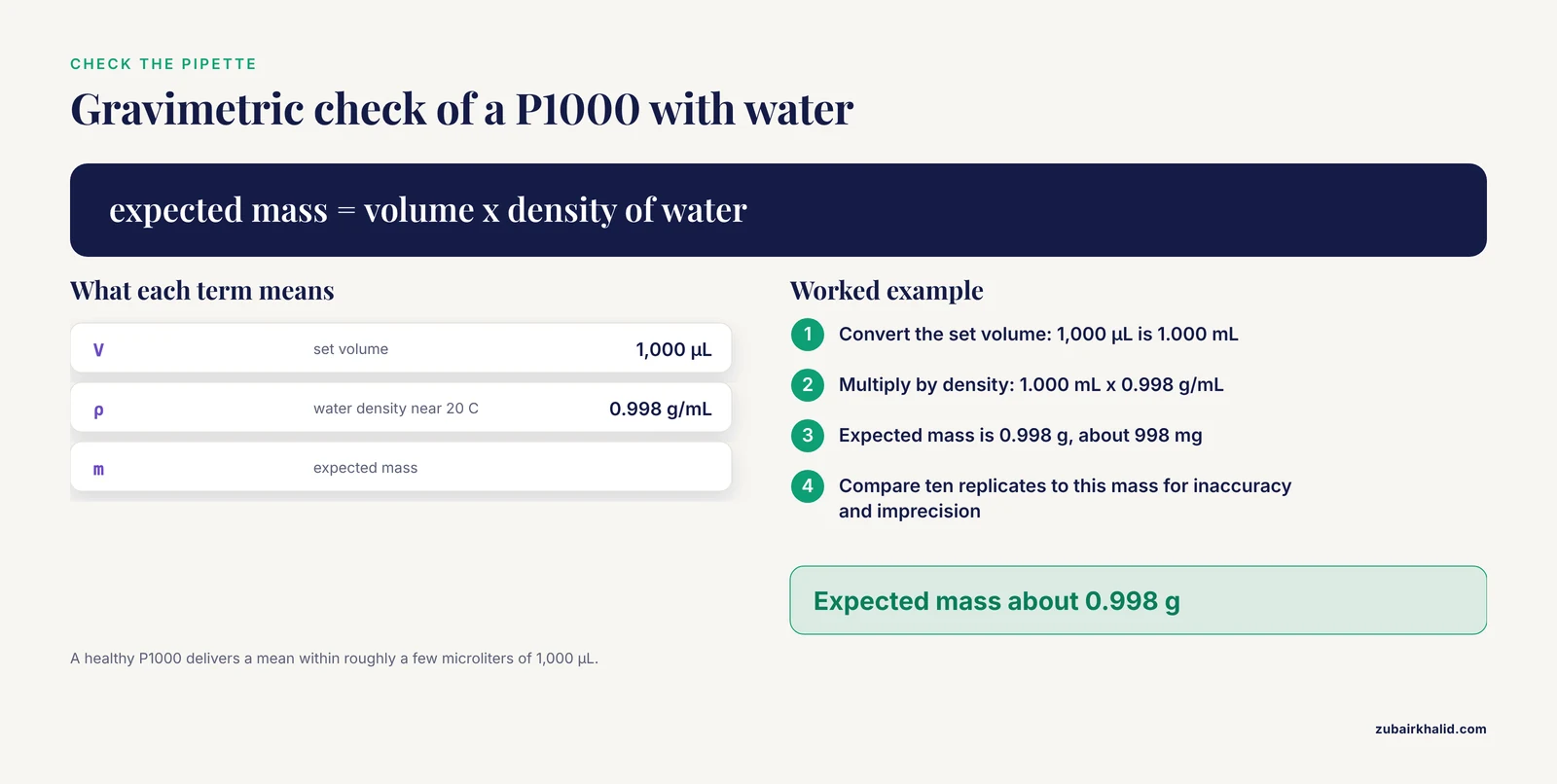
Calibration means gravimetric or photometric verification of the dispensed volume against the pipette's set volume. Standard practice in accredited labs follows the general framework of the ISO 8655 standard for piston-operated volumetric apparatus, which defines test methods and permissible error limits for air-displacement pipettes. A typical institutional program calibrates pipettes annually, with more frequent checks for pipettes in heavy use or used for critical quantitative steps. Manufacturer technical documentation specifies the volume points to test, usually 100 percent, 50 percent, and 10 percent of nominal volume, and the acceptable inaccuracy and imprecision at each point.
In-house verification between formal calibrations is simple and worthwhile. Dispense a set volume of distilled water onto an analytical balance and compare the mass to the expected mass using the density of water at room temperature, about 0.998 g per mL near 20 degrees Celsius. Ten replicate dispenses at the working volume give you both inaccuracy, the mean deviation from target, and imprecision, the standard deviation across replicates. A P1000 set to 1,000 µL should deliver water with a mean within roughly a few microliters of 1,000 µL when the pipette is healthy. If your ten replicates drift or scatter beyond the manufacturer's tolerance, pull the pipette from service for calibration.
Hazardous materials use adds maintenance requirements beyond calibration:
- Inspect nosepieces and seals regularly. A worn seal on an air-displacement pipette leaks air, causes under-delivery, and with volatile liquids causes dripping.
- Never autoclave a pipette body unless the manufacturer explicitly rates it for autoclaving. Most air-displacement pipettes are autoclavable only with the shaft and seals removed per the manual.
- When a pipette is suspected of internal contamination, seal it in a labeled plastic bag, survey the exterior, notify your radiation safety officer, and set it aside for survey after decay or decontamination by trained staff. Never keep working with a pipette you suspect is contaminated internally, because each subsequent use spreads removable contamination.
Safety note. Disassembling a contaminated pipette for cleaning is a maintenance task for trained personnel with the right survey equipment, not a bench task. Radiation safety staff have the tools to decontaminate piston assemblies safely.
Verification: Controls, Surveys, and Wipe Tests
Verification is what converts your precautions into documented evidence that the job was done safely. Three controls apply to essentially every hazardous pipetting job.
The first control is the end-of-job survey. After the stock is closed and waste is sealed, survey your gloves, the pipette exterior, the tray, the bench paper edge, and the work surface with the appropriate meter. For ³²P, a pancake Geiger-Mueller probe will detect activities far below the levels that matter. For tritium and carbon-14, survey with the meter anyway for gross checks, but recognize that a clean meter reading does not clear the area. Wipe tests are the authoritative check for those isotopes.
The second control is the wipe test, also called a swipe test or smear test. Wipe a defined area, typically 100 square centimeters, with a dry filter paper, place the paper in scintillation cocktail, and count it in a liquid scintillation counter. For tritium, where no meter works, the wipe test is the only practical contamination check. Most institutional programs require wipe tests of isotope work areas at defined frequencies, commonly monthly, plus after any suspected spill. Your radiation safety office specifies the count threshold above which an area is considered contaminated and must be decontaminated and re-wiped. Wipe testing before and after a first-time pipetting procedure with a new isotope is good practice even when not required, because it establishes your personal baseline.
The third control is analytical, for experiments where pipetting accuracy affects data quality. Positive controls in radioactive labeling, such as a known template and primer pair run alongside your experimental samples, let you distinguish a pipetting error in the hot stock from a genuine biological result. A probe that underperforms across every sample, including the positive control, points back at the pipetting step or the isotope stock rather than at your biology.
Expected Results and How to Read Them
A correctly executed hazardous pipetting job has four observable outcomes.
One, the end-of-job survey shows only background levels on gloves and equipment, and the work area wipes count below your institution's threshold. Two, the stock vial's remaining activity, recorded at the start and end of the job, matches the volume withdrawn within the tolerance of your pipette. Recording stock activity before and after every use is a standard radiation safety practice and doubles as your pipetting verification, because the difference between the recorded withdrawals and the measured stock decrement is a direct check on your volume accuracy.
Three, the experiment itself behaves. A ³²P random-priming labeling reaction performed with accurate pipetting produces probe activity consistent with the theoretical yield for the template mass and reaction time, and the activity you measured by scintillation counting of an aliquot matches what you would predict from the volume of stock added. A probe that comes out consistently low across many experiments, with the stock decrement confirming that full volume was delivered, suggests either an isotope stock that has suffered radiolysis or a pipette delivering less than its set volume, and calibration will identify which.
Four, nothing spreads. The pipette goes back in its dedicated storage, the bench paper goes into the solid isotope waste, the gloves go into the same waste, and the meter reads background on your hands after glove removal. That closing sequence, in that order, is the practical definition of success.
Troubleshooting
| Symptom | Likely cause | Fix |
|---|---|---|
| Liquid drips from the tip during transfer | Volatile liquid evaporating into the air cushion of an air-displacement pipette | Switch to reverse pipetting or a positive-displacement pipette, pre-wet the tip, keep the receiving tube closed between dispenses |
| Delivered volume consistently low | Pipette out of calibration, worn seal, or tip not seated firmly | Re-seat the tip with a firm twist, run a gravimetric check, send the pipette for calibration |
| Bubbles during aspiration | Plunger released too fast or tip immersion too deep | Aspirate more slowly, immerse 2 to 3 mm, reverse-pipette foamy solutions |
| External tip wetting and carryover | Tip immersion too deep or no wall-touch after withdrawal | Shallow immersion and touch the tip to the vial wall on exit, change tips between transfers |
| Survey meter shows contamination on the pipette exterior | Liquid wicked into the nosepiece through a saturated or missing barrier tip | Bag and tag the pipette for radiation safety review, change to intact barrier tips, retrain the tip-change motion |
| Wipe test positive on the bench after a clean-looking job | Micro-droplets flung during fast motions, or contamination under the bench paper edge | Decontaminate the marked area and re-wipe, slow all motions, extend the lined tray footprint |
| Glove contamination at the fingertips | Fingers touched the contaminated tip instead of using the ejector | Always use the ejector button, survey and change gloves immediately on detection |
| Specific activity of labeled probe lower than expected | Pipette under-delivering the hot stock, or radiolyzed stock | Verify the pipette gravimetrically, check stock age and storage history, run a positive control |
| Reactions inconsistent across a series | Repeated master stock openings changing stock concentration through evaporation | Make one working aliquot, dispense the whole series from it |
Variations
Multichannel pipetting of hazardous materials
For 96-well radioactive applications such as filter-binding assays, multichannel pipettes save handling time, which lowers dose under the time leg of ALARA. Use the same barrier tips and the same tray discipline. The added risk is that a single poorly seated tip on a multichannel head can silently under-deliver across one column. Check tip seating by eye before every row.
Repeat pipettors and dispensers
Electronic repeater pipettes with a disposable reservoir dispense the same volume many times from one aspiration. For distributing a hot master mix into many tubes, this reduces the number of stock manipulations to one and is often both faster and safer than repeated single transfers. Reservoirs and dispensing tips leave the job as contaminated waste, so plan waste volume accordingly.
Automation and robotics
For laboratories performing isotope work at scale, liquid-handling robots move the operator out of arm's reach of the open stock, which is the strongest possible application of the distance leg of ALARA. The pipetting technique principles still apply at the hardware level, with positive-displacement tips and containment trays translated into robotic deck layouts, and decontamination of the deck becomes a scheduled survey item.
Syringes and needles
Some radioactive materials are supplied or administered in volumes or viscosities beyond pipette range, and shielded syringes are used instead. This variation belongs to radiation medicine and to protocols where pipettes are unsuitable, and it requires additional sharps-injury controls. Where a pipette can do the job, a pipette is the safer tool because it eliminates the sharps hazard entirely.
Storage and Stability Notes
Radioactive stocks degrade in two ways. Radiolysis, damage to the dissolved compound from its own radiation, is significant for high-activity nucleotide stocks. Manufacturers commonly supply ³²P nucleotides with stabilizing additives and recommend storage at minus 20 degrees Celsius, with the understanding that high-activity stocks should be aliquoted promptly on receipt to reduce repeated freeze-thaw and concentration of radiolysis damage. Follow the manufacturer's data sheet for the specific product, since storage recommendations differ between isotopes and formulations.
Chemical stocks have their own stability constraints. Phenol oxidizes and develops a pink tint that signals quinone formation, at which point it is discarded. Chloroform stocks stabilized with amylene or alcohol have dated shelf lives and decompose to phosgene in the presence of light and air. Store volatile toxic stocks in secondary containment in a flammables or ventilated cabinet, never in a refrigerator with samples.
Waste stability determines your disposal route. For ³²P and other short-lived isotopes, decay-in-storage means holding the waste in a shielded, labeled, access-controlled location for at least ten half-lives, then surveying and, if at background, disposing through the ordinary channels after removing radiation labels. Your radiation safety office specifies the survey criteria and documentation. Long-lived isotopes such as tritium and carbon-14 do not decay on a bench timescale and must leave through licensed waste channels without a decay hold.
Common Mistakes and Limitations
The following mistakes account for most contamination events and most wasted hot stocks in molecular biology labs.
Wearing one pair of gloves. A single glove perforated by a tube edge or a pipette ejector puts the isotope against skin. Two pairs, with the outer pair changed at the first survey hit, is the standard.
Skipping the pre-job survey meter check. A meter with a drained battery or a probe left on overnight provides the false confidence that lets a small spill go unnoticed until it is a large decontamination job. Check the meter against background and a check source every session.
Pipetting hot liquids with the pipette tilted. Tilt lets liquid run into the nosepiece. Vertical or near-vertical orientation whenever liquid is in the tip is non-negotiable with radioactive materials.
Using unfiltered tips with biohazards or aerosol-forming stocks. The aerosol that travels up the shaft of an unfiltered tip contaminates the piston and is then re-aerosolized into every subsequent sample. Barrier tips are the cheap insurance that prevents the expensive event.
Opening the master stock repeatedly for a series. Every opening is dose, contamination opportunity, and evaporative concentration change. One working aliquot per session, dispensed from that aliquot, fixes all three at once.
Changing gloves without surveying hands. Glove contamination caught by survey is a glove change. Glove contamination discovered by a bench wipe survey three days later is a retrospective investigation and possibly a thyroid or bioassay referral. Survey gloves before removing them.
Ejecting tips by hand. Pulling a contaminated tip off with your fingers is the most common route to fingertip contamination. The ejector exists for this reason.
Ignoring the reverse pipetting method for volatile liquids. Chloroform drips from air-displacement pipettes because it evaporates into the air cushion. Researchers who blame the pipette usually need to change the technique instead.
Storing contaminated pipettes in the general drawer. A pipette with internal contamination mixed back into general circulation becomes a chronic low-level source affecting every future user. Suspect pipettes get bagged, labeled, surveyed, and routed through radiation safety.
Trusting a clean meter reading for tritium and carbon-14. These low-energy betas are invisible to standard meters. Only wipe tests clear an area after tritium or carbon-14 work, and forgetting this is the classic route to an undetected chronic low-level contamination in a shared lab space.
Limits of this article. Institutional radiation safety programs, chemical hygiene plans, and biosafety manuals set the binding requirements for your specific license, isotopes, and quantities, and those documents take precedence over any general guide. Individual cases, in particular any suspected intake of radioactive material or any exposure event, need immediate involvement of your radiation safety officer and occupational health service.
Frequently Asked Questions
Can I use a regular air-displacement pipette for radioactive materials?
Yes, for most aqueous radioactive stocks, provided you use barrier tips, keep the pipette vertical with liquid in the tip, and dedicate the pipette to the isotope area. Switch to a positive-displacement pipette for volatile, viscous, or very high-activity liquids.
How often should pipettes be calibrated?
Standard institutional programs calibrate annually, and accredited labs follow the ISO 8655 framework for test methods and tolerances. Pipettes in daily use or used for critical quantitative transfers should be checked more often, and a simple in-house gravimetric check with water on an analytical balance catches most problems between formal calibrations.
What is ALARA and how does it apply to pipetting?
ALARA stands for As Low As Reasonably Achievable, the governing principle of radiation protection. In pipetting it means minimizing the time the stock is open, maximizing your distance from it using acrylic or lead shielding appropriate to the isotope, and using barriers and containment so the hazard stays confined to disposables.
How do I decontaminate a pipette after liquid gets into the barrel?
Stop using it immediately, survey the exterior, seal it in a labeled plastic bag, and notify your radiation safety officer. Decontamination of the internal piston assembly is performed by trained staff with proper survey equipment, not at the bench, because disassembly risks spreading contamination and exposure.
Should I use positive displacement pipettes for phenol or chloroform?
Yes. Volatile organic solvents evaporate into the air cushion of air-displacement pipettes, causing drips and volume error, and the vapor and liquid are toxic. Positive-displacement pipettes have no air interface, which eliminates both the drip and the aerosol path, and they should be used inside a chemical fume hood.
What personal protective equipment do I need for pipetting radioactive materials?
The baseline is a lab coat, safety glasses, and two pairs of nitrile gloves, with dosimetry as assigned by your radiation safety program. Higher-energy beta emitters such as phosphorus-32 may add finger rings or wrist badges, and iodine-125 work may add thyroid monitoring. Your institutional authorization defines the exact requirements.
How do wipe tests work and how often should I perform them?
A wipe test is a filter-paper smear of a defined work area, placed in liquid scintillation cocktail and counted to detect removable contamination. It is the only reliable check for tritium and carbon-14, which standard survey meters cannot detect. Most institutional programs require wipe tests of isotope areas monthly and after any suspected spill, with count thresholds defined by your radiation safety office.
What should I do if I spill radioactive material while pipetting?
Stop work, announce the spill, survey to define its extent, don fresh gloves, and contain it with absorbent material working from the edges inward. For spills beyond a minor one, or any spill with skin or clothing contamination, call your radiation safety officer immediately. Skin contamination is washed with mild soap and water, never with harsh abrasives, and always under radiation safety guidance.