Pipette Volume Range and Accuracy
By Dr. Zubair Khalid, DVM, MS, PhD ·

Pipette volume range accuracy describes how closely the volume a pipette actually delivers matches the volume set on its dial, evaluated across the full span of volumes the pipette is designed to handle. Every adjustable pipette carries a nominal range printed on its body, and the manufacturer expects the delivered volume to fall within a stated error tolerance at each volume within that range.
This concept matters because nearly every quantitative result in a molecular biology laboratory, from a PCR master mix to a calibration curve, depends on volumes transferred by hand. A pipette that reads 100 µL but delivers 97 µL shifts every concentration built on top of that transfer. The error compounds silently. A multi-center consortium organized by the European Bioanalysis Forum tested handheld pipettes at volumes below 10 µL and found that both accuracy and precision worsened as the pipetted volume decreased, and that experienced technicians consistently outperformed infrequent users [1]. In other words, the instrument, the setting on the dial, and the person holding it all contribute to the number that ends up in your tube.
What Does Pipette Volume Range Accuracy Mean?
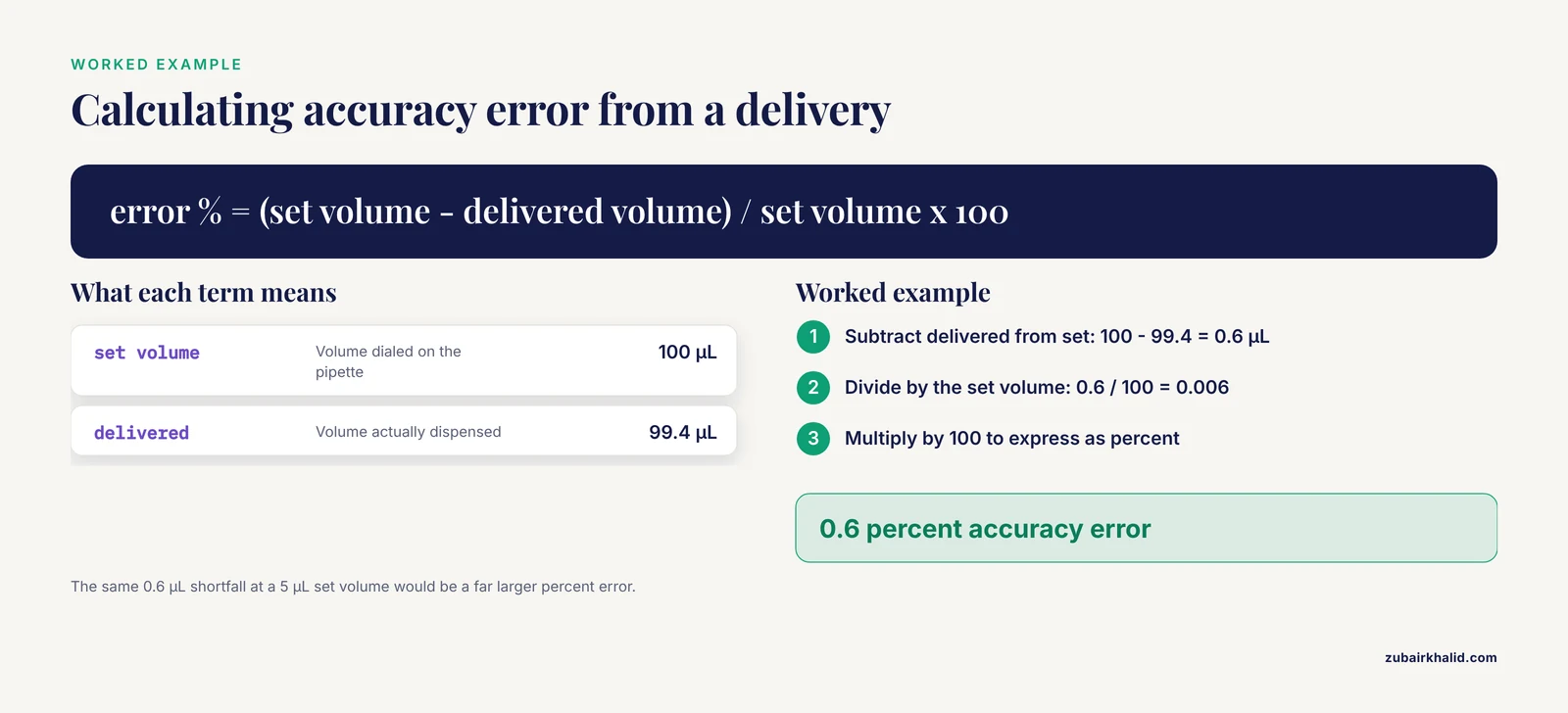
Three terms get tangled together in this phrase, so the pipette volume range accuracy interpretation starts with clean definitions.
Volume range is the span between the minimum and maximum volume a pipette can be set to deliver. A typical adjustable single-channel pipette might carry a range of 10 to 100 µL, 20 to 200 µL, or 100 to 1000 µL. The range is stamped on the pipette body or on the push button. Setting a pipette outside its stated range is not a safeguard against error. It is a guarantee of it, because the mechanism and the factory calibration were established only within that span.
Accuracy is the closeness of the delivered volume to the set volume. If you dial 100 µL and the pipette delivers 99.4 µL, the accuracy error is 0.6 percent of the set value. Accuracy describes systematic behavior, the tendency to run consistently high or consistently low.
Precision is the repeatability of the delivery. If you dial 100 µL ten times and receive 99.4, 100.8, 98.9, 101.1, and similar scattered values, the mean may be close to 100 but the scatter is large. That pipette is accurate on average and imprecise in practice. Precision is usually reported as a relative standard deviation or coefficient of variation, calculated from repeated deliveries of the same set volume.
A pipette can be precise but inaccurate, accurate but imprecise, both, or neither. The four combinations behave differently at the bench. A precise but inaccurate pipette puts the wrong amount in every tube, reproducibly, which shifts an entire experiment in one direction. An imprecise pipette adds random noise that inflates variability between replicates even when the mean is correct.
Calibration is the process of testing a pipette against a reference measurement and adjusting it so the delivered volume matches the set volume within specification. Pipette calibration is covered in detail later in this article, but the relationship is simple. Calibration verifies and corrects accuracy. Technique protects both accuracy and precision during every single delivery between calibrations.
The volume range accuracy specification therefore has two moving parts. The manufacturer states a tolerance, expressed as a maximum percent error for accuracy and a maximum percent coefficient of variation for precision, at the nominal test volumes of the range, usually near the top, middle, and bottom (typically around 100 percent, 50 percent, and 10 percent of the maximum volume in standard industry test protocols such as ISO 8655). Those tolerances hold only when the pipette is clean, undamaged, used with the correct tips, operated with good technique, and tested under laboratory temperature conditions with distilled water.
Key Terms and Common Confusions
| Term | What it describes | How it is reported | Common confusion |
|---|---|---|---|
| , - | , - | , - | , - |
| Volume range | The minimum and maximum settable volume of a pipette | Two numbers on the body, for example 20 to 200 µL | Mistaking the maximum for the only usable volume, or setting below the stated minimum |
| Accuracy | Closeness of delivered volume to set volume | Percent error relative to the set volume | Confusing it with precision, the two are independent properties |
| Precision | Repeatability of repeated deliveries | Relative standard deviation or coefficient of variation | Assuming a tight cluster of wrong volumes is acceptable |
| Calibration | Verification and adjustment against a reference | Gravimetric or photometric test record | Treating a calibration sticker as permanent rather than expiring |
| Tip compatibility | The seal and geometry between tip and shaft | Manufacturer fit guidance | Assuming all tips seal identically on all pipettes |
| Reverse pipetting | Aspirating excess and dispensing only the set volume | A technique choice, not a pipette setting | Confusing it with the default forward mode |
How an Air Displacement Pipette Works
Most pipettes on a molecular biology bench are air displacement pipettes. Understanding the mechanism explains nearly every accuracy problem you will encounter.
The pipette consists of a digital volume-setting mechanism, a piston, a shaft with a tip cone, and a disposable tip. Between the piston and the liquid sits a column of air, the dead air volume. When you press the operating button to the first stop, the piston travels a distance proportional to the set volume. Releasing the button draws the piston back, which expands the air column and pulls liquid into the tip by suction. Pressing to the first stop again dispenses the set volume. Pressing to the second stop, the blowout stop, expels the residual film of liquid clinging to the inside of the tip.
Because air is the coupling medium, several physical factors act on the transferred volume.
Hydrostatic pressure and vapor pressure. The air column compresses and expands with the weight of the liquid and with the vapor pressure of the liquid being handled. This is why a pipette calibrated on water delivers slightly different volumes when handling dense or volatile solvents. Positive displacement pipettes, in which the piston sits directly against the liquid inside a capillary or tip, remove this air cushion and are preferred for viscous, volatile, or foaming liquids.
Temperature. A pipette calibrated at a reference temperature delivers a different volume when the air inside the shaft is warmer or colder than the liquid. The discrepancy grows when pipetting cold liquids, such as reagents taken straight from a refrigerator, because the chilled air column contracts after aspiration.
Tip fit and tip quality. A tip that seats crookedly or leaks lets air escape during aspiration. The drawn volume then falls short even though the piston moved correctly. Universal tips, filtered tips, and low-retention tips differ in cone geometry and in how much liquid clings to the plastic after dispensing.
Evaporation and surface effects at tiny volumes. At submicroliter and picoliter scales, evaporation becomes a dominant source of error rather than a footnote. Researchers evaluating a prototype thermal inkjet picoliter pipette showed that evaporation had to be actively controlled to achieve depositions of 1 to 300 picoliters, and that even with control measures the precision of deposited volumes stayed near but under 10 percent [2]. The same physics, scaled up, explains why a 1 µL delivery is harder to hold accurate than a 500 µL delivery.
Why Accuracy Degrades at the Low End of the Range
The single most practical insight in pipette volume range accuracy explained for a working student is this: the bottom of a pipette's range is its danger zone.
The reason is arithmetic. A fixed absolute error, for example 0.5 µL of fluid retained in the tip or 0.5 µL of dead volume in the mechanism, represents a small percentage of a 200 µL delivery and a huge percentage of a 5 µL delivery. Manufacturer tolerances reflect this. The permitted percent error is always wider at the bottom test point of the range than at the top, because delivering the minimum volume accurately is intrinsically harder.
The European Bioanalysis Forum microsampling consortium demonstrated this directly. Member companies assessed the accuracy and precision of handheld pipettes and microcapillaries at volumes under 10 µL, comparing pipette types, user experience levels, and liquid types, with water as a best-case liquid and blood plasma as a real-world bioanalysis matrix [1]. Three findings stand out for anyone choosing a pipette setting.
First, accuracy and precision on the pipetted volume both decreased at lower volumes. Second, experienced laboratory technicians performed better than infrequent users, confirming that pipetting technique is a measurable component of volume accuracy and not just a matter of comfort. Third, microcapillaries showed better or equivalent accuracy and precision compared with handheld pipettes across the 1 to 8 µL span, independent of the matrix used [1]. When the required volume sits near the floor of a pipette's capability, a different delivery device can outperform the pipette entirely.
The clinical literature echoes the same lesson. In an evaluation of blood transfer devices for malaria rapid diagnostic tests, 227 health workers in Nigeria, the Philippines, and Uganda used five devices to transfer a 5 µL target volume of blood. The overall mean volumes transferred by the devices differed significantly from the 5 µL target, the inverted cup device came closest at a mean of 4.6 µL, and the glass capillary tube was excluded from volume analysis because of transfer failures [3]. A 5 µL target sits deep in the small-volume regime where operator and device effects dominate, and the study measured exactly the kind of deviation that pipette tolerance tables predict.
A practical corollary follows from these findings. If your protocol needs 2 µL, a 2 to 20 µL pipette is the right tool and a 100 to 1000 µL pipette is the wrong one, even though the larger pipette can technically be dialed to 2 µL below its minimum or strained to deliver near its floor with poor accuracy.
How Accuracy and Precision Are Tested
Gravimetric calibration
The standard approach to pipette calibration is gravimetric. The pipette dispenses a set volume of distilled water into a weigh boat on an analytical balance, the mass is recorded, and the volume is calculated from the mass divided by the density of water at the test temperature, with corrections for evaporation and buoyancy. Multiple deliveries, commonly ten at each test volume, are averaged to separate accuracy from precision. The test is repeated at the top, middle, and bottom of the volume range, because a pipette that is accurate at 200 µL can drift badly at 20 µL. The results are compared against the manufacturer's tolerance table, and the pipette is adjusted or retired if it fails.
Gravimetric testing under laboratory conditions remains the default for routine in-house calibration programs. It requires no specialized reagents, only a calibrated balance, stable environmental conditions, and disciplined technique by the operator, since the operator's own delivery style enters into the measurement.
Photometric and spectrophotometric verification
Photometric methods dispense the pipette into a dye solution of known absorbance properties and back-calculate the volume from the dilution. This approach shines at small volumes, where the mass of a few microliters of water approaches the noise floor of even an analytical balance. Photometric testing is also faster for high-throughput calibration programs.
Imaging and volume estimation methods
Where conventional references are impractical, imaging methods take their place. A study of automated pipetting failure in point-of-care testing devices introduced image-based monitoring in which a camera captures the reagent inside the pipette tip and image processing estimates the reagent volume, allowing the system to detect malfunctions caused by worn parts or by human error [4]. The same measurement logic, capturing a delivered volume photographically and quantifying it, appears in bench-scale accuracy work. When researchers needed to verify the accuracy of the OmniPod insulin pump at its lowest delivery volume of 0.05 units, they used a pipette, a digital microscope, and imaging software to measure bolus delivery, and found a relative error ranging from -0.90 percent to +0.96 percent across doses from 0.05 to 6 units [5]. That work shows both the principle of microscopic volume verification and the achievable accuracy ceiling when the measurement is done carefully.
Radiometric measurement of microvolumes
For volumes too small for any of the above, an isotope can serve as the measurable indicator. A method using a gamma camera measured microvolumes prepared with precision pipettes from 99mTc-pertechnetate, spanning sets of scalar volumes from 1 microliter down to 200 picoliters, and evaluated the sensitivity, precision, and accuracy of the volume-activity relationship under different conditions [6]. Radiometric verification sits at the extreme end of the accuracy-testing spectrum and is reserved for research questions where ordinary methods cannot resolve the volume at all.
Comparing devices, not just pipettes
Accuracy evaluation also extends beyond handheld pipettes to the wider family of transfer devices. The malaria blood transfer study compared a loop, a straw-pipette, a calibrated pipette, a glass capillary, and an inverted cup device for safety, ease of use, and volume accuracy in the hands of minimally trained users [3]. The lesson generalizes to the molecular lab. When a volume-critical step is performed by many hands with varying experience, the choice of transfer device becomes an accuracy variable in its own right.
Pipetting Technique: The Operator Component of Accuracy
Instrument specifications assume good pipetting technique. Poor technique can push a perfectly calibrated pipette outside its stated tolerance on every delivery. The elements below are standard practice, described in instructional literature for aseptic volume transfers with serological pipettes and micropipettors, where precise setting and accurate reading of the instrument are treated as core skills to be practiced until they become second nature [7].
1. Set the volume correctly. Turn the dial within the printed range, and approach the target digit from above when possible to eliminate mechanical backlash in the gearing. Rolling the dial up to the value from a lower setting introduces a small systematic overshoot that some pipette designs do not fully cancel.
2. Attach the tip firmly. Press the tip onto the shaft with a firm twist rather than a jab. An incomplete seal lets air leak during aspiration and silently short-changes the drawn volume. This failure mode is invisible to the eye, which is why automated pipetting systems monitor tip insertion and tip position by camera as part of their error checking [4].
3. Pre-rinse the tip. Aspirate and dispense the liquid two or three times before the real delivery. The inside of a dry plastic tip holds back a film of liquid on the first draw, so the first delivery tends to run low. Pre-rinsing equilibrates the tip wall, and the effect is largest with viscous or proteinaceous solutions.
4. Aspirate vertically and slowly. Hold the pipette upright, immerse the tip a few millimeters into the liquid, and release the plunger smoothly. Drawing slowly limits aerosol formation, limits bubble formation, and gives the air column time to equilibrate. Releasing the plunger too fast leaves bubbles in the tip and an undershoot in the volume.
5. Keep the pipette vertical during aspiration and holding. Resting a filled tip at an angle, for example against the wall of a tube, changes the hydrostatic pressure on the air column and can drive liquid into the shaft. Liquid that enters the shaft corrodes the piston seal and destroys calibration permanently.
6. Dispense along the wall. Touch the tip to the side of the receiving vessel, press to the first stop, pause, then press to the second stop to blow out the residual film. Skipping the blowout leaves liquid behind, and at small set volumes the retained fraction is a meaningful percentage of the intended delivery.
7. Reverse pipette for viscous or foaming liquids. In reverse mode you press to the second stop to aspirate, then dispense only to the first stop. The excess liquid stays in the tip, compensating for the film that would otherwise be lost. This mode trades tip waste for volume fidelity.
8. Match the pipette to the volume. Choose the smallest pipette whose range comfortably contains the target volume, and aim for the upper half of that range where accuracy and precision tolerances are tightest.
Technique interacts with experience in a measurable way. The microsampling consortium's finding that experienced technicians outperformed infrequent users [1] gives quantitative backing to something bench supervisors insist on. Pipetting is a motor skill with a learning curve, and accuracy data collected from trainees during their first weeks reflects the operator as much as the instrument.
Choosing the Right Pipette for the Volume
The decision rule is straightforward. Divide the target volume by the pipette's maximum volume. If the result falls below roughly one-tenth, reach for a smaller pipette. At a tenth of the maximum, the air column is large relative to the delivered volume and the percent error ceiling is at its widest. At the top of the range, the same absolute tolerances translate into the smallest percent errors.
Concretely, a 100 µL transfer belongs on a 100 to 1000 µL pipette only as a last resort. It sits at the very bottom of that range, in the zone of widest tolerance. The same 100 µL belongs on a 20 to 200 µL pipette, where it sits at 50 percent of maximum, comfortably within the tightest accuracy band.
Specialized volume regimes have specialized tools. For volumes below about 1 µL, microcapillaries performed as well as or better than handheld pipettes in the consortium's testing across 1 to 8 µL [1]. Below the microliter scale, engineered droplet systems take over entirely. A surface acoustic wave pipette on a chip demonstrated programmable ejection of part of a mobile droplet into a reaction chamber, delivering volumes from 150 picoliters up to 850 picoliters with precision down to tens of picoliters, in a closed, contamination-free format [8]. These devices exist because conventional pipettes, and even microcapillaries, cannot operate reliably at those scales.
Volume Accuracy in Downstream Applications
Volume range accuracy is not an abstract quality metric. It determines whether an entire analytical method validates or fails, and the analytical chemistry literature offers direct illustrations.
Pipette-tip solid-phase extraction methods. In pipette-tip solid-phase extraction, a sorbent is packed into a standard micropipette tip and the sample is drawn through it by the pipette itself. Every critical step, sample loading, washing, and elution, is metered by the pipette. A mitoxantrone method using a molecularly imprinted polymer packed in a micropipette tip achieved a detection limit of 0.2 µg/L, a linear range of 1 to 1000 µg/L, an enrichment factor of 49, and relative standard deviations below 4.4 percent [9]. Those precision figures depend on reproducible aspiration and dispensing cycles through the packed tip. Similarly, a peanut shell biochar pipette-tip extraction method for endocrine-disrupting phenols optimized the aspirating and dispensing cycles as an extraction parameter and reported linearity with R² above 0.993 and detection limits of 0.25 to 2.5 µg/L [10]. A self-assembly pipette tip method for domoic acid in urine packed 9.1 mg of PAX sorbent into a 200 µL pipette tip and reported extraction recoveries from 88.4 to 102.5 percent with intra- and inter-day precisions of 2.1 to 7.6 percent and 2.6 to 12.7 percent respectively [11]. When the pipetting varies, the recoveries and the precision figures deteriorate with it.
Disposable pipette extraction methods. Disposable pipette extraction places the sorbent in a tip that acts both as the extraction cartridge and as the pipette's consumable. A method for anandamide in cerebrospinal fluid optimized the sample volume, the number of draw-eject cycles, and the elution volume, and reported inter- and intra-assay accuracy errors from -8.2 to 9.6 percent with precision coefficients of variation from 1.3 to 14.8 percent [12]. A forensic method for nicotine, cocaine, and their metabolites in meconium using the same extraction format reported extraction efficiencies of 50 to 98 percent, accuracy of 92 to 106 percent, and intra- and inter-assay precision of 4 to 12 percent and 6 to 12 percent [13]. A study of disposable pipette extraction for opiates in vitreous humor required only 100 µL of sample and achieved recoveries of 72 to 91 percent [14]. Each of these small-volume, cycle-based workflows converts pipette behavior directly into analytical accuracy.
Miniaturized extraction format tradeoffs. Pipette-tip micro-solid-phase extraction exists precisely because it improves throughput and reduces solvent and sorbent use relative to traditional solid-phase extraction, as described in a 2024 evaluation of in-house-built devices for amino compound analysis, which reported extraction recoveries of 70 to 120 percent across sample loading, washing, and elution conditions [15]. The format's economy is built on the pipette tip. Its reliability is built on the pipette's volume accuracy.
The through-line across these studies is that pipette-driven sample preparation inherits the pipette's error budget. A pipette running 5 percent low at the chosen setting imposes roughly a 5 percent bias on every recovery and concentration the method reports.
Misconceptions Students Commonly Hold
Misconception 1. The dial reading is the delivered volume. The dial is a set point, not a measurement. The delivered volume can differ by the full stated tolerance, and more if technique or tip fit is poor.
Misconception 2. Accuracy and precision are the same thing. They are independent. A pipette can hit the same wrong volume every time, which is precise and inaccurate, or scatter around the right value, which is accurate on average and useless for triplicates.
Misconception 3. A pipette is equally accurate everywhere in its range. Tolerances are widest at the bottom of the range and tightest at the top. The empirical confirmation comes from the small-volume testing described above, where accuracy and precision both fell as volumes decreased [1].
Misconception 4. Any tip works on any pipette. Cone geometry, seal quality, and liquid retention vary between tip brands and pipette brands. A mismatched tip invalidates the calibration.
Misconception 5. Calibration lasts forever once performed. Calibration is a snapshot. Seals wear, pistons corrode when liquid enters the shaft, and springs drift. That is why calibration programs schedule periodic re-verification rather than one-time certification. Wear and part failure are recognized causes of liquid-handling error, alongside human error [4].
Misconception 6. Experienced users and beginners deliver the same volumes. The consortium data showed otherwise, with experienced technicians performing measurably better than infrequent users [1]. Technique is a variable, not a constant.
Common Mistakes and Limitations
- Dialing below the printed minimum. Setting a 20 to 200 µL pipette to 15 µL moves the mechanism outside its calibrated envelope. Use a smaller pipette.
- Skipping the pre-rinse. The first delivery from a dry tip runs low, sometimes by several percent with viscous liquids. Pre-rinse when accuracy matters.
- Releasing the plunger too fast. This draws bubbles and leaves the delivery short. Release smoothly and give viscous liquids extra time.
- Laying a filled pipette on its side. Liquid creeps into the shaft, contaminates and corrodes the piston, and permanently damages calibration. Hold the pipette upright whenever a filled tip is attached.
- Immersing the tip too deeply. Deep immersion adds hydrostatic pressure to the air column and coats the outside of the tip with liquid that dispenses as unaccounted volume. Immerse just a few millimeters.
- Ignoring temperature mismatch. Pipetting ice-cold reagents with a room-temperature pipette shifts the volume because the trapped air column contracts. Let cold reagents equilibrate when precision demands it, or accept and document the deviation.
- Using one pipette across a huge volume span. A single pipette cannot serve 2 µL and 900 µL duties. Range matching is part of experimental design.
- Treating the calibration sticker as the only check. Calibration intervals catch drift between services, but a quick in-house gravimetric check before a critical experiment catches a dropped or corroded pipette immediately.
- Forgetting the operator in the error budget. The same pipette delivers different accuracy distributions in different hands [1]. When troubleshooting variable results, test the technique before replacing the instrument.
- Assuming a calibration certificate guarantees small-volume accuracy. Tolerances at the bottom of the range are inherently wide. For critical small volumes, verify at the actual working volume, not only at the standard test points.
One limitation applies to this article as a whole. It describes instrument behavior and technique in general terms. Specific pipette models carry their own tolerance tables, service intervals, and compatible tip lists published by their manufacturers, and individual cases of suspected instrument failure should be resolved against those documents or through the manufacturer's service program.
Quick Review
- Volume range accuracy means the delivered volume matches the set volume within a stated tolerance, and that tolerance is tested at defined points across the pipette's full range.
- Accuracy is systematic error, closeness to the true value. Precision is random error, repeatability. The two are independent.
- Tolerances are tightest at the top of a pipette's range and widest at the bottom. Work in the upper half of the range whenever possible.
- Air displacement pipettes couple the piston to the liquid through an air column, so temperature, liquid properties, and tip seal all influence the delivered volume. Positive displacement pipettes remove that air cushion.
- Empirical testing shows accuracy and precision fall at low volumes, experienced operators outperform beginners, and microcapillaries match or beat handheld pipettes in the 1 to 8 µL range [1].
- Calibration is gravimetric or photometric verification against a reference, repeated periodically, and must be tested at low, middle, and high settings because a pipette can pass at one point and fail at another.
- Technique variables, including pre-rinsing, vertical aspiration, slow plunger release, wall dispensing, and the blowout stroke, are part of the accuracy specification, not optional habits.
- Pipette-driven sample preparation formats, including pipette-tip and disposable pipette extraction, inherit the pipette's error directly into their reported recoveries and precisions [9], [12], [11].
Frequently Asked Questions
What does pipette volume range accuracy mean?
It means the agreement between the volume set on the pipette's dial and the volume the pipette actually delivers, measured at several points across the pipette's stated working range. Manufacturers express it as a maximum percent error at each test volume, usually near the top, middle, and bottom of the range, alongside a separate precision figure.
Why is my pipette less accurate at small volumes?
Fixed sources of error, such as the liquid film retained in the tip and the mechanics of the piston travel, stay roughly constant while the delivered volume shrinks. The same half-microliter shortfall is negligible at 500 µL and enormous at 5 µL. Controlled testing at sub-10 µL volumes confirmed that accuracy and precision both decrease as the pipetted volume decreases [1].
How often should pipette calibration be performed?
Most laboratories run calibration on a fixed schedule, commonly every three to twelve months depending on use intensity and the criticality of the work, and add interim verification after any drop, contamination event, or suspicious result. The right interval is set by your institution's quality program and the manufacturer's service documentation, not by a single universal rule.
Does pipetting technique really change accuracy?
Yes, measurably. In multi-site testing, experienced laboratory technicians delivered better accuracy and precision than infrequent users with the same class of devices [1]. Plunger speed, tip immersion depth, pre-rinsing, and wall dispensing each shift the delivered volume, and at small volumes those shifts become a meaningful fraction of the target.
What is the difference between air displacement and positive displacement pipettes?
Air displacement pipettes couple the piston to the liquid through a column of air, which suits aqueous solutions but makes them sensitive to temperature, density, and vapor pressure. Positive displacement pipettes put the piston in direct contact with the liquid inside a disposable capillary, which gives them steadier accuracy for viscous, volatile, or dense liquids.
Can a single pipette cover all my volume needs accurately?
No. Each pipette holds its tightest tolerances in the upper portion of its range and its loosest at the bottom. A bench needs overlapping pipettes, for example a 2 to 20 µL, a 20 to 200 µL, and a 100 to 1000 µL instrument, so every routine volume can be delivered in the accurate zone of an appropriate range.
Sources
- Feedback from the European Bioanalysis Forum liquid microsampling consortium: microsampling: assessing accuracy and precision of handheld pipettes and capillaries.
- Picoliter droplet deposition using a prototype picoliter pipette: control parameters and application in micro X-ray fluorescence.
- Blood transfer devices for malaria rapid diagnostic tests: evaluation of accuracy, safety and ease of use.
- Automated pipette failure monitoring using image processing for point-of-care testing devices.
- Novel methodology to determine the accuracy of the OmniPod insulin pump: a key component of the artificial pancreas system.
- Assay of prick test inoculum volume. I. Use and reliability of a gamma camera-based method.
- Aseptic laboratory techniques: volume transfers with serological pipettes and micropipettors.
- Surface acoustic wave enabled pipette on a chip.
- Determination of mitoxantrone in environmental waters: a spectrophotometric method with preconcentration by salt saturated pipette-tip micro solid phase extraction using molecularly imprinted polymer.
- Peanut shells-derived biochars as adsorbents for the pipette-tip solid-phase extraction of endocrine-disrupting phenols in water, milk and beverage.
- A Rapid LC-HRMS Method for the Determination of Domoic Acid in Urine Using a Self-Assembly Pipette Tip Solid-Phase Extraction.
- Determination of anandamide in cerebrospinal fluid samples by disposable pipette extraction and ultra-high performance liquid chromatography tandem mass spectrometry.
- A rapid assay for the simultaneous determination of nicotine, cocaine and metabolites in meconium using disposable pipette extraction and gas chromatography-mass spectrometry (GC-MS).
- Disposable pipette extraction for gas chromatographic determination of codeine, morphine, and 6-monoacetylmorphine in vitreous humor.
- Evaluation of in-house-built pipette-tip micro-solid-phase extraction devices for sample preparation in the analysis of amino compounds by liquid chromatography-tandem mass spectrometry.