Pipette Tip Racks and Refill Systems: How to Choose the Right Format
By Dr. Zubair Khalid, DVM, MS, PhD ·

A pipette tip rack is a molded or assembled tray that arrives at your bench with tips already seated and ready to use, while a refill system delivers the same tips in compressed stacks or bulk packs that you load into a reusable rack yourself. The rule of thumb is simple. Choose factory-racked tips when sterility, sample integrity, or audit traceability matters, and choose refill systems when you consume large volumes of non-sterile or low-risk tips and want less plastic waste per experiment.
This article walks through the main pipette tip rack types, the refill formats that compete with them, the criteria that actually decide between them, worked scenarios, and the mistakes that cost labs the most time and reagents.
Why Tip Format Matters More Than It Looks
On paper, a 200 microliter tip is a 200 microliter tip. In practice, the format it arrives in affects four things that show up directly in your data.
Fit and sealing. A tip must form an airtight seal on the pipette shaft or cone. Poorly seated tips in a warped rack, or refills stacked at slightly wrong angles, produce slow leaks that read as inconsistent volumes.
Protection of the tip orifice. Tips suspended in a rack hang orifice-down in open air. Racks with sealing lids protect that orifice from airborne contamination, which is why sterile racks dominate molecular biology benches.
Handling speed. Pipetting technique depends on fast, one-handed tip pickup. A rack that holds tips at the right spacing and friction lets you grab a tip without touching the orifice or knocking neighbors loose. How a rack grips and presents tips has been engineered deliberately enough that rack-and-tip presentation is the subject of its own design literature [1].
Waste and cost per box. A pre-loaded rack is a single-use plastic tray plus a lid plus the tip inserts. A refill system reuses the rack and ships tips in thinner packaging. Over a year of high-volume pipetting, that difference is measured in kilograms of plastic and real budget lines.
Pipette Tip Rack Types
The phrase "pipette tip rack types" covers more variety than most new students expect. Here are the formats you will encounter, described on their own terms.
Standard Hinged-Lid Racks (Pre-Loaded)
This is the default format most people picture. A polypropylene base holds 96 tips (8 by 12, matching microplate well spacing), a hinged or detachable lid closes over the tip orifices, and many versions carry colored lids or inserts that code the volume, for example yellow for 200 microliter and blue for 1000 microliter ranges. These racks arrive pre-racked at the factory, often gamma-irradiated and certified free of DNase, RNase, and endotoxin when sold as sterile or "bioclean" grades.
The main advantages are confidence and speed. You open the lid and pipette. Lot numbers and certifications print on the box, which matters for labs working under quality systems. The disadvantages are cost per tip and waste, because the tray and lid are discarded once the tips are gone.
In-Mold (One-Piece) Racks
An in-mold rack is made by molding the rack base and tip holders as a single piece rather than ultrasonically welding or snapping separate parts together. This construction is stiffer, resists warping better, and tends to hold tips more securely, which reduces the loose-tip problem during shipping. Many in-mold racks are designed to be reused with refill stacks, which is where they overlap with the refill systems described below.
Filtered Tip Racks
Filter tips contain a hydrophobic polyethylene plug near the narrow end that blocks aerosols and liquids from reaching the pipette shaft. They come racked exactly like standard tips, and racked sterile filter tips are the standard choice for PCR setup, RNA work, cell culture transfers, and any liquid handling of infectious or volatile material. The penalty is price per tip, often several times that of a plain tip, so most labs reserve them for workflows where crossover contamination would be expensive.
Low-Retention and Specialty Racks
Low-retention tips have a smoother or more hydrophobic interior surface to reduce liquid clinging to the wall, improving recovery of viscous or precious samples. Specialty racks also hold extra-long tips for deep vessels, wide-bore tips for fragile cells or genomic DNA, and gel-loading tips for electrophoresis. These formats follow the same rack conventions as standard tips, so the choice inside this category is about tip design rather than the rack itself.
Racks and Reservoirs for Automated Liquid Handlers
Robotic pipetting heads do not pick tips from a standard 96-place rack the way a hand does. Automation formats include stacked tip towers, bulk magazine loaders, and racks designed for specific deck positions. If you run a liquid handler, the "rack" decision is really a compatibility decision, and it is locked to your instrument model. Manual rack types are irrelevant here, so labs that automate should start from the instrument documentation rather than from catalog browsing.
Bulk Bags (The De Facto Refill Baseline)
A bulk bag is a large sealed pouch of loose tips, sometimes several hundred to a thousand per bag, with no rack at all. You fill an empty rack by hand or with a tip-loading press. Bulk bags are the cheapest format per tip and the most wasteful of technician time, and they break the sterile chain because the bag must be opened and handled. They suit teaching labs, buffer prep, and any application where sterility of the tip exterior does not matter.
Side-by-Side Comparison
| Format | What it is | Best suited for | Pros | Cons |
|---|---|---|---|---|
| Pre-loaded hinged rack, sterile | Factory-racked 96 tips in a sealed lidded tray | PCR setup, RNA work, cell culture, clinical samples | Sterility assured until opened, certifications on box, fastest handling, no user loading error | Highest cost per tip, most packaging waste |
| In-mold rack | Single-piece molded base and holders | Same uses as standard racks, plus long rack service life | Rigid, warp-resistant, holds tips firmly, often refill-compatible | Slightly higher unit cost than welded racks |
| Filtered tip rack | Racked tips with aerosol-blocking plugs | Contamination-sensitive and biohazard work | Protects pipette shaft and samples, sterile grades available | Several times the price of plain tips, filter adds dead volume headroom concerns at very small volumes |
| Low-retention rack | Racked tips with smooth treated interior | Viscous samples, protein solutions, precious low-volume transfers | Better sample recovery, more accurate small-volume delivery | Cost premium, treatment quality varies between manufacturers |
| Nested stack refill | Compressed column of tips stacked tip-on-tip in a sleeve | High-volume non-sterile or routinely handled work | Fast loading, far less packaging, rack reused many times | Loading step can misalign tips if rushed, sterility depends on handling discipline |
| Loose bulk bag refill | Pouch of unstacked loose tips | Teaching labs, buffer and media prep, wash steps | Lowest cost per tip | Slow to load, high contamination exposure, awkward storage |
| Pre-sterilized refill stack | Gamma-irradiated stacks opened inside a clean environment | Labs that want refill economics plus sterility | Combines low waste with sterile tips | Still requires careful loading, pricier than non-sterile refills |
| Automation tip towers and magazines | Instrument-specific bulk tip supply | Liquid handlers and high-throughput screening | Minimal hands-on time, machine-verified seating | Locked to instrument brand, high minimum order sizes |
Refill Systems Explained
Refill systems exist to decouple the tips (consumed constantly) from the rack (consumed almost never). Three designs dominate.
Nested Stack Reload Systems
Nested stacks ship tips pressed tip-into-tip in a tall column, sometimes called a "stack" or "reload pack." You drop the column into a reusable base and press a lid or loader plate down. The tips separate and seat into the rack positions in one motion. Loading a stack takes seconds versus minutes for filling a rack from a bulk bag, and the packaging footprint is a thin sleeve instead of a full tray. The main failure mode is operator error during seating. If the stack is not aligned with the base, some tips seat crooked, and a crooked tip can produce a partial seal on the pipette. A quick visual check across the loaded rack catches this before it costs you an assay.
Loose Bulk Refills
Loose refill bags are the low-tech end of the category. They are cheapest and slowest, and they require the most handling. Every touch is a chance for contamination or for oils from gloves to transfer to the tip surface, which matters more for low-retention applications than for routine ones.
Pre-Sterilized Refills
Some manufacturers sell nested stacks that are individually wrapped and gamma-irradiated, so a lab can keep refill economics while feeding a sterile workflow. These are loaded inside a biosafety cabinet or clean bench when the destination rack will hold sterility-sensitive work. The tradeoff is cost per stack and the discipline required to open wrappers without touching tip orifices.
Reusable and Refill-Compatible Rack Bodies
Refill systems only pay off if the rack body survives. In-mold polypropylene racks and racks sold explicitly as refill-compatible are built for hundreds of load cycles. When choosing a refill route, confirm that the rack, the refill stack, and your pipettes agree on tip geometry. A refill stack that seats perfectly into its own brand rack may still contain tips that fit your pipette poorly, and fit is judged at the pipette, not at the rack.
How to Choose Between Rack and Refill Formats
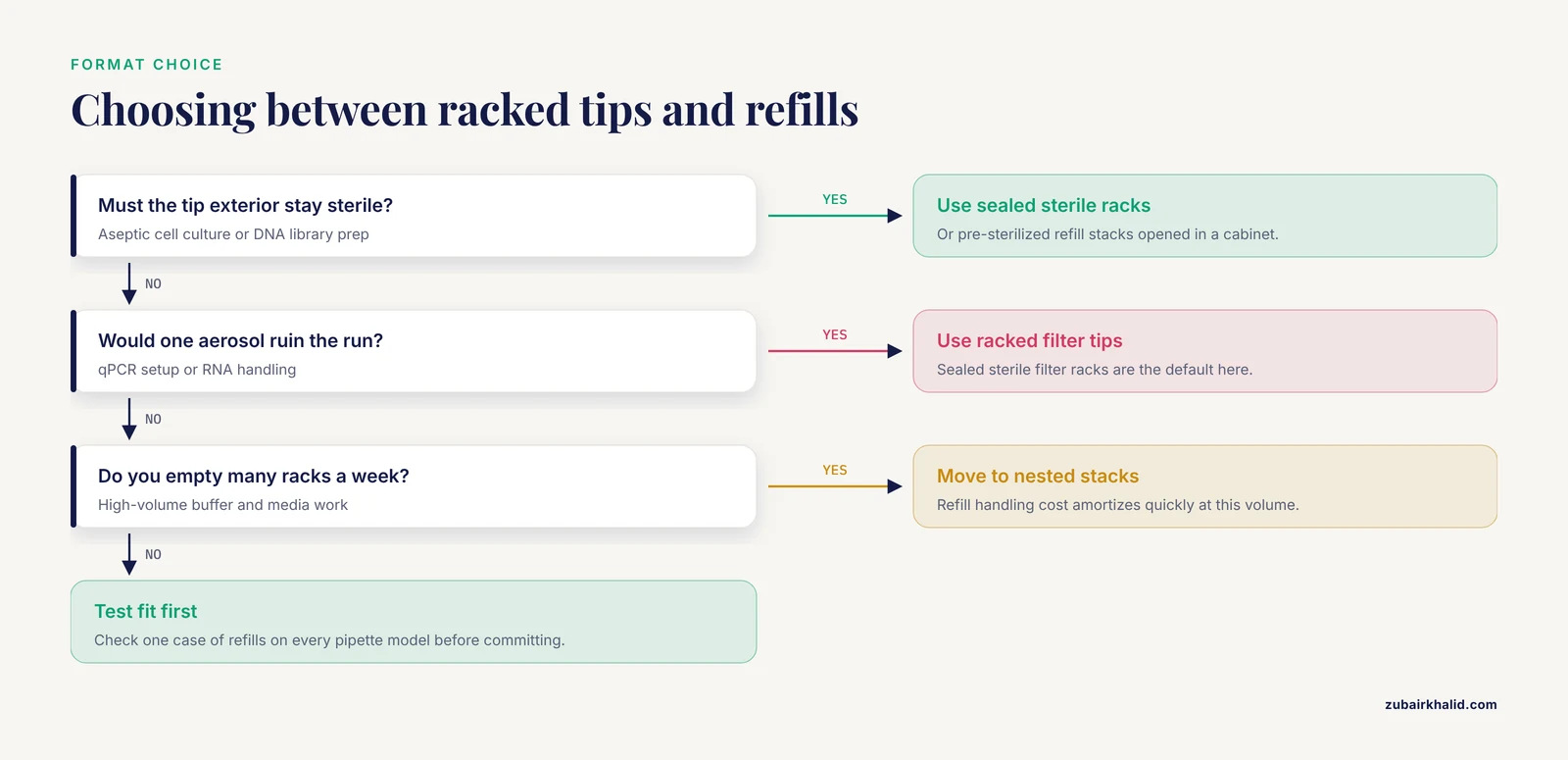
Six criteria decide almost every real-world choice.
1. Sterility requirement. If the tip exterior touching the tube rim must be sterile, such as aseptic cell culture or DNA library prep, start with sealed sterile racks or sealed sterile refill stacks opened in a cabinet. If the tip only contacts reagents that will be filtered, autoclaved, or extracted afterward, refill economics win.
2. Contamination sensitivity of the assay. For work where a single aerosol ruins the run, such as setting up qPCR or handling RNA, filter tips in sealed racks are the default. The cost of repeating an assay dwarfs the tip cost difference.
3. Volume consumed per week. Refill systems amortize their handling cost quickly. A lab that empties twenty racks a week of 1000 microliter tips for buffer and media work saves meaningful money and plastic with stacks. A lab that empties one rack a month of filter tips probably should not bother.
4. Who does the loading. Students loading bulk bags make alignment errors. If the lab relies on rotating trainees, nested stacks with a loader plate are more forgiving than loose bags.
5. Pipette fleet compatibility. Refills are only cheap if the tips fit every pipette in the lab. Mixed pipette brands are the classic reason a well-intentioned refill program fails. Test one case of refills on every pipette model before committing.
6. Automation path. If any workflow will move to a liquid handler within a year, buy manual tips in the same geometry family the robot uses, so reagent validation carries over.
Worked Scenarios
Scenario 1. A molecular biology teaching lab. Two hundred undergraduates pipette water and dye through PCR mock setups. Nobody needs sterility, volumes are forgiving, and rack turnover is enormous. The right choice is bulk bag refills loaded into durable refill-compatible racks, with a small stock of racked sterile filter tips reserved for the instructor demonstration. Cost per student drops sharply, and rack-loading itself becomes a taught skill.
Scenario 2. A core facility running qPCR and RNA-seq library prep. Aerosol contamination and nucleases are the dominant risks. Filter tips in sealed sterile racks are the default for every pre-PCR and pre-reverse-transcription step. Refill economics apply downstream, where amplified or degraded material is no longer contamination-critical, so plain non-sterile stack refills cover post-PCR cleanup and buffer work.
Scenario 3. A protein biochemistry lab with mixed pipette brands. Samples are viscous lysates where low-retention tips genuinely improve recovery. The lab runs three pipette brands. Before switching to refills, the lab tests one case of the candidate refill tips gravimetrically on each pipette model and finds one brand pair seals unreliably, so it keeps racked low-retention tips for that pipette model and moves everything else to stacks.
Pipetting Technique Depends on Tip Presentation
Format choice feeds directly into pipetting technique. A few points of technique that interact with tip format are worth restating, since they are standard bench knowledge taught across molecular biology courses.
Pre-wet the tip. Aspirate and dispense the working liquid two or three times before the measurement transfer. Pre-wetting conditions the air cushion humidity inside the tip and improves accuracy, especially for volatile or small volumes.
Match immersion depth to tip size. Immerse a 10 microliter tip a few millimeters, a 200 microliter tip a few more, and a 1000 microliter tip roughly 2 to 3 millimeters into the liquid. Too deep and the hydrostatic pressure inflates the delivered volume, too shallow and you aspirate air.
Hold the pipette vertical during aspiration and dispense along the vessel wall at a consistent angle. Reverse pipetting, where you dispense by pressing to the first stop and leave the excess in the tip, suits viscous or foaming liquids.
Do not exceed the tip volume rating. Overfilling a 200 microliter tip with 300 microliters of liquid risks liquid entering the filter or reaching the pipette cone, and a wetted polyethylene filter can no longer be trusted as an aerosol barrier.
Pipette Calibration and the Role of Tip Choice
A pipette is only as accurate as the tip it wears. Gravimetric calibration, in which the pipette dispenses distilled water repeatedly and the mass on an analytical balance is converted to volume, is the standard approach for checking air-displacement pipettes, and it is performed with the same tip type and lot the pipette will actually use in daily work. Change the tip brand or switch from standard to low-retention tips, and the calibration result can shift, because tip geometry, orifice shape, and interior treatment all alter how the air cushion behaves.
Three practical rules follow.
Calibrate with your working tips. If the lab switches tip supplier or moves from racked tips to a refill of a different geometry, recalibrate the pipettes with the new tips before trusting volumes.
Never calibrate with a wetted filter tip or a reused tip. Both alter the air cushion and the meniscus behavior in ways that do not reflect normal single-use performance.
Track tip lot changes like reagent lot changes. Note the tip lot in calibration records, the same way you would note a lot of master mix, so an unexplained shift in pipetting accuracy can be traced to a consumable change.
Specialty Tip Formats: When the Tip Itself Is the Instrument
A trend in analytical and cell biology is to treat the pipette tip not as a disposable liquid transfer tool but as the reaction vessel or separation device itself. Understanding these formats clarifies why tip geometry and quality control matter beyond comfort and sterility.
Pipette Tip Solid-Phase Extraction (PT-SPE)
Miniaturized sample preparation has moved cleanup chemistry into pipette tips. In pipette tip solid-phase extraction, a small amount of adsorbent is packed inside a tip and the analyst aspirates and dispenses the sample repeatedly to trap analytes, then elutes them in a tiny solvent volume. A review of these miniaturized extraction concepts describes pipette tip formats and spin columns as the leading small-scale configurations for chromatographic sample preparation, valued for reduced solvent and sample consumption and compatibility with automation [2].
The sorbent chemistry inside these tips is remarkably diverse. Published PT-SPE methods have used graphene and multi-walled carbon nanotube composites to measure 17β-estradiol in milk with only about 1 milligram of adsorbent and roughly 1 milliliter of washing solvent and 1.2 milliliters of elution solvent [3], covalent organic frameworks to enrich sulfonamides from milk and honey [4], melamine sponge composites for extracting six B vitamins [5], and molecularly imprinted polymers that selectively capture targets such as the insecticide profenofos with an enrichment factor of 31 and a total analysis time near 10 minutes [6]. Biochar and waste-derived carbon materials have joined the list, including peanut shell biochars for endocrine-disrupting phenols in water, milk, and beverages [7] and olive pit derived carbon for caffeine in energy drinks using a single milligram of sorbent with minimal solvent [8].
This literature also reveals a purely mechanical lesson about tip format. Most PT-SPE devices use a filter-sorbent-filter sandwich inside the tip, and a study of tip structure noted that loose filters create a real risk of sorbent leaking into the sample, which motivated redesigned tip shapes that hold or shape the sorbent without packing at all [9]. In other words, internal tip construction, not just external fit, is a selection criterion when the tip is part of the chemistry.
For a molecular biology lab deciding between rack formats, the relevance is indirect but real. If you buy tips intended for modified workflows, from home-made extraction tips to commercially packed versions, tip dimensional consistency matters, because a tip that fits loosely on the pipette will leak under the repeated aspiration cycles these methods require.
Tips as Cell Culture and Microfluidic Vessels
Standard tips have also been repurposed as biological vessels. A 2023 study used ordinary laboratory pipette tips as micro vessels for growing three-dimensional tumor spheroids, showing that single and multicell-type spheroids form within 24 hours simply by pipetting a cell suspension into a tip and incubating it, with no microfabrication or surface chemistry required [10]. The same study characterized reproducibility across five boxes of 80 tips each, an unusual but telling detail, because it treats the tip as a consumable whose lot-to-lot consistency belongs in the methods section.
A separate microfluidics method used pipette tips to load cells into droplet-generating devices with essentially no cell loss, preserving scarce primary cells and matching the Poisson-predicted encapsulation statistics closely across several cell types [11]. Both applications depend on the smooth internal taper and reliable geometry of standard tips, which is one more argument for buying tips from a consistent source rather than rotating between cheapest-available bulk bags for cell-facing work.
Tips as Diagnostic Biosensors
Pipette tips have become low-cost diagnostic cartridges as well. One group incorporated a microfiber structure made of acrylonitrile-butadiene-styrene into a pipette tip as an antibody immobilization surface for an ELISA-style assay, measuring C-reactive protein with a limit of detection of 0.78 nanograms per milliliter, about 1.4 times more sensitive than an unmodified tip, while cutting measurement time to roughly a third and sample consumption to 3 microliters [12]. A companion effort built a compact fluorescence reader that accepts a truncated cone-shaped tip directly, achieving a resorufin detection limit of 0.46 micromolar and an immunoglobulin A detection limit of 1.0 nanogram per milliliter in human saliva, performance comparable to a desktop microplate reader [13].
These are research-stage formats rather than everyday consumables, but they make a broader point for anyone choosing between rack types. Tips are precision labware. Whether the application is a nanoliter qPCR, a microextraction, or a spheroid culture, the rack that delivers consistent, undamaged, correctly seated tips is doing quiet work for your data.
Common Mistakes and Limitations

Mixing tip and pipette brands without testing. A tip that seats firmly on one pipette brand may wobble on another. A wobble you can feel at the shaft is a volume error you will see in replicate variability. Test any new tip, including a new refill lot, on every pipette model before adopting it lab-wide.
Loading refill stacks crooked. The most common refill-system failure is a stack seated at a slight angle, leaving some tips half-locked in the rack. These tips can lift partway during pipetting. Always press stacks squarely and glance across the loaded rack at eye level before use.
Treating an open rack as a sterile barrier. Once a sterile rack lid is opened on a cluttered bench, the sterility claim is gone for tips that remain. Move sterile racks into a cabinet or a closed workflow, or buy smaller boxes so an opened box is used in a session.
Reusing filter tips. The polyethylene plug is single-use by design. A washed filter tip looks fine and no longer blocks aerosols reliably.
Wetting the filter. Exceeding the rated volume of a filter tip pushes liquid into the plug. That tip, and potentially the pipette cone behind it, are compromised.
Autoclaving the wrong components. Many polypropylene tip racks tolerate autoclaving, but lids with gaskets, colored inserts, or loader accessories may not, and low-retention surface treatments on refilled tips are not restored by autoclaving the empty rack. Confirm which components are autoclave-rated in the manufacturer documentation rather than assuming.
Buying refills before verifying pipette fit. A pallet of refill stacks that does not seal on half the lab's pipettes is a budget error, not a bargain.
Ignoring lot consistency for cell-facing work. Applications such as tip-based spheroid culture treat tip dimensions as part of the method. Switching cheap bulk suppliers between experiments changes the vessel, not just the dispenser.
One limitation deserves a plain statement. Specific product claims about sterility, nuclease-free certification, and chemical resistance vary by manufacturer and lot, and a lab with regulatory or accreditation obligations should verify those claims against the manufacturer's certificates of analysis for the lots it actually receives.
Frequently Asked Questions
What are the main pipette tip rack types?
The main types are pre-loaded hinged-lid racks, single-piece in-mold racks, racks of filtered tips, racks of low-retention and specialty tips, automation-specific tip towers and magazines, and bulk bags of loose tips. The first four prioritize protection and workflow speed, the automation formats prioritize machine compatibility, and bulk bags prioritize lowest cost per tip.
Are refill systems as reliable as factory-racked tips?
For tip quality, yes, because refills usually contain the same tips as racked boxes from the same manufacturer. The reliability difference is in the loading step. A poorly seated refill stack can leave tips crooked or loose, so refill systems require a visual check after loading, and they are a poor fit where an unsterile handling step is unacceptable.
Can I autoclave a tip rack?
Many polypropylene tip rack bodies can be autoclaved, which is useful when refilling with sterile tips or reusing a rack for nuclease-free work, but lids, colored inserts, and loader accessories may not tolerate the cycle. Check the manufacturer's rating for each component before autoclaving, and remember that autoclaving the rack does not restore any surface treatment on the tips themselves.
Do filter tips need to be racked sterile?
The filter protects the pipette and sample from each other regardless of sterility, so non-sterile filter tips are acceptable when you only need aerosol blocking. Racked sterile filter tips are the better choice when both concerns apply at once, such as setting up PCR or handling RNA in a clean workflow, because the sealed lid protects the tip orifice until the moment of use.
How does tip choice affect pipette calibration?
Calibration is only valid for the tip geometry it was performed with. Tip orifice shape, interior treatment, and fit on the pipette cone all change the behavior of the air cushion, so switching tip brands or moving between racked tips and a different refill lot can shift delivered volumes. Calibrate with the exact tips used for routine work and record tip lots in the calibration log.
Which format is best for high-throughput or automated pipetting?
For robotic liquid handlers, use the tip towers, magazines, and bulk formats specified for your instrument, since automated heads verify tip pickup differently than a hand does. For high-throughput manual work, nested stack refills loaded into durable refill-compatible racks give the fastest reload times and the lowest packaging waste, provided the tips have been tested for fit on all pipettes in use.
Sources
- Pipette tip rack and related methods
- Micro solid-phase extraction (pipette tip and spin column) and thin film solid-phase microextraction: Miniaturized concepts for chromatographic analysis
- Graphene/multi-walled carbon nanotubes as an adsorbent for pipette-tip solid-phase extraction for the determination of 17β-estradiol in milk products.
- Covalent organic framework Schiff base network-1-based pipette tip solid phase extraction of sulfonamides from milk and honey.
- Melamine sponges incorporated azo-linked porous organic polymer as adsorbent for extraction and determination of six B vitamins using pipette tip micro solid-phase extraction.
- Determination of profenofos in seawater and foodstuff samples after its molecularly imprinted polymer pipette-tip micro solid phase extraction optimized by response surface methodology
- Peanut shells-derived biochars as adsorbents for the pipette-tip solid-phase extraction of endocrine-disrupting phenols in water, milk and beverage.
- OLIVE PITS-BASED CARBON BLACK AGGLOMERATE AS AN ADSORBENT FOR PIPETTE-TIP SOLID-PHASE EXTRACTION FOR THE DETERMINATION OF CAFFEINE IN ENERGY DRINKS
- Reshaping of pipette tip: A facile and practical strategy for sorbent packing-free solid phase extraction.
- Using pipette tips to readily generate spheroids comprising single or multiple cell types
- A Pipette-Tip Based Method for Seeding Cells to Droplet Microfluidic Platforms.
- Development of pipette tip-based enzyme-linked immunosorbent assay using a microfiber-type structure-incorporated pipette tip for rapid on-site diagnosis.
- Development of small-sized fluorescence detector for pipette tip-based biosensor for on-site diagnosis.