Pipette Tip Material and Quality: How to Evaluate
By Dr. Zubair Khalid, DVM, MS, PhD ·

Pipette tip material decides which liquids a tip can contact without adsorbing, leaching, or degrading, and tip quality decides whether the pipette actually delivers the volume shown on its display. The rule of thumb is simple: match the material to your chemistry first, then buy the highest manufacturing quality tier that your accuracy requirement demands. A poor-quality tip can silently cost you more accuracy than an uncalibrated pipette, because every pipetting step passes through it.
This article walks through the pipette tip material quality options available in a typical molecular biology lab, the pros and cons of each, the physical features that separate a good tip from a bad one, and how tip choice connects to your pipetting technique and pipette calibration routine.
Why Tip Material and Quality Matter More Than Most New Researchers Expect
A pipette tip looks like a passive piece of molded plastic. In practice it is the last centimeter of your entire liquid handling system, and every source of dispensing error has to pass through it. Three properties of the tip directly change the volume your pipette delivers:
- Wettability. How much liquid stays behind on the inner wall after dispensing. A hydrophobic inner surface drains cleanly. A wettable or rough surface holds droplets that never leave the tip, which matters most at small volumes.
- Fit and seal. The cone of the tip must seat on the pipette shaft with an airtight seal. A cone that is out of round, or a tip designed for a different shaft geometry, leaks air and produces systematically low delivery.
- Dimensional consistency. The orifice diameter, taper, and wall thickness control how liquid meniscus behavior and air displacement translate into delivered volume. Two tips from different molds with the same labeled volume can behave measurably differently at 2 µL.
Add contamination risk on top of accuracy. Tips carry the residue of the mold release agents, packaging, and handling they experienced before they reached your bench. For work with nucleic acids, proteins, or trace analytes, those residues are not trivia. They are the difference between a clean assay and a background signal you cannot explain.
The Main Pipette Tip Material Quality Options
Virgin polypropylene
Polypropylene is the standard material for nearly all laboratory pipette tips, and for good reason. It is a semi-crystalline thermoplastic that is chemically resistant to aqueous buffers, most dilute acids and bases, and many alcohols. It can be molded with high precision, it is translucent enough to see the liquid meniscus, and it withstands standard steam sterilization conditions used in the lab, which for polypropylene labware means autoclaving at 121 °C.
"Virgin" means the resin was never used before molding. Recycled or blended resins can carry residual plasticizers, release agents, or pigments that leach into samples. When you evaluate a tip supplier, virgin polypropylene resin with a stated lot traceability is the baseline you should expect, not a premium feature.
Pros. Broad chemical compatibility, low extractables when properly made, moldable to tight tolerances, compatible with standard pipette shafts, affordable at high volume.
Cons. Inherent hydrophobicity varies between resin lots and mold finishes. Standard polypropylene surfaces bind proteins, nucleic acids, and hydrophobic small molecules to some degree. For trace work this background binding becomes the limiting factor.
Low-retention polypropylene
Low-retention tips start as polypropylene and then receive a treatment that reduces the surface binding of liquids. The two common approaches are smoothing the mold surface to a finer finish and applying a hydrophobic or sometimes hydrophilic coating, depending on the intended sample type. The goal is the same either way: less liquid film left behind after dispensing.
Low-retention tips earn their cost in specific situations, not everywhere. They matter most when you dispense viscous liquids, protein solutions, surfactant-containing buffers, or very small volumes where a residual film is a meaningful fraction of the delivered volume. Dispensing 1 µL of a protein lysate into a standard polypropylene tip can leave several percent of the volume behind on the wall. A low-retention surface recovers much of that.
Pros. Better quantitative recovery of viscous and protein-rich samples, improved consistency at low volumes, reduced sample carryover between aspirations.
Cons. More expensive, coatings vary between manufacturers and can behave differently with organic solvents, and a coating that is not chemically anchored can itself be an extractable in sensitive assays.
Polyethylene and barrier materials
Polyethylene appears in two places. First, some economy tips are molded from polyethylene, which is generally acceptable for rough, non-critical transfers of aqueous solutions but is less consistent in molding precision than polypropylene. Second, and far more importantly, the aerosol-resistant barrier inside a filtered tip is almost always a hydrophobic polyethylene or polyurethane plug. The barrier is designed to stop aerosols and droplets from reaching the pipette shaft while letting air pass freely during aspiration and dispensing.
Filtered tips protect the pipette, not the sample. This is a point worth stating clearly because the confusion is common. When you pipette a radioactive or biohazardous solution, or a volatile compound, the filter keeps the shaft and the piston inside it clean. In the reverse direction, a filtered tip can also reduce cross-contamination between samples in work such as PCR setup, which is why filtered tips are the default in many amplification workflows.
Pros. Aerosol protection for the pipette, reduced cross-contamination, standard practice for hazard and amplification work.
Cons. The barrier adds a component that can interact with solvents, adds cost, and can restrict very rapid aspiration if the filter is not designed well. Some organic solvents degrade barrier materials, so compatibility must be checked.
Conductive and carbon-filled polypropylene
Automated liquid handling systems often use tips with a carbon-filled polypropylene formulation. The carbon gives the plastic electrical conductivity, which allows the robot's capacitive liquid level detection and clotted-tip sensors to work through the tip wall. Chemically this is still polypropylene with additives, but the additives change the surface. Conductive tips are engineered for robotic repeatability, and for manual bench pipetting they offer no advantage over standard tips.
Pros. Enable automated liquid level sensing and error detection, available in robotic-compatible geometries.
Cons. Higher cost, less optical clarity, not designed for manual use, and the carbon filler is a consideration in assays that are extremely sensitive to surface properties.
Glass
Glass is rare as a consumable tip but central where its surface properties are irreplaceable. In electrophysiology, the recording electrodes are pulled borosilicate glass micropipettes, and the entire measurement depends on the seal that forms between the glass surface and a cell membrane. A landmark automated patch clamp design built the whole workflow around glass micropipettes, demonstrating that ultra clean and smooth glass surfaces produced true gigaseal resistances, long-term stability, and reliable whole-cell recordings with compound block detectable in the picomolar range [1]. The lesson for tip evaluation generalizes well. When the surface chemistry and smoothness of the tip is the experiment, glass has no substitute.
Pros. Chemically inert, optically clear, ultra smooth surface, established as the substrate of choice for gigaseal formation.
Cons. Fragile, not disposable in the same sense as plastic tips, requires specialized preparation such as heat polishing and pulling, and is irrelevant for routine liquid transfer.
Specialty adsorbent tips for analytical extraction
A growing category of tips is engineered not to be passive at all. Pipette tip solid-phase extraction, abbreviated PT-SPE, turns the tip itself into a miniaturized extraction column by packing or coating the tip with an adsorbent material. The sample is aspirated and dispensed through the adsorbent bed, analytes are retained, interferents pass through, and then the analytes are eluted in a small volume. This format saves reagents and operation time compared with conventional extraction devices because the pipette itself provides the pumping action [2].
The adsorbent choice defines the application. One design synthesized a graphene oxide and polypyrrole foam and packed it into a homemade pipette tip for extracting three plant hormones (indole-3-propionic acid, indole-3-butyric acid, and 1-naphthaleneacetic acid) from papaya juice. The foam showed high affinity for all three auxins, eliminated matrix interferences, and delivered average recoveries between 89.4 and 105.6 percent with relative standard deviations at or below 3.0 percent across a linear range of 16.3 to 812.5 ng per gram [2]. A second design copolymerized amphiphilic monomers with a cage-like organosiloxane cross-linker to build a porous polymer inside the tip for enriching microcystins from surface water, achieving a linear range of 10 to 10,000 ng per liter and limits of detection of 4.0 to 8.0 ng per liter before liquid chromatography-mass spectrometry [3]. A third, sustainability-focused approach used only 10 mg of Celite and 10 mg of sample per extraction in a pipette-tip micro-solid-phase extraction workflow for water-based perfumes, eluting with 100 mg of a heptane and ethyl acetate mixture at a 70 to 30 mass ratio, and coupled the extraction to simultaneous gas chromatography detection [4].
These examples make a broader point about evaluating tip material quality. When researchers characterize the material inside an engineered tip, they use scanning electron microscopy for structure, nitrogen adsorption for porosity, infrared and photoelectron spectroscopy for surface chemistry, zeta potential for surface charge, and water contact angle for wettability [3]. Those are the same underlying properties, surface chemistry and wettability above all, that determine how any pipette tip, even an ordinary polypropylene one, behaves with your sample.
Pros. Turn a manual pipette into a miniaturized extraction device, cut solvent and sample consumption dramatically, provide matrix cleanup integrated into the pipetting step.
Cons. Application-specific rather than general purpose, performance depends on matching adsorbent chemistry to the analyte, and homemade versions require in-house validation before analytical use.
Side-by-Side Comparison of Pipette Tip Material Quality Options
| Tip type | Base material | Key surface property | Best suited for | Main limitation | Quality checkpoint |
|---|---|---|---|---|---|
| , - | , - | , - | , - | , - | , - |
| Standard universal | Virgin polypropylene | Moderately hydrophobic, molded finish | General aqueous buffer work, routine transfers | Surface binding of proteins and nucleic acids | Smooth bore, clean parting lines, airtight fit |
| Low-retention | Treated polypropylene | Ultra smooth or coated, low wettability | Viscous, protein-rich, and small-volume work | Coating chemistry varies by manufacturer, higher cost | Consistent low-retention behavior, coating uniformity |
| Filtered | Polypropylene with polyethylene or polyurethane barrier | Hydrophobic barrier blocks aerosols | PCR setup, hazardous or volatile liquids, contamination-prone work | Barrier compatibility with solvents, added cost | Barrier integrity, filter position, sterile certification |
| Conductive | Carbon-filled polypropylene | Electrically conductive wall | Robotic liquid handling with level sensing | Not needed manually, reduced clarity | Consistent conductivity for sensor function |
| Glass micropipette | Borosilicate glass | Ultra smooth, inert, hydrophilic-to-hydrophobic tuneable surface | Electrophysiology, gigaseal formation, microinjection | Fragile, preparation-intensive | Surface smoothness and cleanliness under magnification |
| Adsorbent-loaded (PT-SPE) | Polypropylene housing with engineered sorbent | Designed affinity for target analytes | Trace analyte extraction and matrix cleanup | Analyte-specific, needs method validation | Sorbent bed uniformity, recoveries, batch reproducibility |
How to Physically Evaluate Tip Quality Before and After Purchase

Inspect the molding
Hold a tip up to the light against a white background. You are looking for defects that come from a worn or poorly maintained injection mold:
- Flash, thin webs of plastic along the parting line where the mold halves meet. Flash near the orifice disrupts liquid flow and meniscus behavior.
- Roughness or cloudiness inside the bore. A high-quality tip has a glossy, uniform interior finish. A matte or streaked interior signals surface binding problems later.
- Out-of-round orifices. An oval orifice, visible as a distorted opening when viewed end-on, produces inconsistent volume delivery.
- Visible weld or gate marks near the cone, which indicate uneven resin flow during molding.
Run a fingertip over the outside of the cone. Burrs and ridges that you can feel will also prevent clean seating and clean ejection.
Test the fit on your pipettes
Fit is a two-way property between the tip cone and the pipette shaft. A tip that fits loosely rocks on the shaft and aspirates air. A tip that requires excessive force to seat can deform the cone, stress the shaft seal, and in the worst case jam the ejector. The practical test is straightforward. Seat a tip, aspirate a set volume of water, hold the pipette vertical for thirty seconds, and watch for a falling meniscus. Then eject and check that the tip releases cleanly without a hard shake. Do this test with every new tip lot, because mold changes between lots are real and documented by any lab that has chased a mysterious shift in replicate volumes.
Check wettability behavior
For a low-retention tip, the simplest evaluation is a residual-volume comparison. Aspirate and dispense the same small volume, for example 2 µL of water or dye solution, ten times from a standard tip and ten times from a low-retention tip, into a tared vessel or onto a quantitative balance. The tip that leaves less dye clinging inside after the final dispense is performing as advertised. If a low-retention tip shows the same residual film as a standard tip, the coating or surface treatment is not doing its job, and that lot will not deliver the recovery improvement you are paying for.
Surface wettability is quantifiable with a water contact angle test, which is exactly how researchers characterize engineered tip materials. A surface with weak hydrophilicity and a controlled contact angle is a deliberate design feature in adsorbent-loaded tips, where the surface must interact with both aqueous samples and organic elution solvents [3]. For ordinary tips you do not need the instrument, but the principle holds. The more reproducible the wetting behavior, the more reproducible your volumes.
Read the certifications on the box
The certificate of quality on a tip package tells you what the manufacturer has actually tested, and it is the fastest way to compare pipette tip material quality between brands. The claims you will encounter, and what each one means, are:
- RNase-free and DNase-free. Tested free of detectable nuclease activity. Essential for RNA and genomic DNA work.
- Pyrogen-free or low endotoxin. Relevant for cell culture and immunology applications where endotoxin contamination changes cell behavior.
- Sterile. Gamma irradiated or otherwise sterilized. Note that sterile does not imply nuclease-free and nuclease-free does not imply sterile. They are independent claims.
- Non-pyrogenic DNA-free ATP-free. A combined claim aimed at sensitive downstream detection assays.
- Lot-tested for extractables. The manufacturer has checked that background leachables from the plastic stay below a defined threshold. This matters for LC-MS and other trace analytical work.
Match the claim to the experiment. Paying for sterile, certified, individually wrapped tips for buffer prep is waste. Using untested bulk tips for RNA work is a gamble with your experiment.
How Tip Choice Interacts with Pipetting Technique
No tip fixes poor pipetting technique, and a good technique can be defeated by the wrong tip. Three interactions matter most.
Pre-wetting. Aspirating and dispensing liquid two or three times before the measured delivery equilibrates the humidity inside the tip and coats the wall with a consistent film. This reduces evaporation inside the tip and makes the residual film reproducible. Pre-wetting matters more in standard polypropylene tips, where the residual film is a larger fraction of the delivered volume, and less in low-retention tips, though it never hurts. In dry or warm rooms, skipping pre-wetting with small volumes is one of the most common sources of systematically low delivery.
Angle and immersion depth. Holding the pipette vertical during aspiration and keeping the immersion depth shallow and consistent, roughly a few millimeters below the liquid surface for small volumes, minimizes the hydrostatic pressure error. A tip with a poorly molded, wavy orifice exaggerates this error because the meniscus does not form cleanly at the entry point.
Reverse pipetting. For viscous or foaming liquids, you aspirate an extra volume and dispense only the set volume, leaving the excess and the residual film in the tip. This technique deliberately uses the wall film rather than fighting it, and it pairs naturally with standard polypropylene tips where a consistent film can be relied upon. Low-retention tips are the wrong partner for reverse pipetting, because there is no reliable film to discard.
The wider point is that any change of tip material or brand changes the boundary conditions of your pipetting technique. When a lab switches tip suppliers, the protocol should note that a re-verification of technique and volume checks is warranted, especially below 10 µL.
Pipette Calibration Depends on the Tip You Use
Pipette calibration is the gravimetric verification that a pipette delivers its set volume, performed by dispensing distilled water onto a calibrated analytical balance and converting mass to volume with a temperature correction. This is the standard method defined for piston-operated volumetric apparatus under the ISO 8655 family of standards, and it is the reference every pipette calibration service follows.
Here is the part that connects directly to tip material quality. The calibration result is a property of the pipette and the tip together. A pipette calibrated with brand A tips and then used with brand B tips is no longer calibrated in the operational sense, because the tip cone geometry, wall stiffness, and surface wetting all feed into the delivered volume. The practical rules that follow from this are:
- Calibrate with the tip type and brand you actually use in daily work.
- Whenever you change tip brand, especially for small-volume pipettes, run a quick gravimetric check before trusting the pipette.
- Record the tip type on the calibration record. A calibration log that says "checked at 10 µL" without naming the tip is missing half the information.
- For a quality system, treat a change of tip lot or supplier the way you would treat a change of critical reagent. Verify before you proceed.
Worked Scenarios for Choosing a Tip
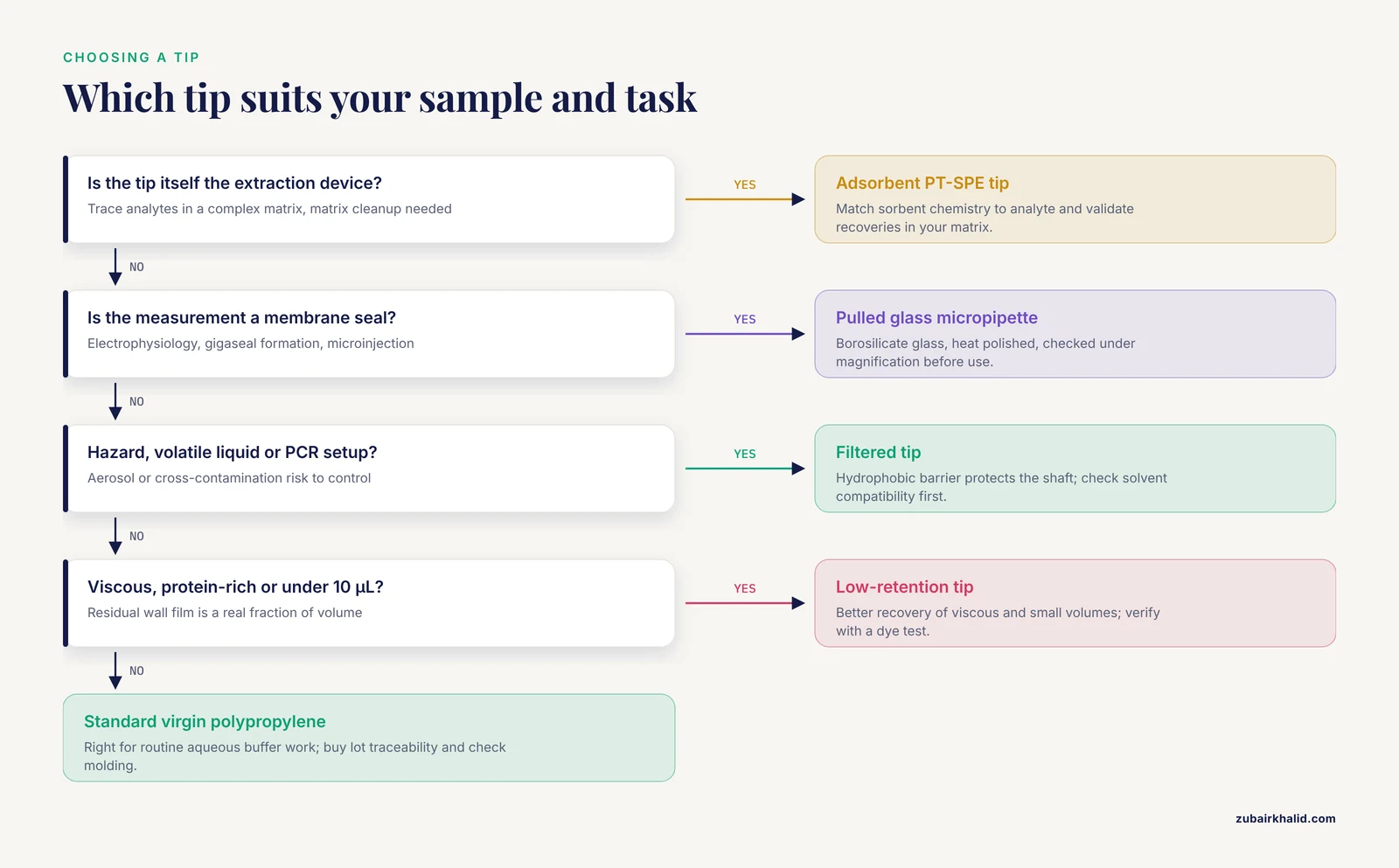
Setting up a 96-well qPCR plate
Accuracy at 2 to 10 µL, absolute exclusion of nuclease and aerosol contamination, and a clean surface for the master mix all matter. The appropriate choice is a sterile, RNase-free and DNase-free filtered tip, preferably low-retention, because the volumes are small and the master mix contains protein and glycerol that cling to standard surfaces. Seating consistency across a full rack matters more than any single-tip property, since well-to-well variation across the plate is what ruins the analysis.
Dispensing a viscous protein lysate
Viscous liquids deliver slowly and cling to walls. Use a low-retention wide-orifice tip if available, aspirate slowly and steadily, and dispense against the receiving vessel wall. Reverse pipetting is the recommended technique. A standard tip with a rough mold finish will hold back a visible fraction of the sample, and over a dilution series that fraction becomes a systematic error that no pipette calibration can correct, because it lives in the tip.
Extracting trace analytes from a complex matrix
When the goal is analytical extraction rather than transfer, the tip becomes the instrument. Pipette-tip solid-phase extraction is the format of choice, and the material inside the tip must be matched to the analyte. Graphene oxide and polypyrrole foam tips handle acidic plant hormones in fruit juice with high selectivity [2]. Amphiphilic porous polymer tips handle cyclic peptide toxins in environmental water before chromatographic analysis [3]. A minimal Celite-based tip extraction handles fragrance compounds in aqueous cosmetic matrices with a fraction of the solvent a conventional extraction requires [4]. In each case the evaluation question is the same. What is the adsorbent, is its surface chemistry appropriate for your analyte, and can the vendor or your own validation show the recoveries and reproducibility you need.
Building an electrophysiology rig
The tip here is a pulled borosilicate glass micropipette, and quality is judged by whether the glass surface supports gigaseal formation with your cell type. Automated patch clamp systems built around glass micropipettes achieve this at scale by relying on the proven ultra clean and smooth surface of pulled glass at low cost per electrode [1]. For a manual rig, the equivalent quality checks are visual inspection of the polished tip under magnification, consistent filling without bubbles, and a seal test on your standard cell preparation before committing a precious experiment.
Common Mistakes and Limitations
- Assuming all tips with the same volume label are interchangeable. Cone geometry differs between pipette brands. Forcing a universal tip onto a proprietary-fit pipette, or vice versa, either leaks or stresses the shaft seal. Check the manufacturer's compatibility documentation for your pipette model.
- Reusing filtered tips. Once liquid touches the barrier, the filter has done part of its job and may be compromised. Filtered tips are single use by design.
- Autoclaving tips that are certified sterile or certified nuclease-free. Re-sterilizing a certified tip can degrade certifications you paid for and can introduce contamination from the autoclave itself. If your protocol requires sterility beyond the factory claim, use individually wrapped sterile tips instead of re-sterilizing bulk tips.
- Calibrating with one tip and working with another. As explained above, calibration is specific to the tip used. This single mistake quietly undoes a paid calibration service.
- Judging quality by clarity alone. A crystal clear tip can still have a rough bore or a high-extractable resin. Visual inspection catches molding defects, not chemical cleanliness. For that you need the certificate of analysis and, for trace work, your own blank checks.
- Ignoring lot-to-lot variation. Resin lots and mold tooling change over the life of a product line. A brand that performed beautifully in your last project can shift. Re-run the simple fit and residual-volume checks with every new lot on critical workflows.
- Expecting a specialty tip to work without validation. Adsorbent-loaded PT-SPE tips are method-specific tools. Recoveries, linear ranges, and matrix effects reported for one analyte in one matrix, such as auxins in papaya juice [2], do not transfer automatically to your analyte in your matrix. Validate in your own system.
- The general limitation. These evaluation criteria are starting points. Your specific samples, solvents, and tolerance for error determine which trade-offs matter, and critical applications require you to verify tip performance in your own hands rather than relying on catalog claims.
Frequently Asked Questions
What is the best pipette tip material quality for general molecular biology work?
Virgin polypropylene is the best general-purpose material, because it is chemically resistant to aqueous buffers, moldable to tight tolerances, and compatible with standard pipette shafts. Choose a supplier that states virgin resin and provides lot traceability, and add low-retention or filtered variants only where your specific assay needs them.
Are low-retention tips worth using for every experiment?
No. Low-retention tips earn their premium in viscous, protein-rich, surfactant-containing, or very small volume work where residual wall film is a meaningful fraction of the delivered volume. For routine buffer and reagent transfers, a high-quality standard polypropylene tip delivers the same accuracy at lower cost.
Can I autoclave pipette tips?
Polypropylene tips tolerate standard autoclaving at 121 °C in material terms, but a tip that arrives certified sterile or nuclease-free should be used as supplied, because re-sterilization can compromise the certification and introduce contamination. If you need sterility beyond the factory claim, buy individually wrapped sterile tips rather than autoclaving bulk tips.
How does tip choice affect pipette calibration?
Calibration is a property of the pipette and tip together, so a pipette calibrated with one tip brand is not verified for another. Always calibrate with the tip type you use daily, record the tip type on the calibration record, and re-run a gravimetric check whenever you change tip brand or lot, especially for small-volume pipettes.
What are filtered pipette tips actually for?
Filtered tips protect the pipette shaft and piston from aerosols and droplets, which matters when pipetting hazardous, volatile, or infectious liquids. As a secondary benefit they reduce cross-contamination between samples, which is why filtered tips are standard in PCR setup. They do not purify your sample.
How do I check tip quality without special equipment?
Inspect against a light source for flash, rough bores, and out-of-round orifices, test the fit by seating the tip and watching a held water volume for thirty seconds for signs of a leak, and compare residual dye film between tips to verify low-retention claims. Then read the package certificate to confirm the cleanliness certifications match your assay.
Sources
- Flip the tip: an automated, high quality, cost-effective patch clamp screen.
- A new graphene oxide/polypyrrole foam material with pipette-tip solid-phase extraction for determination of three auxins in papaya juice.
- Surface amphiphilic hybrid porous polymers based on cage-like organosiloxanes for pipette tip solid-phase extraction of microcystins in water.
- Development, validation, and assessment of a reliable and white method for the analysis of water-based perfumes by pipette-tip micro-solid-phase extraction combined with dual detection gas chromatography.