How to Choose a Pipette for Viscous or Volatile Samples
By Dr. Zubair Khalid, DVM, MS, PhD ·

Viscous samples move slowly and cling to plastic, while volatile samples evaporate from the tip and push back with their own vapor. The rule of thumb is simple: for thick liquids such as glycerol, concentrated protein solutions, and polymer solutions, choose a positive-displacement pipette or use reverse pipetting with wide-bore tips, and for volatile solvents such as chloroform, ethanol, and acetone, use a pre-wetted tip, fast delivery into the receiving liquid, and positive displacement whenever accuracy matters.
This article walks through every practical pipette for viscous liquids, explains the physics that makes ordinary pipetting fail, compares the options on the criteria that decide real purchasing and protocol choices, and covers the technique and pipette calibration adjustments that turn a frustrating session at the bench into reproducible volumes.
Why Viscosity and Volatility Break Normal Pipetting
Most molecular biologists default to an air-displacement pipette. In this design, a piston inside the body of the pipette compresses a cushion of air, and that cushion transmits pressure to the liquid column in the tip. The design is excellent for water and dilute aqueous buffers because water has a viscosity near 1 mPa·s at room temperature, a density of about 1.00 g/mL, and moderate surface tension, which is exactly the liquid manufacturers use to set and verify their volume markings.
Two sample properties disturb this tidy arrangement.
Viscosity is a fluid's resistance to flow, expressed in millipascal-seconds (mPa·s). When you aspirate a viscous liquid with an air-displacement pipette, the liquid flows into the tip too slowly to keep up with the piston stroke. The piston reaches its full travel before the tip is full, the air cushion expands more than it should, and the delivered volume comes up short. The error grows with viscosity, with smaller set volumes, and with faster piston speeds. Rough textbook values show the scale of the problem: 50 percent glycerol in water runs near 6 mPa·s, undiluted glycerol near 1,400 mPa·s, and concentrated polymer solutions climb far higher. Research on dosing polymer liquids notes that conventional droppers and pipettes are effectively unable to quantitatively split and dispense highly viscous liquids above about 100 mPa·s, because long entangled macromolecules and strong cohesion keep the fluid from breaking cleanly at the tip orifice [1]. Viscous drops also relax slowly after they form, and their shape during dispensing depends strongly on the ratio of the liquid's viscosity to that of the surrounding medium, a relationship exploited in careful physical studies of elongated viscous drops [2].
Volatility is the other failure mode. A volatile liquid has a high vapor pressure, meaning its molecules escape into the gas phase readily at room temperature. Acetone boils at 56 °C and has a vapor pressure of roughly 24 kPa at 20 °C, and diethyl ether sits near 58 kPa. When you aspirate a volatile solvent into an air-displacement pipette, solvent evaporates into the air cushion. This does two damaging things. First, the vapor displaces liquid, so the volume you dispense is less than the volume you aspirated, sometimes noticeably. Second, vapor can press the liquid back out of the tip during pauses, causing drips that contaminate the bench, the balance, and your samples. Dense, volatile solvents add a third problem: chloroform has a density of about 1.49 g/mL, well above the water density the calibration assumes, so even a perfect stroke delivers a mass that reads differently on a balance.
A related problem for both sample types is retention. Hydrophobic plastic tips repel water well, but they perform poorly with low-surface-tension liquids and viscous fluids, and hydrophobic surfaces can adsorb biomolecules, which costs both accuracy and precision during pipetting [3]. Viscous liquids leave a film coating the inner wall of the tip, so a full volume never leaves the tip unless you account for that residual deliberately.
Understanding these three mechanisms, slow fill, vapor loss, and wall retention, explains every recommendation that follows.
Pipette for Viscous Liquids Options
There is no single best pipette for viscous liquids for every lab. There is a small set of options, each with clear strengths. The subsections below explain each on its own terms, and the comparison table that follows puts them side by side.
Air-displacement pipette with standard tips
This is the instrument already on your bench. For mildly viscous samples such as serum, diluted glycerol stocks, or concentrated salt solutions, it remains usable if you change your pipetting technique, which is covered in its own section below.
The pros are familiarity, speed, low cost per sample, and a huge tip ecosystem. The cons are a systematic underestimate of volume as viscosity rises, poor control of foamy or stringy samples, and the retention film that clings to the tip wall. For undiluted glycerol or polymer solutions above roughly 100 mPa·s, conventional pipetting loses quantitative control altogether [1], so treat this option as appropriate only for the mild end of the viscosity range.
Air-displacement pipette with wide-bore tips
A wide-bore (or cut-tip) approach keeps the air-displacement mechanism but enlarges the orifice. You can buy wide-bore tips or carefully trim a standard tip with a clean razor or sterile scissors. The larger opening lets thick liquids enter with less resistance, reduces the pressure the piston must generate, and shear-protects fragile samples such as cells or long genomic DNA.
The pros are immediate availability and a real improvement in fill speed. The cons are reduced accuracy at small volumes because the orifice no longer matches the calibrated geometry, drippy dispensing, and the fact that trimming tips by hand introduces variability. Wide-bore tips work well when volume tolerance is generous, for example resuspending viscous bacterial lysates, and poorly when you need tight quantitative accuracy.
Positive-displacement pipette
The positive-displacement pipette is the best pipette for viscous liquids in most molecular biology labs that handle thick samples routinely. Instead of an air cushion, the piston sits directly against the liquid inside a disposable plastic capillary or piston-bearing tip. The piston physically pushes the exact stroke volume of liquid, so the instrument does not care how viscous, dense, or volatile the sample is. Slow fill, vapor pressure, and density effects, the three failures described above, are largely engineered out.
The pros are accuracy across the full viscosity range, excellent behavior with volatile solvents, minimal retention loss because the piston wipes the capillary, and good performance with cold liquids near 4 °C. The cons are higher instrument cost, more expensive per-sample consumables (capillaries and pistons sold together), slower tip loading, and a model range that must match your volume. Many labs keep one positive-displacement instrument specifically for glycerol, mineral oil, protein concentrates, and phenol-chloroform work.
Reverse pipetting
Reverse pipetting is a technique rather than a purchase, and it converts an ordinary air-displacement pipette into a serviceable tool for viscous and volatile liquids. The procedure is the opposite of normal forward pipetting:
- Press the plunger to the second stop.
- Immerse the tip in the liquid and release the plunger slowly to aspirate. The tip now holds the set volume plus an excess.
- Wipe the outside of the tip against the source vessel wall without touching the orifice.
- Dispense by pressing only to the first stop.
- The set volume leaves the tip. The excess remains as a residual film, which compensates for the retention and underfill errors of a viscous sample.
The pros are zero new equipment, a large improvement with glycerol, Tween and detergent stocks, and foamy protein solutions. The cons are that it wastes sample (the excess stays in the tip), it is awkward below about 10 µL, and it does not fully solve the vapor-pressure problem for aggressively volatile solvents, though pre-wetting combined with reverse pipetting does help.
Repeater and positive-displacement dispensers
A repeater pipette is a positive-displacement dispensing instrument that aspirates a reservoir once and dispenses many identical aliquots. Because dispensing, not aspiration, is where viscous liquids cause the most grief (they cling and form strings and drops that will not release), a repeater with a positive-displacement syringe tip handles serial dispensing of glycerol-containing master mixes, detergent solutions, and viscous PCR additives cleanly.
The pros are speed for plate-scale work, consistent aliquots from one aspiration, and the same viscosity immunity as other positive-displacement designs. The cons are cost, the need for compatible syringe tips, and unsuitability when each aliquot must be drawn fresh from different source tubes.
Serological pipettes and electronic pipettors
For viscous liquids in the 1 to 50 mL range, a serological pipette on an electronic pipettor is often more practical than any hand-held micropipette. Electronic pipettors let you set slow aspiration speeds, which matters enormously for thick liquids, and gravity-assisted dispensing from a wide 10 or 25 mL orifice avoids the stringing and cling that plague small tips.
The pros are speed at larger volumes, gentle aspiration, and low cost per pipette. The cons are coarse volume accuracy compared with a calibrated micropipette, gravity-dependent dispensing that varies with angle and immersion depth, and poor suitability for anything below about 1 mL.
Lubricant-infused and specialty surfaces
A newer option addresses retention and carryover directly. Researchers have coated the inner lumen of commercially available pipette tips with a fluorosilane layer by chemical vapor deposition, then infused a fluorinated lubricant to create an omniphobic, lubricant-infused surface (LIS). Contact-angle testing showed drastically enhanced repellency, and the coated tips resisted physical adsorption of sample material, which matters when pipetting low-surface-tension and viscous fluids that normally wet and cling to the tip wall [3]. The practical takeaway for a working lab is twofold. First, tip surface chemistry is a real variable in pipetting accuracy, not a marketing detail. Second, commercial low-retention tips, which reduce but do not eliminate wetting, are worth testing against your specific viscous or sticky samples before committing.
Microfluidic dosing platforms for extreme viscosities
At the far end of the viscosity scale, standard hand pipetting reaches a hard limit. A 2024 study introduced a photopyroelectric slippery microfluidic platform that splits and doses liquids with viscosities as high as 15,000 mPa·s using only sunlight-induced local heating and a cooling source to drive noncontact self-splitting. The platform achieved dosing accuracy above 80 percent, whereas their measurements of traditional pipetting strategies for polymer liquids came out near 1.3 percent accuracy [1]. Bench scientists are unlikely to buy such a chip tomorrow, but the study sets the boundary conditions clearly: when your material is a prepolymer, an adhesive, or a viscous bioink above a few hundred mPa·s, plan on a specialized dosing method rather than expecting any hand-held pipette to save the experiment [1].
Side-by-Side Comparison
| Option | Handles viscosity | Handles volatility | Typical best use | Key limitation |
|---|---|---|---|---|
| Air displacement, standard tips | Poor to fair below ~10 mPa·s | Poor | Dilute aqueous buffers, daily cloning work | Under-delivery rises with viscosity, vapor loss with solvents |
| Air displacement, wide-bore tips | Fair to good | Poor | Lysates, cell suspensions, resuspension | Loses calibrated accuracy at small volumes |
| Positive displacement | Excellent, even >100 mPa·s | Excellent | Glycerol, protein concentrates, phenol-chloroform, viscous PCR mixes | Higher instrument and consumable cost, slower workflow |
| Reverse pipetting (technique) | Good | Fair | Any lab's existing pipette plus viscous stocks | Wastes excess, awkward below ~10 µL |
| Repeater with syringe tips | Excellent | Excellent | Serial dispensing of master mixes into plates | Cost, fixed reservoir, one source per fill |
| Serological pipette plus pipettor | Good at 1 to 50 mL | Fair | Bulk viscous media, gradients, cell culture | Coarse accuracy, gravity-dependent dispensing |
| Lubricant-infused or low-retention tips | Good (retention-focused) | Fair | Sticky samples, low-surface-tension liquids, carryover-sensitive assays | Adds consumable cost, availability varies |
| Microfluidic dosing platform | Excellent up to 15,000 mPa·s | Not the design target | Polymer liquids, adhesives, bioinks | Specialized equipment, not general bench use |
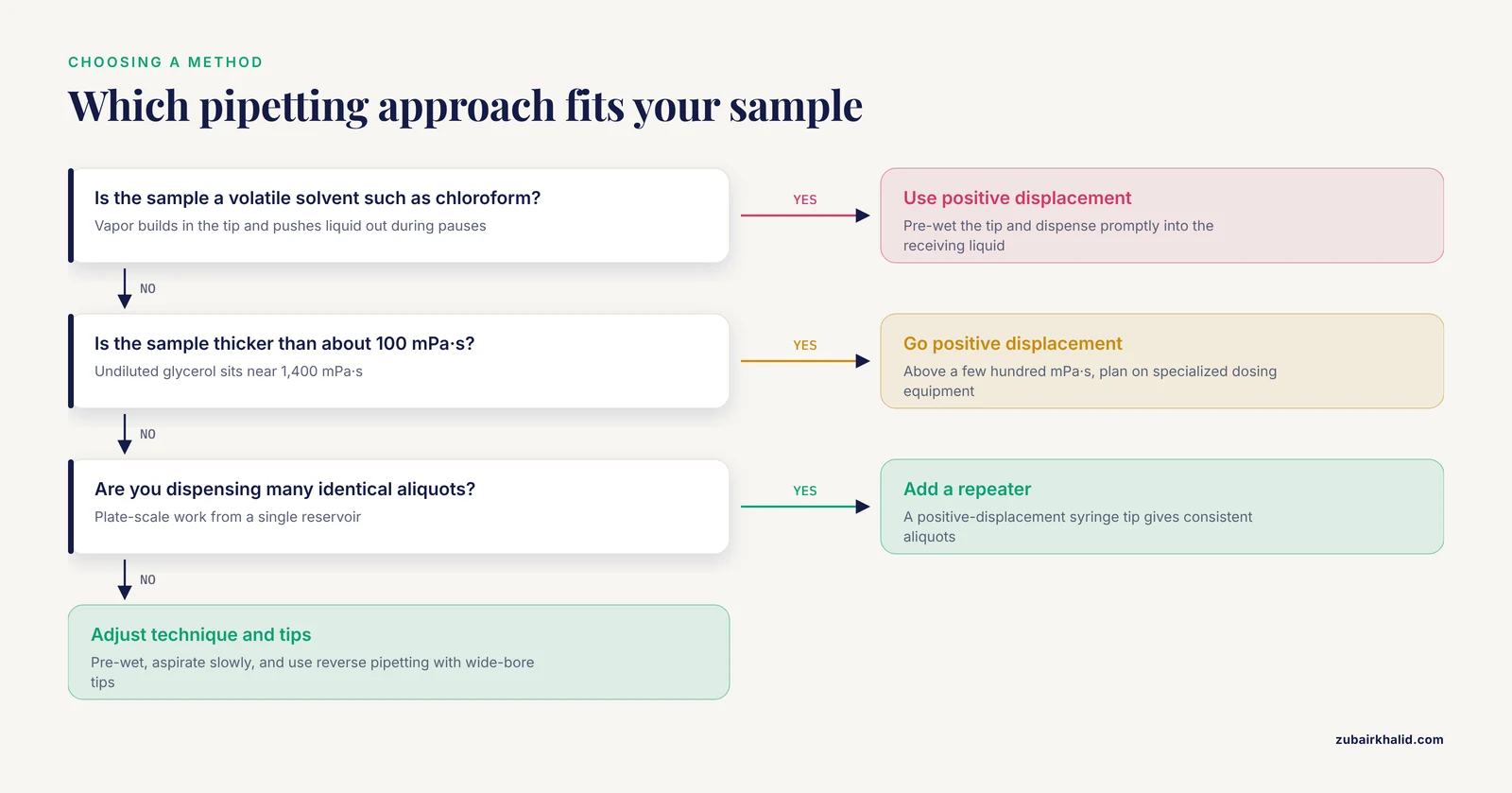
Reading the table as a decision path: if your sample is only mildly viscous, change your technique and tip. If your sample is genuinely thick or volatile and the volume matters, buy or borrow a positive-displacement pipette. If you are dispensing many aliquots, add a repeater. If your material is beyond a few hundred mPa·s, you are in specialized-equipment territory [1].
Worked Scenarios
Scenario 1: Adding glycerol to an enzyme master mix. You need 40 µL of undiluted glycerol (about 1,400 mPa·s) into each of 48 tubes. A standard P200 under-delivers badly, and the glycerol clings in strings. Best choice: a positive-displacement pipette if one is available. If not, use reverse pipetting with a wide-bore tip, aspirate slowly to the second stop, dispense to the first stop while touching the tip tip against the tube wall or just under the liquid surface. Pre-wet the tip three times before the first analytical aliquot.
Scenario 2: Moving viscous bacterial lysate after alkaline lysis. The viscosity here comes from genomic DNA, and the sample is stringy rather than uniformly thick. Accuracy of the transferred volume usually does not matter, because you are clearing lysate, not quantifying it. A wide-bore tip on a standard air-displacement pipette, aspirated slowly, is the right answer. Shear from a narrow orifice is not a concern for DNA you plan to discard, but slow aspiration still avoids aerosols and splashing.
Scenario 3: Dispensing chloroform for RNA phase separation. Chloroform is volatile (vapor pressure near 21 kPa at 20 °C), dense (about 1.49 g/mL), and hazardous. An air-displacement pipette left with chloroform in the tip will drip as vapor pressure builds. Best choice: positive displacement. Acceptable choice: reverse pipetting with a pre-wetted tip, aspirating and dispensing promptly with no pause, and delivering into the aqueous phase below its surface so drops leave the tip cleanly. Keep the bottle capped between draws to limit evaporation and exposure.
Scenario 4: Serial dispensing of a viscous PCR master mix with Tween-20 into a 96-well plate. This is the repeater's home turf. Load the syringe tip once, dispense identical aliquots across the plate, and avoid the repeated slow aspirations that make hand pipetting of detergent stocks both slow and inconsistent. Pre-wet the syringe tip, then dispense. Verify the plate by eye for equal meniscus heights before adding samples.
Pipetting Technique Adjustments That Fix Half the Problem
Hardware choice and pipetting technique reinforce each other. Whether you use the best pipette for viscous liquids or a plain air-displacement instrument, these adjustments apply.
Pre-wet the tip. Aspirate and dispense the set volume two to three times before taking your analytical aliquot. Pre-wetting saturates the air cushion with vapor for volatile liquids, slowing further evaporation, and coats the tip wall with liquid for viscous samples, reducing the volume lost to the retention film on the first draw.
Aspirate slowly. For viscous liquids, release the plunger at the slowest controlled speed. The fluid must flow into the tip at the pace the piston demands, and slow aspiration is the single largest correction you can make. Watch the liquid level in the tip, not the plunger, and release the button fully only when the meniscus stops rising.
Keep immersion depth shallow and consistent. Immerse the tip 2 to 3 mm for small volumes and a few millimeters more for larger ones. Too deep and hydrostatic pressure pushes extra liquid in, too shallow and the tip can gulp air, which is especially easy with thick liquids that cling to the outside of the tip.
Dispense against a surface or into liquid. Touch the tip orifice to the inside wall of the receiving tube or place it just under the surface of the receiving liquid. Viscous liquids frequently hold a drop at the orifice that will not fall on its own, and a hanging drop is volume you intended to deliver but did not.
Temperature matters. Cold viscous liquids (straight from 4 °C) are dramatically thicker than the same liquid at room temperature. Warm them to ambient temperature and mix before pipetting unless the protocol forbids it. For volatile solvents, warm-up has the opposite effect and increases evaporation, so draw and dispense promptly instead.
Reverse pipetting for anything clingy or foamy. As described above, the excess-and-residual logic of reverse pipetting compensates for retention losses and gives viscous and foamy samples a cleaner break at the orifice.
Work fast with volatile liquids. Minimize the time the liquid sits in the tip, keep source and destination containers capped, and never pause mid-stroke with solvent in the tip. If you see the liquid level in the tip dropping on its own, the air cushion is saturated with vapor and pushing back, and your volumes are already compromised.
Pipette Calibration for Non-Aqueous Liquids
Calibration is where viscous-sample errors hide in plain sight. An air-displacement pipette is calibrated and verified gravimetrically with water, because water's density of about 1.00 g/mL and low viscosity match the conditions under which the factory volume settings were established. When you pipette anything else, two corrections come into play.
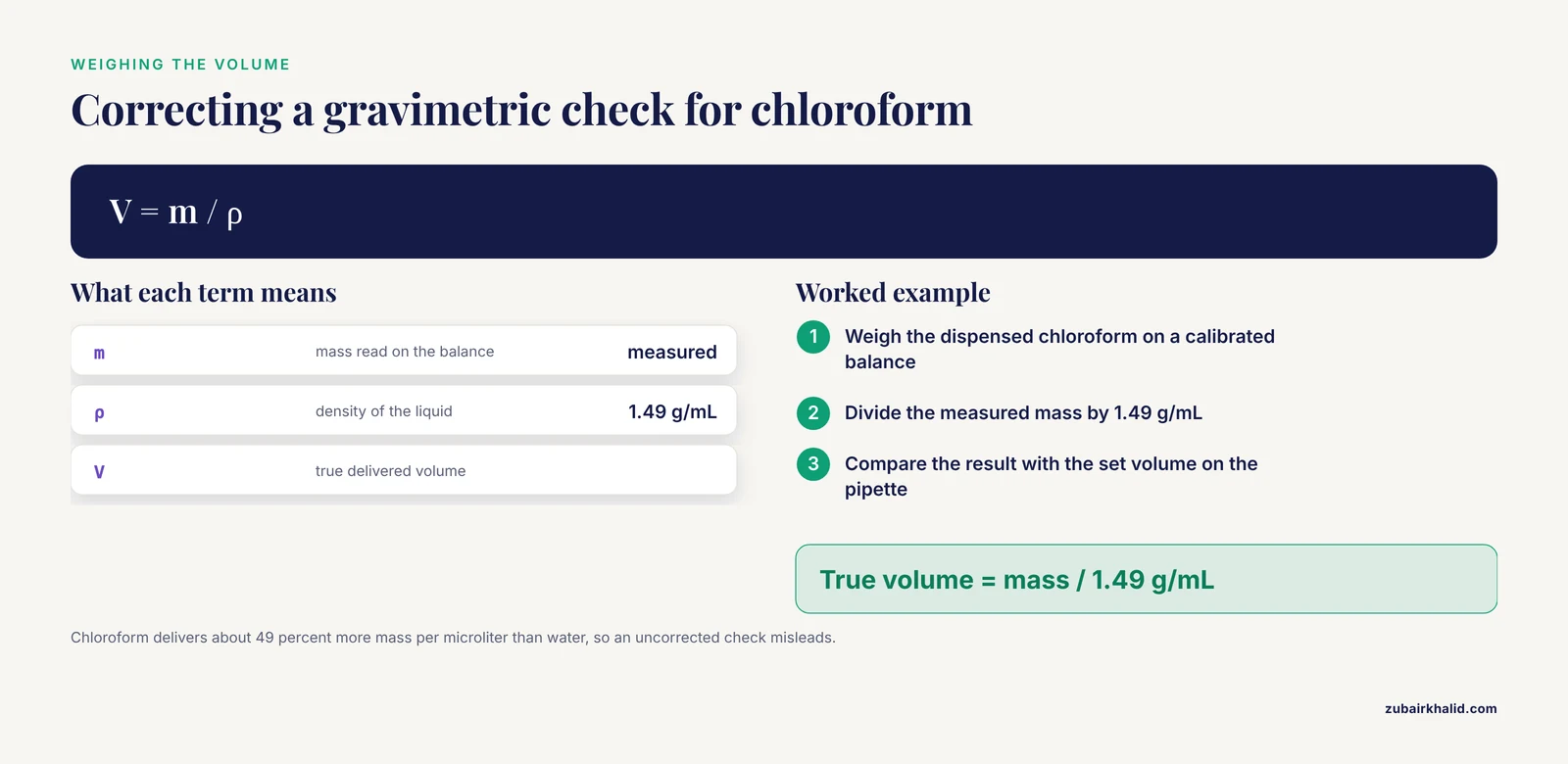
Viscosity correction. A viscous liquid under-fills the tip during aspiration, so the delivered volume is systematically less than the set volume. The standard fix is an empirical correction factor: using a calibrated balance, pipette your actual sample at the actual set volume and temperature, calculate the true delivered volume from the measured mass and the sample's density, and derive a sample-specific coefficient. Apply that coefficient whenever you pipette that sample type. Many labs post a small correction chart next to pipettes dedicated to glycerol or detergent stocks. Positive-displacement pipettes largely eliminate this correction because the piston meters the liquid directly, which is one more reason they are the best pipette for viscous liquids when routine accuracy matters.
Density correction. If you verify volumes by weighing, remember that the balance reads mass, not volume. Divide the measured mass by the liquid's density to get the true volume. Chloroform at 1.49 g/mL delivers about 49 percent more mass per microliter than water, so an uncorrected gravimetric check will badly mislead you.
Practical calibration schedule. Verify any pipette you use for viscous or volatile work more often than one used only for water, because the stresses that degrade accuracy (corrosive vapors reaching the piston, liquid entering the shaft, frequent reverse pipetting) accumulate faster. Check the pipette with water at the volumes you actually use, at minimum near the top and bottom of its range, and check it with the problem liquid itself when the sample is precious enough to justify it. Keep records of the check dates, the measured volumes, and any correction factors in use, and send instruments for professional recalibration on the schedule your institution or manufacturer documentation specifies.
Carryover as a calibration-adjacent issue. In assays where trace carryover produces false results, tip behavior matters as much as volume accuracy. Residual sample in tips is a recognized contributor to cross-contamination, and surface treatments that render tips repellent to adsorption have been shown to reduce that risk [3]. If your viscous sample is also precious or hazardous, plan on changing tips for every aliquot rather than reusing one tip across a series.
Common Mistakes and Limitations
Mistake 1: Ignoring the viscosity threshold. Pipette adjustments and technique buy back accuracy in the mild-to-moderate range. Above roughly 100 mPa·s, conventional pipetting loses quantitative control of polymer-like liquids [1]. If your sample is that thick, no amount of slow aspiration fixes it, so move to positive displacement or a specialized dosing method.
Mistake 2: Pipetting cold viscous liquids. Glycerol at 4 °C is far more viscous than at room temperature, and every error multiplies. Warm and mix first unless your protocol says otherwise.
Mistake 3: Trusting the set volume without verification. Because air-displacement pipettes are calibrated with water, the printed volume is not the delivered volume for a different liquid. If the number matters, weigh it and correct for density.
Mistake 4: Forgetting that volatile liquids drip. A tip holding ether, acetone, or chloroform will dribble as vapor pressure builds during any pause. Keep the tip empty or in motion, cap containers, and clean drips immediately, both for accuracy and because these solvents damage pipette internals and bench surfaces.
Mistake 5: Reusing tips across a viscous series. The retention film in a viscous tip can hold a meaningful fraction of the set volume, and that material transfers into the next sample when the tip is reused. Change tips, or validate reuse deliberately with a checkerboard carryover test.
Mistake 6: Letting solvent or viscous liquid enter the pipette shaft. Solvent vapor corrodes the piston and seal, and dried viscous residue jams the shaft. Hold the pipette vertically during use, never lay it down with liquid in the tip, and eject tips immediately.
Mistake 7: Assuming trimming tips is always harmless. Cutting tips for a wide bore sacrifices the calibrated geometry. That trade is acceptable for resuspension and transfer, not for quantitative steps.
Limitations. The right choice also depends on your lab's budget, tip supply, and assay tolerance, and individual protocols sometimes dictate one approach over another for reasons unrelated to viscosity or volatility. When a specific precious sample is at stake, consult your lab supervisor, the pipette manufacturer's technical documentation, and the reagent's data sheet before committing to a method.
Frequently Asked Questions
What is the best pipette for viscous liquids like glycerol?
A positive-displacement pipette is the best pipette for viscous liquids for most routine work, because its piston acts directly on the liquid and is unaffected by slow fill and retention. If one is unavailable, reverse pipetting with a wide-bore, pre-wetted tip on your existing air-displacement pipette is the standard fallback.
Can I use a regular air-displacement pipette for viscous samples?
Yes, for mild viscosity and when the volume tolerance is generous. Pre-wet the tip, aspirate slowly, use reverse pipetting, and verify the delivered volume gravimetrically with a density correction. For undiluted glycerol or polymer solutions, the errors become too large to compensate by technique alone.
What is reverse pipetting and when should I use it?
Reverse pipetting aspirates an excess by pressing to the second stop, then dispenses only to the first stop, leaving a deliberate residual in the tip that compensates for retention losses. Use it for viscous, foamy, or clingy liquids, and combine it with pre-wetting for volatile solvents.
How do I pipette volatile liquids like chloroform accurately?
Use a positive-displacement pipette when possible. With an air-displacement pipette, pre-wet the tip, minimize the time the liquid sits in the tip, dispense immediately into the receiving liquid, and keep all containers capped to limit evaporation and drips from vapor pressure.
Do I need to recalibrate my pipette for viscous liquids?
The pipette itself is still calibrated with water, but viscous samples require an empirical correction factor determined by weighing the actual sample and dividing the mass by its density. Positive-displacement pipettes largely remove the need for such corrections.
How viscous is too viscous for a normal pipette?
Conventional pipettes and droppers lose quantitative control of liquids above roughly 100 mPa·s, such as concentrated polymer solutions, and research platforms built for extreme viscosities now reach 15,000 mPa·s where hand pipetting cannot. Above a few hundred mPa·s, plan on positive displacement or specialized dosing equipment.