Pipette Calibration and Reproducibility
By Dr. Zubair Khalid, DVM, MS, PhD ·

Pipette calibration is the process of checking and adjusting the volume a pipette actually delivers against a traceable reference, usually by weighing dispensed water on an analytical balance. Reproducibility is the agreement among repeated deliveries of that volume, or among assay results built from those deliveries, when pipetting is repeated across runs, operators, and days.
Every quantitative result in a molecular biology lab sits on top of thousands of small volume transfers. A qPCR standard curve, a protein assay, a dilution series for an ELISA, and a ligation master mix all assume that when the display on a pipette reads 100 µL, close to 100 µL leaves the tip, and that the same thing happens every time the plunger is pressed. When that assumption fails, the error does not announce itself. It hides inside calibration curves, inflates coefficients of variation, and makes genuinely biological differences look like pipetting noise. Studies of routine assay performance have shown that a large share of between-batch variability in immunoassays traces back to the simple act of dispensing aliquots with a micropipette, and that pipette error can dominate the variability of serial dilution series used for quantification [1][2]. This article explains what pipette calibration and reproducibility mean, how both are measured, how pipetting technique shapes the numbers you report, and how to interpret the precision values that appear in method validation papers.
Key Terms at a Glance
Students most often confuse calibration, accuracy, and precision. The table below separates the terms you will meet in pipette logbooks, validation reports, and analytical papers.
| Term | What it means | How it is expressed | Practical example |
|---|---|---|---|
| Calibration | Comparison of delivered volume against a traceable reference, with adjustment if needed | Deviation from set volume, in µL or percent | A 100 µL setpoint actually delivers 98.7 µL |
| Accuracy (trueness) | Closeness of the delivered volume to the true or target volume | Percent error or bias | Delivery is 1.3% below the setpoint |
| Precision (repeatability) | Agreement among repeated deliveries by the same operator, same pipette, short time frame | Standard deviation, coefficient of variation (CV) | Ten deliveries give a CV of 0.8% |
| Reproducibility | Agreement among results when conditions change, such as operator, day, or pipette | CV or relative standard deviation (RSD) across conditions | Between-day CV of an assay batch |
| Calibration curve | Series of known concentrations used to convert signal to amount | Regression fit, r² or R² | qPCR standard curve with a stated R² |
| Verification check | Quick user-level test between formal calibrations | Percent deviation from setpoint | Monthly gravimetric spot check |
How an Air-Displacement Pipette Works
Almost every pipette on a molecular biology bench is an air-displacement pipette. Understanding the mechanism explains nearly every technique rule that follows.
The pipette has a body containing a spring-loaded piston, a digital or dial volume-setting mechanism, an ejector, and a removable disposable tip. When you press the plunger to the first stop, the piston moves down and expels a fixed volume of air, typically the dead space in the tip. As you release the plunger with the tip immersed in liquid, the piston travels back up, the air inside the shaft expands, and the pressure drop draws liquid into the tip. The volume of liquid aspirated equals the volume change of the air column, which is why anything that changes air behavior, such as temperature, barometric pressure, or liquid viscosity, changes the delivered volume.
Pressing to the second stop blows out the residual volume left in the tip after delivery. This is called blow-out, and it exists because a thin film of liquid always clings to the inner tip wall. For aqueous solutions, forward pipetting (aspirate by releasing to the resting position, dispense by pressing to the first stop, then blow out) is the default. For viscous or foaming liquids, reverse pipetting is preferred. In reverse pipetting you press to the second stop first, aspirate, and dispense by pressing only to the first stop. A small excess stays in the tip and is discarded, which improves accuracy for liquids that coat the tip.
Positive-displacement pipettes exist for volatile solvents and very viscous solutions. In these, the piston sits inside the tip itself, usually as a capillary piston or a microsyringe, so there is no air cushion to compress. Because the liquid contacts the piston directly, delivery is nearly independent of the liquid's physical properties. Most molecular biologists will not need one every day, but knowing when the air cushion betrays you is part of understanding your instrument.
What Pipette Calibration Means and How It Is Done
The gravimetric method
Calibration compares delivered volume with a reference standard. The reference method is gravimetric: dispense a set volume of distilled water into a weighed vessel on an analytical balance, record the mass, convert mass to volume using the density of water at the test temperature, and repeat many times. Water density at room temperature is close to 1.000 g/mL but not exactly, so proper gravimetric procedures apply a correction factor that accounts for temperature, air buoyancy, and evaporation. This approach is formalized in international standards for piston-operated volumetric apparatus, and pipette manufacturers document their own gravimetric test conditions in their technical manuals. The key output is not one number but a distribution. A calibration report states the mean delivered volume (accuracy) and the scatter around that mean (precision), each expressed as a percent of the selected volume.
Two points deserve emphasis. First, calibration error is not uniform across a pipette's range. A P1000 set to 1000 µL is usually relatively more accurate than the same pipette set to 100 µL, because mechanical tolerances and the air cushion behave worse at the low end of the range. Second, the tip is part of the measuring system. Calibration is performed with a specified tip type, and switching to an off-brand tip can shift delivered volume enough to matter at small volumes.
Manufacturer specifications versus in-house recalibration
Manufacturers publish two sets of limits for each pipette: the maximum permissible error (how far the mean delivery may sit from the setpoint) and the precision limit (how tightly repeated deliveries must cluster). A study of serial dilutions and colony counts in microbiology took this idea further and asked how well you can predict the precision of dilution-based measurements from those manufacturer specifications alone [3]. The answer was that manufacturer specifications give a reliable estimate of the inherent, best-case precision of serial dilutions and colony counts, but these estimates are minima because they exclude external sources of variation such as operator handling and environmental conditions. The same study found that adding the laboratory's own recalibration data improved the quality of the precision estimates, and that this improvement was worthwhile for homogeneous solutions, even though it added little for colony counts, where biological scatter dominates [3]. The lesson generalizes: if your work depends on liquid transfer precision, in-house calibration data are worth collecting rather than relying on the certificate that came in the box.
What Reproducibility Means and How to Interpret It
Repeatability versus reproducibility
In analytical chemistry vocabulary, repeatability describes agreement among measurements made under identical conditions, usually by one analyst with one instrument in one session. Reproducibility describes agreement when conditions change, such as a different analyst, a different day, or a different pipette. Pipette calibration reproducibility, as the phrase is used in bench practice, usually means how consistently a pipette (and the person using it) delivers its set volume across repeated trials, runs, or operators. When a validation paper reports a relative standard deviation, the context tells you which kind you are reading. An intra-day RSD comes from one session. An inter-day RSD aggregates sessions and is almost always larger.
Reading a coefficient of variation
The coefficient of variation is the standard deviation divided by the mean, multiplied by 100. It is the standard way to report pipetting and assay precision because it is unitless and comparable across volumes. A CV of 1% on a 100 µL delivery means a standard deviation of 1 µL. The same relative scatter on a 10 µL delivery means a standard deviation of 0.1 µL, which demands much more of the instrument and the operator.
A useful reference point comes from a routine clinical laboratory study. Investigators evaluated a single experienced analyst using a Gilson micropipette set to dispense 100 µL inside an immunoradiometric assay run under genuine routine conditions. In each of 15 consecutive batches over seven months, the analyst pipetted ten aliquots of radioactive tracer into clean tubes at the start of the batch (PRE tubes) and ten more at the end (POST tubes), and the tubes were counted in a gamma counter. Across batches averaging 283 tubes each, the global CV ranged from 1.6% to 6.9%, with a mean of 3.1% [2]. Several findings from that study reward close reading.
First, routine precision under realistic working conditions was worse than the instrument's specification-sheet precision, which is exactly why specification-based estimates are treated as minima [3][2]. Second, there was no evidence that analyst fatigue increased imprecision across a batch. Third, and most instructive, nine of the fifteen batches showed a significant difference between the PRE and POST tube means without any difference in precision. The authors called this pseudoimprecision, an apparent increase in CV caused by a shift in the mean rather than by true scatter. The direction of the shift even reversed over time, with POST tubes reading higher in the first seven batches and lower in the last eight [2]. When you interpret your own precision data, ask whether you are looking at genuine scatter or at a drift in the mean that scatter statistics are dutifully reporting.
A worked interpretation
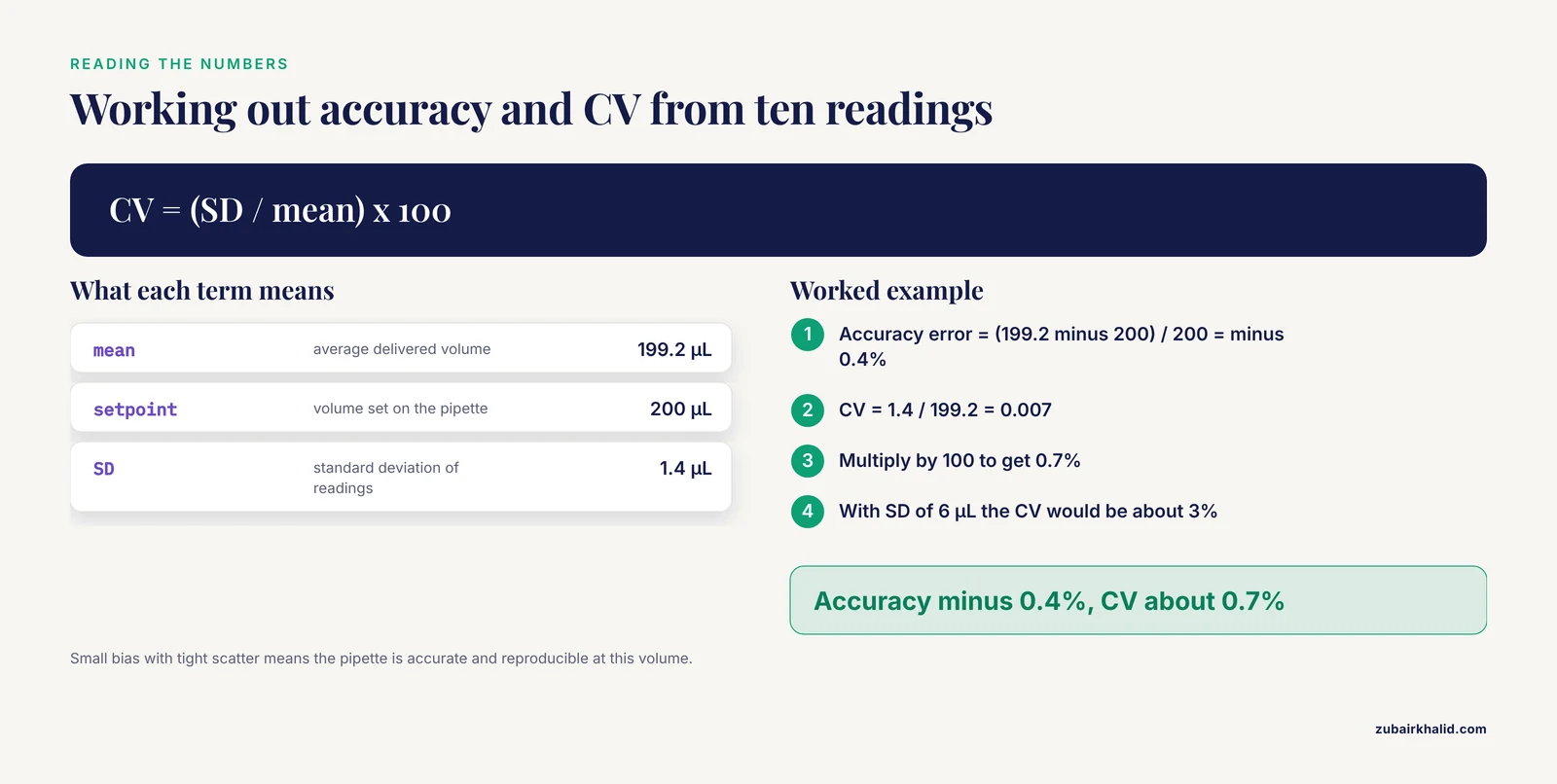
Suppose a gravimetric check on a 200 µL setpoint gives ten readings with a mean of 199.2 µL and a standard deviation of 1.4 µL. The accuracy error is (199.2 minus 200) divided by 200, or minus 0.4%, which is small. The CV is 1.4 divided by 199.2, or about 0.7%, which is good. If instead the mean were 199.2 µL with a standard deviation of 6 µL, the accuracy would still be acceptable but the reproducibility would be poor, and every downstream measurement that uses this pipette would inherit roughly 3% scatter at that volume. This is the core of pipette calibration reproducibility interpretation: accuracy tells you where your results sit on average, reproducibility tells you how much you can trust the differences between them.
How Pipetting Errors Propagate into Assay Results
Pipetting errors do not stay politely inside the pipette. They compound through every step that depends on a previous transfer.
Serial dilutions
In a serial dilution, each tube's concentration depends on the transfer that made it. A systematic error in the transfer pipette biases every tube in the same direction, and a random error accumulates down the series. This is why the low end of a dilution series, made by repeated transfers from the previous tube, is always the least trustworthy concentration in the set.
The qPCR literature provides a concrete demonstration. Investigators examined the reproducibility of quantitative PCR using the Quantifiler Duo DNA quantification kit, reviewing 14 standard curves generated with two different lots of standard DNA. Cycle threshold variation between assays was larger than the variation seen for the internal PCR control, which prompted a search for the source of the variability [1]. DNA addition to the plate turned out to introduce little variation. The problem sat upstream, in the dilution series itself. Comparing seven independent dilution series showed that cycle threshold variation between dilutions was larger than the variation expected from repeatedly measuring the same sample. Modeling the influence of pipette errors on dilution series accuracy led the authors to conclude that a more rigorous approach to external calibration curve production is required, and that calibration curve stability improves when pipette conditions are carefully chosen or a single validated curve is used as the calibrator [1].
Read that conclusion as a bench instruction. If your qPCR standard curves wobble between runs while your control samples stay tight, the dilution series that feeds the curve is the most likely culprit, and the fix is better pipette practice or fewer independently generated curves, not more instrument maintenance on the thermocycler.
Calibration curves and quantification
Every point on a calibration curve carries the pipetting error used to make it. Because regression fits weight points unevenly, scatter at the low end of the curve inflates the uncertainty of every interpolated unknown. Published analytical methods make this visible in their linearity statistics. A graphene-based pipette tip solid-phase extraction method for malondialdehyde in plasma reported a calibration curve from 0.5 to 90 µg/L with r² of 0.991 and a detection limit of 0.3 µg/L, with relative standard deviations of 4.51% and 3.78% across eight replicate measurements at 10 and 40 µg/L [4]. A thorium metal-organic framework pipette tip method for bisphenol A in bottled water achieved linearity from 0.002 to 0.456 ng/mL with r² of 0.996, batch-to-batch extraction repeatability better than 5.0%, and reproducibility of 3.2% in real samples [5]. In both cases, the number of aspirating and dispensing cycles the pipette performed was an optimized parameter, meaning the investigators treated the pipetting action itself as a variable that had to be controlled to reach that linearity and precision [5][4].
Pipetting Technique: The Variable You Control Daily
Calibration cannot rescue poor technique. Most between-operator variability in a calibrated pipette comes from a handful of correctable habits.
Angle and immersion depth
Hold the pipette vertically during aspiration. Tilting the pipette changes the hydrostatic pressure at the tip orifice and aspirates a different volume, an effect that grows at small volumes. Immerse the tip only 2 to 3 mm below the liquid surface. Deep immersion lets liquid cling to the outside of the tip and gets delivered along with the intended volume. Shallow immersion risks drawing air if the liquid level moves during aspiration.
Speed and smoothness
Release the plunger smoothly and at a consistent speed. Slow aspiration gives the air cushion time to equilibrate and slightly overshoots the target. A sudden release creates turbulence and aerosol, which matters for both accuracy and contamination control. The same argument applies to dispensing. Touch the tip to the side of the receiving vessel, above the liquid surface or against the wall, so surface tension pulls the drop out completely.
Pre-wetting the tip
The air cushion inside a dry tip is cooler and drier than the liquid you are about to aspirate. The first aspiration is systematically low because saturated, warmed air occupies less volume. Pre-rinsing the tip, aspirating and dispensing the working liquid two or three times before the measured transfer, saturates the air space and dramatically improves delivery of the first aliquot. This single habit explains a large fraction of the difference between a careful pipettor and a careless one when small volumes are involved.
Temperature equilibration
Pipettes, tips, and liquids should be at the same temperature. Cold liquid aspirated with a warm pipette delivers less volume than the display suggests because the air column contracts inside the tip. This is the classic trap when pipetting enzyme stocks straight from the freezer or buffer from the refrigerator. Let reagents and pipettes equilibrate to room temperature before precision-critical transfers.
Tip fit and tip quality
A tip that does not seat squarely on the shaft leaks during aspiration. Signals of a poor seal include a slow drip from the tip at rest and a first aspirate that falls short. Filter tips add a barrier for aerosol protection, but their extra polymer can slightly change delivery behavior at very small volumes, so validate the tip brand you will actually use, especially for volumes below 10 µL.
Viscous and volatile liquids
For glycerol-heavy enzyme stocks, protein solutions, and detergents, forward pipetting under-delivers because the liquid coats the tip and moves slowly. Reverse pipetting compensates. For volatile solvents, the vapor pressure pushes liquid out of the tip and forward pipetting over-delivers. Here a positive-displacement pipette or reverse technique is the safer choice. This is also why published extraction methods count their aspirating and dispensing cycles explicitly. In a pipette tip solid-phase extraction protocol, the number and volume of aspiration cycles directly determine extraction efficiency, so workers optimize parameters such as sample volume, cycles, and eluent volume, and then report the precision those conditions deliver [5][6][4].
How Pipetting Reproducibility Is Tested in Practice
Gravimetric verification between formal calibrations
Formal calibration is a scheduled, traceable event. Between calibrations, labs run quick verification checks. The gravimetric spot check is the same method as full calibration but shorter: pick a setpoint near the volumes you actually use, dispense a small number of replicates onto the balance, and compare the mean against the expected volume. If the deviation exceeds the tolerance you have set for that pipette class, pull the pipette from service for adjustment.
Statistical process checks inside assay batches
The PRE and POST tube design in the micropipette study described above is a template for any lab [2]. By pipetting identical aliquots into clean tubes at the beginning and end of a work session, and treating them as unknowns in the assay readout, you get a within-batch estimate of pipetting precision plus a signal of drift. The study's finding of pseudoimprecision, where the mean shifted without any loss of precision, is a warning about how you read such data. A rising or falling batch mean with stable CV points to drift in the system, not to a wobbling hand [2].
Interpreting method validation numbers
When you read a paper describing a pipette-based sample preparation method, the precision and reproducibility numbers summarize what that whole workflow, pipetting included, can deliver. A disposable pipette extraction and GC-MS method for drugs of abuse in meconium reported intra-assay precision of 4 to 12%, inter-assay precision of 6 to 12%, accuracy of 92 to 106%, and calibration R² values above 0.99 [7]. Those inter-assay numbers include new days, new batches, and repeated manual pipetting across the workflow, which is precisely why they are wider than a pipette specification sheet. A DPX-based multiresidue pesticide method compared directly with a conventional method over nine weeks of routine produce analysis reported recoveries of 70.5 to 110.0% with RSDs below 10% for most analytes and r² above 0.99, demonstrating that the precision held up across a sustained monitoring campaign [8]. When you set acceptance criteria for your own assays, expectations like these, grounded in published validation data rather than in instrument brochures, are a realistic starting point.
Automation and the Limits of Manual Reproducibility
Some applications push manual pipetting past its practical reproducibility ceiling, and automation becomes the answer. Patch-clamp electrophysiology is an instructive example because it demands precise, repeatable positioning of a glass micropipette against individual neurons, followed by careful suction steps, all repeated manually for every cell. A system developed for brain slices integrated microscope image acquisition, computer-vision identification of the patch pipette and fluorescently labeled neurons, micromanipulator control, and automated pipette movement into a single automated workflow, validated in wild-type and transgenic mouse tissue [9]. The relevant point for this article is structural: whenever a measurement depends on repeated mechanical precision, moving the action from a human hand to a calibrated machine removes operator-to-operator and trial-to-trial variability. Liquid-handling robots, automated multichannel pipettes, and preloaded automated pipetting modules in analytical workflows apply the same logic to volume transfer.
Common Mistakes and Limitations
Treating the calibration certificate as a lifetime guarantee. A certificate describes the pipette on the day it was tested, with the tips used in the test, in the hands of a metrologist. Daily use, drop events, corrosive vapors, and autoclaving misadventures all move a pipette away from its certificate. Manufacturer specifications describe minimum, best-case precision, and real routine performance is broader [3].
Testing only at the top of the range. If you use a P20 mostly at 2 to 5 µL, calibrate and verify at those setpoints. Relative error grows toward the low end of every pipette's range, so a check at 20 µL tells you almost nothing about your 2 µL work.
Ignoring the first aliquot. Without pre-wetting, the first dispense from a dry tip is the worst aliquot in the batch. In a plate loaded row by row, this creates a systematic left-to-right or top-to-bottom gradient that looks like an edge effect but is actually a wetting effect.
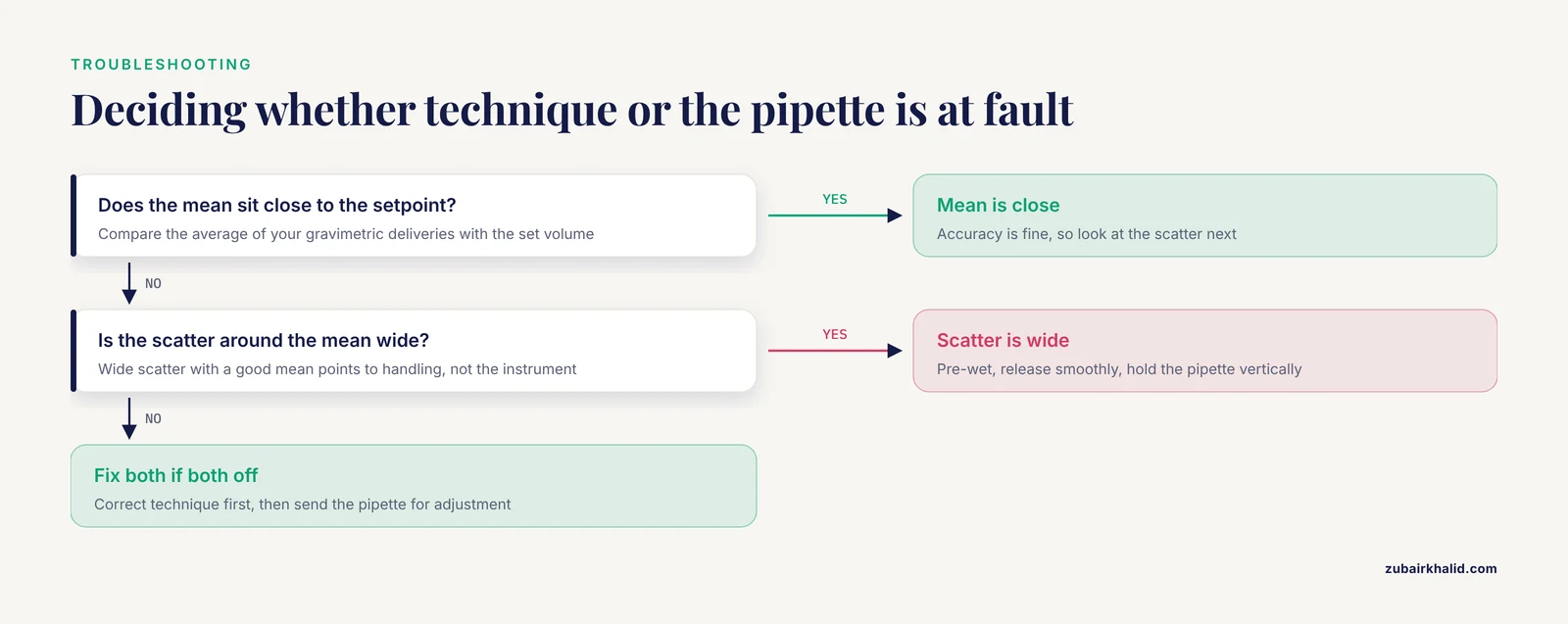
Confusing precision with accuracy when troubleshooting. A tight cluster of wrong volumes is a calibration problem. A wide scatter around the right mean is a technique or handling problem. The gravimetric test distinguishes them, which is why guessing is pointless when a balance is available.
Reading CV without asking what generated it. The micropipette study found batch means shifting between PRE and POST tubes without any loss of precision, and called the resulting apparent CV inflation pseudoimprecision [2]. Before you conclude that a pipette is failing, check whether the mean of your check measurements drifted while the scatter stayed constant.
Blaming the wrong instrument when standard curves drift. The qPCR study traced standard curve variability not to DNA addition but to the dilution series that generated the curve [1]. If curve stability is your problem, examine the pipetting that built the curve before you service the detector.
Expecting biological measurements to inherit instrument precision. Hedges' analysis showed that recalibration data meaningfully improved precision estimates for homogeneous solutions but barely helped for colony counts, where the biology dominates the scatter [3]. Know which limit you are working against before investing effort in tighter pipetting.
Overlooking liquid properties. Viscosity, vapor pressure, and temperature each bias air-displacement delivery in a known direction. Choosing forward versus reverse pipetting, or a positive-displacement instrument, is part of the measurement design, not an afterthought.
Quick Review
- Pipette calibration checks delivered volume against a traceable reference, most often by weighing dispensed water and correcting for temperature and buoyancy.
- Reproducibility describes agreement across changed conditions, such as different days or operators, while repeatability describes agreement within a single session.
- Manufacturer specifications give minimum, best-case precision estimates, and in-house recalibration data improve precision estimates for homogeneous liquid transfers [3].
- Routine micropipette precision in a real assay ran from 1.6% to 6.9% CV with a mean of 3.1%, and apparent imprecision can reflect a shifted mean, called pseudoimprecision, rather than true scatter [2].
- Pipette errors in serial dilution series, not DNA addition itself, drove standard curve variability in a qPCR reproducibility study, and careful pipette conditions or a single validated calibrator curve improved stability [1].
- Core technique habits, vertical holding, shallow immersion, smooth plunger action, pre-wetting, and temperature equilibration, remove most between-operator variability.
- Published pipette tip and disposable pipette extraction methods report workflow reproducibility in the low single-digit percent range when aspiration and dispensing cycles are optimized [5][4][7].
Frequently Asked Questions
What does pipette calibration reproducibility mean?
It means how consistently a calibrated pipette, together with the person using it, delivers the same set volume across repeated deliveries, sessions, and operators. Calibration answers whether the average delivered volume matches the display. Reproducibility answers whether that delivery stays the same every time and across conditions. A pipette can be perfectly calibrated on average yet poorly reproducible if its deliveries scatter widely around the correct mean.
How often should a pipette be calibrated?
A formal, traceable calibration is typically scheduled at fixed intervals set by your laboratory's quality system, with shorter intervals for high-use or critical pipettes. Between formal calibrations, quick user-level verification checks at the volumes you actually use catch drift early. If a pipette is dropped, used with corrosive liquids, or fails a verification check, send it for adjustment regardless of the schedule.
What is the difference between accuracy and precision in pipetting?
Accuracy is how close the average delivered volume is to the setpoint. Precision is how tightly repeated deliveries cluster, regardless of where the cluster sits. A pipette can deliver 98 µL with extreme consistency, which is precise but inaccurate, or deliver an average of 100 µL with deliveries ranging from 94 to 106 µL, which is accurate on average but imprecise. Both are quantified in a gravimetric calibration.
How do I tell whether my technique or my pipette is the problem?
Run a gravimetric test yourself with the pipette, the tips, and the liquid type you normally use. If the mean of your deliveries sits close to the setpoint but the scatter is wide, the problem is mostly technique, and pre-wetting, slower plunger release, and vertical posture usually fix it. If the mean sits far from the setpoint but the deliveries are tightly grouped, the pipette needs adjustment. If both are off, do both.
Does pipetting technique really change assay results?
Yes, measurably. Under routine assay conditions, an experienced analyst's micropipetting produced global CVs between 1.6% and 6.9% across fifteen batches, and systematic shifts in batch means appeared in most batches even though precision itself stayed constant [2]. In qPCR, modeled pipette errors in the dilution series were large enough that the study recommended stricter control of pipette conditions when producing external calibration curves [1].
What is reverse pipetting and when should I use it?
Reverse pipetting means pressing the plunger to the second stop before aspirating, so an excess of liquid enters the tip, and then dispensing only to the first stop, leaving a small excess behind that you discard. Use it for viscous, foaming, or protein-rich liquids where forward pipetting under-delivers because liquid clings to the tip wall. For routine aqueous solutions, standard forward pipetting with blow-out is the correct default.
Sources
- Investigation of reproducibility and error associated with qPCR methods using Quantifiler® Duo DNA quantification kit.
- [[Evaluation of pipetting systems. III. Micropipette precision in a routine task].](https://pubmed.ncbi.nlm.nih.gov/8850144/)
- Estimating the precision of serial dilutions and colony counts: contribution of laboratory re-calibration of pipettes.
- A simple graphene-based pipette tip solid-phase extraction of malondialdehyde from human plasma and its determination by spectrofluorometry.
- Highly Sensitive Determination of Bisphenol A in Bottled Water Samples by HPLC after Its Extraction by a Novel Th-MOF Pipette-Tip Micro-SPE.
- Expanding the applicability of cork as extraction phase for disposable pipette extraction in multiresidue analysis of pharmaceuticals in urine samples.
- A rapid assay for the simultaneous determination of nicotine, cocaine and metabolites in meconium using disposable pipette extraction and gas chromatography-mass spectrometry (GC-MS).
- Multiresidue analysis of pesticides in fruits and vegetables using disposable pipette extraction (DPX) and micro-luke method.
- Integration of autopatching with automated pipette and cell detection in vitro.