Pipette Calibration Temperature and Humidity
By Dr. Zubair Khalid, DVM, MS, PhD ·

Pipette calibration temperature and humidity refers to the controlled ambient conditions, most commonly a room held near 20 to 25 °C at moderate relative humidity, under which an air displacement pipette is gravimetrically tested so that its delivered volumes are traceable and reproducible. Pipette calibration environmental factors interpretation is the practice of reading a pipette's volume errors, and its calibration certificate, in light of the temperature, humidity, barometric pressure, and liquid properties the pipette actually meets during daily use.
An air displacement pipette does not touch the liquid it measures. It moves a trapped column of air, and that column of air is the true measuring element. Because gases expand and contract with temperature, carry water vapor, and thin out with altitude, every pipette result carries an environmental fingerprint. A pipette calibrated in one set of conditions can drift measurably when it dispenses cold reagent, warm solvent, or sits on a bench in dry winter air, and understanding that drift separates a defensible dataset from a quietly biased one.
What Does Pipette Calibration Environmental Factors Mean?
The phrase combines two ideas that students often merge without realizing it. Calibration is a metrology procedure, not a repair. According to standard measurement vocabulary, calibration is the comparison of a device's output against a traceable standard under defined conditions, adjustment is the physical alteration of the device to bring it within tolerance, and verification is the routine workplace check that the device still performs between calibration events. When we say pipette calibration environmental factors, we mean the set of ambient and sample conditions that the calibration procedure must either hold constant or account for, because they shift the reading.
Those factors group into four families:
- Air temperature, which changes the volume of the trapped air cushion, the density of the calibration liquid, and the evaporation rate at the tip orifice.
- Relative humidity, which changes how much water vapor the air cushion can absorb during a dispense and therefore how much liquid is lost to evaporation inside the tip.
- Barometric pressure, which changes the density of the air cushion and the buoyancy correction applied to the calibration weighings.
- Liquid properties, including the liquid's temperature relative to the pipette, its vapor pressure, its viscosity, and its density.
A fifth factor, operator behavior, sits outside the environment but interacts with every item above. Immersion depth, plunger speed, hold time, and dispense angle all modulate how strongly the first four factors express themselves. This is why two people using the same calibrated pipette on the same bench can produce different coefficients of variation, and why pipetting technique is taught alongside calibration rather than after it.
How an Air Displacement Pipette Actually Works
Understanding environmental effects requires understanding the mechanism, because the pipette measures through an elastic, compressible medium.
An air displacement pipette contains a piston sealed against a calibrated barrel. When you press the operating button to the first stop, the piston travels down a fixed distance that corresponds to the set volume. Pressing the button to the second stop after dispensing expels the residual air cushion and any residual liquid, a step called blow-out. A disposable tip holds the liquid at the far end, and between the piston seal and the liquid meniscus sits a column of air, the air cushion, whose volume is called the dead volume.
The delivery sequence works like this:
- The tip is pressed onto the shaft. The tip's internal geometry is part of the metrological system, which is why off-brand or damaged tips cause volume errors that look exactly like calibration failures.
- The plunger is pressed to the first stop, expelling a slug of air equal to the set volume.
- The tip is immersed in liquid and the plunger is released smoothly. The returning piston creates negative pressure, and atmospheric pressure pushes liquid into the tip until the piston stops.
- The liquid is dispensed by pressing the plunger to the first stop, then to the second stop for blow-out.
Everything in this chain depends on the air cushion behaving as expected. The delivered volume is essentially the piston displacement volume plus or minus any change in the state of the air cushion between aspiration and dispensing. Warm the cushion and it expands, pushing liquid back out of the tip. Cool it and it contracts, pulling extra liquid in. Dry the cushion and evaporation from the liquid surface adds vapor molecules, increasing cushion pressure. Every environmental factor acts through this single mechanism, which is why the effects below have consistent directions and can be predicted rather than merely observed.
A positive displacement pipette, by contrast, carries a piston inside the tip itself, in direct contact with the liquid. Because there is no compressible air cushion, temperature, humidity, and vapor pressure effects largely disappear. This distinction explains most of the practical recommendations later in this article.
Temperature and Pipette Calibration
Temperature acts on a pipette through three separate routes, and students most often conflate them.
The calibration room temperature
Gravimetric calibration is performed with distilled water weighed on an analytical balance, and the procedure assumes the water, the pipette, the tips, and the surrounding air are all in thermal equilibrium. For this reason, manufacturers and calibration services commonly specify a controlled room of roughly 20 to 25 °C before calibration begins, and the pipette and tips are allowed to equilibrate in that room for hours rather than minutes. A pipette carried in from a cold delivery van, or tips stored in a refrigerated drawer, need time on the bench before the first weighing. A metal pipette body is a thermal mass, and a tip picked straight from a cold box carries a chilled dead volume of air into the first measurement.
Temperature difference between liquid and pipette
This is the effect students find most surprising, and it has a consistent sign.
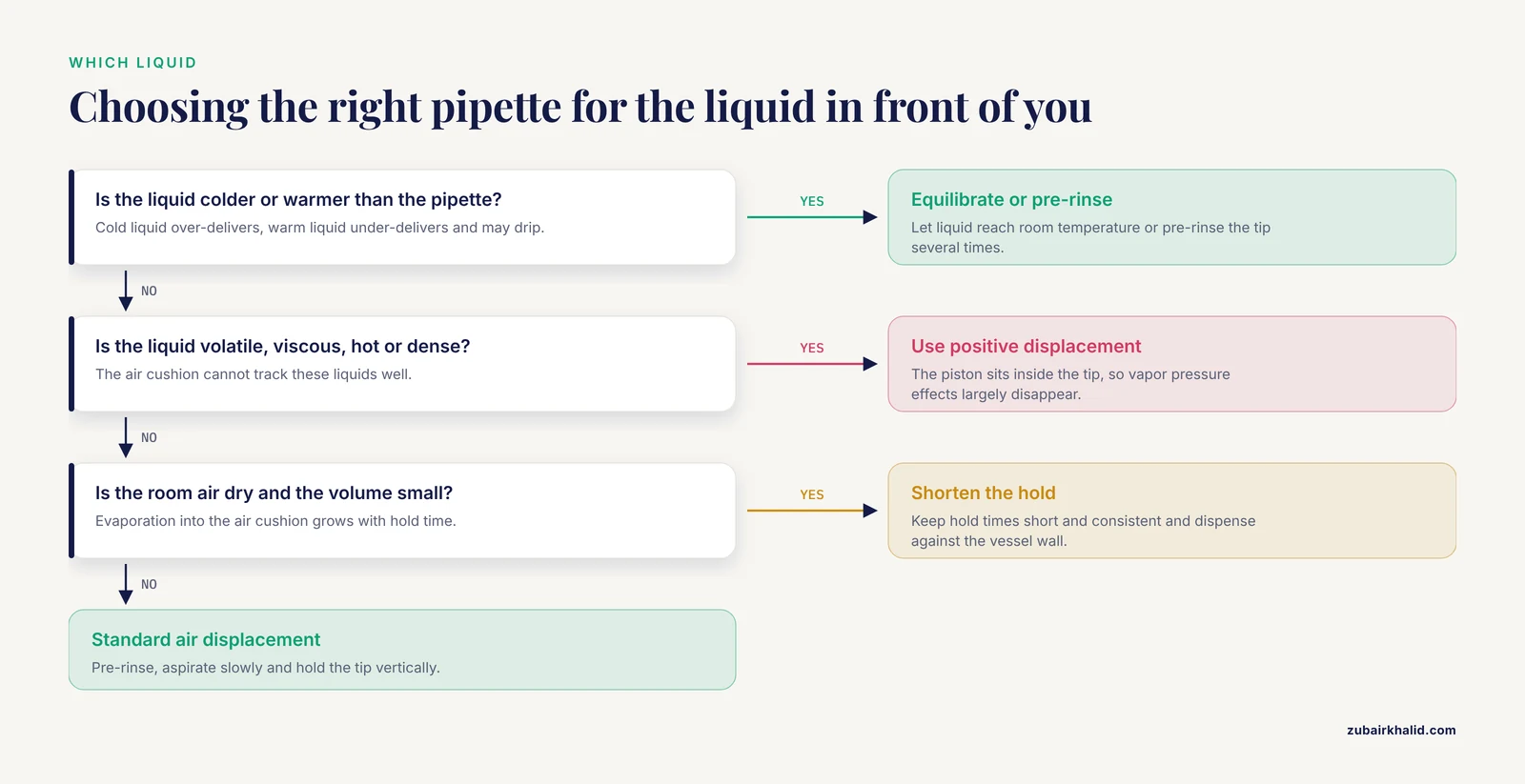
When the liquid is colder than the pipette and its air cushion, the air cushion cools after aspiration, contracts, and pulls the meniscus upward, drawing extra liquid into the tip. When that liquid is dispensed, the extra volume leaves with it, so the pipette over-delivers.
When the liquid is warmer than the pipette, the air cushion warms, expands, and pushes liquid out of the tip between aspiration and dispensing, sometimes visibly as a slow drip. The pipette under-delivers.
The practical control is simple and universally recommended: let liquids come to room temperature, or pre-rinse the tip by aspirating and dispensing the liquid several times so the tip walls and the air cushion reach the liquid's temperature. Pre-rinsing costs a small amount of reagent and buys back most of the thermal error. For cold samples that cannot be warmed, such as enzyme stocks or chilled PCR master mixes, aspirating slowly and minimizing hold time reduces the drift.
Water density and the Z factor
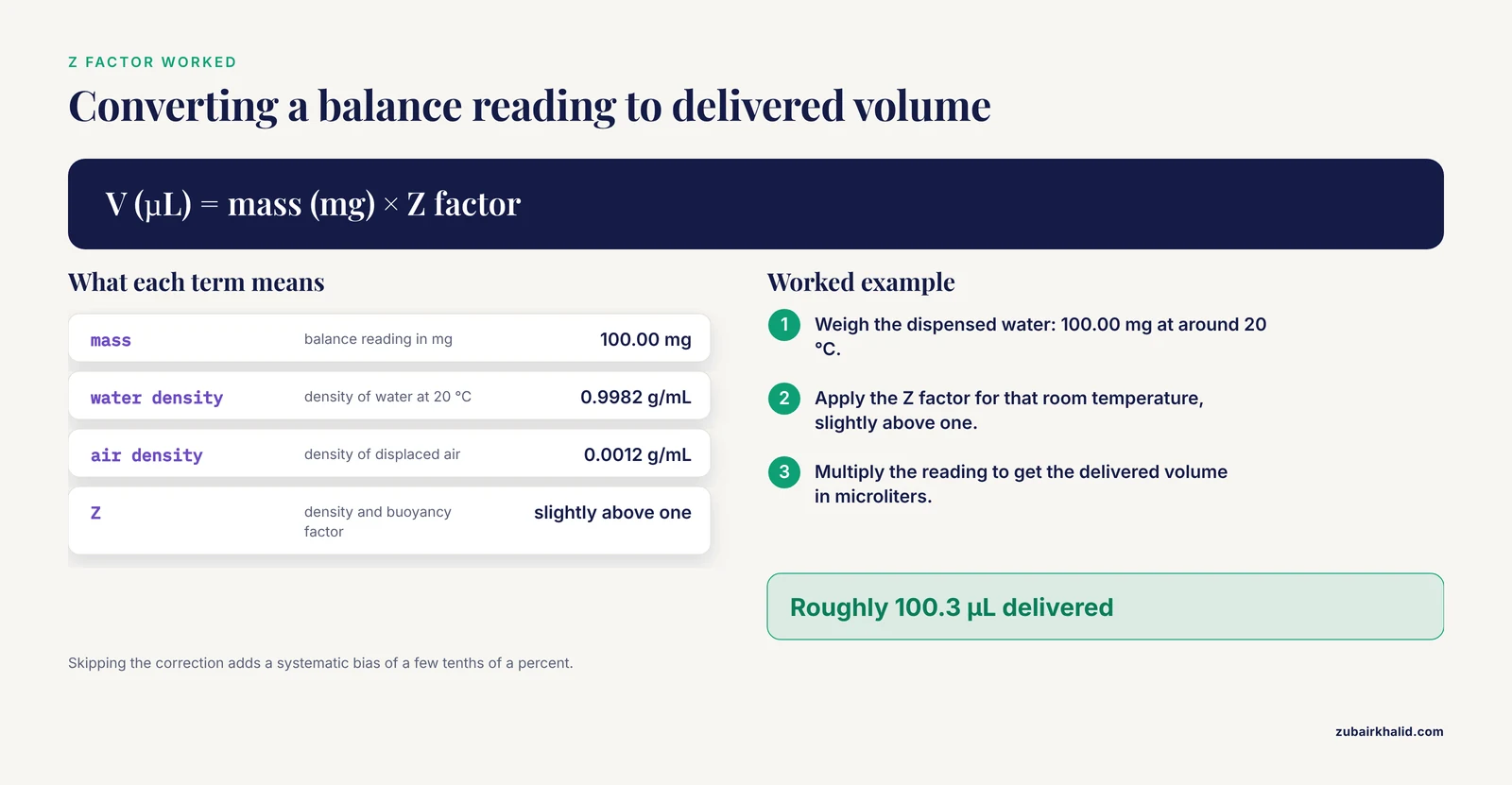
Even with perfect thermal equilibrium, the calibration math itself is temperature dependent. A gram of water does not occupy exactly a milliliter. Water density changes with temperature, and the analytical balance weighs the water in air, so the buoyancy of displaced air makes the reading slightly light. The correction that folds density and buoyancy together is the Z factor, the factor by which the balance reading in milligrams is multiplied to obtain the delivered volume in microliters.
The Z factor depends on water density, air density, and the density of the balance weights, so it is tabulated for each room temperature. As a worked example, at around 20 °C, water density is approximately 0.9982 g/mL and air density approximately 0.0012 g/mL, which gives a Z factor slightly above one, so a balance reading of 100.00 mg corresponds to a delivered volume of roughly 100.3 µL. Skipping this correction introduces a systematic bias of a few tenths of a percent, which is small compared with gross handling errors but large compared with the specification limits of a well-maintained pipette.
Humidity and Pipette Calibration
Humidity acts through evaporation, and its effects are strongest at small volumes and in dry rooms.
The air cushion inside an air displacement pipette is normally not saturated with water vapor. When an aqueous liquid sits in the tip during the interval between aspiration and dispensing, water evaporates into that cushion. Each evaporated molecule adds gas volume and pressure, which pushes liquid out of the tip and reduces the delivered volume. The drier the air, the faster this evaporation runs, and the smaller the delivered volume.
This mechanism explains several common bench observations:
- A pipette that passes verification in a humid summer laboratory can read low in heated winter offices where relative humidity drops well below the range most manufacturers specify for calibration, commonly around 45 to 60 percent.
- The error grows with hold time. A two second pause between aspiration and dispense loses little, but drawing a multichannel plate load and waiting fifteen seconds loses enough to matter at 10 µL.
- The error grows with volatile solvents, whose vapor pressures far exceed that of water, and with long, thin tips that expose a large liquid surface.
The controls are correspondingly direct. Keep hold times short and consistent. Pre-rinse the tip so the air cushion starts closer to saturation. Dispense against the wall of the receiving vessel, which recovers film and residuals. For volatile or hot liquids, switch to a positive displacement pipette, or where available use pipette models with an anti-evaporation design. During calibration itself, humidity is controlled not because the balance cares but because the pipette under test performs differently in dry air, and a certificate generated at 20 percent relative humidity will not transfer cleanly to a laboratory at 55 percent.
Very high humidity brings its own problem. Condensation can form inside the tip and the barrel, and water reaching the piston compromises the seal, which shows up as random error rather than the systematic error evaporation produces. Humidity control in calibration rooms therefore works in both directions.
Barometric Pressure and Altitude
The air cushion contains a number of gas molecules set by ambient pressure. At high altitude, that number is lower, and the relationship between piston travel and delivered liquid volume shifts, most noticeably for small volumes where the air cushion is large relative to the set volume. A pipette calibrated at sea level and used at elevation will show a systematic deviation, which is why laboratories at altitude arrange calibration locally rather than shipping pipettes to a service center at a different elevation. Pressure also enters the Z factor through air density, so a calibration laboratory records the ambient pressure alongside temperature and humidity.
Liquid Properties That Mimic Environmental Errors
Several sample behaviors produce volume errors that students misattribute to the pipette itself, and separating them sharpens the interpretation of any calibration result.
Vapor pressure. Volatile solvents evaporate into the air cushion just as water does, only faster, producing under-delivery and dripping. Positive displacement pipettes, or pre-saturation of the cushion by repeated pre-rinsing, are the standard responses.
Viscosity. Viscous fluids, such as glycerol-containing buffers, serum, or protein solutions, do not enter and leave the tip at the same speed as water. Slow aspiration allows the liquid to track the piston properly, and reverse pipetting, in which the plunger is pressed to the second stop to aspirate and released only to the first stop to dispense, leaves a deliberate excess in the tip so that the delivered volume is accurate.
Density. Liquids denser or lighter than water change the hydrostatic head during aspiration. Immersion depth matters here, because deeper immersion adds hydrostatic pressure that compresses the air cushion and draws in extra liquid. Manufacturer guidance typically keeps immersion shallow, on the order of a few millimeters for small volumes and around a centimeter for large ones, held consistently across every aspiration.
Foaming and wetting. Surfactant-containing solutions wet the tip walls and leave a film, which is why wall-touch dispensing is part of good pipetting technique rather than an optional habit.
How Pipette Calibration Is Performed Step by Step
Gravimetric testing with distilled water is the reference method used by calibration services and specified in international standards for piston-operated volumetric apparatus. The procedure below reflects that standard workflow.
Before testing. Move the pipette, its tips, and a supply of distilled or deionized water into the calibration room and allow them to equilibrate, typically for several hours. Confirm the room sits at the specified temperature and humidity and that the balance sits on a vibration-free, draft-protected bench away from sunlight and heat sources. Record temperature, humidity, and pressure, because the Z factor depends on them.
Balance selection. The balance must resolve the test volumes with enough margin that weighing noise does not dominate the pipette's own variability. A general rule in the standard is that the balance readability should be at least an order of magnitude finer than the volume being tested, which is why sub-microliter pipettes require a microbalance and a controlled, draft-free enclosure.
Test points. The standard approach tests the pipette at two points, the nominal volume, meaning 100 percent of the maximum, and a low point at 10 percent of nominal. For each point, a series of weighings, commonly ten, is performed. This is deliberately asymmetric, because random error grows at the bottom of a pipette's range and a single low-volume check would hide it.
The weighing cycle. For each replicate:
- Place a receiving vessel, typically a small weighed vial or an evaporation trap filled with a little water to limit evaporative loss during weighing, on the balance and tare it.
- Fit a fresh tip and pre-rinse it several times with the test water.
- Aspirate the set volume with standard technique, controlled immersion depth, vertical hold, smooth plunger motion, short hold time.
- Dispense into the vessel, touching off against the wall, with blow-out.
- Record the mass. Repeat without adjusting anything between replicates.
Conversion to volume. Multiply each mass reading by the Z factor for the measured room temperature to convert milligrams to microliters, then compute the mean, the standard deviation, and the coefficient of variation at each test point.
Interpretation. Compare the mean delivered volume at each point against the manufacturer's tolerance for that model, and the coefficient of variation against the model's repeatability specification. The certificate then states whether the pipette passed as found, was adjusted and retested, or failed.
Pipette Calibration Environmental Factors Interpretation
Reading a calibration result is a two-axis exercise, and environmental context changes the reading on both axes.
Systematic error, or inaccuracy, is the difference between the mean of the delivered volumes and the true or nominal value. It is a bias. Systematic error that grows with the set volume, for example a pipette that reads 0.5 percent low at 1000 µL and 2 percent low at 100 µL, points at the pipette or its tip fit. Systematic error that appears only with a particular liquid, or only in a particular season, points at the environment.
Random error, or imprecision, is the scatter around that mean, usually expressed as a coefficient of variation. Rising random error with unchanged bias suggests mechanical wear, a failing seal, inconsistent tip seating, or an operator whose plunger speed varies. Environmental factors usually act on the systematic axis, though condensation in high humidity and dripping with warm volatile liquids add random components too.
A compact summary of how the main environmental factors bias results:
| Factor | Typical direction of error | Mechanism | Primary control |
|---|---|---|---|
| Liquid colder than pipette | Over-delivery | Air cushion cools and contracts, drawing in extra liquid | Pre-rinse tip, slow aspiration, allow equilibration |
| Liquid warmer than pipette | Under-delivery, sometimes visible dripping | Air cushion expands, pushing liquid out before dispense | Pre-rinse, minimize hold time, use positive displacement |
| Dry air, low relative humidity | Under-delivery, worse at small volumes | Evaporation into the unsaturated air cushion during hold | Short hold times, pre-rinse, calibrate at specified humidity |
| High humidity | Random error, seal damage | Condensation reaching the piston | Control room humidity within the specified band |
| High altitude | Systematic deviation, worst at small volumes | Lower air density in the cushion and in buoyancy correction | Calibrate at the altitude of use |
| Volatile solvents | Under-delivery, dripping | High vapor pressure drives evaporation into the cushion | Positive displacement pipette or cushion pre-saturation |
| Viscous liquids | Variable, often under-delivery | Liquid lags the piston, film retention | Reverse pipetting, slow aspiration |
This table also clarifies the terms students most often confuse. Air displacement and positive displacement describe the mechanism, calibration and adjustment describe different metrology actions, and accuracy and precision describe the systematic and random error axes respectively. A pipette can be precisely wrong, and a pipette can be accurate at calibration temperature and biased at the bench, and both distinctions are exactly what environmental factor interpretation is for.
Why This Matters for Molecular and Analytical Work
Every quantitative molecular biology workflow inherits its volumetric error. A calibration curve, an ELISA standard series, a qPCR dilution row, or a chromatography calibration line is only as good as the deliveries that built it, and systematic delivery bias propagates directly into slopes, intercepts, and calculated concentrations.
Recent pipette-tip based sample preparation methods make the point concretely. One published method used a molecularly imprinted polymer packed into a pipette tip to extract and preconcentrate methyl red from seawater before spectrophotometric determination, optimizing eluent volume, sample volume, extraction and elution cycle number, sorbent amount, and sample pH with both one-variable-at-a-time screening and a Box-Behnken response surface design [1]. Sample volume is not a passive variable in such a method. It is a term in the extraction efficiency, which means the liquid volume actually delivered by the pipette tip enters the chemistry, not just the arithmetic.
The performance figures of that method illustrate how volumetric accuracy sets the achievable analytical envelope. The optimized method produced a linear calibration graph from 3.0 to 300.0 µg/L with a detection limit of 0.50 µg/L for methyl red, and when applied to real seawater it returned mean recoveries of 84.0 to 98.0 percent with mean relative standard deviations of 2.5 to 6.7 percent [1]. Recoveries bracketed below and above 100 percent are precisely the signature of small systematic volume errors interacting with extraction and matrix effects, and relative standard deviations in the single digits leave little room for sloppy dispensing. A pipette that drifted several percent because it handled a cold sample or operated in dry air would consume a meaningful share of that error budget before the instrument was even turned on. The same logic scales to molecular work, where a five percent systematic under-delivery across a dilution series silently distorts a standard curve and every concentration read against it.
Common Mistakes and Limitations
The following errors appear repeatedly in teaching labs and in audited facilities alike, and each has a direct fix.
Calibrating at the wrong temperature, then trusting the certificate everywhere. A certificate generated at 21 °C with equilibrated water describes the pipette under those conditions. Using the same pipette with 4 °C reagent straight from the refrigerator moves the systematic error by more than the tolerance band of a good pipette, and no amount of recalibration fixes a mismatch between calibration conditions and use conditions.
Ignoring equilibration time. Pipettes and tips moved into a calibration room, or liquids brought to the bench, need genuine thermal equilibration. Fifteen minutes is not equilibration for a metal-handled instrument and a chilled bottle of water.
Skipping the Z factor. Reading milligrams as microliters bakes a small systematic bias into every calibration, and it compounds with the density change of water across a 5 °C room temperature swing.
Treating pre-rinsing as optional. Pre-rinsing conditions the tip surface and moves the air cushion toward vapor saturation, and it is one of the cheapest accuracy controls available. Discarding the first aspirate is not wasted reagent, it is part of the measurement.
Using air displacement tools for volatile, viscous, or hot liquids. The air cushion mechanism fundamentally cannot track these liquids well. Reaching for a positive displacement pipette is not a preference, it is the correct mechanism for the problem.
Blaming the pipette for tip problems. A worn shaft cone, a poorly fitted tip, or a tip whose inner geometry differs from the specification produces errors indistinguishable from calibration failure. Verification with a known-good tip lot before condemning the instrument saves a service call.
Ignoring hold time and technique consistency. Environmental errors scale with hold time, so an operator who aspires a full plate and then dispenses sequentially is running a different, more biased method than an operator working well by well, even with the same calibrated instrument.
Reading a single failed weighing as failure. Random error is a statistical property of a series. Ten weighings, not one, define the mean and the scatter, and interpretation belongs to the series.
One limitation applies to all of the above. Individual instruments, laboratories, and applications differ, and the tolerance and service decisions for any specific pipette should follow its manufacturer's documentation and the requirements of the quality system governing the work.
Quick Review
- An air displacement pipette measures through a compressible air cushion, so temperature, humidity, pressure, and liquid vapor pressure all bias the delivered volume.
- Liquids colder than the pipette cause over-delivery. Liquids warmer than the pipette cause under-delivery and sometimes visible dripping.
- Dry air causes under-delivery at small volumes because water evaporates into the unsaturated air cushion during the hold, so short hold times and tip pre-rinsing are accuracy controls, not etiquette.
- Gravimetric calibration uses distilled water on an analytical balance with a Z factor correction for water density and buoyancy, commonly at 20 to 25 °C and moderate relative humidity.
- Standard testing covers 10 percent and 100 percent of nominal volume with a series of weighings per point, because random error grows at the low end of the range.
- Calibration compares, adjustment changes, verification rechecks. Accuracy is the systematic error, precision is the random error.
- Positive displacement pipettes remove the air cushion from the equation and are the correct tool for volatile, viscous, hot, or dense liquids.
Frequently Asked Questions
What does pipette calibration environmental factors mean?
It means the ambient and sample conditions, chiefly temperature, humidity, barometric pressure, and liquid properties, that shift the volume an air displacement pipette delivers. Pipette calibration environmental factors interpretation is the habit of reading a pipette's errors, and its calibration certificate, against the conditions the pipette actually operates in rather than assuming the certificate applies everywhere.
What temperature and humidity should a room be for pipette calibration?
Manufacturers and calibration services commonly specify a controlled room near 20 to 25 °C with moderate relative humidity, often in the mid-range of roughly 45 to 60 percent, with pipette, tips, and water equilibrated to that room before testing begins. Check your own pipette's manual for the exact specified band, and record the actual room values during calibration because they enter the density corrections.
Does cold liquid make a pipette deliver more or less?
Cold liquid makes an air displacement pipette deliver more. The air cushion cools after aspiration, contracts, and pulls extra liquid into the tip, which leaves with the dispense. Pre-rinsing the tip with the cold liquid and aspirating slowly reduce the effect substantially.
Why does my pipette under-deliver in dry winter air?
Dry air inside the air cushion pulls water vapor from the liquid in the tip during the hold between aspiration and dispensing, and that added vapor pressure pushes liquid back out, reducing the delivered volume. Keep hold times short and consistent, pre-rinse the tip, and dispense against the receiving vessel wall to recover the losses.
How often should a pipette be calibrated and verified?
A common professional schedule is full external or gravimetric calibration on an annual or semiannual cycle, with shorter in-house verification checks between events, especially after heavy use, a drop, suspected chemical exposure, or any result that looks volumetrically wrong. The correct interval for your instrument comes from its manufacturer's documentation and the quality system your laboratory works under.
When should I use a positive displacement pipette instead?
Use positive displacement for volatile solvents, viscous or foamy solutions, hot liquids, and dense liquids where the air cushion of an air displacement pipette produces under-delivery, dripping, or lag. The piston inside the tip contacts the liquid directly, so temperature, humidity, and vapor pressure effects largely disappear.