Low-Retention Pipette Tips: Do They Really Improve Accuracy
By Dr. Zubair Khalid, DVM, MS, PhD ·

Low-retention pipette tips reduce the film of liquid that clings to the inside of a standard tip, which means more of the aspirated volume actually leaves the tip and reaches your sample tube. For watery buffers the difference is usually small, but for viscous samples such as glycerol-containing solutions, protein lysates, serum, and oils, the clinging film can represent a meaningful fraction of the set volume. A simple rule of thumb: if your liquid pours slowly, strings, or forms droplets that hang from the tip orifice, low-retention tips (ideally paired with adjusted pipetting technique) will improve your accuracy, and for the most difficult liquids a lubricant-infused or omniphobic tip or a positive-displacement instrument is the stronger choice.
This article explains what low-retention tips are, what the peer-reviewed evidence actually shows, how the available options compare, and why technique and pipette calibration often matter as much as the tip itself.
What Low-Retention Pipette Tips Are
A standard micropipette tip is molded from polypropylene, a plastic chosen because it is chemically resistant, inexpensive, and reasonably hydrophobic. Hydrophobic means the surface repels water. Water has a high surface tension (roughly 72 millinewtons per meter at room temperature), so water beads up on polypropylene rather than spreading across it. That beading behavior helps water drain out of a standard tip cleanly, which is why ordinary polypropylene tips perform well with aqueous reagents.
Low-retention tips keep the same polypropylene body but modify the inner surface so that liquids adhere less strongly. Two approaches dominate the market. The first is a surface coating, usually a thin layer of a fluoropolymer or silicone-based compound applied during manufacturing, which lowers the surface energy of the plastic. Surface energy describes how strongly a surface attracts a liquid resting on it. Lower surface energy means weaker adhesion and less residual film.
The second approach, described in a 2021 study by Yousefi and colleagues, is a lubricant-infused surface, abbreviated LIS. The researchers coated the inner lumen of commercially available pipette tips with a fluorosilane layer using chemical vapor deposition, then lubricated the surface by simply pipetting a fluorinated lubricant up and down inside the tip. The treatment drastically decreased the surface free energy of the tips, giving them omniphobic properties, meaning they repel a broad range of liquids rather than only high-surface-tension water [1]. This matters because, as the same study points out, most commercial tips are manufactured with hydrophobic polymers that repel high surface tension liquids but lose performance when low surface tension liquids are involved, including viscous oils [1].
The practical takeaway is that "low-retention" is not one technology. It is a family of surface treatments, and they differ in how well they handle difficult liquids.
Why Viscous Samples Challenge Ordinary Tips
Several physical effects work against accurate pipetting of thick liquids.
Slow drainage. Viscosity is a liquid's resistance to flow. Glycerol, concentrated protein solutions, serum, and lysis buffers containing detergents all flow more slowly than water. When you press the plunger to dispense, the liquid film on the inner wall drains slowly. If you lift the pipette before drainage finishes, some of that film stays in the tip and never reaches your tube, so the delivered volume is smaller than the set volume.
High adhesion. Samples containing proteins, nucleic acids, lipids, or surfactants can adsorb to plastic surfaces. Adsorption means molecules stick to the surface through physical interactions rather than chemical bonds. The LIS study demonstrated this directly by pipetting a food coloring dye and human blood samples and comparing treated tips with untreated controls, using the repellent behavior against physical adsorption as the test endpoint [1]. Residual protein film and dye staining are the visible signs of the same phenomenon that silently skews delivered volumes.
Low surface tension liquids. Counterintuitively, some difficult liquids are difficult because they wet plastic too well. Surfactant-containing buffers, some culture media with serum, and organic solvent mixtures spread into a thin film on the tip wall. A surface that repels high surface tension water can hold onto these low surface tension liquids tenaciously, which is precisely the gap the omniphobic LIS approach was designed to close [1].
Slow aspiration and bubble formation. Viscous liquids resist being drawn into the tip. If you aspirate at the speed you would use for water, the liquid lags behind the moving air column and the pipette aspirates an air bubble along with an under-volume of liquid. This is a technique problem more than a tip problem, but the tip design influences how cleanly the liquid column follows.
Carryover and cross-contamination. Any liquid that stays behind in a tip can transfer to the next sample if the tip is reused, and residual film can also contaminate downstream measurements. Cross-contamination of biological samples during handling and preparation is a major laboratory problem because it produces false-positive and false-negative results, and sample carryover residue in pipette tips contributes substantially to this issue [1].
What the Evidence Actually Shows
The honest answer to "do they really improve accuracy" is that the evidence supports real benefits for difficult liquids, with the strongest data coming from engineered surfaces rather than from commodity coated tips.
The Yousefi study provides the clearest mechanistic evidence. After treatment, contact angle measurements (a standard way of quantifying how a liquid beads on a surface) revealed that the modified tips had enhanced omniphobic properties, and the researchers demonstrated reduced physical adsorption using dye and human blood as test liquids [1]. The work was framed around contamination prevention, since residue left in tips is a recognized driver of false results in sample handling [1].
A separate line of evidence comes from a study titled "The Tip of the Iceberg: How Pipette Tips Influence Results," which examined how tip properties affect experimental outcomes. Its central finding, reflected in the title, is that the choice of pipette tip is not a trivial consumable decision but a variable that can measurably influence results [2]. For working scientists, the practical meaning is that tip selection belongs in your method descriptions alongside reagent lots and instrument settings.
There is also an indirect but useful signal from the analytical chemistry literature. Pipette tips have become platforms for miniaturized sample preparation, where the entire method depends on controlling what sticks to and what releases from the tip interior. Disposable pipette extraction has been validated for extracting psychoactive substances from human breastmilk ahead of gas chromatography-mass spectrometry analysis [3]. Pipette tip solid-phase extraction with C18 adsorbent has been used to preconcentrate selenium from green tea with recoveries between 97.7 and 106.0 percent [4]. A nanostructured polyaniline sorbent packed into a 200 microliter tip enabled selective extraction of three sulfonamide antibiotics for HPLC analysis [5]. A covalent organic framework incorporated into electrospun polyacrylonitrile nanofiber served as a pipette tip solid-phase extraction adsorbent for five sulfonamides in meat, with intraday and interday precision values between 5.4 and 9.2 percent relative standard deviation [6]. Nanoparticle-modified monolithic tips have been built specifically for phosphopeptide enrichment in proteomics [7], and composite nanofibers of PVA-PAA with carbon nanotubes and cellulose nanocrystals inside pipette tips have enabled trace-level monitoring of seven opioid analgesics followed by HPLC-UV [8]. The common thread is that tip surface chemistry demonstrably controls retention and release of molecules. That principle applies just as much to your protein lysate as it does to an antibiotic analyte.
What the literature does not yet provide, for most commercial low-retention tips, is a standardized head-to-head accuracy benchmark across brands. Manufacturer claims are generally supported by internal gravimetric testing, but independent comparative data are limited. This is one reason your own verification practices (covered below) carry real weight.
Low-Retention Pipette Tips for Viscous Samples: The Options Compared
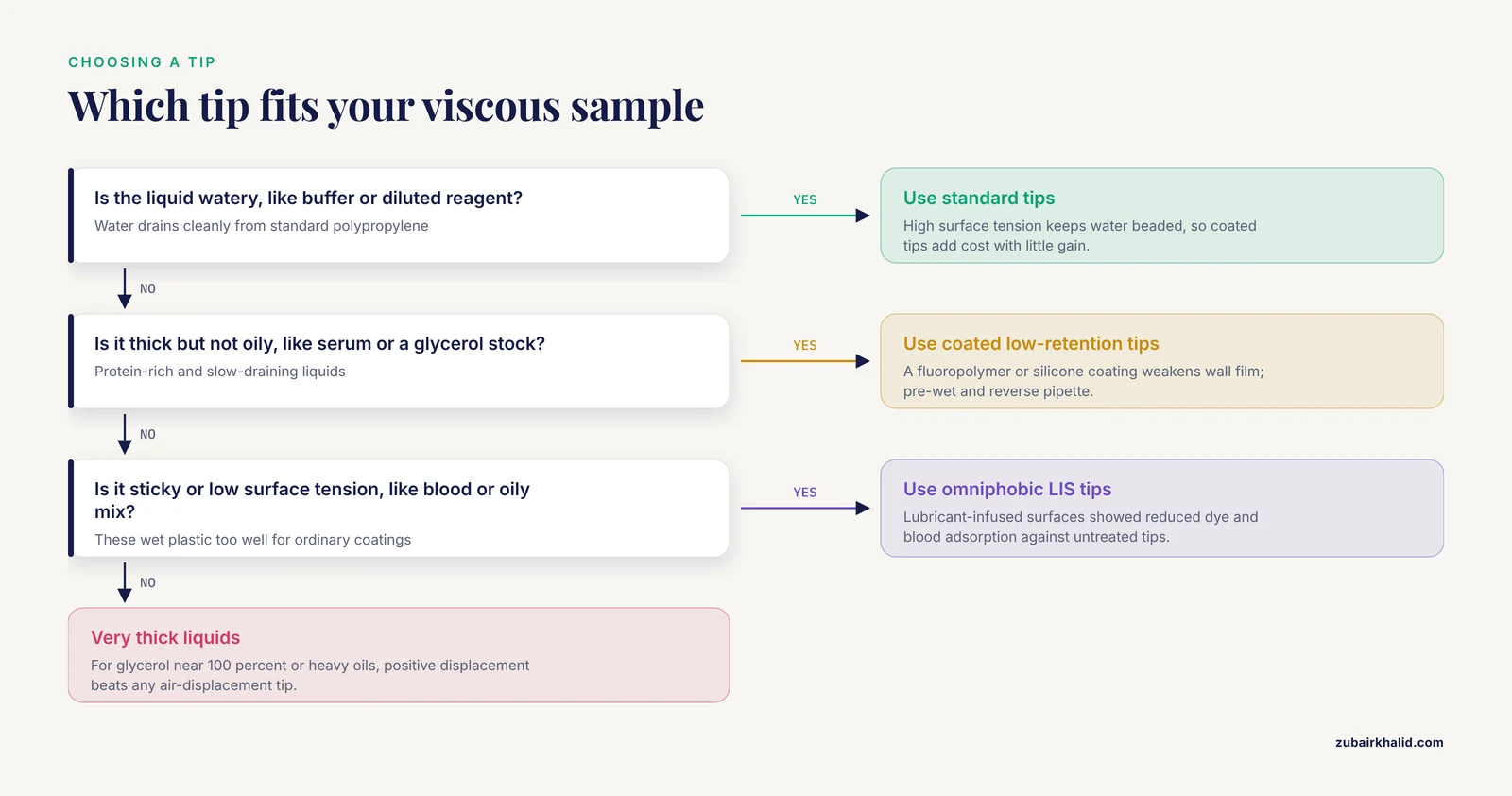
The table below summarizes the main low retention pipette tips for viscous samples options you will encounter, on the criteria that actually decide purchases.
| Tip option | How it reduces retention | Best suited for | Performance with viscous samples | Main drawbacks |
|---|---|---|---|---|
| Standard polypropylene tip | Inherent hydrophobicity of the plastic | Aqueous buffers, routine PCR setup, media | Poor for viscous liquids, film and droplets remain | Highest residual volume, adsorption of proteins |
| Coated low-retention tip (silicone or fluoropolymer inner surface) | Thin hydrophobic coating lowers surface energy | Protein solutions, enzymes, small-volume work with biological fluids | Good improvement over standard tips for most viscous samples | Coating can be a consumable cost premium, performance varies by brand |
| Lubricant-infused surface (LIS) or omniphobic tip | Fluorosilane layer plus infused lubricant creates an omniphobic liquid interface | Low surface tension liquids, viscous oils, sticky biological samples such as blood | Best-in-class repellency demonstrated against dye and blood adsorption [1] | Newer technology, requires lubrication step in some designs, less widely available |
| Wide-bore tip | Larger orifice reduces shear and flow resistance | Cell suspensions, viscous lysates, genomic DNA | Eases aspiration of thick liquids but does not reduce wall film | Poorer precision at small volumes, larger orifice limits fine work |
| Filtered (barrier) tip | Hydrophobic membrane stops aerosols, some brands combine with low-retention surfaces | PCR setup, infectious samples, any aerosol-sensitive work | Retention behavior follows the underlying tip surface, not the filter | Filter adds cost, not itself a retention solution |
| Positive-displacement pipette with matching piston cap | Liquid never touches the pipette's air column, piston displaces volume directly | Glycerol, oils, very viscous or volatile liquids | Most accurate mechanical option for viscous liquids | Higher consumable cost, slower workflow, different technique |
A note on the last row: a positive-displacement pipette is technically an instrument choice rather than a tip choice, but it is included because the best low retention pipette tips for viscous samples still rely on air displacement, and air is compressible. When viscosity is high enough that the air column cannot transfer motion faithfully to the liquid, no surface coating fully solves the problem, and direct piston contact does.
Standard polypropylene tips
These remain the correct choice for the majority of molecular biology work. Water, Tris buffers, saline, and diluted nucleic acid solutions drain cleanly from untreated polypropylene because their surface tension keeps them beaded rather than spread. Buying coated tips for purely aqueous work buys you little and can introduce variability between tip lots. The main failure modes with standard tips appear when your sample contains surfactant, protein, or lipid, or when the liquid is simply thick.
Coated low-retention tips
These are the workhorse upgrade and the option most bench scientists mean when they say "low-retention tips." The coating chemistry is typically a fluoropolymer or silicone treatment, and its effect is to weaken the interaction between the liquid and the plastic wall so the meniscus releases instead of clinging. For protein-rich samples such as serum, enzyme stocks in glycerol, and concentrated lysates, the reduction in retained film translates directly into better delivered volumes and less sample loss when you are working with precious material. The practical caveat is variability. Coating processes differ between manufacturers, and the same brand can perform differently across lots, so verification on your own liquids is worthwhile for quantitative work.
Lubricant-infused and omniphobic tips
The LIS approach deserves separate treatment because it changes the physics rather than just the surface chemistry. In the reported design, a fluorosilane layer is deposited inside commercial tips by chemical vapor deposition, and a fluorinated lubricant is worked into that layer by pipetting up and down. The resulting surface combines low surface free energy with a mobile lubricating layer, so liquids of both high and low surface tension, including viscous oils, experience strong repellency [1]. Contact angle measurements confirmed the enhanced omniphobic behavior, and tests with food coloring dye and human blood demonstrated reduced physical adsorption compared with untreated tips [1]. Because the design was applied to commercially available tips, it illustrates that the barrier to better tip performance is surface engineering rather than tip geometry. For labs handling blood, serum, or oily formulations where carryover and retention are recurring problems, this class of tip is the most evidence-backed option, though availability is still narrower than for conventional coated tips.
Wide-bore and specialized geometry tips
Wide-bore tips attack a different problem. Their larger orifice lowers flow resistance and reduces shear, which matters when pipetting intact cells, chromosomal DNA preparations, or thick tissue homogenates that shear or clog fine orifices. They do not by themselves reduce wall film, so they are best understood as a complement to low-retention surfaces rather than a substitute. Some low-retention lines are available in wide-bore formats, which combines both advantages for viscous biological samples.
Filtered tips
A hydrophobic filter inside the tip protects the pipette shaft from aerosols and prevents cross-contamination from splashes. Many manufacturers offer filtered tips with low-retention inner surfaces. The filter itself does nothing for retention, so treat "filtered" and "low-retention" as independent attributes and check both when ordering.
Positive displacement as the ceiling
If your workflow demands the highest accuracy on glycerol stocks, mineral oil overlays, or very concentrated protein solutions, positive displacement beats any air-displacement tip plus coating combination. The piston cap makes direct contact with the liquid, so viscosity affects only flow speed, not delivered volume. The tradeoffs are consumable cost and workflow speed.
Pipetting Technique and Calibration: The Other Half of Accuracy
A low-retention tip cannot rescue poor technique. Studies of how students learn pipetting highlight exactly which skills separate accurate from inaccurate results: choosing the correct pipette for a given volume, setting the volume correctly, using the plunger properly during aspiration and dispensing, and converting between milliliter and microliter units without error. A 2019 educational project built an interactive simulation called Pipette Master around precisely these stumbling blocks after observing that undergraduates struggle with them repeatedly, and that the skills fail to persist between semesters without reinforcement [9]. The same failure points persist in working labs.
Four technique adjustments matter most for viscous samples.
Pre-wet the tip. Aspirate and dispense the viscous liquid two or three times before taking your actual volume. Pre-wetting equilibrates the vapor space and coats the wall, which makes the liquid move more predictably. With a standard tip, pre-wetting partially compensates for retention because the wall is already wetted by your sample. With a low-retention or LIS tip, pre-wetting still improves consistency, particularly in cool rooms where viscous liquids become stiffer.
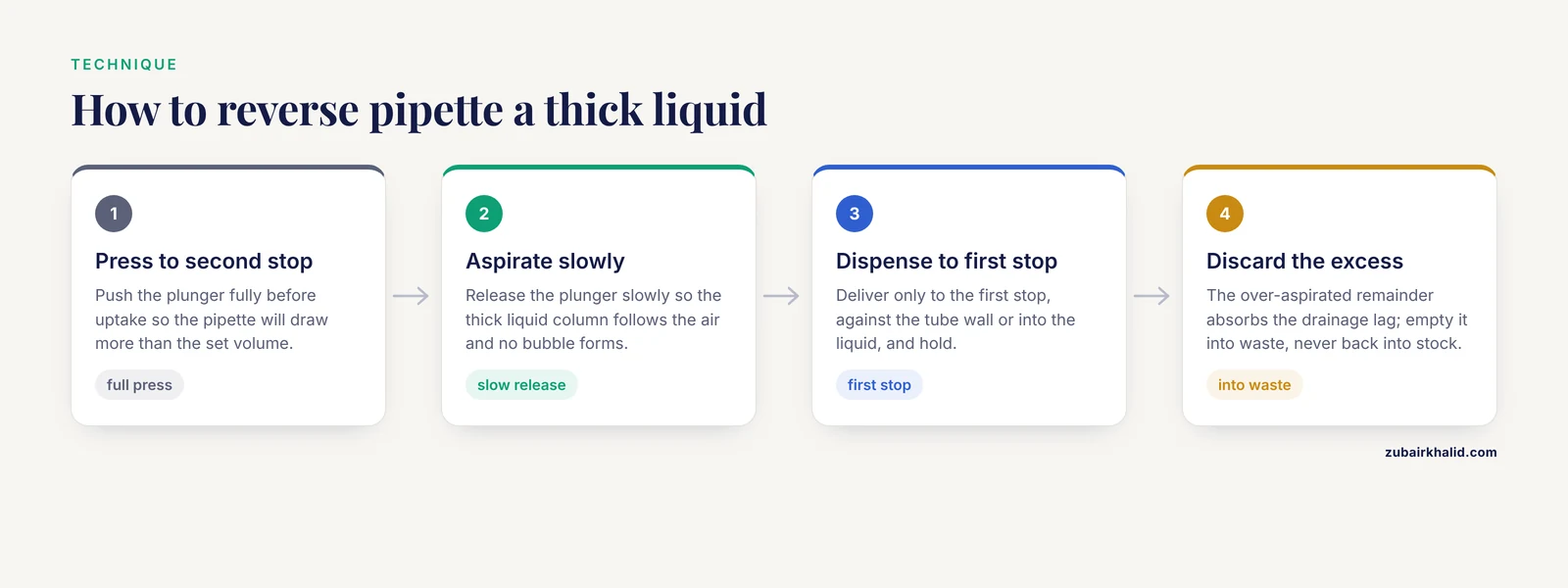
Use reverse pipetting for thick liquids. Reverse pipetting means pressing the plunger to the first stop, aspirating slightly more liquid than needed, then dispensing only to the first stop, leaving the excess in the tip. The small over-aspiration absorbs the drainage lag, so the delivered volume is closer to the set value. Reverse pipetting is the standard recommendation in pipette operation guides for viscous and foaming liquids, and it pairs naturally with low-retention tips because less residual film means the discarded excess is smaller and more consistent.
Slow the aspiration and dispensing. Release the plunger slowly so the liquid column can follow the air movement. Rapid aspiration of viscous liquid pulls air bubbles and leaves the pipette reading an apparently full volume that is actually part air.
Keep the tip in the liquid during dispensing. Dispense against the wall of the receiving tube or into the liquid itself. A droplet that hangs from a standard tip and never transfers is volume you counted but did not deliver. Low-retention surfaces reduce hanging droplets, but wall dispensing removes the failure mode entirely.
These adjustments form the core of good pipetting technique regardless of tip choice, and they interact with the tip. A coated or LIS tip plus correct technique delivers the best result. A coated tip plus rushed technique can perform worse than a standard tip used patiently.
Instrument-side accuracy depends on pipette calibration. Calibration means comparing the volumes a pipette actually delivers against gravimetric or photometric references and adjusting the mechanism so the displayed setting matches reality. Gravimetric calibration, in which dispensed liquid is weighed on an analytical balance and converted to volume using the liquid's density, is the established standard method, and manufacturers and metrology guidance both describe it as the reference approach. Two points deserve emphasis for daily work. First, calibration is performed with water, and water behaves differently from your viscous samples, so a calibrated pipette used with glycerol and poor technique still delivers inaccurate volumes. Second, tip brand and lot are part of the pipetting system. Changing tip brands after calibration changes the tip-to-cone interface seal, which can shift delivered volume slightly, so a study comparing results across tips is consistent with the long-standing practice of verifying pipettes with the tips you actually use [2].
Worked Scenarios
Scenario 1: Enzyme stock in 50 percent glycerol. You need 2 microliters of a restriction enzyme from a freezer stock. The stock is viscous and stored in glycerol. Best practice is a P10 or P20 pipette with a low-retention tip, slow aspiration, pre-wetting, and dispensing directly into the mix against the tube wall. A standard tip will retain a visible film of glycerol-containing stock, and at a 2 microliter set volume even a small retained fraction is a large proportional error. Here the case for the best low retention pipette tips for viscous samples is strongest, because the volume is small and the liquid is thick.
Scenario 2: Whole blood or serum. You are aliquoting human blood for downstream DNA extraction. Blood is viscous, cellular, and prone to adsorbing to plastic. The LIS-treated tips were tested directly against human blood samples and showed reduced physical adsorption relative to untreated controls [1]. For blood and serum work, a low-retention tip plus gentle, pre-wetted aspiration is appropriate, and the omniphobic class of tip is particularly well matched because carryover between samples is also a contamination risk [1].
Scenario 3: PCR master mix with surfactant. Master mixes often contain detergents and are lower surface tension liquids than pure water. A standard tip that handles buffer beautifully may hold a surfactant-rich film. A coated low-retention tip addresses the film. If your assay is quantitative and low-volume, combining the coated tip with careful forward pipetting and consistent pre-wetting keeps precision tight.
Scenario 4: Mineral oil overlay for mouse embryo work or oil-sealed reactions. Oils wet polypropylene poorly to begin with but their viscosity makes drainage slow, so the delivered volume runs short if dispensing is rushed. Reverse pipetting with a low-retention tip, or a positive-displacement instrument for the most demanding volumes, gives dependable delivery.
Pros and Cons of Low-Retention Pipette Tips for Viscous Samples
The main advantages are straightforward. Low-retention tips reduce residual volume, which improves delivered accuracy for viscous, protein-rich, or low surface tension liquids. They reduce sample loss, which matters when your material is scarce or expensive. They reduce carryover between samples, a recognized contributor to false results in biological sample handling [1]. And for the omniphobic class, the repellency extends across liquid types, which simplifies decisions about which tip to reach for [1].
The main disadvantages are equally clear. Coated tips cost more than standard tips, and the price premium is not justified for purely aqueous work. Coating quality varies between manufacturers and lots, so brand switching introduces a variable you must control. Wide-bore formats trade small-volume precision for easier flow. And no tip overcomes the fundamental limits of air displacement with very thick liquids, where positive displacement remains the technically superior answer.
How Tip Surface Chemistry Matters Beyond Liquid Handling
It is useful to see pipette tips as more than passive consumables, because modern analytical practice treats the tip interior as an engineered surface. Pipette tip solid-phase extraction, abbreviated PT-SPE, packs an adsorbent material into a tip so the tip itself performs sample cleanup. Published implementations span a wide range of chemistries and applications, including selenium preconcentration from green tea with a C18 adsorbent held between glass wool plugs [4], sulfonamide extraction from honey and milk with nanostructured polyaniline in a 200 microliter tip [5], sulfonamide extraction from meat with a covalent organic framework nanofiber [6], selenium work in environmental conference proceedings [4], phosphopeptide enrichment with nanoparticle-modified monolithic tips [7], and opioid analysis with composite nanofiber sorbents [8]. Disposable pipette tips have even been validated as extraction devices for drugs of abuse screening in human breastmilk, where ten analytes were measured by gas chromatography-mass spectrometry in samples from a human milk bank [3].
Two lessons from this literature transfer directly to ordinary bench work. First, what sticks to a tip surface is controllable and consequential, so the surface treatment of a low-retention tip is a genuine experimental variable rather than a marketing label. Second, tips have uses beyond volume transfer, and choosing the right tip format for the job (including PT-SPE formats with C18 [4] or nanofiber sorbents [6]) can simplify workflows. Separately, in robot-assisted electrophysiology, machine vision systems now localize pipette tips to micron precision, achieving greater than 98 percent accuracy within 10 micrometers for multi-pipette positioning in in vivo patch-clamp experiments [10], a reminder that tip geometry and position are quantified variables in automated science as well.
Tip reuse is a related practical question. A published in-house method examined how to reuse pipette tips and tubes in PCR and electrophoresis procedures, reflecting real cost pressures in many laboratories [11]. If you reuse tips, decontamination and validation become your responsibility, and the reuse study underscores that cleaning and verification protocols must be established locally rather than assumed [11]. Low-retention coatings add a caution, since aggressive cleaning or autoclaving can alter or remove surface treatments, so coated tips used for quantitative work are best treated as single-use unless your own validation says otherwise.
Common Mistakes and Limitations
Mistake 1: Buying low-retention tips for everything. For water, buffer, and diluted reagents, standard polypropylene tips perform essentially the same job. Spending the premium across the board adds cost without accuracy gain and doubles your consumable inventory.
Mistake 2: Ignoring technique because the tip is upgraded. A low-retention tip does not fix fast aspiration, skipping the pre-wet, or dispensing into open air above the liquid. The educational literature on pipetting shows that volume selection, plunger use, and unit conversion errors are persistent even with standard equipment [9], and none of those errors are tip-dependent.
Mistake 3: Assuming all low-retention tips are equivalent. Coating chemistry and quality control differ across brands and lots. A study dedicated to how tips influence results frames the tip as a variable that shapes outcomes [2], so verify a new tip lot the way you would verify a new reagent lot.
Mistake 4: Expecting low-retention tips to solve very high viscosity alone. With glycerol near 100 percent, heavy oils, or extremely concentrated protein solutions, air displacement itself becomes the bottleneck. Reverse pipetting helps, positive displacement solves it, and a coated tip alone does not.
Mistake 5: Mixing tip brands with a freshly calibrated pipette. The seal between tip and pipette cone affects volume delivery. If pipette calibration is performed with one tip and daily work uses another, a mismatch can go unnoticed. Verify with the tips you intend to use [2].
Mistake 6: Treating carryover casually. Residual film in tips is a documented route to false-positive and false-negative results through sample carryover [1]. Changing tips between samples and never reintroducing a used tip into stock reagents are cheap insurance.
Limitation to acknowledge. The strongest published evidence on engineered low-retention surfaces comes from controlled studies of specific treatments [1], while broad independent comparisons of commercial coated tips remain sparse. For critical quantitative work, a small in-house gravimetric check with your actual samples and your actual pipettes resolves ambiguity faster than any catalog claim. Individual experimental situations vary, and when a protocol carries clinical or regulatory weight, consult your institution's quality standards or a metrology professional for formal verification.
Frequently Asked Questions
Do low-retention tips really improve accuracy with viscous samples?
Yes, for liquids that cling to or drain slowly from standard plastic. Engineered low-retention surfaces demonstrably reduce retained film and adsorption, with lubricant-infused omniphobic tips showing enhanced repellency in contact angle testing and reduced adsorption of dye and blood relative to untreated tips [1]. For watery buffers the gain is small, so match the tip to the liquid.
What are the best low retention pipette tips for viscous samples?
For most viscous biological samples, a coated low-retention tip from a reputable manufacturer used with pre-wetting and reverse pipetting is sufficient. For sticky fluids such as blood or for low surface tension oily liquids, lubricant-infused omniphobic surfaces offer the strongest published evidence of repellency [1]. For extremely viscous liquids, pair the tip choice with a positive-displacement pipette.
Can I use low-retention tips for aqueous samples?
You can, but you gain little. Water drains cleanly from standard polypropylene because of its high surface tension, so coated tips add cost without much accuracy benefit for plain aqueous work. Save the low-retention tips for protein solutions, serum, glycerol stocks, surfactant-containing mixes, and oils.
What is reverse pipetting and when should I use it?
Reverse pipetting means aspirating a slight excess by pressing the plunger fully before uptake, then dispensing only to the first stop and leaving the excess in the tip. Use it for viscous and foamy liquids, where it compensates for slow drainage and keeps delivered volumes closer to the set value. Discard the excess into waste, not back into your stock.
How do I know my pipette and tips are actually accurate?
Verify them gravimetrically. Dispense a set volume repeatedly onto an analytical balance, convert the mass to volume using the density of water, and compare the mean against the set volume and the scatter against your application's tolerance. Calibration should be done with the tip brand and lot you actually use, because the tip is part of the measurement system [2]. Most institutions schedule calibration checks at fixed intervals or after any drop or unusual event.
Can low-retention tips be reused or autoclaved?
Reusing tips is possible only with a validated cleaning and decontamination method, and published work has addressed reuse of tips and tubes in PCR and electrophoresis contexts [11]. Autoclaving can degrade surface coatings, so for coated low-retention tips, single use is the safe default unless you have verified that your treatment and testing preserve performance. Never reuse a tip that has touched a precious or hazardous sample.
Sources
- Bioinspired Repellent Pipette Tips with Low Retention Properties Prevent Contamination in Handling Biological Samples
- The Tip of the Iceberg: How Pipette Tips Influence Results
- Quality control of psychoactive substances in human breastmilk samples from a human milk bank by disposable pipette extraction-gas chromatography-mass spectrometry.
- Pipette Tip Solid-Phase Extraction Combined with Fluorescence Spectroscopy for Determination of Selenium in Green Tea Samples
- Nanostructured polyaniline based pipette tip solid phase extraction coupled with high-performance liquid chromatography for the selective determination of trace levels of three sulfonamides in honey and milk samples with the aid of experimental design methodology
- Facile synthesis of covalent organic framework incorporated electrospun nanofiber and application to pipette tip solid phase extraction of sulfonamides in meat samples.
- Nanoparticle-modified monolithic pipette tips for phosphopeptide enrichment
- Simultaneous trace-level monitoring of seven opioid analgesic drugs in biological samples by pipette-tip micro solid phase extraction based on PVA-PAA/CNT-CNC composite nanofibers followed by HPLC-UV analysis
- Development of an interactive simulation and app (Pipette Master) to teach undergraduate students how to read, set and use and automatic laboratory pipette
- Coarse-to-Fine Learning for Multi-Pipette Localisation in Robot-Assisted In Vivo Patch-Clamp
- How to Reuse Pipette Tips and Tubes in PCR and Electrophoresis Procedures? A New In-house Method Development