Ergonomic Pipette Features: How to Choose
By Dr. Zubair Khalid, DVM, MS, PhD ·

The difference between a comfortable pipette and an uncomfortable one comes down to how much force your thumb and hand generate over thousands of repetitions, and the features that reduce that force are tip ejection effort, plunger effort, weight, length, and balance. A practical rule of thumb for choosing: if you pipette for more than an hour on a typical day, prioritize a lightweight, well-balanced pipette with a low-force tip ejector and an electronic or low-plunger-force manual design, and test the pipette in your own hand before you commit to a large purchase.
This article explains the ergonomic pipette features that research and user testing have identified as the ones that matter, compares the main options side by side, weighs the pros and cons of each, and connects those features to the pipetting technique and workstation habits that determine whether a good pipette actually prevents strain.
Why Pipette Ergonomics Deserve Attention
Pipetting looks like a light task. In practice, it combines sustained pinched gripping, repeated thumb-driven plunger strokes, and frequent forearm rotation, all performed at a bench that often forces the wrist into deviation and the shoulder into elevation. These are exactly the motions associated with work-related musculoskeletal disorders of the hand and arm in laboratory workers [1].
The health effects are not hypothetical. In a questionnaire study of laboratory staff, pipette users reported significantly higher rates of elbow and hand complaints than non-users from the same organizations, and the burden rose with exposure time. In the group that pipetted continuously for more than 60 minutes at a stretch, almost 90 percent reported hand complaints [2]. The same survey found that users could point to specific design features that made their work harder, and that nearly all of the women who reported difficulties identified the plunger mechanism itself as a design deficiency [2].
That last finding matters for anyone choosing a pipette. The tool is not a neutral object. Its geometry, spring forces, and weight determine how hard your thumb, finger flexors, and forearm muscles work on every cycle. Studies that measured muscle activity directly confirmed the point: when experienced laboratory workers used light and short pipettes with good tool comfort, their measured muscular activity and their perceived musculoskeletal strain both dropped compared with a long and heavy pipette, even though their work efficiency did not change [3].
Two practical conclusions follow. First, ergonomic pipette features are a genuine injury-prevention lever, not a marketing extra. Second, no single pipette wins on every attribute. A controlled usability evaluation in which 21 experienced users tested 5 manual and 5 electronic pipettes found that no pipette was rated significantly better than all others on every attribute, though some differences were significant, and the features that correlated with hand and arm comfort were lower tip ejection force, lower blowout force, and better balance in the hand [1]. Your job as a buyer is to match the feature set to your hands and your workload.
The Best Ergonomic Pipette Features to Compare
When you evaluate a pipette, either in a catalog or in your hand, these are the features with the strongest evidence behind them.
- Weight. Lighter pipettes reduce muscle activity and perceived strain [3]. Every gram matters because you hold the pipette suspended in a pinched grip for the entire session.
- Length. Shorter pipettes reduce muscular activity and strain [3]. A long barrel pushes your wrist into extension and shifts the center of gravity away from your hand.
- Tip ejection force. Lower tip ejection force correlated with greater hand and arm comfort in user testing [1]. Tip ejection is the highest-force thumb action in manual pipetting and is repeated hundreds of times per session.
- Blowout force. Lower blowout force also correlated with comfort [1]. Blowout is the second press of the plunger to the second stop that empties the tip, and it requires sustained thumb pressure.
- Balance. A pipette that balances well in the hand feels lighter and requires less grip force to control, and balance correlated with comfort ratings [1]. Balance depends on where the mass sits relative to your grip, which changes when you attach a tip.
- Grip and handle geometry. A handle that fits your hand, supports the finger in a relaxed hook rather than a forceful pinch, and allows a neutral wrist reduces the static load on your forearm muscles.
- Plunger design and force. Plunger operation was the specific deficiency most often named by users who struggled, particularly among female users [2]. Lower plunger resistance, a comfortable thumb rest, and a smooth stroke reduce cumulative thumb loading.
- Electronic actuation. Electronic pipettes move the plunger with a motor, which removes most of the thumb effort from aspiration, dispensing, and often tip ejection. In the head-to-head usability evaluation, the top-rated electronic pipette, the Thermo Scientific Finnpipette Novus, outperformed the manual field on user comfort and usability ratings, and the top manual pipette was the Rainin Pipet-Lite [1].
Ergonomic Pipette Feature Options in Detail
Each feature can be built in several ways. Understanding the options helps you read a specification sheet and ask the right questions at a demo station.
Weight and Material Choices
Manufacturers reduce weight through barrel materials (lighter composites instead of heavy metals), shortened barrels, and pared-down housings. Ultralight manual pipettes in the 100 to 200 gram range are now common, though exact figures vary by model and volume, so compare published weights rather than assuming a category label. The evidence is straightforward that the light option wins: in the six-pipette comparison study, the light, short instruments produced lower forearm muscle activity and lower self-reported strain than the long, heavy ones [3].
One caution: an ultralight barrel can shift the balance point in ways that feel top- or bottom-heavy, especially once a tip is mounted. Weight alone is not the whole story. Balance is the companion criterion.
Length and Barrel Shape
A shorter barrel keeps your wrist closer to neutral, meaning the hand stays in line with the forearm rather than bending up or to the side. Longer barrels force extension and increase the torque your forearm muscles must counteract. Barrel shape also matters. Contoured barrels that rest against the index finger and place the thumb naturally over the plunger reduce the pinch force needed simply to hold the instrument. Some designs use a curved or angled grip saddle for this purpose.
Tip Ejection Mechanisms
The standard manual ejector is a thumb-activated collar or lever at the top of the barrel. Options that reduce its cost to your thumb include:
- Low-force ejectors. Springs and linkage geometry tuned so the same tip comes off with less thumb pressure. This was one of the two force features tied to higher comfort ratings in user testing [1].
- Lever-style ejectors. A separate lever or slide, sometimes positioned for the index or middle finger, so the ejecting force does not pass through the same thumb tendon as the plunger strokes.
- Motorized ejection on electronic pipettes. The same motor that drives the plunger can eject the tip, which removes this force entirely from your hand.
Because ejection force depends partly on the tip, also check whether the manufacturer requires its own tips or accepts a range of third-party tips. A pipette with a gentle ejector paired with stiff, poorly fitting tips still delivers a hard ejection.
Plunger Force and Stroke
The plunger is where the thumb does its real work. Feature options include reduced plunger spring resistance, a padded or contoured thumb rest, and shortened stroke travel. For multichannel work, the total plunger force is the sum across channels, which is why a 12-channel manual pipette can demand substantial thumb force even when each individual channel feels light. If your protocols involve heavy multichannel use, a lower per-channel plunger force or an electronic instrument deserves serious consideration.
Blowout Behavior
The second stop on a manual pipette performs the blowout, expelling the residual volume. A pipette that requires a hard, sustained second-stroke pressure adds fatigue over a session. The usability evaluation found that lower blowout force was one of the measurable features associated with better comfort ratings [1]. On electronic pipettes, blowout is programmable and motor-driven, so this force largely disappears.
Balance and Center of Gravity
Balance is harder to read from a spec sheet than weight, which is why user testing is valuable. A pipette balances well when its center of mass sits close to your grip, so the instrument feels stable without a tight pinch. Attaching a tip moves the center of mass forward, so evaluate balance with tips mounted. The finding that balance correlated with comfort in the multi-pipette evaluation [1] is a reminder to demo pipettes in realistic conditions, not empty-handed.
Electronic and Manual Architectures
Electronic pipettes replace your thumb with a stepper motor. Aspiration and dispensing are triggered by a button or lever, stroke speed is programmable, and many models add features such as reverse pipetting modes, repeating dispense, and motorized tip ejection. The tradeoffs are cost, weight (batteries and motors add mass), charging logistics, and a different failure and service profile. Manual pipettes remain lighter, cheaper, and simpler, and the best modern manual designs have narrowed the ergonomic gap through low-force plunger and ejector engineering. The head-to-head evaluation found strong performers in both categories rather than a blanket winner, with the Rainin Pipet-Lite leading the manual group and the Thermo Scientific Finnpipette Novus leading the electronic group [1].
Multichannel Options
Multichannel pipettes multiply both throughput and hand load. Ergonomic options to look for include reduced channel spacing force, lighter overall construction, rotating or adjustable head angles that let you keep your wrist neutral on plates and tube racks, and electronic actuation. Because a heavy, stiff 8-channel pipette combines poor balance, high ejector force, and high plunger force, it concentrates every ergonomic risk factor at once.
Side-by-Side Comparison of Ergonomic Pipette Features
| Feature | What it changes | Main benefit | Main tradeoff or limitation | Evidence strength |
|---|---|---|---|---|
| Light weight | Mass you support in a pinched grip all session | Lower forearm muscle activity, lower perceived strain [3] | Very light bodies can compromise durability or balance | Direct measurement [3] |
| Short length | Wrist posture and leverage | Neutral wrist, less strain [3] | Some applications need longer reach into deep vessels | Direct measurement [3] |
| Low tip ejection force | Peak thumb force at the most stressful step | Strong correlation with comfort ratings [1] | Depends on tip fit and tip brand | User ratings plus measurement [1] |
| Low blowout force | Sustained thumb pressure on the second stop | Correlated with comfort [1] | Hard to verify from spec sheets, requires hands-on testing | User ratings plus measurement [1] |
| Balance | Grip force needed to control the instrument | Correlated with comfort [1] | Shifts with tip attached, so demo with tips | User ratings plus measurement [1] |
| Low plunger force | Force per stroke, multiplied over thousands of strokes | Reduces thumb tendon load, addresses the deficiency most users named [2] | Lower spring force can affect feel and precision perception | User survey [2] |
| Lever or finger ejector | Redirects ejection force away from the plunger thumb | Shares load across fingers | Adds a control to learn | Mechanistic reasoning, not directly tested |
| Electronic actuation | Removes motor effort from aspiration, dispensing, ejection | Lowest cumulative hand force, programmable modes | Heavier, more expensive, charging and service overhead | Top electronic model ranked highest in usability testing [1] |
| Rotating or angled multichannel head | Wrist angle on plates and racks | Neutral wrist during plate work | Adds mass and moving parts | Mechanistic reasoning, not directly tested |
| Contoured grip and thumb rest | Static pinch force and thumb contact area | Less grip effort, better thumb alignment | Fit varies with hand size, especially small hands | User survey on fit difficulties [2] |
No single pipette was rated significantly better than all others on every attribute in the controlled comparison, which is why the right choice depends on which of these features your daily work stresses most [1].
Pros and Cons of the Main Ergonomic Pipette Feature Options
Every ergonomic feature has a cost somewhere, usually in money, weight, or complexity. Here is an honest accounting.
Low-Force Manual Pipettes
Pros. They keep the simplicity and light weight of a manual instrument while targeting the two force hot spots, plunger and ejector. They need no charging, they are cheaper than electronic models, and service is straightforward. The evidence that low ejection and blowout forces track with comfort [1] means these designs deliver real relief for moderate workloads.
Cons. They still leave all actuation work to your thumb. For very high daily volumes, or for multichannel work where forces add across channels, a low-force manual pipette may not reduce total loading enough.
Electronic Pipettes
Pros. Motor-driven aspiration, dispensing, and often tip ejection remove most repetitive thumb force. Programmable modes such as repeating dispense can cut the number of physical pipetting cycles in repetitive tasks, which reduces exposure rather than just reducing force per cycle. The highest-ranked pipette in the controlled usability evaluation was electronic [1].
Cons. Motors and batteries add weight, which works against the strain benefit of light instruments [3]. Electronic models cost more, require charging discipline at the bench, and add a service and calibration pathway that differs from manual instruments. A heavy electronic pipette with poor balance can negate its low-force advantage.
Ultralight, Short-Barrel Designs
Pros. These are the features with the clearest direct physiological evidence, since light and short instruments measurably reduced muscular activity and perceived strain [3]. They benefit every user, every session, at no operating cost.
Cons. Ultra-compact designs can be harder to maneuver into deep tubes, narrow-necked vessels, or biosafety cabinet corners. Handle contours optimized for one hand size can fit another hand poorly, which matters given that the survey data showed female users disproportionately naming fit and plunger deficiencies [2].
Multichannel Ergonomic Designs
Pros. When your work is plate-based, a well-designed multichannel pipette can cut pipetting time dramatically, which reduces total exposure duration. Rotating heads and reduced spacing force address the wrist postures that make 96-well work painful.
Cons. Force per stroke sums across channels, so manual multichannel pipettes demand substantial thumb effort. They are heavier than single-channel models, and the grip geometry that suits a wide hand can cramp a narrow one. For heavy plate workflows, electronic multichannel models exist precisely to break this tradeoff.
Grip Accessories and Alternative Architectures
Pros. Ergonomic sleeves, hook adapters, and pipette controllers that let the hand hang in a relaxed posture can convert an existing pipette into a lower-strain tool at modest cost. They are useful in labs with a mixed or inherited pipette inventory.
Cons. Accessories add mass, which pushes against the weight principle [3], and a poorly fitted accessory can worsen wrist posture. They are a retrofit, not a substitute for choosing a well-designed instrument when the purchase decision is open.
How Ergonomic Features Interact With Pipetting Technique
A good pipette cannot rescue a poor pipetting technique, and a good technique cannot fully compensate for a high-force pipette. The two interact.
Posture Fundamentals That Multiply Feature Benefits
Keep the wrist straight, in line with the forearm, whether you are aspirating from a tube or dispensing into a plate. Raise the sample rather than bending the wrist to reach it, which means using racks, tube stands, or a raised work surface. Keep the upper arm relaxed at your side and avoid elevating the shoulder to see into vessels. Sit at a height that lets your forearm rest roughly parallel to the bench between strokes. Each of these habits reduces the static background load on which every plunger stroke and tip ejection is stacked.
Stroke Mechanics
For a manual air-displacement pipette, depress the plunger to the first stop, hold, insert the tip, release smoothly to aspirate, dispense by pressing to the first stop, then press to the second stop only when blowout is called for by your protocol. Two technique points have ergonomic consequences. First, releasing the plunger after aspiration should be controlled and smooth, because letting a strong spring snap back hammers the thumb and hand. A low-force plunger makes this easier. Second, use the second stop deliberately, not habitually, since repeated full-stroke plus blowout cycles when they are not needed multiply thumb work. Your pipetting technique is also a calibration issue, because inconsistent stroke rhythm and release speed produce inconsistent delivered volumes, which is covered in the calibration section below.
Seat Yourself in the Workflow
Organize the bench so that tips, samples, and waste sit within easy reach and at similar heights. The questionnaire study that documented elevated hand and elbow complaints among pipette users also recorded that users identified features of the general working environment that made pipetting harder [2]. A well-chosen pipette used at a badly arranged bench still accumulates strain.
Workload and Task Matching
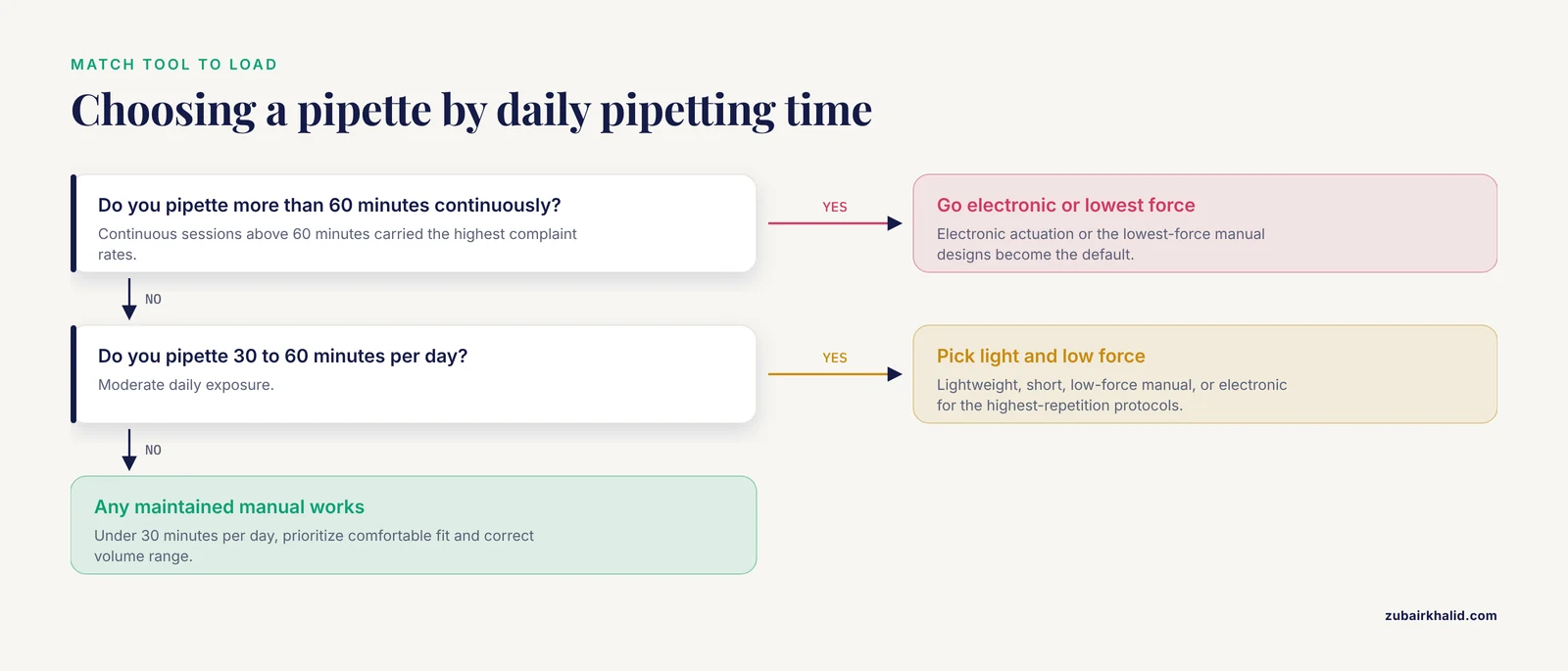
The single most decision-relevant variable is your daily pipetting exposure. The questionnaire data showed a clear dose-response pattern, with hand complaints increasing as continuous pipetting duration increased and reaching almost 90 percent in the group pipetting more than 60 minutes continuously [2]. Use that pattern as a purchasing filter:
- Under 30 minutes per day. Any well-maintained modern manual pipette is reasonable. Prioritize a comfortable fit and correct volume range over specialized ergonomic features.
- 30 to 60 minutes per day. Choose a lightweight, short, low-force manual pipette, or consider an electronic model for the highest-repetition protocols.
- More than 60 minutes continuously. Electronic actuation or the lowest-force manual designs become the default recommendation. Break pipetting into blocks with short rest periods, and rotate tasks where the workflow allows.
Hand size and strength also matter. The finding that nearly all female respondents reporting difficulties identified plunger operation as the design deficiency [2] tells buyers to treat plunger force ratings and handle fit as primary selection criteria, and to insist on hands-on trials for staff with smaller hands.
Pipette Calibration and Maintenance in an Ergonomic Context
Pipette calibration is the periodic verification and adjustment of the delivered volume against a traceable standard, and it connects to ergonomics in two directions.
First, a pipette that is out of calibration pushes users toward compensatory behaviors, such as repeated re-pipetting, extra blowout strokes, or visually checking every dispense with a strained posture. Keeping the instrument accurate removes those extra cycles. Gravimetric calibration, in which a series of deliveries is weighed on a calibrated analytical balance and the volume is calculated from the mass of water at a known density, is the standard method used by calibration services and documented in manufacturer technical materials. Follow the manufacturer's maintenance schedule and your institution's quality system for calibration frequency, which commonly depends on usage intensity and criticality of the application. A pipette in heavy daily service needs verification more often than one used weekly.
Second, maintenance affects the force features themselves. A plunger with degraded seals or contaminated seals requires more force to operate smoothly, and a stiff or corroded ejector raises tip ejection effort. When a pipette that used to feel easy starts to feel heavy, that is a maintenance signal, not something to push through. Regular cleaning, seal and O-ring replacement per the manufacturer's service kit, and professional recalibration preserve both accuracy and the low-force behavior you selected the pipette for in the first place. Your pipetting technique also influences calibration intervals, because consistent, unhurried strokes reduce the variability that makes calibration drift visible sooner.
Keep a simple log per pipette recording calibration dates, service events, and any user report that the instrument has become harder to operate. That log converts ergonomic complaints into actionable maintenance data.
Worked Scenarios
Scenario 1: The Molecular Biology Core With 96-Well qPCR Setup
A core facility runs dozens of qPCR plates per week. Setup requires 8-channel pipetting of master mixes into plates, with continuous sessions frequently exceeding an hour. This is the profile associated with the highest complaint rates in the survey data [2]. The right choice is an electronic 8-channel pipette with motorized aspiration, dispensing, and tip ejection, a rotating head for neutral wrist posture on plates, and a repeating dispense mode that cuts the number of physical aspiration cycles when aliquoting master mix. The added weight of the electronic unit is an acceptable tradeoff at this exposure level, though staff should still verify balance with tips loaded. If budget limits the purchase to one electronic multichannel pipette, assign it to the highest-volume operator and schedule plate work in shorter blocks.
Scenario 2: The Graduate Student Doing Daily Single-Channel Plasmid Prep
A student pipettes roughly 40 minutes per day in single-channel manual work: buffers, elutions, and small transfers across a range of volumes. A lightweight, short-barrel manual pipette with a low-force ejector fits the evidence directly, since light and short instruments reduced muscle activity and strain [3] and low ejection force tracked with comfort [1]. Choose a model with a contoured grip that fits the student's hand, verified at a demo station. There is no efficiency penalty for the lighter instrument, so the only real constraints are budget and availability of tips.
Scenario 3: The Lab With a Mixed Inherited Pipette Inventory
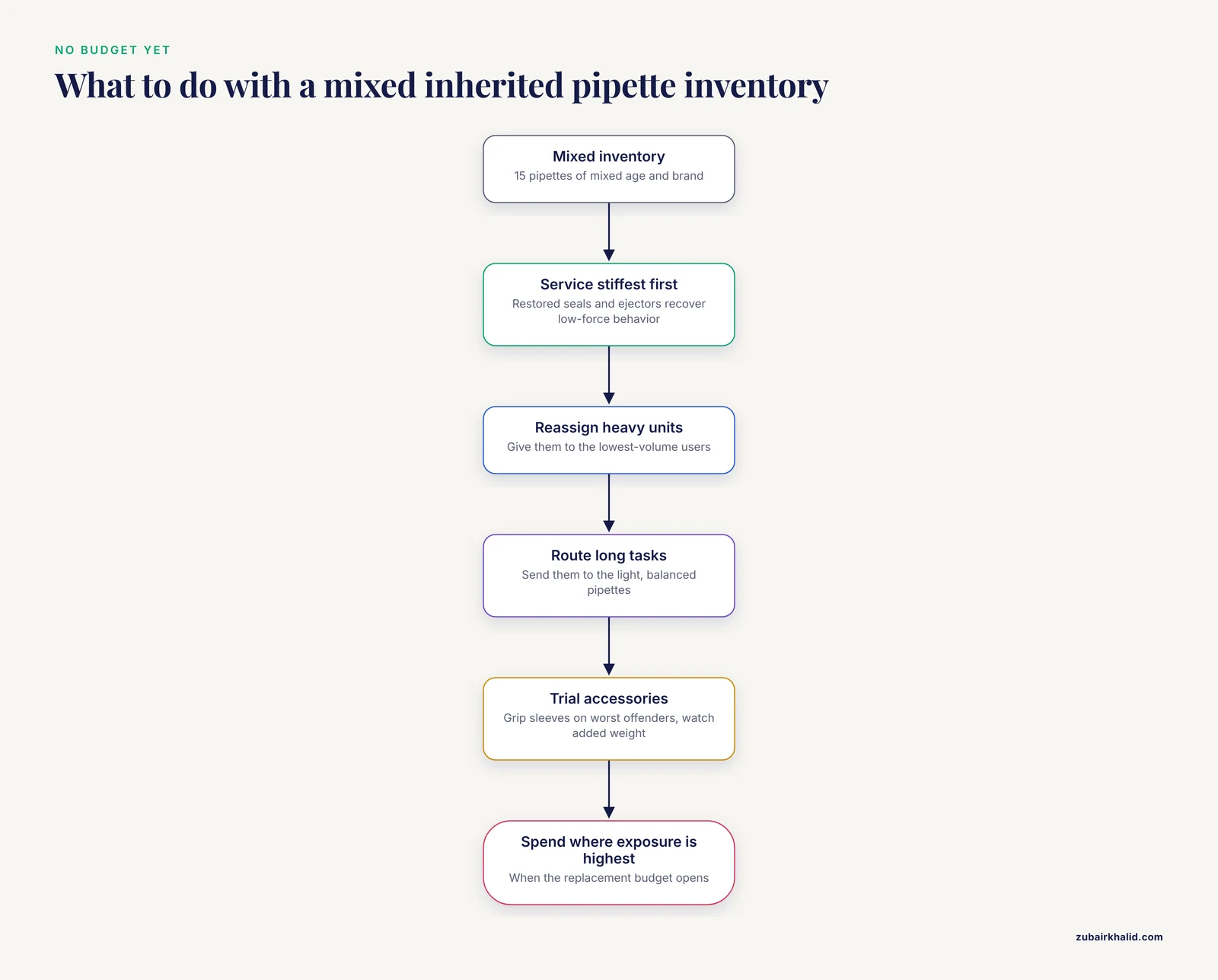
A lab inherits 15 pipettes of mixed age and brand. Several feel heavy and eject tips with a hard snap. Buying a full replacement set is not possible this year. The highest-value moves are, in order: service and recalibrate the stiffest pipettes, since restored seals and ejectors recover lost low-force behavior, assign the heaviest instruments to the lowest-volume users, route the longest pipetting tasks to whichever light, balanced pipettes test best in hand, and trial low-cost grip accessories on the worst offenders while watching for added weight. When the replacement budget does open, spend it where the exposure is highest rather than spreading it evenly.
Scenario 4: The Small-Handed User Struggling With a Standard Manual Pipette
A technician reports thumb and thenar soreness after plate work. The survey literature says this pattern is common and that plunger operation was the named deficiency for nearly all female respondents reporting difficulties [2]. The response is concrete: trial pipettes specifically for plunger force and grip circumference, prioritize models with contoured thumb rests and low plunger resistance, consider an electronic pipette for the highest-repetition steps, and have a supervisor or ergonomics reviewer watch the pipetting technique for wrist deviation and shoulder elevation, since workstation factors compounded the design issues in the survey data [2].
Common Mistakes and Limitations
- Choosing by brand reputation alone. The controlled comparison found significant differences between pipettes but no universal winner, and it explicitly emphasized the value of user testing rather than name recognition [1]. Demo pipettes with your own tips and your own rack layout.
- Judging a pipette without a tip attached. Balance shifts when a tip is mounted, and the comfort correlations included balance in the hand [1]. Evaluate loaded.
- Confusing weight with balance. A pipette can be light yet nose-heavy, or heavier yet better balanced. Both attributes independently predicted comfort [1].
- Ignoring tip choice. Ejection force depends on the tip as well as the pipette. Switching to a tip with a wider or stiffer collar can erase the benefit of a low-force ejector.
- Treating the pipette as the only variable. The usability study concluded that task, workplace layout, and pipette design interact [1]. Bench height, rack position, and schedule matter as much as the instrument.
- Assuming efficiency will drop with an ergonomic pipette. The measured comparison found no difference in work efficiency between the pipettes studied [3]. Comfort improvements do not cost you speed.
- Skipping calibration after service. Seal replacement and repair can shift delivered volume. Recalibrate after any service event, and keep the schedule your quality system requires.
- Purchasing for the average user. Hand-size variation is real and documented. A pipette fleet with one or two small-grip options serves a mixed team better than fifteen identical full-size instruments.
Two honest limitations frame everything above. The controlled comparisons examined a limited number of pipette models and user cohorts, so rankings of specific brands reflect those instruments and those users rather than a permanent market verdict [1] [3]. And none of the evidence replaces individual assessment. If you have persistent hand, wrist, or elbow symptoms, an individual evaluation by your institution's ergonomics program or a clinician should drive the intervention, with the pipette features in this article as the vocabulary for that conversation.
Frequently Asked Questions
Which ergonomic pipette features matter most?
Tip ejection force, blowout force, and balance in the hand showed the strongest correlation with user comfort in controlled testing [1], and light weight and short length independently reduced measured muscle activity and perceived strain [3]. If you must rank features for a purchase, start with weight, length, ejector force, and plunger force.
Are electronic pipettes always the more ergonomic choice?
No. They remove most thumb force from aspiration, dispensing, and ejection, and the top-ranked pipette in one controlled evaluation was electronic [1], but motors and batteries add weight, and weight itself increases strain [3]. For high-repetition and multichannel work the tradeoff usually favors electronic. For light daily use, a well-designed manual pipette is often the better ergonomic and economic choice.
Does a lighter pipette slow down my work?
No. The study that compared light, short pipettes with a long, heavy pipette found no difference in work efficiency between them, while the lighter instruments produced lower muscular activity and perceived strain [3]. Comfort did not cost speed.
How long can I pipette continuously before strain becomes a problem?
Complaint rates rise with continuous pipetting duration, and in the questionnaire data nearly 90 percent of users pipetting continuously for more than 60 minutes reported hand complaints [2]. Treat 60 minutes as a clear signal to structure your day into shorter pipetting blocks with breaks and task rotation, and to invest in lower-force equipment if your protocols cannot be broken up.
How often should a pipette be calibrated?
Follow the manufacturer's technical documentation and your institution's quality system, which typically base the interval on usage intensity and the criticality of the application. Gravimetric verification on a calibrated analytical balance is the standard method. Recalibrate after any service event, and treat a pipette that has become noticeably harder to operate as due for service as well as calibration, since degraded seals and stiff mechanisms raise operating force.
Can I make my current pipettes more ergonomic without buying new ones?
Yes, partially. Service worn pipettes to restore smooth, low-force plunger and ejector action, switch to tips with easier ejection if your current tips are stiff, trial grip sleeves or hook adapters while checking that added weight does not worsen strain, and fix the workstation by raising samples and keeping the wrist neutral. These steps address technique and maintenance, though they cannot fully match a purpose-built low-force pipette for a high-volume user.