Ergonomic Pipette Designs That Reduce Strain
By Dr. Zubair Khalid, DVM, MS, PhD ·

An ergonomic pipette changes where and how your hand applies force during pipetting, which lowers the cumulative load on your thumb, wrist, forearm, and shoulder across a long bench session. The rule of thumb for choosing one is simple: the more hours and the more wells you pipette in a typical week, the more you benefit from a low-force or electronic design, while labs that pipette for short, occasional sessions usually do well with a standard manual pipette, good technique, and a comfortable grip position.
This guide is an ergonomic pipette design comparison for students and working researchers. It explains why pipetting causes strain, describes the main design options and their pros and cons, compares them on the criteria that actually decide a purchase, walks through three worked scenarios, and covers the technique and maintenance habits that determine whether any pipette stays comfortable over years of use.
Why Pipetting Causes Strain in the First Place
Manual air-displacement pipettes, the standard tools in most molecular biology labs, concentrate a surprising amount of mechanical work into small structures of the hand. A repetitive strain injury, often abbreviated RSI, is damage to muscles, tendons, or nerves caused by repeated small movements or sustained static postures rather than a single acute injury. Pipetting is a textbook setup for RSI because it combines several risk factors at once.
Three forces dominate. First, thumb plunger force. Every aspiration and dispensing cycle requires the thumb to overcome the plunger spring. At typical volumes this force is modest for one press, but a full plate assay or a long dilution series can mean hundreds to thousands of presses in a session. The thumb flexor tendons and the joint at the base of the thumb accumulate that load cycle by cycle.
Second, tip ejection force. Ejecting a used tip requires a sharp thumb press against a stiff ejector spring, often at an extended thumb angle. In many workflows this motion happens as often as the plunger stroke, and it is widely considered the single most aggravating movement for the thumb in routine pipetting.
Third, static grip and posture load. Holding the pipette itself requires continuous contraction of the forearm muscles to maintain grip. Add a raised elbow when pipetting into a bottle on a high shelf, a flexed wrist when working inside a deep microplate, or a twisted forearm when working with tubes in a rack, and the shoulder and neck join the list of loaded structures. Holding the arm elevated while repeating precise movements for more than a short period also produces a subtle accuracy problem, because tremor and fatigue make steady hands harder to maintain.
The cumulative nature of this load explains why ergonomic pipette design matters even when each individual motion feels harmless. Laboratory ergonomics guidance from occupational health programs describes pipetting as a high-risk task precisely because it is highly repetitive, involves sustained grip, and often pairs both with awkward wrist and shoulder postures. A design that cuts the force per press, the force per ejection, the pipette weight, or the postural awkwardness reduces the total load a hand absorbs over a career, not just over one afternoon.
Two features of lab work make the problem worse than office typing. Pipetting is done in bursts. An experiment that takes two hours of pipetting compresses a full week of repetitive motion into one session. And the task resists substitution. Unlike typing, there is no practical way to pipette without the hand, so the lever available to the researcher is reducing the force, repetition, and posture demands per cycle through equipment choice, technique, and workflow design.
What Makes a Pipette Design Ergonomic
Pipette manufacturers approach ergonomics through a handful of recurring design levers. Understanding these levers makes any ergonomic pipette design comparison easier, because every product on the market is some combination of them.
Lower plunger force. Softer return springs and refined internal mechanisms reduce the thumb force needed for each stroke. Some manual designs are explicitly marketed around a lighter plunger action, and the difference is noticeable over a long session even when the per-press saving sounds small.
Lower tip ejection force. This is often the highest-yield ergonomic feature in a manual pipette. Well-designed ejector mechanisms and tip/rack systems matched to the pipette let the thumb release a tip with a short, low-force press instead of a hard push. Some designs allow ejection with a different finger or with a sliding collar rather than a thumb strike.
Lighter weight and balanced center of gravity. A pipette that weighs less demands less continuous grip force. Balance matters as much as raw weight. A pipette whose mass sits close to the hand feels lighter and requires less counter-torque at the wrist than a nose-heavy design of the same total weight.
Handle geometry. Handle diameter, contour, and material affect how hard the fingers must squeeze. A contoured grip that spreads contact across the palm and fingers reduces the pinch force needed to control the instrument. Adjustable or interchangeable grip pieces let users with smaller or larger hands find a neutral fit.
Adjustable grip angle. Some designs let the user change the angle between the handle and the shaft, or hold the pipette in a more neutral wrist position during plate work. Keeping the wrist in a neutral position, meaning straight rather than bent up, down, or sideways, keeps the tendons of the forearm gliding through the carpal tunnel without added friction.
Electronic actuation. Electronic pipettes replace the thumb-driven spring with a small motor. Aspiration and dispensing are triggered by a button or touch control, which removes plunger force almost entirely. Many electronic models also consolidate functions, so a single instrument can step through dispensing, mix, and reverse-pipette programs, which cuts the number of physical cycles per task.
Reduced cycle count. Any feature that lets one physical action accomplish more work is ergonomic in effect. Stepper or repeating dispensers deliver many aliquots from a single aspiration. Automated platforms remove the human hand from the loop entirely.
No single pipette wins on every lever. A light manual pipette still demands a thumb press for every cycle. An electronic pipette removes that force but adds weight from its battery and motor and costs more. The sections below describe each option on its own terms before comparing them.
Side-by-Side Comparison of Ergonomic Pipette Design Options
The table below is the core of this ergonomic pipette design comparison. It summarizes the main options on the forces that drive strain and the situations where each earns its place.
| Design option | Thumb plunger load | Tip ejection load | Grip and posture load | Best suited for | Main drawbacks |
|---|---|---|---|---|---|
| Standard manual air-displacement | Moderate to high over long sessions | Moderate to high | Moderate, depends on weight and handle | Short sessions, teaching labs, general cloning and PCR setup | Highest cumulative hand load per cycle |
| Low-force ergonomic manual | Reduced by softer springs and mechanism | Reduced, often dramatically | Often improved with contoured, balanced handles | Daily bench work, anyone with early hand symptoms | Still repetitive, still requires a thumb press per cycle |
| Manual multichannel (8 or 12 channel) | High, plunger presses all channels at once | High | Elevated, nose-heavy and harder to hold level | Plate-based work where an electronic multichannel is out of reach | Heaviest grip load of any manual option |
| Electronic single-channel | Very low, motor actuated | Low, motorized eject on most models | Moderate, extra weight from battery and motor | High-repetition single-channel work, serial dilutions, cell culture feeds | Higher cost, charging discipline required, heavier than a manual |
| Electronic multichannel | Very low | Low | Moderate to elevated, heavy instrument | 96-well and 384-well assays done regularly | High purchase cost, weight and balance matter a great deal |
| Repeater or stepper dispenser | Low per aliquot after the single initial aspiration | One ejection per aspiration cycle | Low to moderate | Filling many plates or tubes with the same volume | Not for single accurate transfers, adds a dead volume consideration |
| Positive-displacement pipette | Similar to comparable manual designs | Similar | Moderate | Viscous, volatile, or dense liquids where accuracy demands it | Ergonomics usually not the reason to buy, disposable pistons add cost |
| Automated pipetting workstation | None for the operator | None | Minimal, setup and plate handling only | High-throughput core facilities, very large screens | High cost, footprint, programming time, still needs qualified staff |
Reading the table by rows gives the profile of each design. Reading it by columns gives the physics of the problem. Plunger load and ejection load are what strain the thumb. Grip and posture load is what strains the forearm, shoulder, and neck. The best ergonomic pipette designs that reduce strain attack all three columns, not just one.
The Options in Detail
Standard Manual Air-Displacement Pipettes
An air-displacement pipette works by pressing a plunger that moves a piston, compressing a column of air between the piston and the liquid. The spring returns the piston, and the cushion of air translates piston travel into liquid movement. This is the default pipette in molecular biology and the design most students learn first.
From an ergonomics standpoint, the standard manual pipette is the baseline against which everything else is measured. Modern versions are far better than older instruments. Many current models feature lightweight housings, contoured handles with finger hooks that let the hand relax between cycles, and ejector mechanisms that need noticeably less force than designs from a decade ago. A well-maintained modern manual pipette is a reasonable ergonomic tool for short to moderate sessions.
Its limits appear with volume. Because every cycle requires a full thumb stroke and a full ejection stroke, the cumulative load grows linearly with the number of transfers. A standard manual pipette is therefore an ergonomic pass for a thirty-minute PCR setup and a poor choice for an afternoon of plating replicate cultures into six 96-well plates.
One practical note favors standard manuals in some contexts. Their mechanical simplicity makes them easy to service, easy to calibrate, and forgiving of rough handling, which matters in teaching labs where many hands share instruments.
Low-Force Ergonomic Manual Pipettes
These are manual pipettes engineered specifically around the three ergonomic levers. Manufacturers achieve lower plunger force through spring geometry and mechanism refinement, lower ejection force through improved ejector design, and lower grip load through reduced weight, balanced mass distribution, and handles contoured for a relaxed hold. Some designs let the user adjust the finger hook or grip position, and some offer a shape that supports holding the pipette with the wrist closer to neutral.
The pros are straightforward. The strain reduction is real, the operating habits are identical to any manual pipette, there is no battery to manage, and the cost premium over a standard manual pipette is modest. For a bench researcher who pipettes daily but whose budget or workflow does not justify electronics, this category is usually the best ergonomic pipette design comparison winner, because it improves the ergonomics of the same task with no change in procedure.
The cons are equally clear. A low-force manual pipette is still a manual pipette. The thumb presses the plunger for every aspiration and dispensing, the thumb ejects every tip, and the repetition count is unchanged. For someone already experiencing thumb pain, cutting the force per cycle helps, but it does not eliminate the motion that provokes the symptoms. That person should be looking at electronic or automated options.
Manual Multichannel Pipettes
A multichannel pipette has 8 or 12 tips mounted on a single manifold, allowing a full row or column of a microplate to be filled in one stroke. This is a workflow accelerator, and it is genuinely ergonomic in one specific sense, because filling a 96-well plate row by row requires roughly one twelfth as many plunger cycles as doing it channel by channel.
The ergonomic problem is in the columns of the table above. The single plunger press must overcome the resistance of twelve springs at once, so plunger force is high. Tip loading requires firm, even pressure across all twelve tips simultaneously, which is one of the most forceful and awkward movements in routine lab work. Tip ejection of a full row carries similar force. And the instrument itself is long, front-heavy, and requires steady two-point control to keep all tips level, which loads the wrist, forearm, and shoulder. Many experienced bench scientists describe the manual multichannel as the pipette that hurt them the most, and that description is consistent with its design physics.
For this reason, the common advice in ergonomic pipette design comparison discussions is to treat the manual multichannel as a transitional tool. It is a major ergonomic and efficiency upgrade over pipetting a plate with a single-channel manual. But if plate work is a regular part of the week, an electronic multichannel removes most of the force problem that the manual multichannel concentrates into every stroke.
Electronic Pipettes
An electronic pipette uses a small motor, guided by an onboard controller, to move the piston. The user sets the volume and any programs on a display, then triggers aspiration and dispensing with a light touch. Because the motor does the mechanical work, thumb plunger force drops to nearly zero. Most electronic models include motorized tip ejection, and many support programmable functions such as sequential dispensing, mixing cycles, and reverse pipetting, where the instrument aspirates a larger volume than needed and dispenses only the target volume to improve accuracy with foamy or viscous liquids.
The ergonomic case for electronic pipettes is the strongest of any handheld design, and it compounds with repetition. Removing plunger and ejection force addresses the two highest-strain movements directly. Consolidating multiple steps into one program reduces the total number of button presses and, often, the number of tube or plate manipulations per task, which also cuts error rates in long dilution series.
The cons deserve honest treatment. Electronic pipettes cost substantially more than manual equivalents. They are heavier because of the motor and battery, so grip load does not disappear, and a badly balanced electronic design can feel worse in the hand than a light manual. Batteries require charging discipline, because a dead battery at the start of an experiment is a real disruption. And a lab adopting electronics should plan for the charging station and a routine that keeps charged instruments on the bench.
Within the category, the single-channel electronic pipette is the natural upgrade for anyone whose strain comes from long single-channel work, such as serial dilutions, culture feeding, or aliquoting reagents. The electronic multichannel is the purpose-built answer for plate-based work, and it is the design that most directly resolves the force concentration problem of the manual multichannel.
Positive-Displacement Pipettes and Repeaters
A positive-displacement pipette eliminates the air cushion. The piston sits in direct contact with the liquid, often via a disposable piston-capillary tip, so the dispensed volume does not depend on air compressibility. This matters for viscous liquids, volatile solvents, and dense solutions, where air-displacement pipettes lose accuracy.
On pure ergonomics, a manual positive-displacement pipette offers no advantage over a comparable manual air-displacement pipette, and the piston-capillary tips can be stiffer to seat. This option belongs in an ergonomic pipette design comparison because of how it is often paired with other hardware. Positive-displacement heads are common on repeater pipettes, and the repeater is where the ergonomic payoff appears.
A repeater or stepper dispenser aspirates a reservoir volume once and then dispenses many identical aliquots from it, one press per aliquot. The thumb work per aliquot is far lower than a fresh aspiration for every dispensing, and the workflow advantage is large when filling many plates, tubes, or wells with the same reagent. The limits are accuracy and task fit. A repeater is not the tool for a single precise transfer into a single tube, and reservoir dead volume, meaning the liquid that remains unreachable in the reservoir after dispensing, becomes a consideration when reagents are expensive.
Automated Pipetting Workstations
A workstation is a robotic liquid handler that performs the transfers itself, while the operator prepares plates, loads tips and reagents, sets up the run, and reviews results. The human hand is removed from the pipetting loop entirely, which eliminates the operator's plunger, ejection, and grip load for every transfer the robot performs.
The honest framing is that a workstation does not eliminate laboratory strain so much as move and shrink it. Setup involves plate handling, sealing, and reagent reservoir management, which carry their own ergonomic demands, though far fewer cycles per experiment. The costs, footprint, programming time, and training requirements confine these systems to labs with sustained high-throughput needs. For a core facility running large screens daily, automation is the definitive ergonomic solution. For a small lab, the handheld electronic options deliver most of the ergonomic benefit at a fraction of the commitment.
How to Compare Designs on the Criteria That Decide Real Choices
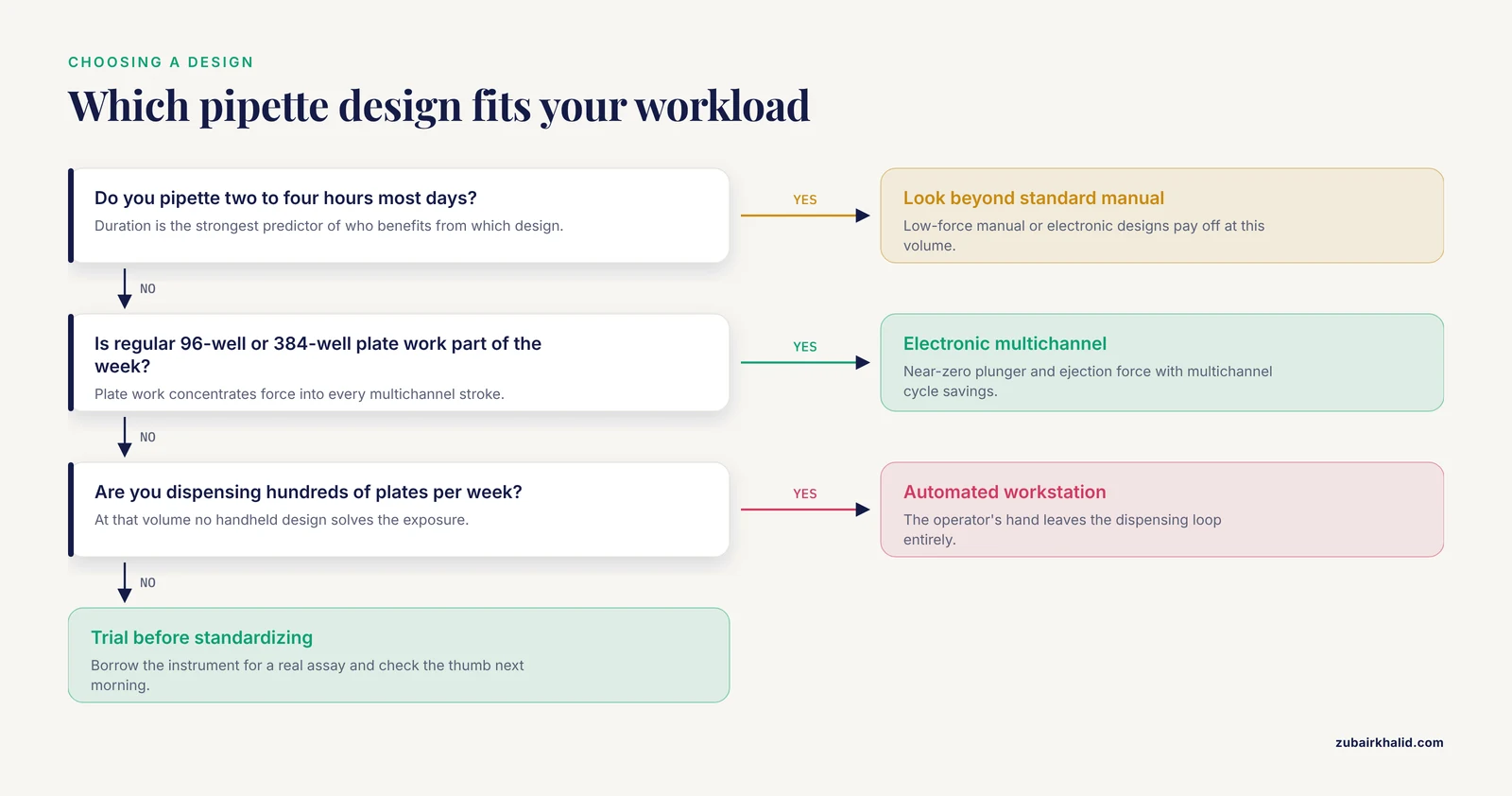
An ergonomic pipette design comparison becomes useful when it is tied to the actual work a lab does. The features matter only in proportion to how often and how hard a given design gets used. Five criteria decide most purchases.
Daily pipetting duration. Duration is the single strongest predictor of who benefits from which design. Someone pipetting less than an hour on a typical day accumulates a load that a well-maintained manual pipette with good technique handles comfortably. Someone pipetting two to four hours a day, or running plate-based assays most days, sits squarely in the range where low-force manual designs pay off immediately and electronic designs pay off over the life of the instrument.
Repetition count per task. Count the actual presses. A 96-well plate filled single-channel is 96 aspiration-dispensing cycles plus 96 tip ejections per row set, multiplied across rows. The same plate with a 12-channel manual is a handful of strokes with high per-stroke force. The same plate with an electronic 12-channel is a fraction of even that, at near-zero force. Redesigning a task at the workflow level, for example choosing a 12-channel plate layout over a tube-by-tube layout, often saves more strain than any pipette feature.
Posture demands of the workflow. Deep plates, tall reservoirs, fume hoods with sashes at fixed heights, and biosafety cabinets with limited reach all force awkward wrist angles. Adjustable grip angles and slim nosepieces help the pipette reach into these spaces with a straighter wrist. Where the space itself is the problem, repositioning the work surface, using low-profile reservoirs, or raising the operator's chair rather than lowering the shoulder helps more than any pipette feature.
Liquid type and accuracy needs. Viscous, volatile, or foamy liquids push the choice toward positive-displacement and electronic reverse-pipetting programs for accuracy reasons, which conveniently are also ergonomic reasons when they reduce re-dos and repeat attempts.
Sharing and standardization. A pipette that one person loves may be awkward for a colleague with much smaller hands. Adjustable grips, and a standard practice of letting each user adjust the instrument before a session, keep a shared bench from quietly becoming a strain source for part of the team. Standardizing on one or two models across a lab also simplifies training, calibration schedules, and tip inventories.
Cost enters only after these criteria are settled, and it enters as a qualitative judgment rather than a fixed rule. Electronic and automated systems carry higher purchase prices than manual designs, and that premium buys force reduction and cycle reduction, which are exactly the quantities that predict injury risk in high-volume pipetting.
Three Worked Scenarios
Scenario 1, a Graduate Student Setting Up PCR Reactions
The work is a few dozen reactions in tubes or strip tubes, several times a week, with a single-channel pipette, taking twenty to thirty minutes per setup. The repetition count is low, the session length is short, and the volumes are typical aqueous samples well suited to air-displacement pipettes.
The best ergonomic choice here is a modern manual single-channel pipette with a contoured handle, a light ejection mechanism, and a properly fitted tip brand. The decisive ergonomic gains come from technique rather than hardware, specifically a relaxed grip, a neutral wrist, working with tubes at elbow height rather than on a high shelf, and alternating hands when the workflow allows. A low-force manual is a reasonable small upgrade. An electronic pipette would remove plunger force but is hard to justify on this workload, because the total cycles per week are modest.
Scenario 2, a Lab Running Weekly ELISA-Style Plate Assays
The work is adding samples, standards, wash buffers, and substrate to 96-well plates, every week, currently with a single-channel manual pipette. Count the cycles and the problem announces itself. A single plate handled single-channel means hundreds of plunger presses and hundreds of tip ejections, and weekly assays mean that load recurs without recovery between sessions.
This is the textbook case for an electronic multichannel pipette. It converts the majority of those thumb cycles into light button presses, it lets one instrument handle the various volume steps through stored programs, and it reduces the re-dos that come from fatigue-induced error late in a plate. If the budget does not allow an electronic multichannel yet, the interim step is a low-force manual multichannel, paired with strict attention to keeping the wrist neutral over the plate and to seating tips evenly without excessive force. That interim step improves the situation substantially, but the per-stroke force remains high, which is the very quantity that scales with injury risk in plate work.
Scenario 3, a Core Facility Screening Large Compound Libraries
The work is dispensing into 384-well plates, hundreds of plates per week, with tight tolerance on volume uniformity across the plate. No handheld design genuinely solves this ergonomically. Even an electronic 12-channel leaves the operator making many strokes per plate across many plates, and even a low-force instrument accumulates career-scale repetition at that volume.
The appropriate ergonomic answer is an automated pipetting workstation. The operator's hand leaves the dispensing loop, and the residual ergonomic exposure is setup, plate handling, and monitoring, which occurs at a fraction of the cycle count. The accuracy and reproducibility gains that motivate automation in this setting arrive alongside the ergonomic benefit. Labs at this scale typically also formalize the surrounding ergonomic program, including task rotation so that setup and analysis duties alternate among staff rather than concentrating bench pipetting in one person's hands.
Pipetting Technique That Multiplies Ergonomic Gains
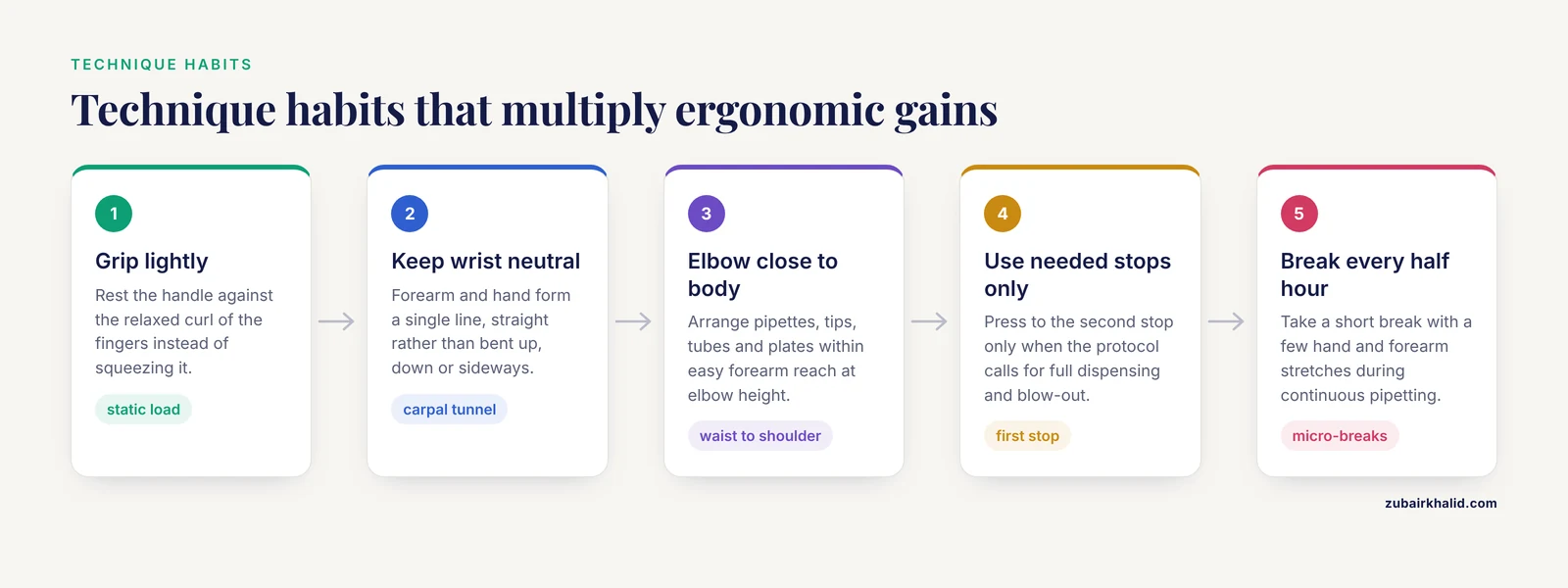
Hardware choice sets the ceiling for comfort, but pipetting technique determines how close any instrument gets to that ceiling. The technique points below apply to every design in this comparison and cost nothing to implement.
Hold the pipette with a light, relaxed grip. Grip force is a static load, and most people grip far harder than control requires. A handle that rests against the relaxed curl of the fingers rather than being squeezed does the same work with less forearm contraction. Between cycles, let the hand rest on the bench or the pipette stand rather than holding the instrument aloft.
Keep the wrist neutral. The wrist should stay straight, as if the forearm and hand formed a single line, during aspiration and dispensing. Bent-wrist pipetting, especially into deep plates or tall reservoirs, loads the wrist extensors and increases friction on the tendons passing through the carpal tunnel. Practical fixes include using low-profile reservoirs and plates rather than tall tubes where the protocol allows, positioning reagents at elbow height, and, in a biosafety cabinet, raising the chair rather than reaching up or angling the wrist down.
Keep the elbow close to the body. A raised abducted elbow, the classic posture when reaching across a bench or up to a shelf, transfers the load to the shoulder and neck. Rearranging the workstation so that pipettes, tips, tubes, and plates all sit within easy forearm reach, in the zone between waist and shoulder height, removes most of the elevation from the task.
Use the lightest effective two-step press. Most air-displacement pipettes have a first stop for aspiration and a second stop for full dispensing and blow-out. Pressing to the second stop on every cycle when the protocol only needs the first stop, for example in many routine transfers, multiplies thumb work for no gain. Learn which steps each protocol requires and use exactly those.
Pre-wet tips deliberately rather than repeatedly. For accurate small-volume work, conditioning a tip with one aspiration and dispensing of the liquid improves reproducibility. Doing this once per tip rather than repeatedly saves cycles and improves accuracy at the same time.
Alternate tasks and hands. Rotating between pipetting and non-pipetting duties within a session, or alternating hands when the protocol permits, gives loaded tendons micro-recovery windows. Occupational health guidance for lab pipetting consistently emphasizes scheduled micro-breaks, on the order of a short break and a few hand stretches roughly every half hour of continuous pipetting, as more protective than a single long break after the session.
Match the tip to the pipette. Tips that fit loosely require extra seating force and can leak, while oversized or stiffer tip collars raise ejection force. Using the tip brand and style the pipette manufacturer validates, or verifying an alternative tip fits and performs, protects both accuracy and the thumb.
Reduce ejection strain structurally. When possible, eject tips into shallow waste receptacles placed at working height rather than up into a high container, which forces an extended-arm, upward-angled ejection. Positioning the waste tray low and close turns a stressful motion into an easy one.
None of these technique points replaces an appropriate instrument. Together with instrument choice, they determine the total load a hand experiences, and they are the reasons two people using identical pipettes can have very different outcomes over the same years of work.
Pipette Calibration and Maintenance in an Ergonomics Program
Pipette calibration is the process of verifying and adjusting a pipette's dispensed volumes against a traceable reference, most commonly by gravimetric testing, in which the mass of dispensed water is converted to volume using its known density and corrected for temperature. Calibration is an accuracy procedure, not an ergonomics procedure, but the two connect in three practical ways.
First, a pipette that is out of calibration produces failed experiments, and failed experiments mean re-dos, and re-dos mean more pipetting. Every accuracy failure in a plate-based assay can turn into a full repeat, which multiplies the exact exposure the ergonomic program is trying to reduce. Keeping instruments within specification is therefore a genuine strain-reduction measure, simply by avoiding repeated work.
Second, mechanical condition affects force. A pipette with a worn seal, contaminated piston, or corroded spring does not only dispense inaccurately, it often requires more force to operate smoothly and can develop sticking or uneven plunger travel. Regular service, meaning seal and O-ring replacement, piston cleaning and lubrication per the manufacturer's service schedule, restores both accuracy and light, consistent action. A pipette that has begun to feel stiff at the plunger or sticky at the ejector is telling the user that maintenance is due.
Third, calibration and service events are the natural checkpoint for ergonomic review. When instruments come back from service, or when a lab schedules its routine calibration cycle, is the moment to check that each pipette's assigned users have handles adjusted to fit, that the tips stocked on the bench match the instruments, and that any user reporting discomfort is paired with a different design for a trial period.
Calibration itself should follow the manufacturer's documentation and the lab's quality system, including the frequency, the reference method, and the acceptance criteria appropriate to the volumes and applications involved. The general principle, that a maintained, accurately calibrated instrument both performs better and feels better at the thumb, is the part that belongs in every ergonomic pipette program.
Common Mistakes and Limitations
Buying an electronic pipette and keeping the old technique. An electronic pipette removes plunger force, but a user who still hunches over a deep plate with a bent wrist keeps most of the postural load. Instrument upgrades work together with posture and technique changes, not instead of them.
Judging ergonomics in a two-minute store demo. The difference between designs only becomes decisive over hundreds of cycles. Where possible, borrow or trial an instrument for a real assay before standardizing on it, and pay attention to the thumb and forearm the next morning, not just during the demo.
Ignoring tip ejection because the plunger is soft. Some labs upgrade to a low-force plunger design and continue hard-thumb ejecting every tip. Ejection force is frequently the more aggravating motion, and it deserves equal attention in any design choice and in technique.
Treating a multichannel as ergonomic simply because it cuts cycles. The manual multichannel reduces cycle count but concentrates force per stroke. Whether it is an ergonomic net gain depends on the workload, and for regular plate work the electronic multichannel resolves the tradeoff in a way the manual one cannot.
Sharing one pipette size across incompatible volume ranges. Using a single large-volume pipette for small volumes, or forcing a small-volume pipette into large transfers, produces both poor accuracy and unnecessary force and repetition. The volume range of each task should map onto the pipette assigned to it.
Expecting an ergonomic pipette to fix an established injury on its own. Persistent pain, numbness, or weakness deserves evaluation by a qualified health professional. Equipment changes reduce future exposure, and early reporting of symptoms makes that reduction matter. Individual cases need medical assessment, and this article does not substitute for it.
Skipping the workflow-level view. The largest ergonomic wins in many labs come from rethinking the assay, meaning plate layouts that reduce transfers, reservoirs that reduce refills, and batch sizes that match realistic session lengths. A design comparison that ignores the task around the instrument misses where most of the strain actually comes from.
Frequently Asked Questions
What does an ergonomic pipette design comparison actually measure?
It measures how each pipette design handles the three loads that cause strain, which are thumb plunger force, tip ejection force, and the static grip and posture load of holding the instrument. A good comparison also weighs cycle count per task, because repetition multiplies every force the instrument demands.
Are electronic pipettes worth the cost?
For someone who pipettes for several hours most days, or who does regular plate-based work, an electronic pipette is usually worth the premium, because it removes nearly all plunger and ejection force, the two motions most associated with thumb and hand strain. For short, occasional sessions, a well-maintained manual pipette with good technique is a sensible and economical choice.
How does pipetting technique affect strain?
Technique determines how much of a pipette's ergonomic potential you actually receive. A relaxed grip, a neutral wrist, an elbow held close to the body, working at elbow height, using only the plunger stops the protocol requires, and short breaks roughly every half hour of continuous pipetting all reduce the load per cycle and the cumulative load per session, regardless of which pipette you hold.
Does pipette calibration affect hand strain?
Calibration is primarily an accuracy procedure, but it affects strain indirectly. A pipette maintained on a regular calibration and service schedule keeps its seals, piston, and springs in condition, which preserves smooth, light plunger action, and it prevents failed experiments that would otherwise be repeated, multiplying your pipetting exposure all over again.
Which ergonomic pipette design is best for 96-well plate work?
For regular plate work, an electronic multichannel pipette is the strongest handheld choice, because it combines the cycle savings of multichannel operation with near-zero plunger and ejection force, resolving the high per-stroke force that makes manual multichannel pipettes demanding. If budgets require a phased approach, a low-force manual multichannel is an interim improvement until an electronic model is feasible.
How often should I take breaks from pipetting?
A practical pattern used in laboratory ergonomics guidance is a short break with a few hand and forearm stretches roughly every half hour of continuous pipetting, with longer task rotation built into the workday. Breaking the repetition into smaller blocks gives tendons recovery time and also reduces the fatigue-related errors that come late in long sessions.