Electronic vs. Manual Pipettes: A Side-by-Side Comparison
By Dr. Zubair Khalid, DVM, MS, PhD ·

The difference between electronic and manual pipettes comes down to one moving part: a manual pipette drives the piston with your thumb on a spring-loaded plunger, while an electronic pipette drives it with a battery-powered motor under program control. Both run on the same air displacement principle and use the same disposable tips, so the choice between an electronic or manual pipette is not about whether one works and the other does not. It is about consistency, fatigue, throughput, and what the protocol demands from your hands.
The rule of thumb for choosing is straightforward. If a protocol involves a few dozen transfers or fewer, and the liquid rewards tactile judgment, a manual pipette is usually the better tool. If a protocol involves long repetitive series, plate-wide dispensing, serial dilutions, or several operators who must generate interchangeable data, an electronic pipette removes the variability that thumbs introduce and protects hands from the accumulated load.
This comparison of electronic vs. manual pipettes follows the way a bench scientist actually decides. It covers how each mechanism works, where accuracy and precision diverge, what the ergonomics data show, how throughput changes, which pipetting technique fundamentals carry over between the two, what pipette calibration requires for each type, and the mistakes that most often cost people results.
What Separates an Electronic Pipette from a Manual Pipette
Both instrument families are air displacement pipettes. A piston inside the body moves a column of air, called the air cushion, that sits between the piston seal and the liquid inside a disposable tip. As the piston retracts, the expanding air cushion creates negative pressure and liquid rises into the tip. As the piston advances, it drives the liquid back out. Because the liquid never touches the piston, the pipette stays clean and cross-contamination leaves with the discarded tip. The same design explains most pipetting errors, because the air cushion is compressible and its temperature, humidity, and the vapor pressure of the liquid all shift how much volume actually moves.
Inside a Manual Pipette
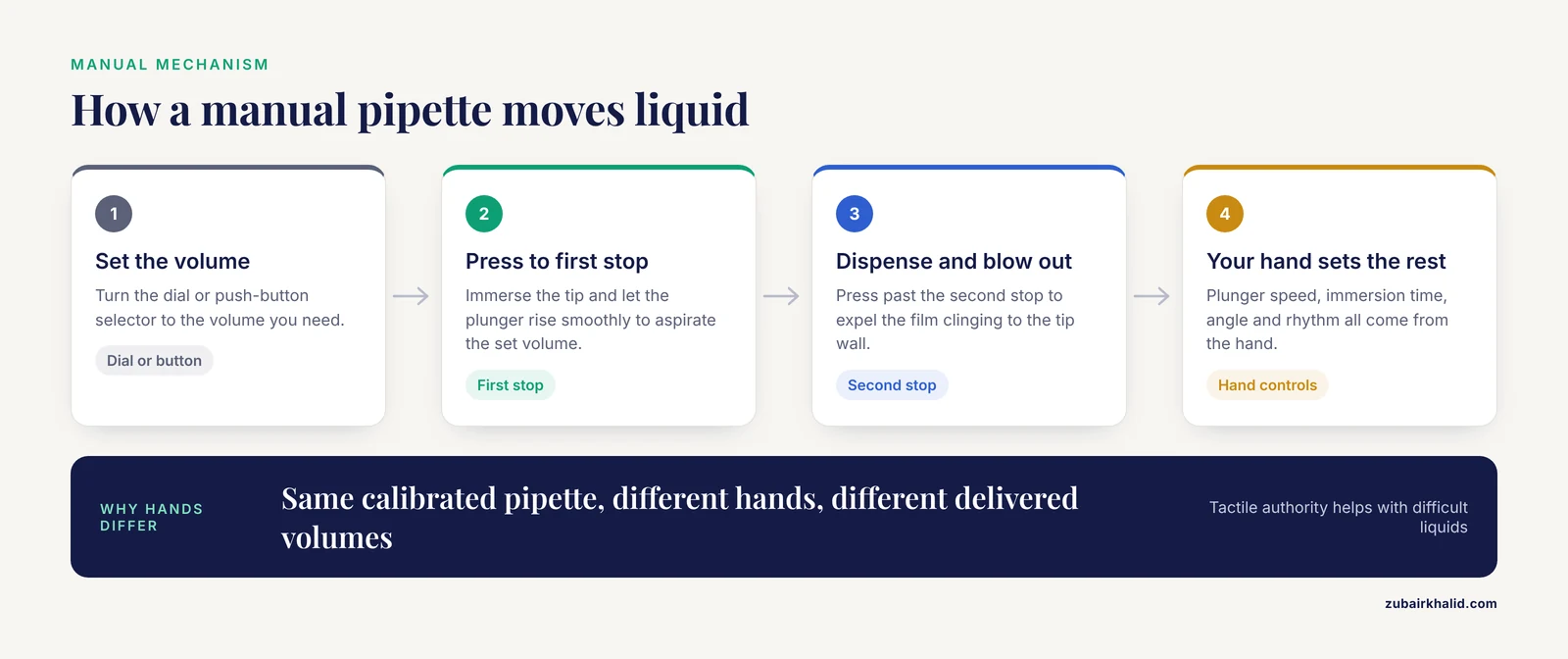
A manual pipette, often called a micropipette or pipettor, carries a volume dial or push-button selector, a spring-loaded plunger, and a tip ejector. The plunger travels through two detents, called stops.
- First stop. Press to the first stop, immerse the tip, and let the plunger rise smoothly. The retracting piston aspirates (draws in) the set volume.
- Second stop. After dispensing, press past the second stop. This blowout stroke expels the thin film of liquid clinging to the inner wall of the tip, which matters whenever a protocol requires quantitative transfer.
Your hand controls everything else: plunger speed, how long the tip stays immersed, dispensing angle, and the rhythm from sample to sample. That tactile authority is why experienced pipetters reach for manual instruments with difficult liquids. It is also why two trained operators can deliver measurably different volumes with the same calibrated pipette.
Inside an Electronic Pipette
An electronic pipette replaces the spring and thumb with a stepper motor, a motor that turns in precise, counted increments, managed through a keypad and display. You set the volume, the aspiration and dispensing speeds, and in most models the number of repeats. Common modes include:
- Standard pipetting, one aspirate and one dispense.
- Reverse pipetting, which aspirates an excess and dispenses a fixed portion, leaving the surplus in the tip.
- Repetitive dispensing, usually called multi-dispense, one aspiration followed by many identical dispenses.
- Dilution and mixing programs that draw sample and solvent and combine them in the tip or well.
- Sequential dispensing, which steps through a stored list of different volumes.
Because a motor rather than a finger sets piston speed, the 40th dispense in a series happens at exactly the same rate as the first. That single property drives most of the practical difference between electronic and manual pipettes in precision, throughput, and fatigue.
Side-by-Side Comparison
Read the table as a decision aid rather than a scorecard. The right column only wins when the workload actually involves repetition.
| Criterion | Manual pipette | Electronic pipette |
|---|---|---|
| Piston drive | Thumb and spring through two plunger stops | Stepper motor following a programmed profile |
| Volume setting | Dial or push button, set by hand | Keypad and display, with stored presets |
| Dispense speed and cadence | Set by the operator, varies with skill and fatigue | Programmed, identical on every dispense |
| Operating modes | Single dispense, reverse pipetting by technique | Standard, reverse, multi-dispense, dilution, mixing, sequential dispensing |
| Precision across a long series | Drifts as fatigue and technique waver | Holds the programmed profile throughout |
| Consistency between users | Depends on training and discipline | Higher, because the motion is standardized |
| Ergonomic load | Thumb, wrist, and forearm absorb every stroke and tip ejection | Motor absorbs plunger force, though the body weighs more |
| Throughput | One aspiration per dispense | One aspiration can feed many dispenses |
| Learning curve | Tactile skill builds over weeks of practice | Menus learn quickly, fundamentals still required |
| Power | None | Battery, charger, occasional software updates |
| Maintenance | Gravimetric calibration, seals, o-rings | Same calibration plus battery and program checks |
| Purchase price | Lower | Higher, plus batteries or chargers over time |
| Best fit | Few transfers, difficult liquids, teaching | Plates, dilutions, long runs, multi-operator standardization |
Two rows repay attention. Dispense speed is the hidden variable in most comparisons. Manual speed changes with the user, the hour, and fatigue, and speed directly affects how much volume an air displacement system delivers. Electronic pipettes lock that variable down. Mode depth is the second. A manual pipette can perform reverse pipetting, but only as a technique the operator executes stroke by stroke. An electronic pipette performs it as a stored program, which means it happens the same way at the start of a shift and at the end of one.
Both types come in single-channel and multichannel formats. A multichannel pipette carries 8 or 12 tips and moves an entire row or column of a microplate in one stroke. Electronic versions coordinate all channels simultaneously, which avoids the uneven thumb pressure across a manual multichannel head that shows up as channel-to-channel variation.
Accuracy and Precision: Where the Difference Shows
Accuracy and precision mean different things, and the electronic versus manual question touches both. Accuracy, or trueness, is how close the delivered volume sits to the set volume. Precision is how tightly repeated deliveries cluster, usually reported as a coefficient of variation (CV), the standard deviation divided by the mean and expressed as a percentage. A pipette can be precise without being accurate. Calibration addresses the first problem, technique addresses the second.
For a manual pipette, accuracy is a joint product of instrument and operator. Pre-wetting, immersion depth, plunger speed, release smoothness, dispensing angle, and the temperature difference between liquid and pipette all move the delivered volume. Manufacturer specifications are measured with water under ideal conditions, and real samples depart from water in density, viscosity, and volatility. For an electronic pipette, the motor removes the speed and cadence terms, and the remaining error concentrates in calibration, tip fit, and liquid properties.
Published comparisons make the pattern concrete. When researchers coupled a microfluidic thread-based electroanalytical device to an electronic pipette held at a fixed three-axis position by a printed stand, electronic injection produced limits of detection (LODs, the lowest quantities distinguishable from background) 2.5-fold to 5-fold lower than manual injection for nitrite, paracetamol, and 5-hydroxytryptophan, along with better repeatability [1]. The electronic pipette delivered each sample plug at the same speed and position every time, so the analytical signal stopped depending on the analyst's hand.
Automated liquid handling shows the same effect at larger scale. In a head-to-head of automated versus conventional manual dispersive pipette-tip extraction for polycyclic aromatic hydrocarbons in sugarcane spirits, the automated parallel method reached intraday precision between 0.40% and 15.8% and interday precision between 7.6% and 31.7%, while the manual parallel method ranged from 5.40% to 18.7% intraday and 8.2% to 38.1% interday [2]. Intraday means variation within a single day, interday means variation across days, and both windows widened for the manual workflow.
The honest counterpoint comes from a validated 96-well preparation for phosphatidylethanol (PEth), an alcohol biomarker measured in blood by UHPLC-MS/MS, which is ultra-high-performance liquid chromatography coupled to tandem mass spectrometry. Once the laboratory optimized its liquid handling parameters, the automated and the manual preparations both achieved intermediate precision below 9% and accuracy of 101% [3]. Intermediate precision describes scatter across days, operators, and routine conditions within one laboratory. A disciplined manual workflow, in other words, can match an automated one. Automation's advantage is a higher floor rather than a higher ceiling, because the good result stops depending on who holds the pipette and how tired they are.
Low Volumes and the Air Cushion
Small volumes magnify every effect above. Set a 1000 µL pipette to 50 µL and the air cushion, sized for a milliliter, now sits over a tiny liquid slug, so compressibility errors become a large fraction of the delivery. The PEth work hit this directly and solved it mechanically. For the minimum required volume of 2-propanol, the laboratory used 300 µL pipette tips instead of 1000 µL tips, keeping the air cushion as small as possible during the pipetting step [3]. The lesson applies to both instrument types. Choose the smallest tip that comfortably covers your volume, and treat any transfer well below the tip's nominal capacity as a special case that needs validation with your own liquid.
Ergonomics: Hands, Wrists, and Long Sessions
Repetitive pipetting is a recognized cause of work-related musculoskeletal disorders (WMSDs), injuries of the hand, wrist, forearm, and shoulder driven by repeated force and awkward posture [4]. A pipetting-heavy day can mean thousands of plunger strokes, and the thumb performs most of them.
Controlled comparisons identify what actually drives discomfort. In an evaluation of ten single-channel pipettes, five manual and five electronic, 21 experienced users completed a standardized task and rated each instrument for comfort and usability. No single pipette won every attribute, but the features that tracked with greater hand and arm comfort were lower tip ejection force, lower blowout force, and good balance in the hand. Among the tested models, the Rainin Pipet-Lite scored highest overall among manual pipettes and the Thermo Scientific Finnpipette Novus ranked first among electronic pipettes [4]. The practical reading is that design details, not the manual-versus-electronic label alone, decide how a pipette feels at hour three.
Redesigning the manual format itself also works. A four-finger-push ergonomic pipette that spreads the operating load across the whole hand cut muscle exertion by 25% during aspiration and 35% during dispensing compared with a traditional thumb-push design, reduced awkward wrist postures by 33%, and was preferred by 9 of 10 participants who pipetted daily [5].
The strain is not hypothetical. The microfluidic injection study cited above lists the costs of manual micropipetting explicitly: inconstant speed and position, dependence on skilled analysts, and the physical effort of the operator during prolonged times, which produces poor reproducibility and a risk of strain injury [1]. Electronic pipettes answer the force problem directly, because the motor performs aspiration and dispensing, and many models add assisted tip ejection, historically one of the highest-force steps in the cycle.
Electronics carry their own ergonomic cost. The battery, motor, and chassis add weight, so balance and grip still decide comfort. Handle instruments before buying whenever possible, with the tips you actually use.
Habits that help with either type:
- Keep the work surface at elbow height and the shoulders relaxed.
- Alternate hands during long runs when the protocol allows.
- Loosen the grip between dispenses instead of choking the barrel.
- Break long plate-loading sessions into blocks and stretch the hand and forearm between blocks.
- Retire any instrument that forces an awkward wrist angle, whatever its specification sheet says.
Throughput: Cycles, Plates, and Time
Count pipetting cycles before you count anything else. Modern sample preparation hides hundreds of plunger strokes inside single protocols. A pipette-tip enzyme reactor that releases N-glycans, the sugar chains attached to asparagine residues in glycoproteins, from therapeutic antibodies required 40 iterations of suction and discharge with a pipette, roughly 8 minutes of continuous manual pipetting per reaction [6]. Pipette-tip solid-phase extraction (SPE), a cleanup format that binds the analytes (the substances being measured) to adsorbent packed inside a pipette tip, runs on the same repetitive motion, with repeated aspirate and dispense cycles performed by a manual micropipettor [7] or with a manual pipette controller, the handheld device used to draw and dispense through large serological pipettes, such as the accu-jet Pro in a urine method for glyphosate and its metabolite AMPA [8].
Electronic pipettes compress that workload in two ways. Multi-dispense turns 96 identical aliquots into one aspiration and 96 motorized dispenses. Programmed cadence turns a timing-sensitive step into a stored profile that executes identically on every run. Both changes remove labor and, more importantly, remove the drift that appears when a person performs the same motion for the two-hundredth time.
The automation spectrum extends past handheld instruments. A mobile robotic platform built around a multifunctional end effector, which carries an operating finger, a camera, a gripper, and a pipette on a six-axis arm, has been demonstrated automating routine work such as pH buffer adjustment across standard laboratory instruments, with gains in efficiency and reproducibility [9]. For most laboratories the practical lesson is one of positioning. Electronic handheld pipettes deliver a meaningful share of automation's consistency at a small fraction of the cost, footprint, and validation burden of robotics, while remaining usable for everything else on the bench.
When to Use Electronic Pipettes, and When Manual Wins
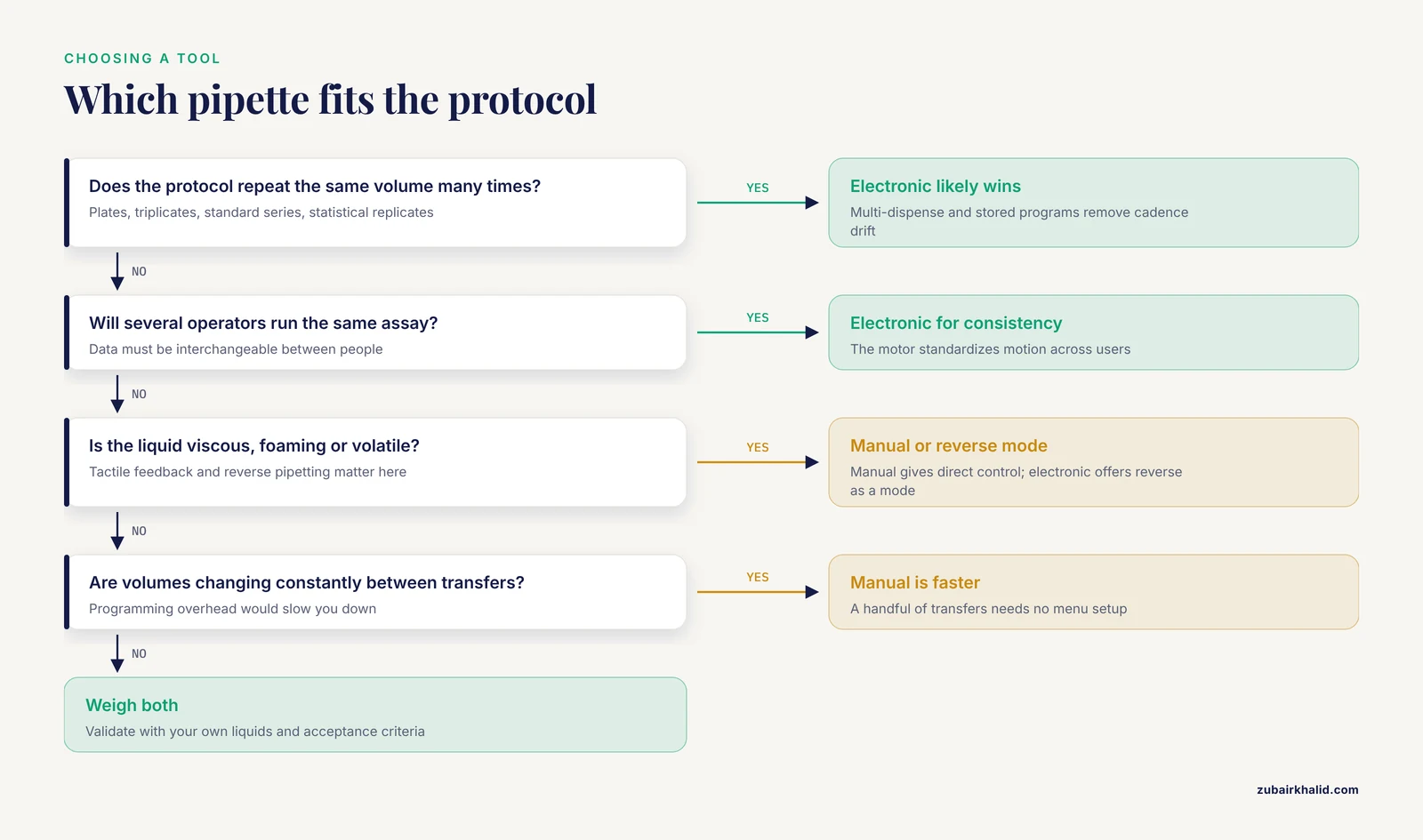
Choose an Electronic Pipette When
- The protocol repeats the same volume many times: microplates, triplicates, standard series, statistical replicates.
- Several operators run the same assay and the data must be interchangeable.
- A step is timing- or flow-sensitive, such as layered gradients, delicate matrices, or device loading where speed changes the result.
- The workload includes serial dilutions, stepwise dilution series in which each tube feeds the next, because programmed ratios remove arithmetic and cadence errors.
- Sessions run long enough that fatigue would visibly change your manual rhythm.
Choose a Manual Pipette When
- You need a handful of transfers right now and programming overhead would slow you down.
- The liquid is viscous, foaming, volatile, or particulate, and tactile feedback plus reverse pipetting beat a fixed program.
- Volumes change constantly from one transfer to the next.
- The bench lacks reliable power, or the instrument must travel between rooms or sites.
- You are teaching or learning, because manual operation builds the feel that makes electronic modes understandable.
Worked Scenarios
Scenario 1: qPCR (quantitative polymerase chain reaction) setup across a 96-well plate. The master mix, a precombined cocktail of PCR reagents, is identical for every well. With a manual pipette you perform 96 full aspiration and dispense cycles, each one a chance for a bubble or a speed change. In repetitive dispensing mode, an electronic pipette aspirates once and dispenses 96 times at a programmed speed, which cuts the cycle count and the fast draws that create bubbles.
Scenario 2: a standard curve for a protein assay. Standards step down in volume across a series of known concentrations used to convert signal into amount, often in triplicate wells. An electronic pipette in sequential dispensing mode steps through the stored volume list without re-dialing between points, which removes a classic source of a bent standard curve.
Scenario 3: pipette-tip SPE cleanup for a dozen samples. Each sample needs a fixed number of aspirate and dispense cycles through the adsorbent-packed tip. At 12 samples and 10 cycles each, a manual micropipettor is entirely workable and gives you direct control of cycle speed. When the sample count grows and the method becomes routine, automated parallel formats are where the measurable precision gains appear.
Scenario 4: patch-clamp electrophysiology. In this technique a glass pipette seals onto a cell membrane so currents through the membrane can be recorded, and seal formation depends on a precise sequence of pressure changes inside the pipette. Performing that sequence by hand adds complexity to every recording session. A device built from solenoid valves (electrically switched valves) that automates pipette internal pressure control simplified seal formation and whole-cell recording and improved standardization and reproducibility [10]. The generalizable point: whenever a manual manipulation follows a strict sequence, automating the sequence removes an entire class of operator error, which is the same argument that justifies electronic pipettes for repetitive liquid moves.
Scenario 5: the teaching laboratory. A structured skills course can walk students through single-channel manual, multichannel, single-channel electronic, and multichannel electronic pipettors across 51 exercises, ending with specialty instruments, using water, food coloring, and reusable plasticware for less than $5 per student per term [11]. The ordering is deliberate. Manual first builds the feel. Electronic second shows what standardization adds.
Pipetting Technique Fundamentals That Apply to Both
An electronic drive changes who moves the plunger. It does not change the physics of air displacement, so the core pipetting technique list applies to both instruments.
- Pre-wet the tip. Aspirate and dispense the set volume two or three times before the real draw. Pre-wetting equilibrates the air cushion with the liquid's vapor and temperature and leaves a film on the tip wall. It matters most with volatile solvents and viscous samples.
- Match the tip to the volume. Use the smallest tip that comfortably covers the range, and keep the set volume in the upper portion of the pipette's span, where accuracy is best.
- Immerse just deep enough. A few millimeters for small volumes, deeper for larger ones. Too shallow risks drawing air, too deep loads liquid onto the outside of the tip.
- Hold the pipette close to vertical during aspiration. A consistent slight angle is acceptable. A wandering angle is not.
- Release smoothly. A snapped plunger pulls liquid in too fast, cools the air cushion, and under-delivers. On an electronic pipette, choose an aspiration speed that is gentle for the liquid at hand.
- Dispense against a wall at a consistent angle, then blow out when the protocol requires quantitative transfer. On manual instruments that means pressing to the second stop. On electronic instruments it is usually a mode setting.
- Use reverse pipetting for viscous, foaming, or volatile liquids. Aspirate an excess, dispense the set volume, discard the surplus. The excess compensates for the film that would otherwise stay behind.
- Equilibrate temperature. Cold liquid in a warm pipette delivers a different volume than calibration assumed. Let reagents and tips reach room temperature when precision matters.
- Keep the cadence constant from sample to sample. An electronic pipette enforces this. With a manual pipette you have to impose it on yourself, and fatigue is the enemy.
Structured practice beats casual bench exposure for building these habits. Free curricula built around graded exercises, from basic single transfers to complex assessment tasks, give any lab a ready-made model that needs nothing more than a balance, a rack of tips, and colored water.
One boundary note belongs here. Air displacement pipettes struggle with extreme liquids, and the fix is a different tool. A positive displacement pipette carries its piston directly against the liquid inside a capillary tip, eliminating the air cushion. Viscous glycerol solutions, volatile solvents, and samples that foam at speed are the classic cases. Neither a manual nor an electronic air displacement pipette is the right answer there.
Pipette Calibration and Maintenance
Pipette calibration is the verification, and correction, of the volume an instrument actually delivers against a traceable standard. The standard approach is gravimetric: dispense the set volume of water onto a balance, convert the measured mass to volume using the density of water at the test temperature, and compare the result with the manufacturer's tolerance. Testing at several points across the range, commonly near the bottom, middle, and top of the span, catches problems that a single-point check hides.
Both electronic and manual pipettes need the same gravimetric verification. A motor does not stop a seal from wearing, a tip cone from scoring, or a drop onto the bench from silently shifting the piston geometry. The schedule belongs to your quality system, and many laboratories verify on a cycle of every three to six months, always after a drop, a suspected aspiration failure, or before a critical assay. Treat any pipette that produced a suspicious result as unverified until it passes a check.
A practical program looks like this:
- Daily or weekly quick checks. Inspect the nose cone (the tip-holding shaft), confirm tips seat with a slight twist, and run a leak test by aspirating the set volume, holding the pipette vertical for several seconds, and watching for a droplet.
- Scheduled gravimetric verification. Multi-point, documented, with adjustment whenever a point falls outside tolerance.
- Manual-specific maintenance. Seal and o-ring (the rubber sealing ring) replacement, volume dial lock inspection, and piston cleaning per the manufacturer's instructions.
- Electronic-specific maintenance. Battery health and charging habits, verification of each stored program after service or software changes, and function checks of every mode the lab actually uses. Practical upkeep guidance, down to battery replacement and which models to avoid, is part of structured pipetting curricula for exactly this reason [11].
- Storage and hygiene. Upright on stands, nose cones cleaned, decontamination with manufacturer-approved agents.
Documentation closes the loop. Log check dates, keep certificates, and tie pipette identification numbers to notebook entries so a reviewer can connect a result to the instrument state on that day. When a dataset looks different in month six than in month one, the calibration record is usually where the answer lives.
Common Mistakes and Limitations
- Running below the comfortable volume band. Setting a P20 to 2 µL puts you near a tenth of the nominal range, where the air cushion dominates the physics and small technique slips become large percentage errors. Choose the pipette whose range keeps the set volume in its upper half.
- Skipping the pre-wet. The first draw from a dry tip, especially with a volatile solvent, undershoots, and the error propagates through the whole series.
- Using the wrong tip, or the wrong tip size. A poor seal leaks slowly and invisibly, and an oversized tip at a small volume enlarges the air cushion and widens error. Published methods have solved real reproducibility problems simply by moving to a smaller tip size.
- Snapping the plunger release, or setting electronic aspiration speed too high. The result is bubbles, spatter, and under-delivery.
- Expecting electronics to repair broken technique. An electronic pipette enforces consistent motion, but it cannot fix a wrong volume entry, a leaking tip, a contaminated barrel, or a skipped pre-wet. The fundamentals above still decide the outcome.
- Trusting a multi-dispense series without validating it. Each dispense is motorized, but the wetting state of the tip changes across a series, and behavior with your actual liquid, not water, is what counts. Run a gravimetric check in multi-dispense mode before committing a plate.
- Electronic-specific operational failures. A dead battery mid-plate, a stored program edited by someone else, or a dispensing profile too brisk for a foaming liquid. Charge before long runs, control who edits programs, and slow the profile for problem liquids.
- Cross-contamination in plate formats. Splashing and aerosol transfer between wells are real at high dispensing speeds. The PEth 96-well method used a deep 2.0 mL well plate to eliminate cross-contamination between wells and observed no carry-over, meaning no residual analyte from a previous high sample appeared in the next measurement, after its highest calibrator (the highest-concentration standard) [3].
- Calibration neglect after drops and abuse. A pipette that looks fine after a fall can be out of tolerance. Re-verify before trusting it.
- Inconsistent angle and immersion across a series. These drift as fatigue sets in and are invisible in the moment. An electronic pipette removes the speed component of this problem but not the physical handling component.
- Ignoring liquid properties. Density, viscosity, and vapor pressure all shift air displacement behavior. Pre-wetting, slower speeds, and reverse pipetting are the countermeasures, and positive displacement is the answer at the extremes.
A limitation of any comparison like this one: laboratories differ in volumes, liquids, budgets, and staff, so the right answer for a core facility is not automatically the right answer for a teaching bench. Validate a pipette choice with your own liquids and your own acceptance criteria, and revisit the decision when the workload changes. Full robotic automation shifts the calculus again, and it becomes worth revisiting once a workflow stabilizes at scale.
Frequently Asked Questions
Is an electronic pipette more accurate than a manual pipette?
Not inherently. Accuracy depends on calibration, tip selection, and technique for both types. Electronic pipettes improve consistency, which raises precision across long series and between users, while a well-trained operator with a calibrated manual pipette can match an electronic one on single transfers.
When should I choose an electronic or manual pipette for a new protocol?
Count the transfers and the operators. Choose electronic for long repetitive series, plate dispensing, serial dilutions, and timing-sensitive steps. Choose manual for occasional transfers, constantly changing volumes, and liquids that reward tactile control, such as viscous or foaming samples.
Do electronic pipettes still need calibration?
Yes. An electronic drive does not prevent drift from worn seals, tip fit, or handling. Verify gravimetrically on the same schedule as manual pipettes, and add battery and stored-program checks to the routine.
Can I use the same pipetting technique with both types?
The fundamentals transfer. Pre-wetting, immersion depth, vertical hold, smooth release, and wall dispensing apply to both. An electronic pipette enforces consistent speed and cadence for you, and its modes replace manual plunger patterns.
Are electronic pipettes worth it for a small lab?
They earn their cost when repetitive volume is high enough that fatigue and inconsistency affect the data. If most of the work is occasional single transfers, well-maintained manual pipettes with a disciplined calibration program are usually sufficient.
What is reverse pipetting and when does it matter?
Reverse pipetting aspirates an excess of liquid and dispenses only the set volume, leaving the surplus in the tip. It improves delivery of viscous, foaming, or volatile liquids where a film would otherwise stay behind. Electronic pipettes offer it as a built-in mode, and manual users perform it with the second stop.
Sources
- Improving the performance and versatility of microfluidic thread electroanalytical devices by automated injection with electronic pipettes: a new and powerful 3D-printed analytical platform.
- Lab-made automated parallel-dispersive pipette extraction device for the determination of polycyclic aromatic hydrocarbons in distilled beverages (sugarcane spirits) using HPLC-DAD.
- A comparison of an optimized automated sample preparation of PEth in blood pretreated by freezing versus manual preparation in whole blood, analyzing by UHPLC - MS/MS.
- Ergonomic evaluation of ten single-channel pipettes.
- Development of an ergonomic four-finger-push manual pipette design.
- A fast and convenient solid phase preparation method for releasing N-glycans from glycoproteins using trypsin- and peptide-N-glycosidase F (PNGase F)-impregnated polyacrylamide gels fabricated in a pipette tip.
- On-site rapid screening of benzodiazepines in dietary supplements using pipette-tip micro-solid phase extraction coupled to ion mobility spectrometry.
- A simple liquid chromatography-high resolution mass spectrometry method for the determination of glyphosate and aminomethylphosphonic acid in human urine using cold-induced phase separation and hydrophilic pipette tip solid-phase extraction.
- A mobile robot bridging manual and automated bioscientific workflows by applying the Swiss army knife principle.
- A device for automated control of pipette internal pressure for patch-clamp recording.
- A freely available pipetting skills laboratory manual.