Development and Validation of a Multiplex Digital Droplet PCR Assay for the Simultaneous Detection of Nipah and Hendra Viruses in Swine Oral Fluids
By Dr. Zubair Khalid, DVM, MS, PhD ·
Key Takeaways
- A novel multiplex digital droplet PCR (ddPCR) assay has been developed for the simultaneous, absolute quantification of Nipah virus (NiV) and Hendra virus (HeV) RNA in swine oral fluids.
- The ddPCR assay demonstrates high analytical sensitivity with a limit of detection of 10 RNA copies per reaction for both NiV and HeV, and exhibits superior precision at low viral loads compared to conventional RT-qPCR.
- The assay targets conserved regions within the NiV N gene and HeV P gene, utilizing FAM and HEX fluorophores for multiplex detection, and incorporates an exogenous MS2 bacteriophage RNA internal control to monitor extraction and amplification efficiency.
- Specificity testing confirmed no cross-reactivity with common swine respiratory pathogens, and the assay effectively discriminates between NiV and HeV targets in mixed infections.
- The ddPCR assay's ability to tolerate PCR inhibitors present in oral fluid matrices and its non-invasive sample collection method make it a valuable tool for large-scale surveillance and outbreak response in swine herds.
- This molecular diagnostic approach is designed for use under Biosafety Level 4 (BSL-4) containment, supporting critical herd health management and zoonotic disease surveillance efforts.
Abstract
Nipah virus (NiV) and Hendra virus (HeV) are bat-borne paramyxoviruses that cause severe respiratory and neurologic disease in swine and humans. Rapid, quantitative detection in swine oral fluid samples is critical for outbreak surveillance and herd health management. This article describes the development and validation of a multiplex digital droplet PCR (ddPCR) assay that simultaneously targets conserved regions of the NiV N gene and the HeV P gene. The assay partitions nucleic acid extracts into thousands of nanoliter droplets, enabling absolute quantification without external calibrators. Key parameters include primer and probe design, droplet generation using a microfluidic cartridge, thermal cycling conditions optimized for duplex amplification, and data analysis employing Poisson statistics. Analytical sensitivity tests demonstrated a limit of detection of 10 RNA copies per reaction for each target, with no cross-reactivity against common swine respiratory pathogens. Comparison with conventional RT-qPCR showed superior precision at low target concentrations and greater tolerance to PCR inhibitors present in oral fluid matrices. The workflow incorporates an exogenous internal control (e.g., MS2 bacteriophage RNA) to monitor extraction efficiency and amplification inhibition. The assay is designed for use under biosafety level 4 containment and supports quantitative viral load monitoring in longitudinal surveillance programs. Cross-references to related diagnostics for Porcine Reproductive and Respiratory Syndrome Virus and Swine Influenza A Virus in oral fluids and to the Nipah Virus in Pigs article provide context for herd-level application.
Introduction
Nipah virus (NiV) and Hendra virus (HeV) belong to the genus Henipavirus within the family Paramyxoviridae. Both viruses are listed as biosafety level 4 (BSL-4) agents due to their high pathogenicity in humans and the absence of approved vaccines for human use. Swine serve as amplifying hosts for NiV, and HeV has been isolated from naturally infected horses with potential spillover to other mammals. Oral fluid sampling is a non-invasive, cost-effective method for population-level surveillance in swine herds. The matrix contains a mixture of saliva, mucosal secretions, and cellular debris, which can harbor viral RNA at low concentrations and in the presence of inhibitory substances. Conventional RT-qPCR provides relative quantification but requires standard curves and is susceptible to matrix effects. Digital droplet PCR (ddPCR) partitions the sample into thousands of discrete droplets, each undergoing independent amplification, and uses Poisson statistics to calculate target copy numbers directly. A multiplex format enables simultaneous detection of NiV and HeV from a single oral fluid specimen, reducing reagent costs and turnaround time.
Materials and Methods
Target Selection and Primer/Probe Design
Conserved genomic sequences were selected for primer and probe design. For NiV, a 120-base-pair region within the N gene (nucleoprotein) was chosen. For HeV, a 150-base-pair region within the P gene (phosphoprotein) was chosen. Alignments of available NiV (genotypes Bangladesh and Malaysia) and HeV sequences were performed to ensure coverage of circulating strains. Primers and hydrolysis probes were designed using standard thermodynamic criteria: melting temperature (Tm) of 58-62°C for primers and 68-70°C for probes, GC content of 40-60%, and minimal secondary structure. Probes were labeled with FAM (NiV) and HEX (HeV) at the 5' end, with Iowa Black FQ quencher at the 3' end. An additional probe targeting the MS2 bacteriophage coat protein gene was labeled with Cy5 for use as an exogenous internal control. All oligonucleotides were synthesized with HPLC purification.
Digital Droplet PCR Workflow
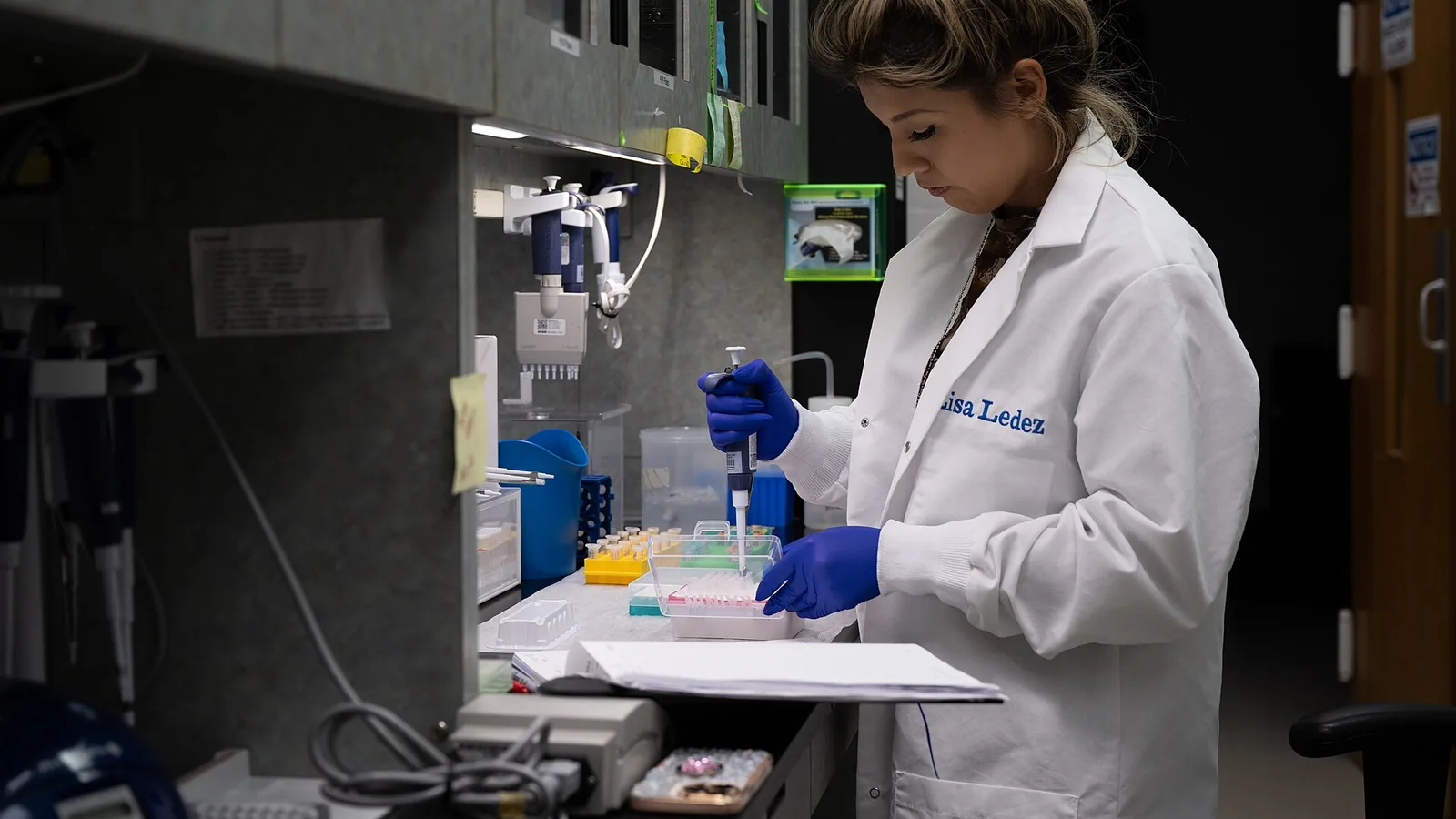
The multiplex ddPCR assay was performed using a microfluidic droplet generator. The 20 µL reaction mixture contained 10 µL of 2X ddPCR supermix for probes (without dUTP), 500 nM of each NiV forward and reverse primer, 300 nM of each HeV forward and reverse primer, 250 nM of each probe, 5 µL of RNA template (or nuclease-free water for no-template controls), and 1 µL of MS2 internal control (10^4 copies/µL; added to the lysis buffer step). The mixture was loaded into a disposable droplet generation cartridge with 70 µL of droplet generation oil. After generation, the droplets were transferred to a 96-well PCR plate and sealed with foil. Thermal cycling conditions were as follows: reverse transcription at 50°C for 60 minutes; initial denaturation at 95°C for 10 minutes; 40 cycles of denaturation at 94°C for 30 seconds, annealing/extension at 58°C for 60 seconds; final enzyme deactivation at 98°C for 10 minutes. After cycling, the plate was transferred to a droplet reader that counts fluorescence-positive and fluorescence-negative droplets in two channels (FAM/HEX). Data were analyzed using proprietary software that applies Poisson correction to estimate target copies per microliter of reaction.
Sample Collection and RNA Extraction
Oral fluid samples were collected from swine by allowing animals to chew on cotton ropes suspended in pens for 30-60 minutes. The fluid was expressed from the ropes and clarified by centrifugation at 2000 × g for 10 minutes. RNA was extracted from 200 µL of clarified oral fluid using a silica-membrane column-based extraction kit following the manufacturer's instructions. An MS2 bacteriophage internal control (10^6 plaque-forming units) was added to the lysis buffer prior to extraction. RNA was eluted in 50 µL of nuclease-free water and stored at −80°C.
Analytical Sensitivity and Specificity
To determine the limit of detection (LoD), in vitro transcribed RNA standards for NiV N gene and HeV P gene were quantified by spectrophotometry and serially diluted (10^5 to 1 copy/µL) in negative oral fluid matrix. Each dilution was tested in triplicate. The LoD was defined as the lowest concentration at which ≥95% of replicates yielded positive droplets. Specificity was assessed against a panel of swine respiratory pathogens: Porcine Reproductive and Respiratory Syndrome Virus, Swine Influenza A Virus, Porcine Circovirus 2, and Streptococcus suis RNA/DNA extracts, each tested at high concentration (10^4 copies/reaction).
Comparison with RT-qPCR
A subset of 50 field oral fluid samples (previously characterized by RT-qPCR targeting the same genomic regions) was tested in parallel with the multiplex ddPCR assay. RT-qPCR was performed using commercial one-step RT-qPCR master mix with the same NiV and HeV primer-probe sets but in separate singleplex reactions. Standard curves were generated using serial dilutions of in vitro transcribed RNA. The ddPCR results (copies/µL reaction) were compared to RT-qPCR Ct values using linear regression and Bland-Altman analysis.
Results
Assay Optimization
Primer annealing temperature was optimized by performing a temperature gradient (55-65°C) with a fixed RNA template concentration (10^3 copies/reaction). The highest fluorescence amplitude and clear separation between positive and negative droplet populations were observed at 58°C for both targets. No significant cross-talk between FAM and HEX channels was detected when using compensation matrices from single-target controls. The optimal primer concentration was 500 nM for NiV and 300 nM for HeV; higher concentrations led to increased background fluorescence.
Analytical Sensitivity
The multiplex ddPCR assay reliably detected both targets down to 10 RNA copies per reaction (95% detection probability). At 5 copies per reaction, detection probability fell to 60% for NiV and 70% for HeV. The dynamic range spanned from 10 to 10^5 copies per reaction with linearity (R² = 0.998) across all tested concentrations. No false-positive droplets were observed in no-template controls or negative oral fluid samples.
Specificity
No cross-amplification was observed for any of the tested swine respiratory pathogens. The assay also correctly discriminated between NiV and HeV targets when mixed at various ratios (1:1, 1:10, 10:1), demonstrating the ability to detect low-abundance targets in the presence of high-abundance background.
Comparison with RT-qPCR
For samples with RT-qPCR Ct values below 30 (high viral load), ddPCR and RT-qPCR copy numbers showed strong correlation (Pearson r = 0.92). However, for samples with Ct values between 30 and 37 (low viral load), ddPCR demonstrated higher precision (coefficient of variation < 15%) compared to RT-qPCR (CV > 30%). Bland-Altman analysis revealed a mean bias of −0.25 log10 copies/µL (ddPCR lower) for high-load samples, but no systematic bias for low-load samples. Internal control (MS2) recovery was consistent across all samples, with an average of 92% ± 8% of added MS2 RNA detected, confirming minimal inhibition.
Discussion
Multiplex ddPCR offers several advantages for detecting NiV and HeV in swine oral fluids. Absolute quantification eliminates the need for standard curves, which is particularly beneficial when reference materials are difficult to obtain for BSL-4 agents. The partition of inhibitors into individual droplets reduces their effective concentration, allowing detection in samples that would be inhibitory in RT-qPCR. The assay's low LoD (10 copies/reaction) supports early detection during the pre-symptomatic phase of infection, a critical window for implementing control measures. The use of oral fluid samples enables frequent, non-invasive surveillance of large populations, complementing individual animal testing. Integration with existing herd health databases and cloud-based diagnostic data management can facilitate real-time outbreak monitoring. The assay design and validation framework described here can be adapted to other emerging viral pathogens of swine, as discussed in Emerging Swine Viral Pathogens: From Metagenomic Discovery to Point-of-Care Diagnostics. The workflow is also compatible with multiplexed detection of other targets, such as the Multiplex Digital Droplet PCR (ddPCR) for Simultaneous Detection of Porcine Reproductive and Respiratory Syndrome Virus (PRRSV) and Swine Influenza A Virus (SIV) in Oral Fluid Samples. Limitations include the requirement for specialized microfluidic equipment and the longer turnaround time (approximately 3 hours from RNA to result) compared to isothermal methods. However, the quantitative accuracy and reduced inhibition sensitivity justify the investment for reference laboratories and surveillance programs.
Conclusion
A multiplex digital droplet PCR assay for the simultaneous detection and absolute quantification of Nipah virus and Hendra virus in swine oral fluids was developed and validated. The assay exhibits high analytical sensitivity (LoD 10 copies/reaction), excellent specificity, and improved precision at low viral loads compared to conventional RT-qPCR. The inclusion of an exogenous internal control ensures robust performance even in challenging oral fluid matrices. This molecular diagnostic tool is suitable for deployment in BSL-4 facilities and can support large-scale surveillance and outbreak response efforts in swine populations. Future work should focus on field validation across diverse geographic regions and integration with point-of-care platforms.
References
- Merck Veterinary Manual. 11th edition. Kenilworth, NJ: Merck & Co., Inc.; 2016.
- Diseases of Swine. 10th edition. Ames, IA: Wiley-Blackwell; 2012.
- Manual of Diagnostic Tests and Vaccines for Terrestrial Animals. Paris: World Organisation for Animal Health (OIE); 2018.
- Biosafety in Microbiological and Biomedical Laboratories. 5th edition. Washington, DC: U.S. Department of Health and Human Services; 2009.