How to Write a Clear and Unambiguous Microbiology SOP
By Dr. Zubair Khalid, DVM, MS, PhD ·

A well-written standard operating procedure (SOP) lets two trained technologists on different shifts, on different days, with different lots of media and reagents, produce the same result from the same specimen. That is the whole point of the document. In microbiology, where interpretation depends on incubation times, colony morphology judgments, stain timing, and control behavior, an ambiguous SOP does not merely slow people down. It creates results that cannot be defended during an audit or a case review.
This guide explains how to write a clear and unambiguous microbiology SOP from blank page to signed and released document. It covers the principle behind good procedure writing, a section-by-section template, a worked example based on a published isothermal molecular assay, controls you can run on the document itself, a troubleshooting table for SOP failure modes, document versioning and retention, and the mistakes that show up again and again in laboratory quality management reviews.
When to use this guide. Use it whenever you need to write a new procedure, rewrite an inherited procedure that no longer matches bench practice, or convert a manufacturer's instruction-for-use into a laboratory-owned document. It applies to culture methods, stain protocols, antimicrobial susceptibility testing, molecular assays, and specimen handling procedures alike.
Time commitment. Plan on roughly 6 to 12 hours of hands-on writing for a routine bench procedure of moderate complexity, spread over several sessions. Add 2 to 6 weeks of elapsed time for technical review, a verification run at the bench, correction, approval signatures, training, and release. A molecular assay SOP with instrument programming and interpretation logic takes longer, commonly 15 to 25 hours of writing and revision. These are planning figures from bench practice, not regulatory requirements. Your accreditation body or institutional policy may specify its own timelines.
The Principle: An SOP Is a Control, Not a Description
Treat the SOP as a quality control reagent for human behavior. Media sterility checks, control strains, and instrument calibration constrain the analytical system. The SOP constrains the operator. If the document leaves room for judgment where judgment is not justified, your microbiology quality control data becomes a measurement of operator variation rather than of the assay.
This is why the best source material for an SOP is a procedure in which every parameter is already fixed. Consider a recently described multiplex assay that detects hepatitis B virus and hepatitis C virus using multiple cross displacement amplification (MCDA, an isothermal nucleic acid amplification method) read on a gold nanoparticle lateral flow biosensor. The published method fixes the reaction temperature at 64 degrees Celsius, the incubation at 35 minutes, and the readout as visual interpretation of the lateral flow strip [1]. A technologist who has never seen the assay run can execute it correctly because there is nothing to interpret about the process itself. Every number is stated, every step has one meaning, and the only judgment called for is the one the method was designed to require, namely reading the test lines.
That is the standard your SOP should meet. When you write, keep asking one question of every sentence: could two competent technologists, reading this independently, do something different and both claim compliance? If yes, the sentence is not finished.
A second principle follows from laboratory quality management practice. The SOP must describe what the laboratory actually does, verified at the bench, not what an idealized version of the procedure looks like. A document that describes a fiction is worse than no document, because it gives auditors and reviewers false confidence and gives new staff a defective map.
What Makes a Sentence Unambiguous
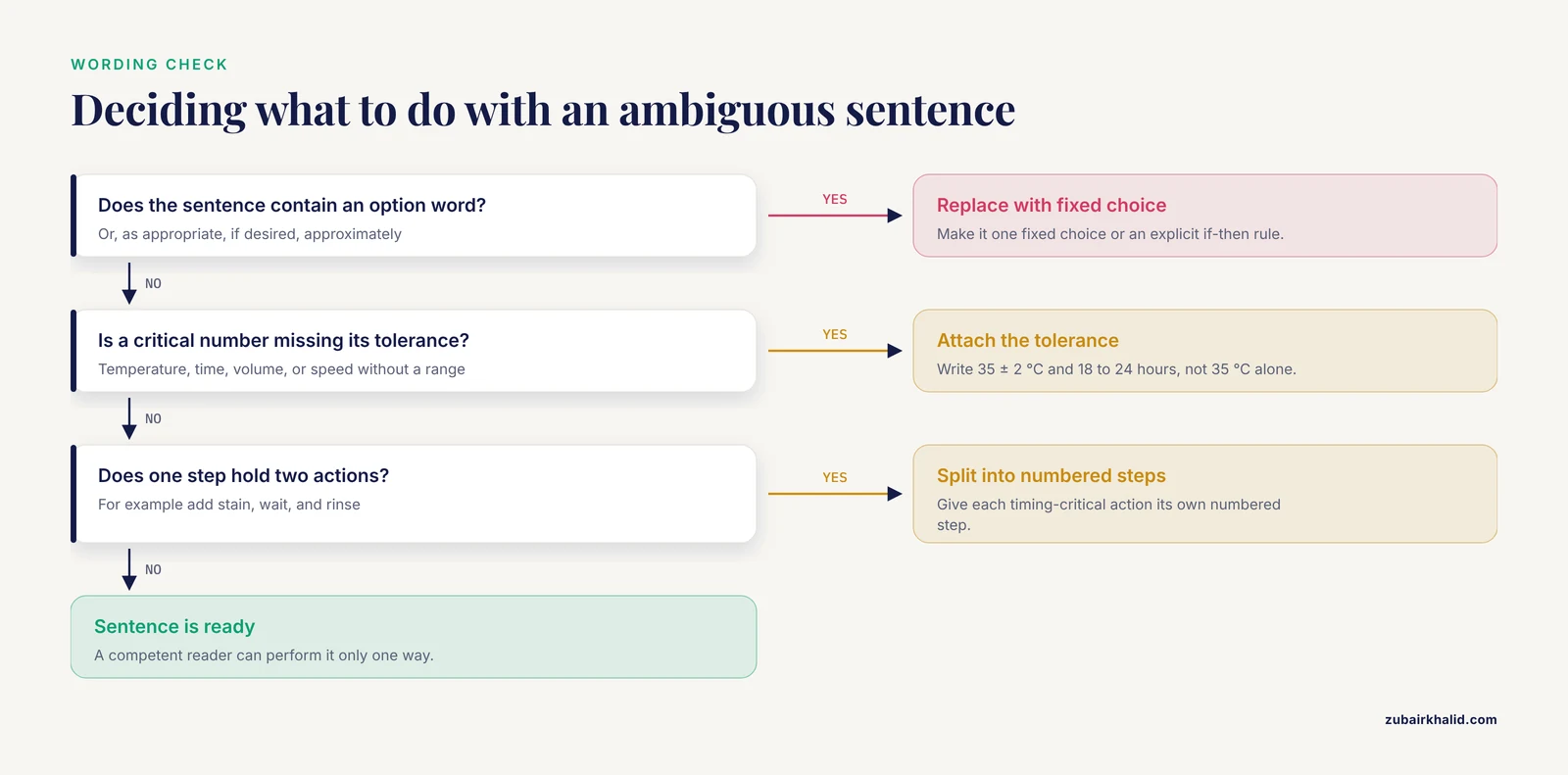
Before drafting, adopt a small set of writing rules and enforce them ruthlessly. These rules are the difference between a document that trains people and a document that people train around.
| Rule | Ambiguous version | Unambiguous version |
|---|---|---|
| One action per step | "Inoculate and incubate the plates" | "1. Inoculate each plate with 10 µL of the suspension. 2. Place plates inverted into the 35 °C incubator within 15 minutes of inoculation." |
| Measurable quantities | "Incubate until growth is visible" | "Incubate for 18 to 24 hours at 35 ± 2 °C in ambient air" |
| Fixed acceptance criteria | "Check that the control strain grows well" | "The control strain must show growth with a colony count of 50 to 150 CFU on the target plate. If the count is outside this range, quarantine the media lot and notify the supervisor." |
| No option words | "Use a sterile swab or loop as appropriate" | "Use a sterile polyester swab. Do not use wooden shafts." |
| Named responsible role | "The sample should be centrifuged" | "The receiving technologist centrifuges the sample at 3,000 × g for 10 minutes." |
| Single reading of timing | "Read results after overnight incubation" | "Read results between 18 and 24 hours after inoculation. Plates read before 18 hours are reincubated and read at 24 hours." |
| Defined terms | "Inoculate with a light inoculum" | "Inoculate to match a 0.5 McFarland standard, prepared as in SOP-MIC-014." |
Follow these tips throughout:
- Write in the present tense, active voice, imperative mood. "Centrifuge the tube." Not "The tube is then centrifuged" and certainly not "It is recommended that centrifugation be performed."
- Put critical numbers where the reader needs them, not in a separate parameters table that forces page flipping. Repeat the number at the step. Redundancy in an SOP is a feature.
- State the tolerance with the target. "35 ± 2 °C" and "18 to 24 hours" are acceptable. "35 °C" alone invites a fight over 37 °C.
- Write decision points as explicit if-then logic. "If the Gram smear shows fewer than 10 polymorphonuclear cells per oil immersion field, proceed to step 8.4. If 10 or more, proceed to step 8.5."
- Number every step and every substep so that deviations, training sign-offs, and audit findings can cite a specific line.
- Cross-reference other documents by their controlled document number, never by title alone, because titles get edited and numbers do not.
Materials and Tools for Writing the SOP
You do not need reagents to write the document, but you do need a defined toolkit. Incomplete toolkits are a common reason drafts stall.
| Item | Specification or purpose | Notes |
|---|---|---|
| Master SOP template | Approved institutional template with header, footer, revision block, and all required sections | Using the template from step one prevents restructuring later |
| Current procedure record | Whatever the bench actually does today, including sticky notes, cheat sheets, and verbal workarounds | Collect these before writing. They reveal real practice and hidden decision points |
| Manufacturer instructions for use | Package inserts and instrument manuals for every reagent, kit, and device in the procedure | The SOP may incorporate these by reference but must restate any parameter the operator controls |
| Method validation or verification summary | The study that established the laboratory can meet the manufacturer's performance claims | Acceptance criteria in the SOP must match what was verified |
| QC plan and control strain inventory | List of reference strains, control materials, and frequency of QC for each element | Ties the SOP to the laboratory quality management program |
| Risk assessment form | Biosafety and chemical hazard assessment for the procedure | Feeds the safety section directly |
| Document control system | Version-controlled repository with controlled distribution and obsolescence tracking | Paper, shared drive, or laboratory information system, as long as version authority is singular |
| Competent second reader | A qualified technologist who did not write the draft | Performs the verification read described later |
One caution on the hazard side before drafting begins. If the procedure involves viable organisms, know the containment level before you write the safety section. Writing biosafety handling requirements requires the risk assessment in hand, not memory.
Section-by-Section Procedure for Writing the SOP
Work through the following steps in order. Each step lists what to produce and the reason it exists. Skipping a step is a common mistake addressed later in this article, so the reasons are stated plainly.
Step 1. Create the header and document control block
Produce a header containing the document number, title, version or revision number, effective date, page number of total pages, and the department. Produce a footer with the review due date.
The reason: microbiology laboratories run dozens to hundreds of SOPs. The document number is the only stable identifier for training records, deviation reports, audit citations, and cross-references. A procedure cited as "the blood culture SOP" is unfindable the day someone retitles it. The review due date turns document control from a memory task into a scheduled task.
Step 2. Write the purpose in two sentences or fewer
State what the procedure accomplishes and, where relevant, the clinical or analytical purpose.
The reason: the purpose section settles scope disputes. When someone asks whether the SOP covers cerebrospinal fluid cultures, the answer should already exist on page one.
Step 3. Define the scope, including exclusions
State specimen types, assay or organism targets, and locations covered. State explicitly what is excluded and which document handles the excluded material.
The reason: exclusions are where ambiguity breeds. A urine culture SOP that does not say whether it covers suprapubic aspirates will eventually be applied to one.
Step 4. List definitions and abbreviations
Define every technical term a new graduate might not know, and every abbreviation used more than once. Define terms the laboratory uses with a local meaning, such as your convention for "endotracheal aspirate quality screening."
The reason: an undefined term is an instruction to guess. Definitions also protect the laboratory when terminology shifts across textbook editions.
Step 5. Assign responsibilities by role, not by name
State which role performs each phase of the procedure and which role approves deviations, reviews QC, and authorizes corrective action.
The reason: names leave the laboratory. Roles do not. Writing "the hepatitis B and C molecular testing technologist validates each run's internal control before releasing results" survives staff turnover, and it makes training checklists map directly onto the document.
Step 6. Write the materials, reagents, and equipment section
List every consumable, reagent, instrument, and software version required. For each reagent, state the required storage condition, the acceptance requirement (for example, lot verification or in-date status), and any preparation steps with concentrations.
The reason: this section is the supply chain of the procedure. Omitted items here become bench improvisations later, and improvised substitutions are a leading root cause in laboratory quality management incident reviews. For equipment, record the identifiers that matter for traceability, such as which incubator and which thermocycler, because calibration records attach to specific instruments.
Step 7. Write the safety section
State biosafety level, containment practices, required personal protective equipment, chemical hazards with handling and spill response, sharps handling, and decontamination methods with contact times.
The reason: this is a regulatory and ethical requirement, and it belongs inside the SOP, not only in a separate safety manual, because the technologist performing the steps reads the SOP. Handle this section with the same precision as the analytical steps. "Disinfect the work surface" is incomplete. "Wipe the work surface with a freshly prepared 1:10 dilution of household bleach (0.5 to 0.6 percent sodium hypochlorite), allow a contact time of at least 10 minutes, then wipe with 70 percent ethanol or water" is complete. Note the real hazards of your specific reagents, such as the flammability of ethanol used for flaming and fixation, the corrosivity of acid-fast decolorizers, and the toxicity of certain stain formulations.
Step 8. Write the step-by-step procedure
Write each action as a numbered, single-verb step with its critical parameters inline. Apply the phrasing rules from the table above. For every step, apply a three-part test before you move on:
- Can this step be performed only one way by a competent reader?
- Is every number, temperature, time, volume, and speed stated with its tolerance?
- Does the step say what to do if it cannot be completed as written?
The third test is the one most drafts fail. Real benches encounter clotted specimens, failed sterile checks, and instrument errors. Each of those situations needs a written branch, or the SOP needs to cite the deviation procedure by document number.
The reason: this section is the product. Everything else supports it. Ambiguity here produces inter-technologist variation that your QC program will eventually detect as unexplained drift, usually after weeks of untraceable results.
Step 9. Write the quality control section
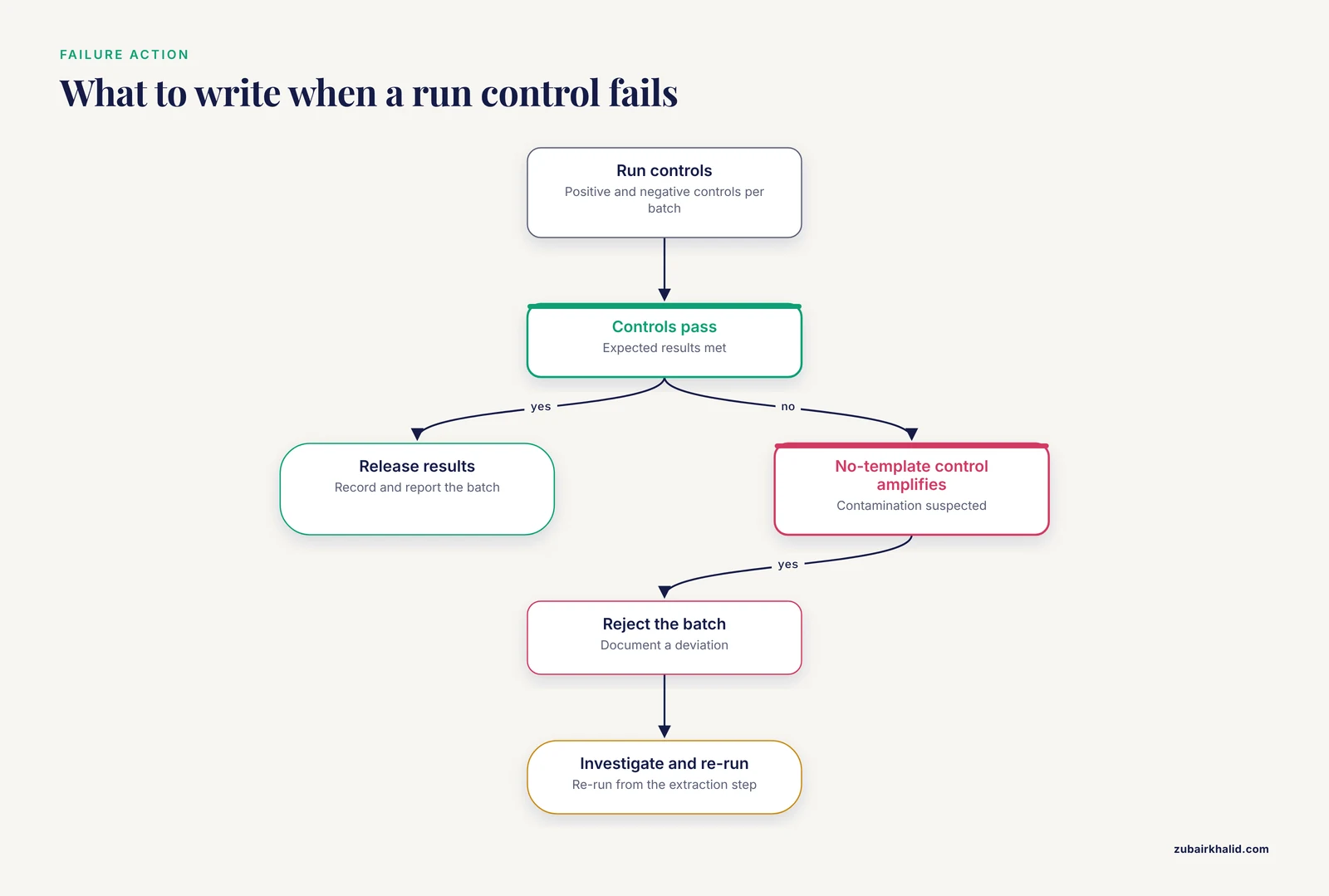
Specify every control, its expected result, its frequency, and the action when it fails. A microbiology QC section typically addresses several layers, and each layer needs its own acceptance criteria and failure action:
- Media and reagent QC. Sterility checks, growth or inhibition performance testing of each new lot with defined control strains, and stain QC (a known Gram-positive and Gram-negative control smear with each new lot and with each staining run, at the frequency your quality program sets).
- Positive and negative run controls. For amplified molecular procedures, the no-template control and a positive amplification control, run per batch.
- Internal and external process controls. For molecular assays, controls that monitor extraction and amplification together.
- Instrument QC. Temperature mappings, calibration status, and daily checks.
State the failure algorithm completely. "If the no-template control amplifies, reject the batch, document a deviation, investigate, and re-run from the extraction step" is an instruction. "Investigate contamination" is a hope.
The reason: microbiology quality control is only interpretable when the procedure it monitors is fixed. A run control failing on an ambiguous SOP tells you nothing, because you cannot distinguish a reagent problem from an operator-variation problem. QC and SOP precision are two halves of the same system.
Step 10. Write the expected results and interpretation section
Describe what a valid run looks like and how to read and record the result. Include photographs or reference descriptions where morphology matters, state the reporting vocabulary exactly, and define what constitutes an invalid run.
The reason: interpretation is where most subjective variation enters microbiology. The fix is not to eliminate judgment but to bound it. Specify the criteria, give examples of acceptable and unacceptable observations, and route everything outside those criteria to a defined escalation path.
A useful model comes from assays designed for visual readout. In the MCDA-lateral flow assay for hepatitis B and C discussed earlier, the result is read as visible lines on a lateral flow strip, an interpretation format that lends itself to binary SOP language, photograph examples, and a defined invalid pattern [1]. When you write the interpretation section of any visual-read assay, aim for that same level of definitional closure, including what the reader does when the control line is absent.
Step 11. Write the limitations section
State known interferences, specimen conditions that invalidate the result, analytical limitations, and conditions under which the method should not be used.
The reason: limitations protect patients and protect the laboratory. They also belong in the SOP rather than only in a validation report, because the bench is where the borderline specimen arrives.
Step 12. Write the troubleshooting table
Format every anticipated failure as three columns: symptom, likely cause, corrective action. Cover equipment faults, control failures, staining artifacts, contamination events, and atypical observations, each with an escape route. The troubleshooting table later in this article covers SOP-level failures. The troubleshooting table inside your SOP covers assay-level failures.
The reason: the moment of failure is the wrong time to design a response. A written fix converts a panic into a procedure and creates a record that feeds corrective action.
Step 13. Write the references and related documents section
Cite the method source, the validation report, related SOPs by number, and any standard methods referenced.
The reason: traceability. Every parameter in the procedure should be traceable to either the manufacturer's instructions, a validation study, or a standard method, and this section is where that chain is visible.
Step 14. Create the revision history and approval block
Build a table of revision number, date, section changed, summary of change, and authorizing signature. Reserve signature lines for author, technical reviewer, and quality officer or laboratory director as your policy requires.
The reason: the revision history is the institutional memory of the procedure. When a result is questioned two years later, the revision history establishes what the procedure said on the date in question, which is often the decisive fact.
Step 15. Verify the SOP at the bench before release
Hand the draft to a qualified technologist who did not write it. Have them perform the procedure using only the document. Every question they ask, every hesitation, and every improvised step is a defect in the document. Revise, then repeat until the reader completes the procedure without contacting the author. Document this verification run.
The reason: the author cannot see their own ambiguity. This single control catches more defects than any amount of self-review, and it converts the SOP from a description into a demonstrated, executable procedure.
Step 16. Approve, train, and release
Route the document for signatures, train affected staff with documented competency assessment, distribute controlled copies or controlled electronic access, and withdraw superseded versions from all work areas on the effective date.
The reason: an SOP that staff have not been trained on is not the laboratory's procedure in any defensible sense. Training records tied to document numbers are the evidence, and controlled distribution is what prevents an obsolete version from being followed during an inspection.
A Worked Example: Parameters That Translate Directly Into SOP Lines
To see the method in action, take a published procedure and rewrite its essential parameters as SOP text. The multiplex MCDA assay with gold nanoparticle lateral flow readout for hepatitis B virus and hepatitis C virus provides clean source material because the published description leaves almost nothing open [1].
| SOP element | Published parameter [1] | How it appears in the SOP |
|---|---|---|
| Amplification method | Multiple cross displacement amplification (MCDA), isothermal | Name the method in the purpose and principle sections, and state that no thermocycler ramping program applies |
| Reaction temperature | 64 °C | "Incubate the reaction at 64 °C. Do not substitute 60 °C or 65 °C. Verify the heat block with a thermometer traceable to the laboratory's calibration program at the frequency specified in SOP-EQP-xxx." |
| Incubation time | 35 minutes | "Incubate for 35 minutes from the moment the reaction reaches 64 °C. Start the timer only after the block temperature is verified at 64 °C." |
| Readout | Visual interpretation on a gold nanoparticle lateral flow biosensor | "Remove the biosensor strip and interpret visually within X minutes of development, per the interpretation criteria in section 10." (Set the window from the manufacturer's instructions and record it here, since the abstract does not state it.) |
| Targets | HBV S gene and HCV 5' untranslated region | State both targets in the scope and in the result interpretation, including what a single-target positive means for reporting |
| Performance context | Analytical sensitivity comparable to laboratory quantitative PCR, shorter turnaround, operational simplicity, no observed cross-reactivity with anatomically relevant non-target pathogens | Restate as verified expectations in the limitations and QC sections, and reference the validation or verification study that confirmed them in your laboratory |
Two lessons from this exercise. First, a procedure whose source publication fixes temperature, time, and readout writes up quickly, because the SOP author is transcribing decisions, not making them. Second, some parameters, such as the strip-reading window after development, may not be stated in every source. Those gaps must be filled from the manufacturer's instructions or a local verification run, and the SOP must record where the number came from. Never leave a gap blank and never fill it silently.
Controls You Run on the Document Itself
Laboratory quality management treats documents the way the analytical bench treats reagents. The SOP needs its own QC, and the controls are simple:
- The novice read-through. As described in step 15, a qualified non-author executes the procedure from the document alone. Pass criterion: completion without contacting the author, with all results falling within the documented acceptance criteria.
- The teach-back. The technologist explains the procedure back to the author in their own words, including the decision points. Pass criterion: no decision point is described differently from the way the SOP states it.
- The worst-case walkthrough. The author and reviewer deliberately walk the document through failure scenarios. What happens if the control fails at step 9, if the specimen is insufficient at step 3, if the instrument errors at step 6? Pass criterion: every scenario terminates in a written instruction or a cited deviation procedure.
- The consistency check. Search the document for option words (or, alternatively, as appropriate, if desired), for steps without numbers, and for terms not in the definitions section. Pass criterion: none remain.
How to read the outcomes. A failed novice read-through with questions clustered in one section indicates a localized ambiguity, and you revise that section. Questions distributed throughout the document indicate a style problem, and you revise the whole draft against the phrasing rules table. A failed worst-case walkthrough means the procedure lacks branch logic, which is a design gap rather than a wording problem, and it may require a conversation about scope before more writing is useful.
Troubleshooting: When the SOP System Fails
SOP problems at the program level present as recognizable symptoms. Match the symptom to the cause and apply the fix.
| Symptom | Likely cause | Fix |
|---|---|---|
| Technologists keep a personal "cheat sheet" at the bench | The SOP is incomplete, inconvenient, or contains steps that differ from real practice | Interview staff, find every divergence, and either correct the SOP to match verified practice or correct the practice to match the SOP. Then eliminate the cheat sheet by making the SOP usable at the bench |
| Two technologists produce different colony counts from the same specimen | A subjective step lacks numeric criteria or defined technique | Locate the step, add measurable criteria and technique detail, and re-run the novice verification |
| QC failures cluster on one shift | A step is time-sensitive or technique-sensitive and is executed differently across shifts | Time-stamp the critical steps in the SOP and observe both shifts performing the procedure. Revise the step to remove the sensitivity |
| The auditor cites a section that does not match current practice | Document drift. The SOP was not updated when the practice changed | Adopt a rule that any practice change triggers a revision before implementation, and audit adherence to that rule. Reconcile the document immediately |
| Staff follow an outdated version | Uncontrolled copies in the work area | Move to controlled electronic access or stamped controlled copies. Sweep the bench for obsolete versions on every release |
| New staff take far longer than expected to reach competency | The SOP assumes experience it should not assume, or training is reading-only | Add the missing detail, and pair document training with observed practical competency assessment |
| Deviation reports reference "the SOP" without a section number | Steps are not numbered, or staff were not trained to cite sections | Number every step and require deviation reports to cite document number and step number |
| The SOP is 40 pages and nobody reads it | Procedural content mixed with policy, education, and reference material | Split the document. Keep the SOP as the executable core, move background to a method summary, and put frequent lookups on a one-page bench aid |
Variations on the Standard Format
The full SOP format above is not the only useful document. Match format to function.
One-page bench aids. A condensed card of the most-used parameters, read from the full SOP, kept under the plastic sleeve at the workstation. It must carry the document number and version of its parent SOP and be reissued whenever the parent is revised. Never let a bench aid become the operative document.
Work instructions. For a narrow task inside a larger procedure, such as preparing a specific stain, a short work instruction referenced by the parent SOP avoids bloating the parent. The work instruction carries its own document number and revision cycle.
Form-driven SOPs. High-volume repetitive procedures, such as specimen accessioning, work best as a checklist or form with the SOP defining the rules and the form capturing the execution. The form then doubles as the record.
Molecular and point-of-care assay SOPs. Decentralized and rapid nucleic acid testing is an active area, and simplified platforms such as the isothermal MCDA-lateral flow format described for hepatitis B and C are intended for settings beyond the large central laboratory, including local clinics and field testing [1]. An SOP for this environment differs from a central laboratory document in one important way. The operator may have less microbiology background, so the SOP must carry more of the interpretive burden, including explicit photographs of valid and invalid results, a stricter handling of the invalid pattern, and simpler failure language. Operational simplicity in the assay itself raises, rather than lowers, the writing standard for the document [1].
Emergency or contingency procedures. Short documents covering what to do when the normal procedure cannot be performed, such as during an instrument outage. These follow the same numbering and approval discipline as ordinary SOPs, and they are typically reviewed more often because the conditions they address change.
Storage, Versioning, and Review
Treat released SOPs like dated reagents.
Version authority. One system holds the current effective version. Every printed or saved copy elsewhere is uncontrolled by definition and should carry a watermark or stamp saying so if paper distribution is used.
Review cycle. Set a review interval in the document control policy, commonly annual for active procedures, and trigger out-of-cycle reviews whenever equipment, reagent lot, method, or staffing structure changes. The review due date in the footer exists so the review happens by schedule rather than by crisis.
Retention. Retain superseded versions for the period your accreditation and legal requirements specify, archived and marked obsolete, never deleted. The superseded version is the document of record for results issued during its effective window.
Training linkage. Each released version generates a training event, and the training record cites the document number and version. When version 4 is released, staff trained on version 3 are due for retraining on the changed sections at minimum.
A note on stability of the underlying science. Methods evolve, and documentation should evolve with them. Rapid isothermal amplification formats with visual readout are an example of a technology whose simplicity and shortened turnaround have moved some testing out of centralized laboratories and toward local and decentralized settings [1]. When your laboratory adopts a method of this kind, the SOP release is the moment to retrain, re-verify competency, and retire any overlapping legacy procedure in the same action.
Common Mistakes and Limitations
These are the recurring defects seen in microbiology SOP reviews. Each one is avoidable at the drafting stage.
- Writing a description instead of an instruction. Narrative prose ("the sample is then carefully inoculated onto the medium") contains no parameters and assigns no actor. Rewrite in imperative steps.
- Leaving option words in place. "Or," "as appropriate," "if desired," and "approximately" transfer decisions from the author to the reader. Every option must become either a fixed choice or an explicit if-then rule.
- Missing tolerances. A temperature without a range, a time without a window, and a speed without a unit are all incomplete. Attach the tolerance at every critical parameter.
- Compressing two actions into one step. "Add 10 µL of stain, wait 1 minute, and rinse" buries a timing decision. Split it. Timing-critical actions deserve their own numbered step.
- Omitting acceptance criteria and failure actions. A QC section that says what to run but not what result is required, or what to do on failure, is decoration. Complete both halves for every control.
- Copying the manufacturer's insert verbatim. The insert describes the method as the manufacturer sells it. The SOP must describe your laboratory's verified implementation, including your instrument, your volumes, your incubation positions, and your local QC frequency. Incorporate the insert by reference for details the operator does not control.
- Undefined local terms. "Screen-positive," "acceptable growth," and "heavy inoculum" mean different things in different laboratories. Define them or delete them.
- No revision history or a history that says "updated." The revision record must say what changed and why, or it cannot support result traceability.
- Writing to the expert. An SOP that assumes the reader already knows the procedure will fail its novice verification every time. Write for the qualified technologist who is new to this specific procedure.
- Letting the document drift. The most damaging mistake in practice. The moment bench practice diverges from the released SOP, you have two procedures, one of which is undocumented and untrained, and your entire quality system is describing a fiction.
Limitations of this guide. This article describes a drafting and control method, not a substitute for your institution's document control policy, accreditation requirements, or local biosafety regulations. Specific acceptance criteria, control strain choices, and review intervals must come from your own validation work, your quality program, and the requirements that govern your laboratory. Individual cases, unusual specimens, and atypical results require judgment by qualified laboratory professionals and, where clinical interpretation is involved, the treating veterinarian or physician.
Frequently Asked Questions
How long should a microbiology SOP be?
As long as the procedure requires and no longer. A straightforward stain might need 4 to 6 pages, while a molecular assay with interpretation logic can exceed 15. Length is a defect when it comes from mixing in policy, background theory, and education that belong in separate documents.
Who should write the SOP?
The person who performs or supervises the procedure, working from the template and the verified bench practice. A technologist with current hands-on experience writes the most executable steps, and the quality officer contributes the document control framework. The author should never be someone who has not performed the procedure recently.
How often must SOPs be reviewed?
Follow your institution's policy, which commonly sets an annual review for active procedures, and always review out of cycle when equipment, reagents, method, or scope changes. The review due date belongs in the document footer so the review is scheduled rather than reactive.
What is the difference between an SOP and a work instruction?
An SOP defines the full procedure, its scope, responsibilities, QC, and failure actions. A work instruction covers one narrow task within or alongside a procedure, such as preparing a single reagent, and is referenced by document number from the parent SOP. Both require version control and approval.
How do I write an SOP for a new molecular assay?
Start from the published method or manufacturer insert, transcribe every fixed parameter (method, temperature, time, targets, readout), fill any gaps through local verification, then build the QC and failure-action sections around the assay's controls. A recent isothermal MCDA assay with lateral flow readout for hepatitis B and C shows the model, with amplification at 64 °C for 35 minutes and visual strip interpretation [1].
How detailed should QC and acceptance criteria be?
Detailed enough that any qualified technologist can judge pass or fail without consulting the author. Name the control material or strain, the frequency, the expected result with numeric limits where they exist, and the exact action on failure. If a limit is qualitative, define what meets it with photographs or concrete descriptors.
How do I handle deviations from an SOP?
Deviations are documented, not improvised. The SOP should cite the deviation procedure by document number, and staff should record the document number, step number, nature of the deviation, patient or sample impact, and corrective action. Recurring deviations on the same step signal that the SOP needs revision rather than repeated exception handling.
How do I train staff on a new SOP?
Combine a documented read-and-discuss session with observed practical performance against a competency checklist keyed to the SOP's step numbers, and record the training against the document number and version. Release the new version, withdraw the old one from all work areas, and schedule retraining for any future revision that touches critical steps.