Best Practices for Storing and Handling Commercial QC Microorganisms
By Dr. Zubair Khalid, DVM, MS, PhD ·
Commercial quality control (QC) microorganisms are standardized bacterial, fungal, or viral preparations, usually derived from well-characterized reference strains such as those maintained by ATCC, that laboratories use to prove their culture media, identification systems, antimicrobial susceptibility tests, and staining procedures are working correctly. Good storage and handling of these organisms achieves three things: it keeps the reference strain alive and true to its documented characteristics, it protects the traceability chain from the original lot to the tube you inoculate today, and it prevents QC failures that would otherwise force you to reject patient results and repeat runs. Handling these organisms well is a core discipline of microbiology quality control and a visible marker of a mature laboratory quality management program.
Use these practices every time a new QC lot arrives, every time you reconstitute or subculture a stock, and whenever you investigate an out-of-range QC result. The hands-on time for receiving, documenting, and storing a new lot is about 10 to 15 minutes. Reconstituting a lyophilized vial and confirming recovery takes roughly 15 to 20 minutes of active bench time plus an elapsed time of 24 to 72 hours for revival, incubation, and verification. Building a master and working stock system from a newly reconstituted strain adds another 30 to 45 minutes of hands-on work spread over one to two days.
Why Commercial QC Microorganisms Matter in Microbiology Quality Control
Every result a microbiology laboratory reports rests on an assumption that the system performed as designed. A catalase reagent could have lost activity, a disk could have degraded, a blood culture bottle could have been manufactured without the growth supplement. QC organisms are the only practical way to test those assumptions with a living, predictable challenge. When a laboratory inoculates a known strain and gets the expected result, that result validates the entire chain of media, reagents, instruments, incubation conditions, and technique.
This is why regulatory and accreditation frameworks, including CLIA in the United States and the ISO standards used by accredited laboratories, treat organism-based QC as a non-negotiable element of laboratory quality management. CLSI standards for microbiology quality assurance describe how reference strains should be selected, maintained, and used to monitor media and susceptibility systems, and manufacturers of commercial QC products document the required storage conditions and passage behavior in their package inserts. Those two documents, the applicable standard and the package insert, always take precedence over any general guidance, including this article.
The organisms themselves are chosen because they are stable, nonpathogenic or of low pathogenicity, widely available, and well characterized for specific reactions. In bacteriology, the workhorses include Escherichia coli ATCC 25922 and ATCC 35218, Staphylococcus aureus ATCC 25923 and ATCC 29213, Pseudomonas aeruginosa ATCC 27853, Enterococcus faecalis ATCC 29212, Streptococcus pneumoniae ATCC 49619, Haemophilus influenzae ATCC 49247, and Neisseria gonorrhoeae ATCC 49226, with Candida albicans ATCC 90028 and Cryptococcus neoformans among common fungal QC strains. Each strain carries documented expected reactions, such as zone diameter ranges for disk diffusion or MIC ranges for broth microdilution, that your laboratory compares against every time you run QC.
Materials and Equipment
Most of what you need is already on the bench. The table below lists the core materials for receiving, reconstituting, and maintaining commercial QC organisms, along with the working concentrations used for the most common preparations.
| Material | Working concentration or specification | Purpose |
|---|---|---|
| Sterile 0.85 to 0.9% sodium chloride | 0.85% NaCl in water, sterile | Reconstituting lyophilized pellets and preparing suspensions |
| Tryptic soy broth (TSB) or brain heart infusion broth | Standard formulation | Recovery of reconstituted organisms and broth subculture |
| Tryptic soy agar with 5% sheep blood | 5% defibrinated sheep blood | Revival plate, purity check, and stock maintenance for most bacteria |
| Chocolate agar | Heated agar base with hemoglobin and enrichment supplement | Fastidious organisms such as H. influenzae and N. gonorrhoeae |
| Glycerol, sterile filtered | 10 to 15% v/v final concentration in broth | Cryoprotectant for frozen master stocks |
| Sterile skim milk | 10% w/v | Alternative cryoprotectant for frozen stocks |
| McFarland 0.5 turbidity standard | 0.5 McFarland equivalent | Standardizing inoculum density for AST and identification testing |
| Sterile cryogenic vials | Polypropylene, screw cap with O-ring | Frozen stock storage |
| Incubators | 35 ± 2 °C ambient and 35 ± 2 °C with 5% CO2 | Incubation at the atmosphere each organism requires |
| Refrigerator and freezer | 2 to 8 °C and -20 °C or colder | Storage of unopened vials, slants, and frozen stocks |
| Ultra-low freezer | -70 °C or below | Long-term master stock storage |
| PPE | Laboratory coat, gloves, eye protection | BSL-2 biosafety compliance |
| Logbook or LIMS module | Lot number, expiration, passage number, dates, initials | Traceability and chain of custody |
Safety note. Most commercial QC organisms are supplied as attenuated or low-virulence reference strains, but they are still viable bacteria and fungi. Handle all reconstitution, subculture, and stock preparation in a certified biosafety cabinet with laboratory coat and gloves. Treat any spill as a viable biological spill and decontaminate with an appropriate disinfectant before cleanup.
Storage and Handling of Commercial QC Microorganisms Step by Step
The following procedure covers the full lifecycle of a commercial QC organism from delivery to routine use. Follow your manufacturer's package insert for strain-specific deviations, because storage temperature, reconstitution volume, and recovery medium vary by product format and organism.
Step 1. Verify Conditions on Arrival
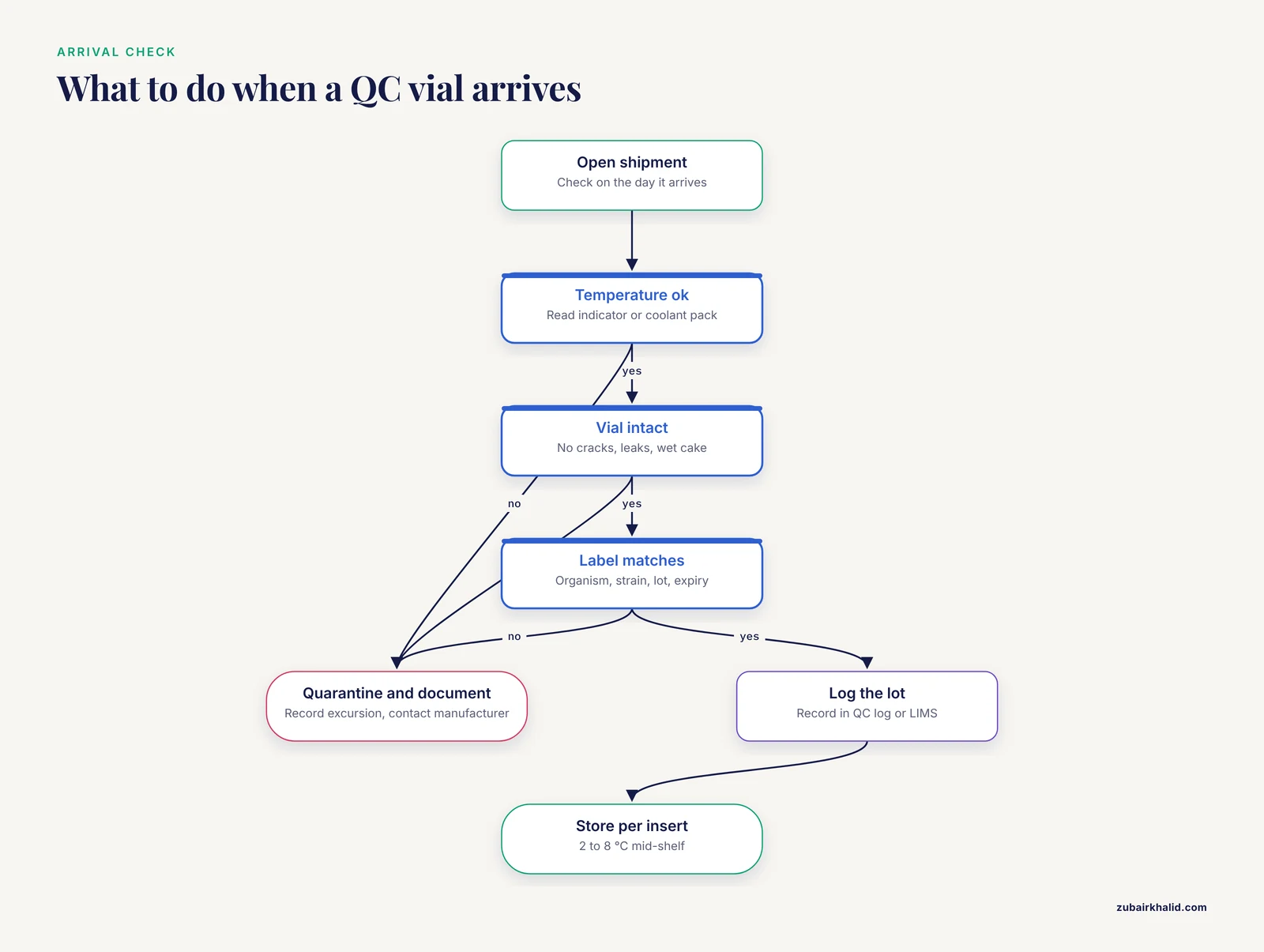
Open the shipment immediately on the day it arrives and check the temperature indicator or coolant pack if one is included. Inspect each vial for cracks, leaks, loss of vacuum, or a shifted and wetted lyophilized cake. Confirm that the label matches your order with respect to organism, ATCC or equivalent strain number, lot number, and expiration date.
Reason for this step. A QC organism that has thawed, overheated, or absorbed moisture during shipping has already lost part of its shelf life before it ever reached your shelf, and a label mismatch destroys the traceability your QC records depend on.
Step 2. Document the Lot in Your Quality System
Before the vial leaves your hand, record the organism, strain designation, lot number, expiration date, date received, receiving condition, and storage location in your QC log or laboratory information system. Assign the lot an internal identifier if your system uses one.
Reason for this step. Regulators and assessors expect a complete chain of custody for every QC material. If an assay fails QC three months from now, the first question will be which lot of which organism was used and under what conditions it was stored.
Step 3. Place the Vial in Its Correct Storage Location
Transfer the vial to the storage condition stated in the package insert, most commonly a 2 to 8 °C refrigerator for lyophilized materials, or -20 °C or colder for certain frozen formats. Use a monitored refrigerator or freezer with continuous or at least daily temperature recording. Store the vial away from the door, away from the compressor line, and never in a door shelf where temperature swings are largest.
Reason for this step. Repeated small thermal excursions kill organisms slowly and invisibly. A vial that sits in a warm door shelf experiences a daily cycling stress that a monitored mid-shelf position avoids.
Step 4. Assemble and Prepare Materials
Before opening any vial, gather sterile saline or broth, the correct recovery and purity media, sterile loops and pipettes, a labeled tube rack, and biohazard waste containers. Warm sealed media plates to room temperature to reduce condensation.
Reason for this step. Once a lyophilized vial is opened, the rehydration clock starts. Everything should be ready so the pellet spends its first moments of life in fresh medium rather than sitting dry on the bench.
Step 5. Reconstitute the Lyophilized Pellet
Remove the cap under appropriate containment, add the volume of sterile 0.85% saline or specified broth called for in the package insert, typically delivered down the wall of the vial rather than directly onto the pellet. Allow the pellet to hydrate for a few minutes, then mix gently by inversion or slow pipetting. Avoid prolonged, violent vortexing.
Reason for this step. Gentle hydration lets the lyoprotectant dissolve evenly and keeps mechanical shear low while the organisms are still in a fragile, freshly revived state. Direct-stream addition can splash a portion of the inoculum out of reach and reduce your effective concentration.
Safety note. Open vials only inside a biosafety cabinet. Aerosols generated during reconstitution of a live organism are an exposure risk even with attenuated strains.
Step 6. Recover the Organism in Rich Medium
Transfer the entire reconstituted suspension to a tube of TSB or inoculate a blood agar plate directly, depending on the insert. Incubate at 35 ± 2 °C for 18 to 24 hours, using 5% CO2 for organisms that require it, such as S. pneumoniae, N. gonorrhoeae, and H. influenzae.
Reason for this step. Lyophilized cells need a recovery period in nutrient-rich medium to repair membrane damage and resume division before they can express the biochemical reactions your QC depends on.
Step 7. Perform a Purity Check
After incubation, examine the plate for a single uniform colony type matching the expected morphology, and confirm identity with a Gram stain and a rapid spot test or the identification panel your laboratory uses. Reject the reconstitution if more than one colony morphology is present.
Reason for this step. A mixed or misidentified stock invalidates every downstream QC result it touches. The purity check is the single cheapest safeguard in the whole system.
Step 8. Verify Expected Reactions
Challenge the recovered organism with the reactions listed in the package insert or your procedure manual, for example catalase and coagulase for S. aureus ATCC 25923, oxidase negativity and lactose fermentation for E. coli ATCC 25922, or optochin susceptibility for S. pneumoniae ATCC 49619. Only after the reactions match the documented profile should the strain be released for routine QC use.
Reason for this step. Viability is not the same as phenotypic fidelity. An organism can grow well and still fail its expected reactions if it was damaged, mislabeled, or contaminated.
Step 9. Establish a Master Stock
From the verified recovery culture, prepare a master stock that will rarely be touched. Common approaches are multiple agar slants stored at 2 to 8 °C, or frozen vials of organisms suspended in broth containing 10 to 15% v/v glycerol or 10% w/v skim milk, stored at -70 °C. Label each vial with organism, strain, lot, passage designation (passage 1 from the original), date, and operator.
Reason for this step. The master stock is your bank. Every future working culture should trace back to it, so it must be prepared from a freshly verified, pure culture and then disturbed as little as possible.
Step 10. Establish Working Stocks from the Master
Subculture from the master stock to prepare a limited number of working stocks, such as monthly slants or weekly plate cultures. Track the passage number on every generation. A widely used convention in microbiology quality control is to allow no more than five passages from the original reference preparation before the line is retired and a fresh vial or frozen master is used.
Reason for this step. Every passage is an opportunity for mutation, selection, or contamination. Limiting the number of generations keeps the organism close to the phenotype the manufacturer verified.
Step 11. Standardize Inoculum Density at the Bench
When the working culture is used for susceptibility QC, prepare a suspension adjusted to a 0.5 McFarland standard in sterile saline or broth, using a photometric device or careful visual comparison against the standard. Use the suspension within the timeframe your procedure allows, generally the same working session.
Reason for this step. Zone sizes and MICs are density dependent. An under-inoculated or over-inoculated suspension produces out-of-range results that look like a system failure when the fault is in the suspension.
Step 12. Log Every Transfer
Each time a vial is opened, a slant is subcultured, or a stock is used, record the date, passage number, operator, and purpose. A QC organism without a complete transfer history is, for audit purposes, an unidentified organism.
Reason for this step. Passage drift and contamination most often surface as patterns across multiple failures. Those patterns can only be detected if the transfer history exists.
Step 13. Minimize Ambient Exposure of Unopened Vials
Retrieve a vial from storage only when you are ready to use it, and return it promptly. Do not set lyophilized vials on the bench during setup of other work.
Reason for this step. Moisture uptake is a silent killer of lyophilized products. Research on the storage stability of hydrophilic polymeric materials shows how strongly retained moisture changes material behavior over time, and the same environmental mechanism, hydration of a hygroscopic preparation, drives viability loss in dried QC pellets [1].
Step 14. Dispose of Spent Materials Properly
Discard exhausted working cultures, used reconstitution vials, and contaminated plates as biohazardous waste. Decontaminate by autoclaving or by an approved chemical disinfection step before the material leaves the laboratory. Workflows that recover or route potentially contaminated medical materials have been evaluated for hygiene risk and show that closed containers, wipe disinfection, and thermal treatment of the waste stream keep infectious risks to workers and the environment negligible [2].
Reason for this step. Discarded viable QC organisms are a genuine, if low, biosafety and environmental exposure, and disciplined disposal is part of the same quality system that governs their storage.
Principle: Why Handling Changes QC Organism Performance
A commercial QC organism is a living population, not a reagent with a fixed chemical identity. Its performance depends on the physiological state of the cells at the moment you use it. Three mechanisms dominate.
First, viability loss. Dried and frozen cells accumulate membrane and protein damage with time, and the rate of that damage rises steeply with temperature and moisture. This is why lyophilized products are held at 2 to 8 °C rather than room temperature, and why repeated freeze-thaw cycles are so destructive. Thermal processing is known to alter the integrity of sensitive biological materials, which is why heat-based workflows must be validated for the material they touch rather than assumed harmless [3].
Second, passage drift. Each subculture is a round of selection. Cells that grow fastest on the maintenance medium outcompete the rest, and small genotypic or epigenetic changes can shift reactions that matter for QC, such as antibiotic susceptibility, hemolysis, or carbohydrate fermentation. The passage limit exists because drift is cumulative and unpredictable.
Third, phenotypic state effects. Many QC reactions depend on growth phase, atmospheric conditions, and media batch. An organism taken from an overgrown 72-hour plate may give different zone sizes than the same organism taken from an 18 to 24-hour plate, even though both are alive and pure. Handling routines that standardize incubation time, atmosphere, and inoculum density are therefore as much a part of quality control as the organism itself.
Controls, Expected Results, and How to Read Them
In daily microbiology quality control, the QC organism is itself the control, but there are internal checkpoints you should be reading at every level.
On Reconstitution
Expected results are visible growth of a single colony morphology within 24 to 48 hours on the appropriate medium, correct Gram reaction on stain, and a match to the documented reactions for the strain. For example, E. coli ATCC 25922 should appear as gray, lactose-fermenting colonies on MacConkey agar, be oxidase negative and indole positive, and produce inhibition zone diameters within the published QC range when tested against the standard disk panel. S. aureus ATCC 25923 should be catalase positive, coagulase positive, and beta-hemolytic on sheep blood agar. If recovery is slow, check whether the organism is one of the intrinsically slow or fastidious species, such as N. gonorrhoeae, which legitimately needs CO2, humidity, and enriched medium.
On Routine QC Runs
When the organism is used against a test system, read results against the published expected range, not against a single target value. For disk diffusion and MIC methods, the published ranges are deliberately broad because they capture the acceptable day-to-day and lab-to-lab variation of the method. A result within range means the system passed. A result outside range means the run is rejected for that antimicrobial agent or test, an investigation is opened, and patient reporting is held until corrective action and repeat QC succeed.
On Trend Monitoring
Modern laboratory quality management treats individual QC results as data points in a trend, not isolated pass or fail events. A zone size drifting steadily downward over several weeks with results still inside range is an early warning that the organism stock, the disk lot, or the incubation conditions are changing. Levey-Jennings style plotting of continuous measurements and simple run charts for categorical QC results make these trends visible before they become failures. Peer comparison and visible performance feedback have been shown to improve adherence to facility protocols in clinical settings, and the same mechanism works when QC performance scorecards are reviewed with the bench staff [4].
Troubleshooting
| Symptom | Likely cause | Fix |
|---|---|---|
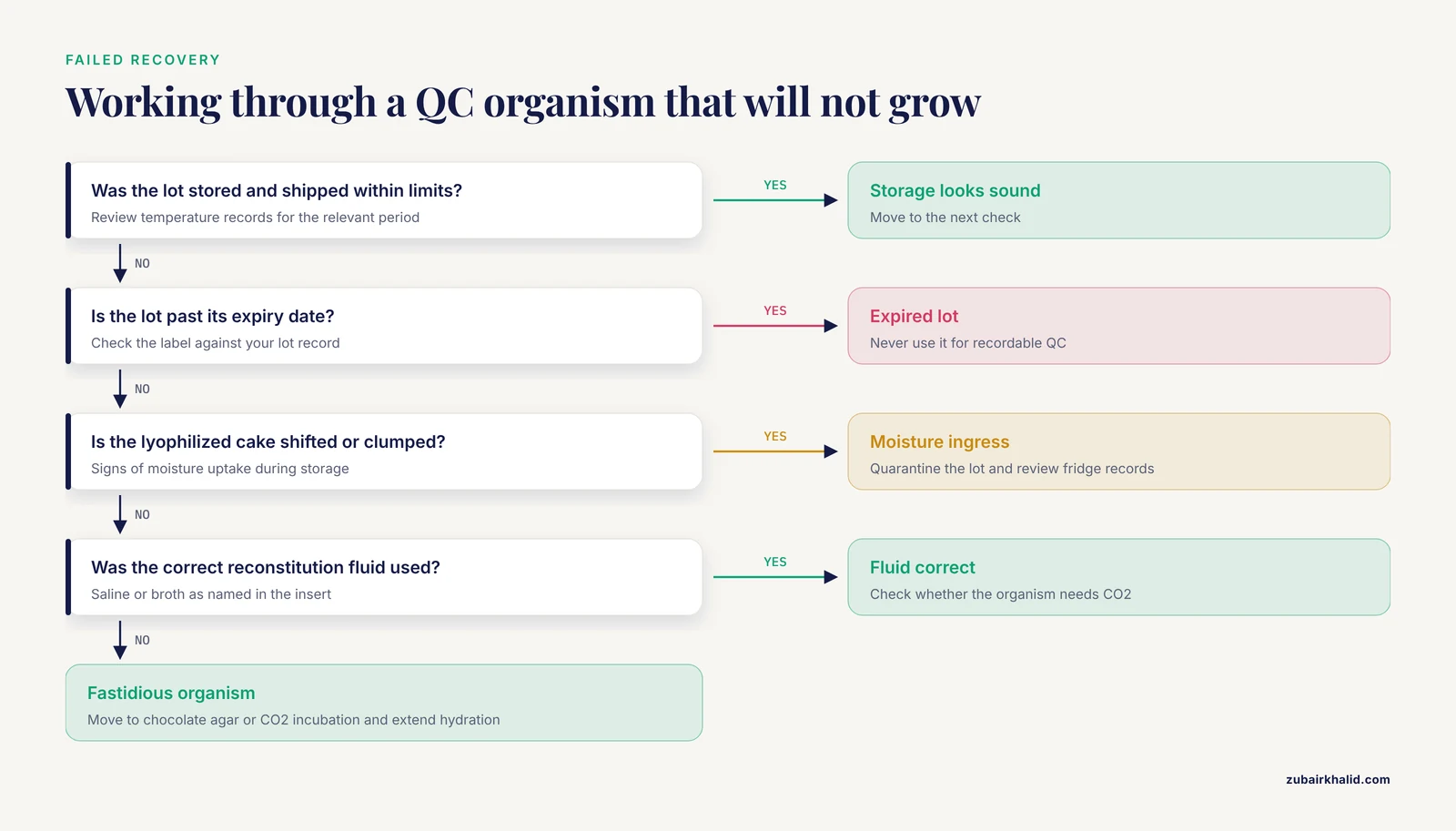
| No growth 48 hours after reconstitution | Vial exceeded storage temperature limits, expired lot, moisture ingress during storage, wrong reconstitution fluid | Check storage and shipping records, discard the vial, open a new one with fresh sterile saline or the fluid named in the insert |
| Slow or scanty growth | Organism requires CO2 or enriched medium, plate too cold, pellet incompletely hydrated | Move to chocolate agar or CO2 incubation as appropriate, extend hydration time, verify incubator temperature and atmosphere |
| Mixed colony types on purity plate | Contaminated reconstitution technique, contaminated sterile fluid, breached vial | Discard the reconstitution, review aseptic technique, test a fresh vial with a new aliquot of sterile medium |
| Expected biochemical reactions do not match | Passage drift, mixed culture, mislabeled vial, reagent failure | Repeat the purity check, revert to the master stock, retire the working stock if reactions still fail |
| AST zone sizes out of range with an in-date organism | Inoculum density wrong, suspension too old, disks degraded, incubation atmosphere wrong | Recheck the 0.5 McFarland suspension, use a fresh working culture, verify disk storage and incubator CO2 |
| Frozen stock fails after months at -20 °C | Non-frost-free requirement violated, thaw-refreeze cycles, inadequate cryoprotectant | Move master stocks to -70 °C, aliquot in single-use volumes, confirm final glycerol concentration of 10 to 15% |
| Lyophilized vial cake discolored, shifted, or clumped | Moisture uptake or thermal abuse during storage | Quarantine the lot, review refrigerator temperature records, obtain a replacement lot |
| Fastidious organism fails weekly QC but others pass | CO2 incubator or supplemented medium problem | Verify incubator gas concentration, medium supplement lot, and humidity, then challenge with a fresh working stock |
Practical Tips for Daily Use
Aliquot once, freeze forever. Prepare frozen master stocks in small single-use aliquots so no vial is ever thawed twice. Each freeze-thaw cycle kills a fraction of the population and stresses the survivors.
Separate master and working stocks physically. Keep the master stock box in a different freezer or at least a clearly separated, differently colored rack. Accidental exhaustion of the master stock because someone grabbed it for a routine working culture is one of the most common and most avoidable QC failures.
Write the passage number on every tube, every time. A tube labeled only with the organism name cannot be audited for drift. Passage tracking takes seconds and answers the first question in every QC investigation.
Let the package insert be the tiebreaker. Storage temperature, reconstitution volume, and recovery medium vary between manufacturers and between product formats from the same manufacturer. When your general SOP and the insert disagree, the insert for that lot governs, and the SOP should be updated to reflect it.
Treat procedures as living documents. Studies of infection prevention practice during the COVID-19 crisis documented how guidelines were repeatedly read, tested, and rewritten as real conditions emerged, and identified that rewriting itself as a source of organizational resilience [5]. Your QC handling SOP should be revised the same way whenever an investigation reveals a gap.
Plan the calendar. Schedule reconstitutions, stock rotations, and expiration reviews in the LIMS or on a visible bench calendar. QC organisms that expire unnoticed mid-run are a self-inflicted failure mode.
Variations by Product Format
Lyophilized Vials and Pellets
The classic format. Long shelf life at 2 to 8 °C, single or multiple use depending on the fill, requires reconstitution and a recovery step. Best for laboratories building their own master and working stock system and for low-volume QC needs.
Rehydrated Stabilized Suspensions
Some manufacturers ship organisms already suspended in a stabilizing medium, ready to plate directly. These trade some shelf life for convenience and usually require refrigeration. The purity check and reaction verification steps still apply, because the laboratory rather than the manufacturer performs the first subculture.
Encapsulated and Microencapsulated Preparations
Certain formats embed organisms in a protective matrix that dissolves at use. The protective principle is the same one exploited in food and pharmaceutical technology, where microencapsulation of labile bioactive agents preserves their activity through storage and delivers them on demand, an approach demonstrated for essential oil microcapsules in coating systems [6]. For the laboratory, the practical consequences are simple, keep the product dry, follow the stated storage temperature, and expect a short revival period after the matrix is hydrated.
Frozen Quantitated Preparations
Some products, notably the colony-forming-unit preparations used for blood culture bottle QC and quantitative challenge studies, ship frozen and are used to deliver a defined inoculum. These demand the strictest temperature discipline because their value lies in the number, not just the identity, of the organisms. Any thaw event outside the validated window compromises the quantitation.
In-House Prepared Stocks
Some laboratories maintain their own long-term stocks from clinical isolates characterized against reference strains. This is acceptable for many applications but is not a substitute for the commercial reference strains in the QC protocols that specify them, and it introduces the burden of full characterization and documentation onto the laboratory.
Storage and Stability Notes
The unopened product shelf life is defined by the manufacturer and stated on the label. Never use an expired QC organism for recordable QC, because the expected results printed in the insert were validated only within the shelf life.
Refrigerated storage at 2 to 8 °C is the default for lyophilized and stabilized suspension formats. Maintain continuous temperature monitoring and review excursion records before using any vial from a period when the monitor logged an out-of-range event.
Frozen storage discipline matters more than absolute temperature for working stocks. At -70 °C or below with an adequate cryoprotectant, bacterial master stocks remain stable for years. At -20 °C, stability is shorter and depends heavily on the freezer type, because auto-defrost freezers cycle above freezing and damage cells. Never store QC stocks in a frost-free -20 °C freezer if an alternative exists.
After reconstitution, most products are meant to be used immediately or within a short window defined by the insert. If your workflow requires holding a reconstituted suspension, validate the hold time and temperature locally before adopting it.
Record the cumulative open time and any deviations in the lot record. Stability claims assume the product was stored as labeled, and a documented excursion changes the risk calculation even when the organism still seems to perform.
Waste Disposal and Decontamination
Spent QC cultures, reconstituted vials, and contaminated plates are biohazardous waste. Autoclaving is the default terminal treatment, and chemical disinfection with an approved agent is the alternative for materials that cannot be heat treated. A formal hygiene evaluation of a hospital raw-material recovery workflow found that when contaminated devices were wipe disinfected, held in closed boxes, and steam disinfected before leaving the facility, risks to workers and the environment were negligible [2]. The lesson transfers directly. Decontaminate at the point of generation, contain the waste in closed biohazard containers, and let the terminal treatment, not the trash can, be the barrier.
Safety note. Never pour live bacterial suspensions into the drain. Never autoclave sealed vials that may contain gas or liquid under pressure, vent or open them first according to your facility's sharps and sealed-container policy.
Common Mistakes and Limitations
Storing lyophilized vials in the refrigerator door. Door shelves see the widest temperature swings in any refrigerator. Move them to a mid-shelf position behind a labeled divider.
Ignoring the package insert. The most frequent serious error is applying a generic procedure to a product whose insert specifies something different, such as a different reconstitution fluid or a colder storage temperature. The insert is the validated instruction for that lot.
Unlimited passaging of working stocks. Continuing to subculture the same working tube for months, without passage limits, produces an organism that no longer represents the reference strain. Enforce the passage limit, commonly five or fewer passages from the original preparation, and retire the line when it is reached.
Skipping the purity check. Assuming a recovered organism is pure because it grew saves two minutes today and costs a week of invalid QC next month.
Using expired vials for recordable QC. An expired organism may still grow, which makes the error tempting. The expected results were validated only through the expiration date, so a passing result on an expired lot proves nothing.
Reconstituting and immediately subculturing without verification. Releasing a strain into routine use on the strength of growth alone, without checking documented reactions, allows a mislabeled or drifted organism to silently poison your QC records.
Missing the link between QC results and corrective action. A failed QC result that is recorded and never investigated is worse than no result at all, because it creates a false paper trail of surveillance. Every out-of-range result needs a documented investigation and a resolution before patient results are released.
Assuming a laboratory quality management program substitutes for bench discipline. A quality manual, training records, and competency assessments establish the framework, but storage and handling quality is decided at the bench, one vial at a time. Formal training that develops critical thinking rather than rote compliance has been shown to improve how staff reason through unfamiliar situations in medical science education [7], and QC organism handling rewards exactly that kind of reasoning.
One limitation belongs in every QC plan. Commercial reference strains verify that a system performs for known, stable, well-characterized organisms. They cannot predict performance against unusual clinical isolates with atypical phenotypes, and individual problem cases require the judgment of a qualified microbiologist or consulting specialist.
Training and Competency
Every person who touches a QC organism needs documented initial training and periodic competency assessment. The most effective training goes beyond a checklist. Case-based learning approaches, which walk trainees through real QC failures and require them to reason from observations to causes, have been shown to cultivate critical thinking dispositions in medical science education [7]. Build your competency program around scenarios like an out-of-range zone size, a contaminated purity plate, and a storage excursion, and require the trainee to propose and defend a corrective action.
Pair competency assessment with performance visibility. The peer comparison literature in clinical settings shows that visible, individualized feedback improves protocol adherence measurably, an effect demonstrated with monthly report cards in a military emergency department quality improvement project [4]. A simple monthly QC scorecard per bench, reviewed in the section meeting, applies the same mechanism to organism handling and to the timeliness of QC runs.
Frequently Asked Questions
How long can commercial QC microorganisms be stored before they expire?
The shelf life is set by the manufacturer and printed on the label, and it varies widely by format, from several weeks for some rehydrated suspensions to years for lyophilized vials held at 2 to 8 °C. Follow the package insert and never use an expired lot for recordable QC.
Can I refreeze a thawed QC stock?
No. Thawing starts irreversible membrane damage and each additional freeze-thaw cycle kills more organisms and shifts the surviving population. Prepare single-use aliquots so a vial is thawed exactly once.
How many passages are allowed from the original QC strain?
A widely used convention in microbiology quality control limits subculture to five or fewer passages from the original reference preparation. Check the passage limit stated by your manufacturer and record the passage number at every transfer.
What temperature should I store lyophilized QC organisms at?
Most lyophilized QC organisms are stored at 2 to 8 °C, but a minority of products require colder storage after opening or a different condition altogether. The package insert for your specific lot is the authoritative source, not general practice.
Why did my QC organism fail to grow?
The most common causes are thermal abuse during shipping or storage, an expired lot, moisture uptake in a lyophilized vial, the wrong reconstitution fluid, or a fastidious organism incubated without CO2 or enriched medium. Work through those five in order and check your temperature monitoring records for the relevant period.
Do I still need to verify a ready-to-use QC product?
Yes. Ready-to-use formats remove the reconstitution step but not the verification step. Confirm the growth, purity, and expected reactions before releasing the strain into routine QC use, because your laboratory performed the first handling of the organism.
Can I use clinical isolates instead of commercial QC strains?
For some internal purposes, such as extra challenge material, a characterized clinical isolate is acceptable. For the QC protocols that specify a reference strain, use the commercial strain, because the expected results published in your methods were generated with those defined organisms and an uncharacterized isolate cannot support the same claim.
What should I do if a QC organism arrived at room temperature?
Quarantine the vial, document the excursion in your lot record, and contact the manufacturer before use. Some organisms and formats tolerate brief ambient exposure while others do not, and only the manufacturer can confirm whether the specific lot remains within its validated storage history.
Sources
- Physicochemical and Functional Properties and Storage Stability of Chitosan-Starch Films Containing Micellar Nano/Microstructures with Turmeric and Hibiscus Extracts.
- Hygienic evaluation of the Resourcify GmbH concept for recovering raw materials from recyclable medical devices after surgery.
- Accuracy and Sterilizability of In-House Printed Patient-Specific Aortic Model for Surgeon-Modified Stent Grafts-A Workflow Description for Emergency Aortic Endovascular Procedures.
- Peer Comparison Improves Guideline Adherence for Urinary Tract Infection in a Military Emergency Department: A Quality Improvement Project.
- Mediating scarcity in pandemic times: an ethnographic study on the prevention and control of SARS-CoV-2 infections during the emergence of the corona crisis in the Netherlands.
- Effect of Protocatechuic Acid-Grafted Chitosan-Based Coatings Enriched With Clove Essential Oil Microcapsules to Improve the Postharvest Quality of Cherry Tomatoes.
- Using Nobel Prize case-based learning in Medical Immunology to cultivate critical thinking dispositions for medical undergraduates.