Stability Testing of Microbiology Quality Control Materials
By Dr. Zubair Khalid, DVM, MS, PhD ·
Stability testing of microbiology quality control materials establishes, with data, that a control material keeps its defined performance characteristics from the day it is prepared or opened until the day its expiry is claimed. A quality control material (QCM) is a specimen or solution analyzed for quality control purposes within a test system, and it only protects patient results if it behaves the same way on day 300 as it did on day 1. Stability testing is how a laboratory proves that before trusting the material at the bench.
This guide walks through the principle, the materials, a step-by-step procedure, controls, expected results, troubleshooting, and the mistakes that most often invalidate a stability study. Plan on a few hours of hands-on work at each assay time point. The elapsed time is longer, usually several weeks for short-term stability claims and the full claimed shelf life for long-term studies, because the material must simply sit under its storage conditions between measurements.
What Stability Testing Accomplishes
Stability testing answers three questions about a QCM:
- Does the measurand (the analyte being measured, such as a viable organism count, an antigen, or a nucleic acid target) hold its assigned value over time?
- Does the material survive realistic handling, including temperature excursions, shipping, and repeated freeze-thaw cycles?
- Over what period, and under which storage conditions, can the laboratory confidently assign an expiry date?
Without this evidence, a laboratory is guessing. A control that drifts quietly can pass routine daily QC checks one day and fail them the next, and the laboratory cannot tell whether the assay or the control failed. A stability study separates those two possibilities in advance.
When to Perform Stability Testing
Run a stability study in these situations:
- When a laboratory prepares its own QCM, whether that is a batch of culture media, a stained slide set, an antimicrobial disk panel, or a molecular control. ISO Guide 80 provides the framework for in-house preparation of quality control materials and treats stability assessment as part of that work [1].
- When a new lot of a commercial QCM is received and the laboratory wants independent confirmation of the manufacturer's claims before switching.
- When storage conditions change, for example moving a material from a 4 °C refrigerator to a -20 °C freezer, or after a documented refrigerator failure.
- Before distributing materials to other laboratories, as in an external quality assessment (EQA) program. Stability data are a prerequisite for shipping, because participants receive and test material days after dispatch.
- When routine QC shows unexplained drift and the material itself is a suspect.
Internal and external quality control processes are recognized as good laboratory practice and as an essential component of a quality management system in diagnostic microbiology, yet surveys have shown that many laboratories operate without structured QC programs or written standard operating procedures [2][3]. A documented stability study closes one of the largest gaps in that structure.
Principle
Stability is demonstrated by storing representative samples of a QCM under defined conditions, pulling them at planned time points, assaying them with a validated method, and comparing the results against the value assigned at time zero. The design rests on three pillars.
Homogeneity first. A stability study on a non-homogeneous lot measures bottle-to-bottle variation, not degradation. Homogeneity testing, done before or in parallel with the stability study, confirms that aliquots drawn from different parts of the lot give results within the accepted uncertainty. Modern molecular QCMs illustrate how far homogeneity can be pushed. A cell-line-based Chlamydia trachomatis QCM was engineered to carry the full cryptic plasmid plus the major outer membrane protein gene, a 9,136 bp insert, at a confirmed copy number verified by real-time quantitative PCR, and the resulting material showed excellent homogeneity and non-infectiousness [4]. An HIV-1 pseudovirus QCM likewise demonstrated excellent homogeneity and absence of matrix effects before its stability claims were made [5].
Time-course design. Stability is a function of time and temperature. The classical model is a first-order degradation, where the measurand declines proportionally to its current concentration. In practice, microbiology QCMs often fail abruptly rather than gradually, especially viable-organism materials, so the study must be designed to catch both drift and sudden loss.
Handling realism. A material that is stable for 12 months at -80 °C but dies after two freeze-thaw cycles is not stable for a laboratory that aliquots from a single vial. Freeze-thaw and short-term temperature-hold challenges are therefore part of the study, not an afterthought. The HIV-1 pseudovirus study made this explicit by testing stability for 7 days at 4 °C and -20 °C and by demonstrating tolerance of up to five freeze-thaw cycles [5]. A SARS-CoV-2 lentiviral reference material was evaluated after one freeze-thaw cycle at -80 °C followed by 7 days of incubation at 4 °C or 25 °C [6].
Materials, Reagents, and Equipment
The exact list depends on the QCM type. The table below covers the core requirements for a molecular QCM study, which is the most common in-house stability project in modern laboratories, with notes for other material types in the Variations section.
| Item | Specification / working condition | Purpose in the study |
|---|---|---|
| QCM lot | Single homogeneous batch, prepared or purchased as one lot | Every aliquot in the study must come from one lot so that lot variation cannot masquerade as degradation |
| Aliquoting vessels | Sterile cryovials or screw-cap tubes, individually labeled with lot, condition arm, and time point | Allows destructive single-use sampling so repeated handling does not bias later time points |
| Low-temperature storage | -80 °C freezer for long-term arm; -20 °C freezer as a comparative arm where used | Time-zero reference storage and long-term condition arm; -80 °C then 4 °C or 25 °C hold was used in a lentiviral SARS-CoV-2 QCM study [6] |
| Refrigerated storage | 4 °C refrigerator, temperature-logged | Short-term stability arm; demonstrated for 7 days in both an HIV-1 pseudovirus QCM [5] and a SARS-CoV-2 lentiviral QCM [6] |
| Room-temperature hold | 25 °C temperature-controlled incubator or cabinet | Simulates bench-top and shipping exposure; tested for 7 days in the lentiviral model [6] |
| Diluent / matrix | Matrix matched to intended use, for example 10% FBS in DMEM for a lentiviral dilution series | Matrix effects can mask or mimic degradation; the SARS-CoV-2 lentiviral material was diluted in 10% FBS/DMEM, and the low-concentration arm was set at 7.41 × 10³ IU/mL [6] |
| Assay system | The routine assay the QCM will control, run per its SOP | Stability must be demonstrated in the system the material will actually monitor |
| Quantification method | Real-time quantitative PCR or equivalent for copy-number confirmation | Confirms assigned concentration and tracks log-scale changes; copy number confirmation by qPCR was part of the C. trachomatis QCM workup [4] |
| Temperature monitoring | Continuous data loggers or twice-daily logged thermometers in every storage arm | Detects excursions that would confound interpretation |
| Data records | Time point, condition, vial ID, operator, raw and transformed results | Required for the expiry assignment and for audit |
Safety note. Even when a QCM is engineered to be non-infectious, handle it under the containment level appropriate to your laboratory's SOPs. The C. trachomatis cell-line QCM was explicitly designed to be non-infectious [4], and the HIV-1 pseudovirus system was restricted to single-cycle infection for biosafety [5], but the default expectation in any microbiology laboratory is that unknown or unexpected organisms could be present, so gloves, lab coat, and eye protection are standard for all aliquoting and testing steps.
Step-by-Step Stability Testing Procedure
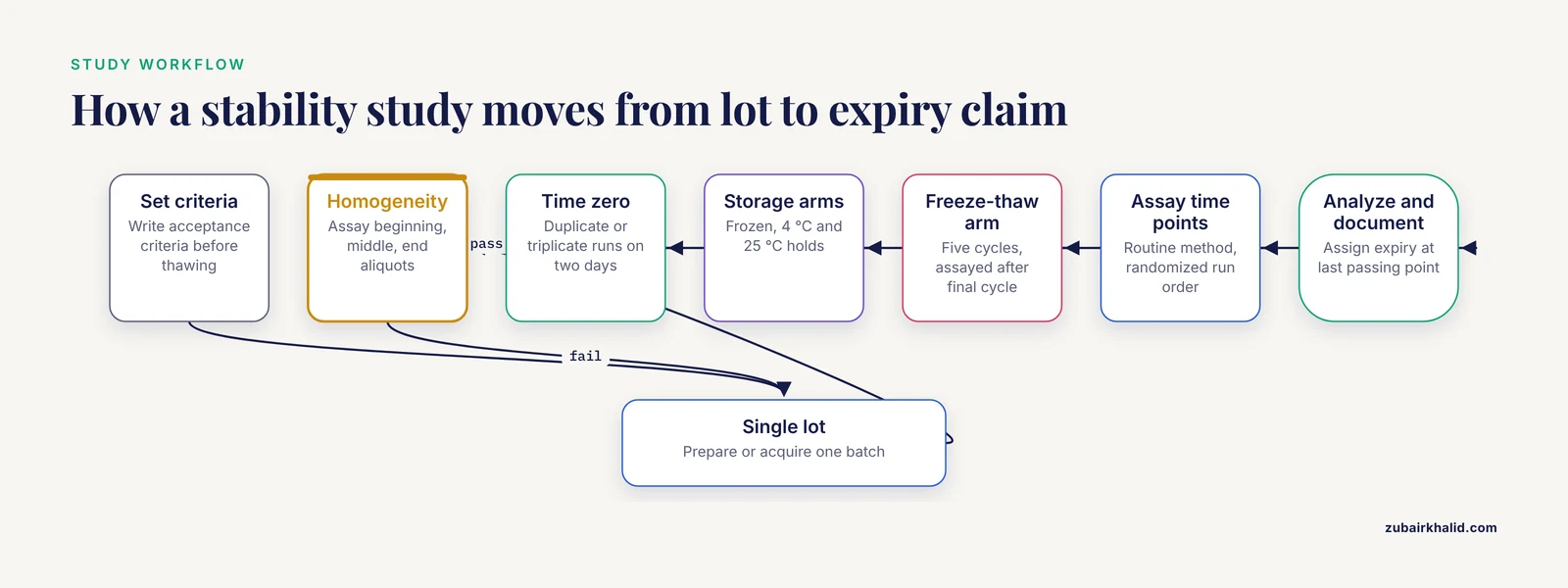
The following procedure reflects the consensus approach for in-house QCM characterization under ISO Guide 80 [1], adapted with concrete design choices from published microbiology QCM studies.
Step 1. Define the material and its acceptance criteria
Write down, before the first vial is thawed, what "stable" means. For a molecular QCM, a typical criterion is that the measured concentration at each time point stays within a defined log-scale band of the time-zero value and that the qualitative result (positive detection at the claimed low limit) does not change. For a viable-organism material, the criterion may be growth characteristics, colony morphology, and typical biochemical reactions on defined media [7]. The reason this step is critical is simple: without pre-set acceptance criteria, any result can be argued either way after the fact, which destroys the objectivity of the study.
Step 2. Prepare or acquire a single lot
Prepare the QCM as one batch. If the material is in-house, follow the preparation, mixing, and subdivision guidance of ISO Guide 80 [1]. The reason for a single lot is that a stability study cannot distinguish between degradation and lot-to-lot variation if more than one lot is involved.
Step 3. Confirm homogeneity before starting the clock
Select aliquots from the beginning, middle, and end of the fill sequence, in random order, and assay them. Homogeneity must be demonstrated before stability can be interpreted. Both the HIV-1 pseudovirus QCM [5] and the C. trachomatis cell-line QCM [4] reported excellent homogeneity as a precondition for their stability claims. If homogeneity fails, fix the mixing and filling process first. A stability study on a non-homogeneous lot produces noise, not information.
Step 4. Assign the time-zero value
Assay a sufficient number of aliquots, in duplicate or triplicate runs on at least two days, and assign the reference value with its uncertainty. This value anchors every later comparison. The reason for running across multiple days is to fold day-to-day assay variation into the baseline so that genuine degradation is not over- or underestimated.
Step 5. Set up storage condition arms
Allocate randomized aliquots to each condition arm. A practical minimum set is:
- Long-term storage at the intended holding temperature (for example, -80 °C or -20 °C).
- Short-term holding at 4 °C, reflecting in-use storage.
- A room-temperature arm at approximately 25 °C, reflecting bench handling and shipping.
The lentiviral SARS-CoV-2 study used -80 °C as the base condition with 4 °C and 25 °C holds for 7 days [6]. The HIV-1 pseudovirus study tested 4 °C and -20 °C holds for 7 days [5]. The reason for multiple arms is that a material can be stable frozen and unstable refrigerated, and the expiry claim must reflect how the laboratory actually stores and uses it.
Step 6. Define the time points
Space early time points tightly and later points further apart. A common pattern for a short-term claim is day 0, day 1, day 3, day 7, then every 1 to 4 weeks thereafter, extending to the intended shelf life. The tight early spacing catches the rapid losses that most often occur immediately after preparation or first thaw. Always include a final time point at or beyond the intended expiry so the claim is supported by observation rather than extrapolation.
Step 7. Run the freeze-thaw challenge
Set aside a dedicated arm of aliquots that undergo repeated freeze-thaw cycles, for example five cycles of thawing at room temperature and refreezing, assayed after the final cycle and optionally after intermediate cycles. The HIV-1 pseudovirus QCM withstood up to five freeze-thaw cycles and outperformed an MS2-based comparator on freeze-thaw stability [5]. The reason for a dedicated arm is that repeated cycling is destructive and cannot be layered onto aliquots needed for the time-course, or a failed later time point becomes uninterpretable.
Step 8. Assay each time point with the routine method
At each time point, remove the assigned aliquots, randomize their run order within the assay batch, and test them exactly as the routine assay runs, including extraction and any pre-treatment steps for molecular materials. Full-process control matters because a material that bypasses extraction cannot detect failures in that step. Traceable, full-process control materials were a stated design goal of the sequence-customized lentiviral SARS-CoV-2 standard [6]. The reason for randomizing run order is to prevent position effects on a plate or an instrument drift from being mistaken for time-related change.
Step 9. Record everything contemporaneously
Log the date, time, condition arm, vial, operator, instrument, raw signals, and transformed results at every time point. Retrospective reconstruction of missing data is one of the most common reasons a stability package fails an audit.
Step 10. Analyze the data
For quantitative measurands, plot the measured value against time for each condition arm and evaluate the trend against the pre-set acceptance criteria. For categorical or qualitative measurands, tabulate positive and negative agreement at each time point. If degradation appears linear, a regression-based estimate of the degradation rate can support an expiry date; if the data are noisy or the acceptance band is crossed at any observed point, the expiry must be shortened to the last time point that met criteria. Do not extrapolate an expiry date beyond the last observed time point that passed.
Step 11. Conclude and document
Write a summary that states the material, the lot, the acceptance criteria, the design, the results at each condition and time point, the freeze-thaw outcome, the assigned expiry and storage conditions, and the signature of the reviewing laboratory quality lead. This document becomes part of the laboratory quality management file and is the record an assessor will ask for.
Controls
A stability study needs its own controls to be interpretable.
- Positive control material of known stability. Run a well-characterized material alongside each assay to confirm the assay itself performed as expected. If the reference material also shifted at a given time point, the problem is the assay run, not the study material.
- Negative control. For molecular and antigen systems, include a no-template or negative matrix control to detect contamination that accumulates over a long study with many opening events.
- Matrix control. For engineered QCMs, a matrix-only control confirms that the carrier (cell lysate, diluent, or transport medium) contributes no signal and does not degrade in a way that would alter results. The absence of matrix effects was explicitly verified for the HIV-1 pseudovirus QCM [5].
- Routine QC parallel run. During each stability assay, run the laboratory's current in-use QCM so that a failure in the study material can be distinguished from a bad run.
- Growth control for culture-based materials. For media and viable-organism QCMs, include reference strains with known expected reactions so that media performance, not strain drift, is the variable being tracked [7].
Expected Results and How to Read Them
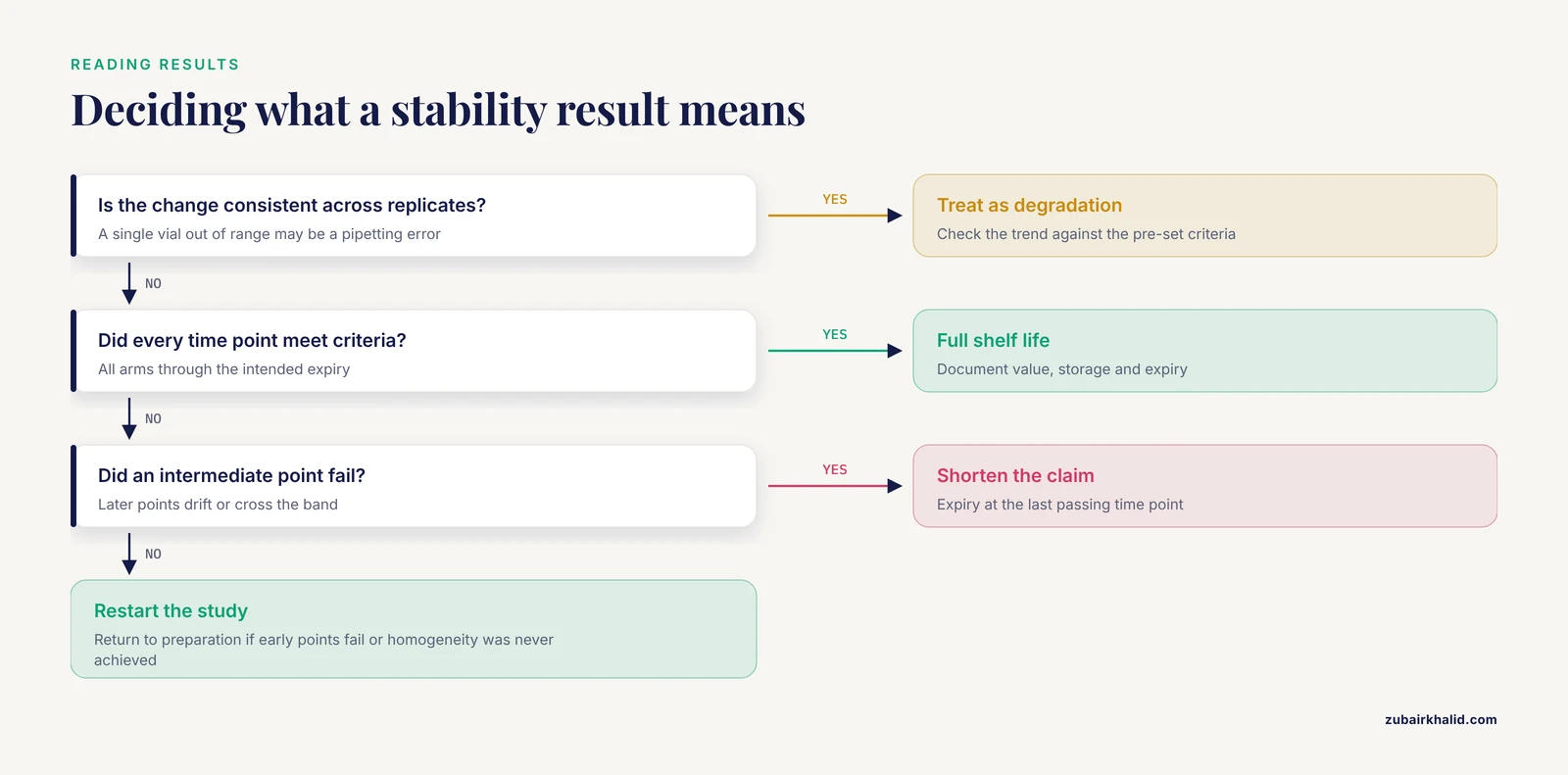
A well-run study produces one of three outcomes.
Pass with full shelf life. All time points in all condition arms meet the acceptance criteria through the intended expiry. The assigned value, storage condition, expiry date, and open-vial or in-use stability (the 4 °C and 25 °C arm results) are documented, and the material enters routine use.
Pass with a shortened claim. The material meets criteria through an intermediate time point and then drifts or fails. Assign the expiry to the last passing time point under each relevant condition. For example, a material stable for 7 days at 4 °C after a freeze-thaw cycle supports an in-use claim of about one week refrigerated, which is precisely the kind of specific, bounded claim that published QCM studies support [6][5].
Fail. The material does not hold its value even at early time points, or homogeneity was never achieved. Return to preparation. In engineered molecular systems, failure often traces back to copy number, packaging efficiency, or matrix interactions rather than to true instability, which is why the HIV-1 pseudovirus work optimized the vector system to reach high particle concentrations of up to 10⁹ copies/mL before stability claims were made [5].
Reading the results also means reading the error. A single vial out of range at one time point may be a pipetting error rather than degradation, which is why replicates and repeated runs matter. A consistent, monotonic trend across replicates is degradation. A single outlier with neighbors normal is noise.
Troubleshooting
| Symptom | Likely cause | Fix |
|---|---|---|
| High scatter between replicates at every time point | Lot not homogeneous, or mixing and filling were inconsistent | Stop the study, re-verify homogeneity with a fresh fill, restart [1] |
| Gradual downward drift in quantitative value | True degradation, or extraction efficiency changing with matrix aging | Compare with a freshly reconstituted reference arm and check extraction controls |
| Abrupt failure at one time point, recovery at the next | Temperature excursion in the storage arm, or a failed assay run | Check the temperature log for that interval and retest adjacent vials |
| Low-concentration arm turns negative while high concentration stays positive | Real loss of measurand near the detection limit, or the low arm was set too close to the assay limit | Set the low-concentration arm at a justified level above the detection limit, as in the 7.41 × 10³ IU/mL low arm of the lentiviral study [6] |
| Freeze-thaw arm fails while continuously frozen arm passes | Repeated cycling damages the material or allows repeated water-crystal and osmotic stress | Pre-aliquot into single-use volumes so thawing more than once is never needed [5] |
| 4 °C or 25 °C arm fails while the frozen arm passes | In-use handling conditions are harsher than the storage claim | Shorten the in-use stability window and document a discard date after opening |
| Interference or false signal appears over time in matrix controls | Matrix degradation generating signal, or microbial contamination of the matrix | Re-verify the matrix, add preservatives compatible with the assay, or change matrix [5] |
| Results differ between instruments or operators | Stability confounded by method variability | Lock the SOP, train operators, and randomize vial assignment across operators |
Variations by Material Type
Culture media
Culture media QC checks growth-supporting characteristics, physical characteristics, gel strength, and batch contamination, and each parameter has systematic checking methods [7]. Stability testing of prepared media plates and tubed media runs on the same logic as any QCM study, with representative plates pulled at intervals and challenged with reference organisms of known expected reactions. Because media composition directly shapes the morphological appearance and properties of microorganisms, an aged or degraded medium can change colony characteristics and lead to incorrect inferences even when growth occurs [7]. Sterility and pH checks belong in every time point for media studies.
Antimicrobial susceptibility testing materials
Antimicrobial disks and reference strain systems for disk diffusion have their own stability history. Disk diffusion quality control guidelines were being evaluated with new agent panels as early as the multicenter work on HR810, a fourth-generation cephalosporin, in clinical microbiology laboratories [8]. Stability concerns for susceptibility materials include potency loss of antimicrobial-impregnated carriers and drift in the expected zone or MIC values of the reference strains. Establishing MIC quality control ranges, as done in a multilaboratory, multicountry study for bedaquiline phenotypic susceptibility testing, depends on stable reference materials and standardized methods across participating sites [9]. A laboratory verifying its own disk lots should therefore zone-read a stable reference strain at each time point, since the strain serves as the ongoing positive control.
Molecular and engineered QCMs
Molecular QCMs now span several technologies, each with distinct stability behavior.
- Cell-line-based materials. The C. trachomatis QCM used CRISPR-Cas9 to integrate the target sequence into the MUC4 gene of HEK293T cells, screened positive clones by flow sorting and single-cell culture, and processed cells under optimized preservation procedures. Stability and clinical applicability were then demonstrated on the finished material [4].
- Pseudovirus materials. HIV-1 pseudovirus packaged with an improved four-plasmid lentiviral system reached up to 10⁹ copies/mL and showed stability for 7 days at 4 °C and -20 °C plus five-cycle freeze-thaw tolerance, outperforming both inactivated virus and MS2-armored RNA comparators in those respective challenges [5].
- Sequence-customized lentiviral standards. A SARS-CoV-2 model material built on a concatenated target sequence was stable for 7 days at 4 °C after one -80 °C freeze-thaw cycle when diluted in 10% FBS/DMEM, and it functioned in a 31-laboratory pilot EQA in which 30 laboratories detected the high-concentration material and 27 detected the low-concentration material [6].
The lesson across all three is that engineered materials can be designed for stability, but the design choices (integration locus, packaging system, preservation procedure, diluent) must be validated by an actual time-course, not assumed.
Water and environmental microbiology
Water microbiology has its own tradition of stable QC samples. A simple, widely applicable method for preparing homogeneous and stable quality control samples for water microbiology was described decades ago and remains a model for laboratories that need stable enumerated-organism or defined-flora controls [10]. Laboratories working with environmental samples should adapt the same time-course logic, with viability of the challenge organisms as the primary measurand.
Storage and Stability Notes
- Assign separate expiry claims per condition. A material may carry a 12-month frozen claim and a 7-day refrigerated in-use claim. Both claims need their own arm data.
- Protect the time-zero reference. Keep unopened time-zero aliquots at the most conservative temperature available and do not cannibalize them for routine QC.
- Log every temperature. Excursions during a stability study either invalidate the affected interval or, if documented and shown not to affect results, can be defended. Undocumented excursions cannot.
- Track open-vial behavior. Once a vial is in daily use, contamination, evaporation, and repeated pipetting become stability factors distinct from storage. The 4 °C and 25 °C arms approximate this exposure.
- Re-verify after process changes. A change in preservative, diluent, fill volume, or vial type restarts the stability clock for the affected material.
- Ship with data. EQA distributions should only ship materials with demonstrated short-term stability under the actual shipping temperature profile. The lentiviral SARS-CoV-2 work embedded the stability evaluation directly into its EQA validation [6].
Stability Testing Within Laboratory Quality Management
Stability testing is one element of a larger microbiology quality control framework that includes internal QC, external quality assessment, personnel competency, method validation, and document control. Reviews of internal and external QC in medical microbiology laboratories describe culture media QC as the backbone of bacteriology quality, since media support isolation, identification, and antimicrobial susceptibility testing, and they emphasize that a proper quality management system must safeguard media quality before results can be trusted [2]. Regional experience shows the cost of gaps in that system. In a European survey of diagnostic oral microbiology laboratories, most participating laboratories did not take part in any internal or external QC program, nearly half lacked standard operating procedures, and QC rounds revealed large variation in antibiotic susceptibility testing results and interpretation across laboratories, supporting a call for harmonization [3].
Risk-based QC frameworks are also reshaping how stability data are used. Commentary in the Journal of Clinical Microbiology examined whether the individualized quality control plan (IQCP) approach adds value for clinical microbiology, and the discussion turns on whether a laboratory's risk assessment, which must include the behavior of its control materials over time, is grounded in real evidence [11]. A stability study is exactly that evidence. It converts an assumed shelf life into a measured one, which is what allows a laboratory to defend its QC frequency and its expiry dates to an assessor.
Common Mistakes and Limitations
These are the errors that most often waste a stability study.
- Skipping homogeneity. Running a time course on a poorly mixed lot measures fill variation. Homogeneity data must come first.
- Too few time points at the end of the claim. A study that ends two weeks before the proposed expiry forces extrapolation. Extend the final time point past the intended expiry date.
- No freeze-thaw arm. Many molecular QCMs pass storage stability and fail cycling. Five freeze-thaw cycles is a demonstrated tolerance level for a well-designed pseudovirus QCM, but it must be tested for each material [5].
- Testing stability with a different assay than the routine one. A research-grade confirmatory assay can look stable while the routine assay with its extraction kit and instrument shows drift. Stability is only meaningful in the intended-use system.
- Ignoring matrix effects. A diluent or carrier that degrades, evaporates, or grows contaminant organisms changes the measurand's apparent behavior. Matrix effects were explicitly checked in the HIV-1 pseudovirus work [5].
- Assuming inactivated or engineered materials mimic authentic samples. Inactivated virus preparations and armored RNA controls each have known limitations in sustainability, biosafety, and how faithfully they reproduce extraction and detection of authentic particles, which motivated the development of pseudovirus-based alternatives [5]. State what the material does and does not model.
- Unlogged temperature excursions. Without continuous monitoring, a failed time point cannot be distinguished from a degraded arm.
- Assigning expiry by extrapolation. An expiry date must sit at or before the last observed time point that met criteria.
- Underpowered replicates. Two vials per time point cannot distinguish degradation from a single pipetting error. Plan replicates and multiple assay days at time zero.
- Treating stability as a one-time event. Materials age, suppliers change processes, and laboratories change freezers. Re-verify stability when any of those variables change.
The main limitation of any stability study is that it demonstrates stability only for the tested lot, the tested conditions, and the tested assay. Individual patient results always require interpretation by qualified personnel in the context of the full clinical picture, and this article is a laboratory bench guide rather than a substitute for professional judgment on any specific case.
Frequently Asked Questions
How long does a stability study of a microbiology QC material take?
Hands-on time is a few hours per assay time point. Elapsed time ranges from about one week for a short-term in-use claim, such as the 7-day refrigerated holds demonstrated in published pseudovirus and lentiviral QCM studies, up to the full intended shelf life, often months, for a long-term expiry claim [5][6].
How many time points and replicates should the study include?
A practical minimum is time zero plus at least four spaced time points through and past the intended expiry, with duplicate or triplicate aliquots per point and assay runs spread across multiple days. The exact design should be fixed in writing before testing starts, following the planning framework for in-house quality control materials [1].
What is the difference between homogeneity and stability?
Homogeneity describes whether aliquots within one lot give the same result. Stability describes whether the lot keeps its assigned value over time. Homogeneity must be shown first, because time-course data from a non-homogeneous lot cannot be interpreted as degradation.
Can I refreeze a molecular QC material after thawing?
Only if your own freeze-thaw data support it. A well-designed HIV-1 pseudovirus QCM tolerated up to five freeze-thaw cycles, but that tolerance was measured, not assumed, and it will not necessarily apply to other materials [5]. The safer practice is single-use aliquoting so no vial is ever thawed twice.
What acceptance criteria should I set for a stability study?
Set criteria before testing, tied to how the material is used. For quantitative molecular QCMs, a defined band around the time-zero concentration plus unchanged qualitative detection at the claimed low level is typical. For culture media and viable-organism materials, the criteria are growth support, expected colony morphology, and typical biochemical reactions on the specified media [7].
Do noninfectious engineered QC materials behave like authentic clinical samples?
They behave like themselves, and the differences must be documented. A noninfectious cell-line-based C. trachomatis QCM demonstrated strong clinical applicability without infectious risk [4], while pseudovirus-based HIV-1 QCMs were developed precisely because clinical plasma and inactivated culture supernatants carry limitations in sustainability, biosafety, and cost [5]. Know which step of the assay your material does and does not exercise.
Do I need to stability-test commercial QC materials if the manufacturer provides data?
Manufacturer data support the manufacturer's claim, under the manufacturer's storage conditions, usually with the manufacturer's assay assumptions. A laboratory should verify performance under its own storage and handling conditions, especially when storage temperature, open-vial duration, or assay platform differ from the label.
How does stability data support external quality assessment participation?
EQA providers must distribute materials that survive shipping and participant handling, and pilot EQA programs validate stability directly, as done for a sequence-customized lentiviral SARS-CoV-2 material tested across 31 laboratories [6]. For an individual laboratory, stable in-house QC data are equally the foundation for meaningful participation in external schemes, which is one of the harmonization needs highlighted in interlaboratory QC surveys [3].
Sources
- The new ISO Guide 80: Guidance for the in-house preparation of quality control materials (QCMs)
- Internal and external quality control in the medical microbiology laboratory
- Quality control for diagnostic oral microbiology laboratories in European countries
- A novel method for the preparation of reproducible, stable, and non-infectious quality control materials for Chlamydia trachomatis nucleic acid detection.
- Development of a novel pseudovirus-based quality control material for HIV-1 nucleic acid testing and its application in external quality assessment.
- Development of traceable international standard materials using sequence-customized lentivirus, modeled on SARS-CoV-2 nucleic acid amplification tests, and validation through a pilot external quality assessment.
- Quality control of culture media in a microbiology laboratory.
- Disk diffusion testing, quality control guidelines, and antimicrobial spectrum of HR810, a fourth-generation cephalosporin, in clinical microbiology laboratories
- A Multilaboratory, Multicountry Study To Determine Bedaquiline MIC Quality Control Ranges for Phenotypic Drug Susceptibility Testing
- A Simple and Widely Applicable Method for Preparing Homogeneous and Stable Quality Control Samples in Water Microbiology
- Commentary: Individualized Quality Control Plan (IQCP): Is It Value-Added for Clinical Microbiology?