SOP vs. Work Instruction vs. Policy in the Microbiology Lab
By Dr. Zubair Khalid, DVM, MS, PhD ·

A policy states what the laboratory requires and why it requires it. A standard operating procedure, or SOP, states how a task is performed from start to finish by a qualified role. A work instruction zooms in one level further and describes a single narrow action inside that task, in enough detail that a trained technologist performing it once, correctly, has nothing left to interpret.
The rule of thumb for choosing between them is a question test. If the document answers "why do we do this and who decides," it is a policy. If it answers "how do we perform this whole task," it is an SOP. If it answers "how do I execute this one step without breaking the assay," it is a work instruction. Most documentation failures in microbiology laboratories trace back to putting content at the wrong level, usually by writing a vague policy where a stepwise SOP belongs, or by burying critical bench detail inside an SOP that then balloons to forty pages nobody reads.
This article defines each document on its own terms, puts them side by side in a comparison table, explains the criteria that decide real choices between an SOP and a work instruction, walks through worked scenarios from the bench, and lists the mistakes labs make most often when building their document hierarchy.
Why Document Hierarchy Matters in Laboratory Quality Management
Laboratory quality management rests on a simple premise: consistent results come from consistent actions, and consistent actions come from written, controlled, trained-to instructions. A microbiology laboratory produces interpretive, biologically variable results on living organisms. Two technologists reading the same mixed Gram stain, or the same borderline Kirby-Bauer plate, can reasonably reach different conclusions unless the laboratory has constrained their decisions in writing. The document hierarchy is how that constraint is built.
Accreditation frameworks and quality management standards used across clinical and veterinary diagnostic laboratories, including ISO 15189-based accreditation programs and the quality systems required by bodies such as the College of American Pathologists, all expect a controlled document system with defined levels. The vocabulary varies slightly between frameworks, but the functional structure is nearly universal: policies at the top, SOPs in the middle, work instructions and forms at the bottom, with records generated as evidence that the documents were followed.
The hierarchy matters for three practical reasons.
First, traceability. When a result is questioned, whether by a clinician, an inspector, or a lawsuit, the laboratory must show which document governed the work, which version was in force that day, and how staff were trained on it. A three-level hierarchy makes that trail clean. A flat pile of undifferentiated documents makes it impossible.
Second, change control at the right altitude. If the laboratory medical director changes the acceptable range for a QC criterion, you should edit one policy, not chase that number through thirty SOPs. If the manufacturer changes the incubation time on a chromogenic agar, you should edit one SOP and its attached work instruction, not rewrite policy. Putting content at the correct level means a change ripples through exactly one document instead of many.
Third, training efficiency. New technologists should not have to read the laboratory's position on clinician notification rules to learn how to plate a wound swab. They should read the SOP for specimen inoculation, and, if they are new to a tricky manipulative step, the work instruction attached to it. Correct altitude keeps training packets short and comprehension high.
The need for a well-built hierarchy is growing, not shrinking. Clinical microbiology is in the middle of a shift toward faster, simpler, decentralized molecular testing, including isothermal amplification platforms paired with visual-read biosensors that can run outside the core laboratory with turnaround times that beat batched central testing [1]. Every new platform that enters the lab, whether it lands in the core, a stat bench, or a point-of-care satellite site, needs its own policy tier decision, its own SOP, and its own bench-level work instructions. Labs that never built the hierarchy properly feel that cost with every new assay.
The Three Documents, Defined
What a Policy Is in the Microbiology Lab
A policy is a formal statement of the laboratory's position on a matter of governance, safety, or quality. It says what is required, who is accountable, and why the requirement exists. It deliberately does not explain bench mechanics.
A microbiology policy answers questions like these:
- The laboratory will report positive blood cultures Gram stain results by direct call within one hour of detection. Who makes the call, and why this standard exists.
- Every new lot of Mueller-Hinton agar must pass QC with a reference strain before patient testing. Why: media performance directly affects susceptibility interpretations.
- Only authorized personnel may accept specimens rejected under the contamination policy. Why: rejection decisions carry clinical consequences.
Good policies share three features. They are short, usually one page or less. They are approved at a high level, typically the laboratory director or medical director, sometimes with hospital or corporate sign-off. They change rarely, because they encode positions rather than procedures. If you find yourself writing incubation times and reagent volumes in a policy, you are writing an SOP and calling it a policy.
Policies also carry the laboratory's non-negotiable positions on things like biosafety, data integrity, result reporting, and competency. "All personnel handling viable cultures must complete annual biosafety training" is policy language. It commits the laboratory to a position without prescribing how the training is delivered.
What an SOP Is in the Microbiology Lab
An SOP is a controlled, stepwise description of how to perform an entire task, written for a trained operator, covering the task from start to finish. In microbiology, a task is something like "processing blood culture bottles," "performing and interpreting a Gram stain," "setting up a Kirby-Bauer susceptibility plate," "preparing and dispensing culture media," or "performing and interpreting a nucleic acid amplification test."
A complete SOP for a bench task typically contains these elements:
- Purpose and scope, naming the test or task and the specimen types covered.
- Responsibilities, naming the roles qualified to perform and review the work.
- Principle, a short explanation of the microbiology or chemistry behind the method.
- Specimen requirements, including acceptance and rejection criteria.
- Reagents, media, and equipment, with storage and handling requirements.
- Safety considerations, including biosafety level and containment practices for the organisms likely to be encountered.
- Stepwise procedure, written in the imperative ("Inoculate," "Incubate," "Examine").
- QC requirements, including what to run, how often, acceptance criteria, and what to do on failure.
- Result interpretation and reporting, including limitations and confirmatory steps.
- References to package inserts, CLSI or WOAH standards where applicable, and related documents.
- Revision history.
The SOP is the workhorse of microbiology quality control. It is the document a competency assessor observes against, the document an inspector reads first, and the document the bench technologist consults when an uncommon specimen or an unexpected organism appears. It lives at a middle altitude: detailed enough to execute, general enough to cover normal variation.
What a Work Instruction Is in the Microbiology Lab
A work instruction is the narrowest document in the hierarchy. It describes one specific action or subtask inside an SOP, at the level of physical technique, exact settings, or exact manipulations. Work instructions exist because some steps in microbiology are genuinely technique-sensitive, and a paragraph inside a long SOP is not enough to make them reproducible.
Typical microbiology work instructions cover things like:
- How to prepare a uniform, confluent lawn for disk diffusion using the correct turbidity standard and swabbing technique.
- How to read a zone of inhibition with calipers, including edge rules for fuzzy zones and double zones.
- How to load a cartridge or reagent strip into a specific instrument, with photos of correct orientation.
- How to subculture from a positive blood culture bottle without aerosolizing the contents.
- How to clean and calibrate the balance used for media preparation, down to the specific check weights.
- How to perform a specific pipetting pattern in an extraction protocol, including tip-change points.
A work instruction is often a single page with photographs, labeled images, or instrument screenshots. It is frequently produced by the manufacturer, adapted by the laboratory, and attached to the parent SOP by document number. The parent SOP says "prepare the inoculum to match the 0.5 McFarland standard as described in WI-MIC-014." The work instruction shows the exact swab rotation, the angle of insertion into the tube, and what the correct suspension looks like against the comparator.
Side-by-Side Comparison
The table below is the core of the difference between SOP and work instruction microbiology staff need to internalize, with policy added as the third tier.
| Criterion | Policy | SOP | Work Instruction |
|---|---|---|---|
| Core question answered | What do we require and why | How is this task performed end to end | How is this one step performed exactly |
| Scope | Laboratory-wide or multi-department | One task or method | One action or subtask within a task |
| Typical length | Under 1 page | 3 to 20 pages | 1 page, often visual |
| Primary audience | Leadership, quality staff, all employees | Trained bench technologists performing the task | Technologists performing the specific step, often trainees |
| Level of detail | Positions and requirements only | Complete workflow, QC, interpretation | Physical technique, settings, images |
| Written by | Laboratory director or quality manager with leadership input | Senior technologist or supervisor with technical input | The technologist who performs the step, or the manufacturer |
| Approved by | Laboratory or medical director, sometimes executive | Laboratory director, supervisor, or designee | Supervisor or SOP owner |
| Typical review cycle | Every 2 to 3 years or on organizational change | Every 1 to 2 years or on method change | With the parent SOP, or on instrument or reagent change |
| Microbiology examples | Specimen rejection policy, direct-call reporting policy, biosafety policy | Gram stain SOP, blood culture processing SOP, disk diffusion SOP | 0.5 McFarland inoculum preparation, zone reading with calipers, cartridge loading |
| Failure mode if misplaced | Requirements become vague and unenforceable | Document becomes bloated and unread | Critical technique detail is lost and results drift |
| Change frequency | Rare | On method, reagent, or criteria change | Most frequent, follows consumable and instrument updates |
| Record generated | Training acknowledgment | Run logs, QC records, competency checklists | Embedded in the SOP's records, or instrument logs |
Read the table column by column when you are deciding where new content belongs, and row by row when you are auditing an existing document system. The "failure mode if misplaced" row is the one most worth memorizing, because it describes nearly every documentation problem inspectors find.
How the Three Documents Fit Together
In a well-built document system, the three tiers reference each other in one direction, downward, and never duplicate content. A policy on result reporting states that significant positive cultures are called to the ordering clinician within defined timeframes and points to the SOP for blood culture processing. That SOP contains the full workflow, including the direct-call step, and points to the work instruction for the specific act of sampling the positive bottle. The work instruction shows the needle-and-syringe technique or the subsampling device technique in photographs.
This one-way reference structure has a specific benefit during inspections and audits. An assessor can start at any tier and walk downward to full detail, or start at the bottom and walk upward to the governing requirement. What the assessor should never find is the same requirement written three times at three altitudes with small contradictions between them. A direct-call timeframe that appears as "within one hour" in the policy and "within two hours" in the SOP is a finding, not a paperwork nuisance, because the bench cannot follow both.
Document numbering usually encodes the tier. Many labs use a scheme like POL-xxx for policies, SOP-MIC-xxx for microbiology SOPs, and WI-MIC-xxx for work instructions, with the microbiology section prefix keeping the hierarchy visible at a glance on the master document list. Version numbers, effective dates, and approval signatures live on every page or in the electronic document control system, and superseded versions are archived, not deleted, so that results generated under old versions can always be reconstructed.
When to Use an SOP
The question of when to use an SOP, rather than a policy or a work instruction, comes up constantly when labs build or rebuild their document systems. The answer follows from altitude. Use an SOP whenever a task meets these tests:
- The task is performed by a defined role and has a defined start and end. "Processing a respiratory specimen from receipt to workup" qualifies. "Maintaining good laboratory practice" does not.
- The task has more than a handful of steps or involves decisions a new-but-trained person could not make unaided. Plating a urine specimen with a calibrated loop and recording the colony count qualifies.
- The task generates a result or a record that must be reproducible and defensible. Essentially every analytic and post-analytic task in microbiology passes this test.
- The task is audited, accredited, or cited in a regulatory expectation. This covers nearly everything, which is why SOP counts in an accredited micro lab routinely run into the hundreds.
If the content fails test one, it belongs in a policy. If it passes all four but the detail you are writing is a single manipulative step, that detail belongs in a work instruction attached to the SOP. A common drafting error is expanding the SOP until it absorbs everything, then watching technologists stop reading it because no one can find the actual steps among the tables and instrument screenshots. Keep the SOP at task altitude and push step-level detail down.
One structural decision worth making early: many labs adopt a family-of-documents approach in which one SOP covers a method at a stable altitude and the instrument-specific or lot-specific detail lives in attached work instructions. This pays off enormously when the lab replaces an instrument or a reagent system. The SOP survives the swap unchanged except for a reference line, and only the work instruction is rewritten.
SOP vs Work Instruction in Microbiology: The Deciding Criteria
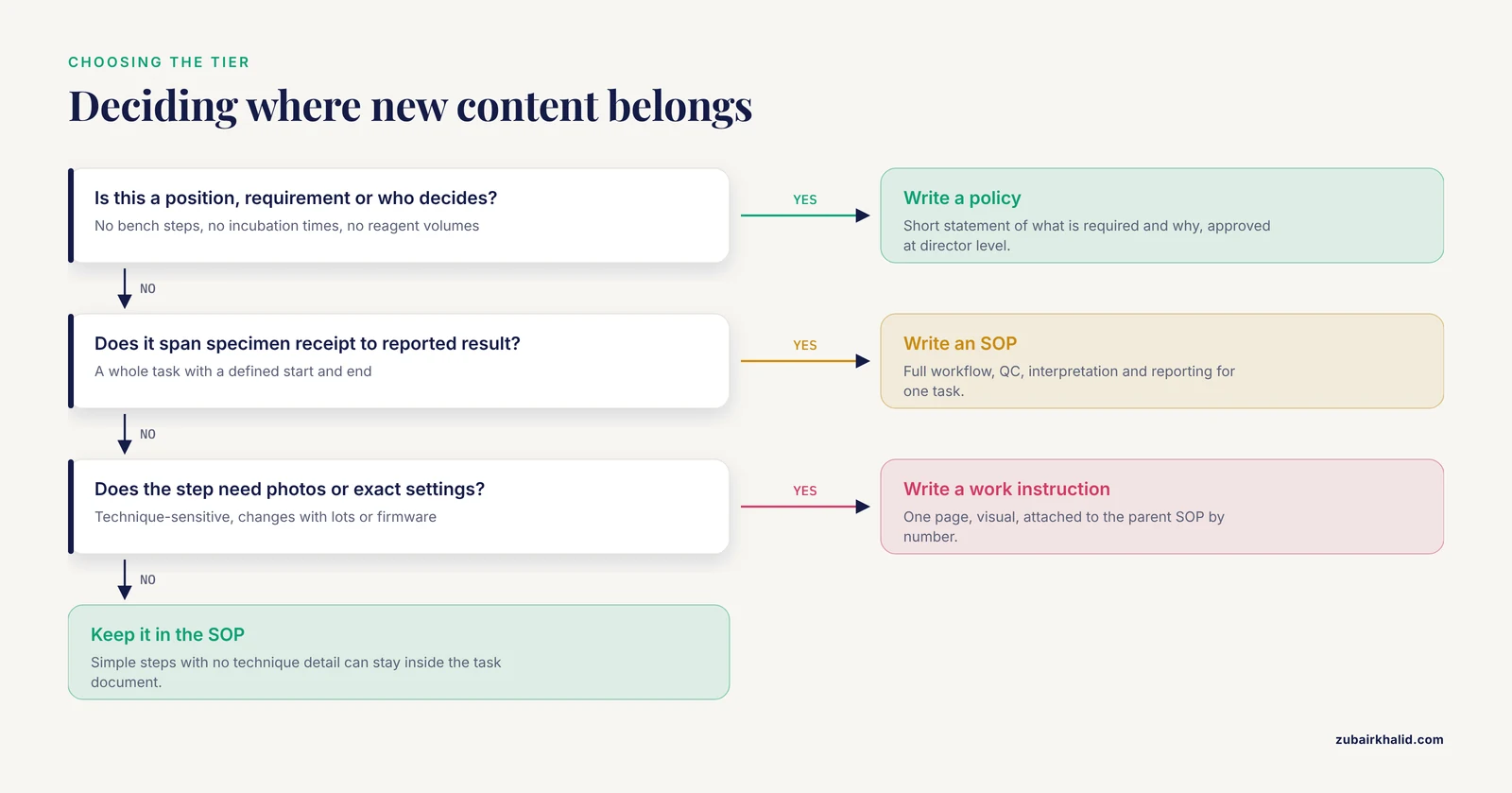
The difference between SOP and work instruction in microbiology practice comes down to five criteria. Apply them in order when you are unsure where a piece of content belongs.
Criterion 1: Breadth of the action. If the action spans from specimen receipt to reported result, it is SOP territory. If the action is one manipulation within that span, it is work instruction territory. Preparing the inoculum is a step inside the disk diffusion SOP, so the swabbing technique is work instruction content.
Criterion 2: Who needs it. An SOP serves anyone qualified to run the task. A work instruction serves the person physically performing the step, and it is disproportionately useful to trainees, to staff covering an unfamiliar bench, and to anyone performing a step performed rarely. If a step is done once a year, like maintaining a specific lyophilized reference strain, its work instruction will be worth more than any paragraph in the SOP.
Criterion 3: Visual necessity. Some detail cannot be conveyed in prose. The correct appearance of a zone edge, the correct position of a cartridge latch, the correct turbidity against a comparator card, these need photographs. Content that requires images to be unambiguous belongs in a work instruction, because SOPs formatted for controlled printing handle images poorly.
Criterion 4: Change frequency. Detail that changes with every reagent lot, instrument firmware update, or consumable revision belongs at work instruction level, where edits are cheap and localized. Detail that changes only when the method itself changes belongs in the SOP. Detail that changes only when the laboratory's position changes belongs in policy.
Criterion 5: Consequence of variation. The more a step's variation changes the result, the more it deserves its own work instruction with verification criteria. Inoculum density in susceptibility testing is the classic example. A heavy or light lawn changes zone diameters directly and can flip an interpretive category, which is why that step carries its own controlled document in well-run labs.
A practical summary of the difference between SOP and work instruction for microbiology teams: the SOP is the contract for the task, and the work instruction is the coaching note for the step. Labs that treat work instructions as optional usually discover the gap through QC, when inter-technologist variation shows up in zone sizes, colony counts, or instrument runs.
Worked Scenarios from the Bench
Scenario 1: Rolling Out a Rapid Molecular Point-of-Care Assay
Suppose the laboratory is adding a multiplex isothermal nucleic acid amplification assay for viral pathogen detection, run on a compact benchtop reader with a lateral-flow style visual readout. A recent example of this platform class pairs multiple cross displacement amplification with gold nanoparticle-based lateral flow biosensors, detecting targets from two virus families in a single tube run at 64 degrees Celsius for 35 minutes, with results read visually and analytical sensitivity comparable to laboratory-based quantitative PCR [1].
The document hierarchy for this rollout looks like this.
At the policy tier, the laboratory decides and records its position: this assay may be reported for patient care, it may be run only by competency-verified personnel, and its results fall under the laboratory's existing critical result and direct-call reporting policy. The policy does not mention incubator settings or tube handling.
At the SOP tier, the laboratory writes the full task document: specimen types accepted, extraction and setup, the amplification run, the visual read of the biosensor, internal and external controls, QC frequency, result reporting, limitations, and contingency steps for invalid runs. The SOP records the method's operating conditions, including the isothermal temperature and run time, and defines exactly what a valid, invalid, and indeterminate biosensor read looks like in words.
At the work instruction tier, the lab attaches short visual documents for the steps that are technique-sensitive: how to open and close the single-tube format without cross-contamination, how to load the tube into the heating block in the correct orientation, how to photograph or record the biosensor line pattern for the record, and how to distinguish a true test line from a faint or edge artifact.
This platform class illustrates why the hierarchy pays. The whole selling point of these hybrid assays is operational simplicity, short turnaround time, reduced cost, and suitability for decentralized settings far from the core lab, a direction the field is moving toward deliberately [1]. But simplicity at the device level does not remove the laboratory's obligation to document who may run it, how it is run, and how each manipulative step is standardized. In some ways it raises the stakes at the work instruction tier, because decentralized and rapid formats push performance into the hands of staff with less molecular bench experience, and the visual-read step replaces instrument software judgment with human judgment [1]. The lab that wrote thin documents because "the cartridge does everything" is the lab that will see reader-to-reader variation in line interpretation.
Scenario 2: Media and Reagent Quality Control in the Routine Lab
Consider the laboratory's approach to culture media quality control, one of the oldest and most instructive examples of document tiering in microbiology.
The policy states the laboratory's position: no medium, reagent, or identification system is used for patient or animal testing until it passes in-house or manufacturer-declared QC appropriate to its use, and QC failures are handled under the laboratory's corrective action policy. This is a position, not a procedure, and it changes only when the laboratory changes its standards.
The SOP for media preparation and QC contains the workflow: how media are received, stored, and labeled, how each batch or lot is logged, which QC organisms are used for which media categories, how growth and biochemical performance are assessed, and what documentation must exist before the lot is released for use. It defines acceptance in general terms appropriate to task altitude and points to specific documents for the details.
The work instructions carry the technique-heavy pieces: how to perform a heavy inoculum streak on a selected agar to demonstrate differential reactions, how to inoculate a specific biochemical panel, how to read and record hemolysis patterns on blood agar against the reference descriptions, and how to document a lot failure and quarantine the affected batch. Each of these is a single action with an unambiguous right way and several plausible wrong ways, which is exactly the profile of work instruction content.
Microbiology quality control is where misplaced documents do the most damage, because QC decisions are dense with small judgments. If the judgment lives only in a paragraph inside a twenty-page SOP, two technologists will make it differently. If it lives in a one-page visual work instruction, they will not.
Scenario 3: Managing a Deviation in the Gram Stain Procedure
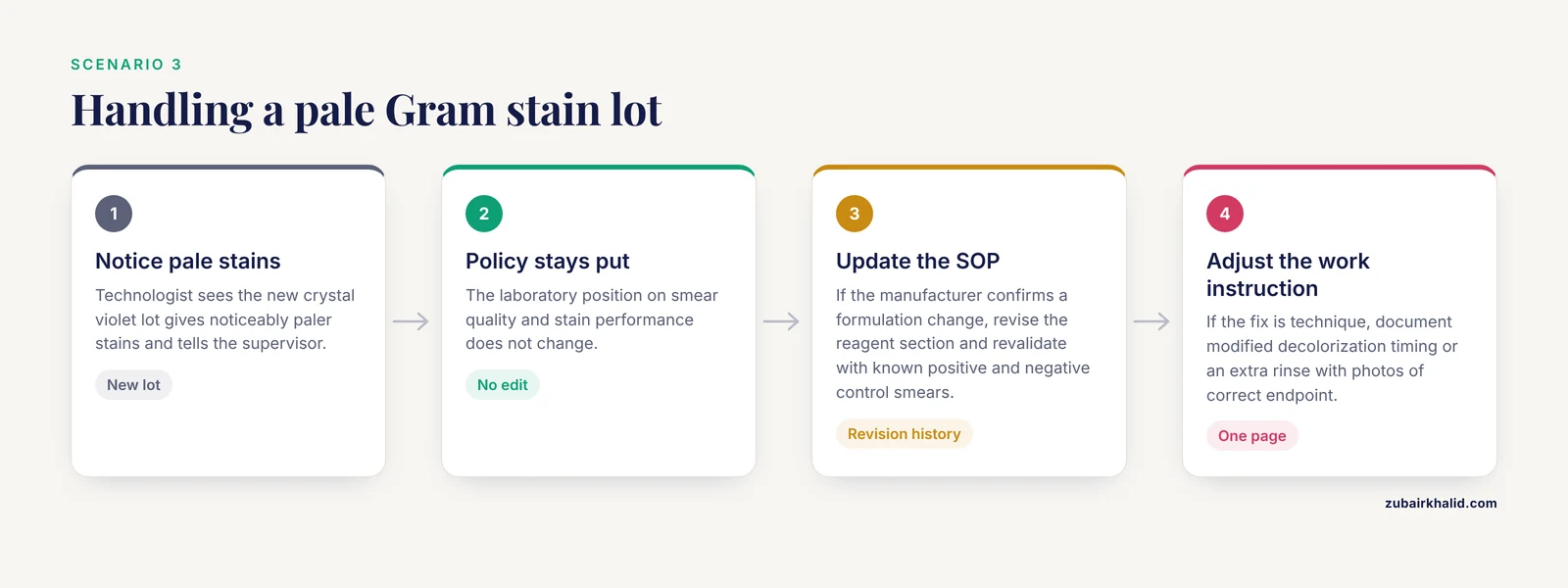
A technologist notices that the new lot of crystal violet produces noticeably paler stains and brings it to the supervisor. The document system determines what happens next.
The policy tier is untouched. The laboratory's position on smear quality and stain performance does not change.
The SOP tier changes if the deviation is systematic. The supervisor documents the issue, contacts the manufacturer, and, if the manufacturer confirms a formulation change, updates the SOP's reagent section and revalidates the staining performance with known positive and negative control smears. The revision history records what changed and why.
The work instruction tier changes if the fix is a technique adjustment, for example a modified decolorization timing or a fixed extra rinse documented with photographs of correct endpoint appearance. That is a one-page edit at the bottom tier, approved by the supervisor, attached to the same SOP number.
The three-tier structure turns a disruptive event into three small, correctly placed edits. In a flat document system, the same event either produces an uncontrolled email that becomes the real procedure, or a full SOP rewrite that takes weeks and leaves the bench improvising in the meantime.
Document Control Essentials: Numbering, Review, and Competency
Three administrative practices make the hierarchy function in daily operation.
Numbering and linkage. Give every document a unique identifier that encodes its tier and section. Reference downward only: policies may reference SOPs, SOPs may reference work instructions, work instructions reference nothing below. Cross-references in the upward direction create circular version dependencies that break during revisions.
Review and obsolescence. Set review intervals by tier, commonly two to three years for policies and one to two years for SOPs and work instructions, with event-driven review whenever a method, instrument, reagent, standard, or organizational role changes. In microbiology, event-driven review is triggered predictably: package insert revisions, new CLSI breakpoint tables, new instrument firmware, new media lots with changed formulations, and new assay menus. The labs that fail here are the ones whose review cycle is a calendar exercise disconnected from actual change events.
Competency linkage. Every document that describes work a person performs should map to a competency event: initial training, initial competency assessment, and ongoing periodic assessment. The SOP defines what the task is, the work instruction makes the technique teachable, and the competency record proves the person was trained on the current version. When an inspector asks how a technologist was qualified to perform an assay, the answer chain runs policy, SOP, work instruction, training record, competency record, in that order.
Common Mix-Ups at the Bench
These are the confusions that show up repeatedly when labs build or audit their document systems, stated as the mistakes readers actually make.
Putting procedure into policy. A policy that says "the laboratory will use the CLSI-recommended method for susceptibility testing, incubating plates at the specified conditions for the specified time" is an SOP wearing a policy title. The tell is any operational number or step appearing above the SOP tier. Pull it down.
Promoting an SOP by gut feel. When a step is causing errors, the reflex is to "make an SOP about it." Usually the right move is a work instruction attached to the existing SOP, because the problem is technique, not task definition. Adding a new SOP fragments the workflow and creates a second place to update later.
Treating the package insert as the SOP. A manufacturer's insert is a source document, not a laboratory document. It does not contain the lab's specimen acceptance rules, reporting conventions, staffing, or QC scheme. Reference it, extract from it, but write your own SOP.
Writing work instructions nobody can find. A work instruction that lives in a shared drive folder, referenced by no SOP and listed on no master document list, is not part of the quality system. If it matters, link it and control it. If it does not matter, delete it.
One document doing three jobs. The lab-wide "microbiology procedures manual" that mixes policy statements, procedures, and step photos in one continuously renumbered file is the most common structure in small labs and the hardest one to maintain. Every edit invalidates the whole document, every review re-reads everything, and contradictions accumulate silently. Split by tier.
Letting training outrun the documents. Rapid test menus now expand quickly, and decentralized platforms are explicitly designed for operational simplicity and minimal infrastructure [1]. It is tempting to train staff directly on the vendor's quick-start guide and backfill documents later. Resist it. Vendor material is training aid content, not controlled procedure, and the gap becomes visible the first time something goes invalid.
Common Mistakes and Limitations
Beyond the structural mix-ups, these are the practical failure points that document systems hit, written for the people who will have to fix them.
Version control on paper copies. A laminated work instruction at the bench that survives three SOP revisions is a defect waiting to be found. Either place a controlled electronic display at the bench, or adopt a printed-copy verification stamp system where every printed copy carries a validity date and is destroyed on expiry. Never allow an unmarked printout to serve as the bench reference.
Photographs without control. Work instructions earn their keep with images, but images are content too. When the instrument interface changes with a firmware update, an out-of-date screenshot actively misleads. Include image capture dates in the work instruction footer and treat interface changes as a trigger for review.
Approval inflation. Some labs route every work instruction through the medical director for signature, which sounds rigorous and functions as a bottleneck. It results in work instructions waiting weeks for signature while staff work from drafts. Match approval authority to document tier, and reserve director-level signature for policies and SOPs, with supervisor or SOP-owner signature for work instructions.
Orphaned documents after method retirement. When an assay is retired, its SOP is retired with a note, but its attached work instructions often survive on the master list for years. Audit the list after every method change and retire the whole family.
Confusing forms with documents. A worksheet, log, or form is a record template, not an instruction. It belongs under document control as a form with its own number and version, attached to the SOP that uses it. Some labs fold forms into work instructions, which works, but the form's own revision must then follow the work instruction's revision, which couples two different kinds of change.
Assuming simpler platforms need thinner documents. The evidence base behind newer rapid assays can be strong, with validated analytical sensitivity approaching reference methods and demonstrated lack of cross-reactivity against related organisms [1], and that validation supports confidence in the method. It does not reduce the laboratory's documentation obligations. It changes where the documentation weight sits, away from complex workflow and toward technique standardization, read interpretation, and contingency handling for invalid runs.
A limitation on scope. This article describes the general structure of document hierarchies in diagnostic microbiology. Individual laboratories operate under specific accreditation programs, institutional policies, and jurisdictional requirements that may impose additional document classes or approval chains, and individual implementation decisions need a quality management professional or laboratory director familiar with those obligations.
Frequently Asked Questions
Can an SOP and a work instruction ever be the same document?
Yes, for very short and simple tasks. If a task consists of a few steps with no technique-sensitive manipulations, the SOP can contain all the detail and no separate work instruction is needed. The test is whether any step in the task needs photographs, exact settings, or step-level coaching that would bloat the SOP. If not, one document is enough.
Who should write each type of document?
Policies are written or directed by laboratory leadership, typically the laboratory or medical director with the quality manager. SOPs are written by a senior technologist or supervisor who performs or supervises the task, then reviewed by the director or designee. Work instructions are written by whoever performs the step best, often with manufacturer material as a starting point, and approved by the SOP owner or supervisor.
How often should microbiology SOPs be reviewed?
A common schedule is every one to two years on a fixed cycle, with mandatory off-cycle review whenever the method, instrument, reagent system, relevant standards, or interpretive criteria change. In microbiology, breakpoint updates, package insert revisions, and new media or reagent lots with changed formulations are the most frequent triggers.
Is a manufacturer's package insert an SOP?
No. The package insert is a source document that describes the manufacturer's intended use and instructions. Your SOP is your laboratory's controlled procedure, incorporating the insert's method but adding your specimen acceptance rules, QC scheme, reporting conventions, staffing, and references. Referencing the insert inside your SOP is correct, substituting the insert for the SOP is not.
Do work instructions need the same approval level as an SOP?
Generally no. Because work instructions are narrower and change more often, most labs assign their approval to the supervisor or the SOP owner, while reserving director-level approval for policies and SOPs. The important requirement is that approval authority for every tier is defined in your document control policy, not that every document carries the same signature.
Where do forms and worksheets fit in the hierarchy?
Forms and worksheets are record templates, not instructions, and they belong under document control as their own tier or as attachments to the SOP that uses them. Give each form its own number and version, and when a form is revised, update the parent SOP's reference at the same time so the two never drift apart.