SOP Training and Competency Assessment in Microbiology
By Dr. Zubair Khalid, DVM, MS, PhD ·
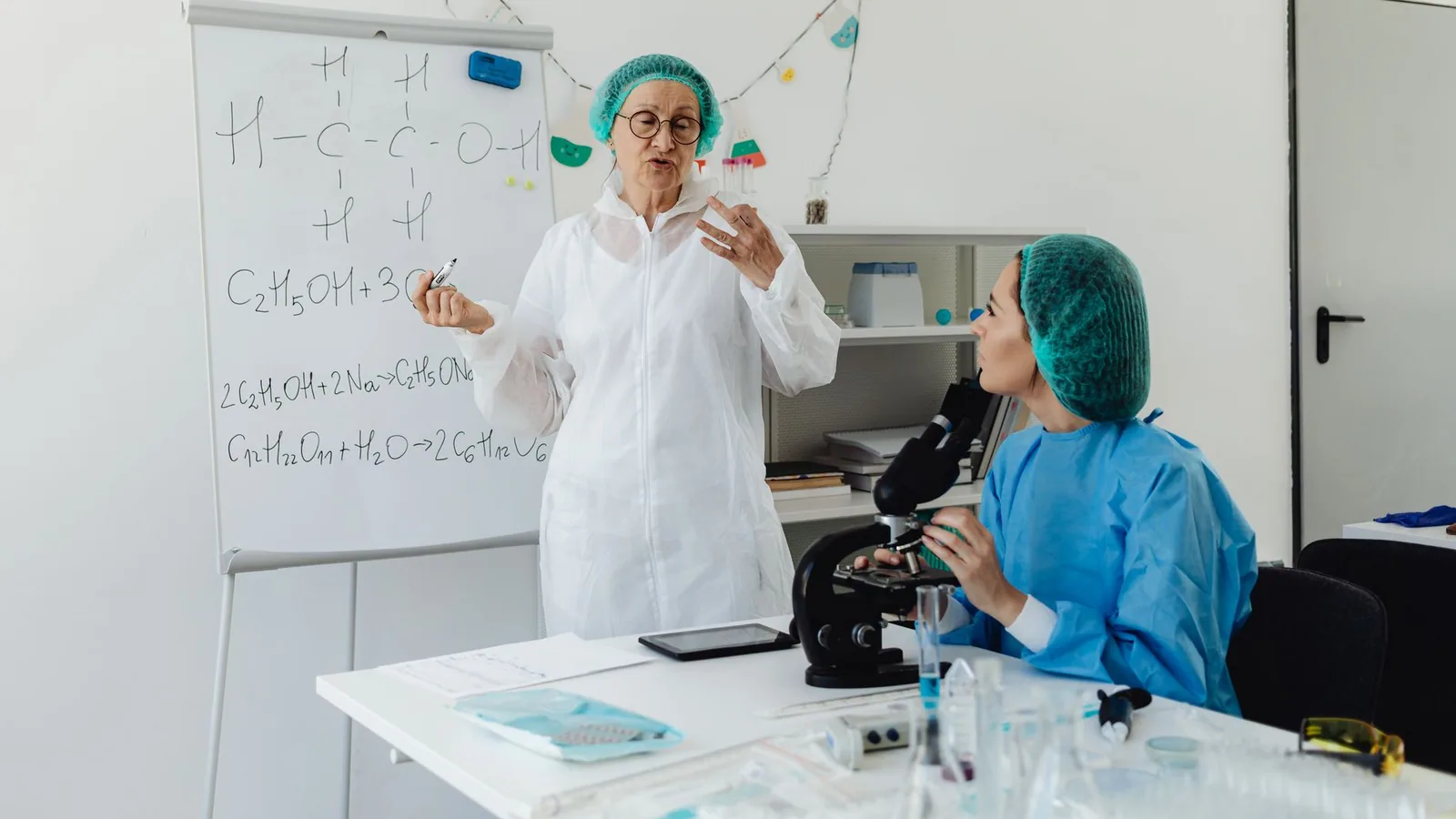
A structured standard operating procedure (SOP, a controlled written document that describes exactly how one laboratory task is performed) training and competency program converts a validated written method into consistent bench performance. The goal is simple to state and hard to fake. Every technologist who touches a specimen must perform the test the same way the method was validated, and the laboratory must be able to prove, with dated records, that each person can do so.
Training and competency assessment are distinct activities. Training teaches the method. Competency assessment verifies, after training and again on a schedule, that the person can perform the method correctly without supervision. A laboratory that trains without assessing has no evidence of skill. A laboratory that assesses without a written SOP has no fixed standard against which skill can be measured. Both halves are needed for a defensible quality system.
This guide covers the full cycle for SOP training in a microbiology lab: what a usable SOP contains, how to take a new technologist from first read-through to authorized independent testing, how to assess and document competency, how quality control (QC, the use of known materials to prove a run worked) fits into training, and the mistakes that most often undermine these programs.
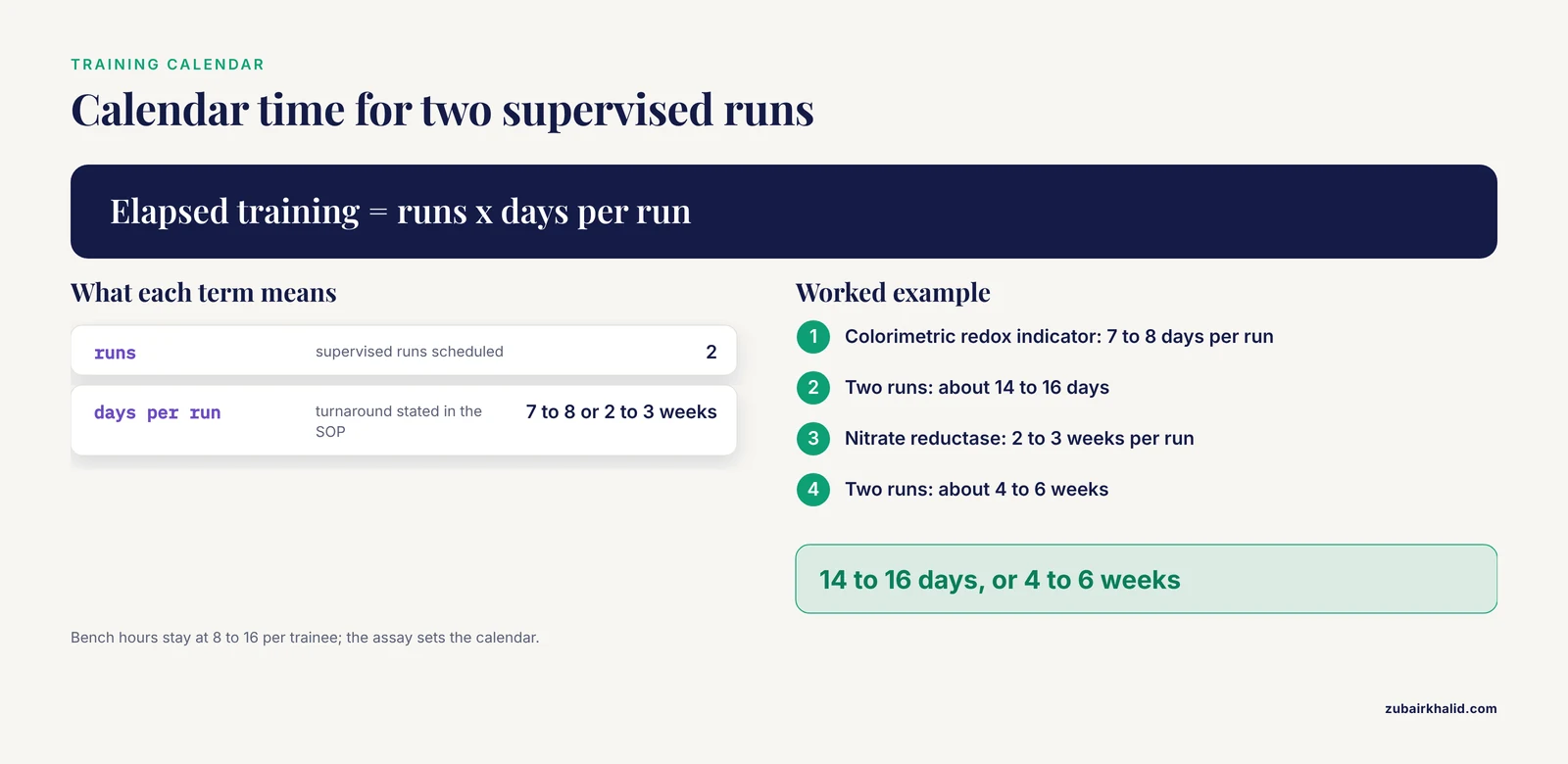
Time commitment. For a single SOP, plan on roughly 8 to 16 hours of hands-on bench time per trainee, most of it during supervised practice runs. Elapsed time is set by the assay itself. A molecular point-of-care method can be demonstrated and practiced within a single shift, since a multiplex isothermal amplification assay with a lateral flow readout completes in about 35 minutes at 64 degrees Celsius [1]. A colorimetric redox indicator drug susceptibility assay for Mycobacterium tuberculosis requires a supervised run spanning 7 to 8 days before identification and susceptibility results are available [2]. A nitrate reductase assay on the same organism takes 2 to 3 weeks per run [3]. The training calendar must contain the full run, not just the setup.
Where SOP Training Fits in Laboratory Quality Management
Laboratory quality management treats the lab as a system with documented processes, controlled documents, trained people, and monitored results. SOP training and competency assessment sit at the junction of the personnel and document-control elements. The logic of the system works in one direction:
- A method is validated and written as an SOP.
- Staff are trained against that SOP and assessed for competency.
- Quality control materials confirm that each run performed by a trained person behaved as expected.
- Records from steps 2 and 3 demonstrate, at any audit, that results released by the laboratory were produced by qualified people using a controlled method.
When an inspection or an outbreak investigation traces a questionable result, the questions follow that same chain. Was the SOP current? Was the analyst trained on that version? Is there a dated competency record? Does the QC for that run meet acceptance criteria? A program that cannot answer those four questions on paper has a gap no amount of bench skill can cover.
The Anatomy of a Microbiology SOP
A trainee cannot be trained against a vague document. Before any training session, the SOP itself must be complete, approved, version controlled, and current. Well-constructed published SOPs show what a complete document looks like. Two non-commercial tuberculosis drug susceptibility SOPs, published as a series for laboratories in resource-constrained settings, illustrate the pattern. Each carries a formal version designation (v1.3.12), states its intended audience and intended use up front, describes the biological principle of the assay, and then walks the analyst through the procedure step by step [2], [3]. That structure is not decoration. Every element maps directly onto a training step.
A usable microbiology SOP contains, at minimum:
- Title, document number, version, and effective date. Version numbers matter because training records must name the exact version a person was trained on. A SOP at version 1.3.12 is a different document from version 1.3.11, and the training file must say which one the person read [2].
- Principle and intended use. What the test measures and what question it answers. The nitrate reductase assay SOP, for example, states plainly that the test detects the ability of M. tuberculosis to reduce nitrate to nitrite, that nitrite is revealed by adding a color-developing reagent, and that the reaction is read by the naked eye [3].
- Biosafety requirements. Which containment level, which personal protective equipment, which waste stream.
- Specimen requirements and rejection criteria.
- Reagents and materials, with concentrations, storage conditions, and lot-specific acceptance steps.
- Step-by-step procedure, written so a trained person can follow it without improvisation.
- Controls and acceptance criteria. Which controls must be run, what result each must give, and what to do when a control fails.
- Result interpretation and reporting language. For a susceptibility assay, the SOP defines exactly how growth versus no growth translates into resistant or susceptible [2], [3].
- Expected turnaround time. The nitrate reductase SOP states that identification and susceptibility results are available in 2 to 3 weeks [3]. The colorimetric redox indicator SOP states 7 to 8 days [2]. Trainers use these figures when scheduling supervised runs.
- Limitations and troubleshooting.
- References and revision history.
If any of these elements is missing, fix the SOP before training anyone on it. Training a person on an incomplete document teaches improvisation, and improvisation is the enemy of reproducibility.
Materials and Tools for SOP Training and Competency Assessment
| Item | Purpose | Practical notes |
|---|---|---|
| Controlled master SOP with version and effective date | The single standard against which everyone trains and is assessed | Read-only distribution. Superseded versions are withdrawn from the bench and archived |
| Trainee training file (one per person per SOP) | Documents read-through, teach-back, supervised runs, challenges, and sign-off | Kept for the life of employment plus the period required by the laboratory's record retention policy |
| Direct observation checklist | Converts subjective "seems competent" into scored, dated observations | One row per critical step, scored as met or not met, signed by the assessor |
| Written knowledge check | Confirms understanding of principle, controls, and interpretation | Questions must map to SOP sections, especially acceptance criteria and error handling |
| Blind or challenge panel | Verifies the trainee reaches the correct result on unknown coded material | Organisms or simulated specimens with known expected answers, blinded to the trainee |
| Quality control materials | Reference organisms, media lots, stain lots, reagent lots used during training runs | Each lot accepted per the SOP before trainee use |
| Personal protective equipment | Protects the trainee, who is at peak risk of technique errors | Lab coat, gloves, eye protection, and respiratory protection where the SOP requires it |
| Competency tracking log (central) | Flags due dates for periodic reassessment across all staff and all SOPs | Reviewed monthly by the supervisor or quality manager |
For the worked examples later in this article, the relevant reagents are those specified in the assay SOP itself. In a nitrate reductase assay, nitrate is incorporated into the culture medium, a color-developing reagent is added after incubation, and the color reaction is interpreted by direct visual inspection [3]. In a colorimetric redox indicator assay, an oxidation-reduction indicator such as resazurin is added to the drug-exposed culture, and viable bacilli reduce the dye, shifting its color in proportion to the viable population [2]. In a multiplex multiple cross displacement amplification assay with a gold nanoparticle lateral flow biosensor, the amplification mix runs isothermally and the amplicon is read on a lateral flow strip by eye [1]. The trainee learns each reagent's role, its acceptance criteria, and its failure mode as part of the supervised runs.
SOP Training Step by Step
The sequence below is the core answer to the question of how SOP training in a microbiology lab proceeds from first contact to independent work. Each step includes the reason it exists, because a trainer who understands the reason will not skip the step under time pressure.
- Verify the SOP version and its approval status. Pull the controlled master copy, confirm the version number, effective date, and approval signatures before anything else. The reason: training against a superseded or unapproved version produces an invalid training record and can teach obsolete technique.
- Assign the read-through and document it. The trainee reads the full SOP, then signs and dates a read-and-understood attestation naming that version. The reason: the attestation creates the anchor record for the training file and forces actual engagement with the document rather than osmosis from a neighbor at the next bench.
- Conduct a teach-back briefing on principle, controls, and biosafety. The trainee explains, in their own words, what the assay detects, why each control exists, what result each control must produce, and what personal protective equipment and containment the SOP requires. The reason: a person who can restate the principle will interpret unexpected results sensibly. A person who memorized steps without understanding will keep running a failed assay and call it a result.
- Watch the trainer perform a complete run. The trainer performs the SOP start to finish, narrating each critical step and deliberately showing the control steps, the timing checkpoints, and the disposal points. The reason: watching a correct performance calibrates the trainee's sense of pace, technique, and timing before they touch a specimen.
- Perform supervised practice runs with graded independence. The trainee performs the full procedure with the trainer beside them for the first run, then with the trainer observing critical steps only, then with the trainer available on call. Each run uses quality control materials accepted per the SOP. The reason: graded withdrawal of support exposes exactly where the trainee needs help while every run remains safe and interpretable.
- Run a blind challenge. Present coded material with a known expected result and let the trainee process, read, and interpret it without help. The reason: this is the first true test of independent performance. It tests the complete chain, including interpretation and documentation, rather than isolated manual steps.
- Administer the written knowledge check. Questions target principle, control acceptance criteria, interpretation rules, and the correct response to a failed control. The reason: some competencies, such as knowing when to reject a run or when a result is unreportable, are judgment calls that direct observation alone may never sample.
- Complete the observed competency evaluation and sign-off. The assessor scores the direct observation checklist, reviews the challenge and written results, and signs a dated competency determination naming the SOP and version. The reason: a single signature backed by multiple converging pieces of evidence is far stronger at audit than a stack of attendance sheets.
- Authorize and release to independent testing. Enter the authorization in the personnel record and the competency tracking log, with the next assessment due date. The reason: independent work must begin on a defined date, tied to a defined record, not on the informal moment when the supervisor stops looking.
- Schedule the first reassessment. Commonly, competency is reassessed at 6 months after initial authorization and then annually, a cadence used widely in clinical laboratory accreditation programs, though the exact interval follows the laboratory's own policy and accreditor. The reason: skills decay, methods drift through revision, and the reassessment date is what converts a one-time event into a maintained state.
Competency Assessment in Microbiology
Competency assessment answers a different question from training. Training asks, can this person learn the method. Assessment asks, can this person perform it correctly today, unsupervised, and can the laboratory prove it.
When Assessment Happens
Three triggers define the assessment calendar:
- Initial competency, before the person reports patient results independently. This follows the training sequence above.
- Periodic reassessment, on the interval the laboratory's quality policy defines, most commonly at 6 months after initial authorization for new personnel and annually thereafter.
- Event-driven reassessment, whenever the method changes materially. A revised SOP version, a new instrument, a new reagent system, a change in reportable range or interpretation criteria, or a return from extended absence all require reassessment on the affected elements before the person resumes independent testing.
The event-driven trigger is the one laboratories most often miss. When an SOP is revised, every person authorized under the old version is, by definition, no longer trained on the current method. The revision rollout must include a delta training, covering exactly what changed, plus a documented re-authorization.
Assessment Tools
Recognized laboratory quality programs rely on several complementary tools, because no single tool samples all the competencies a microbiologist needs:
- Direct observation of routine work. The assessor watches the analyst perform bench work, including technique, timing, and adherence to the SOP. This is the primary tool for manual skills such as streaking for isolation, reading plates, and performing stain procedures.
- Monitoring of recording and reporting. The assessor reviews the analyst's worksheets, worklists, and reports for completeness, accuracy, correct terminology, and correct turnaround time documentation.
- Written assessment. Questions test knowledge the observer cannot see, such as why a control failed, what to do with a contaminated plate set, and which organisms trigger public health notification.
- Review of proficiency testing or external assessment results. How the analyst's answers compared with the expected and peer results on blinded external specimens.
- Review of instrument and equipment records. For methods that depend on instruments, the assessor confirms the analyst can verify calibration, run and interpret QC, and document maintenance.
- Blind retesting or challenge samples. Coded specimens or simulated cases inserted into the workflow, scored against known expected results.
In microbiology, direct observation carries unusual weight because so much of the discipline is interpretive and visual. Colony morphology, hemolysis patterns, Gram reaction, and plate reading are skills assessed best by watching the analyst work a plate and articulate what they see and why.
Microbiology Quality Control During Training
Quality control and training reinforce each other, and the training period is when QC habits either take root or fail to form. The trainee must learn QC as an integral part of every run, not as an administrative layer bolted on afterward.
Key QC elements a trainee must master:
- Media QC. Each lot of media is checked for sterility, growth support, and, where applicable, biochemical or differential performance, before or concurrent with use. The trainee learns to check lot documentation, storage conditions, and expiration dates as part of setup.
- Reference strain QC for identification and susceptibility testing. Well-characterized reference strains, such as Escherichia coli ATCC 25922, Staphylococcus aureus ATCC 25923, and Pseudomonas aeruginosa ATCC 27853 for routine susceptibility work, are run per the method's QC schedule. The trainee learns the expected zone diameters or minimum inhibitory concentration ranges and the acceptance rule: if a control is out of range, patient results from that run are not reported until the problem is resolved.
- Stain and reagent QC. Gram stain reagents are checked with known positive and negative control organisms on the schedule the SOP defines.
- Antimicrobial agent integrity. Storage conditions, expiration dates, and disk or cartridge lot acceptance.
- Documentation discipline. Every QC result is recorded, dated, and signed at the time of the run. Retroactive documentation is a training failure even when the QC itself passed.
The published tuberculosis SOPs embed this same discipline. Their acceptance criteria and control structures are explicit enough that a laboratory adopting the SOP can build its training checklist directly from the document's own control and interpretation sections [2], [3]. That is the mark of a well-written SOP: the training and QC materials fall out of it almost mechanically.
Worked Example: Training on a Non-Commercial Tuberculosis Susceptibility Assay
Non-commercial assays for M. tuberculosis culture and drug susceptibility testing, developed through the culture and drug susceptibility testing subgroup of the STOP TB Partnership New Diagnostic Working Group, are written specifically for laboratories that want rapid, low-cost methods in resource-constrained settings [2], [3]. They make an excellent training case study because the SOP documents are complete and the stakes of poor training are high.
Nitrate reductase assay. The principle is biochemical. M. tuberculosis reduces nitrate to nitrite. Nitrate is incorporated into the culture medium, and after drug exposure and incubation, a color-developing reagent is added that reveals nitrite. The result is read with the naked eye, and because drug-containing and drug-free media sets are run in parallel, the same color comparison yields both identification and a susceptibility result. The SOP states that identification and susceptibility results are available in 2 to 3 weeks [3]. A training program schedules two full supervised runs, which means the trainee's elapsed training window for this single assay approaches 4 to 6 weeks.
Colorimetric redox indicator assay. The principle is metabolic. An oxidation-reduction indicator is added to liquid cultures that have been exposed to anti-mycobacterial drugs. Viable bacilli reduce the indicator, shifting its color in proportion to the viable population. Growth in a drug-containing well, shown by color change, indicates resistance. The SOP states results are available in 7 to 8 days [2], which allows a tighter training calendar than the nitrate reductase assay while still spanning multiple supervised runs.
Training checklist derived from the SOPs. For either assay, the critical steps that the direct observation checklist must cover include: medium and drug plate preparation and labeling, inoculum standardization, correct drug set assembly, incubation timing, indicator or reagent addition at the correct step, naked-eye reading against the controls, applying the SOP's interpretation rules, and recording results in the format the SOP specifies. Each checklist line names the version of the SOP it was scored against.
Safety note. Culture and manipulation of M. tuberculosis carry a genuine occupational infection risk through aerosol generation. This work demands biosafety level 3 containment practices, dedicated equipment, respiratory protection per the institutional exposure control plan, and trained handling of spills and waste. No trainee performs any open manipulation of viable M. tuberculosis outside the containment conditions specified by the institutional biosafety program, and the biosafety elements of the SOP are assessed with the same rigor as the analytical steps.
Worked Example: Competency for Point-of-Care Molecular Methods
The expansion of point-of-care (POC) testing changes the competency problem in two ways. First, the operators are often not laboratory-trained personnel. Second, the assays compress steps that used to happen in separate rooms into a single closed or semi-closed workflow.
A recent example is a single-tube multiplex assay combining multiple cross displacement amplification (MCDA, an isothermal nucleic acid amplification method that runs at a constant temperature without a thermal cycler) with a gold nanoparticle lateral flow biosensor (AuNPs-LFB, a strip test that produces a visible line when target amplicon is present). The assay targets the hepatitis B virus S gene and the hepatitis C virus 5' untranslated region, runs at 64 degrees Celsius for 35 minutes, achieves analytical sensitivity comparable to laboratory-based quantitative PCR, and showed no detectable cross-reactivity against anatomically relevant non-target pathogens. The commentary accompanying the study highlights that visual interpretation of the strip result, short turnaround, low cost, and operational simplicity make the format suitable for decentralized settings, moving testing from centralized laboratories into local clinics and field settings [1].
For the laboratory that trains staff or clinic operators on such a platform, the competency program shifts emphasis:
- Specimen handling and pre-analytical discipline dominate, because the amplification step is closed and fast but the specimen before it is not. Contamination prevention at the collection and addition steps is the main technical risk.
- Visual readout competency must be trained explicitly. A lateral flow line is read by eye, and marginal, faint, or malformed bands require a trained decision. The SOP must contain images of valid and invalid strip results, and the direct observation checklist must include reading a panel of strips with known valid, invalid, and negative patterns.
- Temperature and timing adherence is simple to teach (one temperature, one duration, 64 degrees Celsius for 35 minutes in this format) but still requires a documented check, since a missed timer invalidates the run.
- Escalation rules matter more than in a central lab. The operator must know exactly which results trigger referral to the central laboratory and which are reportable at the point of care.
Safety note. Even closed-cartridge molecular workflows involve patient specimens that may contain bloodborne pathogens. Operators wear gloves, handle collection devices per the SOP, and dispose of consumables in the designated biohazard stream. Where the workflow includes an amplification step with open tubes or a lateral flow strip handled after amplification, the SOP's containment and disposal instructions are followed without modification.
Troubleshooting Training and Competency Problems
| Symptom | Likely cause | Fix |
|---|---|---|
| Trainee signed the read-and-understood form but fails the hands-on evaluation | Passive reading without engagement | Replace the sign-off-only step with a teach-back briefing and trainer demonstration before any bench work |
| Two trainees read the same plate or strip differently | SOP language for interpretation is ambiguous, or no reference images exist | Add reference images and explicit decision criteria to the SOP, then retrain both on the revised version |
| Trainee passes the blind challenge but real results drift afterward | Challenge panel is too easy, too dated, or too small | Refresh the panel regularly, use material reflecting current specimen types, and increase panel size |
| Trainee skips QC steps when the workload is heavy | QC was trained as paperwork rather than as part of the run | Schedule QC into the run plan itself and audit worksheets for QC completion during the first months |
| Competency due dates lapse unnoticed | No central tracking system | Maintain a single competency log listing every person, every SOP, and every due date, reviewed monthly |
| High error rate after go-live on a new point-of-care method | Too few supervised repetitions before release | Require a defined number of successful supervised runs before independent work, regardless of schedule pressure |
| Competency cannot be maintained on a rarely performed test | Low test volume provides no natural practice | Institute scheduled mock runs using retained or simulated material on a fixed calendar |
| Training records reference a superseded SOP version | Version control failure at the bench | Remove superseded copies physically from the bench, distribute controlled copies only, and verify version at each assessment |
Variations and Special Situations
New graduates and experienced hires. A new graduate needs the full sequence above. An experienced technologist transferring from another laboratory still needs the full sequence for every local SOP, because local practice, reagent systems, and interpretation criteria differ. Experience shortens the learning curve but does not shorten the documentation chain.
Cross-training. When a technologist trained on SOP A learns related SOP B, the trainer may compress the shared elements and focus the supervised runs on the elements unique to SOP B. The training file must still document a complete, dated competency determination for SOP B on its own.
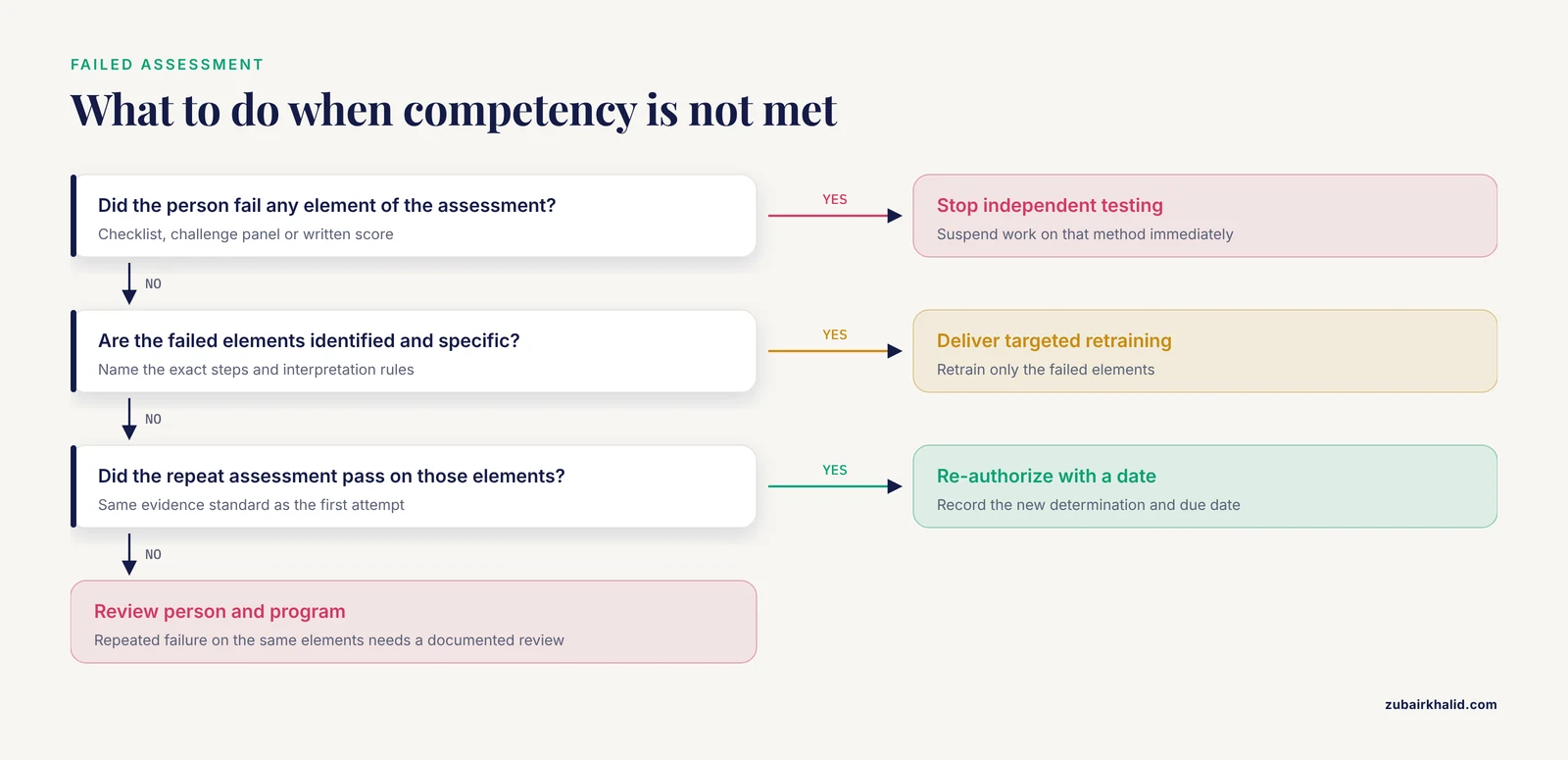
Remediation after a failed assessment. A failed competency assessment suspends independent testing on that method immediately. The supervisor identifies the specific failed elements, delivers targeted retraining, and repeats the assessment on those elements. Repeated failures on the same elements indicate either a training program defect or a person-method mismatch, and both warrant a documented review.
SOP revision. Every revision triggers delta training on the changed sections for all authorized staff, followed by re-authorization. A revision that changes interpretation criteria or a critical control requires a challenge panel repeat. A revision that only corrects a typographical error may require a documented read-through of the changed section, per the laboratory's policy.
Point-of-care and decentralized operators. As molecular formats move into clinics and field settings, the training program travels with the assay. The 35-minute, visually read MCDA format illustrates the shift: a short formal training session plus supervised hands-on repetitions on the actual device can prepare an operator, provided the competency file documents observed specimen handling, correct run execution, and correct strip interpretation [1].
Low-volume and on-call methods. For assays performed rarely, schedule deliberate practice between real cases. Skill decay is a documented reality for infrequent tasks, and the mock-run calendar is the standard countermeasure.
Records, Retention, and Stability of the Training File
The training and competency file is a permanent quality record, not a working document. A complete file for one person and one SOP contains: the read-and-understood attestation naming the SOP version, the teach-back and demonstration dates, the supervised run log, the direct observation checklist signed by the assessor, the written assessment with answers, the blind challenge results, the signed initial competency determination, every periodic reassessment record, every event-driven reassessment record, and the current authorization status.
Retention follows the laboratory's records policy and applicable accreditation and regulatory requirements, and the file must remain retrievable for the full retention period, including after an employee leaves. Paper originals or scanned images both work, but the retrieval path must be tested. An inspection finding of "record exists but cannot be located" is functionally identical to "record does not exist."
The SOP document itself follows parallel discipline. The controlled master lives in the document management system, bench copies are controlled or marked as uncontrolled references, and superseded versions are archived with their effective and retirement dates. When a trainee's file cites SOP version 1.3.12 [2], the document system must be able to produce that exact version years later.
Common Mistakes and Limitations
These are the failures seen most often when auditors trace quality problems back to training and competency:
- Training on an unapproved or superseded SOP. The record then documents that the laboratory knew the training preceded the current method.
- Substituting a generic orientation for SOP-specific training. A general lab orientation does not confer competency on a specific assay.
- Read-and-understood sign-offs without verification. A signature proves someone held a pen. Pair it with teach-back or a written check.
- Direct observation staged for the assessment. If staff know assessment day in advance and the observed run is rehearsed, the record shows competence that routine work does not possess. Unannounced observation and routine-work sampling reduce this.
- Assessing only manual technique. Interpretation, error handling, and result reporting are competencies too, and they fail more often than pipetting.
- Letting competency lapse after personnel changes. When the person who tracked due dates leaves, the system dies silently. A central, role-independent log with monthly review prevents this.
- Skipping delta training after SOP revisions. Every authorized person on the old version is untrained on the new one the moment it takes effect.
- Training without QC linkage. A trainee who has never seen a failed control handled according to the SOP will improvise when one fails at 2 a.m.
- One assessor signing without evidence. A competency signature should trace to a checklist, a challenge result, and a written score, all dated.
Limitations. A training and competency program verifies performance against the SOP as written. It does not validate the method itself, it does not substitute for external proficiency testing, and it cannot compensate for a poorly written document. Individual trainees also differ, and the timing and format of training require judgment by qualified supervisors rather than rigid application of any single template. Where a specific method, organism, or institutional policy raises questions, consult the laboratory's quality manager and the current SOP rather than general guidance.
Frequently Asked Questions
How long does SOP training take in a microbiology lab?
For a single SOP, expect roughly 8 to 16 hours of hands-on bench time per trainee, spread over multiple supervised runs. Elapsed time depends on the assay. A rapid molecular point-of-care method can be trained within a single shift, while a tuberculosis susceptibility assay spans 7 to 8 days per run for a colorimetric redox method or 2 to 3 weeks for a nitrate reductase method, so two full supervised runs can occupy a month or more of calendar time.
What is the difference between training and competency assessment?
Training teaches the method. Competency assessment verifies, with dated evidence, that the person can perform it correctly without supervision. Training happens once per SOP version. Assessment happens initially, then periodically, then again whenever the method changes.
How often must competency be reassessed?
The most widely used schedule is initial assessment before independent testing, reassessment at 6 months for newly authorized staff, and annual reassessment thereafter, with an additional assessment whenever the SOP is revised or the person returns from an extended absence. The laboratory's quality policy and accreditor define the exact intervals.
Who can train and assess competency in a microbiology lab?
Training and assessment are performed by a qualified person, meaning someone currently competent on the SOP themselves who has been designated by the laboratory director or supervisor to train and assess. The assessor signs a dated determination naming the SOP and version.
What happens when someone fails a competency assessment?
Independent testing on that method stops immediately. The supervisor identifies the failed elements, delivers targeted retraining, and repeats the assessment on those elements. Repeated failure on the same elements triggers a documented review of both the trainee and the training program.
What documents must a training and competency file contain?
At minimum: the read-and-understood attestation naming the SOP version, the teach-back record, the supervised run log, the signed direct observation checklist, the written assessment, blind challenge results, the signed competency determination, all periodic reassessment records, and the current authorization status with the next due date.
How do you train staff on a new point-of-care molecular method?
Follow the same sequence: read-through and teach-back on the SOP, trainer demonstration, supervised runs on the actual device, a blind panel including valid, invalid, and negative readout patterns, a written check, and a signed competency determination. For visually read formats, the SOP must contain reference images of strip results and the observation checklist must score the readout directly.
How does competency assessment differ for culture-based versus molecular methods?
Culture-based methods emphasize manual technique, plate reading, organism identification, and interpretation over multi-day incubations, so direct observation across full runs carries the most weight. Molecular point-of-care methods compress the workflow and often shift the risk to specimen handling and visual readout, so observation focuses on contamination control, timing adherence, and strip or signal interpretation.
Sources
- The new gold rush in clinical diagnostics: from standard laboratory assays to fast and accurate point-of-care (POC) methods.
- Rapid Identification and Drug Susceptibility Testing of Mycobacterium tuberculosis: Standard Operating Procedure for Non-Commercial Assays: Part 3: Colorimetric Redox Indicator Assay v1.3.12.
- Rapid Identification and Drug Susceptibility Testing of Mycobacterium tuberculosis: Standard Operating Procedure for Non-Commercial Assays: Part 2: Nitrate Reductase Assay v1.3.12.