Turning Audit Findings into Action: A Root Cause Analysis Framework
By Dr. Zubair Khalid, DVM, MS, PhD ·

An audit finding in a microbiology laboratory is rarely caused by the thing the auditor wrote down. A finding that reads "media sterility check not documented for the March lot" is a symptom. The underlying cause is usually a broken system, such as a preparation procedure that never required the check, a bench where the check is skipped when staffing is short, or a supervisor who never reviews sterility records. Root cause analysis (RCA) is the structured process of moving from that written symptom to the system that produced it, and then fixing the system so the finding does not return.
The first thing to check for any recurring finding is whether the affected step is governed by a written, current, and trained procedure. In one published case study from a university microbiology laboratory, media quality complaints traced back to non-standardized preparation procedures and missing routine growth promotion and sterility testing rather than to careless staff [1]. That pattern holds across most laboratory settings. When a finding appears, look first at the procedure and the records around it, then at the people and equipment, and only last at the individual who happened to be on shift.
This article sets out a complete framework for root cause analysis of microbiology laboratory audit findings. It covers the cause categories to use, the analytical tools to pick from, a troubleshooting table that maps common findings to likely causes, a diagnostic sequence you can follow bench-side, and the corrective action and verification steps that turn a finding into a permanent fix. Throughout, the goal is turning audit findings into action rather than filing them.
Why Audit Findings Recur Without Root Cause Analysis
Most laboratories respond to an audit finding with a quick correction. The missing record gets filled in, the expired reagent gets discarded, the staff member gets a reminder. The next audit finds the same problem in a different form. This happens because the correction addressed the visible defect, not the cause that generated it.
Quality management literature distinguishes several layers of evidence about laboratory performance, and each answers a different management question. A standard sets a requirement. An inspection or audit finding records a deficiency. A quality indicator signals a risk area. Root cause analysis explains why a deficiency occurred or recurred. Remediation feeds the explanation back into the quality system so the assessment cycle renews itself. When a laboratory skips the RCA layer and jumps straight from finding to fix, the remediation is aimed at the wrong target.
Regulatory frameworks in other professions have made this lesson explicit. International quality management standard ISQM 1 now makes root cause analysis mandatory for certain adverse events in audit firms, precisely because point-fixes were not preventing recurrence [2]. Clinical laboratories face the same logic under their own accreditation requirements. A finding that recurs across two audit cycles is telling you that the cause lives in the system, not in the task.
A Cause Taxonomy for Laboratory Audit Findings
A common failure in RCA practice is that every investigator names causes in their own words, so nothing accumulates into learnable patterns. One solution is a shared cause taxonomy. An empirically developed taxonomy from the audit profession sorts root causes into six categories, validated against finding data collected from 2021 to 2024 [3]. The same six categories map cleanly onto microbiology laboratory failures.
Strategy and policy. The cause sits in leadership decisions. An example is a laboratory director's decision to run two media lots per week with no backup technologist trained on preparation, which guarantees shortcuts when one person is absent.
Systems and procedures. The cause sits in the written or informal workflow. Missing growth promotion testing, an SOP that predates a new automated analyzer, or a result release pathway with no second check all live here.
Knowledge and understanding. The cause sits in what staff know. A new officer who never received orientation to case definitions or reporting rules will produce incomplete surveillance submissions [4].
Time and capacity. The cause sits in workload. Turnaround time findings and skipped quality control steps often trace to volume that outgrew staffing.
Human factors. The cause sits in the interaction between people and the working environment. Fatigue, interruptions during media pouring, and ambiguous label formats belong here. The high reliability tradition treats human error as a symptom of the system rather than as a cause, and asks why the action made sense to the person at the time [5].
Client matters. In a clinical microbiology laboratory, the "client" is often the submitting clinic or ward. Poor specimen collection technique, unlabeled containers, and delayed transport arrive at your bench as pre-analytical failures that audit findings frequently misattribute to the laboratory.
A key empirical observation from the taxonomy work is that root causes appear together rather than in isolation [3]. A media contamination finding may combine a procedure gap, a capacity shortfall, and a knowledge deficit. Plan the corrective action for the combination, or the finding will return through whichever branch you left untreated.
Choosing the Right Analytical Tool
Five RCA methods dominate practice, and each suits a different type of finding [6].
| Tool | Best suited to | Typical laboratory use |
|---|---|---|
| 5 Whys | Single, well-bounded events | A single wrong result released to a chart |
| Fishbone (Ishikawa) diagram | Multi-factor problems with unclear cause | Media quality complaints, reporting gaps |
| Pareto analysis | Many findings needing prioritization | Annual audit reports with dozens of observations |
| Failure Mode and Effects Analysis (FMEA) | Prospective risk, before failure | Validating a new MALDI-TOF workflow |
| Fault Tree Analysis | Binary failure chains in equipment or safety | Biosafety cabinet failures, sterilizer faults |
The 5 Whys asks why repeatedly until the answer reaches a controllable system property. It is fast but collapses when several causes feed one event. The fishbone diagram sorts candidate causes into categories, most commonly the 6M framework of man, method, material, machine, measurement, and environment, and works well when a problem has multiple contributors [6].
Pareto analysis ranks findings by frequency or impact so that limited improvement capacity goes to the causes producing most of the harm. Combined use of a Pareto chart and a fishbone diagram has been recommended for risk-based audits that surface five or more high-risk findings, because the Pareto chart sets the priority order and the fishbone explains the top item [7]. FMEA scores each potential failure mode for severity, occurrence, and detectability, which suits laboratory quality control planning. Fault tree analysis works backward from a defined failure through Boolean logic gates and fits engineering-heavy failures.
For a single audit finding, start with the fishbone diagram. For a year's worth of findings, start with Pareto. Reserve FMEA and fault tree analysis for prospective design work and equipment investigations.
Troubleshooting Table: From Audit Finding to Root Cause
This table is the working core of the framework. It maps the audit findings most commonly raised in microbiology laboratories to the likely root cause category, the confirmation step, and the first fix.
| Audit finding (symptom) | Likely root cause category | How to confirm | First fix |
|---|---|---|---|
| Poor bacterial growth on prepared media | Method and measurement gaps in media preparation | Observe a preparation run against the SOP. Check calibration records for the sterilizer and incubator [1] | Write a standardized preparation procedure with specified volumes, sterilization cycles, and storage conditions |
| Contamination of prepared media | Missing sterility testing plus environmental or technique factors | Review whether pre-incubation sterility checks exist for each lot. Plate-check a sample lot from the complaint period [1] | Institute routine sterility testing before release of every lot, with a documented reject pathway |
| Inconsistent antimicrobial susceptibility test results | Measurement factors, media quality, and procedure standardization | Compare AST panel performance across media lots and operators. Re-run quality control strains [1] | Lock the AST protocol to one validated media lot type and add routine QC strain performance monitoring |
| Documentation gaps that recur every audit cycle | Systems and procedures, weak remediation loop | Pull the last three audit reports and compare findings | Treat the record itself as a system output. Redesign the form or workflow so the record is produced as a byproduct of the task |
| Pre-analytical specimen failures flagged by the lab | Client matters plus lab communication systems | Trace affected specimens back to the submitting site. Interview submitters | Build a feedback loop to the submitting clinic with specific specimen requirements and rejection criteria |
| Turnaround time findings, delayed results | Time and capacity, method design | Map the workflow step by step with timestamps. In one hospital investigation, the basic metabolic panel was the slowest laboratory step and point-of-care testing removed the delay [8] | Target the single slowest step for redesign before adding staff |
| Rising infection indicator, such as a bacteraemia rate above peer centers | Surveillance data quality or a true clinical event | Validate the surveillance data first, then investigate clinical practice with a structured risk assessment method such as ALARM [9] | Confirm the numerator and denominator before investigating the wards |
| Outbreak or cluster with an instrument or device link | Systems and procedures, communication between departments | Audit the reprocessing procedure and inspect the equipment physically. An independent expert review of two dismantled duodenoscopes identified four major abnormalities including miscommunication about reprocessing [10] | Freeze the implicated device, audit the full reprocessing chain, and involve an independent reviewer |
| Incompletely reported surveillance cases | Knowledge and understanding, orientation gaps | Interview staff on case definitions. In one district analysis, poor understanding of case definitions and lack of orientation for new staff were fully controllable local causes [4] | Run case-definition training and add surveillance orientation to onboarding |
| The same finding after corrective action was "completed" | Strategy and policy, or an action aimed at the symptom | Re-run the RCA on the recurrence. Ask what system property allowed the same failure twice [2] | Escalate to the quality management level and redesign the system, not the reminder |
A safety note applies across this table. Any investigation that involves opening or dismantling reprocessed patient-contact equipment, such as endoscopes, must follow biosafety procedures for contaminated devices and be handled by trained staff with appropriate personal protective equipment.
Failure Mechanisms, Most Common to Rarest
Understanding the mechanism behind each failure category tells you where to dig during the analysis and what the fix must look like.
Method and measurement failures
These are the most common mechanisms in microbiology bench findings. A method failure means the written procedure is absent, outdated, non-standardized, or unenforceable. A measurement failure means the equipment or the verification of its output is unstable. In the media quality case study, direct observation of preparation processes, SOP review, calibration record review, and structured discussions with staff showed that non-standardized preparation, absent growth promotion and sterility testing, and unstable sterilization and incubation equipment were the dominant contributors, while human and environmental factors were secondary [1]. The mechanism is straightforward. Without a verification step built into the process, a drifting sterilizer or a mis-weighed agar component reaches the bench as a released product, and the failure surfaces only when a clinician complains about poor growth.
The fix must restore the missing control point, not exhort staff to be careful. A sterility check is a control point. A reminder email is not.
Knowledge and orientation failures
These mechanisms operate when a task depends on judgment that the performer was never trained to exercise. Surveillance reporting illustrates this well. In a participatory fishbone analysis of case reporting gaps, poor understanding of case definitions and lack of orientation for newly posted staff appeared among the fifteen identified root causes, and these were classified as fully controllable at the local level [4]. The mechanism is a knowledge transfer system that assumes learning by osmosis. The fix is structured onboarding and periodic competency assessment, which also satisfies most accreditation frameworks for laboratory quality management.
Pre-analytical and communication failures
Specimens spend most of their life outside the laboratory, and audit findings about hemolysis, wrong preservative, delayed transport, or mislabeling usually have causes upstream. A clinical chemistry investigation of falsely low intact parathyroid hormone results illustrates the mechanism and the scale. During a Plan-Do-Check-Act cycle audit from July to December 2017, 2,559 iPTH samples were analyzed and 110, or 4.3 percent, were apparently falsely low. After recollection with immediate centrifugation and maintained cold chain, 60 of those 110, or 2.4 percent of all samples, returned normal or elevated values. The identified causes were poor staff compliance with pre-analytical steps, including delayed sample separation and unfavorable temperature chain maintenance [11]. Because iPTH has a half-life of two to four minutes, the sampling regimen demands stringent pre-analytical control [11].
The mechanism here is a system that permits deviation. The corrective interventions included online meetings with staff across the network and circulation of guidance, followed by a reassessment period from January to March 2018 to confirm improvement [11]. The re-audit is the part most laboratories skip.
Capacity and workload failures
When volume outgrows capacity, staff unconsciously triage, and quality control steps are what get triaged because their failure is invisible until an audit. Turnaround time findings often have the same mechanism. In a stroke center investigation, the interdisciplinary team used RCA to decompose an 87-minute average door-to-treatment time against a 60-minute benchmark. Laboratory audit of individual test turnaround revealed that the basic metabolic panel consumed the most time, which led to instituting point-of-care testing rather than adding general staffing [8]. The mechanism was a bottleneck inside the laboratory workflow, and the fix was targeted at that bottleneck.
Organizational and policy failures
These are the rarest single causes but the most powerful when they operate, because they generate findings across the whole laboratory. A comprehensive RCA of persistently high maternal mortality in an Indonesian district reviewed thirty maternal deaths with verbal autopsy interviews, medical record review, and audit committee reports. The root causes sat in poor quality of care, and within hospitals the poor implementation of standard operating procedures was itself rooted in inadequate skills, lack of forward planning, ineffective communication, and unavailable essential services [12]. The transferable lesson for laboratory leadership is that a recurring pattern of procedure non-compliance usually signals a resourcing and planning failure above the bench, and an RCA that stops at the bench will prescribe the wrong fix.
Outbreak and incident mechanisms
When an audit finding connects to patient harm, such as a cluster of infections linked to a device or procedure, the investigation must go deeper than routine RCA. The multidrug-resistant Klebsiella pneumoniae outbreak investigation linked to two duodenoscopes combined contact patient screening, a microbiological laboratory database search, an audit of reprocessing procedures, and full physical dismantling of both scopes. Of 102 patients invited for screening, cultures were available for 81, yielding 27 infected or colonized patients, of whom 10 developed active infection. The two devices showed attack rates of 35 percent and 29 percent, and identical isolates were cultured from channel flushes of both [10]. The independent expert review identified four major abnormalities, including miscommunication about reprocessing [10]. The mechanism combined device design, procedural ambiguity, and interdepartmental communication failure, which is why a single-department fix would have been inadequate.
A parallel lesson comes from hemodialysis surveillance. When a dialysis center's bacteraemia rate rose significantly in 2017 against five years of national network data from 2013 to 2017, investigators first validated the surveillance data and then applied a structured risk assessment protocol, the ALARM methodology, to analyze clinical incidents and build action plans [9]. The mechanism distinction matters. A data quality problem produces an apparent rise. A practice problem produces a real one. The RCA must determine which before any clinical intervention.
A Diagnostic Sequence You Can Follow
When a finding lands on your desk, work this sequence.
- Restate the finding as an observable event. Convert "inadequate quality control" into "growth promotion testing was not performed on lot 2026-114 released on March 12." Observable events can be investigated. Adjectives cannot.
- Check the immediate data. Pull the records, calibration logs, and QC results around the event. Look at the specific lot, date, and operator before generalizing.
- Assemble a small team with the right knowledge. Include someone who performs the task, someone who supervises it, and someone from quality. A high reliability framework assigns an executive sponsor to remove barriers and creates a written charter defining scope [5].
- Interview one-on-one, not in a group. The high reliability approach conducts individual interviews and reconstructs the world in which the person found themselves at the time of the event [5]. Group interviews produce polite fiction.
- Build the causal picture with a fishbone or event sequence. Sort candidate causes into your six taxonomy categories and into the 6M operational groups. Expect co-occurrence of causes.
- Test each candidate cause against the evidence. A valid root cause explains the specific event, predicts similar past events, and is absent when the process works correctly.
- Classify each confirmed cause by controllability. The TPN framework, which classifies factors as totally, partially, or not controllable at the local level, prevents the team from writing action plans for causes they cannot change and from ignoring causes they can [4].
- Design corrective actions at the system level. Each action should either add a control point, remove an error opportunity, or change the physical or informational environment. In radiation oncology, automated analysis of 254 incident reports showed that systemic factors such as teamwork, management, and organization drove event severity, supporting system-level rather than person-level actions [13].
- Assign owners and dates, and verify. An action without an owner, a date, and a verification method is a wish.
- Re-audit after a defined interval. The iPTH investigation reassessed performance after interventions were deployed [11]. Without the re-audit, you cannot claim effectiveness, only intent.
Turning Causes into Corrective Actions That Stick
The distance between a completed RCA and a closed finding is where most programs fail. Three practices close the gap.
First, match the action to the cause level. If the confirmed cause is a missing procedure step, the action is a revised SOP with the step embedded and a training record. If the cause is capacity, the action is a staffing or workload decision that only leadership can make. A multilayer quality framework emphasizes that remediation must return the assessment result to the renewal of the quality management system, which means the action feeds forward into policy, resources, or process design rather than into a memo.
Second, build controls into the action. The high reliability framework specifies action planning with controls, meaning each corrective action carries a mechanism that detects or blocks recurrence, such as an interlock, a checklist gate, or an automated record capture [5]. An action plan item reading "staff will be more careful" has no control and will fail.
Third, plan the verification before implementing. Define the metric, the threshold, and the observation window. The stroke center tracked prep-to-delivery times with a pharmacy log and compiled year-end performance summaries by attending physician, which sustained the improvement through feedback [8]. Verification data turns the corrective action into evidence for the next audit cycle.
Common Mistakes and Limitations
- Stopping at human error. Naming a person as the cause ends the investigation prematurely. High reliability practice treats human error as a symptom and asks why the action made sense to the individual at the time [5]. If your RCA concludes with "technologist failed to follow SOP," ask what made the SOP path harder than the shortcut.
- One cause per finding. Empirical work shows root causes manifest in conjunction with one another rather than in isolation [3]. A single-cause RCA leaves the other branches armed.
- Copy-pasting corrective actions. If the same action phrase appears under multiple findings, the actions are not derived from the analysis.
- Investigating only internally. Pre-analytical causes live in the submitting clinic, and a laboratory-only RCA will miss them. The iPTH investigation had to interview and re-educate staff across an entire specimen collection network [11].
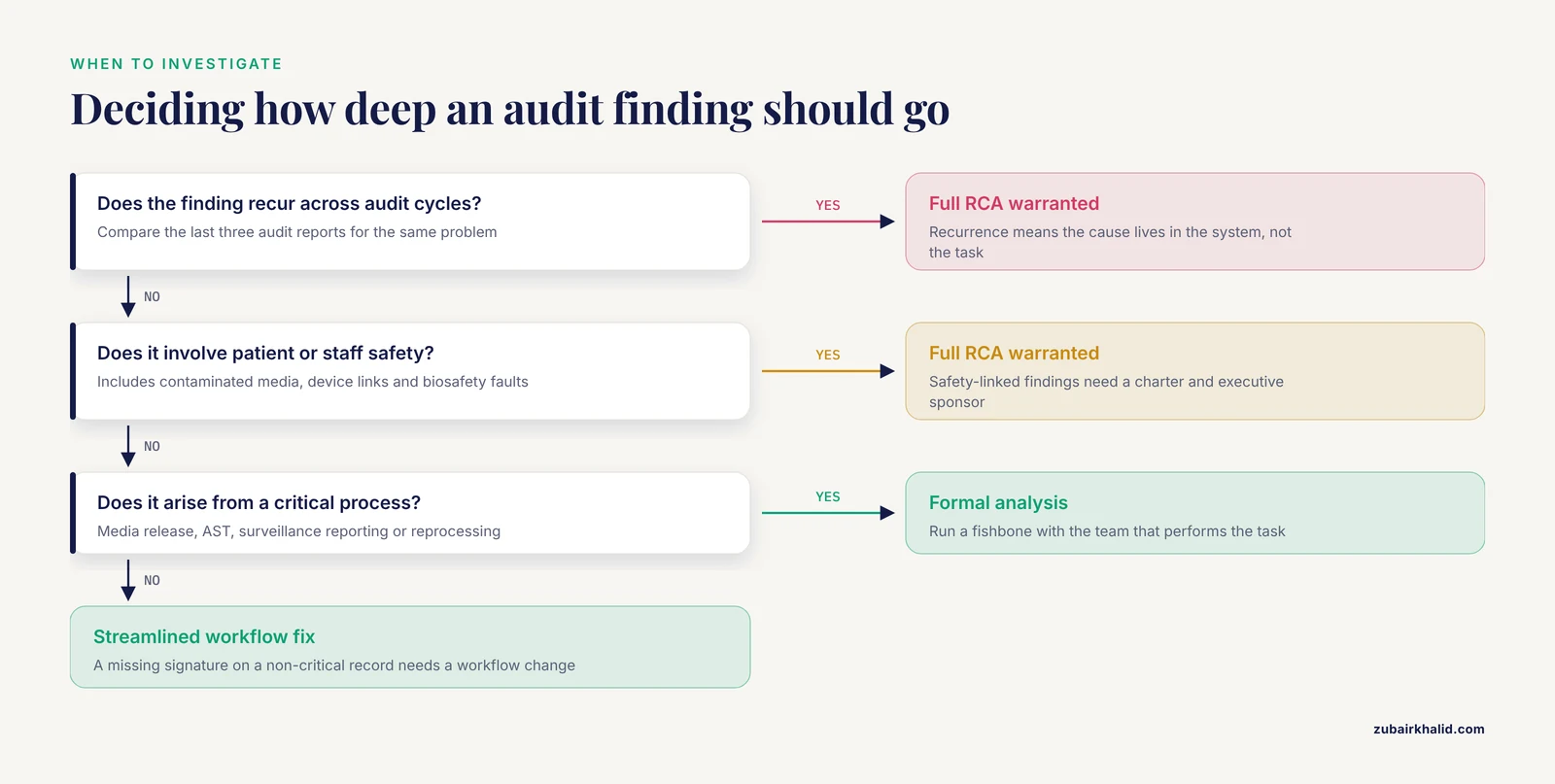
- Treating every finding with the same depth. Not every observation justifies a full RCA with a charter and executive sponsor. A risk-calibrated approach matches investigation intensity to the severity and recurrence risk of the finding [6]. A missing signature on a non-critical record needs a workflow fix. A contaminated blood culture series needs the full framework.
- Skipping the verification step. Intent is not effectiveness. Only a defined re-audit interval demonstrates that the cause is gone [11].
- Ignoring data validity in surveillance findings. An apparent rise in an infection indicator may be a reporting artifact. Validate the surveillance data before investigating the clinical process [9].
- Blaming the taxonomy. Any cause list is not exhaustive [3]. Use the categories as a checklist for brainstorming, not as a set of boxes to fill.
One limitation applies to any published framework. Individual laboratories differ in staffing, volume, accreditation regime, and instrumentation, and the corrective actions described here are patterns rather than prescriptions. Each laboratory must validate actions against its own processes.
Prevention: Building RCA into Routine Laboratory Quality Management
Prevention is not a separate program. It is the habit of treating every audit finding, complaint, and QC excursion as a data point about the system, and feeding all of them into the same improvement loop.
Adopt a standing taxonomy. Write the six cause categories [3] into your quality manual and require every RCA to classify its causes against them. Over time this builds a laboratory-specific cause profile that tells you where your system is weak.
Keep a no-blame stance as policy. The RCA literature across industries converges on systems-based analysis and a no-blame culture as the conditions under which staff report freely and investigations reach real causes [2]. State the policy in writing, and honor it when it is tested.
Run Pareto on your own finding history annually. Rank the year's audit findings, complaints, and QC failures. Combined Pareto and fishbone analysis is the recommended approach for prioritizing audit activity when many high-risk findings exist [7]. The top few causes usually account for most of the findings, and fixing them is the highest-yield quality work available.
Embed verification points in every critical process. Growth promotion and sterility testing for media, QC strain performance for AST systems, and timestamp checkpoints for turnaround are control points that convert silent failures into detectable ones [1].
Orient every new staff member to the systems, not just the tasks. Orientation gaps appeared as fully controllable root causes in the surveillance reporting analysis [4]. A structured onboarding checklist covering case definitions, SOPs, QC duties, and escalation paths removes an entire cause category before it produces findings.
Share findings across departments. The duodenoscope outbreak investigation showed that miscommunication between units was a major contributing abnormality [10]. RCA conclusions that affect another department, such as specimen collection or reprocessing, must be transmitted to that department as an action, not mentioned in a report.
Consider automation where volume justifies it. Automated classification of incident narratives into structured taxonomies can reveal systemic patterns across large report volumes and support quantitative risk assessment [13]. A laboratory with a mature incident reporting system can apply the same logic to its own data.
Close the loop formally. Every finding should end in one of three documented states. Fixed and verified. Accepted risk with rationale. Escalated to policy level. A finding without a terminal state is an open loop that will reappear.
Frequently Asked Questions
What is a root cause analysis in a microbiology laboratory?
It is a structured investigation that traces an audit finding, complaint, or error back to the underlying system condition that produced it, then designs and verifies a corrective action at that level. The six working cause categories are strategy and policy, systems and procedures, knowledge and understanding, time and capacity, human factors, and client matters [3].
When should an audit finding trigger a formal RCA?
Any finding that recurs across audit cycles, involves patient or staff safety, or arises from a critical process warrants a formal RCA. Single minor observations can be handled with a streamlined analysis, matched to a risk-calibrated intensity level [6].
Which RCA tool should I start with?
Start with a fishbone (Ishikawa) diagram for a single multi-factor finding, and with Pareto analysis when you must prioritize among many findings. Combining the two works well when an audit surfaces five or more high-risk observations [7].
How do I tell a root cause from a symptom?
A symptom is what the auditor observed. A root cause is a condition that, when present, makes the failure possible and, when absent, prevents it. Test each candidate cause against three questions. Does it explain this event? Does it predict similar past events? Does removing it prevent recurrence?
What is a no-blame culture and why does it matter?
A no-blame culture treats individual error as a symptom of system conditions rather than as the cause, and it protects staff who report problems. This stance is a core recommendation drawn from industries where RCA practice is mature, including aviation and healthcare [2].
How do I know if my corrective action actually worked?
Define a metric, a threshold, and an observation window before you implement, then re-audit after that window. The iPTH investigation reassessed results after its interventions were deployed to confirm improvement [11].
How long should an RCA take?
A single-finding fishbone analysis can be completed within a week by a small team. A full high reliability investigation with a charter, individual interviews, and event diagramming runs across a three-meeting model [5]. Outbreak-linked investigations take longer because they may require sampling, records review, and independent expert assessment [10].
Can we reuse one RCA to cover several similar findings?
You can run one RCA on a grouped finding if the findings share a demonstrable mechanism, such as the same procedure gap appearing at three benches. You cannot reuse it if the findings differ in cause category, because empirical evidence shows root causes combine differently in each event [3].
Sources
- ROOT CAUSE ANALYSIS OF INCONSISTENT BACTERIAL CULTURE MEDIA QUALITY USING THE FISHBONE (ISHIKAWA) DIAGRAM: A CASE STUDY
- Root cause analysis - what do we know?
- An empirical model for root cause analysis in the audit profession
- Silent signals in Bongo: Root cause analysis of case reporting gaps in disease surveillance, 2025
- Root cause analysis: A framework using principles of high reliability.
- Maximizing Audit Value Through Root Cause Analysis: A Strategic Framework Aligned with the 2024 Global Internal Audit Standards
- Menentukan Prioritas Audit Sistem dan Teknologi Informasi Berdasarkan Root Cause Analysis Menggunakan Pareto Chart dan Fishbone
- Abstract T P247: An Interdisciplinary Approach Using a Root Cause Analysis to Decrease Door to IV tPA Times
- Root-cause analysis of bacteraemia increase and surveillance data in hemodialysis
- Independent root cause analysis of contributing factors, including dismantling of 2 duodenoscopes, to an outbreak of multidrug-resistant Klebsiella pneumoniae.
- Is it True Hypoparathyroidism? A Root Cause Analysis of Unusually Low Intact Parathyroid Hormone (iPTH) at a Clinical Laboratory
- Root-Cause Analysis of Persistently High Maternal Mortality in a Rural District of Indonesia: Role of Clinical Care Quality and Health Services Organizational Factors
- Quantitative Risk Assessment in Radiation Oncology via LLM-Powered Root Cause Analysis of Incident Reports