How to Match Risk Groups to Biosafety Levels: A Practical Guide
By Dr. Zubair Khalid, DVM, MS, PhD ·
A risk group describes how dangerous an organism is on its own, while a biosafety level describes how tightly a laboratory contains the work being done with it. The rule of thumb is simple: start with the risk group as your default containment anchor, then move up or down based on what you actually do with the agent, the volume you handle, the route of exposure your procedure creates, and the protective measures available in your facility. Getting this match right is the core skill of laboratory biosafety, and this guide walks through it step by step with worked scenarios you can adapt on your own bench.
Risk Group Classification and Biosafety: Two Systems, Two Jobs
Risk group classification and biosafety containment answer different questions, and confusing them is the single most common error in laboratory planning. A risk group (RG) is a hazard classification assigned to a biological agent based on its pathogenicity, transmissibility, available countermeasures, and potential impact on individuals and communities. A biosafety level (BSL) is a set of containment practices, safety equipment, and facility design features applied to a specific laboratory space and the work performed in it.
The four-tier risk group framework is broadly consistent across major international systems:
- Risk Group 1 (RG1): Organisms that are not known to cause disease in healthy adult humans. Examples include standard laboratory strains such as Escherichia coli K-12 derivatives and Bacillus subtilis.
- Risk Group 2 (RG2): Organisms that cause human disease but are unlikely to spread in the community and for which effective treatment or prevention usually exists. Examples include Staphylococcus aureus, Salmonella species, and hepatitis B virus.
- Risk Group 3 (RG3): Organisms that cause serious disease and may spread, but for which some countermeasure often exists. Examples include Mycobacterium tuberculosis, yellow fever virus, and SARS-related coronaviruses.
- Risk Group 4 (RG4): Organisms that cause severe or fatal disease, spread readily, and for which no vaccine or treatment is generally available. Nipah virus and Hendra virus are the classic examples [1].
Biosafety levels run on a parallel four-tier scale, BSL-1 through BSL-4, adding layers of containment at each step. BSL-1 relies on standard microbiological practices with open bench work. BSL-2 adds restricted access, biological safety cabinet (BSC) use for aerosol-generating tasks, and specified personal protective equipment (PPE). BSL-3 adds directional airflow, sealed rooms, respiratory protection, and dedicated engineering controls. BSL-4 provides maximum containment, typically a cabinet line or positive-pressure suit facility, dedicated air supply, chemical showers, and strict entry and exit protocols.
The critical point is that a risk group is a property of the organism. A biosafety level is a property of the room, the procedure, and the person doing the work. The organism travels between buildings, but containment is decided locally.
Side-by-Side Comparison: Matching Risk Groups to Biosafety Levels
The table below is the practical core of risk group classification and biosafety planning. Treat the default pairing in the second and third columns as a starting point, not a verdict. The final column explains why the pairing can shift in either direction.
| Risk Group | Default Biosafety Level | Typical Agent Examples | What Drives the Assignment Up | What Can Justify Lower Containment |
|---|---|---|---|---|
| RG1 | BSL-1 | E. coli K-12, B. subtilis, most environmental saprophytes | Aggregating unknown isolates, work with large volumes, insertions of virulence genes | None below BSL-1 |
| RG2 | BSL-2 | S. aureus, Salmonella, hepatitis viruses, dengue virus (in many national lists) | Aerosol-generating concentration, large volumes, immunized or naive staff issues, novel vector systems | Inactivated material, cell-free assays, well-characterized noninfectious fractions |
| RG3 | BSL-3 | M. tuberculosis, yellow fever virus, eastern equine encephalitis virus | Propagation, sonication, centrifugation without sealed rotors, animal work | Highly attenuated strains, subunit or killed preparations, diagnostic assays on fixed or extracted material (jurisdiction dependent) |
| RG4 | BSL-4 | Nipah virus, Hendra virus, smallpox virus (variola) | Any live virus handling at scale | Inactivated or recombinant subunit material only, with documented verification |
A second comparison, the containment ladder itself, helps when you are deciding what physically changes between levels:
| Feature | BSL-1 | BSL-2 | BSL-3 | BSL-4 |
|---|---|---|---|---|
| Access control | Open, during work | Limited, posted | Restricted, keyed/badge | Isolated, sequential entry, airlocks |
| BSC requirement | Not required | Required for aerosol-generating work | Required for all open manipulation | Class III cabinet line or suit laboratory |
| PPE baseline | Lab coat, gloves | Lab coat, gloves, eye protection | Dedicated gown, gloves, respiratory protection | Positive-pressure suit or cabinet containment |
| Facility design | Sink, easy cleaning | Autoclave available, eyewash | Directional airflow, sealed penetrations, dedicated air handling | Dedicated supply and exhaust air, chemical showers, redundant filtration |
| Personnel measures | Basic training | Training plus documented competency | Training, medical surveillance, baseline serum where indicated | Full medical clearance, monitoring, stringent decontamination and exit protocols |
The Standard Default Pairings and Where They Come From
The default one-to-one mapping, RG1 to BSL-1 through RG4 to BSL-4, appears in essentially every national and international biosafety reference framework. Recent comparative analysis of ten national and international reference documents, including the World Health Organization (WHO) Laboratory Biosafety Manual fourth edition, the CDC and NIH Biosafety in Microbiological and Biomedical Laboratories (BMBL) sixth edition, and the CDC Biological Risk Assessment framework, found strong conceptual convergence on this baseline structure [2]. That convergence is reassuring for anyone writing a biosafety manual because the defaults will be recognized almost anywhere.
National risk group lists formalize these defaults. The experimental guidelines for genetic modification published by the Republic of Korea, revised in 2025, classify listed biological agents into Risk Groups 1 through 4 using international anchors such as the US National Institutes of Health (NIH) Guidelines and the United Kingdom Approved List of Biological Agents, together with domestic references such as the pathogen biosafety data sheets maintained by the Korea Disease Control and Prevention Agency (KDCA) [3]. The structure is the same elsewhere: a published list, a risk group number for each agent, and a default containment expectation attached to that number.
Two practical observations come out of these national list documents. First, the actual risk group assignments for a given agent have been stable across recent revisions, with the Risk Group 1 through 4 assignments unchanged since the 2022 revision in the Korean framework [3]. Second, nomenclature changes constantly. The International Committee on Taxonomy of Viruses (ICTV) naming rules have driven substantial revisions in how viruses are written and grouped, and modern guidance presents revised and existing virus names in parallel so laboratories can map old labels to new ones [3]. A biosafety manual that hardcodes old species names will age badly.
Why the Default Match Is Only a Starting Point
The defaults fail in predictable ways because they ignore what happens inside the room. Handling 10 milliliters of a Risk Group 2 organism in a closed tube on the open bench is a different exposure scenario than aerosolizing 10 liters of the same organism in a fermenter, yet pure agent-based classification treats them identically. A recent framework addressing exactly this problem proposes an 8-step, procedure-specific risk protocol in which the exposure generated by the procedure, rather than agent taxonomy, serves as the primary determinant of containment, integrating agent risk group classification, procedural exposure characterization, and modulating factors into a final biosafety level assignment [2]. That procedure-specific risk (PSR) framework was built by synthesizing the same ten major reference documents that underpin the defaults, so it is not a departure from the consensus. It is a structured way to apply it.
The logic works in both directions. A Risk Group 3 agent handled as a fully inactivated antigen in a plate assay may not require BSL-3 containment, because the procedure creates no exposure. A Risk Group 2 agent processed in large-volume, high-pressure, aerosol-generating equipment may justify BSL-3 controls for that specific step, even though the agent alone would normally sit at BSL-2. This is why biosafety professionals insist that a biosafety risk assessment be performed per procedure, per agent, per facility, not once per organism.
How to Match Risk Groups to Biosafety Levels: A Structured Risk Assessment
The following sequence adapts the PSR framework's logic into a bench-usable workflow [2]. Run it for every new protocol, and rerun it whenever the agent, the equipment, the scale, or the personnel change.
- Identify the agent and assign a provisional risk group. Use your national list, the NIH Guidelines, the UK Approved List, or published biosafety data sheets. For uncharacterized isolates, assign conservatively until identification is complete.
- Characterize the procedure. List every step that manipulates the agent. Note which steps open the containment boundary: opening tubes, pipetting, vortexing, sonication, centrifugation, homogenization, filtration, animal inoculation.
- Characterize the exposure the procedure generates. Estimate the route of exposure each step creates (inhalation, percutaneous, mucosal, ingestion) and the likely inoculum. Aerosol-generating steps and large volumes raise the exposure score.
- Evaluate modulating factors. Consider host factors (immunization status of staff, pregnancy, immunocompromise), agent factors (vaccine availability, treatment availability, transmissibility), facility factors (BSC class, sealed rotors, directional airflow), and operational factors (staff experience, procedure frequency, single-operator versus team work).
- Assign the containment level. Match the combined exposure profile to a biosafety level. Default to the agent's risk group pairing, then justify any deviation in writing.
- Specify engineering controls. Translate the level into equipment: BSC class, sealed rotors and safety cups, primary containment for centrifugation, sharps controls.
- Specify practices and PPE. Write the procedural rules: hand ties versus gowns, glove changes, decontamination methods, transport containers.
- Document, approve, and review. Record the rationale, obtain institutional biosafety committee (IBC) or equivalent approval where required, and set a review trigger (protocol change, incident, new staff).
A freely accessible implementation of this assessment approach has been described alongside the PSR framework, which lowers the barrier for smaller laboratories that lack a dedicated biosafety office [2].
Risk Group Classification Biosafety Options: Which Framework Should You Follow
Laboratories face a genuine choice among risk group classification and biosafety frameworks, and the best option depends on your legal context and the type of work you do.
National regulatory lists. Most countries publish or adopt a list of biological agents with risk group assignments. These lists differ. A global analysis of dengue virus biosafety found substantial variability in biosafety level requirements and risk group designations across regions, with the inconsistencies complicating research collaboration and outbreak response [4]. Dengue virus sits at Risk Group 2 in some frameworks and Risk Group 3 in others, and the assigned containment for laboratory work varies accordingly [4]. The practical takeaway is that a multinational project must decide up front which list governs each site, and document that decision.
Agent-based frameworks anchored to international references. The Korean genetic modification guidelines illustrate this option well, drawing on the NIH Guidelines, the UK Approved List, and domestic pathogen data sheets to build a harmonized list updated to current ICTV taxonomy [3]. This approach is fast to apply and easy to audit, which is why it dominates institutional biosafety manuals.
Procedure-based frameworks. The PSR framework assigns containment by exposure rather than by organism alone, using a structured 8-step protocol validated for content against the major reference documents and supported by a digital tool [2]. This approach suits laboratories handling viral vectors, genetically modified organisms, and multi-step protocols, where a single agent may pass through procedures with radically different exposure profiles.
Risk assessment guidance documents. The CDC biological risk assessment framework, referenced as a core input in the comparative analysis of biosafety documents, provides the underlying methodology used by both other options [2]. Learning it pays off regardless of which list your institution uses.
Pros and Cons of Each Matching Approach
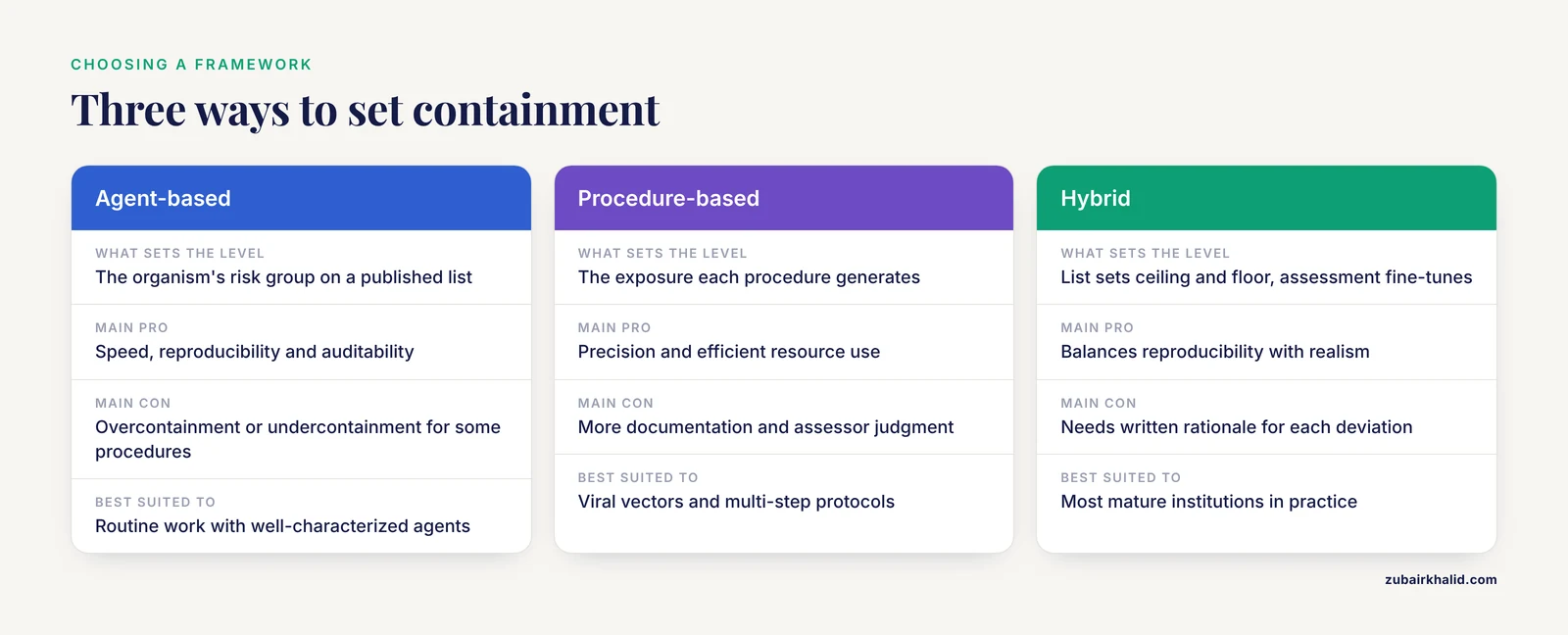
Agent-based (list-driven) matching. The pros are speed, reproducibility, auditability, and regulatory alignment. Any reviewer can check an agent against a list and confirm the number. The cons are overcontainment for low-exposure procedures, undercontainment for high-exposure procedures with modest agents, and the harmonization problem. The dengue analysis demonstrates the harmonization problem concretely, showing that the same virus carries different risk group designations and containment requirements across countries, which hinders consistent mitigation and outbreak management [4].
Procedure-based matching. The pros are precision, efficient resource use, and honest accounting of the actual exposure your staff faces. The PSR framework was designed precisely because direct RG-to-BSL linkage fails to capture how exposure varies across modern procedures involving viral vectors and genetically modified organisms [2]. The cons are increased documentation burden, greater dependence on assessor judgment, and the need for validation. Because procedure-based assignments can deviate from the default pairing, they require a written rationale and institutional oversight to remain defensible.
Hybrid practice, which is what most mature institutions actually run. The agent list sets the ceiling and floor, and the procedure-based assessment fine-tunes within it. This balances reproducibility with realism, and it mirrors how the major reference documents are intended to work together [2].
Worked Scenarios
Scenario 1: Routine culture of a defined Risk Group 1 strain
A teaching laboratory cultures E. coli K-12 on agar plates for undergraduate exercises. The agent is Risk Group 1, the procedure involves open plates at room temperature, and volumes are milliliter scale. Assignment: BSL-1. Standard microbiological practices, handwashing, a lab coat, and autoclaving of waste are sufficient. No BSC is required.
Scenario 2: Diagnostic serology on human serum
A clinical laboratory performs enzyme immunoassays on human serum samples that may contain hepatitis B virus or bloodborne pathogens. Human-source material is treated as potentially infectious regardless of known agent status. Assignment: BSL-2 practices for all manipulation, with BSC use only if a procedure could aerosolize material. The modulating factor that drives this assignment is the unknown agent status of the sample, not the known properties of any single organism.
Scenario 3: Dengue virus research
Dengue virus illustrates why regional and procedural context matters. A global review of dengue biosafety found that risk group designations and containment standards vary widely between regions, and that the vector-borne nature of the virus, with rare nonvector transmission documented, creates assessment challenges that pure agent lists handle poorly [4]. A laboratory performing routine serologic assays on inactivated samples can often operate at BSL-2 under its national rules, while a laboratory propagating live virus in mosquito cells or infecting mosquito colonies faces different exposure routes that may justify higher containment depending on the governing framework. The scenario demonstrates why each site must run its own biosafety risk assessment rather than importing another country's assignment [4].
Scenario 4: Yellow fever virus manipulation
Yellow fever virus is classified as a Risk Group 3 pathogen by the WHO, requiring handling in a BSL-3 laboratory for live virus work. Personnel must be vaccinated against yellow fever at least 10 days before any contact with the virus, a requirement grounded in documented cases of occupationally acquired infections among healthcare and laboratory workers [5]. Note the two separate control measures here. Containment (BSL-3) addresses the environment, and vaccination addresses the host. A complete risk assessment uses both.
Scenario 5: Henipavirus research
Nipah virus and Hendra virus are Risk Group 4 agents and WHO priority pathogens [1]. Any live virus propagation, animal inoculation, or high-titer preparation requires BSL-4. ICTV taxonomic revisions have restricted the genus Henipavirus to bat-borne viruses, and multiple novel henipaviruses have been identified recently, but for most of these, no live virus isolates or animal model data exist, which precludes definitive risk assessment [1]. Until evidence exists, the conservative and correct move is to treat uncharacterized henipaviruses as Risk Group 4 candidates and refer them to maximum containment facilities.
Scenario 6: Modeling RG4 infection without animals in a BSL-4 suite
A recent effort piloted lung organ-on-chip microfluidic systems, seeded with human and porcine cells, inside a maximum containment (BSL-4) laboratory using Nipah virus [6]. The work recapitulated key features of Nipah lung infection, including viral infection and replication, inside the chips [6]. The biosafety lesson is instructive. Moving to a nonanimal model reduced the ethical and logistical burden of the science, but it did not reduce the biosafety level, because the procedure still involved live Risk Group 4 virus inside the containment boundary. New methodology changes the experimental question, not the containment decision.
Scenario 7: An environmental isolate of unknown risk
An industrial microbiology laboratory isolates bacteria from volatile organic compound emissions at a wood painting plant. Among the robust isolates is a strain identified as Pseudomonas aeruginosa. Published guidance on exactly this type of workflow emphasizes that identifying the isolate is the first step required to evaluate its risk group by comparison with type strains in worldwide culture collections, and that this evaluation precedes correct procedure implementation and appropriate containment, including at large scale [7]. P. aeruginosa is a recognized opportunistic pathogen, so the laboratory assigns RG2 and BSL-2 until strain-specific characterization justifies otherwise. The scenario is common in environmental, food, and bioremediation laboratories, and the principle generalizes: no identification, no defensible risk group, therefore conservative containment.
Scenario 8: Synthetic biology and eradicated agents
Variola virus, the agent of smallpox, sits at the extreme end of both scales. A strategic review of post-eradication biosafety highlights converging risks from the technical feasibility of de novo orthopoxvirus synthesis and the expanding immunity gap since routine vaccination ceased, with the 2022 mpox resurgence serving as a sentinel event for declining cross-protective immunity [8]. For biosafety planning, this means that containment for orthopoxvirus work is inseparable from biosecurity: personnel immunity status, sequence and material access controls, and institutional memory all factor into the assessment alongside the physical containment level [8].
Microbiology Biosafety Training: Making the Match Stick
An assignment on paper protects no one until staff can execute it. Microbiology biosafety training should be tiered, documented, and competency based.
Tier 1, universal training. Every person entering the laboratory, including custodial and maintenance staff, needs training on the meaning of the posted biosafety level, entry and exit rules, spill reporting, and emergency contacts.
Tier 2, agent and procedure training. Personnel performing work at BSL-2 and above need documented training on the specific agents and protocols they will run, the exposure routes their procedures create, correct BSC use, centrifugation safety with sealed rotors, sharps handling, and decontamination procedures, including autoclave parameters and chemical disinfectant contact times appropriate to the agents in use.
Tier 3, higher containment training. BSL-3 and BSL-4 work requires supervised progression, medical surveillance, and in many institutions baseline serum collection. BSL-4 programs require intensive mentored training inside the containment suite before independent work, and vaccination or other medical countermeasures where they exist, as the yellow fever example shows with the 10-day precontact vaccination requirement [5].
Training should be refreshed on a defined schedule and after any protocol change, incident, or near miss. The biosafety risk assessment itself is a training tool. Walking a new technologist through the 8-step assessment for their protocol teaches both the reasoning and the specific controls better than a generic lecture [2].
Common Mistakes and Limitations
- Treating the risk group as the biosafety level. Risk group classification describes the agent. Biosafety level describes the work. A Risk Group 2 organism handled in a large-scale aerosol-generating process may need more than BSL-2, and a Risk Group 3 agent in a fully inactivated assay may not need BSL-3 [2]. Always run the procedure-specific assessment.
- Borrowing another country's assignment. National lists disagree, sometimes for the same virus. The dengue virus case demonstrates real-world inconsistency in risk group designations and containment standards across regions [4]. Check your own jurisdiction's governing list and document which list you used.
- Letting taxonomy drift break your manual. Virus names change under ICTV rules, and recent guidance presents revised and existing names in parallel to keep lists usable [3]. If your biosafety manual references agents only by old names, staff may not recognize that a newly named agent maps to an already classified risk group.
- Assigning risk groups to uncharacterized isolates without identification. Environmental and clinical isolates must be identified before a defensible risk group assignment, using comparison against type strains in recognized culture collections [7]. Until then, assume the higher plausible group.
- Forgetting the host side of the assessment. Containment is only half the equation. Vaccination requirements, such as yellow fever vaccination at least 10 days before contact with the virus [5], and medical surveillance are modulating factors that belong in the written assessment, not in institutional memory alone.
- Treating new experimental platforms as containment reductions. Replacing animal models with organ-on-chip systems changes the science, but if live Risk Group 4 virus is still manipulated, the work still requires maximum containment [6].
- Ignoring biosecurity in high-consequence assignments. For agents where synthesis feasibility and population immunity interact, such as variola virus, the risk assessment must include access control, personnel screening, and institutional memory, not just physical containment [8].
- Assuming novel relatives inherit the risk group automatically. For newly discovered henipaviruses without live isolates or animal data, definitive risk assessment is not yet possible, and provisional conservative classification with documented reevaluation is the defensible path [1].
One limitation applies to this guide generally. Risk group lists, containment requirements, and approval pathways are jurisdiction specific, and individual protocols require review by your institution's biosafety professional or biosafety committee before implementation.
Frequently Asked Questions
Does Risk Group 2 always mean BSL-2?
No. The pairing is a default, not a rule. A Risk Group 2 organism handled in small, closed volumes at BSL-2 is typical, but procedures that generate aerosols at scale, such as large-volume centrifugation or homogenization, can justify raising containment for those steps. Procedure-based risk assessment frameworks were developed precisely because direct risk group to biosafety level linkage misses these exposure differences [2].
What is the difference between a risk group and a biosafety level?
A risk group classifies the inherent hazard of an organism based on pathogenicity, transmissibility, and available countermeasures. A biosafety level specifies the containment practices, equipment, and facility design for a particular laboratory and procedure. The agent travels, the containment is local, and the biosafety risk assessment connects the two.
Which risk group classification list should my laboratory use?
Use the list required by your national or institutional regulator, and document that choice. National frameworks commonly anchor their assignments to the NIH Guidelines, the UK Approved List of Biological Agents, or national pathogen data sheets such as those from the KDCA [3]. Be aware that lists disagree for some agents, as the dengue virus analysis showed, so multinational projects must harmonize their assignments explicitly [4].
Do I need BSL-3 to work with dengue virus?
It depends on your governing framework and your procedure. Dengue virus risk group designations and required containment vary across regions and guidelines [4]. Inactivated or noninfectious work may fall under BSL-2 in many frameworks, while live virus propagation may carry higher requirements. Run a written biosafety risk assessment for your specific protocol and confirm with your biosafety office.
What training is required before working at higher biosafety levels?
Training escalates with containment. BSL-2 requires documented agent and procedure training with competency sign-off. BSL-3 adds supervised progression, respiratory protection training, and medical surveillance. BSL-4 requires intensive mentored training inside the containment suite, medical clearance, and, where countermeasures exist, vaccination with adequate lead time, as the yellow fever 10-day precontact vaccination requirement illustrates [5].
Who approves a biosafety level assignment?
Your institutional biosafety committee or equivalent oversight body holds final approval, informed by the written risk assessment and your national regulatory requirements. Structured assessment protocols and supporting digital tools make that approval defensible by documenting the agent basis, procedural exposure, modulating factors, and the rationale for any deviation from the default pairing [2].
Sources
- Distribution, diversity, and biological risk of henipavirus from a One Health perspective: A mini-review.
- An 8-step procedure-specific risk framework enables reproducible biosafety level assignment beyond agent-based classification.
- [[Experimental Guidelines for Genetic Modification (2025 Revision): Understanding Biological Risk Group Classification].](https://pubmed.ncbi.nlm.nih.gov/41332505/)
- Dengue Virus Biosafety: An Analysis of Evidence, Global Inconsistencies, and Risk Gaps.
- Enhancing Biosafety Protocols in Laboratories Conducting Research on the Yellow Fever Virus.
- Modeling Risk Group 4 virus infection and antiviral treatment in microfluidic lung organ-on-chips in maximum containment laboratories.
- Identification and characterization of bacteria isolated under selective pressure of volatile organic compounds.
- Global health security and smallpox: A strategic review of post-eradication biosafety and preparedness.