Respirators for Microbiology Labs
By Dr. Zubair Khalid, DVM, MS, PhD ·
A surgical mask catches droplets you breathe out and blocks splashes, while a respirator seals against the face and cleans the air you breathe in. That seal is the whole difference, because microbiology work releases aerosols, particles small enough to stay airborne and reach the deepest parts of the lungs. The rule of thumb is straightforward: if the biosafety risk assessment for a task identifies an inhalation hazard that the biosafety cabinet and other engineering controls cannot fully remove, wear a fit-tested N95 filtering facepiece respirator or better, and step up to a powered air-purifying respirator when facial hair, fit failure, or long run times make a disposable respirator impractical.
This guide covers the main respirator for microbiology lab options, the pros and cons of each, and the fit testing, comfort, reuse, and training practices that decide whether the device actually protects anyone.
Why Microbiology Labs Need Respirators
Microbiology is an aerosol discipline. Routine bench actions that look harmless release particles into the air: vortexing and mixing cultures, snapping off lids, decanting supernatants, flaming a contaminated loop, grinding tissue, harvesting spores from plates, flooding slides, loading an unsealed centrifuge rotor, and cleaning up spills. Even opening an incubated plate or dropping a lid onto the bench can put a puff of dried culture dust into the breathing zone. An aerosol behaves differently from a droplet because it stays suspended, drifts with air currents, and can be inhaled deep into the lung, where a small inoculum can establish infection.
Some agents handled in diagnostic and research labs are dangerous mainly through that route. Mycobacterium tuberculosis, Brucella species, and Francisella tularensis are classic laboratory infection hazards, and the arthroconidia of Coccidioides are infectious when inhaled from environmental cultures. For these organisms, inhalation is the exposure that matters, and a procedure that looks routine becomes the event that defines the risk.
Allergy adds a second reason. Laboratory animal allergens, proteins from rodent urine, pelts, and serum that become airborne from bedding and cages, cause a recognized occupational disease among animal handlers, and respiratory protection is part of the answer.
Respirators sit at the end of the hierarchy of controls, the standard ordering of protections from most to least reliable: eliminate or substitute the hazard, enclose it with engineering controls such as a class II biosafety cabinet and sealed centrifuge cups, reduce exposure with administrative controls and training, and only then add personal protective equipment. A respirator for microbiology lab work supplements the biosafety cabinet and never replaces one. When a task is done correctly inside a cabinet, the respirator is the backup for the moments the cabinet is not enough, such as spill response or equipment failure.
Start With a Biosafety Risk Assessment
A biosafety risk assessment is a written, structured judgment of what could go wrong with a specific agent in a specific procedure and what will be done about it. It turns the question "should we wear respirators here" from an opinion into a decision, and it is the natural starting point for microbiology biosafety training.
Four questions drive it. First, the agent: how does it infect, what dose establishes infection, how stable is it in air, and is there a vaccine or prophylaxis. Second, the procedure: does it generate aerosols, at what volume and concentration, and inside what containment. Third, the people: what is their training, immunization status, and medical fitness for respiratory protection. Fourth, the residual risk: after engineering and administrative controls, what exposure remains for the respirator to cover.
The assessment maps onto the biosafety level (BSL) framework, the standard containment tiers numbered BSL-1 through BSL-4. BSL-1 covers well-characterized agents with no inhalation hazard and typically needs no respirator. BSL-2 covers most diagnostic bacteriology and virology, where a respirator appears when a specific task, such as processing specimens outside a cabinet or responding to a spill, creates inhalation risk. BSL-3, for agents transmitted by the airborne route such as M. tuberculosis cultures, makes respiratory protection standard practice. BSL-4 work depends on supplied air through a fully isolated suit or cabinet system.
The output should be concrete: a named respirator class, the task list that requires it, who is enrolled, and how the decision is revisited whenever the agent, the procedure, or the equipment changes. The biosafety officer signs it, occupational health clears the wearers, and the training program teaches it. Without that chain, respirators drift into the two failure modes seen everywhere: worn when unnecessary, or absent when needed.
Respirator for Microbiology Lab Options
Five equipment families cover essentially every microbiology need. Each is defined by how it captures particles and how it stays on the face.
Filtering Facepiece Respirators (N95 and Beyond)
A filtering facepiece respirator (FFR) is a disposable device in which the entire facepiece is the filter, with no replaceable parts. The N95 designation means the filter captures at least 95 percent of airborne particles when the respirator is properly fitted, with the hardest particles to capture sitting near 0.3 micrometers, a size the electrostatically charged fibers still trap efficiently. Higher grades exist in the same family, including N99, N100, and P100 filters, where the letters describe oil resistance (N for not oil resistant, R for oil resistant with time limits, P for oil proof) and the numbers describe filtration efficiency. Microbiology benches rarely produce oil aerosols, so N-series filters dominate.
An FFR is the default choice for routine aerosol tasks at BSL-2 and for spill response, because it is light, needs no maintenance, and works immediately. Surgical N95 variants add fluid resistance for settings that combine clinical and laboratory duties. Models with an exhalation valve breathe easier and stay drier, but the valve releases unfiltered exhaled breath, which matters when the work must stay sterile or when the wearer should not shed exhaled air into cultures or shared spaces.
The cons are real. Protection depends entirely on fit, which varies by face shape and model, so each model and size must be fit tested. Speech is muffled. Breathing resistance becomes noticeable during long or physically demanding sessions. And the devices are single use, which creates both waste and the temptation to stretch wear past the point where the respirator still does its job.
Elastomeric Half-Mask Respirators
An elastomeric half-mask respirator is a reusable facepiece made of rubber or silicone, fitted with replaceable filter cartridges, most commonly P100, the highest efficiency common particle filter class. The elastomeric body conforms to the face and generally holds a seal more consistently than the pressed edges of a disposable FFR, and a speech diaphragm keeps communication usable.
The advantages accumulate in labs that run respirator-requiring tasks every week. The facepiece is cleaned and disinfected between uses, cartridges are swapped on a schedule, and the program does not depend on a continuous supply of disposables. The disadvantages are the mirror image: someone must own the cleaning, the cartridge change schedule, the storage, and the inspection. A half-mask covers only the nose and mouth, so eye protection is separate. Like an FFR, it requires fit testing, and its exhalation valve vents unfiltered exhaled air, so it is a poor choice where the product or the room must be protected from the wearer.
Full-Facepiece Elastomeric Respirators
A full-facepiece elastomeric respirator wraps the same cartridge logic in a sealed visor that covers the eyes. That adds splash protection to inhalation protection and raises the expected performance, expressed as an assigned protection factor (APF), the workplace protection a properly functioning respirator of that class is expected to deliver. In United States programs, half masks and FFRs are commonly assigned an APF of 10, and full facepieces an APF of 50.
The trade-offs are weight, fogging, and maintenance. Eyeglasses can break the visor seal unless the program provides spectacle kits designed for the facepiece. Fit testing must be repeated with the full facepiece, and cleaning takes longer. In exchange, the wearer gets one device that covers the classic combined hazard of microbiology work, an aerosol and a splash from the same manipulation.
Powered Air-Purifying Respirators (PAPR)
A powered air-purifying respirator (PAPR) uses a battery-driven blower to pull room air through a high-efficiency particulate air (HEPA) filter, which captures at least 99.97 percent of particles, and push it into a hood, helmet, or tight-fitting facepiece. Because air arrives under slight positive pressure, leaks tend to move outward rather than inward, so protection does not rest on a perfect face seal.
Loose-fitting hoods are the version most microbiology labs choose. They require no fit test, tolerate facial hair far better than any tight-fitting device, and deliver a constant stream of cool filtered air that makes long sessions tolerable. Tight-fitting PAPR facepieces exist and are used when a hood interferes with other equipment.
The cons are logistical. The blower and battery ride on the belt, the noise is constant, batteries need charging and eventual replacement, airflow indicators must be checked before each use, and shared hoods must be cleaned and disinfected between users. A PAPR program demands more administrative attention than a box of FFRs, and it earns that attention in return for comfort, beard compatibility, and high protection during the heaviest aerosol tasks.
Supplied-Air Respirators
A supplied-air respirator delivers clean air from a remote source through a hose, so the wearer breathes air that is independent of the room. This is the equipment of major spill response and the highest containment levels, not of the routine bench. It demands an air quality program, tether management, and rehearsed emergency procedures. Most microbiology labs will never own one, but staff should recognize it and understand that its appearance on a spill cart means the task has outgrown ordinary PPE.
Side-by-Side Comparison of Respirators for Microbiology Labs
| Option | How it works | Best for | Pros | Cons |
|---|---|---|---|---|
| , - | , - | , - | , - | , - |
| Procedure (surgical) mask | Loose-fitting barrier, no seal | Splash protection, source control | Comfortable, no fit test, easy to don | Almost no inhalation protection, never a respirator substitute |
| N95 filtering facepiece (FFR) | Entire device is an electrostatic filter, disposable | Routine aerosol tasks at BSL-2, spill response | Light, no maintenance, ready to use | Fit dependent, single use, muffled speech, breathing resistance |
| Elastomeric half-mask with P100 cartridges | Reusable facepiece with replaceable filters | Recurring respirator tasks, supply resilience | Consistent elastomeric seal, speech diaphragm, reusable body | Cleaning and cartridge schedules, no eye protection, valve vents exhaled air |
| Full-facepiece elastomeric | Sealed visor plus cartridges | Combined splash and aerosol hazards | Eye protection, higher assigned protection factor | Weight, fogging, glasses interference, more upkeep |
| Loose-fitting PAPR hood | Battery blower pushes HEPA-filtered air into a hood | Long sessions, failed fit, facial hair, heavy aerosol tasks | No fit test, cool airflow, high protection | Battery and blower upkeep, noise, hood disinfection |
| Supplied-air respirator | Clean air delivered from a remote source | Major spill response, highest containment | Highest protection, independent of room air | Tether and air supply program, training burden |
How to read the table: fit beats filter class, every time. A perfectly worn N95 outperforms a carelessly worn P100, and a hood that leaks at the shoulder line underperforms its rating. The second reading is program weight, because the options that protect best over long sessions are the ones that demand cleaning, batteries, and record keeping.
Choosing the Best Respirator for a Microbiology Lab
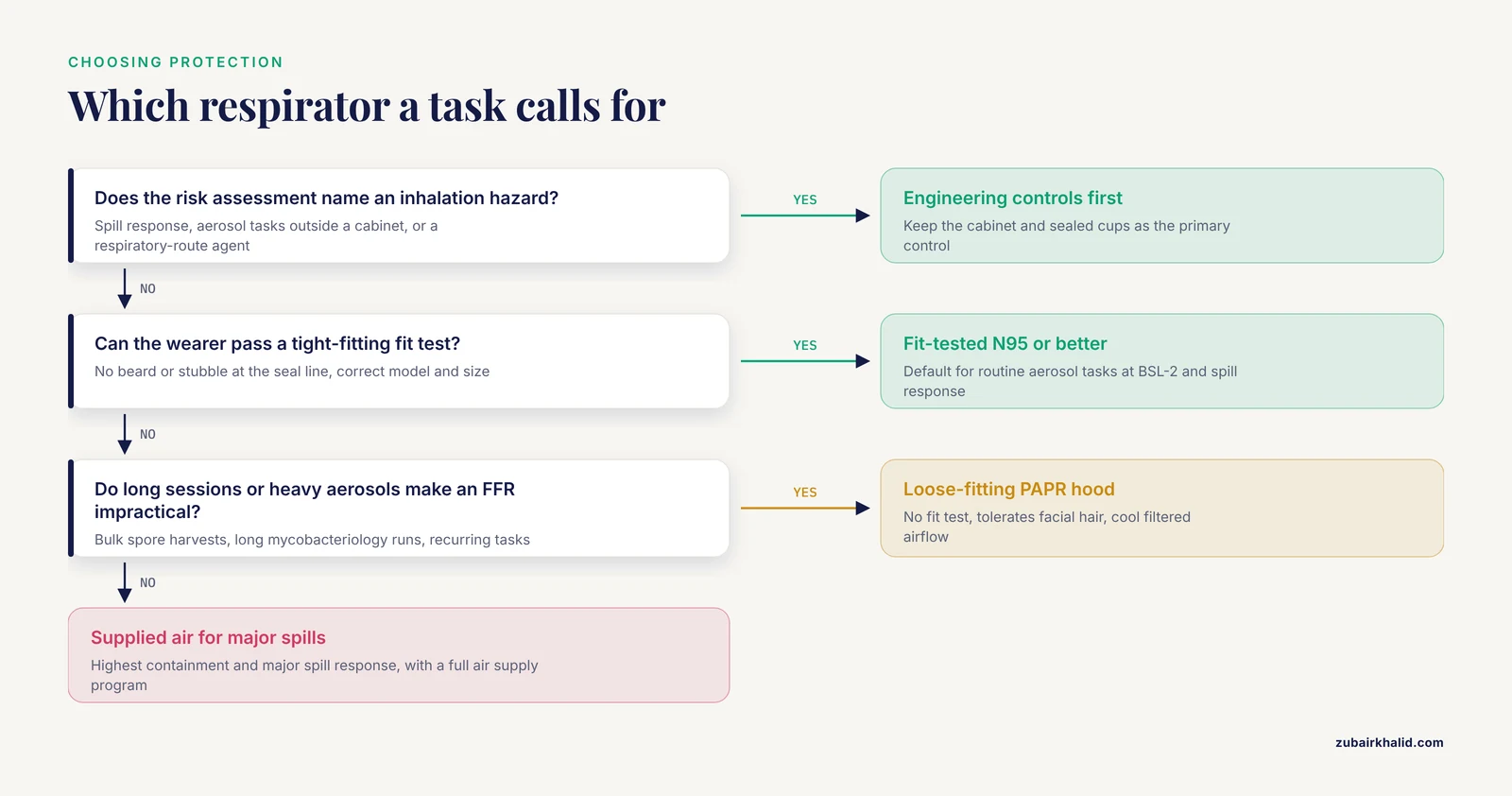
There is no single best respirator for microbiology lab work, only the best match among the risk assessment, the wearer, and the task. Four criteria decide most real choices.
Protection and Fit
The respirator must cover the hazard, and it must fit the face in front of you. Fit testing exists because filter efficiency means little at a leaking edge. When a risk assessment calls for more than an FFR delivers, the usual step is either a higher filter class in a tight-fitting mask or a move to positive-pressure equipment, and the second step is the one that rescues wearers whom the first step cannot fit.
Comfort and Breathability
Comfort is a safety property, not a luxury, because an uncomfortable respirator gets loosened, shifted, or quietly skipped. Breathing resistance, heat, pressure points at the nose and straps, and fogging all push wearers toward failure. Programs that let end users trial candidate models before stocking them avoid buying pallets of a device nobody keeps sealed.
Communication and Compatibility
Speech intelligibility matters when the wearer must talk to colleagues, read instrument prompts, or answer a phone through the device. Compatibility matters just as much: the respirator must coexist with goggles or a face shield, hearing protection, a lab coat collar, and, in animal facilities, the rest of the zoonotic PPE set. Exhalation valves decide one more compatibility question, namely whether the wearer is allowed to shed exhaled air into the workspace.
Program Burden and Sustainability
Every option above implies a workload. Disposables imply procurement and waste, elastomerics imply cleaning and cartridge schedules, PAPRs imply batteries, alarms, and hood disinfection. The best respirator for microbiology lab duty is the one the program can sustain for years, because protection that fades when attention drifts was never protection.
Fit Testing and User Seal Checks
A fit test is a formal, documented check that a specific respirator model and size seals on a specific face. A qualitative fit test uses a challenge agent the wearer can detect: saccharin or denatonium benzoate for taste, isoamyl acetate for smell. If the wearer notices the agent while performing exercises, the fit fails. A quantitative fit test uses an instrument to count particles outside and inside the facepiece and reports a fit factor, the ratio between the two counts, with programs commonly setting a pass threshold of 100 for half masks and 500 for full facepieces.
Fit testing is model and size specific. Passing one model says nothing about another, which is why programs fit test the exact device the wearer will receive. Retesting is triggered by change: a different model, a different size, weight change, dental work, facial surgery, or injury that alters the seal line.
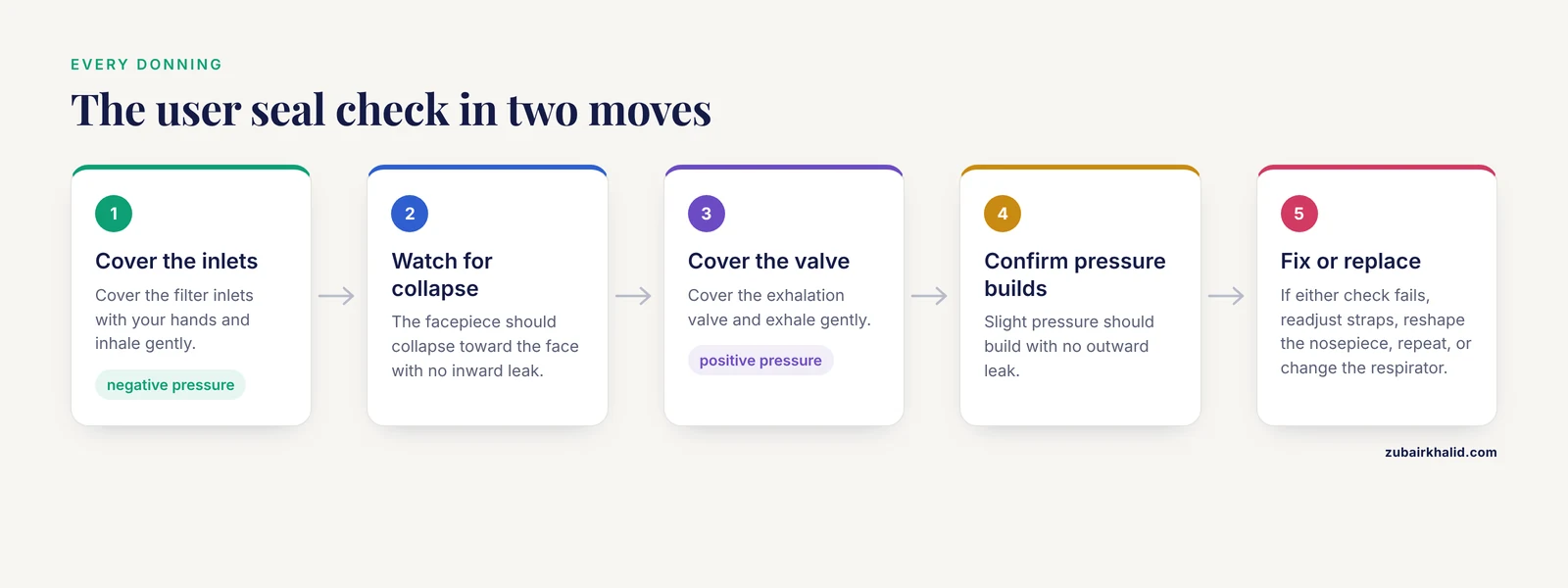
Between fit tests, the user seal check is the wearer's own quick verification at every donning. The negative pressure check covers the filter inlets, inhales gently, and confirms the facepiece collapses toward the face with no inward leak. The positive pressure check covers the exhalation valve, exhales gently, and confirms slight pressure builds with no outward leak. If either check fails, readjust the straps, reshape the nosepiece, and repeat, or change the respirator.
Facial hair is the classic silent killer of fit. Stubble a fraction of a millimeter long at the seal line is enough to leak, which is why tight-fitting respirators and beards do not coexist, and why the PAPR hood exists as the standard answer.
Comfort Testing and the Human Factor
Certification alone does not guarantee a wearable device. During the COVID-19 pandemic, personal protective equipment specifications concentrated on synthetic blood penetration tests (SBPT), which spray simulated blood at fabric to verify splash resistance, and capped non-woven fabric weight at 95 grams per square meter, while staying silent on air permeability and on water vapor transmission rate (WVTR/MVTR), the measures of how well air and moisture move through fabric. The result was certified gear with poor breathability, and the authors of that analysis argued that end users should take part in comfort testing and field trials, wearing the equipment through real clinical work before wide adoption, because the human-comfort factor determines whether PPE is worn correctly at all [1].
The laboratory translation is direct. Before a lab stocks a respirator model, staff should wear candidate devices through a real bench session: media pouring, plate loading, incubator transfers, a centrifuge run, a mock spill. Score pressure marks on the nose bridge and behind the ears, fogging, speech clarity, heat buildup, and how often the wearer reaches up to adjust. The model that passes the fit test but loses the comfort trial will fail in daily practice, and the comfort trial costs one afternoon.
Reuse, Decontamination, and Storage
Reuse became a visible reality during the pandemic. A survey of 721 diagnostic laboratories estimated that 41.4 percent of laboratory professionals were re-using N95 masks during that period, which means any respirator program that pretends reuse does not happen is writing policy for a world that does not exist [2]. The distinction worth teaching is between extended use, wearing the same FFR through repeated encounters without removing it, and reuse, removing it and putting it back on later. Extended use limits handling and is the safer of the two when supply or task demands stretch a single device.
Decontamination research gave programs a real fallback during supply crises. In one study, methylene blue plus light (MBL) treatment, 10 micromolar methylene blue exposed to 50,000 lux of white light or 12,500 lux of red light for 30 minutes, inactivated three coronaviruses including SARS-CoV-2 by 99.8 percent to more than 99.9 percent on three N95 FFR models and two medical mask models, with respirator integrity and fit maintained across five decontamination cycles, and the process was benchmarked against an FDA-authorized vaporized hydrogen peroxide plus ozone method [3]. That is evidence for an emergency method under controlled conditions, not a license for improvised disinfection. Wiping a disposable respirator with alcohol or bleach degrades the electrostatic filter and the fit, and it was never the studied method.
Routine practice stays simple. FFRs are single use by default. If a written program permits extended use or reuse, it specifies who, for which tasks, and with what inspection criteria: discard on visible soiling, moisture, creases or holes, strap damage, a distorted nosepiece, or a noticeable rise in breathing resistance. Between uses, store the respirator dry in a breathable labeled container such as a paper bag, never crumpled in a pocket where the inside surface picks up whatever the pocket holds. Elastomeric facepieces are assigned to one person and disinfected before anyone else touches them.
Special Settings: Animal Facilities and Teaching Laboratories
Animal Facilities and Lab Animal Allergy
Laboratory animal allergy is the classic occupational disease of animal facilities, driven by aeroallergens, airborne proteins from rodent urine, pelts, and serum. The measurement question was settled decades ago in a mouse housing room, where investigators sampled air with low-volume samplers behind various dust respirators and quantified what passed through using fluorometric enzyme-linked immunosorbent assays (ELISA), antibody-based tests that detect specific proteins. The lowest-capability respirator eliminated 65 to 86 percent of mouse urinary protein, pelt proteins, and mouse serum albumin, while the two higher-capability models eliminated 98 percent of urinary protein and reduced pelt protein and serum albumin to undetectable levels [4].
The lesson generalizes: filter grade and fit together decide allergen exposure, and respirator performance against a specific airborne hazard can be measured rather than assumed. A facility that sees allergy symptoms in staff pairs a higher-efficiency FFR or a PAPR with engineering fixes such as ventilated caging and careful bedding handling, and brings occupational health into the loop early, because allergy progresses with continued exposure.
Teaching Laboratories and Access Control
Teaching microbiology labs carry a special burden: the population changes every semester, and experience ranges from none to plenty. A published incident in which a student brought a guide dog in training to a microbiology teaching lab forced consultations across disability services, human resources, risk management, and legal counsel before the conclusion was reached that the lab is a restricted space, not a public one, and that entry conditions, closed-toe shoes and personal protective equipment, apply to everyone [5]. For respirator and PPE programs, the teaching setting adds two duties: train novices who have never worn any of this equipment, and hold the access rules for every visitor, volunteer, and animal that approaches the door.
Training That Makes the Respirator Work
Microbiology biosafety training turns equipment into protection. A complete respirator module covers: when a respirator is required and when it is not, which procedures generate aerosols, donning and doffing order so the respirator comes off after gown and gloves in a contaminated setting, the user seal check, cartridge and battery care, spill response, and the limits of the device, including what it does not filter.
The program around the training matters as much as the content. Wearers need medical clearance before first use, because increased breathing resistance can matter for asthma, pregnancy, or cardiovascular conditions. They need fit testing before first assignment and periodically after. Most institutional programs repeat training and fit testing yearly, and again whenever the model, the face, or the procedures change. Records should show who was cleared, on which model and size, and when.
Good training also inoculates against the bad habits that spread in busy labs: pulling one strap off and letting the mask dangle under the chin, touching the filter surface with contaminated gloves, storing the device in a coat pocket, and borrowing a colleague's elastomeric facepiece without disinfection. Each of those habits converts a certified device into a fomite or a loose piece of cloth.
Worked Scenarios
- Routine diagnostic bacteriology at BSL-2. Specimens are opened inside a class II biosafety cabinet, centrifugation uses sealed cups, and plates are read on the bench. No respirator for routine work. An N95 is assigned for spill response, because a dropped culture outside the cabinet is exactly the moment the hierarchy of controls runs out.
- Mycobacteriology digestion and concentration. Sputum digestion, centrifugation, and smear preparation are aerosol-heavy steps performed in a biosafety cabinet within appropriate containment. The risk assessment assigns an N95 for these tasks, and a PAPR where sessions run long or where any wearer cannot achieve a fit-tested seal.
- Spore harvest from Bacillus or fungal cultures. Scraping sporulating lawns and vortexing harvest suspensions release dry spores that resist settling. An N95 is the minimum for the task, and a PAPR earns its belt weight during bulk harvests.
- A mouse facility technologist develops sneezing and wheeze near the cage room. The response combines medical evaluation, a higher-efficiency FFR or PAPR for cage work, ventilated caging, and bedding handling changes, because respirator performance against animal allergens can be verified by measurement rather than assumed.
- A bearded scientist joins the mycobacteriology rotation. Fit testing of tight-fitting devices will fail, so the rotation issues a loose-fitting PAPR hood, trains on battery and airflow checks, and schedules hood disinfection.
Common Mistakes and Limitations
- Calling a procedure mask a respirator. The mask has no seal and no rating for inhalation protection, and wearing one during an aerosol task is a costume, not a control.
- Facial hair at the seal line. Stubble defeats tight-fitting respirators silently, and the failure only shows up on a fit test or in an exposure.
- Skipping the user seal check. The check takes seconds and catches the strap adjustment that happened in the hallway.
- Wearing valved respirators where exhaled air matters. Sterile work and shared spaces argue for valveless models or a PAPR with a filtered exhaust path.
- Reusing FFRs without a written policy. Ad hoc reuse means unknown inspection, unknown storage, and no fit re-check.
- Storing respirators badly. A crumpled FFR in a pocket contaminates the inside surface and creases the nosepiece.
- Treating the respirator as a substitute for the biosafety cabinet. The cabinet is the primary control, the respirator is the layer behind it.
- Wrong cartridge logic. Gas and vapor cartridges do not stop particles, and particle filters do not stop solvent vapors, so the cartridge must match the hazard named in the biosafety risk assessment.
- Assuming certification guarantees comfort. Certified devices can still breathe poorly, which is why comfort trials belong in procurement.
- Not retesting fit after change. A new model, a new size, a new beard, or new dental work all reset the fit to unknown.
Individual decisions, especially medical clearance and agent-specific respirator selection, belong with the institution's biosafety officer and occupational health provider, who can see the local risk assessment and the wearer in front of them.
Frequently Asked Questions
Is a surgical mask an acceptable respirator for microbiology lab work?
No. A surgical mask fits loosely, has no seal, and is designed to catch droplets the wearer exhales and to block splashes. It does not protect against inhaling aerosols, so it can never substitute for a respirator in the lab.
When does a microbiology lab actually need a respirator?
When the biosafety risk assessment identifies an inhalation hazard that engineering controls cannot remove, such as spill cleanup, aerosol-generating tasks outside a biosafety cabinet, or agents that infect through the respiratory route.
Can I wear a respirator with a beard?
Not with tight-fitting respirators, because any hair at the seal line breaks the fit. A loose-fitting PAPR hood is the standard option for bearded staff.
How often should fit testing and microbiology biosafety training be repeated?
Most institutional programs repeat both annually, and again whenever the respirator model changes, the face changes through weight or dental work, or the procedures change.
Can disposable N95 respirators be decontaminated and reused?
Only under a written institutional program with inspection and fit re-checks. Emergency decontamination methods exist for supply crises, but single use remains the default for disposable respirators.
Which respirator helps with lab animal allergies?
A well-fitted higher-efficiency filtering facepiece or a PAPR, combined with ventilated caging and careful bedding handling, plus medical evaluation for the affected person.
Sources
- Breathability and Safety Testing of Personal Protective Equipment: "Human-comfort" Factor Remains Undefined.
- Indian microbiology EQAS registered laboratory's capacity building and infection control practices during the COVID-19 pandemic in India: Lessons learnt and gaps identified.
- Addressing personal protective equipment (PPE) decontamination: Methylene blue and light inactivates severe acute respiratory coronavirus virus 2 (SARS-CoV-2) on N95 respirators and medical masks with maintenance of integrity and fit.
- Evaluation of dust respirators for elimination of mouse aeroallergens.
- Who Let the Dogs Out? A Plea for Official Guidelines on Service Animals in the Teaching Laboratory.