Real-Time vs. Batch QC Review in Microbiology
By Dr. Zubair Khalid, DVM, MS, PhD ·
Real-time QC review judges each quality control (QC) result the moment it is generated and can hold reporting until the check passes, while batch QC review accumulates QC results and evaluates them as a set at scheduled intervals, usually after the affected patient results already exist.
The rule of thumb for choosing is equally direct. If a QC failure would change, delay, or force recall of results that are about to be reported, that check belongs in real time. If a failure only informs how the laboratory improves next week or next month, batch review handles it.
The difference between real-time and batch QC review is therefore a difference in error latency, and the stakes are highest where a failed lot or a failed run can sit behind hundreds of reported organism identifications and susceptibility results before anyone looks. Microbiology quality control is not one activity. It spans living control organisms, lot-verified media and reagents, instrument and environmental alarms, and data plausibility checks, so real-time vs. batch QC review in microbiology is never a single global choice. Laboratory quality management treats the cadence as a risk decision made check by check, and ISO 15189:2022 gives that decision a formal frame by making risk management a core requirement of the quality system [1].
This guide is written for the bench technologist, supervisor, or laboratory director deciding which checks get watched live and which can wait for the weekly packet. In practice almost no laboratory chooses one mode for everything. The unit of decision is the individual QC check, and the assignment is where the value lies. The sections that follow define both modes on their own terms, compare them side by side, work through bench scenarios, and list the mistakes laboratories make when they force one cadence onto everything.
What QC Review Means in a Microbiology Laboratory
Quality control (QC) is the practice of running known materials or checks with expected outcomes to confirm that a test system performs before unknown specimens are trusted. QC review is the decision step that follows. The reviewer compares each outcome against acceptance criteria, the predefined limits or reactions that separate pass from fail, and decides whether the process is in control (performing as intended) or out of control (producing results no one should trust).
Microbiology QC differs from chemistry QC in three ways that shape the review question.
First, much of the control material is alive. Reference strains are maintained on media, subcultured on a schedule, and can themselves drift or lose characteristic reactions, so QC review includes judging the health and identity of the control organism, not just its reaction.
Second, many checks are categorical rather than numeric. A sterility tube either grows or stays clear. A Gram stain control either shows the expected purple rods and pink cocci or it does not. Statistical rules still apply to quantitative outputs such as minimum inhibitory concentrations (MICs, the lowest antimicrobial concentration that inhibits visible growth), but a large share of microbiology QC is pass or fail.
Third, QC attaches to lots as much as to runs. A lot is a manufactured batch of media, panels, disks, antisera, or stain sharing one expiration and one performance profile. Many microbiology QC events are triggered by a new lot arriving rather than by every analytical run.
The bench inventory that needs a review decision looks like this:
- Media and culture systems: sterility checks on each in-house lot, growth promotion with known organisms, and inhibition checks on selective media.
- Stains and rapid reagents: Gram stain control slides with a known Gram-positive and a known Gram-negative organism on each day of use, acid-fast stain positive controls, and catalase, oxidase, and coagulase reagent controls with each new lot.
- Antimicrobial susceptibility testing (AST): reference strains such as Escherichia coli ATCC 25922 or Staphylococcus aureus ATCC 25923 run on a defined schedule, plus lot-to-lot verification of panels, cards, and disks.
- Molecular and rapid immunoassays: positive, negative, and internal controls on every run, because a run without passing controls has no valid interpretation.
- Instruments and environment: incubator and CO2 setpoints, blood culture instrument flags, and calibration checks on identification systems such as MALDI-TOF mass spectrometry (matrix-assisted laser desorption ionization time-of-flight, which identifies organisms by their protein mass fingerprints).
- Data-level checks: plausibility rules such as organism-antibiotic logic and interpretive category consistency, often executed as auto-verification rules.
Where the review happens depends on the laboratory's technology. On a paper-based bench, real-time review is a technologist reading a control slide before touching patient smears and initialing a log. In a connected laboratory, the same review is a middleware rule that refuses to release an identification until the associated control passes, recorded automatically in the laboratory information system (LIS). The decision logic is identical. What changes is whether the hold is enforced by a person or by software, and software-enforced holds do not forget.
Every check on that inventory feeds one of two questions. "Can I report results right now?" is a real-time question. "Is the system drifting over time?" is a batch question. Laboratories that conflate the two either hold results unnecessarily or release results they later have to recall.
Real-Time QC Review Explained
Real-time QC review evaluates each QC result within moments of generation, at the point of testing, and ties the verdict directly to a release decision (whether results may be reported). The defining feature is timing relative to release. The review happens before the associated patient results leave the laboratory, so a failure stops the process instead of documenting it.
Real-time review runs on four kinds of machinery.
Instrument-integrated checks. Analyzers verify control performance, reagent placement, and run validity internally and refuse to release data from an invalid run. Automated blood culture instruments continuously monitor each bottle and flag positives and instrument errors as they occur, hour by hour, rather than at a scheduled reading time.
Middleware rules. Middleware is software that sits between analyzers and the LIS and applies laboratory-defined rules to every result. Auto-verification is the practice of letting middleware release results that satisfy every rule without human touch and flag everything else for review. In microbiology, a middleware rule can block AST release whenever the QC linked to that card lot is out of range, or hold an organism identification whose profile is internally inconsistent.
Continuous environmental monitoring. Sensors on incubators, refrigerators, and freezers alarm the moment a setpoint is violated. This converts what used to be a daily manual log entry into an immediate event with a timestamp.
Closed-loop vision and robotics. Khan and colleagues integrated a YOLOv8 object detection model (a neural network that locates and classifies objects in images) with an Opentrons OT-2 liquid handling robot, detecting missing pipette tips and incorrect liquid levels and feeding errors back to the system in real time [2]. The closed loop is the part that matters. The system does not merely record the error, it acts on it. The same architecture is reaching microbiology automation such as plate inoculators and automated pipetting stations.
A related concept is patient-based real-time quality control (PBRTQC), which uses streaming patient results instead of dedicated control material as a continuous QC signal. Wang and colleagues built an intelligent PBRTQC platform over 158,259 patient LDL-C results and used it for daily testing, real-time execution, and performance validation across biochemical instruments [3]. Microbiology has functional analogs, such as monitoring blood culture time-to-positivity distributions or identification frequency dashboards, where the data stream itself flags the moment something looks wrong.
Real-time review does not require automation. A technologist who reads the Gram stain control slide before reading patient smears, and who stops staining when the control is unreadable, is performing real-time review by hand. What automation changes is reliability at scale. Software-enforced holds apply the same rule to every result at any volume, they do not get distracted at the end of a long shift, and they timestamp every decision for the record. The trade-off is that every rule must be written, maintained, and revalidated whenever the assay, the lot, or the software changes.
The benefit of real-time review is near-zero error latency, and no other cadence provides it. The cost is attention. Brown and Badrick project that as total laboratory automation (TLA) expands across chemistry, immunoassay, hematology, and microbiology, enhanced real-time QC measures will generate a significantly greater number of failure flags, which is why they argue the flag-handling decisions themselves must be automated as an integral part of the automation rather than left to humans scrolling queues [4]. A real-time system that produces more flags than staff can meaningfully act on has traded silent failure for alarm fatigue, and both are quality failures.
Batch QC Review Explained
Batch QC review accumulates QC results over a defined period (a run, a day, a week, a month, a quarter) and evaluates them as a set against statistical and comparative criteria. The defining feature is direction of gaze. Batch review looks backward at aggregated data to answer questions no single result can answer: is the system drifting, is this lot behaving like the last one, are we actually improving.
Batch review runs on five kinds of machinery.
Levey-Jennings charts and statistical rules. A Levey-Jennings chart plots each QC value across runs against the control's mean and control limits, so shifts, trends, and drift become visible as shapes rather than as single numbers. Multirule schemes, such as the Westgard multirule scheme, turn those shapes into consistent decisions by defining exactly which patterns count as a problem.
Lot-to-lot comparison. When a new lot of panels or media arrives, its QC data are compared in parallel with the outgoing lot before the switch. The comparison is inherently a batch exercise because it needs both datasets side by side.
Quality indicators (QIs). A QI is a measurable element of laboratory performance tracked on a schedule. Chen and colleagues evaluated 15 QIs against national benchmarks, found that 13 of them (excluding internal QC and external assessment indicators) performed at sigma levels above 3.5 (a process performance grade derived from defects per million opportunities, where higher is better), and then used the gap analysis to drive statistically significant improvement in seven indicators the following year [5]. That is batch review converted into management action, and it reflects the emphasis ISO 15189:2022 places on quality indicators and continual improvement.
Scheduled sign-offs. Daily QC sign-off, monthly instrument log review, quarterly QC committee meetings, and annual reviews tied to competency assessment all aggregate QC evidence at intervals.
Control material strategy. Batch review is also where control material performance is judged over time. Kulkarni and colleagues showed that pooled in-house serum, prepared from screened leftover samples and stored in frozen aliquots, performed comparably to commercial internal quality control (IQC) material across the evaluated analytes over 30 days of parallel testing, at lower cost [6]. Lee and colleagues describe experience consolidating QC materials within a total laboratory automation system serving multiple analyzers [7]. Consolidation changes what the batch reviewer sees, since fewer pooled controls must stand in for more instruments, and it makes the lot-to-lot comparison the critical batch product.
Cadence is a design choice. Daily sign-off suits high-risk checks and busy benches. Weekly review suits scheduled AST QC and stain trends. Monthly and quarterly cycles suit quality indicators, instrument logs, and management review. The reviewer also differs from the real-time case. Real-time review usually belongs to the bench technologist running the test, while batch review belongs to a supervisor, a quality officer, or a QC committee with authority to open improvement projects. Writing the cadence and the reviewer into the QC plan is what turns review from a habit into a control.
The digital backbone of batch review is the laboratory information management system (LIMS). Balamurugan and colleagues document a pharmaceutical QC laboratory LIMS implementation spanning reagent management, instrument lifecycle, master data approval, and automated analytical calculations, and they are equally clear about the failure modes: inadequate user training, master data configuration errors, incomplete data migration, partial instrument integration, and server dependency [8]. A batch review program is only as good as the data pipeline beneath it.
The benefit of batch review is statistical power and perspective. Trends that are invisible result by result become obvious across thirty of them. The cost is error latency. A failure found in monthly review may implicate weeks of already-released results, which converts a QC event into a recall and rework project.
Modern batch dashboards increasingly automate the flagging step. SingleCellMQC, a quality control framework built for single-cell multi-omics data, implements QC across sample, cell, feature, and batch levels using empirical thresholds and outlier detection, and surfaces automated flags in interactive reports [9]. The pattern it demonstrates, automated flagging with human review of the flagged subset, is exactly how well-run batch QC review works in regulated laboratories.
Real-Time vs. Batch QC Review: The Side-by-Side Comparison
This table condenses the decision. The row that settles most real arguments is error latency, because it determines whether a QC failure is an inconvenience or a recall.
| Criterion | Real-time QC review | Batch QC review |
|---|---|---|
| Timing | Evaluated seconds to minutes after generation, at the point of testing | Evaluated at set intervals (end of run, daily, weekly, monthly, quarterly) |
| Core question | Can results be reported right now? | Is the system drifting over time? |
| Primary purpose | Gate result release, stop an active failure | Detect trends, verify lots, drive improvement |
| Error latency | Near zero, failure caught before release | Hours to weeks, failure caught after results may have gone out |
| Unit of review | One QC result against acceptance criteria, plus instrument flags | Charts, lot comparisons, indicator dashboards, sign-off packets |
| Workload pattern | Continuous, distributed across the shift | Concentrated at scheduled review points |
| Typical tools | Middleware auto-verification rules, instrument-integrated checks, continuous environmental monitors, closed-loop vision systems | LIMS reports, Levey-Jennings charts, lot-to-lot comparisons, QI dashboards, QC meetings |
| Dominant failure mode | Flag fatigue and rule gaps when responses are not automated | Silent failures between reviews, followed by recalls |
| Best suited for | New lots before first patient use, per-run molecular controls, AST gating, critical instrument alarms | Trend and drift analysis, lot comparison, quality indicators, management review |
| Skill demanded at review | Immediate interpretation with authority to hold or release | Data analysis and trend interpretation |
Mapping the modes across the testing phases helps. Pre-analytical QC (specimen acceptance criteria and rejection rules) is mostly real-time, because a rejected specimen must be flagged before work begins. Analytical QC splits by check, as the scenarios below show. Post-analytical QC splits too, with auto-verification rules acting in real time and indicator dashboards acting in batch.
Two consequences follow from the table. First, the modes are not interchangeable, because only real-time review prevents errors while batch review documents and explains them. Second, the modes are not competitors, because every mature laboratory quality management system runs both, and the design work lies in assigning each QC check to the correct lane.
Choosing Real-Time or Batch QC Review for Each Task
ISO 15189:2022 gives the decision its frame. The standard embeds risk management across personnel competence, equipment performance, information systems, environmental conditions, and organizational processes, and expects laboratories to identify hazards, assess their impact, implement preventive measures, and monitor whether the controls work [1]. Review cadence is one of those controls. The question is not which mode is better in the abstract, it is which mode controls the specific risk attached to a specific check.
Six criteria do most of the deciding.
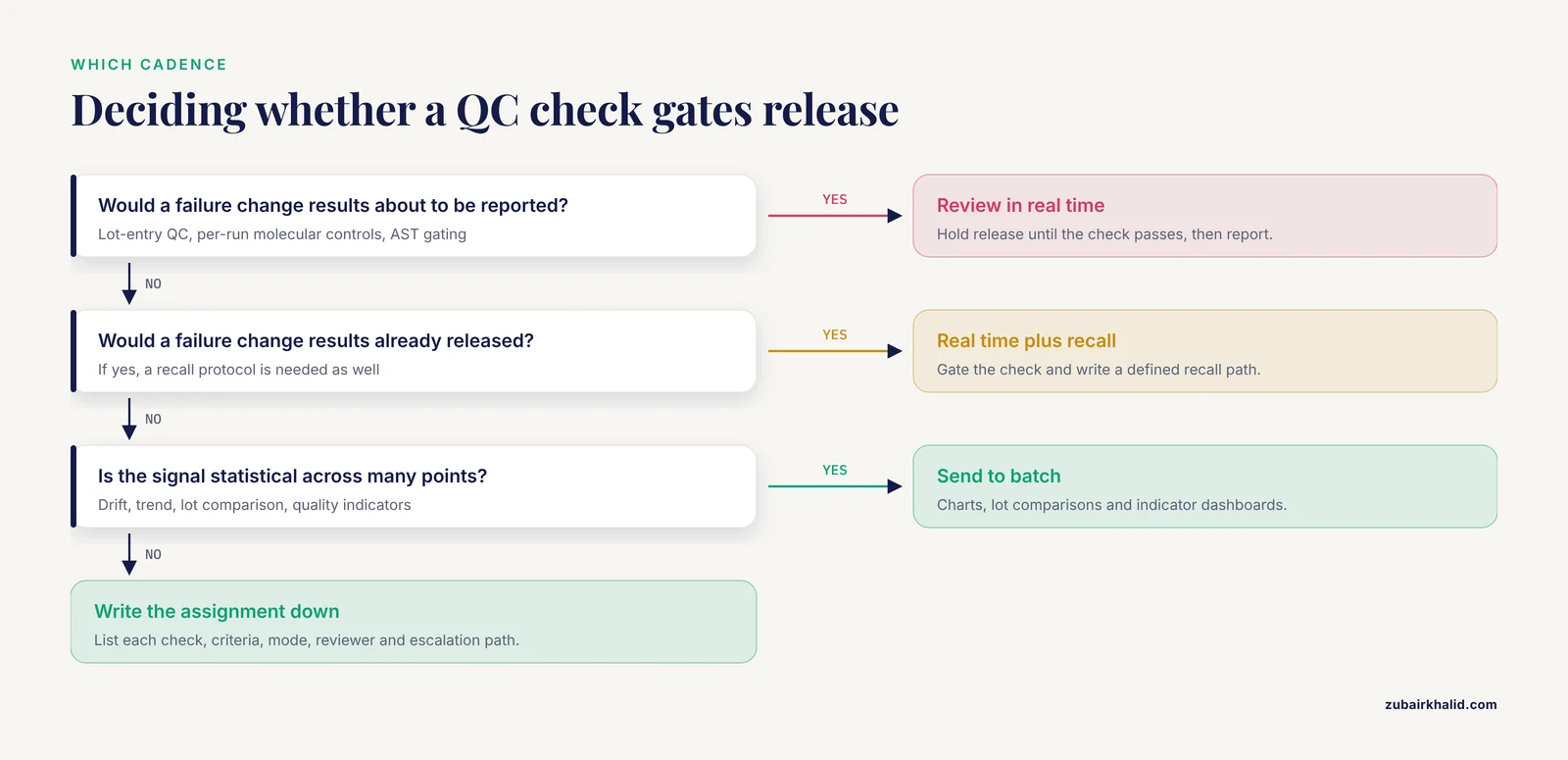
- Does the check gate release? If a failed check means patient results must not be reported, the review must happen in real time. Lot-entry QC, per-run molecular controls, and AST gating all pass this test.
- Would a failure change already-released results? If yes, the check needs real-time review plus a defined recall protocol, because the residual risk of batch-only review is rework at scale.
- Is the signal statistical? Drift, trend, and lot comparison only exist across many data points. Forcing them into real time produces noise. These belong in batch.
- Is the check categorical and lot-bound? Pass or fail lot QC gets a real-time decision at lot entry and a batch trend review across lots.
- What can the workflow sustain? High-volume automated lines cannot depend on humans watching queues. Brown and Badrick argue that automation, enhanced real-time QC, and auto-verification in middleware must be implemented together, with the critical decisions automated rather than left to human intervention [4].
- How long can a silent failure run before harm? The shorter the tolerable latency, the stronger the case for real-time review.
When to Use Real-Time Review
Assign these checks to real-time review:
- New lot verification for media, panels, disks, antisera, stains, and extraction reagents, before the lot touches a patient specimen.
- Positive, negative, and internal controls on every molecular and rapid assay run, because the run has no valid interpretation without them.
- AST QC on scheduled days, linked so that a failure blocks patient AST from the same lot and instrument until it is resolved.
- Critical instrument and environmental alarms, including incubator temperature, CO2 concentration, and blood culture instrument errors.
- Data plausibility rules that would stop an obviously wrong result from reaching a clinician.
- Any check whose failure triggers correction or recall of reported results.
When Batch Review Is the Right Tool
Assign these to batch review:
- Levey-Jennings trending of quantitative controls across runs and lots.
- Lot-to-lot comparison reports at changeover.
- Quality indicators such as contamination rates, specimen rejection rates, and turnaround time, reviewed monthly or quarterly.
- Retrospective data mining, including identification frequency shifts and antibiogram consistency.
- Instrument log review, competency-linked QC history, and management review packets.
- Any check where a failure informs future improvement more than it changes current results.
Whatever the assignments, write them down. A QC plan that lists each check, its acceptance criteria, its review mode, its reviewer, and its escalation path is the artifact assessors ask to see, and it keeps the assignment consistent when staff rotate. The plan also makes gaps visible. Any QC check that appears in neither column is either unnecessary or unmanaged, and both findings are useful.
Worked Scenarios from the Bench
Scenario 1: A new lot of Mueller-Hinton agar (real-time)
A laboratory receives a new lot of Mueller-Hinton agar for disk diffusion testing. Before the lot enters service, the bench runs the standard QC strains, for example Escherichia coli ATCC 25922 against a panel of antimicrobial disks, and reads zone diameters after overnight incubation. Every zone must fall inside the published acceptance range for that strain and agent. The reviewer signs the lot into service only if all strains and agents pass, and quarantines the lot if any fail. Patient isolates stay on the old lot until the new one clears. This is real-time review in its purest form: the QC decision gates the lot, and the lot gates the results. If the same data were reviewed at month-end instead, the laboratory could spend weeks reporting susceptibility results on a medium that was never verified.
Scenario 2: The CO2 incubator (both, deliberately)
A CO2 incubator holding culture plates sits near 35 °C with about 5 percent CO2. A continuous monitor alarms the moment either parameter leaves its set band, and the bench responds before cultures are compromised. That is the real-time layer. The monthly review of the same sensor's log is the batch layer, and it answers a different question: is the sensor drifting, is the door seal wearing, are excursions clustering at a particular time of day. Remove either layer and you lose either prevention or perspective.
Scenario 3: A molecular respiratory panel (real-time run control, batch trend)
Each run of a multiplex molecular panel carries a positive control, a negative control, and an internal amplification control. The run is not interpreted until all three behave as expected, so this review is real-time and gating. Separately, the laboratory plots the positive control's cycle threshold values (the amplification cycle at which signal crosses the detection threshold) across the month. A slow upward creep signals reagent degradation while the run controls still pass. The batch layer catches the problem before the real-time layer ever fires.
Scenario 4: Automated AST with middleware (hybrid)
An automated AST instrument runs reference strain QC on its scheduled day. Middleware holds the association between the QC result, the card lot, and the instrument, and auto-verification releases patient AST only while the linked QC is in control. A QC failure blocks release for affected isolates immediately, and the same failure flows into the weekly trend report. The laboratory designed the real-time gate and the batch trend as one system rather than as two unrelated chores.
Scenario 5: Blind QC specimens (real-time assessment of the whole system)
A blind QC program submits samples with known expected answers through the normal workflow, disguised as routine work, and measures whether the laboratory reaches the right answer through its ordinary processes. The Houston Forensic Science Center implemented such a program across its sections on the strength of recommendations from a 2009 National Academy of Sciences report, submitting 973 blind samples between 2015 and 2018, of which 901 were completed and only 51 were recognized by analysts as QC cases [10]. The program's value is that it assesses the entire quality management system in real time, under genuine working conditions. A microbiology laboratory can run the same pattern on a smaller scale by periodically submitting blinded proficiency-style specimens, such as a spiked blood culture bottle or a disguised isolate for identification and AST, through the normal bench workflow.
Hybrid Designs: Where Real-Time and Batch Review Meet
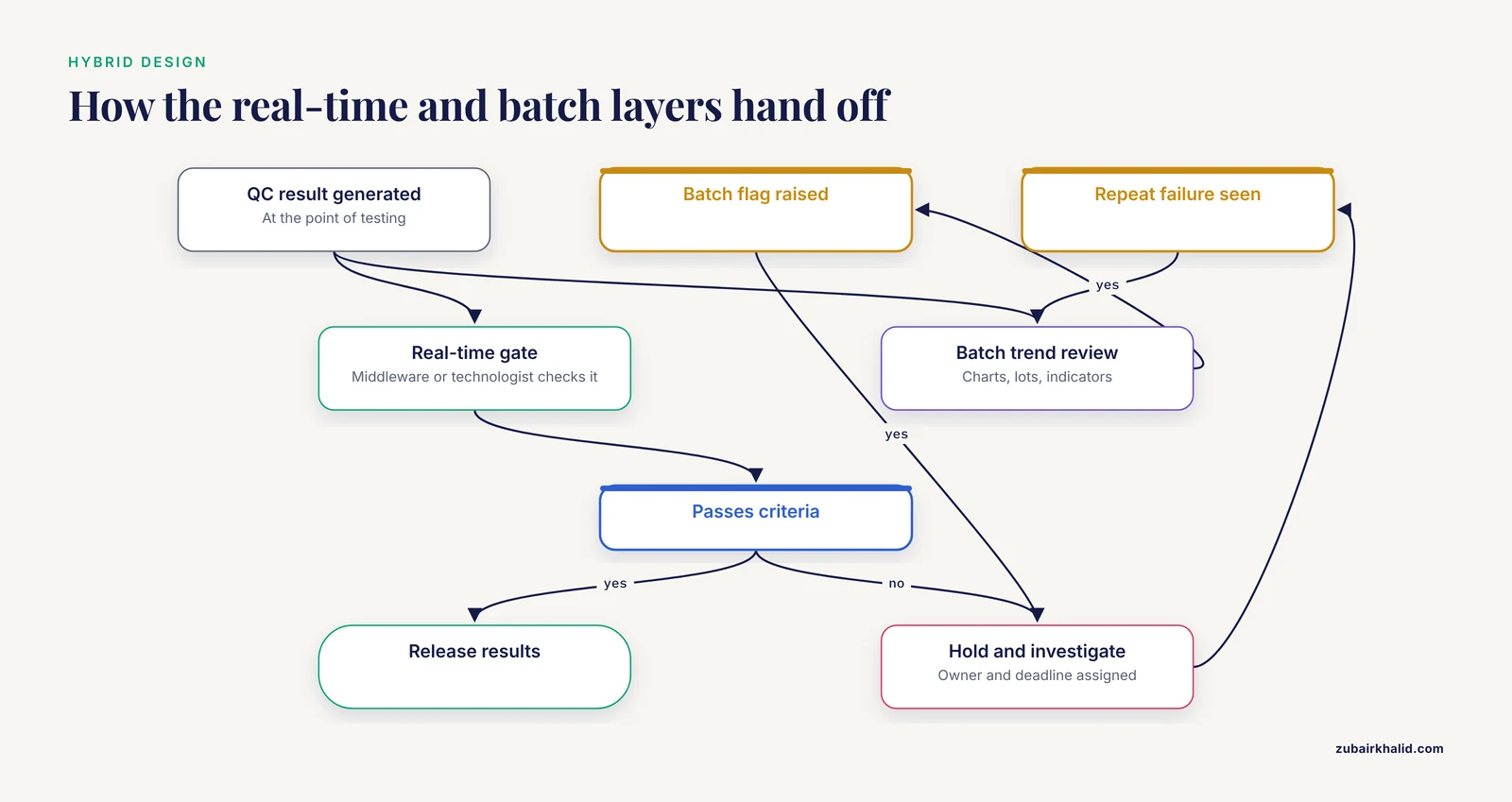
The mature design layers the two modes rather than choosing between them. Real-time rules sit at the point of testing and handle gating. Batch analytics sit above them and handle trends, lots, and indicators. Three developments are making the layering easier to build and maintain.
Integrated continuous QC. Regulations mandate internal QC, so patient-based systems have historically run as a separate, labor-consuming layer, which has slowed adoption [11]. Duan and colleagues proposed integrating IQC with PBRTQC in a single system, introducing MaxANPTE (the maximum average number of patients with unacceptable analytical errors) as the benchmark metric under a modified patient risk model. In the chemistry setting they studied, the integrated system incorporating regression-adjusted real-time quality control (RARTQC) outperformed the IQC-only system in most cases and reduced QC events by up to 45 percent for alanine aminotransferase [11]. The design lesson travels across disciplines. When a continuous data stream is engineered against patient risk, it can absorb part of the scheduled QC workload, freeing batch review to focus on what only aggregation can answer.
Automation that changes what review is feasible. Lee and colleagues report that integrating hematology and coagulation analyzers into a total laboratory automation track raised turnaround time compliance from 82.0 to 95.2 percent for hematology and from 76.9 to 93.0 percent for coagulation within a year, while eliminating manual specimen transport and freeing one full-time equivalent [12]. The microbiology relevance is structural. Once specimen transport, plating, and incubation run on an automated line, real-time QC must be engineered into the line itself, because there is no technologist standing between the instrument and the incubator to notice a problem.
AI assistance on both layers. Dabla and Badrick describe laboratory medicine moving from automation to augmentation, with professionals shifting from operating instruments to overseeing algorithmic performance, validating digital tools, and collaborating with clinicians [13]. On the real-time layer, language models with explainable reasoning are being validated as digital quality assistants, including a reported validation of ChatGPT-5 in that role for laboratory quality control [14]. On the batch layer, the same class of tools can draft trend summaries and surface anomalies for the QC committee. The governance obligations arrive with the tools, including data integrity, algorithmic transparency, and defined human oversight [13].
Escalation is the connective tissue between the layers. A batch flag, such as a monthly contamination rate above its threshold, should trigger a real-time investigation with a defined owner and deadline, not a note in the minutes. Conversely, a real-time failure that repeats should trigger a batch analysis of every result produced since the last in-control point. Laboratories that define both escalation directions recover faster from failures and accumulate evidence for their risk assessments.
The design principle that ties the layers together comes straight from the automation literature: automate the critical decisions that still require human intervention, and make QC an integral part of the workflow rather than a parallel paperwork stream [4]. In practice, middleware rules own the gating, dashboards own the trending, and people own the exceptions.
Common Mistakes and Limitations
These are the errors laboratories actually make when assigning QC checks to a review cadence.
- Batch-reviewing a gating check. Reviewing lot-entry QC at month-end, after a month of patient results ran on the unverified lot, converts a prevention step into an archaeology project. Any check that gates release must be reviewed before release.
- Building real-time flags without automating the response. A real-time system that produces more flags than staff can act on has recreated the silent failure it was built to catch, just with better documentation. The response to a flag needs a rule, not merely a notification.
- Reviewing without predefined acceptance criteria. If the reviewer decides pass or fail ad hoc, two reviewers reach different verdicts on the same data. Acceptance criteria belong in the procedure before the first QC result exists.
- Confusing control material choices with review cadence. Switching to pooled in-house control material lowers cost and changes the control matrix [6], but it does not change whether the check gates release. Material choice and review timing are separate design decisions.
- Trusting a blind QC program that is not blind. Analysts in any blind program eventually recognize some submissions as QC cases, and once they do, their behavior changes and the measurement stops reflecting routine performance. Genuine blinding, including plausible submission routes and realistic specimen matrices, is what keeps the assessment honest.
- Treating QC review as a signature rather than a risk control. A monthly signature on an unread report satisfies the calendar, not the risk management expectation of the standard [1]. The signature should certify that someone actually interpreted the data and decided something.
- Assuming automation removes the need for review. Even in highly automated lines, many tasks still require humans who monitor the automation [4]. Review shifts toward exceptions and algorithm oversight, but it does not disappear.
- Standing up batch review on a weak data pipeline. If the LIMS reports are wrong or slow, reviewers quietly revert to spreadsheets, and the batch program decays. Budget implementation effort, training, and data migration before the first monthly review depends on the system.
- Letting auto-verification rules age. Rules written for one assay version or card lot keep releasing results after the assay changes. Revalidation after every method change is part of a rule's lifecycle, not an optional extra.
A limitation worth stating once. This framework organizes cadence decisions, it does not replace judgment. Individual QC failures, especially those involving atypical control organism behavior or conflicting results, need interpretation by a qualified microbiologist with authority to hold results. The same framework transfers to public health, food, and veterinary diagnostic microbiology laboratories, with the QC inventory adjusted to the discipline.
Frequently Asked Questions
What is the difference between real-time and batch QC review?
Real-time QC review evaluates each QC result at the moment of testing and can block result release until the check passes. Batch QC review accumulates QC results and evaluates them as a set at scheduled intervals, usually after the related patient results already exist. The practical difference is error latency, near zero in real time versus hours to weeks in batch.
When should a microbiology laboratory use real-time QC review?
Use real-time review whenever a QC failure would change, delay, or force recall of results that are about to be reported. The standard cases are new lot verification, per-run controls on molecular and rapid assays, AST QC linked to result release, and critical instrument or environmental alarms.
Can batch QC review replace real-time review?
No. Batch review detects trends and drives improvement, but it looks backward, so it cannot stop a failure at the bench. A laboratory that relies on batch review alone learns about QC failures after affected results have been reported, which turns every failure into a recall project.
What tools support real-time QC review in microbiology?
Middleware with auto-verification rules, instrument-integrated control checks, continuous environmental monitors with alarms, and closed-loop vision systems on automated pipetting and plating equipment. AI-based quality assistants are emerging as a triage layer for the flags these systems generate.
Is patient-based real-time QC relevant to microbiology?
Patient-based real-time QC was developed in clinical chemistry, where patient results stream continuously and can serve as a QC signal. Microbiology has analogs, such as blood culture time-to-positivity distributions and identification frequency dashboards, and the design idea of layering continuous data surveillance on scheduled QC transfers directly.
Does ISO 15189:2022 require real-time or batch QC review?
Neither cadence is mandated. The standard requires a risk-based quality system with quality indicators and continual improvement, and the laboratory chooses review timing through its risk assessment. In practice, accredited microbiology laboratories run a hybrid, with real-time gating for release-critical checks and batch review for trends and indicators.
Sources
- Integrating Risk Management into Medical Laboratory Quality Systems: ISO 15189:2022 Perspectives
- Real-time AI-driven quality control for laboratory automation: a novel computer vision solution for the opentrons OT-2 liquid handling robot
- Integrating Patient-Based Real-Time Quality Control (PBRTQC) in a New Field: Inter-Comparison between Biochemical Instrumentations with LDL-C
- The next wave of innovation in laboratory automation: systems for auto-verification, quality control and specimen quality assurance
- From assessment to action: experience from a quality improvement initiative integrating indicator evaluation and adverse event analysis in a clinical laboratory
- Efficacy of Pooled Serum Internal Quality Control in Comparison with Commercial Internal Quality Control in Clinical Biochemistry Laboratory
- Experience in the Consolidation of Quality Control Materials in Total Laboratory Automation System
- Implementation of a Laboratory Information Management System (LIMS) in a Pharmaceutical Quality Control Laboratory: Implementation Workflows, Challenges, and Mitigation Strategies
- SingleCellMQC: A comprehensive quality control workflow for single-cell multi-omics.
- Implementation of a Blind Quality Control Program in a Forensic Laboratory
- Improving the efficiency of quality control in clinical laboratory with an integrated PBRTQC system based on patient risk
- Improving the Workflow of Hematology and Coagulation Workstations Using a Total Laboratory Automation System.
- Expert Interview: From Automation to Augmentation- How Artificial Intelligence is Re-Shaping Clinical Laboratory Workflow
- Explainable language model reasoning for laboratory quality control: validation of the ChatGPT-5 as a digital quality assistant