QC Strain Viability Testing: How Often and What Methods to Use
By Dr. Zubair Khalid, DVM, MS, PhD ·

QC strain viability testing confirms that a reference or quality control strain in your laboratory is alive, culturable, and behaving within its established performance envelope before you trust any result that depends on it. In practical terms, the test answers three questions at the bench. Is the strain still growing? Is the population still uniform and uncontaminated? And does the strain still produce the expected result in the assay it is meant to control, whether that is an antimicrobial susceptibility test, a biocide challenge, or a sterility and enumeration procedure.
This guide is written for bench microbiologists and quality managers in clinical, pharmaceutical, food, and veterinary microbiology laboratories. It covers when to test (the frequency question), a step-by-step revival and verification procedure, the main enumeration and identity methods available today, expected results, troubleshooting, storage practice, and the mistakes that most often derail a microbiology quality control program.
Time expectations up front. A routine revival and growth check takes roughly 15 to 20 minutes of hands-on time and gives an answer the next morning after overnight incubation. A quantitative plate count adds duplicate dilution series and 24 to 48 hours of incubation. A flow cytometry viability assay compresses the same question into about an hour of staining and acquisition. Genomic identity verification of a seed strain is a campaign-level activity, not a bench-level one, because it requires sequencing capacity and bioinformatics support [1][2].
Why Viability Testing Matters in Microbiology Quality Control
A quality control (QC) strain is a well-characterized microorganism, usually a reference strain from a recognized culture collection, that a laboratory runs through its methods to prove the methods still work. If the QC strain is dead, injured, contaminated, or has drifted physiologically, every result it touches becomes uninterpretable. The QC strain is the canary for the whole analytical system.
Viability and identity are separate properties, and mature laboratory quality management programs test both. Viability asks whether the cells are alive and culturable. Identity asks whether the cells are still the strain you think they are. Modern work shows why both matter. A study of live attenuated animal vaccine seed strains in South Korea used complete genome sequencing to verify, at the strain level, that manufacturers were using the same seed strains over time, and the authors frame this kind of verification as a foundation for consistent mass production and reliable quality control of biological products [1]. A companion study did the same for inactivated vaccine strains, producing gap-free genome assemblies with completeness above 99 percent and contamination below 1 percent for all eleven strains examined [2]. Phenotypic checks catch gross problems. Genomic checks catch the silent ones, such as a seed lot that was substituted years ago with a near-neighbor strain.
Viability itself is more subtle than a yes-or-no culture result. Cells can be intact and metabolically active yet no longer form colonies on the media you use. This state, called viable but not cultivable (VBNC), is a central reason plate counts can disagree with newer viability methods, a point examined directly in shelf-life work on a multi-strain synbiotic product where plate counts fell faster than flow cytometry measures of membrane integrity and metabolic activity [3]. The same dissociation appeared in a multi-species probiotic product, where flow cytometry routinely detected higher viable cell counts than plate counting [4]. For a QC strain program, the lesson is that a negative culture result on one medium is not proof of death, and a positive one is not proof of full physiological fitness.
How Often Should You Test QC Strain Viability?
The short answer is that frequency scales with risk. A strain in daily rotation gets checked every day it is used. A strain in long-term storage gets checked on a calendar schedule and after any storage incident. The table below reflects widely adopted practice in clinical and industrial microbiology laboratories and fits the structure of standard laboratory quality management systems.
| Event | Minimum viability check | Full verification |
|---|---|---|
| , - | , - | , - |
| Receipt of a new strain or new lot | Growth on recovery medium after revival | Purity, identity confirmation, baseline enumeration, first functional QC run |
| Revival from master stock (every revival) | Growth and purity check on solid medium | Enumeration and functional QC before the strain enters routine use |
| Each day of use in an assay run | In-range performance in the assay plus visible growth | Full recheck after any out-of-range or aberrant result |
| Reduced periodic schedule for susceptibility QC | Continued in-range results on the reduced schedule | Return to every-run testing after an out-of-range result, following recognized susceptibility testing standards such as those from CLSI |
| Stored working stocks not in rotation (monthly to quarterly) | Spot-check subculture from one vial | Enumeration if any growth abnormality appears |
| After any storage incident (freezer alarm, refrigerator failure, desiccation) | Immediate subculture | Full enumeration and purity before the stock is used again |
| Before release of a production, validation, or stability batch | Growth and purity | Quantitative viability with a defined acceptance range |
| Periodic identity verification | Phenotypic profile as usual | Genomic or molecular identity confirmation at defined intervals or whenever phenotypic drift is suspected |
Three points about scheduling deserve emphasis.
First, for antimicrobial and biocide susceptibility QC, the strain is tested with every run until the laboratory has demonstrated stable in-range performance, after which many recognized standards permit a reduced schedule. Any out-of-range result sends the strain back to daily testing until the cause is found. Recent interlaboratory work shows exactly why medium and reagent lots matter here. In an eleven-laboratory trial that developed quality control ranges for biocide susceptibility testing, three different lots of tryptic soy broth were evaluated because lot-to-lot variation shifts the observed endpoint, and the resulting QC ranges spanned three to five dilution steps for most strain and biocide combinations [5]. When you change medium lot, retest your QC strains against the new lot before relying on it.
Second, calendar-based checks on stored stocks are not optional overhead. Viability of bacteria in cold storage declines in a strain-dependent and formulation-dependent way. In a study of Lactobacillus casei carried in labneh during 15 days of cold storage, viability behavior differed between free and encapsulated cells across the storage period [6]. A working stock that performed well six months ago may not perform today, and the only way to know is to test.
Third, testing frequency and testing sensitivity interact. Surveillance modeling work in a different field demonstrated that increasing testing frequency produced a strongly nonlinear improvement in outcome detection, to the point that a frequent schedule with a modestly less sensitive test beat an infrequent schedule with a better test [7]. The same logic transfers to QC strain monitoring. A short, cheap growth check every week will catch more problems over a year than an exhaustive annual characterization, because problems develop continuously and any single deep test only samples one moment in time.
Materials and Reagents
| Item | Working concentration or specification | Purpose |
|---|---|---|
| , - | , - | , - |
| Reference QC strains | Recognized reference strains, for example S. aureus ATCC 6538, E. hirae ATCC 10541, E. coli ATCC 10536, P. aeruginosa ATCC 15442 as used for biocide QC [5] | The test articles themselves |
| Tryptic soy broth (TSB) or strain-appropriate recovery broth | Prepared per manufacturer directions, from documented lots | Revival and inoculum preparation [5] |
| Tryptic soy agar or blood agar (5 percent sheep blood for fastidious strains) | Standard formulation | Purity plating and growth checks |
| Mueller-Hinton broth or strain-appropriate assay medium | Per the method being controlled | Functional QC testing (susceptibility, biocide, enumeration) |
| Sterile 0.85 percent saline or buffer | 0.85 percent NaCl, pH 7.2 to 7.4 | Dilution series and cell suspension |
| Cryoprotectant | Sterile glycerol, 15 to 20 percent v/v in broth | Master and working stock preparation |
| McFarland 0.5 standard or densitometer | 0.5 McFarland, approximately 1 to 2 × 10⁸ CFU/mL for most bacteria | Standardizing inoculum density |
| SYTOX Green or equivalent membrane-integrity dye | Stock and working dilution per manufacturer instructions | Flow cytometry viability staining [4] |
| Appropriate solid counting medium per strain | Documented lot | Quantitative plate counts |
| Gram stain reagents | Standard kit | Purity and identity screening |
| Personal protective equipment and class 2 biological safety cabinet | Per institutional biosafety procedures | Safe manipulation of live cultures |
Safety note. Reference organisms are live cultures and must be opened only inside a certified biological safety cabinet at the biosafety level appropriate to the organism. Biocides used in some QC programs, including chlorhexidine and benzalkonium chloride, are skin and eye irritants and require gloves and eye protection. Autoclave all cultures and contaminated materials before disposal.
Step-by-Step Procedure for QC Strain Viability Testing
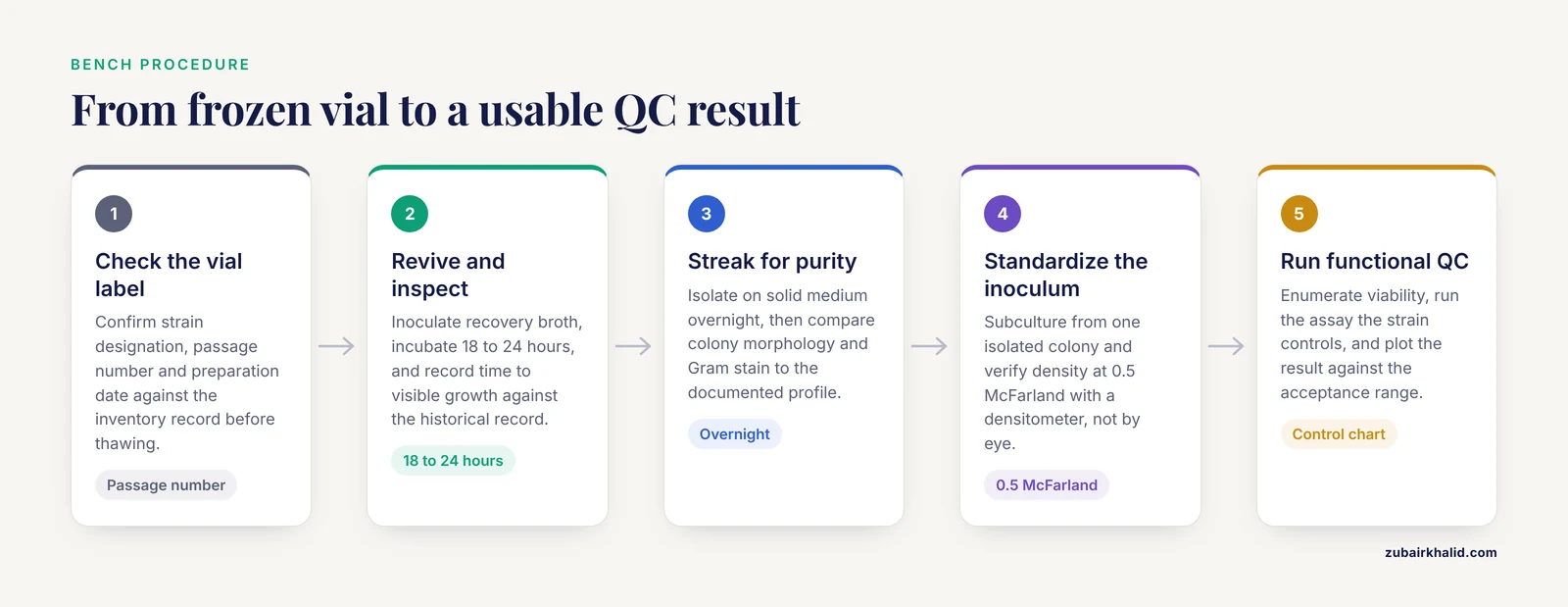
The following procedure covers revival from a frozen or lyophilized stock through documentation. Adjust media and incubation conditions to the specific strain. QC strain viability testing frequency methods succeed or fail on discipline in these steps, so each step includes the reason it matters.
- Plan the revival and pull the correct vial. Confirm the vial label against the inventory record, including strain designation, passage number, and preparation date. Why: mixing up lots is the most common source of phantom QC failures, and every downstream result inherits the error.
- Thaw or rehydrate on ice or per the supplier's instructions, quickly. For frozen vials, thaw the surface and transfer a small inoculum rather than thawing the whole vial repeatedly. Why: freeze-thaw cycles kill cells cumulatively, and slow thawing gives osmotic injury time to accumulate.
- Inoculate recovery broth appropriate to the strain. Use tryptic soy broth or the medium the culture collection specifies, at the specified incubation temperature and atmosphere, typically 35 to 37 degrees C with 5 percent CO2 for fastidious organisms. Why: revived cells are often injured and need rich conditions to recover. Under-recovery here produces false "nonviable" calls.
- Incubate 18 to 24 hours, then inspect for visible growth. Record turbidity, pellet formation, or sediment. Why: the time to visible growth is itself a viability metric. A strain that used to grow overnight and now takes 36 hours is telling you something changed.
- Streak for isolation on solid medium and incubate overnight. Why: broth culture cannot reveal contamination or colony variation. Isolated colonies are the only reliable purity check.
- Examine colony morphology and perform a Gram stain. Compare against the strain's documented profile. Why: a mixed morphology or an unexpected Gram reaction ends the QC exercise immediately. The strain is contaminated or substituted and cannot be used.
- Subculture from a single isolated colony to obtain a fresh, actively growing culture. Why: reviving directly from a stressed population carries over injured cells into your assay and inflates variability. One clean subculture standardizes the physiological state.
- Standardize the inoculum to 0.5 McFarland or the density the target method requires. Verify by densitometer rather than by eye. Why: inoculum density is the single largest technical driver of susceptibility endpoints, and an unstandardized inoculum invalidates the functional QC result you are about to generate.
- Perform quantitative viability enumeration by your chosen method. Plate count in duplicate serial dilutions, or run a flow cytometry viability assay, or both if the strain is new to the laboratory. Why: a growth check proves the strain is alive. Enumeration proves it is alive at the expected level, which is what your method's acceptance ranges assume.
- Run the functional QC assay the strain is meant to control. For susceptibility or biocide QC, test the strain against the reference agent and compare the endpoint to the established QC range for your method and medium lot. Why: viability alone does not guarantee performance. A strain can be fully alive yet out of range because the medium lot, inoculum, or incubation conditions shifted [5].
- Compare all results against acceptance criteria and record them on a control chart. Why: single results carry noise. Control charts reveal drift long before a result actually fails, which is the core value of a laboratory quality management system.
- Prepare a new working stock only from an approved master stock, and record the passage number. Limit working stocks to a small number of serial passages from the master, a widely adopted convention being no more than five. Why: each passage is a chance for selection and physiological drift, and passage count is the number that lets an auditor reconstruct the strain's history.
- Discard the exhausted working stock and archive the record. Why: expired stocks in the refrigerator are the most common source of "someone grabbed the wrong vial" incidents.
Viability Testing Methods Compared
Culture and Plate Count
The plate count is the classical reference method. Serial dilutions are plated on a suitable solid medium, colonies are counted after incubation, and the result is expressed as CFU per milliliter. It is cheap, requires no special equipment, and produces a permanent, auditable record in the form of plates. Its limitations are equally well documented. It cannot count cells that are metabolically active but not culturable, it struggles with slow-growing organisms, and multi-strain mixtures may need different media for each component, a set of limitations described directly in the flow cytometry literature for probiotic products [4]. Shelf-life work on a clinical synbiotic batch found that plate counts indicated a faster destruction rate than flow cytometry measures, consistent with cells shifting toward the VBNC state while remaining intact [3].
Flow Cytometry with Membrane-Integrity Dyes
Flow cytometry passes single cells through a detector after staining with a dye such as SYTOX Green, which enters and labels only cells with compromised membranes. Intact live cells exclude the dye. The method counts total cells and the viable fraction in the same run, works on multi-species and fiber-containing formulations where plating is impractical, and can be used to measure the effect of stressors such as bile acids on viability [4]. It is rapid, typically delivering a result within about an hour including staining, and it detects the VBNC population that plate counts miss [3][4]. The trade-offs are instrument cost, the need for trained operators, and the fact that membrane integrity is not identical to reproductive competence, so results should be interpreted alongside culture data during method validation.
Automated Cell Counters and Impedance Methods
For laboratories that need speed and reproducibility without a full flow cytometer, automated slide-based counters using bright-field microscopy with dye exclusion, and radio-frequency impedance instruments, are established options for yeast and other microbial suspensions. In a comparison against manual hemocytometer counts, an automated counter correlated strongly with manual live cell concentrations, with a reported R² of 0.9913, and completed a count in about 7 seconds versus 2.28 minutes for manual counting [8]. The impedance instrument showed the smallest deviation between replicate counts, the counter was intermediate, and manual hemocytometer counts showed the largest operator-to-operator error, the very problem automation exists to solve. For a QC program, this matters because counting precision directly determines whether an observed count drop is real or is operator noise.
Functional QC Ranges as a Downstream Viability Readout
For strains used in susceptibility or biocide control, the most informative viability test is often the assay itself, run against a defined QC range. Two recent efforts illustrate the standard approach. The biocide QC range study selected four laboratory reference strains, S. aureus ATCC 6538, E. hirae ATCC 10541, E. coli ATCC 10536, and P. aeruginosa ATCC 15442, ran a multicenter broth microdilution trial, and used RangeFinder software to set QC ranges for combinations with benzalkonium chloride, chlorhexidine, octenidine, and polyhexanide [5]. Similarly, a multilaboratory, multicountry study established quality control ranges for bedaquiline minimum inhibitory concentration testing, the same statistical logic applied to an antimicrobial [9]. Note the instructive failure in the biocide study. QC ranges could not be established for P. aeruginosa ATCC 15442 with chlorhexidine and polyhexanide because of limited solubility of those biocides at the concentrations required for that strain [5]. A strain and reagent combination that cannot produce a stable endpoint is itself a QC finding, and it belongs in your method validation file.
When comparing susceptibility methods against the reference broth microdilution, expect imperfect agreement. In a comparison of colistin testing methods on P. aeruginosa and A. baumannii isolates, all four methods gave the same interpretation for 93.9 percent of P. aeruginosa and 75.5 percent of A. baumannii isolates, with broth microdilution-based methods agreeing in 98.0 percent and 85.7 percent respectively, and gradient strips generally confirming broth microdilution results for P. aeruginosa while the automated method was less labor-intensive but gave less precise MIC values [10]. If your QC strain is used to monitor a non-reference method, set its acceptance range against that method's own demonstrated performance, not against the reference method's range.
Genomic Identity Verification
Genome sequencing is the definitive identity check for a seed strain and sits upstream of viability testing in a complete QC program. The published work on vaccine seed strains shows the current practical workflow. Hybrid assembly combining Illumina short reads on a NovaSeq 6000 with Oxford Nanopore long reads on a MinION produced complete, gap-free, well-annotated genomes for five live vaccine bacterial strains, with genome sizes from 0.95 to 5.34 Mb [1], and the same workflow generated complete genomes for eleven inactivated vaccine strains ranging from 2.28 to 5.35 Mb with completeness above 99 percent [2]. These datasets exist precisely so that laboratories and manufacturers can confirm at the strain level that the same seed is being used over time [1][2]. A full genome is not a per-use viability test. Treat it as a periodic or event-driven confirmation, for example when a seed lot is established, when a new supplier lot is qualified, or when phenotypic behavior has drifted and you need to know whether the strain itself changed.
Controls, Expected Results, and How to Read Them
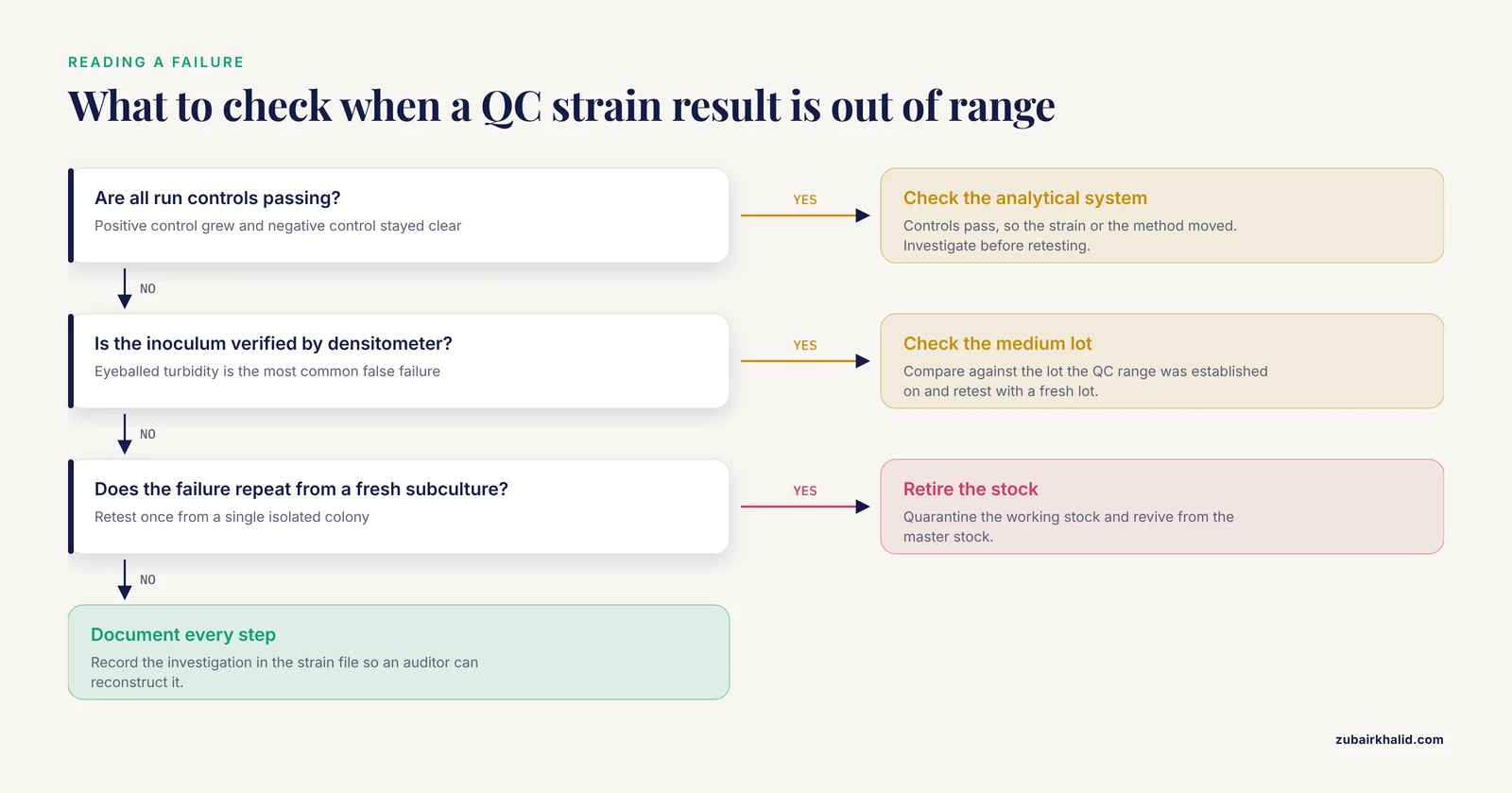
A viability test without controls is just an observation. Build these controls into every run.
Positive control. A strain and lot combination with a known, recent viability history, processed in parallel. It proves the medium, incubator, and operator are competent on the day.
Negative control. Uninoculated medium incubated alongside the test. Growth or turbidity here means contamination of reagents and invalidates the run.
Reference colony morphology. Photograph or describe the expected colony appearance for each strain. When a new operator evaluates the plates, they compare against the record, not against memory.
Expected results for a healthy QC strain look like this. Visible turbidity in recovery broth within 18 to 24 hours. Uniform, morphology-consistent isolated colonies on purity plates. A correct Gram reaction and microscopic appearance. A quantitative count within the strain's established acceptance range on your control chart. For strains used in susceptibility or biocide QC, an endpoint inside the documented QC range for the current medium lot, with the understanding that published ranges typically span three to five dilution steps [5]. For a flow cytometry viability assay, a high viable fraction with a low dead-cell and damaged-cell fraction, and consistency with previous runs on the same lot.
How to read borderline results. A single marginal value within a wide published range is normal variation. A value at the range edge on two consecutive runs is drift and warrants investigation even though it technically passed. A value outside the range with all controls passing is a genuine QC failure. Quarantine the strain, retest from a fresh subculture, and if the failure repeats, retire the working stock and revive from the master.
Troubleshooting
| Symptom | Likely cause | Fix |
|---|---|---|
| , - | , - | , - |
| No growth after revival | Dead stock, cumulative freeze-thaw damage, wrong recovery medium or temperature | Try a second vial from a different freezer position. Use the recovery medium specified by the culture collection. Extend enrichment before declaring the lot dead. |
| Visible growth but colonies look mixed | Contamination of the working stock or the vial during sampling | Restreak from a single colony, run identity checks, discard the compromised stock. Review aseptic technique records. |
| Growth slower than historical record | Injured population, exhausted or over-aged medium, incubator drift | Subculture once into fresh medium from a documented lot. Verify incubator temperature with a calibrated probe. |
| MIC or biocide endpoint out of range with good growth | Inoculum density error, medium lot variation, or reagent solubility problems | Verify inoculum with a densitometer. Retest with a fresh medium lot. For hydrophobic agents, confirm the solubility limit is not being exceeded, the documented failure mode for two biocide-strain combinations [5]. |
| Plate count far below flow cytometry viable count | VBNC or injured subpopulation that does not plate | Treat the plate count as measuring culturability, not total viability. Investigate storage history and cumulative stress [3]. |
| High replicate-to-replicate count scatter | Manual counting error | Move to an automated counter, which reduced inter-operator error substantially compared with manual hemocytometry in controlled comparison [8]. |
| Steadily declining counts across successive working stocks | Passage-related drift or storage stress accumulating over cycles | Return to the master stock, tighten passage limits, and review cryoprotectant and storage temperature records [6]. |
| Strain passes viability but fails identity checks | Historical lot substitution or long-term molecular drift | Sequence the current stock against the seed reference genome and replace the stock from the verified source [1][2]. |
Variations and Special Situations
Fastidious organisms. Some reference strains are nutritionally demanding. Among the seed strains characterized in the vaccine QC work, Mycoplasmoides gallisepticum requires specialized serum-rich mycoplasma media and longer incubation than the standard bacteria in the same panel [1]. Fastidious strains generally need longer revival windows and richer recovery media, and their viability checks should be scheduled more generously than those of robust organisms.
Strains stored with protective formulations. Encapsulation and carrier formulations change storage behavior. In the L. casei study, free cells and cells encapsulated in alginate-milk, sodium alginate, or kappa-carrageenan showed different viability behavior during cold storage and under simulated gastrointestinal conditions [6]. If your QC strains are stored in or delivered in any carrier matrix, validate the viability method on the matrix itself, because the matrix interferes with both plating and staining.
Yeast and fungal QC strains. Automated counting platforms validated on yeast handle viability assessment by dye exclusion and correlate well with manual methods, and impedance instruments add an independent, culture-free measurement [8]. For a laboratory that controls fermentation or compendial sterility workflows with yeast reference strains, these platforms are a practical middle ground between plate counts and full flow cytometry.
Mixed populations and multi-strain preparations. Where the article of commerce is a consortium rather than a single strain, plate counting requires a different medium per strain and undercounts unculturable members, while flow cytometry can enumerate total and viable cells in the complete mixture [4]. QC programs for such products should define which population-level metric, total viable cells or per-strain CFU, the acceptance criteria apply to, before the first lot is tested.
Storage and Stability of QC Strains
Storage practice determines how often viability testing has to rescue you. The hierarchy is standard. Master stocks, prepared once from the verified seed and never subcultured except to make working stocks, stored at cryogenic temperatures in 15 to 20 percent glycerol or lyophilized. Working stocks, derived from masters in limited passage, stored at 2 to 8 degrees C for short-term use or frozen for intermediate terms. Bench cultures, used for the current run and discarded, never used to seed new stocks.
Cold storage is protective but not static. Viability in refrigerated carrier systems declines measurably over weeks, with the rate depending on formulation, as shown in the labneh carrier study where viability was tracked over 15 days of cold storage [6]. Over longer horizons, stability modeling frameworks apply. The synbiotic shelf-life study applied ICH pharma guidelines and tested the Arrhenius model as a predictive tool for viability loss during storage [3]. A laboratory that stores critical QC strains can borrow the same logic. Hold strains at the lowest temperature available, avoid temperature excursions, log every opening of the vial, and schedule spot-check viability testing at intervals short enough that an undetected decline cannot span more than one or two reporting cycles.
Stability also has a functional dimension. In the synbiotic work, the product maintained its acidification capability in nutrient medium even in samples whose CFU count had fallen below the nominal dose level, indicating that measured functional activity and counted CFU can diverge over shelf life [3]. For QC strains, the practical translation is that the functional assay result, not the raw count alone, is the acceptance criterion for use.
Common Mistakes and Limitations
These are the errors seen most often in audit findings and in the bench literature, phrased as practical guidance.
Testing viability only when something fails. By the time a QC strain fails an assay, the runs since the last valid check are already suspect. The frequency schedule exists to catch the problem before it contaminates a reporting period.
Treating "it grew" as "it is viable." Growth on one medium is a yes-or-no signal with poor resolution. A strain can grow while its population is half dead, shifting your effective inoculum and your endpoints. Quantitative enumeration on a defined schedule is what turns the growth check into a control.
Ignoring the VBNC gap between methods. Plate counts and membrane-integrity measurements answer different questions, and the published comparisons show plate counts falling below flow cytometry values as cells shift toward VBNC [3]. Do not "average" the two methods or assume the lower number is the conservative truth. Decide during validation which metric governs acceptance.
Unstandardized inoculum. Eyeballing turbidity instead of using a densitometer produces endpoints that fail QC ranges for reasons that have nothing to do with the strain. This is the most common false failure in susceptibility QC.
Blaming the strain when the medium lot changed. The interlaboratory biocide work explicitly built medium lot variation into its design because lots shift endpoints [5]. Whenever a new lot of any critical medium arrives, requalify the QC strains against it before routine use.
Unlimited subculturing. Every passage is a selection event and a contamination opportunity. Cap passages from the master, record the count on every label, and enforce the cap physically by dating working stocks at preparation.
Counting precision taken for granted. Manual hemocytometer counts carry the largest inter-operator error of the common methods, several-fold larger than automated counting in a controlled comparison [8]. If two operators produce different answers on the same culture, your acceptance ranges are wider than you think they are.
Separating identity from viability forever. A strain can be vigorously alive and still be the wrong strain. Periodic molecular or genomic confirmation closes that gap, and reference genome datasets now exist specifically to support that confirmation at strain level for vaccine and biological product seed stocks [1][2].
Accepting an endpoint combination that was never validated. The P. aeruginosa and hydrophobic biocide case shows that some strain-reagent combinations simply cannot generate stable QC ranges [5]. When a combination resists range-setting in your own validation, document it and choose a different combination rather than forcing a range onto noisy data.
One limitation applies to all of the above. Individual situations, unusual organisms, and failed investigations need judgment from a qualified microbiologist or laboratory director, and this guide cannot substitute for that professional assessment.
Fitting Viability Testing into Laboratory Quality Management
Viability data only creates value if it is structured. Within a laboratory quality management system, each QC strain should have a strain file containing the source and verification history, including genomic confirmation where performed, preparation and passage records for every stock, the acceptance ranges for each method it controls with the medium lots they were established on, and a running control chart of viability and functional results. Interlaboratory and multicenter range-setting studies give the statistical template for how those ranges should be built, from multiple lots and multiple operators, evaluated with dedicated range-finding software [5][9]. A range established from a single operator on a single day is a hypothesis, not a control limit.
The identity layer integrates cleanly. Reference genome datasets for biological product seed strains were generated explicitly to let parties confirm strain-level identity over time and to support consistent production and QC [1][2]. A laboratory does not need to sequence routinely, but it should know who did, when, and where the reference data live.
Frequently Asked Questions
How often should a laboratory perform QC strain viability testing?
Test on every revival from stock, with every routine use until performance is proven stable, at calendar intervals for stocks in storage, and immediately after any storage incident. Quantitative enumeration belongs at revival, at lot qualification, and before release of any batch that depends on the strain.
What is the difference between viability testing and identity testing?
Viability testing asks whether the cells are alive and performing, through growth checks, enumeration, and functional assays. Identity testing asks whether the organism is still the correct strain, through phenotypic profiling and, definitively, genomic comparison against a reference sequence.
Can flow cytometry replace plate counts for QC strain viability?
It can complement them and, once validated against culture on your strains, can serve as the routine rapid method. Flow cytometry detects VBNC cells that plate counts miss and routinely reports higher viable counts, but membrane integrity is not identical to the ability to reproduce, so validation against culture is required before switching over.
Why is my QC strain growing slowly after revival?
Most often the cells are injured from storage or thawing, the recovery medium is too lean, or the incubation conditions are wrong for the strain. Subculture once into fresh documented medium, verify incubator conditions, and extend the observation window before declaring a viability failure.
How many passages are allowed from a master stock?
A widely adopted convention limits working cultures to five serial passages from the verified master stock. Each passage risks selection and contamination, so record the passage number on every vial and enforce the limit.
Why did my QC strain fail an out-of-range MIC with perfectly good growth?
The strain is alive but the analytical system moved. Check inoculum density first, then the medium lot, then reagent properties such as solubility limits, which have prevented QC range establishment for some hydrophobic agent and strain combinations.
How should QC strains be stored between tests?
Master stocks at cryogenic temperature in 15 to 20 percent glycerol or as lyophilized vials, working stocks frozen or refrigerated for short terms with dated passage labels, and bench cultures discarded after use. Log every retrieval and protect stocks from temperature excursions.
Do I need to reverify strain identity after long-term storage?
Yes, periodically and whenever behavior changes. Genomic verification against a reference sequence is the definitive check and is now standard practice for seed strain confirmation in biological product manufacturing and quality control.
Sources
- High-quality genome assembly and annotation of live animal vaccine bacteria strains in South Korea.
- High-quality genome assembly and annotation of inactivated animal vaccine bacteria strains in South Korea.
- Assessment of shelf-life and metabolic viability of a multi-strain synbiotic using standard and innovative enumeration technologies
- High-Throughput Viability Testing of Microbial Communities in a Probiotic Product Using Flow Cytometry
- Development of Quality Control Ranges for Biocide Susceptibility Testing
- Assessment the viability properties of Lactobacillus casei strain using labneh as a carrier.
- Identifying optimal COVID-19 testing strategies for schools and businesses: Balancing testing frequency, individual test technology, and cost
- Comparison of a new digital imaging technique for yeast cell counting and viability assessments with traditional methods
- A Multilaboratory, Multicountry Study To Determine Bedaquiline MIC Quality Control Ranges for Phenotypic Drug Susceptibility Testing
- Comparison of the recommended colistin susceptibility testing methods with colistin gradient strips and semi-automated method for antimicrobial-resistant non-fermenting rods.