How to Prepare Your Microbiology Lab for a Proficiency Testing Audit
By Dr. Zubair Khalid, DVM, MS, PhD ·

By the end of this guide you will be able to build a pre-audit timeline for your laboratory, verify that every test on your menu has either an external proficiency testing (PT) challenge or a documented interim alternative, run a PT panel the way an assessor expects to see it handled, and assemble the exact documentation file an auditor will ask for. You will also get a worked example of a PT result summary calculation, a sample register template, and a corrective action format you can adopt directly.
Have the following on hand before you start: your current test menu with method names, your enrollment certificate from each external quality assessment (EQA) provider, the last two PT return cycles with feedback letters, your media and reagent lot records, your calibration log for incubators and autoclaves, the current CLSI breakpoint document your laboratory uses for antimicrobial susceptibility testing (AST), your training and competency files, and your corrective action log. If your laboratory performs whole genome sequencing (WGS), also pull your bioinformatics pipeline version records and your most recent sequencing PT report.
What a Proficiency Testing Audit Actually Checks
Proficiency testing, also called external quality assessment (EQA), is a system in which samples of known but undisclosed content are introduced into a laboratory's routine testing procedure. The samples are a direct challenge to those procedures, not a separate exercise [1]. An auditor evaluating your PT program is really asking four questions:
- Does every reportable test have an independent external check?
- Were PT samples handled exactly like clinical specimens, by the staff who normally run them?
- Did the laboratory interpret its own performance honestly, including failures?
- Did unsatisfactory results produce a documented root cause analysis and corrective action that changed practice?
These four questions come straight from how PT programs themselves are designed. EQA providers accredited to ISO/IEC 17043 must demonstrate planned sample production, stability verification, scheme design, and statistical evaluation of participant results before they send anything to your bench. When you prepare for an audit, you are preparing to show the receiving half of that same system. A study of PT program design across analytical chemistry, microbiology, and laboratory medicine emphasizes that the value of a scheme depends on participants treating the samples within their normal workflow rather than as special events [2].
Auditors in microbiology pay attention to a problem that other disciplines do not have: viability. PT samples in microbiology are living organisms or simulated matrices containing organisms, and how you reconstitute, incubate, and subculture them is part of what is being assessed [1]. A PT program for transfusion microbiology in South Africa demonstrated the scale of this problem by spiking real blood products with defined bacterial strains and confirming that 568 of 572 prepared matrices, 99 percent, remained stable for 30 days, with correct organism identification possible for up to 23 days after preparation [3]. If a provider can guarantee stability for roughly three weeks, your laboratory's handling speed and storage conditions are squarely within the assessed window.
Building Your Pre-Audit Timeline
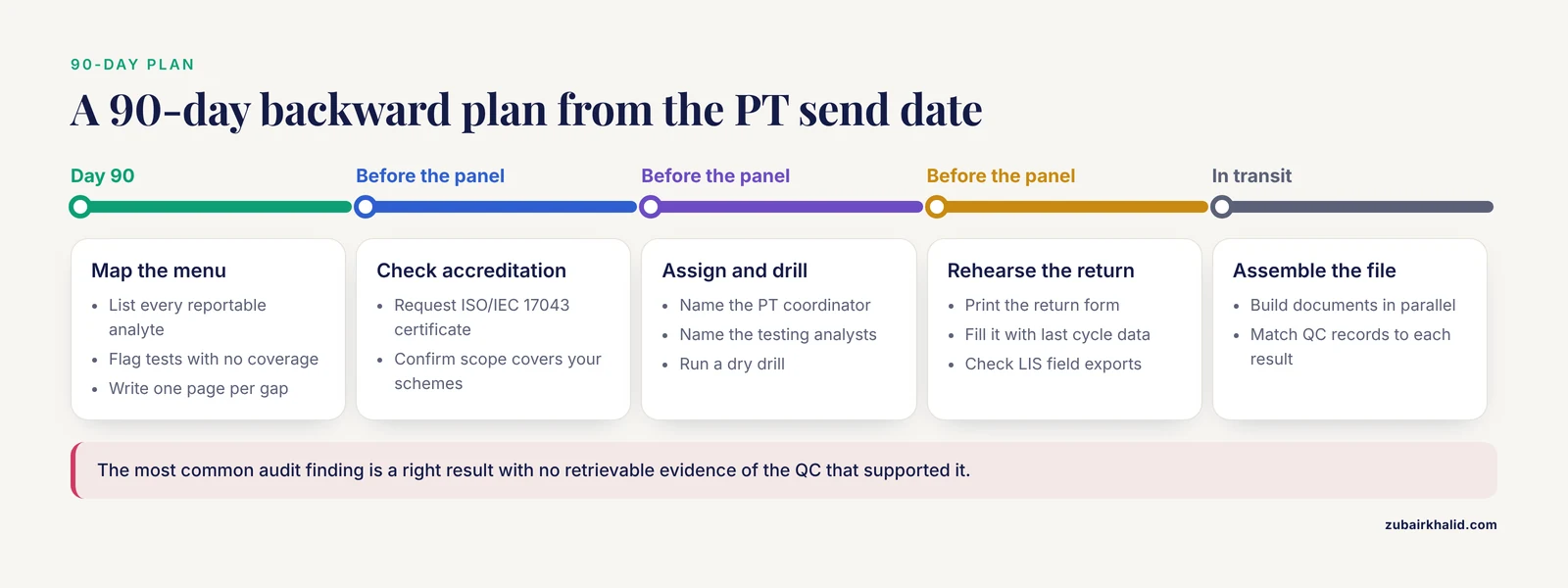
The most reliable format for preparing for a proficiency testing audit in microbiology is a 90-day backward plan from the scheduled PT send date or audit date. The following walkthrough assumes a laboratory running bacteriology, mycology, mycobacteriology, and molecular testing. Adjust the scope to your menu.
Step 1: Map your test menu to PT coverage
List every reportable analyte and match it to a PT challenge from your EQA provider. Flag anything with no external coverage. Common gaps in microbiology include unusual matrices (sterile fluids, tissue, blood products), rare organisms, in-house molecular assays, and sequencing or typing services. The transfusion microbiology study cited above exists precisely because no routine PT program covered bacterial detection in blood products, so the South African National Blood Service built its own matrix-equivalent panel from pooled platelet and red cell products [3]. Canadian Blood Services did the same for bacterial screening of apheresis platelets, developing an in-house PT program with spiked and negative panel members distributed to every participating center [4].
For each gap, your audit file needs one page stating the gap, the interim measure, and the review date. "Interim measure" means one of the following: split-sample comparison with a reference or peer laboratory, an in-house blinded panel prepared by someone who does not perform the routine test, or enrollment in a research or surveillance EQA round if one is open.
Step 2: Verify your provider's accreditation status
Ask each provider for its ISO/IEC 17043 accreditation certificate and check the scope covers the schemes you buy. This matters because the quality of the challenge itself is a precondition for fair assessment of your laboratory. In Canada, the drinking water microbiology PT program run by Proficiency Testing Canada with the Canadian Microbiological Proficiency Testing program is delivered by ISO/IEC 17043-accredited EQA providers, with twice-yearly challenges of four samples containing unknown concentrations of Escherichia coli and Enterobacter spp. . An auditor who sees accredited providers on your enrollment list has one less question about the validity of your external checks.
Step 3: Assign roles and rehearse blind handling
Name a PT coordinator who receives shipments, logs condition on arrival, and allocates samples. Name the analysts who will test them. The defining rule, stated in the food microbiology EQA literature, is that samples of undisclosed content enter the laboratory's routine testing procedure [1]. That means no marking the rack, no extra repeat runs the routine workload would not receive, and no senior scientist re-checking every plate. Run a dry drill with a retained QC strain or an old commercial panel so the handling path is practiced, not improvised.
Step 4: Rehearse the reporting return
PT returns in microbiology usually ask for organism identification to species level, quantitative or semi-quantitative results, AST interpretations, and sometimes a case-based question. The Cambodia AMR surveillance EQA, which has provided panels of three isolates three times per year to sentinel laboratories since 2012, requires species-level identification, verification of AST results, and a case study question that has included parasitology [6]. Print the return form now, fill it with last cycle's data as a rehearsal, and find out whether your laboratory information system exports the fields the form requires.
Step 5: Assemble the audit file in parallel
While the panel is in transit, assemble the documents listed in the template section below. Do this in parallel, not afterward, because the most common audit finding is not a wrong result. It is a right result with no retrievable evidence of the QC that supported it.
The table below summarizes the main challenge types and what to have ready for each.
| Challenge type | Typical content | What the auditor checks | Preparation checkpoint |
|---|---|---|---|
| , - | , - | , - | , - |
| Culture identification | Pure or mixed isolates on media, lyophilized vials, or spiked matrices | Species-level ID, handling of mixed cultures, communication of limitations | Requisition, ID method version, mixed-culture SOP |
| Quantitative culture | Simulated samples with defined organism loads | Plating method, colony counting, reporting units | Counting SOP, dilution scheme, units on the return form |
| Antimicrobial susceptibility | Isolate plus standardized AST panel | Correct species ID drives AST, correct interpretation against current breakpoints | Current CLSI or EUCAST breakpoint version on file, instrument AST panel in date |
| Molecular detection | Extracted material or whole organisms for PCR or NAAT | Extraction control results, assay version, invalid result handling | QC run records for the assay lot in use |
| Sequencing and typing | Nucleic acid or isolates for WGS, plus epidemiological metadata | Genome quality metrics, lineage or cluster assignment, interpretation | Pipeline version record, reference database version, WGS PT feedback |
| Case-based questions | Written clinical scenario, sometimes parasitology or syndrome based | Correct test selection and interpretation logic | Staff competency records for case interpretation |
Receiving and Handling PT Samples Like Clinical Specimens
Treat every PT item as a patient specimen from the moment it arrives. Log the shipment condition, temperature indicator status, and integrity at receipt. Reconstitute lyophilized materials with the diluent and volume the provider specifies, and record the reconstitution time, because growth kinetics of stressed organisms differ from fresh clinical isolates. Food microbiology EQA schemes historically offer either freeze-dried mixtures of organisms simulating foods or preweighed portions of spiked dried foods, and the reconstitution and homogenization steps are assessed parts of the procedure [1]. Reviews of PT design in food microbiology note that matrix choice and organism stress state are among the main technical challenges a scheme must solve, which is why provider instructions exist and why deviating from them is an audit finding [7].
Viability timing matters more than most laboratories realize. In the South African transfusion microbiology study, spiked blood product samples supported correct identification for up to 23 days, while samples treated with preserving fluid containing antibiotics remained negative through day 30 [3]. Practical implications for your bench:
- Schedule PT processing within 48 hours of receipt whenever the provider's instructions allow.
- If a sample must be held, document storage temperature and hold duration, and expect the auditor to compare those entries against the provider's stated stability window.
- Never assume a negative PT culture means the matrix was spiked. Some panel members are deliberately negative, and in the Canadian platelet screening program the distributed panels combined positive and negative members specifically to test both directions of the assay [4].
If your laboratory receives a PT sample that is visibly compromised, cracked vial, leaking, wrong labeling, document it and contact the provider before testing. A documented rejection with provider correspondence is a strong audit artifact. A silent workaround is not.
Microbiology Quality Control Before the Panel Arrives
PT measures the whole system, so microbiology quality control failures that a routine patient sample would tolerate can surface as a PT failure. In the weeks before a panel arrives, verify the following, which are standard elements of a laboratory quality management system.
Media. Check each in-use lot for sterility (sample and incubate a percentage of plates), growth support using reference strains, and physical characteristics such as pH and hemolysis patterns on blood agar. Record lot numbers and expiry on the bench.
Stains and reagents. QC Gram stain reagents with known Gram-positive and Gram-negative controls each day of use.QC catalase, oxidase, coagulase, and other spot reagents with positive and negative controls per the manufacturer's frequency.
Instruments. Document incubator temperatures at defined setpoints (for example 35°C for routine bacteriology, 42°C where the method requires), CO2 concentrations, and autoclave cycles with chemical and biological indicators.
AST systems. Run the reference strains your AST method requires on the required frequency. The established control strains for disk diffusion and broth microdilution include Escherichia coli ATCC 25922, Staphylococcus aureus ATCC 25923, Pseudomonas aeruginosa ATCC 27853, and Enterococcus faecalis ATCC 29212. Confirm that the acceptance ranges you are checking against come from the breakpoint edition your laboratory has formally adopted, because ranges are revised between editions.
Environment. Auditors increasingly look at the laboratory itself as a QC element. A three-month sampling study of an active clinical microbiology facility during the COVID-19 pandemic mapped microbial populations on floors, benches, and sinks across the bacteriology, molecular, and COVID testing sections and showed that surface microbiota in a testing facility is dynamic and tied to the work performed there [8]. Your environmental monitoring records, cleaning schedule, and biosafety cabinet certification are all part of the answer to the auditor's implicit question about whether the building could contaminate a PT culture.
A worked calculation you can put in your QC file, using the kind of agreement arithmetic PT providers themselves publish. The South African transfusion PT study reported 98 percent agreement between three participating laboratories and the reference results across spiked samples, calculated as 153 of 156 results [3]. Reproduce that arithmetic for your own interim panels with the script below.
# pt_summary.py - summarize interim in-house PT results
results = [
    ("S1", "Staphylococcus epidermidis", "Staphylococcus epidermidis"),
    ("S2", "Pseudomonas aeruginosa",     "Pseudomonas aeruginosa"),
    ("S3", "No organism detected",       "No organism detected"),
    ("S4", "Streptococcus pneumoniae",   "Viridans group streptococci"),
    ("S5", "Escherichia coli",           "Escherichia coli"),
]

correct = sum(1 for _, exp, rep in results if exp == rep)
total = len(results)
print(f"Identification agreement: {correct}/{total} = {correct/total:.0%}")
for sid, exp, rep in results:
    if exp != rep:
        print(f"MISMATCH {sid}: expected {exp}, reported {rep}")
Expected output:
Identification agreement: 4/5 = 80%
MISMATCH S4: expected Streptococcus pneumoniae, reported Viridians group streptococci
That mismatch line is what feeds your root cause analysis. In the Canadian platelet screening example, an organism that failed to grow consistently, Streptococcus pneumoniae at low inocula, was simply not selected for the implemented program, which is itself a legitimate, documentable design decision [4]. Declining to challenge a target your method cannot reliably meet, and saying so in writing, is defensible. Failing silently is not.
Antimicrobial Susceptibility Testing: The Highest-Risk Section
Across four years of EQA results from seven AMR surveillance sentinel laboratories in Cambodia, evaluated between 2016 and 2019, the recurring assessment elements were species-level identification, verification of AST results, and case interpretation, and the program's central purpose was to identify the main sources of unsatisfactory analytical processes and drive corrective action [6]. That structure tells you exactly where auditors will dig.
Three failure modes dominate microbiology AST returns:
- Identification error cascading into AST error. If your identification is wrong, your AST interpretation is automatically wrong even if every zone diameter or MIC was measured perfectly, because interpretations depend on the species. This is why EQA programs insist on species-level ID as a scored component [6].
- Stale breakpoints. Reporting susceptible or resistant categories against an outdated breakpoint edition is a straightforward nonconformity. Keep the edition date of your breakpoint document visible on the AST worksheet and in the LIS.
- Inconsistent qualitative language. Mixed culture reports, "few", "moderate", "many" without a defined scale, and interpretive comments that differ between analysts on identical findings are frequent EQA findings in every scheme design review [1].
Before the panel arrives, run one rehearsal AST on a QC strain, interpret it against your current breakpoint document, and have a second analyst independently interpret the same raw data. If the two interpretations differ, you have found your audit finding before the auditor did.
Molecular and Sequencing-Based PT
If your laboratory reports nucleic acid amplification results or genomic data, your PT preparation has an extra layer. Implementation guidance for WGS in routine diagnostic microbiology identifies proficiency testing as a core quality control requirement when integrating sequencing into clinical workflows, alongside managing batch processing demands and maintaining compatibility with established methods [9].
Sequencing PT programs score different things than culture PT, and you should know your provider's metrics in advance. The SARS-CoV-2 whole genome sequencing proficiency testing program covering one New Zealand and 14 Australian public health laboratories assessed participants on genome coverage, Pango lineage assignment, and sequence quality, and refined its metrics between the 2021 and 2022 rounds, with the result that more participants would have failed the earlier round under the stricter metrics [10]. The lesson for your preparation is to obtain the current scoring rubric from your provider and self-audit your most recent runs against it before the challenge arrives.
Interpretation is the weak point. In a Swiss-wide ring trial, nine clinical bacteriology laboratories analyzed methicillin-susceptible Staphylococcus aureus strain relatedness from WGS and epidemiological data. Phylogenetic trees and cluster identification were highly reproducible across laboratories, but cluster interpretation was more laboratory dependent, and detailed analysis showed that apparently similar clusters were built on different sets of SNPs retained after differing sample preparation and SNP calling procedures [11]. Preparing for an audit of genomic PT therefore means documenting three things explicitly: your pipeline version, your SNP calling and filtering thresholds, and your written rule for what SNP distance constitutes an outbreak cluster.
Molecular oncology PT data reinforce the same principle from a different discipline. Across 6,897 responses to 35 College of American Pathologists molecular oncology PT samples covering 13 variants in the BRAF, EGFR, and KRAS genes, 23 of 26 reported commercial kits achieved greater than 95 percent accuracy, and laboratory-developed tests with no specified kit demonstrated 96.8 percent accuracy or greater across all three analytes [12]. Method choice measurably moves PT performance, so record which method and kit produced each PT result.
Running the Panel: A Step-by-Step Walkthrough
- Receipt day. Log the package, photograph any temperature indicator, assign anonymous PT accession numbers that mimic your LIS numbering, and file the provider's instruction sheet in the PT folder.
- Allocation. Distribute samples to routine benches with routine workload. The PT coordinator does not perform or review the testing beyond their normal supervisory role.
- Testing. Follow your standard SOPs. Enter results into the LIS as you would a patient result. If a step fails, for example a contaminated broth, document it as you would a specimen incident and proceed according to your SOP, including requesting a replacement from the provider if indicated.
- Interpretation and sign-out. Analyst signs, supervisor verifies, per routine.
- Return submission. Submit through the provider's portal by the deadline. Keep the submission confirmation.
- Internal scoring before feedback arrives. Score your own performance using your own expectations. The script above does this for identification. Do the same for AST categories by comparing your interpretation against your breakpoint document.
- Feedback reconciliation. When the provider's evaluation arrives, reconcile every discrepancy against your own score, classify each as analytical, interpretive, clerical, or sample-related, and open corrective actions where needed.
Root Cause Analysis and Corrective Action After Unsatisfactory Results
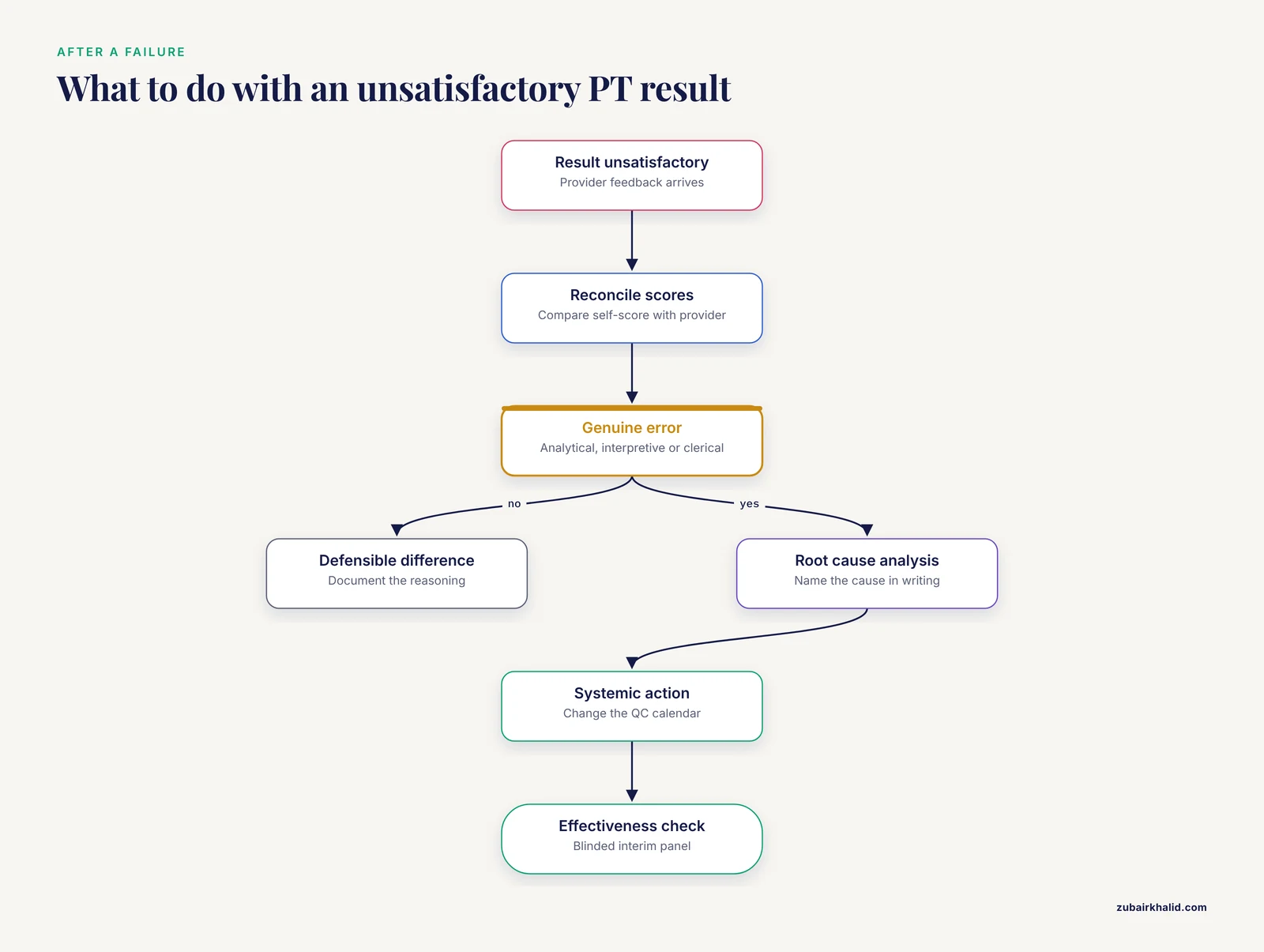
The Cambodia AMR EQA program reviewed feedback results and corrective actions to identify the root cause of nonconformity and suggest areas for improvement, and treated that loop as the core function of the program rather than an add-on [6]. Your corrective action record should be short enough that people actually complete it. Use this template.
CORRECTIVE ACTION RECORD - PT-EQA
Record number:        CAPA-2026-014
PT round:             CMPT 2026-B, sample 3
Finding:              Organism reported as "Enterobacter cloacae complex";
                      provider expected "Klebsiella aerogenes"
Category:             Analytical (identification)
Root cause:           MALDI-TOF library version in use did not include
                      K. aerogenes entry for this target
Immediate action:     Library updated to current version, all staff briefed
Systemic action:      Quarterly library version check added to QC calendar
Effectiveness check:  Interim in-house panel, 5 organisms, planned Q3
Owner:                J. Doe, Microbiology Supervisor
Target date:          2026-08-15
Status:               Open
Note the distinction between immediate action and systemic action. Fixing the individual result fixes nothing. Changing the QC calendar changes the next audit outcome. An effectiveness check that uses a blinded interim panel, prepared the way the South African and Canadian programs prepared theirs, spiked matrices with defined organisms and defined concentrations, closes the loop with objective evidence [3] [4].
Documentation Format and a Ready-to-Use Template
Auditors rarely tell you in advance which single document they will open first, but the order that satisfies nearly all of them is the following PT file format. Build one folder or binder per scheme, per year.
- Provider enrollment letter and ISO/IEC 17043 accreditation certificate for the provider [5].
- Annual PT plan listing every scheme, every analyte covered, every gap and its interim measure.
- Sample receipt log with condition-on-arrival entries.
- Raw bench worksheets for each panel member.
- Signed-out LIS results or the return form copy with submission confirmation.
- Provider feedback letter with the laboratory's performance score.
- Internal reconciliation sheet comparing self-scoring with provider scoring.
- Corrective action records for every unsatisfactory or acceptable-with-comment result.
- Training and competency records for every analyst who touched a PT sample.
- Management review minutes showing PT performance was discussed at the defined frequency.
The annual PT plan is the document auditors use to test completeness, so make the gap analysis explicit. A minimal template:
ANNUAL PT PLAN - MICROBIOLOGY - [YEAR]
Scheme        | Analyte covered            | Frequency | Gap? | Interim measure
External ID/AST | Aerobic bacteria, ID + AST | 3 rounds/yr | No   | N/A
External AFB   | Mycobacteria, ID           | 2 rounds/yr | No   | N/A
External Mol   | SARS-CoV-2, influenza NAAT | 2 rounds/yr | No   | N/A
In-house       | Bacterial screening of platelets | Per prepare | Yes | Blinded spiked panels, 10^1-10^2 CFU/mL targets [5]
Split-sample   | Fungal ID, uncommon molds  | Quarterly   | Yes  | Reference lab comparison
WGS PT         | Bacterial typing, outbreak | Annual      | No   | N/A [12]
Review date: [date]  Reviewed by: [name]  Approved by: [name]
Adjust the interim measures to what your laboratory can actually source. The guiding examples are established: a purpose-built matrix-equivalent program for a gap no commercial scheme covered [3], and an in-house program with positive and negative panel members at defined inocula for a high-consequence screening test [4].
Common Mistakes and Limitations
- Treating PT samples as special. Extra incubation time, extra repeats, and senior-review sign-out that routine samples never receive invalidate the measurement and are visible in auditor interviews with bench staff. The definition of EQA is undisclosed samples in the routine workflow [1].
- Processing PT samples late. Viability has a finite window. Organisms in a properly prepared matrix-equivalent panel were reliably identifiable only up to day 23 in one validated program [3], so a sample that sits in receiving for two weeks may fail for reasons that have nothing to do with your competence.
- Treating an unsatisfactory result as an individual failure. PT measures the system. Punitive responses drive result manipulation on the next round. The effective model, demonstrated across multiple programs, is root cause analysis with corrective actions that change the system [6].
- Assuming the provider's expected answer is always the only correct one. Ring trial data show that legitimate methodological differences, such as different SNP sets underlying the same cluster call, produce defensible variation between laboratories [11]. Your reconciliation should distinguish genuine error from defensible difference, and document the reasoning either way.
- Ignoring interim PT for uncovered tests. A test menu item with no external challenge and no interim measure is the single most predictable audit finding. The fix is documented in this article and takes one page.
- Letting breakpoints and library versions drift. Both the AST breakpoint edition and the bioinformatics pipeline version must be pinned and recorded. Untracked version drift is invisible until a PT round or an audit exposes it.
- A limitation to state plainly. PT performance at a point in time does not certify every future result, and individual patient or specimen questions always require judgment by the responsible clinician working with the laboratory, not extrapolation from a PT score.
Frequently Asked Questions
What is the difference between proficiency testing and external quality assessment?
They describe the same activity. Proficiency testing is the more common term in accreditation standards, while external quality assessment is the traditional term in microbiology literature, and both refer to undisclosed samples of known content sent through a laboratory's routine process [1].
How often should a microbiology laboratory participate in PT?
Follow your accreditation requirement and provider schedule. Real-world programs run from three isolate-based rounds per year in the Cambodian AMR surveillance EQA [6] to twice-yearly challenges of four samples each in the Canadian drinking water program [5], so match your menu's risk profile to the available scheme frequency.
Can I treat PT samples differently from patient samples?
No. PT samples must enter the routine testing procedure without special handling, because the assessment measures your normal process [1]. Extra repeats or additional review make the score meaningless and are a reportable finding.
What should I do if I receive an unsatisfactory PT result?
Document the result, perform a root cause analysis that distinguishes analytical, interpretive, clerical, and sample-related causes, implement a systemic corrective action, and verify effectiveness with an objective check such as a blinded interim panel [6].
How do I prepare for PT when no commercial program covers one of my tests?
Build an interim measure. Options are a blinded in-house panel with defined spiked organisms and concentrations, validated before use as the Canadian platelet screening program did [4], or a split-sample comparison with a reference laboratory. Document the gap, the interim measure, and the review date in your annual PT plan.
Who in the laboratory should handle PT samples?
The analysts who normally perform the test on patient specimens, with normal supervisory review. The PT coordinator manages logistics and documentation but must not function as an extra layer of checking the routine workflow does not have.
How are sequencing-based PT programs scored?
Typically on genome coverage, lineage assignment, and sequence quality metrics, as used in the SARS-CoV-2 WGS program that assessed genome coverage, Pango lineage, and sequence quality across participating public health laboratories [10]. Obtain the current rubric from your provider before the challenge.
What documents does an auditor ask for first?
The annual PT plan with the gap analysis, the enrollment and provider accreditation records, the receipt log for the most recent round, and the corrective action file for any unsatisfactory result [6]. A complete, current PT file answers most audit questions before they are asked.
Sources
- Proficiency testing in the food microbiology laboratory.
- Proficiency testing in analytical chemistry, microbiology and laboratory medicine: working discussions on current practice and future directions
- Establishment of a stable proficiency testing matrix in transfusion microbiology in South Africa
- Implementation of a proficiency testing programme for bacterial screening in platelet preparations in Canada.
- Improving drinking water quality through proficiency testing-the impact of testing method and accreditation status on Escherichia coli detection by Canadian environmental testing laboratories
- Proficiency Testing Performances Analysis of Microbiology Laboratories Participating in Cambodia Antimicrobial Resistance (AMR) Surveillance System
- Challenges in Food Microbiology Proficiency Testing
- Characterization of SARS-CoV-2 Distribution and Microbial Succession in a Clinical Microbiology Testing Facility during the SARS-CoV-2 Pandemic
- Practical issues in implementing whole-genome-sequencing in routine diagnostic microbiology.
- Continued improvement in the development of the SARS-CoV-2 whole genome sequencing proficiency testing program.
- NGS-Based S. aureus Typing and Outbreak Analysis in Clinical Microbiology Laboratories: Lessons Learned From a Swiss-Wide Proficiency Test
- Performance Comparison of Different Analytic Methods in Proficiency Testing for Mutations in the BRAF, EGFR, and KRAS Genes: A Study of the College of American Pathologists Molecular Oncology Committee.