How to Don and Doff PPE in a Microbiology Lab
By Dr. Zubair Khalid, DVM, MS, PhD ·
Correct donning and doffing of personal protective equipment (PPE) is the barrier between a microbiologist and the organisms handled every day on the bench. Donning puts the barrier on in a sequence that leaves no skin or mucous membrane exposed, and doffing removes it in a sequence that keeps contaminated outer surfaces away from hands, face, and clean clothing. Done properly, the procedure prevents self-contamination, prevents carry-out of infectious material from the laboratory, and protects the specimens you are working with from your own flora.
This guide covers the full procedure for a microbiology laboratory working at Biosafety Level 2 (BSL-2), the baseline for clinical and diagnostic bacteriology, mycology, and routine virology benches. It also covers the enhanced sequence used when respiratory protection is added, the reasoning behind each step, the mistakes that show up most often in observational studies, and how labs verify competency. Hands-on time is roughly 5 minutes for donning and 5 to 10 minutes for doffing. Total elapsed time, including hand hygiene before and after and a spot check by a trained observer or buddy, is about 20 minutes for a full cycle. In a busy diagnostic laboratory where staff enter and exit containment areas many times per shift, that time budget is why the sequence must become automatic.
The sequence below is a standard, widely taught framework. Your institution's biosafety manual and the manufacturer's instructions for your specific gown and respirator models take precedence where they differ.
The Principle Behind the Sequence
Two rules govern the entire PPE donning and doffing order in microbiology.
Rule 1: don from the top down, inside to outside. You put on the items that cover the largest area first, so each later item overlaps the earlier one. Gown first, then respirator or mask, then eye protection, then gloves. The gloves pull over the gown cuffs so there is no bare wrist at the interface. Every joint between items is sealed by the item added later.
Rule 2: doff so the dirtiest surface never touches your skin. The outside of every item is presumed contaminated the moment you leave the donning area. Doffing reverses the logic of donning. Gloves, the most heavily contaminated item, come off first, followed immediately by hand hygiene. The respirator or mask, the item closest to your face, comes off late, after the gown, and only after hands have been cleaned again. Each removal step is followed by hand hygiene where hands touched a contaminated outer surface.
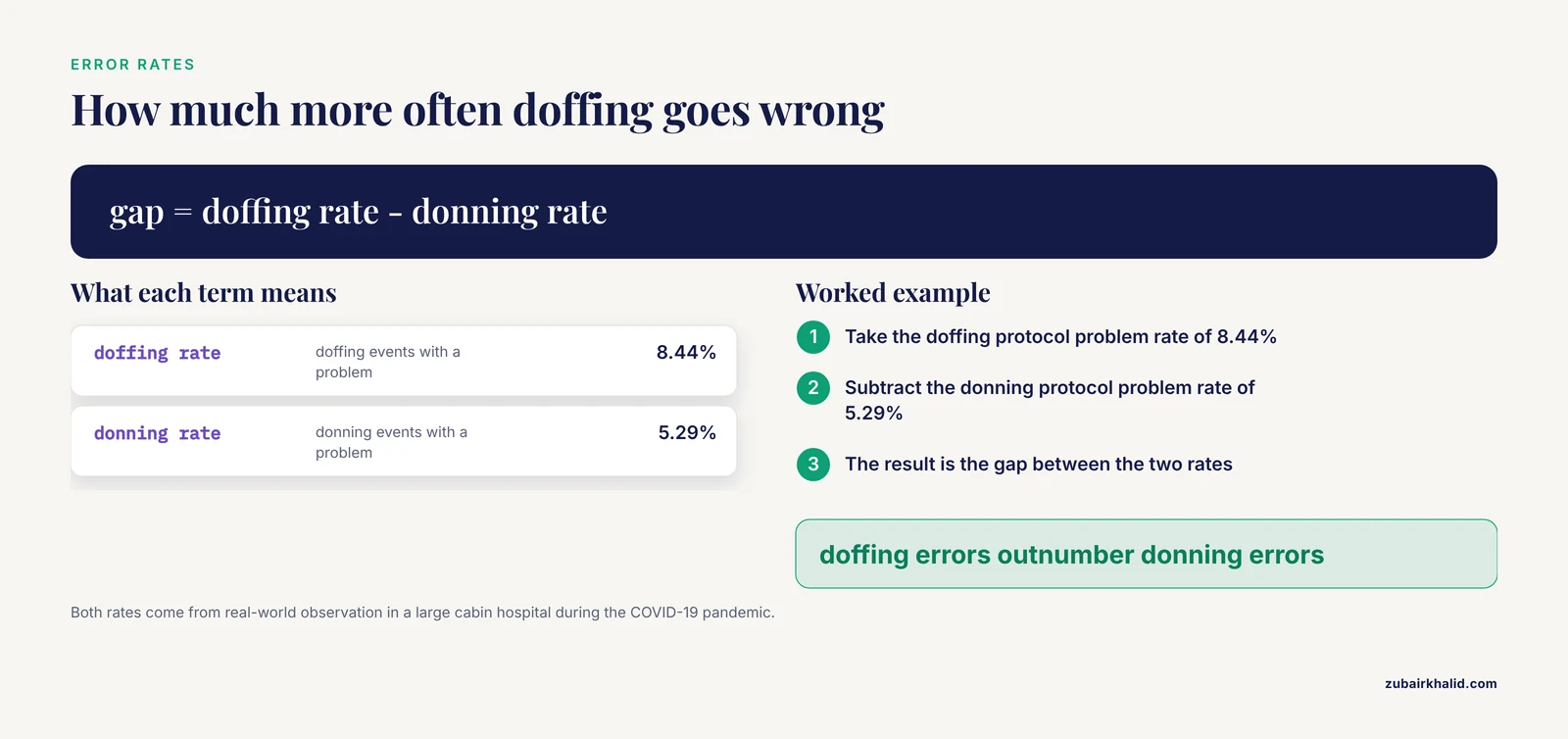
The asymmetry between the two processes is well documented. In a large real-world study during the COVID-19 pandemic, 5.29% of donning events involved a protocol problem compared with 8.44% of doffing events, a difference that was statistically significant [1]. Doffing is harder because you are manipulating contaminated surfaces with contaminated gloves, working blind at the back of the head, and often doing it hurriedly at the end of a task. The extra disinfection steps built into doffing sequences exist precisely because contamination events during removal are expected, and the sequence must neutralize them [2].
Biosafety Risk Assessment Before You Don
The PPE you put on is an output of a biosafety risk assessment, not a starting point. A biosafety risk assessment asks what agent you are handling, what you will do with it, what the exposure routes are, and what competency the staff have. In microbiology biosafety training, this assessment drives every PPE decision.
A practical risk assessment before bench work should answer five questions.
- Agent and route. A routine bacterial culture on routine media handled on an open bench carries different risk from a powdered lyophilized stock, a large-volume liquid culture, or a specimen likely to contain a high-consequence agent such as Brucella or Mycobacterium tuberculosis in aerosol-generating concentrations.
- Activity. Pipetting, vortexing, centrifuging, grinding, and sonication generate aerosols. Work inside a certified Class II biosafety cabinet reduces the PPE burden for some steps and mandates respiratory protection for others, depending on your institution's risk assessment.
- Volume and concentration. A plated diagnostic specimen and a 500 mL broth culture of the same organism are not the same hazard.
- Person factors. Staff training status, glove allergy, facial hair that prevents respirator seal, and eyeglasses that interfere with goggle fit all modify the PPE plan.
- Environment. Shared benches, cold rooms, and incubators visited mid-task create exit-and-reentry events, and each reentry is another donning and doffing cycle with its own error risk.
The output of the risk assessment should be a written PPE specification for the task. At BSL-2 baseline for routine open-bench microbiology, that specification typically reads as a dedicated lab gown or fluid-resistant lab coat, gloves, and eye protection when splash is possible. Enhanced PPE, including a fitted respirator, is added when the assessment identifies inhalation risk. The Environmental and Institutional Safety or Biosafety Officer signs off on the specification, and microbiology biosafety training reinforces it during onboarding and at refresher intervals.
One planning point deserves emphasis because it is measurable. Environmental design changes compliance more than posters do. In a simulated healthcare study using a 2³ factorial design, placing a computer workstation inside the work area significantly increased total, donning, and doffing compliance issues, and work interruptions such as a phone call significantly increased in-room compliance problems [3]. For a microbiology lab, the practical translation is to place the donning and doffing area away from phones, printers, and traffic, and to stock it so nobody has to leave mid-sequence for supplies.
Materials and Equipment
| Item | Specification / working concentration | Purpose and notes |
|---|---|---|
| Fluid-resistant lab gown or coverall | Disposable, single-use per entry, or lab-dedicated reusable gown per institutional policy | Primary body barrier. Sleeves must reach the wrist. |
| Disposable nitrile gloves | Powder-free, appropriate size, two pairs for high-risk tasks | Outer pair is sacrificed at doffing. Change between tasks with different contamination profiles. |
| Surgical mask | ASTM-rated fluid-resistant mask for splash tasks | Droplet and splash barrier for mouth and nose. |
| NIOSH-approved filtering facepiece respirator (N95 or equivalent) | Model for which the wearer has a documented fit test | Added when the risk assessment identifies inhalation hazard. |
| Goggles or face shield | Indirectly vented goggles, or face shield covering to below the chin | Splash protection for conjunctiva. Eyeglasses alone are not eye protection. |
| Shoe covers or dedicated lab footwear | Optional per risk assessment | Prevents tracking contamination out of the lab. |
| Alcohol-based hand rub | 60% to 95% alcohol formulation | Hand hygiene at every doffing transition point where hands touch contaminated surfaces. |
| Soap and water sink | In the doffing area | Preferred when hands are visibly soiled. |
| Disinfectant for surfaces | 70% ethanol or an EPA-registered hospital disinfectant used per label contact time | Disinfection of the donning and doffing surfaces, buckets, and waste containers between cycles. |
| Biohazard waste container | Hands-free lid, lined, within arm's reach of the doffing spot | Every removed item goes directly in. Nothing contaminated is set on a clean surface. |
| Full-length mirror or reflective surface | Mounted in the doffing area | Lets the wearer see the back and shoulders, the usual blind spots. |
| Trained observer or buddy | Required for enhanced PPE and recommended for routine doffing | Watches the sequence, calls out steps, and flags contact between contaminated and clean surfaces. |
Safety note. Alcohol-based hand rub and 70% ethanol are flammable. Keep them away from open flames, including Bunsen burners on the microbiology bench, and never apply hand rub immediately before working near a flame. Disinfectants and hand rub also degrade glove integrity over repeated contact, which is a second reason gloves are replaced rather than repeatedly doused.
Step-by-Step Donning Procedure
Perform donning in a clean area, outside the containment or work zone, on a disinfected surface. The numbered ppe donning and doffing order microbiology step by step sequence below reflects the standard gown-first approach.
- Prepare and inspect. Remove personal items that interfere with the barrier, including rings, watches, lanyards, and dangling earrings. Tie back hair. Inspect every PPE item for tears, missing straps, holes, or discoloration, and discard defective items. Reason: a barrier with a hole is not a barrier, and items removed after donning would require restarting the sequence.
- Perform hand hygiene. Clean hands with alcohol-based hand rub or wash with soap and water. Reason: you are about to touch the inside surfaces of every item, the surfaces that will rest against your skin.
- Don the gown. Put the gown on, fasten the neck tie or Velcro, and secure the waist ties at the back. Check that the cuffs come to the wrist. Reason: gown first so later items overlap it. Waist ties secured at the back rather than the front keep the tie from becoming a contaminated handle near your face.
- Don the mask or respirator. For a surgical mask, secure the upper ties or strap over the crown of the head and the lower strap at the neck, then mold the nose piece. For an N95, cup the respirator under the chin, pull the top strap over the head and high on the crown, then the bottom strap at the neck, and mold the nose clip with both hands. Perform a user seal check. Reason: the respirator protects the mucous membranes of the nose and mouth, the most common portals of laboratory-acquired infection. A respirator without a seal check is decorative, and seal test failures were among the documented respirator problems in real-world observations [1].
- Perform a user seal check. Cup both hands over the respirator and exhale sharply. A positive-pressure seal check shows slight outward puffing with no leaks around the edges. Then inhale sharply for a negative-pressure check. The respirator should collapse slightly toward the face with no inward airflow. Redo the fit and the check if you feel leakage. Reason: the seal check is the only way to confirm function before exposure. Do this every time, every donning.
- Don eye protection. Place goggles or a face shield, adjusting so they sit comfortably and cover the eyes fully. If you wear prescription glasses, goggles must fit over them. Reason: the conjunctiva is an entry route for splash and droplets. Eye protection sits outside the respirator straps where they cross so the seal is not broken.
- Don the first pair of gloves. Extend the cuff over the wrist, and pull the gown cuff under the glove or tuck it so no wrist skin shows. Reason: this first pair often serves as the inner layer that keeps gown cuffs from slipping down during work.
- Don the second pair of gloves for high-risk tasks, extended cuffs over the gown. For splash-generating or high-consequence work, pull the outer pair's cuff over the gown sleeve. Reason: the outer glove is the sacrificial surface. It takes the contamination and comes off first, leaving the wearer's hands protected by the inner pair during the rest of doffing.
- Final visual check. Look yourself over, or better, have a buddy check. Confirm full coverage, no gaps at wrists or neck, respirator seal intact, and goggles seated. Reason: a 10-second check catches the loose head and neck fit that was the single most common gown problem recorded during donning in large-scale observational work, accounting for 56.25% of gown-related donning problems in one study [1]. Visual layout optimization of the donning station, with each item laid out in the exact order of use, further supports the correct sequence [4].
- Enter the work area and disinfect hands at the entry point if policy requires it. Reason: hand hygiene immediately before bench contact removes any contamination picked up in the donning area.
A note on workload physiology. Full PPE measurably alters heat exchange. In a study of recruit firefighters, donning PPE immediately reduced the core-to-skin temperature gradient, with the effect persisting across repeated donning transitions, largely through changes in skin temperature [5]. Microbiologists in full gowns, respirators, and face shields during long incubator-loading or media-pouring sessions face the same physics. Schedule breaks and hydrate, and treat heat discomfort as an operational problem rather than a personal failing, because discomfort is a documented driver of protocol shortcuts [6].
Step-by-Step Doffing Procedure
Doff in the designated doffing area, at the boundary between the work zone and the clean zone, with a waste container within arm's reach. Move slowly. Almost every documented contamination event happens because someone sped up. If a trained observer is available, have that person watch and coach. Observers reliably catch doffing errors, although inter-rater agreement on doffing steps is harder to achieve than on donning steps even for trained safety officers, which is one reason structured checklists matter [7].
- Stop work, disinfect gloves, and leave the work zone. Disinfect gloved hands, then move to the doffing area. Reason: you are removing the laboratory, not just the PPE. The doffing spot is the last place contamination exists, so it must be controlled, not the corridor.
- Remove the outer gloves if double-gloved. Pinch the outside of one glove at the wrist and peel it away, turning it inside out. Hold it in the still-gloved hand. Slide a bare-inner-glove finger under the cuff of the remaining glove, peel it inside out over the first glove, and drop both into the waste container. Reason: the pinch-and-peel technique keeps the contaminated outer surface folded inward and away from skin.
- Remove the gown. Unfasten the waist ties first, then the neck fastener. Touch the inside surfaces only. Pull the gown away from the shoulders and roll it inward and downward, contaminated surface to contaminated surface, and drop it in the waste container. Reason: rolling inward traps the contaminated exterior. Grabbing the front of the gown is the classic self-contamination move. In real-world observations, contamination of the gown's inner surface during doffing was the most frequent gown problem, seen in 46.43% of gown-related doffing events [1]. The inner-surface contact that turns into hand and wrist contamination is exactly the route that surrogate-virus studies expose, where labeled viral surrogates placed on PPE are later recovered on the hands and body of the wearer after doffing [2].
- Perform hand hygiene. Alcohol-based hand rub on the inner gloves or bare hands, whichever is present. Reason: hands touched the gown's inner and outer surfaces.
- Remove eye protection. Handle it by the arms or the headband, never the front. Remove without touching the face. If the item will be reused after disinfection, place it directly in the designated disinfection container. Reason: the front of goggles and face shields is among the most heavily contaminated surfaces on the body. Fluorescent-marker and surrogate studies repeatedly find it in the contaminated zone after doffing [8], [2].
- Remove the respirator or mask. For an N95, lean forward slightly, grab the bottom strap at the back of the neck, then lift the top strap over the crown, and pull the respirator away from the face without touching the front. For a surgical mask, unfasten the bottom tie first, then the top, and remove by the ties. Discard or place in the designated container. Reason: the straps are the only reasonably clean handles. Any touch of the respirator front transfers its whole respiratory-droplet load to your fingers.
- Remove the inner gloves. Using the pinch-and-peel technique again. Discard. Reason: the inner gloves are now the last contaminated barrier and must come off before anything clean is touched.
- Perform hand hygiene. Full hand hygiene, soap and water if hands touched any suspect surface, otherwise alcohol-based hand rub. Reason: this is the final removal of the contamination chain. Skipping it leaves the whole sequence incomplete.
- Disinfect the doffing area. Wipe the mirror handle, waste container lid, and any touched surface with 70% ethanol or hospital disinfectant per label contact time. Reason: the next person's doffing starts from a clean baseline.
- Exit and recheck hands before touching personal items, phones, or door handles. Reason: everything between the doffing area and the office is a contamination handoff point.
The structure of this sequence, with hand hygiene inserted between every contaminated-to-clean transition, is deliberate. Complex doffing protocols that include intermediate disinfection steps were designed on exactly this logic, to protect the wearer even when a contamination event occurs mid-removal, and studies using more sensitive viral surrogates than fluorescent lotion show that those steps earn their place in the sequence [2].
Expected Results and How to Read Your Own Technique
A correctly executed donning and doffing cycle produces observable, checkable outcomes.
During donning. The buddy or mirror shows full coverage, overlapping cuffs, a positive and negative respirator seal check that both pass, and no skin exposed at the wrists, neck, or hairline. Elapsed time from hand hygiene to entry is 3 to 6 minutes for the full enhanced sequence, less for gown-and-glove baseline PPE.
During doffing. Every removed item goes directly into the waste container. Hands touch inner surfaces only. Hand hygiene occurs at every step where hands contacted a contaminated surface, and a final full hygiene event closes the sequence. Nothing contaminated is set down anywhere.
Verification with contamination markers. The definitive readout of technique is what a marker study shows afterward. In the classic fluorescent-gel approach, a fluorescent lotion such as Glo Germ is applied to the PPE surface before doffing, the person doffs under normal lighting conditions unaware of where the marker sits, then a UV light reveals contaminated skin, hair, and clothing. In a study of anesthesiology residents trained this way, contamination rates dropped after instruction and stayed low for donning at long-term follow-up, but doffing compliance decayed significantly by 20.7% at follow-up at least 7 months after training [8]. The expected result of good technique is a UV check with no fluorescence on the hands, face, neck, and hair. Any glowing spot is a map of your own error.
Advanced readouts. More sensitive surrogate systems exist. Lipid nanoparticles carrying DNA barcodes, applied to defined PPE sites before doffing, can be recovered afterward from hands and work surfaces, exposing blind spots that fluorescent lotions miss, including failures of the intermediate disinfection steps [2]. MS2 bacteriophage and similar surrogates serve the same purpose in formal assessment programs, and a structured review of hospital-based PPE assessment methods identified five approaches in current use, namely checklists, video review, fluorescent marker contamination, MS2 bacteriophage, and artificial-intelligence-assisted assessment [9].
What failure looks like. Fluorescence on the dorsum of the hands points to glove-removal technique. Fluorescence on the neck and hair points to gown or respirator removal over the head without rolling. Fluorescence on the front of the torso points to self-hugging the gown during removal. Each pattern is correctable with targeted retraining.
Training, Competency, and Verification Methods
PPE technique is a perishable skill, and the evidence base on how to train it and how long it lasts is now substantial. Labs building a microbiology biosafety training program should match the method to the error they are trying to prevent.
Checklists and direct observation. Checklist-based assessment shows the strongest overall utility among hospital-based PPE assessment methods when evaluated for validity, reliability, educational impact, acceptability, and cost, chiefly because it is feasible, cheap, and widely accepted by staff [9]. Every microbiology lab should have a printed or electronic donning and doffing checklist posted in the PPE area. Electronic audit tools built on simple form platforms auto-populate dashboards and make compliance data shareable with the team in near real time, a step up from paper audits for busy departments [10].
Ultraviolet-fluorescent simulation. UV-fluorescent marker training makes contamination visible and measurably raises skill scores in the short term. In a quasi-experimental study of intensive care nurses, both printed-material and mobile-app training raised mean PPE skill scores immediately after training, from 85.83 to 97.50 and from 84.79 to 94.37 respectively, but scores declined at 8 weeks, to 85.62 and 87.08 [11]. The implication for a microbiology lab is that a single annual demonstration is not enough. Skills decay on a scale of weeks to months.
Refresher frequency. Health workers trained in high-consequence PPE procedures report strong confidence after blended learning workshops that combine e-learning with face-to-face practice, and 89.2% of workshop participants indicated a need for ongoing refresher training, most often preferring annual or biennial updates [12]. Combined with the decay data, a defensible schedule is initial hands-on training at onboarding, a competency verification with a checklist observer, and refresher verification at least annually, with an additional verification after any doffing error with actual exposure consequence.
Doffing-specific retraining. Because doffing skills decay faster than donning skills, as shown by the 20.7% drop in doffing compliance at long-term follow-up against a statistically stable donning score [8], refresher sessions should weight doffing practice more heavily.
Observer programs. Peer safety officers using curated checklists can catch protocol violations in real time, and virtual observation by remote safety officers achieved 87.6% accuracy against 82.4% for in-person observation in a feasibility study, though with lower inter-rater reliability for doffing steps [7]. For a microbiology lab, a rotating trained observer, even 30 minutes per week of paired observation, is one of the highest-yield interventions available.
AI-assisted systems. Computer-vision systems now provide real-time feedback on donning and doffing technique without a human observer. A scoping review of AI-assisted PPE training found systems using computer vision and machine learning integrated into real-time feedback, virtual simulation, and compliance monitoring, with evaluations suggesting improved performance [13]. In a prospective cohort of 293 healthcare workers using one such platform at 3-month intervals, accuracy for correct donning and doffing improved after each guided session and reached 100% correct use after 2 guided sessions, with improvements maintained at subsequent intervals [14]. AI tools fit naturally into the microbiology lab as an always-available observer for staff on evening and weekend shifts.
Immersive and video methods. Virtual reality training focused on the correct event order of PPE use in a spatially realistic facility supports repeated practice without consuming PPE and outperformed video-based learning on event-order memorization in a pilot randomized trial [15]. Video debriefing, in which learners watch recorded footage of their own attempt and debrief it, produced significantly higher observer-scored donning and doffing performance than video-based training alone in a randomized nursing-student study [16]. Both are reasonable supplements to hands-on lab training, not replacements for it.
Environmental and Human Factors That Break the Sequence
The best-trained staff make PPE errors when the environment fights them. Several factors are now documented well enough to design around.
Interruptions and placement. As noted above, workstation placement inside the work area and phone interruptions significantly increase compliance issues [3]. In a microbiology lab, the analog situations are answering a phone mid-doffing, being asked a bench question while removing gloves, and exiting through a door that requires a badge touch with contaminated gloves. Fix these with phone-free doffing zones, a no-interruption norm, and badge readers placed so a bare-handed touch is always possible after gloves come off.
Comfort and fatigue. Discomfort drives protocol violations. In a mixed-method study of 257 healthcare workers, 99.2% reported PPE discomfort, 95.3% excessive sweating, and 48.7% admitted breaking PPE protocol because of discomfort, while 32.7% struggled with donning and doffing despite prior training [6]. Psychological burden is real as well, with 33% reporting anxiety and 68.1% discomfort in a separate survey of healthcare workers wearing PPE during COVID-19 duties [17]. For microbiology labs running long sessions in gowns and respirators, the operational answers are climate control, scheduled PPE-off breaks, task rotation, and honest sizing of gowns and respirators.
Breathability and garment quality. Protective garments certified only for penetration resistance can still be nearly impermeable to air and moisture vapor, which drives the sweating and suffocation complaints above. End-user comfort testing before an institution commits to a garment model is a documented recommendation, and field trials in which staff wear the PPE during real work tasks capture the human-comfort factor that specifications alone miss [18]. Labs selecting gowns and coveralls should involve the bench staff in the trial.
Station design. Laying PPE out in the exact order it will be donned, on a marked station, supports the correct sequence without any instruction at the moment of use. Combine this with a mirror, a hands-free waste container, and a wall-mounted checklist and the doffing area does most of the training by itself.
Troubleshooting Table
| Symptom | Likely cause | Fix |
|---|---|---|
| Fluorescent marker on hands after doffing | Pinch-and-peel glove removal not used, or gloves snapped off by fingertips | Retrain glove removal, observe with checklist, repeat UV drill |
| Fluorescence on neck, hair, or face | Gown or respirator pulled over the head without rolling inward | Practice rolling the gown inward at the shoulders, remove respirator by straps only |
| Fluorescence on wrists and forearms | Gown cuffs slipping, no overlap between glove and sleeve | Tuck gown cuff under inner glove, use outer glove extended over cuff |
| Respirator fails seal check repeatedly | Wrong model or size, facial hair in seal zone, warped nose clip | Re-fit test with a different model, enforce clean-shaven seal zone, replace damaged respirators |
| Gown neck or head area loose during donning | Wrong size or fastener not secured, the most common documented donning problem [1] | Stock multiple sizes, buddy check the neck and hood fit before entry |
| Inner surface of gown contaminated at doffing | Grabbing the gown front, brushing against the waste bin | Retrain inner-surface-only handling, reposition the waste container within arm's reach |
| Staff skip hand hygiene between doffing steps | No dispenser at the doffing point, hurry at shift end | Mount hand rub inside the doffing area at eye level, supervisor model the behavior |
| Checklist completed but errors persist | Checklist marked by memory rather than observation | Require observer-signed checklists for verification, not self-report |
| Skill scores fine after training but poor months later | Expected decay, steepest for doffing [11], [8] | Schedule refresher verification at 6 to 12 month intervals, emphasize doffing |
| Doffing area congested and rushed at shift end | One doffing spot for many staff | Add a second station or stagger exit timing, keep supplies stocked at both |
Variations of the Procedure
Baseline BSL-2 open-bench work. Many routine microbiology benches use a shortened cycle, laboratory coat, gloves, and eye protection as needed, with hand hygiene and glove changes between task types. The full gown-plus-respirator sequence above is reserved for tasks the risk assessment flags. The don and doff logic stays identical even when the item list is shorter, because the principles of overlap on donning and outside-surface containment on doffing do not change.
Respirator programs. Any staff member wearing an N95 or equivalent needs medical clearance, fit testing for the specific model, and documented seal-check training. Fit testing is a one-time and periodic event, but the user seal check is an every-donning event. Facial hair within the seal area voids the fit, and this must be part of the written program.
High-consequence or aerosol-generating work. When the risk assessment identifies inhalation hazard beyond a filtering facepiece, laboratories move to powered air-purifying respirators or supplied-air systems with coveralls, and doffing becomes a two-person, observer-led procedure with defined disinfection steps between items. The expanded sequence follows the same top-down, inner-surface logic described here, with more intermediate hand hygiene and disinfection points.
Double-gloving. Standard for high-risk work, optional for routine bench work. When double-gloving, the outer pair is always removed first and the inner pair carries the wearer through the rest of doffing. Labs that skip double-gloving for routine work should still train the technique so it is available when needed.
Cohorting and zoning. Large operations, such as outbreak surge work, organize the lab into cold, warm, and hot zones with dedicated donning and doffing stations at each boundary. The full gown-plus-respirator sequence applies at the boundary into contaminated zones. Problems concentrate at these boundaries, as the cabin hospital study showed, so staffing the boundary with an observer is worth the labor during surge periods [1].
Storage and Stability Notes
PPE storage. Store gowns, respirators, masks, and gloves in their original sealed packaging, off the floor, in a clean dry area away from direct sunlight and disinfectant vapors. UV light and ozone degrade elastomeric materials and fabric over time. Rotate stock so the oldest boxes are used first, and respect manufacturer expiration dates, because glove material and respirator strap elasticity degrade in storage. A respirator with a brittle strap fails the seal check in the field no matter how good the fit test was.
Reuse rules. Disposable gowns, masks, and gloves are single-use per entry. Goggles and face shields are reusable only through a documented disinfection cycle, disinfected between users with an approved disinfectant at the label contact time, inspected for crazing and coating damage, and retired when optical clarity suffers. Respirators in extended-use programs follow the manufacturer's and the institutional respirator program's limits on donnings and storage between uses, stored hanging or in a breathable container, never folded with the front surface inward against the facepiece.
Disinfectant stability. Prepared 70% ethanol solutions should be labeled with the preparation date and verified per the institutional schedule, since concentration drifts with evaporation and the working concentration is the whole point. Commercial hand rub and ready-to-use disinfectants carry their own expiration dates on the container.
Training records. Competency verification records, checklists, fit test cards, and refresher dates belong in the training file with a defined re-verification interval. The records are part of the biosafety program, not paperwork attached to it.
Common Mistakes and Limitations
These are the ppe donning and doffing order microbiology common mistakes seen repeatedly in observational and marker studies, phrased as the errors themselves.
- Treating doffing as the fast, casual part. Doffing errors outnumber donning errors in real-world observation, 8.44% versus 5.29% of events [1], and doffing skill decays faster after training [8]. The doffing sequence deserves more attention, not less.
- Skipping the user seal check. A respirator worn without a seal check has an unverified fit. Seal test failure was among the documented respirator problems in field observation [1]. The check takes 15 seconds.
- Touching the front of the mask, goggles, or gown during removal. Every touch moves the load onto the fingers. The hands are the vehicle for nearly all self-contamination routes found in marker studies.
- Removing the gown by hugging it or grabbing the front. This contaminates the inner surface, which then contacts clothing and skin. Inner-gown contamination was the leading gown problem during doffing in field data [1].
- Skipping intermediate hand hygiene. The steps between items exist to break the contamination chain. Compressing them into one wash at the end defeats the design.
- Doffing in the wrong place. Removing PPE in the corridor, by the phone, or next to the printer spreads contamination and multiplies interruption-driven errors [3].
- Self-verification only. Staff cannot see their own back, shoulders, and the inside of the hood. Self-graded checklists overestimate performance. Trained observers, mirrors, and contamination markers catch what self-report misses, [9].
- Assuming one training session lasts. Skills decay within weeks to months, with the steepest loss in doffing [11], [8]. Annual or biennial refreshers are what trained staff themselves ask for [12].
- Ignoring comfort until it fails. Discomfort causes documented protocol violations [6]. Garment selection should include user trials for breathability and fit [18], and break schedules should be built into long sessions.
- PPE as a substitute for engineering controls. PPE is the last layer. Primary containment, biosafety cabinets, centrifuge safety cups, and sharps discipline reduce the load that PPE has to face. A risk assessment that leans on PPE alone is incomplete.
Limitations of this guide. The exact item list, order details, and disinfectant specifications vary by institution, agent, and task. The sequence here is a standard framework for teaching and audit, and your laboratory's biosafety manual, risk assessments, and respirator program govern where they differ. Individual exposure incidents need evaluation by your institution's biosafety or occupational health professionals.
Frequently Asked Questions
What is the correct order for donning PPE in a microbiology lab?
The standard gown-first sequence is hand hygiene, gown, mask or respirator with a seal check, eye protection, then gloves over the gown cuffs, followed by a final visual check. Each item overlaps the previous one so no skin is exposed at the joints.
What is the correct order for doffing PPE?
Doffing reverses the contamination logic. Remove the outer gloves first, then hand hygiene, gown by rolling it inward, hand hygiene again, eye protection by the arms, respirator or mask by the straps, inner gloves, and a final hand hygiene. Contaminated outer surfaces never touch skin.
Why is doffing more error-prone than donning?
Doffing involves manipulating contaminated surfaces with contaminated or newly bare hands, working blind at the back of the head, and rushing at the end of a task. Real-world observation found doffing problems in 8.44% of events versus 5.29% during donning, and doffing skills decay faster after training.
How often should microbiology lab staff complete PPE competency training?
Initial hands-on training with observer verification at onboarding, then refresher verification at least annually, with doffing weighted heavily because it decays fastest. Most trained health workers themselves prefer annual or biennial refresher training.
What is a user seal check and how is it done?
A user seal check verifies a respirator's seal every time it is donned. Cup both hands over the respirator and exhale sharply for a positive-pressure check, looking for slight outward puffing with no edge leaks, then inhale sharply for a negative-pressure check, looking for a slight inward collapse with no airflow at the edges.
What PPE is required at BSL-2 versus higher containment levels?
BSL-2 baseline for routine open-bench work is typically a dedicated lab gown or coat, gloves, and eye protection when splash is possible. Respiratory protection and full-body coveralls are added when the risk assessment identifies inhalation or high-consequence exposure, with observer-led doffing for the most hazardous procedures.
Can gloves or gowns be disinfected and reused?
Disposable gloves and gowns are single-use per entry and are discarded, not disinfected and worn again. Goggles and face shields are reusable through a documented disinfection cycle with an approved disinfectant at label contact time, inspected for damage between uses.
What should I do if I contaminate myself during doffing?
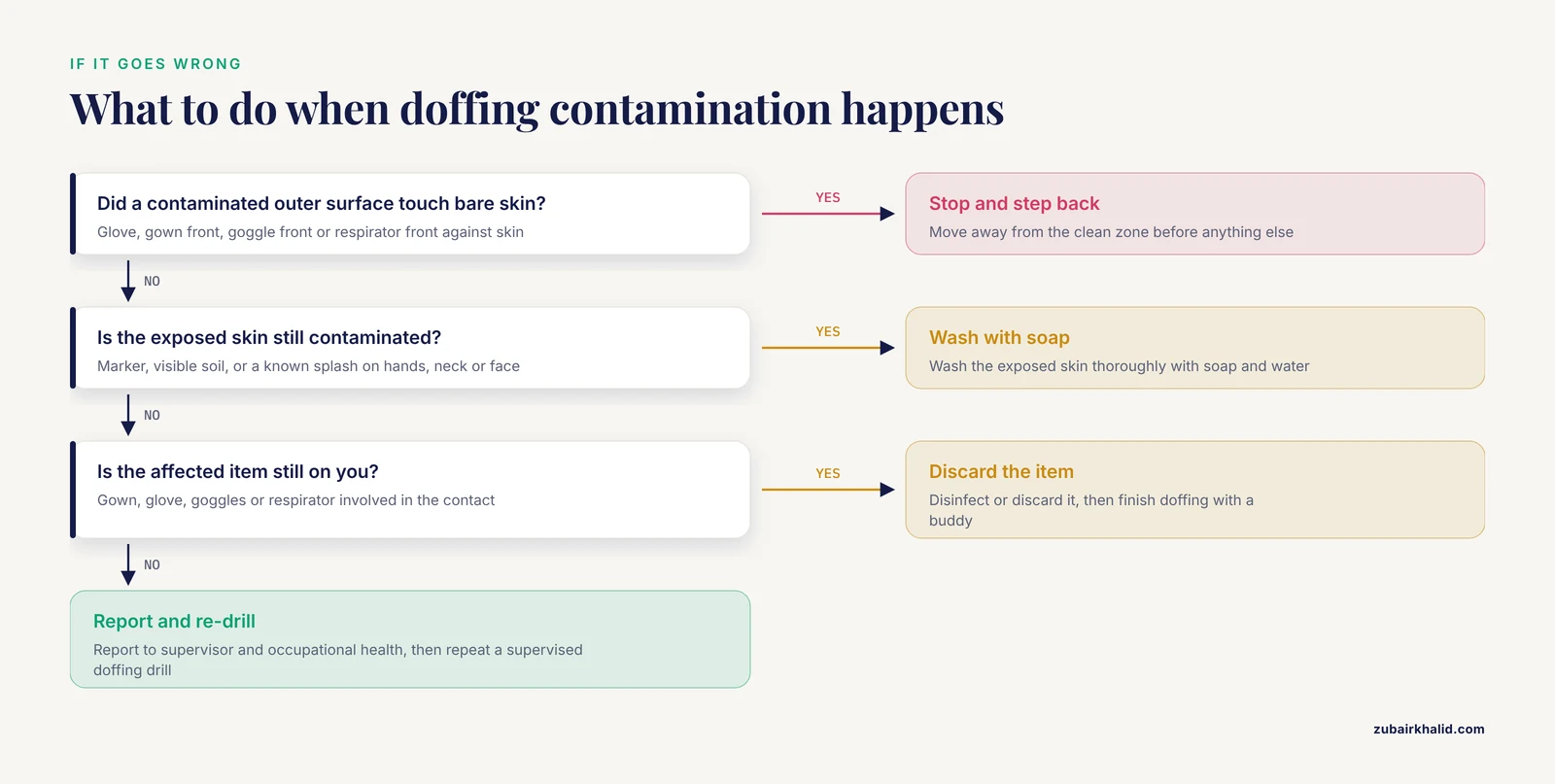
Stop immediately, move away from the clean zone, wash the exposed skin thoroughly with soap and water, disinfect or discard the affected item, complete doffing with a buddy observing, and report the exposure to your supervisor and occupational health per institutional policy. Afterward, repeat a supervised doffing drill to find the step that failed.
Sources
- Analysis of interception problems in donning and doffing personal protective equipment in a large cabin hospital during the COVID-19 pandemic: a real world study.
- Doffing procedures of personal protective equipment evaluated with lipid nanoparticles as viral surrogates: uncovering potential blind spots.
- A Systems View of Health Care Worker Personal Protective Equipment (PPE) Compliance in a Simulated Setting.
- Wear It Exactly as You See It: Promoting Proper PPE Donning through Visual Layout Optimization.
- Personal Protective Equipment Immediately Alters the Core-Skin Temperature Gradient in Recruit Firefighters.
- Difficulties faced by healthcare workers in PPE use during covid-19 pandemic: A mixed-method study from a tertiary hospital in India.
- Feasibility of a virtual safety officer in detecting PPE donning and doffing violations.
- Long-term retention following best practices instruction for proper donning and doffing of personal protective equipment.
- Assessing PPE donning and doffing competence in healthcare workers: A utility-based structured narrative review.
- An electronic audit tool to track the donning and doffing practices of personal protective equipment in the emergency department
- Optimizing Personal Protective Equipment Donning and Doffing Among Intensive Care Unit Nurses: A Quasi-Experimental Comparison of Mobile App-Based and Traditional Training Using Ultraviolet-Fluorescent Simulation.
- Self-reported competence and confidence following personal protective equipment workshops: A survey.
- Artificial intelligence-assisted personal protective equipment donning and doffing training for health professions students and healthcare workers: a scoping review.
- Artificial intelligence (AI) use for personal protective equipment training, remediation, and education in health care.
- Personal Protection Equipment Training as a Virtual Reality Game in Immersive Environments: Development Study and Pilot Randomized Controlled Trial.
- Effectiveness of donning and doffing personal protective equipment education using video debriefing among Korean undergraduate nursing students.
- Psychological and physical impact of wearing personal protective equipment among health care workers during the COVID-19 pandemic.
- Breathability and Safety Testing of Personal Protective Equipment: "Human-comfort" Factor Remains Undefined.