PPE for Handling Bloodborne Pathogens in Microbiology Labs
By Dr. Zubair Khalid, DVM, MS, PhD ·

Personal protective equipment (PPE) for bloodborne pathogens is the barrier clothing and equipment, including gloves, fluid-resistant coats and gowns, eye and face protection, and respirators, that keeps infectious blood and body fluids away from a laboratory worker's skin, mucous membranes, and airway. In a microbiology laboratory, PPE is the final layer of a biosafety program that begins with a documented biosafety risk assessment and ends with decontamination and safe disposal.
The stakes are concrete. Microbiology laboratories process human blood, serum, cerebrospinal fluid, and tissue specimens every working day, and any of these materials can carry hepatitis B virus (HBV), hepatitis C virus (HCV), or human immunodeficiency virus (HIV). An exposure takes seconds. A needlestick while recapping, a splash during serum aliquoting, or an aerosol released by an opened centrifuge can introduce virus directly into tissue or across a mucous membrane. In the United States, the Occupational Safety and Health Administration (OSHA) Bloodborne Pathogens Standard (29 CFR 1910.1030) makes appropriate PPE a legal requirement for work involving human blood. PPE also fails quietly when it is selected poorly, worn loosely, or removed carelessly, so this article covers PPE for handling bloodborne pathogens in microbiology labs from definition to daily practice: what the terms mean, how a risk assessment converts into specific PPE choices, how the equipment is tested before purchase, how it is donned and doffed, what real-world evidence says about comfort and supply, and which mistakes cause most failures.
What Does PPE for Bloodborne Pathogens in a Microbiology Lab Mean?
Bloodborne pathogens are pathogenic microorganisms carried in human blood and certain body fluids that can cause disease in exposed people. Three agents shape most laboratory policy: HBV, HCV, and HIV. Others include the syphilis spirochete (Treponema pallidum), malaria parasites, and Brucella species. The fluids of concern are blood itself plus cerebrospinal, synovial, pleural, pericardial, peritoneal, and amniotic fluid, along with semen and vaginal secretions. Urine, feces, sweat, tears, sputum, and vomit fall under the same handling rules when they contain visible blood.
PPE is equipment worn to place a physical barrier between a hazard and the worker. It sits at the bottom of the hierarchy of controls, the ranked set of protection strategies used in occupational safety. Elimination and substitution come first, engineering controls such as biosafety cabinets and puncture-resistant sharps containers come second, administrative and work-practice controls such as training and no-recapping rules come third, and PPE is the last line. The ranking matters because a biosafety cabinet (BSC), the ventilated and filtered enclosure used for open handling of infectious material, removes splash and aerosol hazards at the source, while a face shield only blocks material that reaches the worker.
Standard precautions, historically called universal precautions, mean treating all human blood and body fluids as if they are infectious regardless of any patient's known status. In diagnostic microbiology, this principle is built into Biosafety Level 2 (BSL-2) practice, the baseline for handling human clinical specimens in most laboratories.
Put together, the phrase means this: PPE for bloodborne pathogens in a microbiology lab is the task-specific set of barriers, matched to the riskiest step of the procedure, that a worker dons before touching human material and removes before leaving the room. The phrase appears in exams and job interviews because it tests whether a student can move from the general idea (wear protection) to the specific decision (a fluid-resistant gown, double gloves, goggles, and a fit-tested N95 respirator for a spill cleanup, versus simple nitrile gloves and a buttoned lab coat for reading an agar plate).
Why Bloodborne Exposure Is a Bench-Level Problem
Bloodborne agents travel by four routes in a laboratory:
- Percutaneous exposure, meaning entry through broken skin, most often a needlestick, a scalpel or glass cut, or an animal bite.
- Mucous membrane exposure, meaning a splash to the eye, nose, or mouth.
- Contact with non-intact skin, such as chapped hands, cuts, or dermatitis.
- Inhalation of aerosols, the fine suspensions generated by vortexing, centrifugation, snapping open tube caps, or spills.
The bench scenarios behind these routes are ordinary. Decapping a vacutainer tube can flick serum toward the face. Pouring off supernatant generates droplets. A needle hidden in a garbage bag or a pipette tip protruding from an overfilled sharps container can pierce a glove and skin during trash handling. A cracked blood culture bottle dropped in a sink can aerosolize its contents.
HBV deserves special respect. It is far more infectious per exposure than HIV, can remain infectious on surfaces for a week or more in dried blood, and is preventable by vaccination. This is why the OSHA standard requires employers to offer the hepatitis B vaccination series, at no cost, to employees with reasonably anticipated blood exposure within 10 working days of initial assignment, and why a signed declination does not end the employer's duty to protect the worker by other means.
PPE reduces the size and depth of an exposure but does not make the work safe by itself. A nitrile glove will not stop a hollow-bore needle. A lab coat will not stop a splash that reaches an unprotected eye. That is the core reason PPE is paired with engineering and work-practice controls rather than substituted for them.
The Biosafety Risk Assessment That Drives PPE Selection
A biosafety risk assessment is the structured process of identifying what an agent can do, what a procedure can generate, and which controls, including PPE, will keep the exposure risk acceptable. Under the CDC and NIH laboratory biosafety guidance, it is the first principle of working with infectious material, and every PPE list in a laboratory standard operating procedure (SOP) should trace back to one.
A practical risk assessment for bloodborne work follows five steps:
- Identify the agent hazard. Known or suspected agents, their routes of transmission, vaccine or treatment availability, and the concentration of infectious material in the specimen type.
- Identify the procedure hazard. Which steps create splashes, droplets, aerosols, or sharps injuries. Pouring, aliquoting, vortexing, blending, centrifuging, and decapping rank high. Microscopy of a fixed, stained smear ranks low.
- Estimate volume and frequency. A 10 mL serum aliquot and a loopful of culture carry different consequences if spilled, and a task performed fifty times a day accumulates risk.
- Assign the biosafety level. Biosafety Level 1 (BSL-1) covers well-characterized agents not known to consistently cause disease in healthy adults. BSL-2 covers moderate-risk agents, including all human blood and clinical specimens handled for diagnosis. BSL-3 covers agents that can cause serious disease through aerosol exposure, such as Mycobacterium tuberculosis. BSL-4 covers dangerous agents with no available vaccine or therapy. Most bloodborne work in diagnostic microbiology sits at BSL-2 with standard precautions.
- Select controls and write the PPE list. Engineering controls first, work practices second, and PPE matched to the highest-risk step of the procedure, not the average step.
Interpreting PPE Requirements in a Microbiology Lab SOP
The interpretation step is where students and new employees most often go wrong, so here is how to read a typical SOP line.
Consider this entry: "BSL-2 practices. PPE: buttoned lab coat, nitrile gloves, safety glasses with side shields." In bench terms, this means the procedure has no expected splash or aerosol. The coat protects clothing and forearms from contamination, gloves protect hands from contact with specimens and contaminated surfaces, and the safety glasses guard against an unexpected droplet. You should not downgrade this list, and if you believe the task needs more protection, the correct move is to request a risk assessment review rather than improvise silently.
Escalation triggers are the signals that the written minimum is no longer enough:
- The procedure will pour, decant, aliquot, vortex, blend, or centrifuge human material outside a closed system.
- The procedure is performed outside a BSC when the material would normally be handled inside one.
- The task is spill cleanup, where expected contact with blood is high.
- The specimen is known or suspected to contain a high-consequence agent, which moves the work to a different biosafety level and a different PPE plan.
For a spill of fresh human blood, a typical escalation is a fluid-resistant gown, double nitrile gloves, goggles plus a surgical mask or a face shield, and shoe covers if the floor is involved. For routine plate reading, none of that is required. The risk assessment owner, usually the laboratory biosafety officer, makes the call, not the individual bench worker.
Worked Example: One Blood Culture, Five PPE Decisions
A blood culture bottle flags positive on the automated incubator. The same specimen generates different PPE demands at different steps:
- Transport from the incubator to the BSC. Sealed rack, baseline PPE, no special escalation.
- Sampling inside the BSC. Gloves, buttoned coat, safety glasses. The needle and syringe create a sharps hazard at the moment of withdrawal, so the sharps container comes into position before the draw begins.
- Subculture plating. A loop and agar generate no splash, so baseline PPE continues.
- Direct smear for Gram stain. Once fixed and stained, the smear is low risk, and baseline PPE applies.
- Contingency. If the bottle cracks or the worker must centrifuge material outside a sealed rotor, the task stops and shifts to the spill or aerosol PPE plan.
The point of the exercise is that PPE is assigned per step, not per specimen. A single SOP can legitimately list two or three PPE configurations for one workflow.
PPE Types for Bloodborne Work, Item by Item
Each item in the bloodborne PPE kit has a defined job and a defined failure mode.
Gloves. Nitrile exam gloves are the default for bloodborne work because they resist bench chemicals and avoid the latex allergy problem. Gloves protect against contact with blood on specimens and surfaces, and they protect the specimen from the worker's skin flora. They do not stop needles or glass. Change gloves between specimens, after touching shared equipment such as keyboards, incubator handles, or telephones, and immediately when a glove tears or becomes visibly contaminated. Double gloving adds a layer for high-contact tasks and lets the worker strip off a soiled outer glove without bare-handing it.
Lab coats, gowns, and coveralls. A buttoned, long-sleeved lab coat is the baseline for BSL-2 work. A fluid-resistant gown or coverall is the upgrade for tasks with expected splash. The distinction is real: a standard cloth coat absorbs a splash and holds it against skin and street clothes underneath, while a fluid-resistant gown sheds it. Gowns are graded by fluid resistance under industry standards, from minimal protection up to full barrier, and the grade should match the task. Coats stay in the laboratory and are laundered by the institution, never taken home.
Eye protection. Safety glasses with side shields protect against impact and large droplets. Goggles form a seal around the eyes and are the minimum for splash-generating tasks. Neither protects the nose or mouth.
Face protection. A surgical mask plus goggles, or a full face shield worn over goggles, covers eyes, nose, and mouth during tasks that can spatter. A face shield alone does not seal to the face, so material can run behind it, which is why splash-prone work pairs a shield with goggles or a mask.
Masks versus respirators. A surgical mask is a loose-fitting barrier that blocks droplets and spatter. It is not a respirator. An N95 respirator is a tight-fitting device certified by the National Institute for Occupational Safety and Health (NIOSH) to filter at least 95 percent of airborne particles when worn with a proper seal. Respirator use requires medical clearance, fit testing, and a user seal check every time it is donned.
Footwear and body coverage. Closed-toed shoes that cover the whole foot are mandatory in any microbiology laboratory, and the laboratory itself is a restricted space rather than a public area, a point the teaching-lab literature treats as a core safety control along with mandatory PPE [1]. Shoes absorb spills and protect feet from broken glass and dropped sharps. Head covers, shoe covers, and fluid-resistant aprons enter the kit for spill response and large-volume work.
The table below gives the whole system explained in one view, including the terms each item is most often confused with.
| PPE item | What it protects | Typical bloodborne use | Most often confused with |
|---|---|---|---|
| Nitrile exam gloves | Hand contact with blood and contaminated surfaces | All specimen handling, changed between tasks | Sterile surgical gloves, which serve aseptic procedures rather than general bench work |
| Buttoned lab coat | Clothing and forearm skin from routine contamination | Baseline BSL-2 bench work | Fluid-resistant gown, the splash-rated upgrade |
| Fluid-resistant gown or coverall | Skin and clothing from splashes and large-volume contact | Aliquoting, spill cleanup, centrifuge loading | Standard cloth lab coat |
| Safety glasses with side shields | Eyes from impact and large droplets | Baseline bench work | Goggles, which seal against splash |
| Goggles | Eyes from splashes arriving from any angle | Splash-generating tasks | Safety glasses |
| Face shield | Whole face from spatter, worn over goggles or mask | High-splash tasks, spill response | Goggles alone |
| Surgical mask | Nose and mouth from droplets, and specimens from the wearer | Splash tasks paired with eye protection | N95 respirator |
| N95 respirator | Lungs from airborne particles when sealed | Aerosol-generating tasks, spill cleanup, high-consequence agents | Surgical mask |
| Closed-toed shoes | Feet from spills, sharps, and broken glass | Mandatory at all times in the lab | Sandals, mesh shoes, open heels |
How PPE Is Tested and Certified Before It Reaches the Bench
Purchasing decisions should rest on test data, and two families of tests matter for bloodborne PPE.
The first family is barrier testing. The synthetic blood penetration test (SBPT) exposes a material to synthetic blood at defined pressures to check whether liquid can pass through. Gowns, coveralls, and mask materials carry SBPT-based results, and during the COVID-19 pandemic, regulatory technical specifications leaned heavily on SBPT outcomes, including a fabric weight ceiling of 95 grams per square meter (GSM) for non-woven coverall fabric [2]. GSM is simply the mass of fabric per unit area, a proxy for thickness and density.
The second family is wearability testing. The same analysis found that specifications were silent on air permeability (AP), the rate at which air moves through fabric, and on water vapor transmission rate (WVTR or MVTR), the rate at which moisture vapor escapes. Kits that passed SBPT could therefore be nearly unwearable, with extremely poor breathability that drives workers to loosen, remove, or avoid the equipment [2]. The authors' proposed fix is to involve end users directly in comfort testing before certification and to run field trials in which workers don the PPE and perform real clinical tasks, capturing what they call the human-comfort factor [2].
Respirators follow a different certification path. The N95 designation describes the filter medium's minimum capture efficiency under NIOSH certification conditions. Fit testing then verifies that the specific model seals on the specific face, because a perfect filter with a leaking seal delivers unfiltered air. This is why respirator programs pair the certified device with fit testing and a seal check at every donning.
The practical takeaway for a laboratory manager is to demand both barrier ratings and breathability data when evaluating gowns and coveralls, and to involve the people who will wear the equipment in the selection trial.
Donning and Doffing: The Sequence That Prevents Self-Contamination
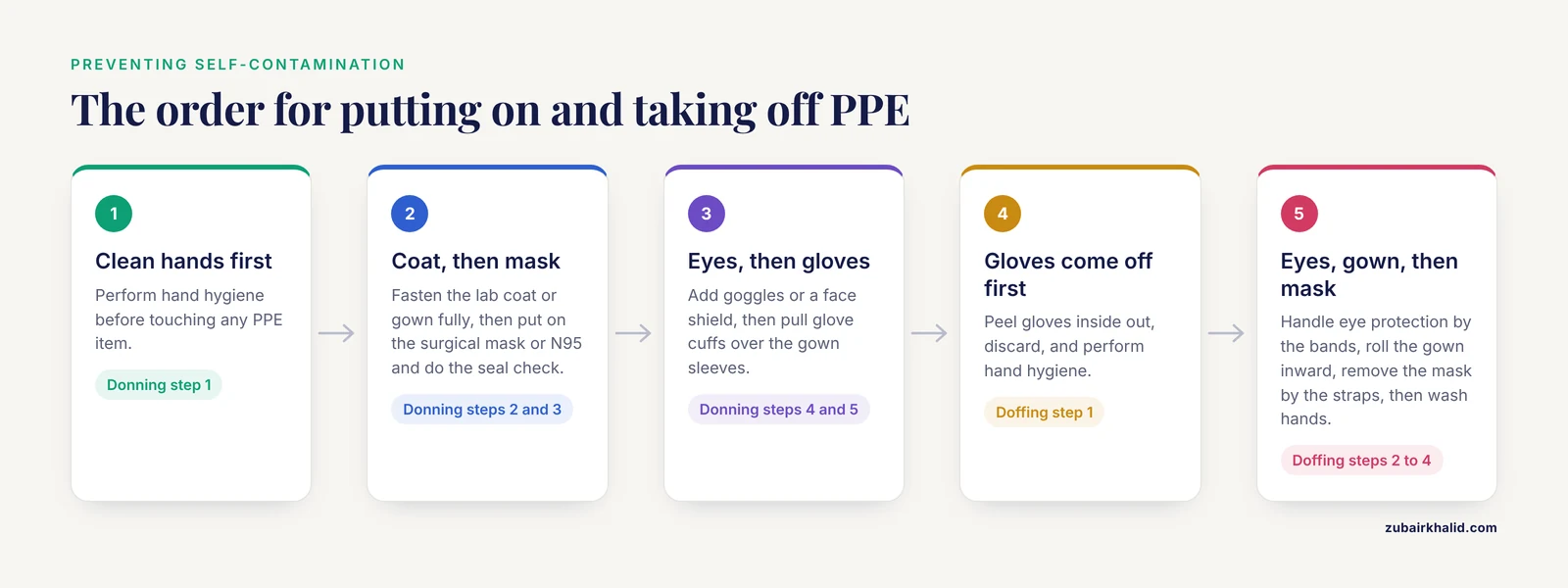
Most self-contamination happens during removal, when gloved or contaminated hands touch bare skin. A fixed sequence prevents it.
Donning, in order:
- Perform hand hygiene.
- Put on the lab coat or gown and fasten it fully.
- Put on the surgical mask or, for respirator users, the N95, and perform the user seal check.
- Put on goggles or a face shield.
- Put on gloves, pulling the cuffs over the gown sleeves.
Doffing, in order:
- Remove gloves by pinching the outside of one glove at the wrist, peeling it inside out, and holding it in the gloved hand, then sliding a bare finger under the second glove's cuff and peeling it inside out over the first. Discard and perform hand hygiene.
- Remove goggles or the face shield by handling the ear or head bands only.
- Remove the gown by unfastening it and pulling it away from the body, rolling the contaminated side inward, and discarding it.
- Remove the mask or respirator by the straps without touching the front, then perform hand hygiene again.
Wash with soap and water for at least 20 seconds, or use an alcohol-based hand rub with at least 60 percent alcohol when hands are not visibly soiled. After glove removal, soap and water is preferred whenever the gloves handled blood or the hands are visibly soiled. Many programs add hand hygiene between doffing steps, and every program requires it after all PPE is off.
Two habits protect the sequence. First, assume the outside of every item is contaminated, including the front of the mask and the gown sleeves. Second, never rush doffing. The last minute of a procedure is where exposures happen.
Daily Bench Rules That Keep PPE Working
PPE is a system, and small rule violations break it.
- Change gloves between specimens, between tasks, and after touching shared surfaces such as keyboards, door handles, incubator doors, and telephones.
- Never wash or disinfect disposable gloves for reuse. Disinfectants degrade the material and create false confidence.
- Remove all PPE before leaving the laboratory, before eating, drinking, applying cosmetics, or handling contact lenses, all of which are prohibited in the laboratory itself.
- Do not recap needles by hand. Recapping is permitted only with a mechanical device or a one-handed scoop technique when no alternative exists. Place sharps directly into a puncture-resistant container and never fill it past the marked fill line.
- Keep street clothes and personal items out of the splash zone. A coat hung on the back of a chair near the bench is contamination storage.
- Prepare dilute household bleach fresh for blood spills, commonly a 1:10 dilution made the day of use, because hypochlorite loses strength in storage.
- Report every exposure and near miss immediately, including splashes that did not break skin. Post-exposure management works best when it starts within hours, and the report also fixes the engineering or procedural gap that caused it.
Special Situations That Change the PPE Plan
Centrifugation. Use sealed rotors or safety cups for human specimens, load and unload them inside the BSC, and allow time for aerosols to settle before opening, following the laboratory's written wait period. If a tube breaks inside the rotor, close the lid, leave the area, and treat the cleanup as a spill with full escalated PPE.
Spill response. Contain the spill with absorbent material first, apply freshly prepared disinfectant, allow the contact time specified in the SOP, then clean from the edges inward. Cleanup PPE is heavier than routine PPE: fluid-resistant gown, double gloves, goggles plus mask or face shield, and shoe covers when the floor is involved. All cleanup waste goes into regulated medical waste streams.
Specimen transport. Blood and body fluids move between areas in sealed, leak-proof secondary containers. Sealed transport needs no special PPE, but a leaking container is handled with gloves and decontamination, never with bare hands.
Instrumentation. Automated decappers, aliquoters, and analyzers contain splash points behind guards. Never open an instrument mid-run, and treat the unloading of uncapped tubes as a splash-generating task.
Teaching laboratories. Student populations turn over every semester, and unexpected situations test the rules. The teaching-lab literature describes an incident in which a student brought a guide dog in training to a microbiology class, and the resolution turned on the principle that the laboratory is a restricted space requiring closed-toed shoes and PPE, where untrained animals cannot be admitted [1]. The lesson generalizes: exceptions to PPE and access rules are decided by the risk assessment process, not by goodwill in the moment.
Microbiology Biosafety Training: What a Competent Program Includes
Microbiology biosafety training converts written policy into practiced behavior, and it is a legal requirement, not a formality. Under the OSHA Bloodborne Pathogens Standard, employees with occupational blood exposure receive training at the time of initial assignment and at least annually thereafter, with additional sessions whenever procedures or equipment change.
A complete program for a bloodborne-pathogen laboratory includes:
- Agent and transmission training. What HBV, HCV, and HIV are, how they move between hosts, and why standard precautions assume infectivity.
- Risk assessment literacy. How to read the laboratory's biosafety manual, what each biosafety level requires, and how to interpret the PPE list attached to each SOP.
- PPE competency. Observed donning and doffing, glove change technique, and correct selection for each task category.
- Respirator program elements. Medical clearance, fit testing with periodic retesting, and seal checks for N95 users.
- Spill and exposure response drills. Physical practice with absorbents, disinfectants, and the exposure reporting pathway.
- Sharps safety. No-recapping rules, sharps container use, and safer device options.
- Decontamination and waste handling. Disinfectant preparation, contact times, and regulated medical waste segregation.
Competency should be demonstrated, not attested. An observed donning-and-doffing pass, a completed spill drill, and a signed fit-test record are the evidence a training file needs. In teaching laboratories, safety rules are part of the curriculum itself, and the expectation that students arrive in closed-toed shoes and don PPE before touching any culture reinforces that the lab is a controlled space [1].
Comfort, Compliance, and Supply: What Real-World Evidence Shows
PPE that is technically protective can still fail in the field if workers cannot tolerate wearing it, and the evidence on this point is direct.
An analysis of PPE specifications during the COVID-19 pandemic found that certified kits could pass synthetic blood penetration requirements while having extremely poor air permeability and moisture vapor transmission, and that acceptability improves substantially when end users participate in comfort testing and field trials before equipment is approved for purchase [2]. The lesson for a microbiology laboratory is to trial gowns, coveralls, and respirators with the actual staff who will wear them, across the actual tasks, before committing to a supplier.
Supply stress is the second failure mode. In a survey of 721 diagnostic laboratories, an estimated 41.4 percent of laboratory professionals reported reusing N95 respirators during the pandemic, a practice driven by shortage rather than by policy, and the same survey documented rapid capacity building, accreditation uptake, and participation in external quality assessment programs among those laboratories [3]. The operational lesson is to stock PPE with realistic turnover, maintain full size ranges for respirators and gloves, and treat reuse as a contingency plan with defined rules rather than a default.
Compliance is the third variable. Rules that match the task get followed. Rules that overprotect low-risk work get quietly ignored, and rules that underprotect high-risk work get people hurt. This is the practical argument for a living risk assessment process rather than a single static PPE poster.
Common Mistakes and Limitations
The failures below account for most real-world PPE breakdowns in bloodborne work.
- Wearing gloves outside the lab. Gloves that touch elevator buttons, office doors, or personal phones carry contamination out of the controlled space and bring contamination back in.
- Treating a cloth lab coat as splash protection. A standard coat absorbs a splash and holds it against skin and street clothes. Splash-rated gowns exist for a reason.
- Confusing a surgical mask with a respirator. A mask blocks droplets. It does not filter inhaled air and it does not seal.
- Skipping the seal check or fit test. An N95 worn with facial hair at the seal line, or on an untested fit, delivers unfiltered air around the filter.
- Assuming certification equals comfort. A barrier rating says nothing about breathability, and unwearable PPE gets modified or abandoned by its users [2].
- Recapping needles "just this once." Hand recapping is the classic needlestick scenario and is permitted only with a mechanical device or a one-handed technique.
- Overfilling sharps containers. Sharps protruding from a container injure the next person who reaches in.
- Substituting PPE for engineering controls. Working on an open bench when the SOP requires a BSC is a risk assessment violation, not a style choice.
- Not reporting minor exposures. Small splashes and superficial scratches still warrant immediate washing, reporting, and medical evaluation, and the report is what triggers correction of the underlying hazard.
Two limitations frame all of the above. Risk assessments are laboratory- and task-specific, so the PPE list in any given SOP reflects that laboratory's agents, volumes, and equipment, and the local biosafety officer is the authority for interpreting it. Any actual or suspected exposure is a medical event that belongs with occupational or employee health services immediately, not with a written guide.
Quick Review
- Bloodborne pathogens of primary laboratory concern are HBV, HCV, and HIV, and standard precautions treat all human blood and body fluids as infectious.
- PPE is the last layer of the hierarchy of controls, after elimination, engineering controls, and work practices.
- A biosafety risk assessment matches the PPE list to the riskiest step of the procedure, and escalation triggers include pouring, aliquoting, vortexing, centrifuging, and spill cleanup.
- Nitrile gloves protect against contact, not against needles. Closed-toed shoes, a buttoned long-sleeved coat, and eye protection form the BSL-2 baseline.
- A surgical mask blocks droplets. An N95 respirator filters at least 95 percent of airborne particles and requires fit testing and a seal check.
- Barrier certification, such as the synthetic blood penetration test, does not guarantee breathability, so comfort testing and end-user trials belong in purchasing decisions.
- Doffing order is gloves, then eye protection, then gown, then mask or respirator, with hand hygiene after glove removal and again after all PPE is off, because removal is where self-contamination happens.
Frequently Asked Questions
What does PPE for bloodborne pathogens in a microbiology lab mean?
It means the task-specific barrier equipment, including gloves, fluid-resistant coats or gowns, eye and face protection, and respirators, that prevents infectious blood and body fluids from contacting a worker's skin, mucous membranes, or airway. It is the final layer of a biosafety program built on a risk assessment, standard precautions, and engineering controls.
What PPE is required for routine handling of human blood specimens?
The BSL-2 baseline is a buttoned long-sleeved lab coat, nitrile exam gloves, and closed-toed shoes, with safety glasses for any droplet risk. Tasks that can splash, such as aliquoting or decanting, add a fluid-resistant gown, goggles, and a mask or face shield.
Is a surgical mask the same as an N95 respirator?
No. A surgical mask is a loose barrier that blocks droplets and spatter, while an N95 is a sealed respirator certified to filter at least 95 percent of airborne particles. Only the N95 requires fit testing and a user seal check.
How can I tell whether a gown or coverall will actually hold up against blood?
Look for a synthetic blood penetration rating for the barrier, and ask for air permeability and moisture vapor transmission data for wearability. Then have the staff who will wear it trial it during real tasks, because certified equipment with poor breathability gets abandoned in practice.
When can gloves or respirators be reused?
Disposable gloves are single-use and are changed between specimens, tasks, or any tear. N95 respirators may be reused only under a written program that defines the conditions, and shortage-driven reuse should be a contingency plan with rules, not a habit.
What is the first thing to do after a possible blood exposure?
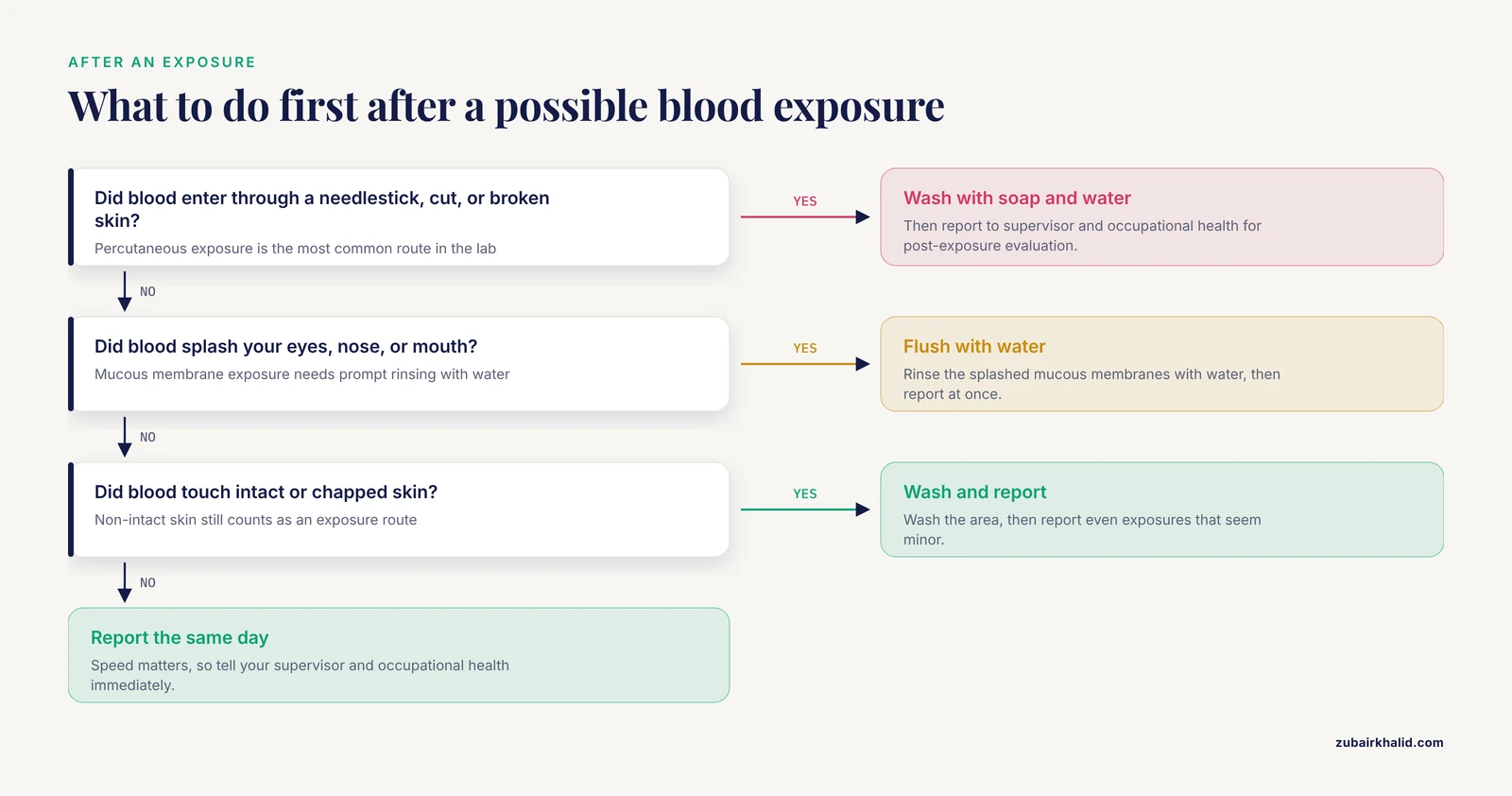
Wash needlestick and cut sites with soap and water, flush splashed eyes or mucous membranes with water, and report immediately to the supervisor and occupational health for post-exposure evaluation. Speed matters, so report even exposures that seem minor.
Sources
- Who Let the Dogs Out? A Plea for Official Guidelines on Service Animals in the Teaching Laboratory.
- Breathability and Safety Testing of Personal Protective Equipment: "Human-comfort" Factor Remains Undefined.
- Indian microbiology EQAS registered laboratory's capacity building and infection control practices during the COVID-19 pandemic in India: Lessons learnt and gaps identified.