Best Online Microbiology Courses for Self-Study: A Comparative Review
By Dr. Zubair Khalid, DVM, MS, PhD ·
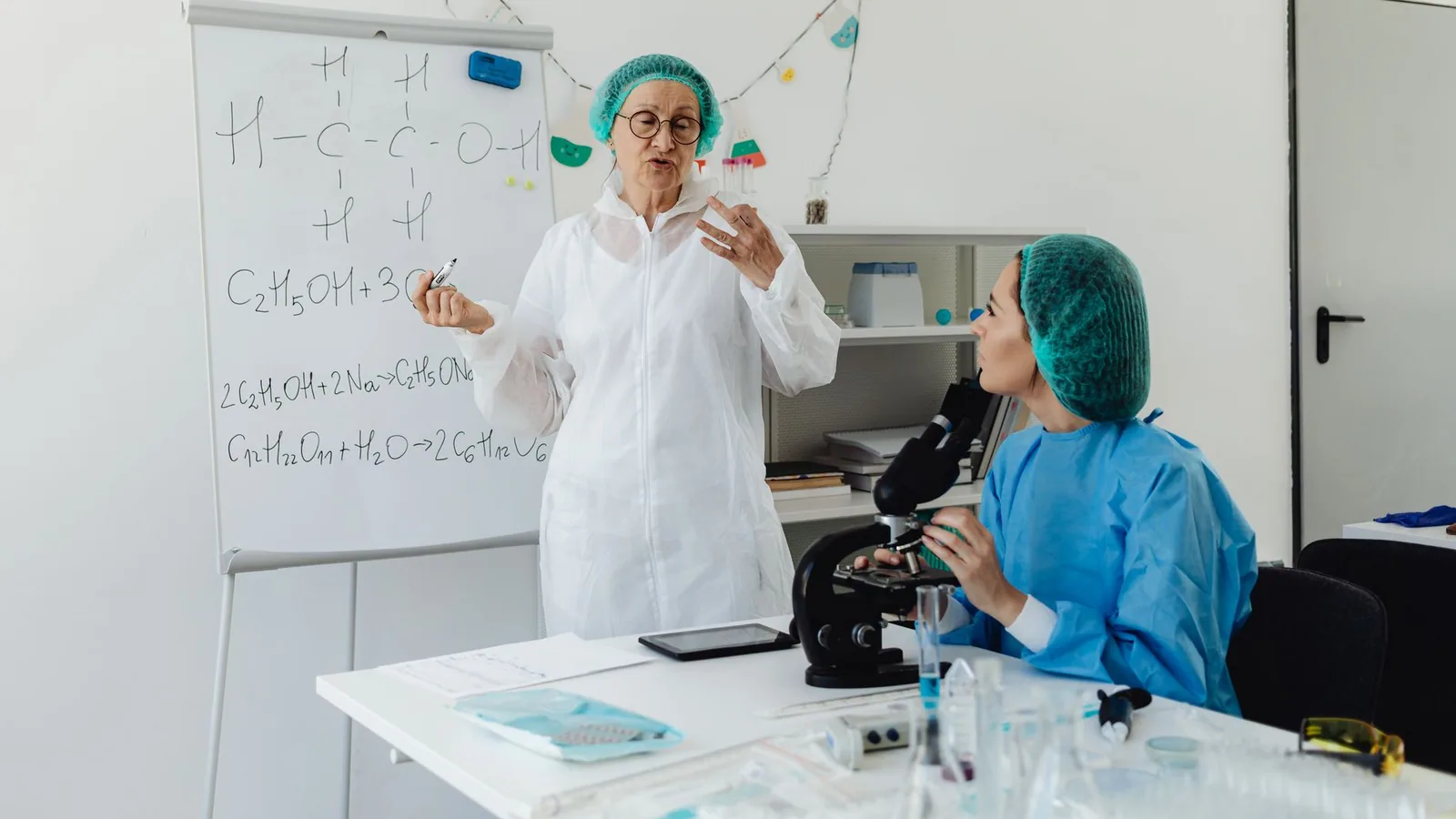
The difference between a real online microbiology course and a stack of lecture videos is feedback. A course tells you what you got wrong, why it matters, and what to study next. A rule of thumb: pick the option that makes you retrieve information from memory and interpret images every week, not the one with the longest video library.
This review compares the main online microbiology course options available to self-directed learners. It covers for-credit university courses, hybrid classes with a lab component, self-paced modules, accredited professional training, virtual laboratories, gamified review sessions, spaced repetition systems, and AI tutors. Each format has a distinct job. None of them replaces the others, and the best online microbiology course for you depends on whether you need a credential, a skill, or a foundation for another program.
What Makes an Online Microbiology Course Worth Your Time
Microbiology is a visual and procedural discipline. You learn to recognize a Gram stain reaction, a colony morphology, a hemolysis pattern, and a biochemical test result. You also learn a vocabulary of organisms, virulence factors, and antimicrobial mechanisms. A course that only delivers text and video leaves half the subject untouched.
Several terms matter when you compare formats:
- Asynchronous means you work on your own schedule, within deadlines or without them. Synchronous means live scheduled sessions.
- Formative assessment is low-stakes practice with feedback, such as weekly quizzes. Summative assessment is the final graded exam or project.
- Retrieval practice is recalling information from memory rather than rereading it. It is the single most reliable study technique in content-heavy sciences.
- Spaced repetition means reviewing material at increasing intervals, ideally with flashcards.
- A virtual laboratory is a screen-based simulation of bench work. It can teach workflow and interpretation but cannot teach hand skills.
- A learning management system (LMS) is the software platform that hosts modules, quizzes, and grades, such as Canvas or Moodle.
The evidence on course design points in one direction. Active retrieval and repeated revisiting beat passive exposure. In a study of 320 medical students taking Medical Bacteriology and Mycology, online quiz scores correlated strongly with summative exam scores (p = 0.013). Students who did well on the final exam shared three behaviors: they tried to pass the online quizzes in their early attempts (p < 0.001), they kept revisiting quizzes after passing (p = 0.011), and they pushed to improve their quiz scores (p = 0.002) [1]. The lesson for self-study is direct. A course that lets you take a quiz once and move on is leaving learning on the table.
A second design principle is that online delivery can match on-site delivery when the content and assessment are equivalent. During the summer of 2020, medical students at Saarland University in Germany took a web-based medical microbiology course built from clinical scenarios, theoretical content, and instructional videos on microbiological techniques. Their written exam performance (mean 7.6, SD 1.7, n = 100) was comparable to the prior year's on-site cohort (mean 7.3, SD 1.8, n = 131, P = .20). Oral exam performance was also comparable (mean 33.6 vs 33.4, P = .78), and failure rates did not differ significantly (2.4% vs 3.3%) [2]. The course worked because it was a course, with structured content, assessment, and instructors, not a passive archive.
A third principle is that not every online activity is equally effective for every learner. A general microbiology study compared three delivery methods (PowerPoint, eLearning, and hands-on activities) across three course sections completing six activities on difficult topics, and measured performance, perceived knowledge, and confidence [3]. The design matters because it shows that the question is not "online versus in person" in the abstract. The question is which specific activity a format supports well.
Side-by-Side Comparison of Online Microbiology Course Options
| Format | Best for | Typical structure | Image or lab work | Assessment and feedback | Credential | Main limitation |
|---|---|---|---|---|---|---|
| Fully online for-credit university course | Prerequisite seekers, degree students | 12 to 16 weeks, lectures, readings, weekly quizzes, proctored final | Video demonstrations, labeled images, sometimes a virtual lab | Graded quizzes, exams, instructor email | Transcript credit | High cost, fixed schedule, limited bench skill |
| Hybrid course with on-campus lab | Pre-health students who need lab credit | Online lectures plus scheduled bench sessions | Real Gram stains, cultures, aseptic technique | Practical exams, lab reports | Transcript credit with lab | Requires attendance, not truly self-study |
| Self-paced MOOC or continuing education | Working adults, curious learners | Modular video and reading, self-paced quizzes | Usually images and animations | Auto-graded quizzes, certificate quiz | Certificate of completion | Variable rigor, little feedback |
| Accredited professional society course | Clinicians, pharmacists, lab professionals | Cohort-based, facilitated, live session | Case-based, applied to practice | Post-course test, follow-up surveys | Accredited certificate | Eligibility rules, narrow scope |
| Virtual laboratory or AI-enhanced lab platform | Learners without bench access | Simulated experiments with feedback | Simulated staining, culture, identification | Automated scoring, adaptive hints | Platform certificate | No transfer of hand skill |
| Gamified module or escape game | Revision, engagement, team learning | Short session, stations or puzzles | Spot diagnosis, image recognition | Immediate in-session feedback | None | Not a stand-alone curriculum |
| Spaced repetition flashcard system | Long-term retention of facts and images | Daily short reviews | Image cards, case cards | Self-graded recall | None | No explanation unless you add it |
| AI conversational tutor | Just-in-time explanation, self-quizzing | Open-ended dialogue | Text and image prompts | Immediate explanatory feedback | None | Accuracy and bias risk |
University For-Credit Online Microbiology Courses
A for-credit online microbiology course is the most complete option. It has a syllabus, a sequence, deadlines, graded assessments, and an instructor of record. The Saarland University example shows what a well-built version looks like: clinical scenarios that force application, theoretical background, and technique videos that substitute for some of the visual experience of a lab [2].
The pros are structure and accountability. You cannot skip weeks without consequence, and your grade depends on summative performance rather than good intentions. The cons are cost, pace, and inflexibility. These courses are built for matriculated students, and enrolling as a non-degree learner can be expensive and slow.
For self-study, a for-credit course makes sense in three situations. You need the credit for a professional program. You have failed to finish self-paced courses before and need external deadlines. You want instructor feedback on written work. If none of those apply, a cheaper modular option plus a disciplined flashcard routine will usually get you to the same knowledge level.
One caution applies to online exams generally. A single-center study of medical basic science courses tracked grade patterns across pre-pandemic, during-pandemic, and post-pandemic phases. Mean GPA in basic science courses fell from 16.97 ± 1.38 before the pandemic to 16.24 ± 1.49 after it (P < 0.001) [4]. That finding does not prove online teaching lowered learning. It does show that grading patterns shift when delivery and assessment change, which is a reason to prefer courses with transparent, proctored, or competency-based assessment over ones with loose online quizzes.
Hybrid Courses With a Real Lab Component
The hybrid format pairs online lectures with scheduled bench sessions. It is the only format that teaches hands-on microbiology properly. Aseptic technique, streak plating, Gram staining, and reading a catalase or oxidase test are motor and judgment skills. You cannot acquire them from a screen.
The comparison of virtual and hands-on activities in a large general microbiology course is a useful reality check. Students in three sections completed six activities on historically difficult topics, with each section receiving a different delivery method: PowerPoint, eLearning, or hands-on [3]. The study was designed to test whether the virtual format is universally beneficial. The broader point is that the delivery method should match the learning objective. A concept like bacterial growth curves can be taught well on a screen. A skill like flame-sterilizing a loop cannot.
For a self-directed learner without campus access, the practical substitute is a documented home microbiology course using safe organisms and a biosafety-minded workflow, paired with a virtual lab for interpretation. That combination is not equivalent to a supervised lab. It is better than no lab at all.
Self-Paced MOOCs and Continuing Education Modules
Self-paced modules are the most accessible entry point for anyone who wants to learn microbiology without enrolling in a program. They typically consist of short video lectures, readings, and auto-graded quizzes. The best ones are built on multimedia learning principles: focused visuals, short segments, and interactive knowledge checks.
A study of supplemental multimedia modules in food microbiology and food biotechnology courses illustrates what good module design looks like. The modules covered gene expression analysis, protein engineering, and fermentation genomics. They were built around cognitive load theory, with focused visual media and interactive checks. Among 85 students in an introductory food microbiology course, 73% to 76% voluntarily accessed the modules, average engagement was 5 to 8 minutes per module, and exam performance on module-related items improved by 6% to 10% compared with overall exam averages [5]. Voluntary access and short engagement times are the signature of modules that respect the learner's time.
The pros of self-paced modules are flexibility and low friction. You can start today and sample the subject before committing. The cons are weak accountability and shallow feedback. Auto-graded multiple-choice questions tell you whether you picked the right answer, not why your reasoning failed. Use these modules to build first-pass familiarity, then move to a retrieval-heavy system.
A related option is a short asynchronous study-skills course. Iowa State University offered an optional online summer course for incoming veterinary students covering spacing, retrieval practice, metacognition, note-taking, and stress management. About 15% of incoming students completed it, satisfaction was high, and 90% of completers would recommend it. About half of participants reported applying new cognitive strategies in their first semester [6]. The takeaway for microbiology self-study is that a few hours spent learning how to study pays off across every subsequent course.
Accredited Professional Courses
Professional society courses sit at the applied end of the spectrum. They assume prior knowledge and focus on practice change. The strongest published example is a country-specific, accredited, facilitated online antimicrobial stewardship course developed by the British Society for Antimicrobial Chemotherapy with World Health Organization Egypt.
The course combined online modules with an interactive live session. Across 15 cohorts, 1,776 learners took part, and 74.7% passed the post-course test. Follow-up surveys at 3 and 6 months tracked whether knowledge turned into action. At 3 months, the most frequently reported stewardship interventions were new guidelines, education, and changes to microbiology testing. At 6 months, guidelines remained the most common intervention, and staff collaboration was a reported facilitator [7].
That design is a model for what continuing education should do. It measures translation, not just satisfaction. If you are a pharmacist, nurse, physician, or laboratory professional who already knows basic microbiology, this type of course is a better use of time than another introductory survey. The pros are applied content, accreditation, and a cohort to learn with. The cons are eligibility requirements, a narrow scope, and a schedule.
Virtual Laboratories and AI-Enhanced Lab Platforms
A virtual laboratory simulates bench procedures on screen. Good platforms let you choose a specimen, select a medium, interpret growth, and receive feedback on errors. AI-enhanced versions add intelligent tutoring, personalized pathways, and real-time hints.
A 14-week study of 128 undergraduate food science and food quality students compared an AI-enhanced virtual laboratory with traditional laboratory instruction. The virtual group achieved higher knowledge acquisition (86.3% vs 78.6%, P < 0.001, d = 0.80) and higher skill evaluation scores (84.6% vs 72.8%) [8]. Those results are encouraging for access and cost. They do not mean a virtual lab replaces a physical one. Skill evaluation in that study measured platform-based tasks, not hand technique at a bench.
The honest framing is that virtual labs solve a logistics problem, not a competence problem. They are excellent for learning experimental logic, troubleshooting, and data interpretation. They are poor for teaching sterile technique and specimen handling.
AI adds a second layer of risk. A review of AI in microbiology notes that most models, especially deep learning tools, lack transparency, which makes results hard to interpret. Overfitting, limited generalizability, and ethical concerns such as data privacy are also unresolved [9]. When a virtual lab platform makes a recommendation, treat it as a teaching aid, not a validated diagnostic.
Gamified Modules and Interactive Review Sessions
Gamification means adding game mechanics (points, cards, puzzles, competition) to a learning task. It works best for revision, not first exposure.
Bingo Lab is a clear example. Educators built a mock revision exam from 25 "unknown" microbiology spots, the kind used in spot diagnosis assessments, and mapped them randomly onto a 5x5 Bingo card. Students earned a Bingo by completing five stations in a line. The intervention was piloted in Dentistry and Nursing programs, with engagement measured early, midway, and late in the session, plus anonymous feedback [10]. The structure converts a stressful practical exam into repeated retrieval with low stakes.
BioDecryptors took a different approach. It is an educational escape game designed to introduce bioinformatics principles and tools in clinical microbiology. In a prospective before-and-after study, 55 participants (22 second-year medical students and 33 postgraduate MDs or PharmDs) played in teams of 3 to 4 using versions adapted to their training level. Knowledge was assessed with two distinct 10-item tests before and immediately after the activity [11].
The pros of gamified modules are engagement, immediate feedback, and social learning. The cons are that they are short, they assume baseline knowledge, and they often lack validated outcome data beyond immediate post-session tests. Use them as a weekly review layer on top of a primary course.
Spaced Repetition and Flashcard Systems
Spaced repetition is the most efficient way to hold onto microbiology facts and images over months. The principle is simple. Review a card just before you would forget it, then extend the interval each time you recall it correctly.
A study of instructor-made spaced repetition flashcards in a bachelor's-level introductory microbiology course found no significant change in overall exam performance (p = 0.2657). Student perception changed substantially. Confidence in their ability to succeed improved (p = 0.0066), belief that the course made them think like a microbiologist improved (p = 0.0011), and students rated the approach as effective (p = 0.0076) [12].
That result is often misread. It does not mean flashcards are useless. It means that in that course, the exam did not reward the specific facts the cards reinforced, or students used the cards instead of other effective study. For self-study, flashcards are strongest when you write them yourself from your course's learning objectives and include images.
A practical card set for microbiology includes:
- Organism-to-disease cards. One side names the organism, the other gives the syndrome, key virulence factor, and treatment category.
- Image cards. Gram stain, colony morphology, and biochemical reactions.
- Mechanism cards. Antimicrobial class to target and resistance mechanism.
- Calculation cards. Dilution, colony-forming unit, and magnification problems.
Keep cards short. One fact per card. Add a case-based card every week so you practice application, not just recall.
AI Tutors and Conversational Study Aids
A general-purpose chatbot can explain a concept on demand, generate practice questions, and quiz you Socratically. The risk is that it can also invent a fact with confidence.
A crossover pilot study at the University of South Carolina tested a curriculum-aligned custom GPT against conventional resources in second-year medical students preparing for pathology small-group discussions. Students using the aligned GPT scored higher on self-directed learning documentation (10.3 vs 9.4 out of 12, mean difference 0.9, 95% CI 0.5 to 1.3, P < .001, Cohen d = 0.71) and on small-group discussion performance (14.9 vs 13.7 out of 16, mean difference 1.2, 95% CI 0.7 to 1.7, P < .001, Cohen d = 0.78). Delayed retention on end-of-block exam items did not differ [13].
Two lessons follow. First, the benefit came from curriculum alignment and Socratic scaffolding, not from raw model power. Second, immediate performance gains did not translate into better delayed retention. Use an AI tutor for explanation and quizzing, then verify the content against a textbook and test yourself without the model.
The known weaknesses of AI in microbiology reinforce that caution. Opaque reasoning, overfitting, poor generalizability, and privacy concerns are documented limitations [9]. A chatbot is a study partner with no accountability. Treat it as one.
How to Choose an Online Microbiology Course for Self-Study
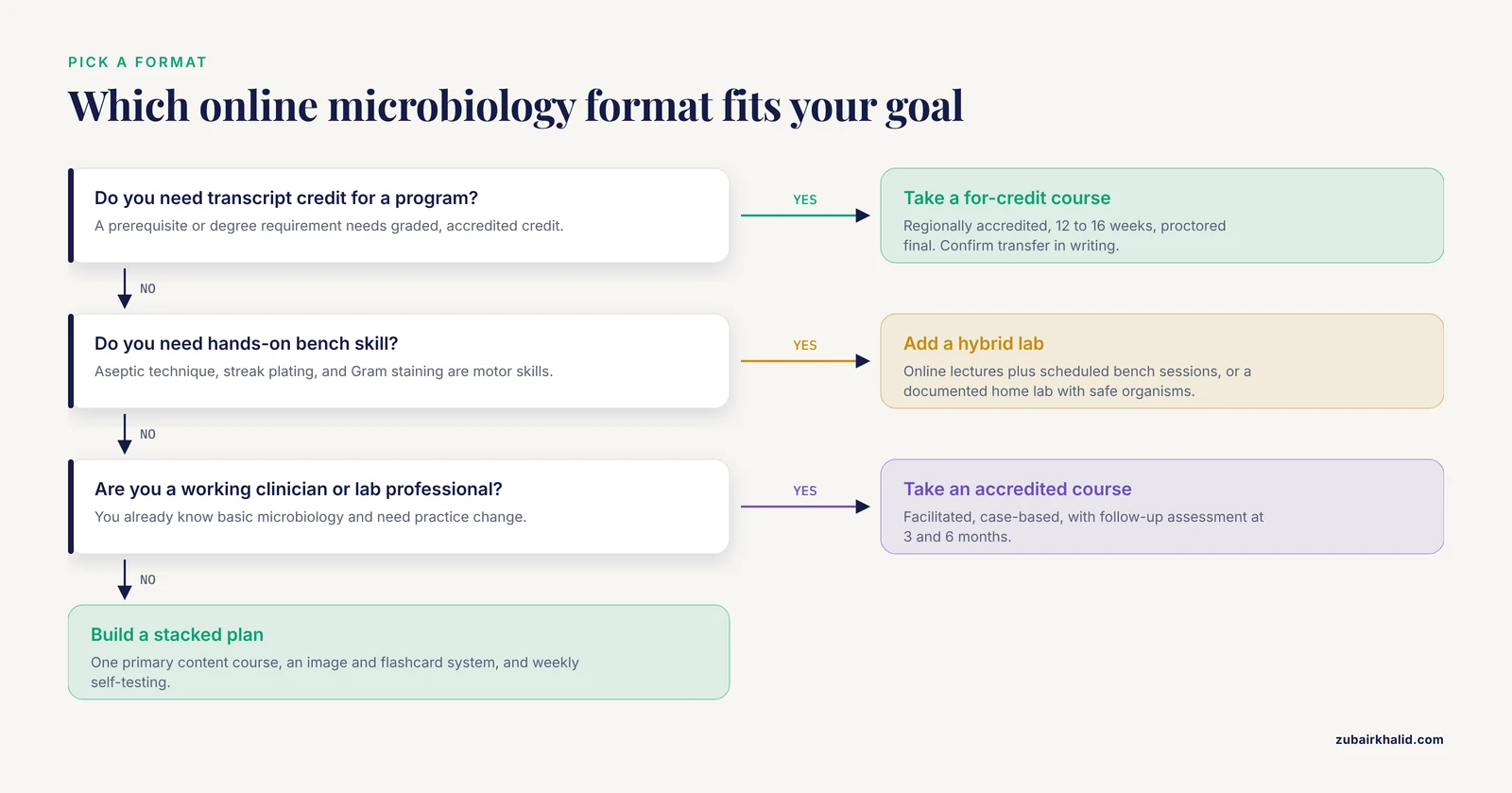
Compare options on the criteria that actually change outcomes.
Assessment design
Prefer courses with frequent formative quizzes and at least one summative assessment that requires interpretation. The quiz correlation study showed that quiz behavior predicts exam performance, and that early attempts, revisiting, and score improvement are the behaviors to emulate [1]. A course that lets you see the correct answer without an explanation is a weaker choice than one that explains each distractor option.
Feedback loop
Good feedback tells you the category of your error. Did you misidentify the organism, misread the stain, or misunderstand the mechanism? Auto-graded quizzes can do this if the question writer built in explanations. Live facilitated courses do it better. A hybrid introductory module in an anti-infectives therapeutics course improved pre-to-post test scores from 71% to 83% (p < 0.0001), with improvement on 8 of 10 knowledge questions and a rise in student confidence. Of 129 students, 98% agreed the content was essential for course success [14]. Structured review with feedback produced measurable gains.
Visual and procedural content
Microbiology cannot be learned from text alone. Check whether the course includes labeled images of stains, colonies, and biochemical panels. Check whether it shows technique, even on video. If you plan to work in a lab, plan a hands-on component separately.
Time and pacing
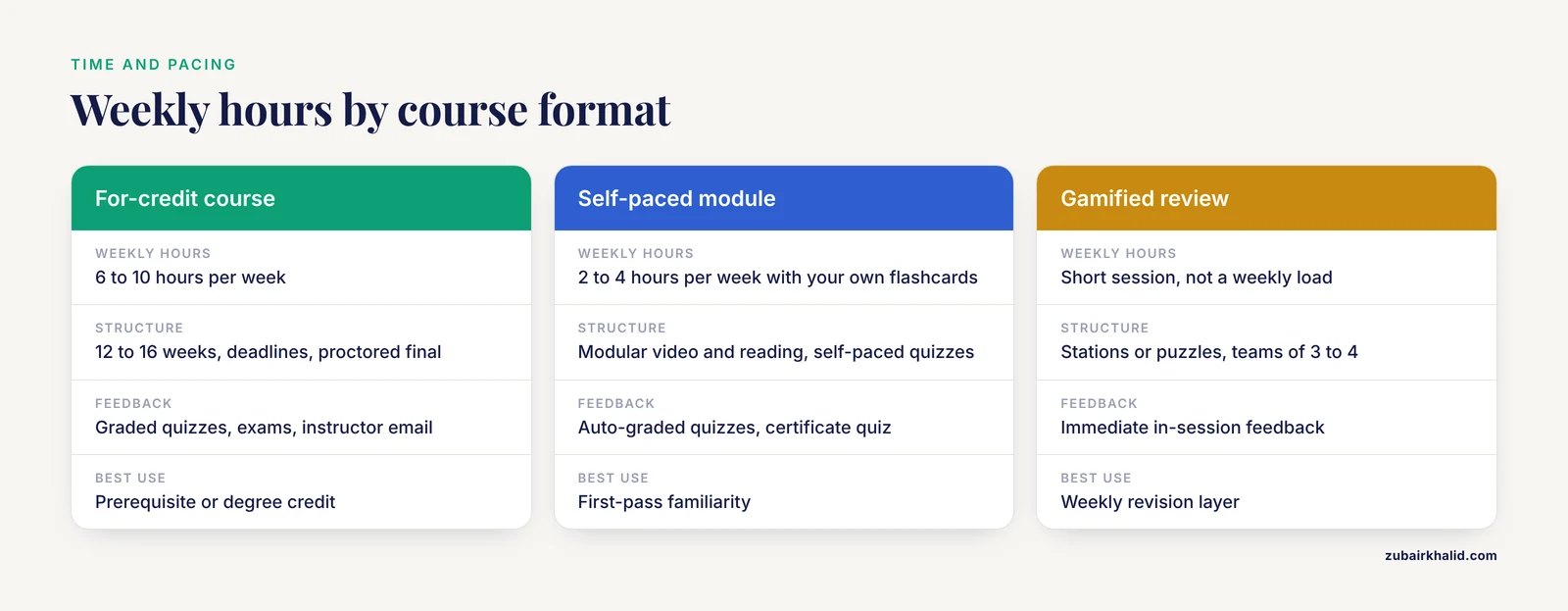
Estimate the weekly load honestly. A 12-to-16-week for-credit course typically requires 6 to 10 hours per week including reading and review. A self-paced module might take 2 to 4 hours per week if you add your own flashcards. The multimedia module study found average engagement of 5 to 8 minutes per module, which works for supplements but not for a primary curriculum [5].
Credential and portability
If you need the course for a prerequisite, check the accreditation and whether the credit transfers before you pay. If you need continuing education, check whether the accrediting body accepts the certificate. A certificate of completion from a self-paced platform is not the same as transcript credit.
Blended design
Some of the strongest microbiology teaching pairs online modules with in-person or live application. A blended model that used online course resources to reorganize microbiology content around real-world cases and guided problem chains improved students' conceptual literacy and innovation ability [15]. The design principle is that the online portion carries content delivery and the live portion carries application.
Cost
Costs vary too widely to compare as a single number, and the right question is cost per learning outcome. A free video series with no assessment often costs more in wasted time than a paid course with graded feedback. Decide what you need (credential, skill, or foundation), then pay only for the format that delivers it.
Worked Scenarios
Scenario 1: A pre-nursing student who needs a microbiology prerequisite
The requirement is a transcripted course with a lab. Choose a regionally accredited online course that includes a hands-on lab kit or a scheduled lab residency. Verify transferability with the target program in writing before enrolling. Supplement with daily flashcards on organisms and lab tests. Do not substitute a MOOC certificate for the prerequisite.
Scenario 2: A laboratory technician refreshing clinical bacteriology
You already have bench skills. Choose a modular course with clinical case questions, image-heavy quizzes, and a section on antimicrobial resistance mechanisms. Add a spaced repetition deck for organism-to-disease pairs. If you handle stewardship questions, follow it with an accredited professional course like the BSAC/WHO model, which measured practice change at 3 and 6 months [7].
Scenario 3: A pharmacist or physician who needs antimicrobial stewardship training
Skip the introductory survey. Choose an accredited, facilitated course with case-based content and a live session. Look for follow-up assessment, not just a post-course test. The Egyptian program's design, with 1,776 learners across 15 cohorts and 74.7% passing the post-course test, shows what a scaled professional course looks like [7].
Scenario 4: A curious adult learner with no deadline
Start with a self-paced module to confirm interest. Add a free image-based flashcard deck and a weekly case question. If you want structure after eight weeks, enroll in a for-credit or facilitated course. The risk in this scenario is collecting courses without finishing them, so commit to one primary source at a time.
Scenario 5: A pre-veterinary or pre-medical student who wants an edge
Pair a rigorous online course with a spaced repetition system and a study-skills module. The Iowa State study found that about half of participants applied new cognitive strategies in their first semester after a short asynchronous course [6]. Use the course for content and the study-skills training for how you learn it. Add image interpretation practice weekly.
Common Mix-ups
- A video library is not a course. Without assessment and feedback, it is a lecture archive.
- A virtual lab is not a bench lab. It teaches logic and interpretation, not sterile technique.
- A quiz score is not mastery. Passing once is the weakest version of quiz use. Revisiting and improving is what correlates with exam performance [1].
- AI fluency is not knowledge. A chatbot can produce a plausible answer and a wrong one with the same tone [9].
- Accreditation is not teaching quality. It tells you the course meets an external standard, not that the explanations are clear.
- Gamification is not frivolous, but it is not a curriculum. Bingo-style review works for retrieval, not for first exposure [10].
- Completion is not competence. A certificate proves attendance, not that you can identify an organism from a stain.
Common Mistakes and Limitations
Skipping the formative quizzes. The students who did best on the summative exam took quizzes early, revisited them, and pushed their scores up [1]. Treat quizzes as study tools, not gatekeeping.
Cramming instead of spacing. Microbiology has a large factual load. Spacing beats massed review for retention, even when exam scores look similar in the short term [12].
Watching videos passively. Pause and answer a question before continuing. If the course does not provide questions, write them.
Never practicing images. A text-only study plan fails the visual parts of microbiology. Build a deck with Gram stains, colony morphologies, and biochemical panels.
Assuming an online course covers lab competency. It usually does not. If you need bench skills, plan a hands-on component.
Trusting an AI tutor without verification. Check every factual claim against a textbook or a peer-reviewed source. The known problems are opacity, overfitting, and limited generalizability [9].
Ignoring updates in taxonomy and resistance. Organism names and resistance mechanisms change. Choose courses with a recent revision date.
Confusing engagement with learning. Gamified sessions and short modules can raise engagement and confidence without raising exam scores. That is acceptable if you know which outcome you are buying.
Expecting a single course to do everything. The best online microbiology courses for self-study are usually a stack: one primary content course, one image and flashcard system, one applied or lab component, and periodic self-testing.
Individual circumstances vary. A learner with a specific professional requirement, a disability, or a tight timeline should confirm course suitability with an advisor or instructor before enrolling.
Frequently Asked Questions
Can you learn microbiology entirely online?
Yes, for the knowledge portion. You can learn taxonomy, pathogenesis, immunology, antimicrobial mechanisms, and image interpretation through a well-designed online course with graded retrieval practice. You cannot learn hands-on bench skills such as aseptic technique and Gram staining without physical practice.
How many hours a week should an online microbiology course take?
Plan on 6 to 10 hours per week for a for-credit course, and 2 to 4 hours per week for a self-paced module plus your own flashcard review. The hours matter less than the distribution. Short daily retrieval beats one long weekly session.
Do online microbiology courses count for college credit?
Some do, if the provider is regionally accredited and the receiving institution accepts the credit. Confirm transferability in writing with the program that requires the prerequisite before you enroll. A certificate of completion from a self-paced platform is not transcript credit.
What is the best free way to study microbiology on your own?
Pair open lecture videos or an open textbook with a free spaced repetition app that you fill with your own image and organism cards. Add a weekly case question and explain your answer out loud. Free content is abundant, so the limiting factor is retrieval practice, not access.
Do you need a microscope to learn microbiology online?
No for the conceptual and diagnostic interpretation parts, because labeled images and virtual labs can carry those. Yes if you want practical competence in staining and microscopy. A used student microscope and a safe staining workflow are reasonable additions for a serious self-learner.
Is an AI chatbot a good microbiology tutor?
It is useful for on-demand explanation and self-quizzing, especially when it is constrained to your course objectives. It is not a reliable source of facts. Verify its claims against a textbook or peer-reviewed reference, and test yourself without it to check retention.
Sources
- Comparison of online quizzes and standard summative examination for the evaluation and guidance of students in medical bacteriology and mycology.
- Teaching Medical Microbiology With a Web-Based Course During the COVID-19 Pandemic: Retrospective Before-and-After Study.
- Investigating virtual versus hands-on interventions in promoting increased performance, perceived knowledge, and confidence in a large general microbiology course.
- Association of the Transition to Online Examination with Grading Patterns in Medical Basic Sciences: A Single-Center Retrospective Study Before, During, and After the COVID-19 Pandemic.
- The development of supplemental multimedia learning modules and their impact on student learning in food biotechnology courses.
- Bridge to Success in Veterinary School: Evaluation of a Study Skills and Behavioral Strategies Course for Incoming Students.
- An evaluation of the impact of a national facilitated antimicrobial stewardship e-learning course on learners' practice in Egypt.
- AI-enhanced virtual laboratories improve learning outcomes and student engagement in food microbiology education.
- The benefits and biases of artificial intelligence in microbiology.
- Bingo Lab: game-based learning in microbiology.
- BioDecryptors, a Bioinformatics Escape Game for Undergraduate and Postgraduate Learners in Clinical Microbiology: Prospective Before-and-After Study.
- Usage of Spaced Repetition Flashcards to Improve Educational Outcomes in Microbiology.
- Curriculum-Aligned Conversational AI to Support Pathology Self-Directed Learning in Preclinical Medical Students: Crossover Randomized Pilot Study.
- An introductory review module for an anti-infectives therapeutics course.
- [[Exploration and practice of integrating "dual carbon" concept into the teaching of Microbiology].](https://pubmed.ncbi.nlm.nih.gov/41873093/)