How to Handle Non-Conforming Work in a Microbiology Lab
By Dr. Zubair Khalid, DVM, MS, PhD ·
A nonconformity is any departure from a specified requirement, and handling it correctly means separating the immediate fix (a correction) from the permanent fix (a corrective action). The rule of thumb for choosing between response options is simple: contain the problem within minutes, decide what happens to affected results within the day, and never close the record until you have verified that the fix held. A non-conforming work microbiology lab procedure exists to make that sequence automatic rather than improvised.
This article walks through the full procedure as it applies at the microbiology bench, where the stakes differ from chemistry or hematology. Cultures take days to grow, specimens cannot always be recollected, and a single contaminated or misread plate can change antibiotic therapy for a patient. The guidance here draws on published quality management frameworks for microbiology laboratories and on the practical experience of laboratories that have implemented formal quality systems.
What Counts as Non-Conforming Work in Microbiology
Before you can handle nonconforming work, you have to recognize it. A nonconformity is any failure to meet a requirement, where the requirement can come from your own standard operating procedure (SOP), a manufacturer's insert, an accreditation standard, or a regulatory rule. The requirement is the reference point. If your SOP says to incubate Thayer-Martin plates at 35 to 37 C in 5 percent CO2 and the incubator log shows 41 C overnight, that is a nonconformity regardless of whether any culture was actually harmed.
Microbiology nonconformities fall into predictable categories:
Pre-analytical nonconformities. These occur before testing begins. Examples include specimens collected in the wrong container, sputum specimens with excessive epithelial cells on Gram stain, blood culture bottles drawn during infusion of antimicrobials without documentation, unlabeled or mislabeled containers, and specimens delayed beyond the accepted transport window. Many of these are caught at accessioning, and the standard response is rejection and recollection.
Analytical nonconformities. These occur during testing. The classic examples in microbiology are quality control (QC) failures on antimicrobial susceptibility testing with reference strains such as Escherichia coli ATCC 25922 or Staphylococcus aureus ATCC 29213, failed sterility or growth checks on plated media, expired reagents, out-of-range incubator or CO2 readings, positive controls that fail for catalase, oxidase, or coagulase tests, matrix-assisted laser desorption ionization (MALDI-TOF) identification scores below the manufacturer's threshold, and contaminated or overloaded sequencing runs in molecular work.
Post-analytical nonconformities. These occur after testing. Examples include a transcribed organism name that does not match the bench record, an antibiotic panel reported that does not match the isolate type, a result released before the interpretive criteria for that organism-drug combination were verified, and critical values not called to the provider within the required window.
System nonconformities. These involve the quality system itself rather than a single test. A missed competency assessment, an unvalidated in-house modification of a commercial identification panel, and a training record that does not match the personnel roster all qualify.
A Quality Management System (QMS) is the set of interacting activities, methods, and procedures a laboratory uses to monitor, control, and improve the quality of its services [1]. Nonconforming work control is one of the core processes inside that system. In the framework described for medical microbiology laboratories, quality management is organized around a defined set of quality system essentials that includes process management, documents and records, equipment, and corrective action, and the handling of nonconforming events sits at the intersection of all of them.
Why Microbiology Is Different
Microbiology complicates nonconforming work control in three ways that bench staff and quality managers need to plan around.
First, the specimen is often irreplaceable. A tissue biopsy submitted for culture cannot simply be recollected if the lab discovers the transport medium was wrong. Chemistry labs can frequently redraw, but the microbiology lab must sometimes make a judgment call on the only material it will ever receive, and that judgment needs to be documented as a formal disposition decision.
Second, results are time-sensitive in a specific way. A blood culture that flags positive at hour 30 has already triggered therapy decisions. If the laboratory later discovers an incubator excursion that called the culture's validity into question, the response cannot simply be to discard the result. The clinical team needs to know, and the laboratory needs a defined way to communicate the level of uncertainty.
Third, the workflow is modular and multi-day. A culture moves from plating to incubation to workup to identification to susceptibility testing, often across different benches and different shifts. An error introduced at any step may only surface days later, which makes traceability, the ability to reconstruct exactly what happened to a specimen and when, essential. Written procedures and records provide that traceability in any quality system [2]. The same challenge drove the Centers for Disease Control and Prevention NGS Quality Workgroup to prioritize process management, quality control, and validation when it built quality guidance for laboratories performing next-generation sequencing, because the complex, modular nature of those workflows multiplies the places where something can go wrong [3].
Where Nonconformities Are Detected
A non-conforming work microbiology lab procedure only works if detection is reliable. Most nonconformities surface at one of these checkpoints:
- Daily QC review. Temperature logs, CO2 readings, inoculation loop calibration, and reagent lot checks reviewed each morning.
- Media and reagent QC. Growth promotion and inhibition checks for each new lot of plated media, sterility checks on tubed media, and stain control slides for each new lot or each day of use depending on the SOP.
- AST QC. Reference strain zone diameters or minimum inhibitory concentrations (MICs) compared against published ranges with every new lot and on a routine schedule.
- Instrument flags. Blood culture instrument alarms, incubator excursions, autoclave cycle failures, and MALDI-TOF score outliers.
- Result review. The microbiology supervisor or technical specialist reviewing final reports against the bench records, looking for mismatches between organism, source, and reported antimicrobial panel.
- Proficiency testing. External assessment specimens processed exactly like patient work.
- Complaints and clinician feedback. A provider questioning an unexpected result is often the first signal of a post-analytical error.
- Audits and inspections. Internal audits and external accreditation inspections find system-level nonconformities that daily bench review misses.
Every one of these detection points should feed a single intake channel for nonconforming events, typically a form in the laboratory information system (LIS) or a controlled paper form, so that nothing depends on someone remembering to mention it at the daily huddle.
The Core Procedure, Step by Step
The best non-conforming work microbiology lab procedure follows eight steps. The steps are sequential, but the first two happen fast and the rest can take days.
Step 1. Stop and contain
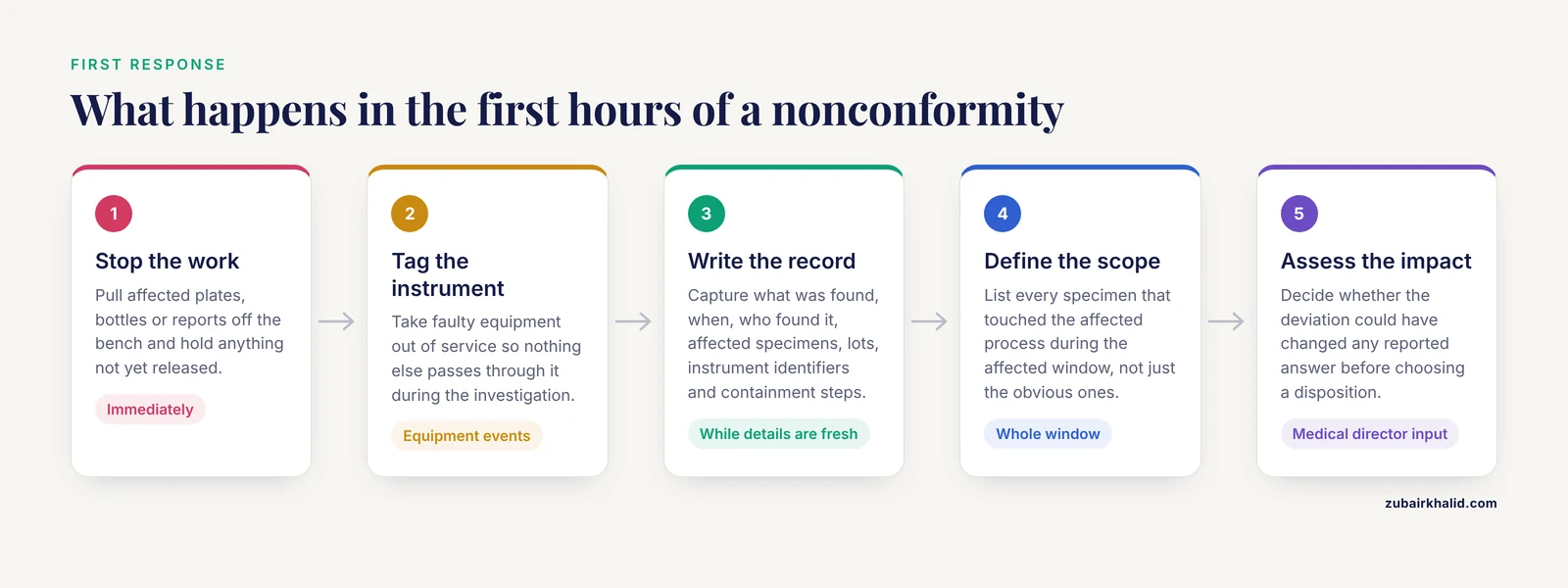
The moment a nonconformity is identified, stop the affected work. Pull the affected plates, bottles, or reports off the bench, tag the instrument out of service if equipment is involved, and quarantine any results not yet released. Containment is about limiting damage, not about assigning blame. If the autoclave failed its biological indicator check, every load processed since the last passing indicator is potentially affected and needs to be identified before anything else happens.
Step 2. Document the event immediately
Record what was found, when, who found it, which specimens, assays, lots, and reports are involved, and what containment steps were taken. Write it while the details are fresh. The record should capture lot numbers and expiration dates of any reagents involved, instrument identifiers, and the accession numbers of affected specimens. This documentation is what later allows you to prove, during an inspection, that you knew exactly which patient results were at risk.
Step 3. Define the scope
Ask the question that defines everything downstream: how many results are affected, and how badly? For a QC failure, the scope question is whether any patient or surveillance results were reported using the failing reagent, lot, or instrument, and if so, over what date range. For a specimen problem, the scope is usually a single specimen. For an equipment problem, the scope is every specimen that passed through the equipment during the excursion window. For a molecular workflow, the scope analysis is genuinely complex, which is why risk-based process management was a priority in the CDC quality guidance for sequencing laboratories [3].
Step 4. Evaluate the impact on patient results and clients
This is the analytical heart of the procedure. Not every nonconformity invalidates a result. A pH indicator on a carbohydrate test that drifted slightly may still support the reported identification. A susceptibility panel where one reference strain QC value fell slightly outside range while all internal parameters looked normal may still produce defensible results, or it may not, depending on the drug and organism. The evaluation should consider the direction and magnitude of the deviation, whether the deviation would bias results toward resistant or susceptible calls, the clinical consequence of a false susceptible call versus a false resistant call, and whether any alternative evidence (repeat isolate growth, historical QC performance, parallel testing) supports the result.
Step 5. Decide the disposition
Choose one of the response options described in the next section and record the decision, the rationale, and who made it. The medical director or designee makes this call whenever patient results are involved. The decision is not complete until it names a specific action for every affected specimen and every affected report.
Step 6. Correct or take corrective action
A correction fixes the immediate problem without addressing its cause. Rerunning a QC, repeating a stain, and relabeling a mislabeled plate are corrections. A corrective action eliminates the cause so the problem does not recur. Root cause analysis (RCA) is the structured process of finding that cause, using tools such as the 5 Whys or a cause-and-effect (fishbone) diagram. If the autoclave failed, the correction is repairing it and revalidating with a new biological indicator. The corrective action might be adding a second physical indicator to each load and revising the loading procedure that had been blocking the steam pathway. Both the correction and the corrective action need documented owners and due dates.
Step 7. Verify effectiveness
Close the loop by checking, after a defined interval, that the problem did not recur. If the corrective action was retraining staff on urine culture screening criteria, verify by reviewing subsequent urine culture rejection decisions or by direct observation after 30 days. If the action was a change in reagent storage, verify by reviewing QC performance over the following lot. A corrective action that was never verified is an open nonconformity in the eyes of any assessor.
Step 8. Close the record and trend it
Sign off the event, file it where assessors can find it, and feed it into the trending process. Individual events matter, but patterns matter more. Three minor incubator excursions in six months from different units point at a facility problem. Trending nonconformities by category, bench, and month is standard practice in laboratory quality management and is one of the activities that distinguishes a functioning quality system from a paper exercise.
Response Options Compared
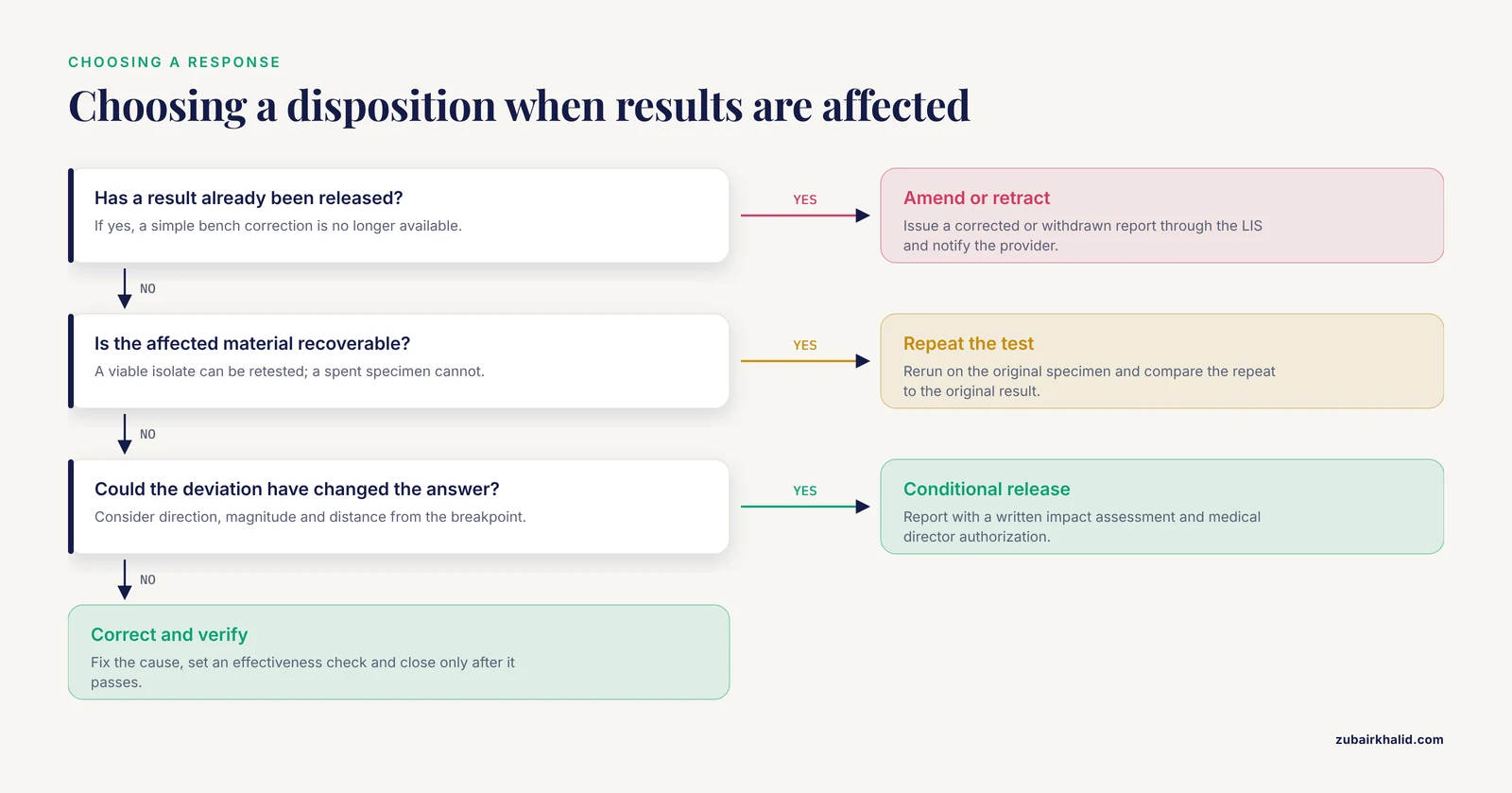
When a nonconformity touches reportable results, the laboratory has a limited set of disposition options. Each carries different obligations and different risks. The table below is the core decision framework for the whole procedure.
| Option | What it is | When it fits | Pros | Cons | Required documentation |
|---|---|---|---|---|---|
| Correction at the bench | Fix the immediate error and move on | The error was caught before any result was released | Fast, low cost, no client impact | Inappropriate for anything that reached a report | Event record with the correction noted |
| Repeat the test on the original specimen | Rerun using existing material | QC failed but the isolate or extract is still viable | Uses material you already have, answers the impact question directly | Delay in turnaround, repeat may fail for the same reason | Event record, repeat result, comparison to original |
| Request a new specimen | Reject and recollect | Specimen was compromised and is recollectable | Cleanest solution, defensible result | Patient burden, delay, often impossible for tissue or sterile fluids | Rejection record, recollection request, provider communication |
| Conditional release (use as is) | Report the result with a documented scientific justification for why the nonconformity did not compromise it | Deviation was minor, well characterized, and did not plausibly affect the reported result | Avoids unnecessary delay and recollection | Hardest option to defend, requires medical director sign-off, easy to abuse | Written impact assessment, justification, director authorization |
| Amend or retract the report | Issue a corrected or withdrawn report through the LIS | A released result was wrong or unsupported | Corrects the clinical record, meets accreditation expectations | Alarm and confusion for clinicians, may prompt therapy changes | Amended report, notification to provider, event record |
| Corrective action (CAPA) | Eliminate the root cause through process, training, or equipment change | The event could recur, or trending shows a pattern | Prevents recurrence, satisfies accreditation, drives real improvement | Slow, consumes resources, can stall if ownership is vague | Root cause analysis, action plan, owner, due date, effectiveness check |
| Escalate and notify | Inform the medical director, infection prevention, public health authorities, or the requesting clinician | Patient safety or public health consequences are possible | Meets duty of care, enables downstream response | Sensitive, requires clear criteria for when to trigger | Notification log, who was told and when |
Choosing among these options comes down to four criteria that decide real cases:
- Was a result already released? If yes, a simple correction is off the table. The choice becomes amend, retract, or justify.
- Is the affected material recoverable? A viable isolate can be retested. A spent specimen cannot. Recoverability determines whether repeat testing or recollection is even available.
- Could the deviation have changed the reported answer? A CO2 excursion of 2 degrees for 90 minutes is a very different question from a 9-degree overnight excursion. The impact assessment answers this, and the answer drives conditional release versus rework.
- Can the event recur? A one-time transcription error and a systemic flaw in how the LIS maps antibiotic panels look identical on day one. The root cause analysis tells you which corrective path is warranted.
The pros and cons of each non-conforming work microbiology lab procedure option mostly trade speed against defensibility. Bench corrections are fast but leave recurrence unaddressed. Conditional release is fast for the patient but the hardest to defend in an inspection. Corrective action is slow but is the only option that changes the future. A mature laboratory uses all of them, matched to the situation, and documents the match.
Worked Scenarios
Scenario 1. Susceptibility QC failure with patient isolates already on the bench
A technologist sets up MIC panels for six patient isolates at 0800. The E. coli ATCC 25922 QC control, read at 1800, shows a ceftriaxone MIC one dilution above the accepted range. Containment: all six patient panels from that lot and run are pulled and held, results are not released, and the lot number is flagged. Documentation: the event record captures the lot, the expiration date, the failing drug, and the six accession numbers. Scope: only that drug-organism combination failed, and all other QC values on the panel are in range. Impact evaluation: the medical director reviews whether a one-dilution shift toward higher MIC would change any of the six patient interpretations, considering the isolate sources and breakpoints involved. Disposition: two isolates have interpretations far from the breakpoint, so the director authorizes conditional release with a written justification. Four isolates sit near the breakpoint, so those panels are repeated from the remaining isolate suspension, and one specimen requires recollection because insufficient growth remains. Corrective action: the root cause analysis identifies that the new lot had been stored in the lab refrigerator door, where temperature fluctuation is documented to be greatest, and the corrective action is moving all AST panels to the stable shelf with a shelf-label change and a targeted competency review. Effectiveness check: the next QC event on that lot passes, and the storage location is added to the monthly QC walk-through checklist.
Scenario 2. Incubator over-temperature overnight
The morning log shows the primary bacteriology incubator reached 41 C for an estimated six hours overnight. Containment: the incubator is tagged out, and everything scheduled for it is redirected to the backup unit. Scope: every plate and bottle in that incubator over the excursion window is listed, including blood culture bottles still incubating, respiratory cultures on day two, and mycobacterial cultures if the unit was shared. Impact evaluation: this is a judgment call requiring input from the medical director, because heat exposure can kill fastidious organisms, causing false-negative cultures, while having little effect on hardier organisms. The safest disposition for high-stakes specimens, such as cultures from sterile sites, is to request recollection where possible. Blood culture bottles that have already flagged positive are unaffected in practice, since the organism is already recovered and in workup. Corrective action: the root cause analysis traces the failure to a compressor fault that the alarm should have caught, and the investigation reveals the alarm dialer had been silenced during a maintenance visit and never reactivated. The corrective action pairs the equipment repair with a policy that no alarm is silenced without a documented reactivation step and a daily confirmation that the dialer answers.
Scenario 3. A released report names the wrong antibiotic panel
Result review catches that a urinary isolate of Klebsiella pneumoniae was reported with an extended-spectrum gram-negative panel that the bench never set up, because the LIS panel mapping for that specimen type had been configured incorrectly during a build change two weeks earlier. This is a post-analytical nonconformity with released results, so containment is impossible and the response must be amendment. Scope: the LIS is queried for every report issued under the same specimen-type mapping since the change date, which identifies 43 reports. Disposition: each report is amended with the correct results where the correct panel was actually performed, and retracted where no valid basis exists. Corrective action: the mapping is fixed in the LIS build, and a validation check is added to the change-control procedure so that any future LIS configuration change triggers a parallel review of one live report per affected specimen type before go-live. Effectiveness check: a 30-day review of amended reports confirms no further mapping errors. This scenario illustrates why trending matters, since a single complaint about one report could have been written off as a one-off, but the scope query revealed a systemic fault affecting more than 40 patients.
Scenario 4. Contamination in a modular molecular workflow
A public health laboratory running a sequencing workflow detects cross-contamination between samples during library preparation, invalidating a batch of surveillance specimens. This is the situation the CDC NGS Quality Workgroup addressed directly, recommending that laboratories manage these complex modular processes through defined quality control checkpoints, risk assessment, and documented procedures at each stage of the workflow [3]. The response follows the same eight steps: the affected batch is contained and not released, the event is documented with the specific batch and library identifiers, the scope is defined by which samples shared reagents and space, the impact evaluation determines which results are genuinely at risk, the disposition ranges from repeat extraction for salvageable material to re-collection through the submitting network, and the corrective action targets the physical or procedural source of the contamination, verified by subsequent negative-control performance.
Choosing the Best Non-Conforming Work Microbiology Lab Procedure for Your Laboratory
There is no single best procedure in the abstract. The best non-conforming work microbiology lab procedure is the one your laboratory will actually follow, scaled to your size and risk profile. That said, published experience points to a few design principles.
Write it as a flow of decisions, not a flow of blame. Procedures that treat every event as a personnel failure drive underreporting, and an underreported nonconformity is worse than a reported one because it spreads silently through the result stream. Healthcare quality experts interviewed about QMS implementation consistently identify unclear definitions of success and poorly designed implementation as the main reasons quality initiatives disappoint [4]. A nonconforming work procedure succeeds when staff use it without hesitation.
Match the response to the risk. A laboratory that forces full corrective action for every trivial deviation will drown in paperwork, and a laboratory that allows informal fixes for serious events will accumulate hidden risk. The procedure should include explicit criteria for escalation, such as any released result affected, any critical value affected, any repeat event in the same category within a defined period, and any event involving a reportable pathogen.
Keep the process orientation. Research on ISO 9001 implementation in service organizations found that the standard's main contribution to organizational resilience came from promoting process orientation and consistent risk management practice, with the effect strongest in units that had not already reached that maturity on their own [5]. For a microbiology lab, that translates into designing the nonconforming work procedure around process steps and risk, not around individual errors.
Put quality monitoring where it has leverage. In an assessment of 28 hospitals using a structured QMS index, the strongest performing dimension was quality monitoring by the board, and the weakest was the completeness of quality policy documents [1]. The lesson for laboratory leadership is that visible, regular review of nonconformity trends at the department and laboratory-director level does more for the system than producing polished policy text that nobody reads.
Writing a Non-Conforming Work Microbiology Lab Procedure
A usable SOP for nonconforming work contains a defined set of elements. Laboratories building or revising theirs can use the following as a checklist.
- Purpose and scope. State that the procedure applies to all pre-analytical, analytical, post-analytical, and system nonconformities in the microbiology department, and define nonconformity, correction, corrective action, and root cause analysis in the definitions section.
- Responsibilities. Name who can identify an event (everyone), who performs containment (the identifying technologist), who evaluates impact and approves disposition (the technical supervisor and medical director or designee), and who verifies corrective actions (the quality manager).
- Intake and documentation form. A single form or electronic record with fields for date, identifier of the reporter, event description, affected specimens and reports, lot and instrument numbers, containment actions, impact assessment, disposition and rationale, corrective action, owner, due date, and effectiveness verification.
- Containment instructions. Specific guidance for the common events, such as pulling plates, tagging instruments, holding unreleased results, and freezing or discarding affected lots.
- Disposition decision rules. The options table from this article, adapted to the laboratory's test menu, with the criteria for conditional release stated explicitly and medical director authorization required for that option.
- Escalation criteria. A short list of triggers for immediate escalation, including any released result found to be wrong, any event affecting a critical value, any suspected cluster of events, and any event with public health or infection prevention implications.
- Timelines. Define how fast containment must occur (immediately), when the disposition decision is due (typically within one working day for patient-facing events), and when corrective action and effectiveness verification are due.
- Trending and management review. Specify the categories used for trending, the review interval, and the requirement that trends be presented at the management review meeting that feeds the laboratory's overall quality program.
The written procedure matters for a reason beyond inspection readiness. Controlled written procedures give the laboratory total traceability of its operations and preserve institutional knowledge through staff turnover. When a technologist leaves after ten years, the procedure is what keeps the nonconformity response from leaving with them.
Integration with Microbiology Quality Control and Laboratory Quality Management
Nonconforming work control does not stand alone. It connects to every other quality process in the laboratory.
Quality control. QC is the detection engine. Media QC, reagent QC, AST reference strain QC, instrument QC, and stain controls are all designed to fail visibly when something is wrong, and every QC failure is either a nonconforming event itself or evidence of one. A laboratory that records QC failures in a separate silo from its nonconformity log loses the pattern data that trending depends on.
Documents and records. Every disposition decision and corrective action references the SOP versions and lot records in force at the time. Document control and nonconforming work control are symbiotic, because an outdated SOP in use is itself a common nonconformity finding.
Competency and training. A recurring nonconformity at a particular bench is often a training signal. The procedure should require the quality manager to consider competency as a possible root cause and to route verified training gaps to the competency program.
Proficiency testing. A proficiency testing failure is a nonconforming event with an unusual feature, namely that the specimen is external and the comparison is external, which makes root cause analysis broader and the potential reputational and regulatory consequences higher.
Management review. The aggregated nonconformity data, including counts by category, open versus closed status, and time to closure, is a standard management review input. In the medical microbiology quality framework, this feedback loop connecting event management to laboratory leadership is what makes the quality system self-correcting rather than self-documenting.
The payoff for this integration is measurable. A university research laboratory that implemented a certified quality management system reported high user satisfaction and a very small number of failures in its operations, attributing that performance directly to the effectiveness of the system [6]. In hospitals, organization-level quality management has been examined alongside safety culture and leadership for its association with patient-level outcomes, reflecting the same underlying principle that structured quality processes and clinical outcomes travel together [7].
Common Mix-Ups at the Bench
Certain confusions appear in almost every laboratory learning this procedure.
Confusing correction with corrective action. Technologists repeat the QC, it passes, and the event is closed with no root cause analysis. If the QC failure had a cause that persists, the next lot fails too. The correction answers what happened this time. The corrective action answers why it happened at all.
Treating conditional release as the default. When turnaround pressure is high, the temptation is to release results with a shrug and a mental note. Conditional release is a legitimate option, but only with a written impact assessment and director authorization. Used casually, it converts quality control into decoration.
Scoping too narrowly. The scope question for an incubator excursion is not which plates were on the top shelf. It is every specimen that touched the affected process during the affected window. Under-scoping is the error that turns a contained event into a cluster of amended reports weeks later.
Closing events before verification. An event marked closed the day the corrective action was assigned is not closed. Effectiveness verification with a defined interval and method is what makes closure meaningful, and assessors look for exactly this gap.
Blame-first investigations. Root cause analyses that stop at the individual who made the error miss the system conditions that made the error easy to make. The most productive question is why the process allowed the error to reach a report, not who touched it last.
Ignoring near-misses. A mislabeled specimen caught at accessioning caused no harm, but it is still a nonconformity worth recording. Near-misses are the cheapest data a laboratory will ever get about where its process is fragile.
Common Mistakes and Limitations
- Underreporting driven by culture. If the implicit message from leadership is that nonconformities are trouble, staff will handle them quietly. The quality manager should track not only reported events but also signals of unreported ones, such as QC failures absent from the event log.
- Procedures that exist only on paper. A 40-page SOP nobody has read fails the same test as no SOP. Keep the operative procedure to a decision flow that fits the bench, with the detail in appendices.
- Impact assessments without a scientific basis. Statements like "the results were probably fine" do not survive scrutiny. The impact assessment should reference the nature of the deviation, the relevant analytical evidence, and the clinical stakes of an erroneous call.
- Corrective actions assigned without resources. An action item with no owner, no due date, and no allocated time is a wish. Healthcare quality experts point to poorly resourced and poorly defined implementation as a leading cause of quality initiative failure [4].
- One-size-fits-all escalation. A procedure that routes every event to the medical director will be bypassed, and a procedure that routes nothing to the director is unsafe. Define the escalation criteria and keep them short.
- Failure to trend by process step. Trending by bench or by month without mapping events to the process workflow hides the stages where failures concentrate.
- Assuming molecular and sequencing workflows are covered by the culture SOP. Modular, multi-day workflows need their own checkpoints and their own risk assessment, as the CDC guidance for sequencing laboratories makes explicit [3].
- The general limitation. This article describes procedure design, not case-by-case decisions. Every actual nonconformity touching patient results requires judgment by the laboratory's supervisory and medical staff under its own policies, accreditation requirements, and the specific facts of the event.
Frequently Asked Questions
What is non-conforming work in a microbiology laboratory?
Non-conforming work is any departure from a specified requirement, including your own SOPs, manufacturer instructions, or accreditation standards. In microbiology this spans specimen rejection issues, QC failures on media, reagents, and susceptibility panels, instrument and incubator excursions, molecular workflow failures, and errors in released reports.
What is the first step when non-conforming work is discovered?
Stop and contain the affected work immediately. Pull affected cultures, panels, and reports off the bench, tag out any faulty instrument, quarantine unreleased results, and document what you found, when, and which specimens and lots are involved, before moving to the impact assessment.
What is the difference between a correction and a corrective action?
A correction fixes the immediate problem, such as rerunning a failed QC or amending a wrong report. A corrective action eliminates the underlying cause so the problem cannot recur, such as fixing an alarm that was left silenced and adding a rule that silencing requires documented reactivation. Both must be documented, and the corrective action must be verified for effectiveness.
Can a microbiology result be released after a QC failure?
Sometimes, yes, through a conditional release. The medical director or designee must review the nature of the QC failure, whether it plausibly affected the reported result, and the clinical stakes, and then authorize release with a written justification. Results near a decision point, such as a susceptibility interpretation near the breakpoint, usually need repeat testing instead.
Who is responsible for handling non-conforming work?
Every technologist is responsible for identifying and containing events. The technical supervisor typically scopes the event and performs the impact assessment, the medical director or designee approves any disposition affecting patient results, and the quality manager owns the record, the corrective action tracking, the effectiveness verification, and the trending.
How do you know a corrective action actually worked?
Define an effectiveness check when the corrective action is assigned, with a specific method and interval. Examples include reviewing QC performance across the next reagent lot, observing the revised bench practice after 30 days, or querying the LIS for recurrence of the error type. The event is closed only after the check shows the problem has not recurred.
Sources
- Assessing hospital quality management systems: evidence from Iran.
- Quality management systems
- Practical Guidance to Implementing Quality Management Systems in Public Health Laboratories Performing Next-Generation Sequencing: Personnel, Equipment, and Process Management (Phase 1)
- Facilitators, Barriers, and Benefits of Quality Management Systems Implementation: Healthcare Experts’ Perspectives
- The impact of quality management systems on organizational resilience
- Impact of implementing quality control systems in laboratories associated with teaching and research institutions - The case study of the laboratory for macromolecules and colloids in the petroleum industry
- The relationships between quality management systems, safety culture and leadership and patient outcomes in Australian Emergency Departments.