Microbiology Study Apps: The Best Mobile Tools for Learning on the Go
By Dr. Zubair Khalid, DVM, MS, PhD ·
The difference between a microbiology study app that works and one that wastes your commute is feedback: a real study app makes you produce an answer first, then tells you within seconds whether that answer was correct. Everything else, the streak counters, the confetti, the animated mascots, is packaging around that single loop.
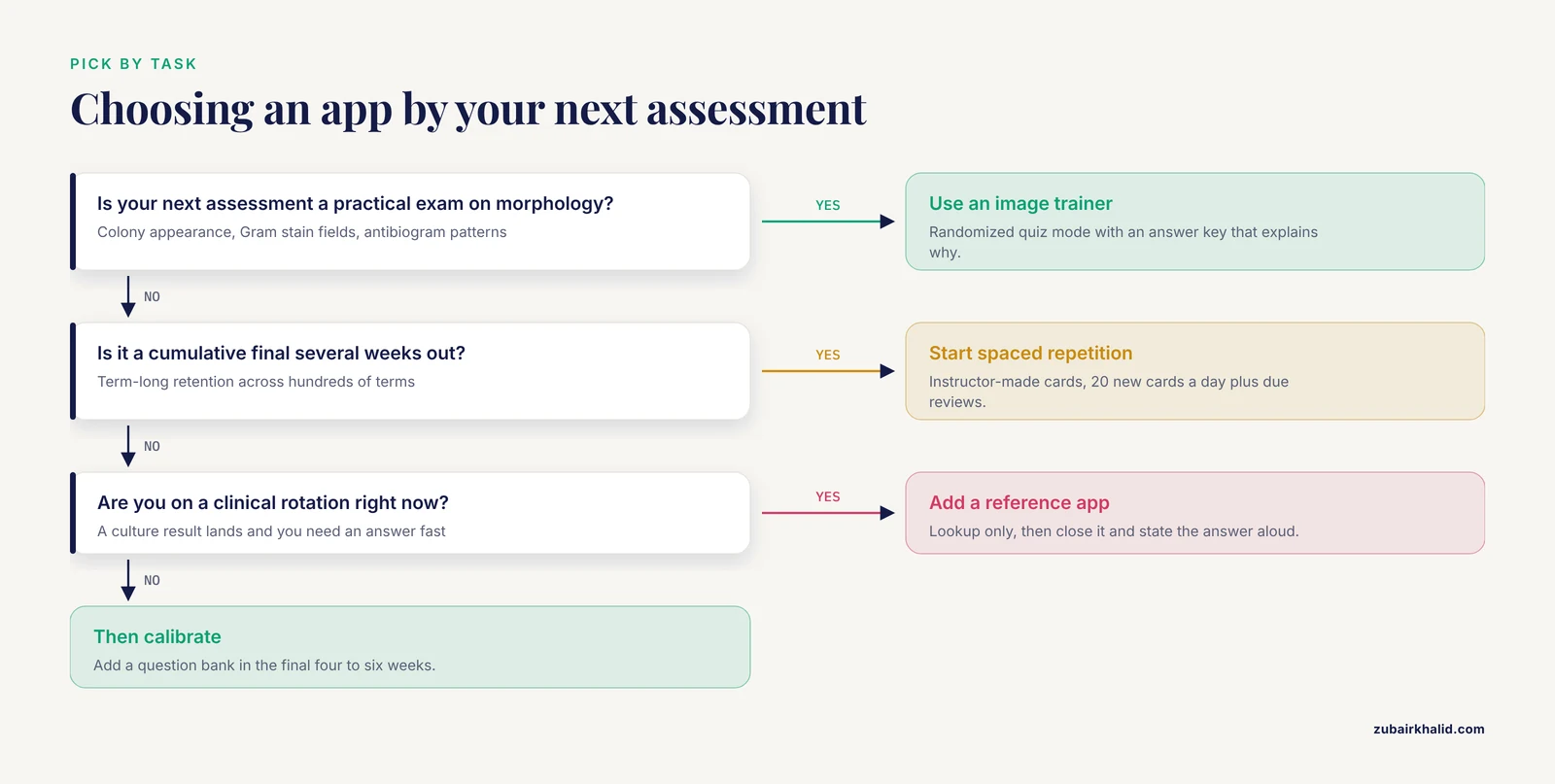
The rule of thumb is simple. Choose the app that matches the exact task you will be judged on in the next four weeks, not the app with the longest feature list. If you have a practical exam on colony morphology, you need an image trainer. If you have a cumulative final in ten weeks, you need spaced repetition. If you are on a clinical rotation and a culture result lands at 6 p.m., you need a reference tool that opens in under three seconds. One app rarely does all three well.
This guide breaks down the real categories of microbiology study apps, explains what each one trains and where each one fails, and shows how to assemble a small stack that covers a full microbiology course without turning your phone into a slot machine.
What Makes a Microbiology Study App Different From a Textbook
Microbiology is unusually hostile to passive reading. The subject asks you to hold three different kinds of knowledge at once.
The first is visual discrimination. A Gram stain is a differential stain that splits bacteria into Gram-positive and Gram-negative groups based on cell wall structure, and reading one means separating purple cocci in clusters from purple cocci in chains from pink rods from pink diplococci, often in a single oil-immersion field. No paragraph of text teaches that. Only repeated exposure to images does.
The second is conditional logic. Identification is a chain of if-then steps. A lactose-fermenting, oxidase-negative, indole-positive Gram-negative rod points toward Escherichia coli. Change one result and the whole branch collapses. Apps that let you walk a dichotomous key or a biochemical panel train this better than any linear chapter.
The third is vocabulary volume. A single introductory microbiology course can carry several hundred terms, from selective media to minimum inhibitory concentration (MIC, the lowest drug concentration that inhibits visible growth). Volume like that decays without scheduled review.
A printed textbook delivers all three statically. An app can deliver them as retrieval, spacing, and simulation. That is the whole case for mobile study, and it is a strong one when the app is built around retrieval rather than around reading.
Short mobile-native modules appear to hold attention well. In an evaluation of supplemental multimedia modules built on cognitive load theory for food microbiology and food biotechnology courses, 73% to 76% of students voluntarily accessed the modules, average engagement ran 5 to 8 minutes per module, and exam performance on module-related items improved by 6% to 10% compared with overall exam averages [1]. The design lesson transfers directly to phone screens: small, replayable, focused units beat long recordings.
The Best Microbiology Study App Options, Side by Side
Treat the table below as a map of categories rather than a ranking. Every row represents a real class of microbiology study app, and each class solves a different problem.
| App category | What it actually trains | Typical session | Strongest feature | Weakest point | Best fit |
|---|---|---|---|---|---|
| Spaced repetition flashcards | Recall of organisms, media, biochemical reactions, drug mechanisms | 5 to 15 min | Forces daily retrieval and schedules review automatically | Encourages isolated facts if cards are poorly written | Term-long retention in a microbiology course |
| Curriculum-aligned AI tutor | Explanation, Socratic questioning, structured self-directed learning | 15 to 30 min | Answers follow-up questions and generates cases on demand | Accuracy drift, weak alignment with your syllabus | Deep preparation before small-group sessions |
| AI virtual laboratory | Bench workflow, plating order, interpretation steps | 20 to 45 min | Repeatable, safe, and available without a physical lab | Simplifies real-world variability | Students with limited lab access |
| Gamified and escape-game apps | Team reasoning, bioinformatics vocabulary, sequencing workflow | 45 to 90 min | High motivation and peer teaching | Setup effort, novelty decays | Orientation, residency retreats, cohort building |
| Image-based identification trainers | Gram stain morphology, colony appearance, antibiogram patterns | 3 to 10 min | Trains the visual pattern recognition text cannot deliver | Small image libraries, few rare organisms | Before practical exams and bench rotations |
| Reference and database apps | Taxonomic lookups, breakpoint tables, biochemical keys | 30 sec bursts | Speed at the moment of need | A lookup is not a learning event | Clinical rotations and bench shifts |
| Question banks and exam prep | Item format, pacing, distractor logic | 30 to 60 min | Calibrates you to the real test | Thin teaching explanations | Final four to six weeks before boards |
| Bench-aid diagnostic software | Automated culture reading, Gram stain prediction | Not a study tool | Speed and consistency at high volume | Systematic errors on specific organism groups | Understanding what automation can and cannot do |
Read the table in two directions. Across the rows, ask which category addresses your next assessment. Down the columns, ask whether the app you are considering actually belongs to the category you think it does. Many apps marketed as "microbiology study apps" are flashcard shells with a purchased deck, and many AI study apps are general chatbots with a microbiology prompt layered on top.
Spaced Repetition Flashcards: The Workhorse of Any Microbiology Course
Spaced repetition is a scheduling method that shows you a fact just before you are likely to forget it, then pushes the next review further out each time you recall it correctly. The algorithm is doing the boring part of memory management so you do not have to guess what to review.
Flashcards are the most widely used category of microbiology study app, and the evidence for them is more nuanced than the marketing suggests. In a bachelor-level introductory microbiology course, students used instructor-made spaced repetition flashcards to scaffold their review. Overall exam performance did not change significantly (p = 0.2657). What did change was how students saw themselves: confidence in their ability to succeed improved (p = 0.0066), belief that the course made them think like a microbiologist improved (p = 0.0011), and students rated the approach as effective instruction (p = 0.0076) [2].
That result is worth sitting with. The cards did not move scores in that cohort. They moved self-concept, which matters for persistence in a course that many students find intimidating, but it is not the same as a grade increase. The practical implication is that card quality decides whether the app earns its place. Instructor-authored cards tied to specific learning objectives behave differently from a purchased deck of 4,000 undifferentiated facts.
What Makes a Good Microbiology Card
A card should ask for one decision, not three. Compare these.
- Weak card: "Tell me everything about Staphylococcus aureus."
- Strong card: "A Gram-positive coccus in clusters is catalase positive and coagulase positive. Name the organism." (Answer: S. aureus.)
- Strong card: "Which coagulase-positive Gram-positive coccus is also beta-hemolytic on blood agar?" (Answer: S. aureus.)
The strong versions are answerable in under ten seconds and fail in a way that tells you exactly what you missed. The weak version fails in a way that tells you nothing.
Image Cards and the Cloze Problem
Flashcard apps handle text well and images unevenly. If you plan to load Gram stain images into a deck, use the cloze deletion format (a card where part of a sentence or image is hidden and you supply the missing element) and keep one image per card. Stacking four images on one card trains you to recognize the card layout, not the organism.
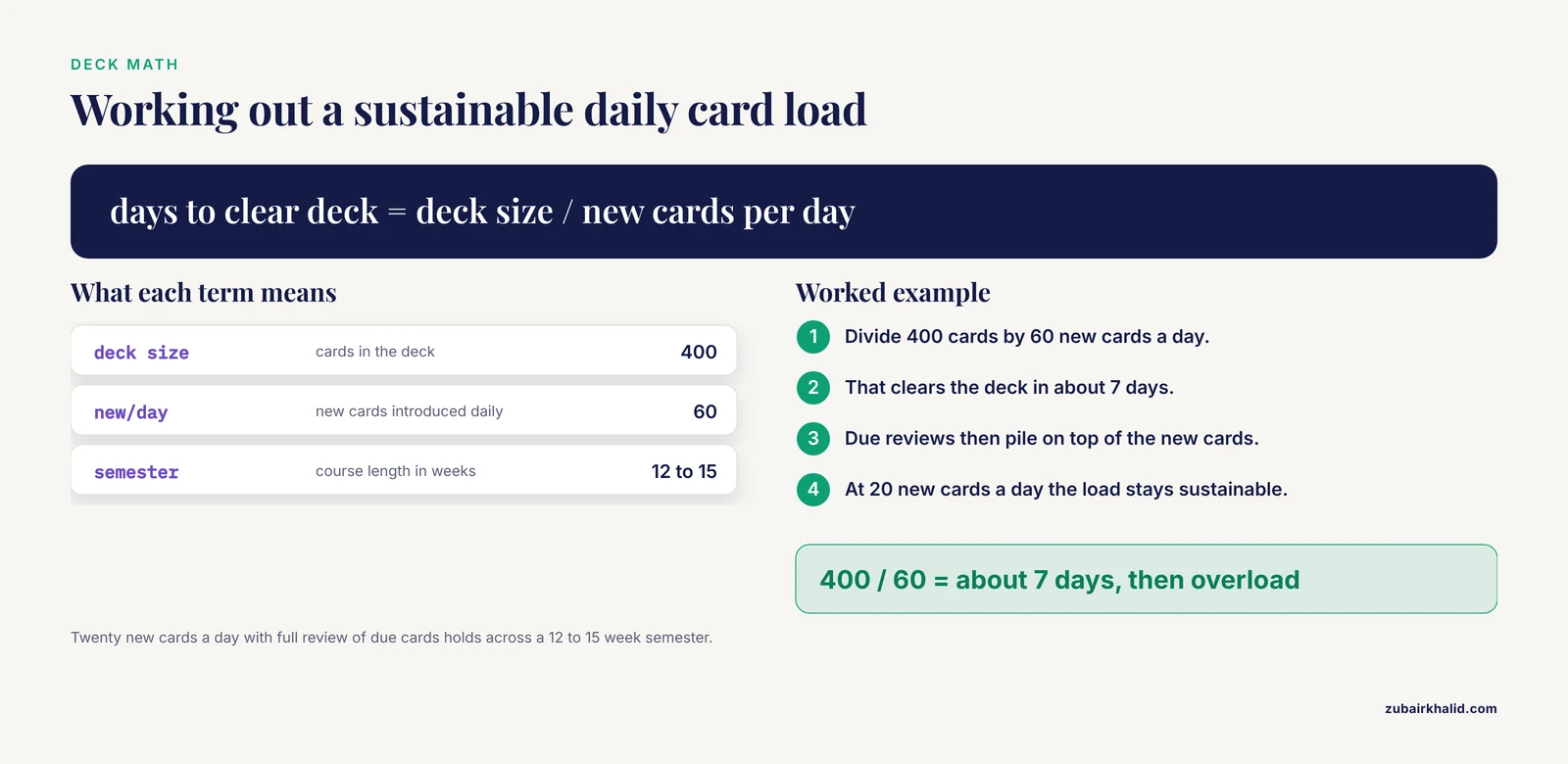
Set a realistic daily ceiling. A deck of 400 cards reviewed at 60 new cards a day becomes unmanageable by week two. Twenty new cards a day with full review of due cards is sustainable across a 12 to 15 week semester.
Conversational AI Tutors and Curriculum-Aligned Chatbots
A general-purpose chatbot will explain the urea hydrolysis test to you at 11 p.m. That is genuinely useful and genuinely risky. The risk is not that the model knows nothing. The risk is that it produces a confident, plausible, wrong statement about a breakpoint or a biochemical reaction and you have no easy way to detect the error.
The better model is a curriculum-aligned AI tutor, meaning a tool built around your specific course objectives rather than the open internet. A crossover pilot study tested exactly this in second-year medical students at one US medical school, comparing a custom GPT built to support AI-scaffolded self-directed learning against conventional unguided preparation. Students using the curriculum-aligned GPT scored higher on self-directed learning documentation (10.3 vs 9.4 out of 12, mean difference 0.9, 95% CI 0.5 to 1.3, Cohen d = 0.71) and on small-group discussion performance (14.9 vs 13.7 out of 16, mean difference 1.2, 95% CI 0.7 to 1.7, Cohen d = 0.78). Delayed retention on end-of-block examination items did not differ between the two conditions [3].
Two things follow. First, structured prompting with Socratic scaffolding beats an open chat box for preparation quality. Second, the gain showed up in discussion and documentation rather than in delayed recall, so an AI tutor complements flashcards rather than replacing them.
Where AI Study Tools Break
The known failure modes of AI in microbiology are documented. Deep learning models, in particular, often lack transparency, which makes results hard to interpret. Overfitting and limited generalizability across settings are persistent concerns, and ethical and legal issues around data privacy in microbiome data remain unresolved [4]. For a student, this translates into three habits.
- Verify any number the tutor gives you against your course materials or a primary reference.
- Ask the tutor to show its reasoning steps, then check the steps rather than the conclusion.
- Never paste identifiable patient material into a general chatbot.
The same caution applies to AI features embedded in commercial study apps. A generated multiple-choice question about carbapenem resistance may be pedagogically useful and factually wrong at the same time.
Virtual Laboratories and Simulation Apps
A virtual laboratory is a simulated bench environment where you perform the procedural steps of an experiment on screen, from sample handling through plating to interpretation. For microbiology, this means practice with streak plating, media selection, incubation timing, and reading results without consuming reagents or risking contamination.
The strongest evidence for this category comes from food microbiology education, where traditional lab instruction is expensive, biosafety-restricted, and hard to scale. In a 14-week quasi-experimental study of 128 undergraduates, students using an AI-enhanced virtual laboratory platform incorporating intelligent tutoring, automated assessment, personalized learning pathways, and real-time feedback outperformed the traditional lab group on knowledge acquisition (86.3% vs 78.6%, P < 0.001, d = 0.80) and on skill development (84.6% vs 72.8%) [5].
That is a large effect, and it needs a fair reading. The comparison was against traditional laboratory instruction in a resource-constrained context, and virtual labs simplify the messy variability of a real bench. A simulated colony is always well separated and never overgrown by a contaminant. Use virtual labs to learn sequence and decision points, then use real bench time to learn what to do when the plate does not cooperate.
What Virtual Labs Do Best
Three specific skills transfer well to simulation.
- Order of operations. Which medium, which incubation temperature, which atmosphere. Getting the sequence wrong in simulation costs nothing and teaches the cost of getting it wrong at the bench.
- Interpretation rehearsal. You can read 50 simulated plates in the time it takes to incubate one real plate.
- Rare events. A virtual lab can show you a Burkholderia cepacia complex isolate on a respiratory culture whenever you want one.
Gamified Formats: Escape Games and Team Apps
Gamification in this context means applying game mechanics (teams, timers, puzzles, scoring) to a learning objective. The clinical microbiology version that has been formally evaluated is the educational escape game, a timed puzzle format where participants solve discipline-specific problems to progress.
One prospectively evaluated example, designed to introduce bioinformatics concepts and tools in clinical microbiology, enrolled 55 participants. Twenty-two (40%) were second-year medical students and 33 (60%) were postgraduate MDs or PharmDs. Participants worked in teams of three to four using versions adapted to their training level, and knowledge was assessed before and immediately after the activity using two distinct 10-item tests that mapped to the same predefined learning objectives. Motivation was measured with a 12-item, 5-point Likert questionnaire [6].
The appeal of this format is not mysterious. Bioinformatics is hard to introduce in a lecture because the vocabulary arrives before the intuition does. A game forces learners to use the vocabulary to solve a problem within a time limit, which is closer to how the tools are used in practice.
The Honest Limits of Gamified Apps
Novelty is a depreciating asset. A cohort that plays an escape game in September will not be enthusiastic about the same game in November. Gamified formats work best as a single high-impact event, a cohort-bonding exercise, or a rotation icebreaker, not as a daily driver. They also tend to assess the learning objective indirectly, through whether your team solved the puzzle, rather than item by item.
Image-Based Identification Trainers and the Limits of Automated Reading
This category deserves the most careful treatment because it sits closest to actual diagnostic practice, and because the evidence shows exactly where automation falls short.
An image trainer presents a Gram stain field, a colony on a chromogenic plate, or a disk diffusion pattern and asks you to commit to an interpretation before revealing the answer. In a course with a practical exam, this is the highest-yield app category available.
Automated reading tools have been developed for the same images. A computer-aided diagnosis (CAD) system that uses artificial intelligence to predict causative pathogens from Gram-stained blood culture images was compared against microbiology specialists in a retrospective study using iPhone-captured images of clinical samples stained with the Bartholomew and Mittwer method from two tertiary care hospitals. Among 126 samples (378 images) from aerobic bottles, specialist accuracy was 91.5% (95% CI 90.5% to 92.3%) and CAD accuracy was 75.4% (95% CI 70.7% to 79.7%). Among 90 samples (270 images) from anaerobic bottles, specialist accuracy was 90.1% (95% CI 88.9% to 91.2%) and CAD accuracy was 76.7% (95% CI 71.2% to 81.6%). Non-inferiority was not demonstrated. Most mispredictions occurred with Gram-negative cocci, Haemophilus influenzae, and Campylobacter species, while performance was relatively good for other organisms [7].
Three lessons for anyone using an app to learn image interpretation:
- Human calibration still sets the ceiling. A trained eye outperformed the algorithm in this comparison, so the target you are training toward is the specialist, not the software.
- Error is not random. The algorithm's mistakes clustered in specific organism groups. Train extra hard on Gram-negative cocci and on thin, fastidious Gram-negative bacilli.
- Image capture matters. The study used phone-captured images, so this is a realistic proxy for mobile learning. Blurry, poorly white-balanced captures degrade both human and machine performance.
Choosing an Image Trainer
Look for three attributes. A searchable library by Gram reaction and morphology. A quiz mode that randomizes fields rather than showing them in deck order. And an answer key that explains why, not just what. A trainer that says "wrong, it is Neisseria" teaches less than one that says "wrong, you called it a rod but these are coffee-bean diplococci with a pink hue."
Reference Apps, Question Banks, and Bench-Aid Tools
These three categories are often bundled together in marketing and should not be.
Reference and database apps are lookup tools. You use them on a rotation when a culture finalizes, or at the bench when you cannot remember the indole reaction for Proteus mirabilis. They are valuable and they are not study. Retrieval practice requires you to recall before you check, and a lookup inverts that order.
Question banks are the closest thing to exam rehearsal. Their value is pacing and item interpretation, not teaching. A good question bank shows you why each distractor is wrong. A bad one just gives a percentage.
Bench-aid software is regulated diagnostic software that happens to run on a phone or tablet. It is not for learning microbiology, but you should understand it, because you will work alongside it.
The best-documented example is an AI-assisted urine culture interpretation application evaluated in a centralized microbiology laboratory. Across 1,304 cultures (1,251 evaluable for growth score comparison), exact agreement across four growth categories was 86.2%. At a triage threshold of <10⁶ CFU/L (colony-forming units per liter), overall agreement was 95.9%, with positive percent agreement of 89.9% and negative percent agreement of 98.9%. In that dataset, 30.5% of cultures met the threshold for potential auto-release or batch review. For presumptive identification in pure or predominant cultures at ≥10⁷ CFU/L, the application performed best for E. coli (positive percent agreement 98.9%). For Enterococcus species, positive percent agreement was 89.5% but positive predictive value (the proportion of positive calls that were truly positive) was only 25.4%, reflecting frequent false-positive presumptive identifications [8].
Read that last number again. A tool can be sensitive and still generate a lot of noise. That is exactly the kind of nuance a study app should teach you and almost never does.
The underlying analytical tools are also worth knowing about as a category. Variant calling in bacterial genomics, which underpins outbreak clustering and resistance detection, has been benchmarked across 14 bacterial species, with deep learning-based callers outperforming traditional methods and reaching high precision and recall even at 10× depth on high-accuracy nanopore data [9]. Predictive models for antimicrobial susceptibility trained on surveillance data from the Pfizer ATLAS programme achieved moderate performance, with test accuracies ranging from 57% to 76% across seven antibiotic-specific models [10]. These are not study apps, but understanding their accuracy ceilings is part of modern microbiology literacy.
Why does any of this matter to a student? Because the point of knowing microbiology is faster appropriate treatment. In a retrospective cohort of 400 urgent care patients, a pharmacist-driven microbiology review program reduced time to appropriate treatment from 13 hours to 11 hours compared with physician or advanced practice provider review alone (p = 0.047), with similar 30-day unplanned revisit rates (14%) [11]. Speed of correct interpretation is a clinical outcome, not an academic one.
Microbiology Study App Pros and Cons
The pros and cons of microbiology study apps are not the same as the pros and cons of studying on a phone. Separate the two.
Pros
Retrieval frequency. A phone is with you in line at the pharmacy, on the bus, and between patients. Ten minutes of flashcards in three dead spaces beats an hour of rereading a chapter you never actually schedule.
Image exposure volume. You can see more Gram stains and colony morphologies in a week of mobile quizzing than in a full semester of laboratory sessions, because you are not waiting for incubation.
Immediate feedback. Wrong answers surface instantly rather than at the exam.
Personalization. Adaptive scheduling and AI tutoring adjust to your weak areas, which a static textbook cannot do.
Repetition without cost. A virtual plate can be read a hundred times. A real plate is consumed once.
Cons
Illusion of competence. Recognition is not recall. Swiping through a deck and thinking "yes, I know that" is a recognition task. Typing the answer or saying it aloud is a retrieval task. Many students discover the difference on exam day.
Fact fragmentation. Flashcards reward discrete facts. Identification in practice requires chaining facts into a decision tree, and no card deck teaches chaining by itself.
Accuracy risk in generated content. AI-generated cards and explanations can be confidently wrong. Model transparency and generalizability remain open problems in microbiology applications of AI [4].
Cost of curation. A high-quality deck takes hours to build. A purchased deck saves that time and often misses your specific course objectives.
Distraction tax. A phone that hosts your flashcards also hosts everything else. The app with the best algorithm loses to the app you actually open.
Not a substitute for bench time. Simulation teaches sequence and decision points. It does not teach the motor skills, the contamination events, or the smell of a Proteus plate.
How to Choose: The Criteria That Decide Real Choices
Six criteria separate a study app you will keep from one you will delete in a week.
1. Does it force production before revealing the answer? If the card shows the answer on the same screen as the prompt, it is a recognition drill. Flip-style cards and free-text recall are better.
2. Does the content map to your syllabus? Instructor-authored or curriculum-aligned content outperforms generic decks. The medical student study above found benefits specifically from a curriculum-aligned tutor rather than an open-ended chatbot [3].
3. Does it handle images at native resolution? Zoom into a Gram stain and see whether the app resamples it into mush. Morphology trainers live or die on image quality.
4. Does it explain wrong answers? A one-word correction is a missed teaching moment.
5. Can you export your data? Cards, progress, and notes should leave with you. Vendor lock-in on a four-year investment is a real cost.
6. Does it work offline? Laboratory buildings, basements, and international rotations have unreliable connectivity.
A seventh criterion is worth adding for AI-heavy apps: can you see the source or reasoning behind a claim? If the app cannot show its work, treat every generated fact as unverified.
Worked Scenarios
Scenario 1: A Second-Year Student Facing a Cumulative Microbiology Final in Ten Weeks
Start with a spaced repetition app loaded with instructor-made cards mapped to the course learning objectives. That is the foundation, and the evidence supports the confidence and engagement benefit even where exam scores stayed flat [2]. Add one image trainer for Gram stain and colony morphology, ten minutes a day, starting in week three. Add a question bank in weeks eight to ten for pacing.
Daily load: 20 new cards plus due reviews, one 10-minute image quiz, and nothing else until week eight. Total time: about 25 minutes a day, mobile-native.
Scenario 2: A Clinical Laboratory Science Student Preparing for a Practical Exam
Flip the order. The practical exam is a visual and procedural assessment, so the image trainer and a virtual laboratory should take the majority of the time. Flashcards become the supporting tool for media composition and biochemical reactions.
Use the virtual lab to rehearse the sequence of a urine culture workup and a blood culture Gram stain. Use the image trainer to drill the specific error-prone groups identified in the CAD comparison, particularly Gram-negative cocci [7]. Add a reference app to your home screen for rotation use, understanding that it is a lookup tool rather than a study tool.
Scenario 3: A Medical Student on an Infectious Diseases Rotation
Your constraint is time, not motivation. You need a reference app that opens fast, plus a small flashcard deck of the 100 organisms and resistance mechanisms that appear on rounds. Skip the virtual lab and the escape game unless your program schedules them.
Add one habit: when a culture result finalizes, look up the organism, then close the app and state the likely source and empiric coverage aloud before checking yourself. That converts a lookup into a retrieval event. The clinical stakes are real, since turnaround from finalized result to appropriate treatment is measured in hours [11].
Scenario 4: A Residency Program Designing an Orientation Week
Run a gamified session. The escape game format has been evaluated with both undergraduate and postgraduate learners in mixed teams of three to four, with knowledge tested before and after against predefined objectives [6]. Pair it with a short AI tutor orientation so residents know which questions to ask and which answers to verify.
Do not build a year-long curriculum on gamification. Build one memorable event and move the daily work to flashcards and bench time.
Assembling a Study Stack for a Microbiology Course
A stack is three apps, not nine. Choose one from each tier.
Tier 1, daily retrieval. A spaced repetition flashcard app with cards you or your instructor wrote. This runs every day.
Tier 2, skill-specific. Pick one based on your next assessment: an image trainer for practical exams, a virtual lab for procedural exams, an AI tutor for discussion-based courses.
Tier 3, calibration. A question bank or practice exam used only in the final month.
Then set boundaries. Turn off non-study notifications during review sessions. Keep the flashcard app on the first home screen and the social apps on the second. Set a hard stop at 30 minutes. The reason short modules worked in the multimedia evaluation is that they were short, replayable, and focused [1]. Your sessions should have the same shape.
One more design rule: schedule the hardest material for your highest-energy slot, not your commute. Spaced repetition algorithms do not care when you review, but your encoding does.
Common Mistakes and Limitations
Treating a lookup as a study session. Opening a reference app and reading about Salmonella feels productive and produces almost no durable learning. Retrieval first, lookup second.
Building a deck from scratch when a good one exists. Card authoring is a legitimate learning activity, but 600 hours of deck construction is not a microbiology course. Borrow, then edit.
Confusing flashcard fluency with clinical reasoning. Knowing the oxidase reaction for Pseudomonas aeruginosa does not mean you can interpret a wound culture with two organisms and a heavy neutrophil burden. Chain-building requires cases, not cards.
Trusting AI output on numeric values. Breakpoints, dilutions, and interpretive categories are exactly where generated text fails. Verify each number.
Overusing gamification. A game is a spike. It is not a schedule.
Assuming an app replaces the bench. Virtual labs improved knowledge and skill scores in a controlled comparison against traditional lab instruction [5], but they simplify away the variability that makes real microbiology hard. Simulation is preparation, not substitution.
Ignoring the error profile of automated tools. If you plan to work in a laboratory that uses AI-assisted culture reading, learn where those tools fail. A positive predictive value of 25.4% for enterococcal presumptive identification means the software will overcall enterococci often, and a human has to catch it [8].
Studying only recognized material. Students review what they already know because it feels good. Use the app's scheduling rather than your instinct.
Letting the phone win. The best microbiology study app is the one you open. Every additional app on the home screen is a competing pull.
Limitations
App-based learning cannot assess manual technique, and mobile content cannot substitute for supervised bench training or clinical judgment. Individual learning needs vary, and anyone making decisions about a training program, an examination pathway, or a laboratory workflow should consult the appropriate educator or supervisor rather than relying on a general guide.
Frequently Asked Questions
Do microbiology study apps actually improve exam scores?
The evidence is mixed and depends on the app category. Flashcards improved confidence and engagement in one microbiology course without a significant change in exam scores [2], while structured AI tutoring improved preparation and discussion performance but not delayed retention [3]. Apps are most likely to move scores when they match the specific assessment format you face.
Are AI tutors reliable enough to learn microbiology from?
They are reliable for explanation and questioning and unreliable for unverified specifics. Ask for reasoning steps, check every number against a primary source, and prefer curriculum-aligned tools over open chatbots. Documented concerns include limited model transparency, overfitting, and weak generalizability [4].
Can I learn microbiology entirely from a phone app?
No. Apps are strong on recall, vocabulary, and image recognition. They are weak on bench technique, contamination handling, and the ambiguity of real clinical specimens. Use apps to prepare for and reinforce laboratory and clinical time, not to replace it.
How long should a mobile study session be?
Five to fifteen minutes for flashcards, twenty to forty-five for a simulation. Short, focused, replayable units match how mobile attention actually works, and short supplemental modules have been associated with measurable gains on related exam items [1].
Which app type is best for learning to identify organisms on a Gram stain?
An image-based identification trainer with a randomized quiz mode and explanatory answer keys. Drill the difficult groups hardest, particularly Gram-negative cocci and thin Gram-negative bacilli, which are where both trainees and automated systems make most of their mistakes [7].
Are flashcard apps enough for a microbiology course?
They are enough for the recall layer and not enough for the reasoning layer. Pair a spaced repetition deck with case-based practice and either bench time or a virtual laboratory so that isolated facts get chained into identification decisions.
Sources
- The development of supplemental multimedia learning modules and their impact on student learning in food biotechnology courses.
- Usage of Spaced Repetition Flashcards to Improve Educational Outcomes in Microbiology.
- Curriculum-Aligned Conversational AI to Support Pathology Self-Directed Learning in Preclinical Medical Students: Crossover Randomized Pilot Study.
- The benefits and biases of artificial intelligence in microbiology.
- AI-enhanced virtual laboratories improve learning outcomes and student engagement in food microbiology education.
- BioDecryptors, a Bioinformatics Escape Game for Undergraduate and Postgraduate Learners in Clinical Microbiology: Prospective Before-and-After Study.
- Comparison of Gram stain interpretation accuracy between a computer-aided diagnosis app and microbiology specialists in blood culture samples.
- Evaluation of the BD urine culture application for artificial intelligence-assisted urine culture interpretation.
- Benchmarking reveals superiority of deep learning variant callers on bacterial nanopore sequence data.
- Surveillance-Driven Machine Learning for Prediction of Antimicrobial Susceptibility: An Explainable Modeling Framework using the Pfizer ATLAS Dataset (2004 - 2023).
- A Retrospective Evaluation of a Pharmacist-Driven Urgent Care Microbiology Review Program.