Anatomy of a Microbiology Lab SOP: Required Sections
By Dr. Zubair Khalid, DVM, MS, PhD ·

A microbiology lab SOP (standard operating procedure) is a controlled, versioned document that describes one laboratory task in enough detail for any qualified technologist to perform it the same way every time and produce a defensible result. Microbiology SOP structure is the fixed set of sections, from the document header through the revision history, that reviewers, assessors, and inspectors expect to find in every such document.
This structure matters because microbiology is unusually vulnerable to drift. Interpretation of a Gram stain, the choice of a colony for identification, and the call on a borderline minimum inhibitory concentration (MIC) all depend on judgment, and judgment without a written standard produces different answers from different bench scientists on different days. Organizations that lack clear, effective procedures show measurably lower productivity, higher stress, and poorer work quality among their staff, a pattern documented in qualitative research on task ambiguity [1]. Healthcare safety analyses reach the same conclusion from the risk side, finding that recurring, high-risk procedures are most efficiently controlled when they are formalized as SOPs built on a risk-assessment methodology [2]. In a clinical microbiology laboratory, the SOP is also the backbone of laboratory quality management, because it is the document that links a reported result back to a defined, validated, and controlled process. This article explains the anatomy of a microbiology lab SOP section by section, gives microbiology SOP structure examples, and describes how these documents are written, reviewed, audited, and kept alive.
What Is Microbiology SOP Structure?
An SOP is one tier in a hierarchy of controlled documents. At the top sit policies, which state what the laboratory commits to. Below policies sit protocols or methods, which describe the scientific basis of a test. The SOP sits in the middle and translates the method into the exact sequence of actions performed at the bench. Below the SOP sit work instructions and forms, which capture single steps or record the evidence that the SOP was followed.
| Document type | Question it answers | Typical scope | Microbiology example |
|---|---|---|---|
| Quality policy | What does the laboratory commit to? | Lab-wide, long-lived | The laboratory is committed to accurate, timely identification and susceptibility reporting |
| Protocol or method | What is the scientific basis? | A reference method with a literature basis | Broth microdilution antifungal testing per CLSI M27-A3 [3] |
| SOP | How is this task performed here, step by step? | One task, one laboratory | "Culture and identification of organisms from blood culture bottles" |
| Work instruction | How is one narrow step done? | One step, changed frequently | How to load bottles into the continuous-monitoring blood culture instrument |
| Form or record | Was the SOP followed? | One instance of work | Daily incubator temperature log, media QC worksheet |
The word "controlled" carries specific weight. A controlled document has a unique identifier, a version number, an effective date, a named approver, and a defined review cycle. Only the current version may be used at the bench, and superseded versions are archived, not destroyed, so that a result reported in 2023 can be traced to the exact procedure in force on the date of the report. That traceability requirement is the reason microbiology SOP structure looks bureaucratic. Every section exists to answer a question an assessor will eventually ask.
The Anatomy of a Microbiology Lab SOP: Section by Section
The sections below describe a full-length SOP for a bench task such as bacterial culture, identification, or antimicrobial susceptibility testing (AST). Shorter SOPs may merge some sections, but a complete, audit-ready document contains all of them.
1. Document Header and Identification Block
Every SOP begins with a header that carries the document control identifiers. At minimum this includes the SOP number (many laboratories use a system such as MB-MIC-007, where MB is the department, MIC is the section, and 007 is the sequence), the full title, the version or revision number, the effective date, the scheduled review date, the page number in "page X of Y" format, and the names and signatures of the author, reviewer, and approver with their qualification codes.
Two details separate a competent header from a weak one. First, the effective date and the review date are separate fields. A document can be effective for years while its scheduled review date passes, and assessors look specifically for overdue reviews. Second, the header identifies which controlled forms and instruments the SOP references, so that a reader can find the companion documents without leaving the bench.
2. Purpose
The purpose states, in one to three sentences, why the procedure exists and what it accomplishes. "This SOP describes the processing, staining, and examination of direct smears from clinical specimens for the presence of bacteria and yeasts." A purpose that drifts into background theory is a signal the author has confused the SOP with a training manual. Background belongs in the references or a separate educational document.
3. Scope
The scope defines the boundaries. It names the specimen types covered, the personnel authorized to perform the procedure, and, just as important, what the procedure does not cover. A smear examination SOP that covers wound swabs but excludes cerebrospinal fluid should say so explicitly, because the exclusion directs the reader to a more urgent dedicated procedure. Research on SOP development across industries consistently identifies clearly stated scope and purpose as prerequisites for staff adherence to the advice contained in procedures [4].
4. Definitions and Abbreviations
Microbiology is dense with acronyms, and an SOP used by rotating staff or students cannot assume they know them. This section defines every abbreviation used in the document, such as BAP (blood agar plate), MAC (MacConkey agar), MIC (minimum inhibitory concentration), and CLSI (Clinical and Laboratory Standards Institute). It also defines any local terms of art, such as the laboratory's own definition of a "significant" colony count, if that definition is referenced later.
5. Responsibilities
This section assigns each task in the procedure to a role, not to a named person. Roles are used because staffing changes while documents persist. A typical distribution for an identification and AST SOP reads as follows: the bench technologist performs setup, inoculation, and reading. The senior technologist reviews and interprets results against criteria. The microbiology supervisor verifies competency annually and approves deviations. The laboratory director approves the SOP itself and any changes to interpretation criteria. Research on SOP implementation in high-stakes operational settings shows that unclear assignment of who owns each step is one of the main barriers to procedures being followed in practice [5].
6. Materials, Reagents, and Equipment
List everything required, with specifications. This includes media and their storage conditions, reagents with lot numbers and expiration dates, stains prepared according to a referenced staining SOP, antiserums or cards for automated identification systems, calibration requirements for incubators (for example, 35 ± 2 °C with ambient air or 5% CO2 as appropriate), and required personal protective equipment. Generic reagent lists are a common defect. "Gram stain reagents" is insufficient. The controlled document should name crystal violet, Gram's iodine, the decolorizer (acetone-alcohol or equivalent), and safranin, each with a link to its own preparation SOP and QC record.
7. Step-by-Step Procedure
This is the body of the document and the part most often written badly. Effective procedure sections share three structural features drawn from how rigorous organizations model operations.
First, they use a hierarchical numbering scheme. A well-regarded approach to procedure design borrowed from software engineering structures operations as discrete units divided into phases, which are then broken down into procedures and steps, with constraints defined at each transition to guarantee safe state changes [6]. In SOP language, this becomes numbered sections such as 7.1 Specimen receipt and accessioning, 7.1.1 Verify specimen labeling against the requisition, 7.1.2 Reject unlabeled specimens per policy, and so on. The numbering lets a reviewer cite a specific step in a deviation record, which is impossible with unnumbered paragraphs.
Second, each step is written as a single imperative action in plain language. Guidance on writing effective SOPs emphasizes short, direct sentences in the active voice, written at the reading level of the least experienced qualified user [7]. "Inoculate the plate" is weaker than "Using a calibrated 1 µL loop, streak the specimen onto one quadrant of the blood agar plate."
Third, each step that involves a decision or a transition includes its acceptance condition. A subculture step should state what the reader must confirm before proceeding, such as visible isolated colonies after 18 to 24 hours of incubation, and what to do if the condition is not met. This mirrors the constraint-based structure that modern procedure-engineering methods use to prevent unsafe or invalid transitions between steps.
8. Quality Control
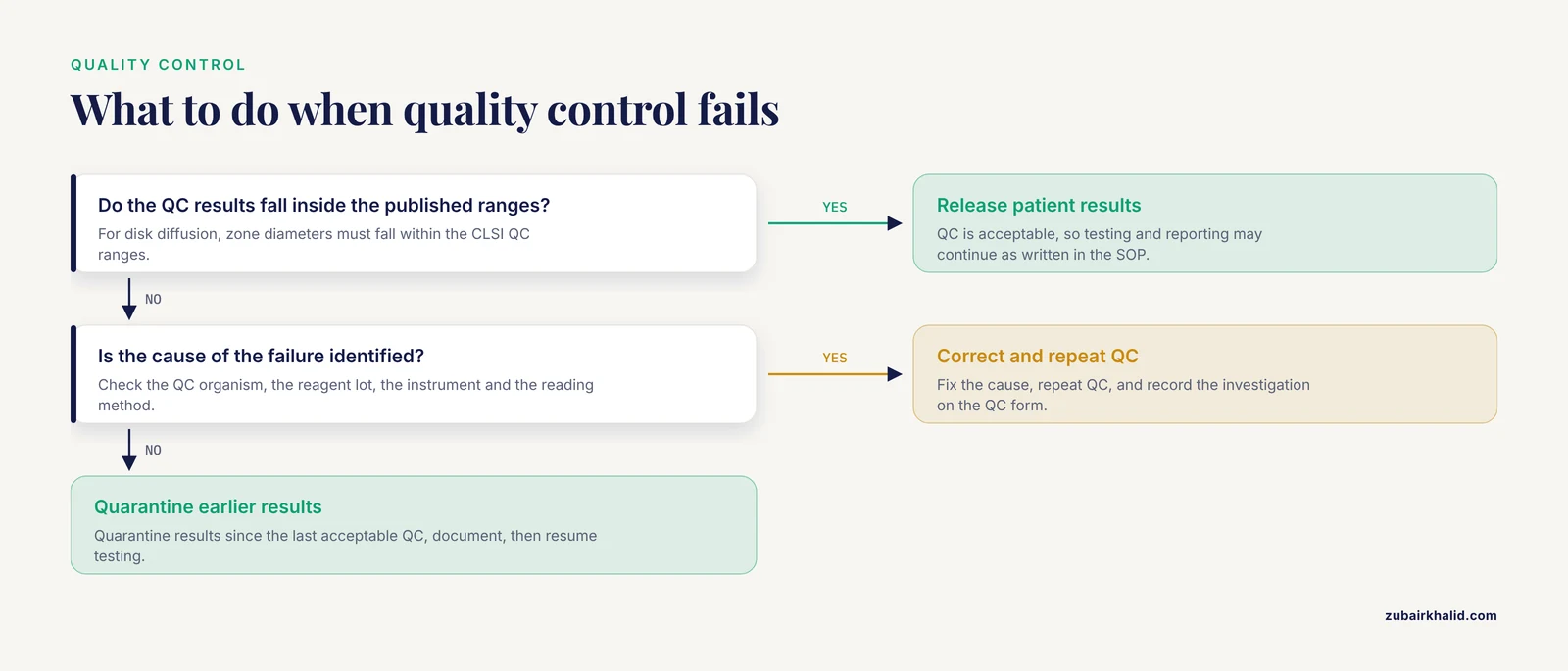
The quality control section is where microbiology quality control lives inside the document, and assessors read it first. It must specify, for each material and instrument used in the procedure, the QC material, the expected result, the frequency, and the corrective action for failure.
Concrete examples make the expectation clear. For a blood agar plate used in a culture SOP, QC includes sterility checks on an uninoculated plate from each lot and growth-support checks with a known organism, confirmed visually by hemolysis pattern and colony morphology. For a chocolate agar plate, the QC organism must be one with defined growth requirements that will not grow on the plate if it was over-heated during preparation. For disk diffusion AST, the laboratory tests reference strains such as Escherichia coli ATCC 25922, Staphylococcus aureus ATCC 25923, and Pseudomonas aeruginosa ATCC 27853 and confirms that zone diameters fall within the published CLSI QC ranges before patient results are released. Pharmaceutical compounding quality programs formalize this same logic, treating the QC SOP as an essential tool for ensuring that each preparation meets predefined quality attributes every time it is made [8].
The QC section must also define the response to an out-of-range result: quarantine results since the last acceptable QC, investigate, document, and only then resume testing. A QC section that states what to test but not what to do on failure is incomplete.
9. Method Validation and Limitations
This section documents why the laboratory is entitled to trust the method. For a commercial system, it records the verification study performed before the test was placed into service. The stakes are well illustrated by the antifungal susceptibility literature. An evaluation of the ATB FUNGUS 3 system, the most commonly used commercial antifungal susceptibility method in China at the time, compared automated reader output against broth microdilution following CLSI M27-A3 as the reference standard. Visual reading achieved 99.1% essential agreement with the reference method, but automated reading achieved only 86.2% overall, dropping to 73.4% for itraconazole, largely because azole trailing growth misled the optical reader [3]. The lesson for SOP structure is twofold. The validation section must exist and must be specific to the exact system and read mode in use, and the limitations section must state known interferences, such as trailing endpoints in azole testing, so the technologist knows when a flagged result needs manual review.
The limitations section also covers specimen-level constraints, such as mixed cultures, polymicrobial smears, and organisms below the detection threshold of the identification database.
10. Safety and Biosafety
Microbiology SOPs handle risk group 2 organisms routinely and risk group 3 organisms occasionally, so the safety section is not decorative. It specifies containment level, required personal protective equipment, sharps handling, decontamination of work surfaces before and after the procedure, spill response, and the location of the nearest eyewash station. Detailed guidance on SOP development for high-containment arthropod research makes the general principle explicit: concisely written SOPs link safe work practices, containment measures, institutional training, and the specific research protocol into a single document that a biosafety committee can review as a unit [9]. The same integration principle applies to a diagnostic lab handling cultures of Brucella or Mycobacterium. The safety section must name the agents likely to be encountered, the route of exposure of greatest concern, and the specific engineering controls required.
11. Result Interpretation and Reporting
This section converts bench observations into reportable results. For an identification SOP, it lists the interpretive thresholds for biochemical panels or the MALDI-TOF score criteria used locally for species-level calls. For an AST SOP, it states which breakpoints apply and cites the specific CLSI or equivalent breakpoint document and year, because breakpoints change and the SOP must record which edition is in force. It also defines critical or panic results, such as a positive blood culture smear or a cerebrospinal fluid smear showing organisms, and the direct-call procedure with timeframes, who is called, and how the call is documented.
12. Documentation and Records
The documentation section lists every record generated by the procedure, where it is stored, in paper or electronic form, how long it is retained, and who can correct it. Correction rules deserve explicit text. A manual entry on a QC worksheet is corrected by a single line through the error, the correct value, the reason, the date, and the initials of the person making the correction. Erasure, correction fluid, and overwriting are prohibited because they destroy the audit trail.
13. Troubleshooting
The troubleshooting section is a table of common failures and responses: no growth on any medium after 48 hours despite a positive Gram stain, contaminated selective media, a viscous specimen that will not centrifuge clear, an identification card that fails to populate, or an AST panel with an invalid control well. Each row names the symptom, the likely cause, the corrective action, and when to escalate to the supervisor. This section is often the most-used part of the document at the bench, and writing it from the actual error log rather than from imagination is what makes it useful.
14. References and Related Documents
This section cites the source method (for example, the CLSI M27-A3 standard referenced for broth microdilution antifungal testing [3]), the manufacturer's package insert with its revision date, and the related internal SOPs for media preparation, specimen collection, and instrument maintenance. Cross-references by document number and title, never by "see attached."
15. Revision History and Approval
The final section is a table of every version of the document: version number, date, a summary of changes, the author, and the approver. Assessors use this table to reconstruct the history of a method, and it is the section most often missing or abandoned in labs that update SOPs by overwriting files. A revision history also carries operational weight. When an outbreak investigation later asks how a given isolate was worked up in a specific month, the revision history plus the archived superseded version provide the answer.
Microbiology SOP Structure Examples
Abstract sections become clearer with a filled-in skeleton. The following outline shows the anatomy of a microbiology lab SOP applied to a common bench task.
SOP MB-ID-014, "Identification and Antimicrobial Susceptibility Testing of Enterobacterales from Clinical Cultures," version 3.0
- Header. MB-ID-014, version 3.0, effective 1 March 2026, review due 1 March 2028. Author, senior technologist. Approved by laboratory director.
- Purpose. To describe identification and susceptibility testing of aerobic Gram-negative bacilli recovered from clinical cultures on the laboratory's automated identification and AST system.
- Scope. Applies to pure cultures of Enterobacterales from blood, urine, respiratory, and wound specimens. Excludes fastidious organisms requiring supplemental media and organisms processed under enhanced biosafety precautions, which are covered by MB-ID-021.
- Responsibilities. Bench technologist performs testing and first-line interpretation. Senior technologist verifies results. Supervisor manages QC failures and competency documentation. Director approves interpretation criteria changes.
- Materials. Identification and AST panels with lot number and expiry recorded at each use, 0.5 McFarland turbidity standard, calibrated inoculum devices, cotton swabs, sterile saline, incubator verified at 35 ± 2 °C.
- Procedure. 6.1 Select well-isolated colonies from an 18 to 24 hour culture. 6.2 Prepare suspension to 0.5 McFarland within 15 minutes of removal from the incubator. 6.3 Inoculate panel per the manufacturer's current package insert, cited by document number. 6.4 Apply lids without trapping bubbles. 6.5 Load into the reader within the manufacturer's specified time window. 6.6 Review the instrument call against the inoculum purity check before release.
- Quality control. Test E. coli ATCC 25922 and P. aeruginosa ATCC 27853 panels with each new lot and shipment and at the defined frequency for in-use lots. Acceptable MIC ranges come from the current CLSI QC tables. On failure, quarantine results since the last passing QC, repeat QC, document on form F-MB-03, and escalate.
- Validation status. Verified against a reference broth microdilution method before implementation, with the verification summary filed under document number MB-VAL-009. Limitations note that inducible resistance mechanisms may require supplemental testing.
- Safety. All manipulation of live cultures performed in a certified biosafety cabinet. Gloves and lab coat required. Decontaminate surfaces before and after with an approved disinfectant and record on the daily log.
- Reporting. Report organism name and MIC with categorical interpretation per the breakpoint edition listed in section 11. Blood culture isolates trigger a direct call to the ordering unit within a defined timeframe, documented on the notification log.
- Troubleshooting. Table of symptoms, causes, and actions, including insufficient growth, contaminated suspension, and instrument flags.
- Records. Raw instrument output, QC worksheet, and patient report retained per the laboratory retention schedule.
- Revision history. Version 3.0 updates breakpoint tables to the current CLSI edition and adds a purity check step. Prior versions archived.
The same skeleton scales down for a simple task such as preparing smears and scales up for molecular assays, where the QC section expands to include contamination controls, positive and negative extraction controls, and run-validity criteria. Multicenter scientific programs demonstrate the value of this consistency when it is engineered deliberately. A pancreatic cancer biorepository consortium consolidated the SOPs of its clinical centers, harmonized them against the published biobanking literature, and produced a single biorepository SOP set whose meticulous, standardized specimen handling was the stated precondition for downstream molecular work [10]. A liquid biopsy consortium reached the same conclusion for blood and urine preanalytics, noting that implementation in clinical practice was limited by the lack of shared, reproducible SOPs for sample collection, processing, and storage, and publishing its own trial-level procedures to close that gap [11].
How Microbiology SOPs Are Written, Reviewed, and Kept Alive
Development: Evidence Before Prose
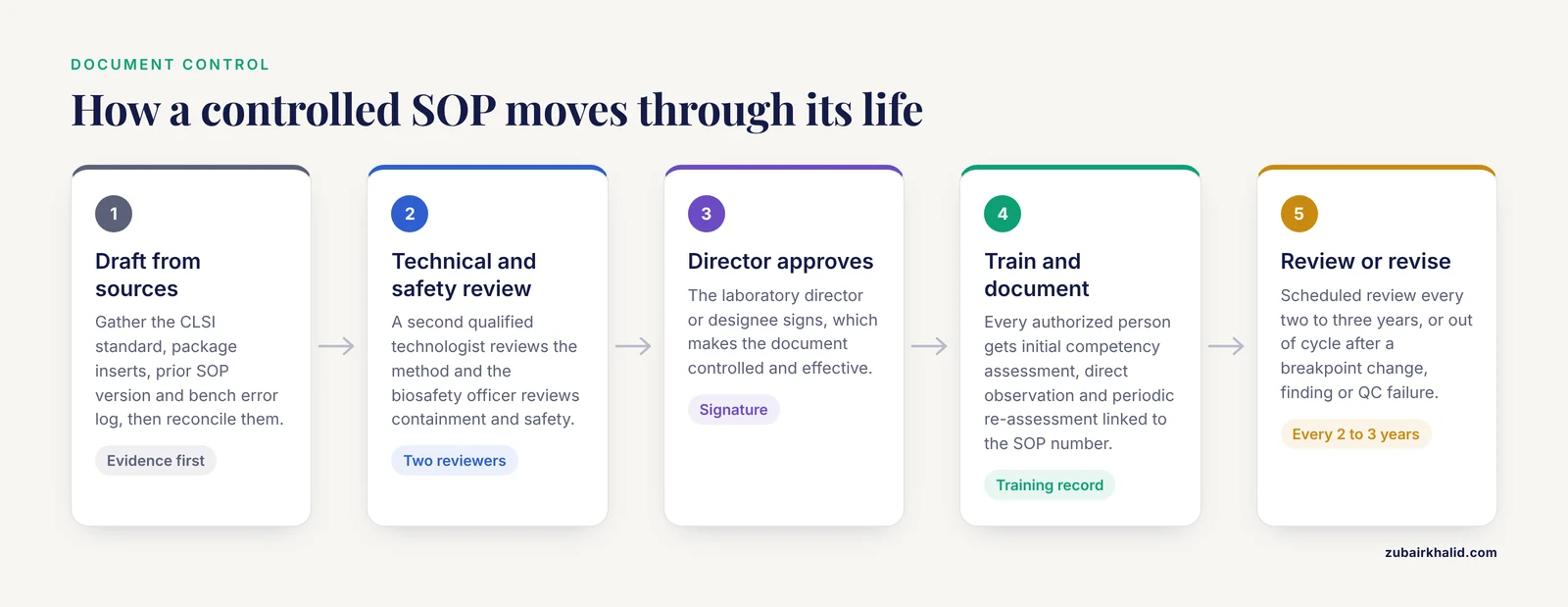
Strong SOPs are assembled from sources, not written from memory. A consensus-building exercise in vector control research offers a model: investigators collated many existing methods for testing insecticide-treated nets, interrogated them against the evidence, and distilled them into a single consensus SOP for monitoring residual efficacy [12]. Clinical laboratories can follow the same pipeline. Gather the CLSI standard, the manufacturer package insert, the package inserts of any reagents, the prior version of the local SOP, and the bench error log, then reconcile them. Risk-based prioritization helps here. Healthcare safety methodology recommends using risk assessment to identify the activities whose standardization yields the greatest safety benefit, and building SOPs for those first [2].
End-user involvement is not optional courtesy. In a survey of dairy farm personnel offered ready-made SOPs for animal care tasks, only 13.1% of farms already had written procedures, but 69.4% wanted them, 66.5% judged ready-made SOPs feasible for their operation, and 64.2% of employees said they wanted to be involved in creating procedures specific to their own operation [13]. The laboratory parallel is direct. The technologist who runs the bench daily knows where the written procedure and the real workflow have diverged, and involving that person during drafting produces a document that survives contact with practice.
Review and Approval
Draft SOPs circulate for technical review by a second qualified technologist, safety review by the biosafety officer or safety committee, and final approval by the laboratory director or designee. The approval signature certifies that the document is scientifically sound, safe, and consistent with laboratory policy, and that signature is what makes the document controlled.
Training and Implementation
An approved SOP that staff have not read is a paper artifact. Implementation research across fields converges on the same requirements. In helicopter emergency medical services, a qualitative study of how units create and implement medical SOPs found that implementation depended on structured introduction, integration into daily workflow, and cultural acceptance, not on document quality alone [5]. In the calf-care survey, 85% of participants agreed that SOPs were a suitable tool for training new employees, and SOP-based e-learning modules measurably increased confidence in performing the tasks covered, particularly the tasks performed less frequently [13]. In a laboratory, this translates to a documented training record for every person authorized under the SOP, with initial competency assessment, direct observation, and periodic re-assessment, all linked to the SOP number in the training file.
Review, Revision, and Retirement
SOPs carry scheduled review dates, typically every two to three years, and are also revised when a triggering event occurs: a new instrument or reagent lot system, a breakpoint change, an inspection finding, a QC failure investigation, or an incident. Containment research offers the discipline model here as well. Guidance for SOP development in high-consequence research recommends explicit processes for maintaining the effectiveness of SOPs through periodic evaluation and revision, with biosafety officers and committees sharing responsibility for keeping documents current [9]. When a procedure is retired, the document is withdrawn from circulation, marked superseded, and archived, never deleted.
How SOP Structure Is Tested in Practice
Assessors, inspectors, and internal auditors test an SOP's structure with a predictable sequence of probes, and understanding them helps authors anticipate weakness.
Traceability probes. The assessor picks a reported result and walks backward: result, then the SOP version in force that day, then the QC record for the reagent lot used, then the training record of the person who signed the bench worksheet. Every link in that chain depends on the header, QC, documentation, and revision-history sections being complete.
Compliance probes. Compliance can be quantified when the SOP defines time-based process variables. In the global polio eradication program, outbreak response SOPs specified critical timelines, and analysts compared observed timelines against the indicators published in SOP version 3.1 across 111 outbreaks to measure whether compliance was associated with stopping transmission [14]. A laboratory can run the same logic internally by defining, for example, the time from blood culture positivity flag to Gram stain result, and auditing actual performance against the SOP's stated timeframe.
Gap probes. Auditors also look for what is missing. A framework analysis of 32 adverse-event SOPs in digital health research found common strengths in some domains but consistent gaps in others, particularly in classifying events during trials and in providing training and supervision for the staff doing the measurement and reporting [15]. In microbiology terms, the analogous finding is an SOP that describes the bench steps thoroughly but says nothing about who verifies competency or how deviations are classified.
Specificity probes. A specificity audit asks whether a qualified but unfamiliar technologist could perform the task from the document alone. The value of precision shows up starkly in cross-program comparisons. An evaluation of end-of-life SOPs from eight government authorities managing cetacean strandings extracted 29 decision parameters and found high variability in procedures and equipment, and, critically, only five of the SOPs provided criteria for verifying death, while only two recommended recording time to death, which undermined later evaluation of welfare outcomes [16]. The microbiology parallel is an SOP that instructs "read the panel and report" without defining how to resolve a discrepant identification or an off-scale MIC. Anything the document leaves unverified is left to individual judgment, and unverified judgment is exactly what the SOP exists to constrain.
Currency probes. The assessor checks the review date, interviews staff against the current version, and compares the bench practice to the text. A documented practice that differs from the written procedure is a finding either way: either the document is wrong or the bench is out of compliance.
Misconceptions Students Most Often Hold
"A longer SOP is a better SOP." Length is not rigor. A procedure written at the reading level of the least experienced qualified user, with each step as a single action, outperforms a dense treatise, because the document's job is consistent execution, not instruction [7].
"The SOP is the same thing as the package insert." The manufacturer's insert is a source document that the SOP references and adapts. The SOP must reflect the laboratory's actual workflow, specimen types, instruments, and reporting conventions, which no insert can know.
"Once approved, an SOP is finished." A controlled SOP is a living document with a scheduled death and rebirth cycle. Treating approval as an endpoint is how laboratories end up reporting from breakpoint tables that are years out of date.
"QC is a section you can skip for simple procedures." Even a manual wet-mount benefits from defined QC: stain lots checked with known organisms, microscope calibration, and defined rejection criteria. The QC obligation scales with the procedure but never reaches zero.
"Validation is a one-time event handled by the manufacturer." Performance must be verified in the specific laboratory, on the specific instrument, with the specific read mode before patient testing begins. The ATB FUNGUS 3 experience shows that the same product can agree almost perfectly with a reference method when read one way and disagree materially when read another, which is invisible until the laboratory runs its own comparison [3].
Common Mistakes and Limitations
The following are the defects most frequently found when microbiology SOPs are audited, phrased as fixable problems.
- Copy-paste drift. The document describes an instrument or workflow the laboratory no longer owns. This usually follows adoption of a template from another facility without local adaptation. Fix by auditing the document against the bench during the review cycle.
- Missing acceptance criteria. Steps that say "incubate and read" without stating the required duration, temperature, and what constitutes an acceptable result. Every step with a judgment call needs the criterion written next to it.
- Verification gaps at the decision points. As the cetacean SOP analysis showed, the steps most often missing are the ones that confirm an outcome rather than perform an action, such as death-verification criteria in euthanasia procedures [16]. Microbiology equivalents include confirmation of colony purity before identification and confirmation of organism growth before interpreting an MIC.
- Unvalidated or unverified methods. Introducing a commercial system without local verification, then discovering reader-dependent bias in patient results, the exact failure seen with automated azole susceptibility readings [3].
- Orphaned roles. Responsibilities assigned to job titles that no longer exist, leaving no owner for QC review or deviation investigation. Research on task ambiguity shows this gap degrades both output quality and staff morale [1].
- Training that is assumed rather than documented. Adverse-event SOP analysis across 32 documents identified training and supervision of the people doing the measurement as a recurring hole [15]. If competency is not documented and linked to the SOP, it does not exist for assessment purposes.
- Documents written without the bench. Procedures drafted by supervisors in an office diverge from practice and breed quiet workarounds. End users report both that they want SOPs and that they want a voice in writing them.
- Deviation handling left undefined. The SOP describes the happy path only. When the analyzer fails mid-run or a specimen arrives unlabeled, the technologist improvises, and improvisation is the audit finding.
- A limitation of the tool itself. Even a well-structured SOP cannot compensate for an unsafe method, a reagent outside its expiration date, or staff who are not competent. The document enables quality work, it does not replace it, and individual clinical cases always require qualified professional judgment.
Quick Review
- A microbiology SOP is a controlled, versioned document, distinct from policies, methods, work instructions, and forms, and it anchors laboratory quality management.
- The required sections run from an identification block through purpose, scope, definitions, responsibilities, materials, numbered procedure steps, quality control, validation and limitations, biosafety, reporting, records, troubleshooting, references, and revision history.
- Every procedural step that involves a decision needs an explicit acceptance criterion and a defined action if the criterion is not met.
- The QC section names the organism or material, the expected result, the frequency, and the corrective action on failure, including quarantining results since the last passing QC.
- Methods are verified locally before use, because performance can differ sharply between read modes or instruments on the same product.
- SOPs are living documents with scheduled reviews, event-triggered revisions, archived superseded versions, and documented, SOP-linked competency training.
- Assessors test structure through traceability, compliance, gap, specificity, and currency probes, and the sections that fail most often are validation, deviation handling, and revision history.
Frequently Asked Questions
What is microbiology SOP structure?
Microbiology SOP structure is the standardized set of sections a laboratory uses to document a bench procedure, including the identification block, purpose, scope, definitions, responsibilities, materials, numbered procedural steps, quality control, validation and limitations, biosafety, reporting, records, troubleshooting, references, and revision history. The structure exists so that any qualified person can perform the task identically and every result can be traced back to a defined process.
What sections are absolutely required in a microbiology lab SOP?
At minimum, a complete SOP needs document control information, a purpose, a scope, defined responsibilities, a list of materials and equipment, the step-by-step procedure, a quality control section with acceptance criteria and corrective actions, safety instructions, result interpretation and reporting rules, record-keeping requirements, and a revision history. Shorter documents may merge definitions or troubleshooting into other sections, but the control, QC, and revision elements cannot be omitted.
Who writes and approves SOPs in a clinical microbiology laboratory?
The technical staff member who performs the procedure usually drafts it, often with input from the senior technologist and the bench team. Review follows from a second qualified technologist and the biosafety or safety function, and final approval rests with the laboratory director or a designated qualified approver. Involving the people who run the bench is associated with procedures that are actually followed.
How often should a microbiology SOP be reviewed?
Laboratories commonly set a scheduled review every two to three years, but any triggering event forces an out-of-cycle revision, such as a new instrument, a reagent or breakpoint change, an inspection finding, a QC failure investigation, or a documented deviation. The scheduled review date appears in the document header so that overdue reviews are visible.
What is the difference between an SOP and a policy or a work instruction?
A policy states what the laboratory commits to, an SOP describes how a specific task is performed step by step, and a work instruction covers one narrow step within a procedure. In practice, a policy might commit the lab to timely susceptibility reporting, the SOP describes the susceptibility testing workflow, and the work instruction explains how to load the panel into the reader.
How does microbiology quality control fit into an SOP?
Quality control is a mandatory section inside the SOP, not a separate activity. It specifies the QC organisms or materials, the expected results and acceptance ranges, the testing frequency tied to reagent lots and shipments, and the required response when QC fails, including quarantining patient results since the last acceptable QC. Auditors typically read this section first because it demonstrates whether the procedure can produce valid results.
Sources
- Task Ambiguity: The Effects of Missing Standard Operating Procedures and Inter-Leadership Harmony in Organizations
- Standard operating procedures as a trend in ensuring healthcare safety
- The Widely Used ATB FUNGUS 3 Automated Readings in China and Its Misleading High MICs of Candida spp. to Azoles: Challenges for Developing Countries' Clinical Microbiology Labs
- Dairy farmer advising in relation to the development of standard operating procedures.
- The creation, implementation, and harmonisation of medical standard operating procedures and checklists of Finnish Helicopter Emergency Medical Service units
- An Object-Oriented Approach for Developing Standard Operating Procedures for Novel Aerial Systems
- Developing Effective Standard Operating Procedures
- Quality-control standard operating procedures-an essential tool for developing quality preparations.
- Developing standard operating procedures for gene drive research in disease vector mosquitoes
- Standard Operating Procedures for Biospecimen Collection, Processing, and Storage: From the Consortium for the Study of Chronic Pancreatitis, Diabetes, and Pancreatic Cancer
- Standard Operating Procedures (SOPs) for non-invasive multiple biomarkers detection in an academic setting: a critical review of the literature for the RENOVATE study protocol.
- Developing Consensus Standard Operating Procedures (SOPs) to Evaluate New Types of Insecticide-Treated Nets
- Feasibility and acceptance of ready-made standard operating procedures in calf care on German dairy farms.
- Assessing country compliance with circulating vaccine-derived poliovirus type 2 outbreak response standard operating procedures: April 2016 to December 2020
- Measurement of Adverse Events in Studies of Digital Health Interventions for Psychosis: Guidance and Recommendations Based on a Literature Search and Framework Analysis of Standard Operating Procedures
- When and how to say goodbye: An analysis of Standard Operating Procedures that guide end-of-life decision-making for stranded cetaceans in Australasia