Training Your Microbiology QC Team
By Dr. Zubair Khalid, DVM, MS, PhD ·
A microbiology QC training plan converts quality control from a signature on a log sheet into a skill your bench can defend under inspection. The program below builds a documented, role-based curriculum that takes a new technologist from general bench skills to independent quality control work in about 12 weeks of elapsed time, with roughly 70 hours of structured classroom and bench time per trainee. After release to independent work, the program settles into a standing cycle of about 2 hours per month per trained staff member.
Use the plan when you onboard new staff, when a QC failure or a proficiency testing (PT) result points to a knowledge gap, when you roll out a new method or instrument, or when you prepare for a CLIA, College of American Pathologists (CAP), or ISO 15189 inspection. It also works as a remediation track for an experienced technologist whose control charts or error history show drift.
Microbiology quality control is the set of scheduled checks that prove your media, stains, reagents, instruments, and people perform as intended before patient results are released. In bacteriology that means organism controls for stains and biochemical tests, new-lot checks on culture media, scheduled QC of antimicrobial susceptibility testing (AST), daily temperature and sterilization logs, and documented competency for every person who touches a specimen. The trained team running those checks is the layer that catches a quiet failure before it reaches a patient report.
Why a Trained QC Team Changes Laboratory Outcomes
Quality control failures in microbiology rarely announce themselves. A weak decolorizer, a contaminated media lot, or a drifting incubator produces results that look plausible. The only reliable detection layer is a person who knows what to check, why the check exists, and what to do when the check fails.
The clearest published picture of what a systematic program delivers comes from a large routine diagnostics service. In 2013, Jinan KingMed Diagnostics in Shandong Province, China, established a systematic training and quality control program for its cervical screening bench, then tracked diagnostic performance across four years of routine practice, from January 2014 through December 2017, in more than 4,800 patients with histologically confirmed cervical intraepithelial neoplasia (CIN), a precancerous cervical lesion graded from 1 to 3, or invasive cervical cancer (ICC) [1]. Prior screening results were available for 1,829 patients with CIN1, 2,309 with CIN2/3, and 680 with ICC [1]. The design matters for any QC team because the program was judged against patient outcomes over years of real workload, not against a single audit day. That is the standard a microbiology QC training plan should aim for, and the sections below show how to build toward it.
What Microbiology Quality Control Covers
Laboratory quality management is the umbrella system that holds the quality manual, document control, training records, QC schedules, PT, and corrective action records. Microbiology QC sits inside that umbrella and splits into three pillars.
- Materials QC. Culture media, stains, reagents, antisera, and antimicrobial disks, each checked with reference organisms at the lot level before routine use.
- Instrument and environment QC. Incubators, refrigerators, freezers, autoclaves, biosafety cabinets, and AST readers, each monitored with logs, physical indicators, and biological indicators.
- Personnel competency. The people layer, assessed through observation, blind retests, record review, and problem-solving exercises, then documented and renewed.
The technical targets come from standards your laboratory already follows. CLSI publishes the QC standards most US microbiology benches use, including the media QC and AST QC documents that define the organism strains and target ranges your trainees will plot against. CLIA requires documented competency assessment for testing personnel. ISO 15189 frames the same requirements internationally as a quality management system, and CAP inspects US laboratories against them. Keep this frame in view, because every step below produces a record one of these bodies will ask to see.
The Principle Behind the Training Plan
The plan rests on four ideas. First, competency is a combination of knowledge, observed skill, documented QC performance, and the ability to respond to failure, so the curriculum has to touch all four. Second, training and QC operate as one system rather than two separate functions, a design the KingMed program followed by pairing its training curriculum with routine QC monitoring of real clinical workload [1]. Third, layered checks beat single checks, a point the outcome data make directly in the Expected Results section below. Fourth, adults learn bench skills at the bench, so at least two thirds of the scheduled hours are hands-on.
One person owns the program. That QC lead demonstrates techniques, signs off competency, runs the monthly review, and holds the authority to stop testing when QC fails. Everyone else on the team trains to the role-specific tasks the matrix assigns them.
Materials, Reagents, and Documents
Buy or assemble these before the first session. The reference strains come from the American Type Culture Collection (ATCC), the strain bank most QC standards name, and they arrive as verified stocks with documented passage history.
| Item | Preparation or working concentration | Purpose in training | Notes |
|---|---|---|---|
| Escherichia coli ATCC 25922 | 0.5 McFarland suspension for AST, direct colonies for stain and biochemical QC | Gram-negative QC strain for AST, Gram stain, indole-positive and oxidase-negative controls | Limit working cultures to about five passages from the verified original stock |
| Staphylococcus aureus ATCC 25923 | 0.5 McFarland suspension for AST, direct colonies for stain and biochemical QC | Gram-positive AST and stain QC, catalase-positive and coagulase-positive control | Same passage limit |
| Pseudomonas aeruginosa ATCC 27853 | 0.5 McFarland suspension for AST | Oxidase-positive control, Gram-negative AST QC | Same passage limit |
| Enterococcus faecalis ATCC 29212 | Direct colonies or suspension per method | MIC QC, catalase-negative control, medium suitability checks | Same passage limit |
| 0.5 McFarland standard | 0.5 mL of 1.18% barium chloride dihydrate in 99.5 mL of 1% sulfuric acid, or a commercial equivalent | Standardizes inoculum turbidity, roughly 1 to 2 × 10^8 colony-forming units (CFU) per mL | Replace when volume drops or appearance changes, verify against a densitometer at setup |
| Gram stain kit | Crystal violet, Gram iodine, ethanol or acetone-alcohol decolorizer, safranin, used as supplied | Stain QC and smear technique | QC each new lot with ATCC 25923 (purple cocci) and ATCC 25922 (pink bacilli) |
| Culture media | 5% sheep blood agar, chocolate agar, MacConkey agar, Mueller-Hinton agar poured to a uniform depth of about 4 mm, Mueller-Hinton broth | New-lot growth, selectivity, and AST support checks | Cation-adjust the broth where the AST method requires it |
| Catalase reagent | 3% hydrogen peroxide, fresh | Enzyme test technique with positive and negative controls | Oxidizer and irritant, store cold and closed |
| Oxidase reagent | 1% tetramethyl-p-phenylenediamine dihydrochloride, freshly prepared | Oxidase technique | Discard when it darkens, it oxidizes in air |
| Kovács indole reagent | 5 g p-dimethylaminobenzaldehyde in 75 mL isoamyl alcohol, then 25 mL concentrated hydrochloric acid | Indole technique | Corrosive acid and flammable alcohol, mix in a fume hood |
| Antimicrobial disks or AST cards | Store at 2 to 8°C with desiccant, or frozen where the manufacturer directs | AST QC practice | Warm to room temperature before opening to prevent condensation |
| Sterilization indicators | Chemical indicator strips per load, biological indicators with Geobacillus stearothermophilus spores | Autoclave QC training | Keep an unprocessed indicator as the positive growth control |
| Reference thermometer | Traceable thermometer for daily instrument checks | Incubator, refrigerator, and freezer logs | Recalibrate on the schedule your SOP sets |
| Documents | Training matrix, SOPs, QC log templates, Levey-Jennings charts, competency checklists, corrective and preventive action (CAPA) forms, plus a standard reference such as the ASM Manual of Clinical Microbiology | The written backbone of the program | Version-controlled with effective dates |
Safety note. Treat every strain and every specimen at biosafety level 2, the standard containment set for human-associated organisms, with lab coat, gloves, and eye protection, and use a biosafety cabinet for any aerosol-generating step. Barium chloride is toxic, sulfuric acid and hydrochloric acid are corrosive, hydrogen peroxide and the oxidase reagent are oxidizers and irritants, and the alcohols are flammable. Keep sharps in a sharps container, never pipette by mouth, and confirm eyewash access before the first bench session.
The Step-by-Step Microbiology QC Training Plan
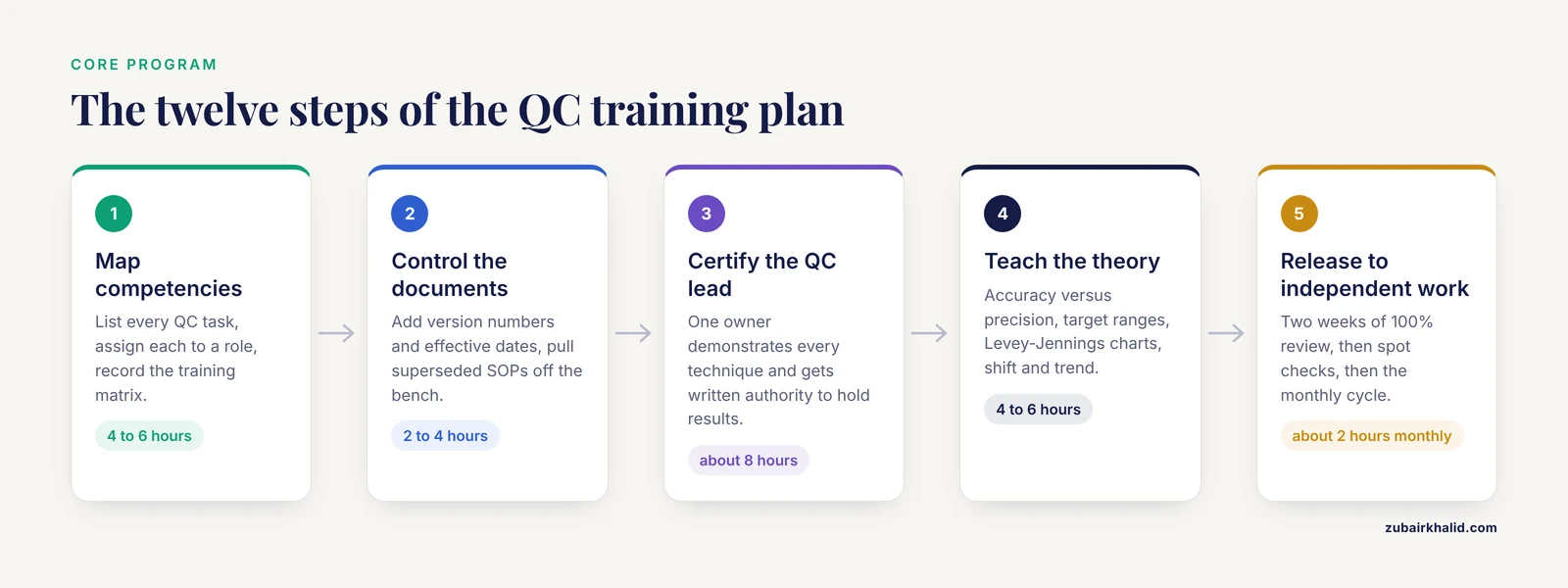
The sequence below is the core program. Each step lists the hands-on time and the reason the step exists, because a trainee who knows why a step exists performs it better than one who memorizes it.
- Map competencies to roles. Time, 4 to 6 hours with the supervisor team. List every QC task in the laboratory, from media lot checks and stain QC to AST QC, temperature logs, autoclave runs, chart review, and CAPA. Assign each task to a role, set the minimum competency for each role, and record the result as a training matrix. Reason. Competency requirements are role-specific under the CLIA framework, the matrix prevents both gaps and duplicate training, and it becomes the audit trail inspectors ask for first.
- Put documents under control before training starts. Time, 2 to 4 hours. Collect every SOP the trainee will use, add version numbers, effective dates, and review dates, and pull superseded copies off the bench. Reason. Training against an obsolete SOP creates trained-in errors that later surface as QC failures, and document control is the backbone of laboratory quality management.
- Certify the QC lead. Time, about 8 hours of preparation plus a demonstrated bench sign-off. Choose one accountable owner, have that person demonstrate every technique to the laboratory director or an external assessor, and give explicit written authority to hold results. Reason. A program without a single owner fragments, and a lead who cannot stop testing when QC fails cannot protect patients.
- Teach the theory block. Time, 4 to 6 hours. Cover accuracy versus precision, control materials, target ranges, the Levey-Jennings chart, which plots each control result over time against its target range, and how to recognize shift, trend, and out-of-range results. Introduce multirule control chart logic in plain language and the concept of lot-to-lot verification. Reason. Trainees who understand what a control chart detects treat QC as an error-detection tool instead of paperwork.
- Run stain and rapid reagent QC at the bench. Time, about 4 hours. Prepare control smears with ATCC 25923 and ATCC 25922, time the decolorizer step with a clock, then run catalase, oxidase, and indole with positive and negative controls and record every result. Safety note. Hydrogen peroxide is an oxidizer and the oxidase reagent is an irritant, so wear gloves and eye protection and work with the reagents capped when not in use. Reason. Stains and rapid tests are the highest-frequency QC items in microbiology, and a weak decolorizer or stale oxidase reagent corrupts every report downstream.
- Perform new-lot media checks. Time, about 4 hours. Inoculate blood, chocolate, and MacConkey plates from the QC strains, assess growth, colony morphology, and selectivity, run a sterility check on uninoculated plates from the same lot, and complete the lot record before release. Reason. A bad media lot fails silently, and the release decision is exactly the judgment you are training.
- Run AST QC end to end. Time, about 6 hours. Make 0.5 McFarland suspensions of ATCC 25922, 25923, and 27853, inoculate Mueller-Hinton plates or panels, apply disks or load cards, incubate, measure zones of inhibition or read the minimum inhibitory concentration (MIC), the lowest antibiotic concentration that inhibits visible growth, then plot results against the published target ranges and decide pass or fail. Heat-sterilize loops fully between strains or use disposable loops. Reason. AST results direct antibiotic therapy, so this session teaches both the technique and the quantitative reading of control ranges.
- Cover instruments and the environment. Time, about 3 hours. Read and record ambient incubators held near 35°C, CO2 incubators near 5% CO2, refrigerators at 2 to 8°C, and freezers per SOP. Run an autoclave cycle at 121°C with a chemical indicator per load and a biological indicator on the schedule your SOP sets, and check biosafety cabinet certification status. Safety note. Never open an autoclave before the cycle completes and the chamber depressurizes, and use heat-resistant gloves for loaded racks. Reason. Environmental drift invalidates everything the bench does downstream, and instrument logs are the records auditors sample first.
- Drill data review. Time, about 2 hours. Hand the trainee a packet of plotted control data with planted shifts, trends, and outliers, and ask them to detect each problem, classify it, and state the required action. Reason. Reading control charts is a perishable skill, and drills build the pattern recognition that routine bench days do not.
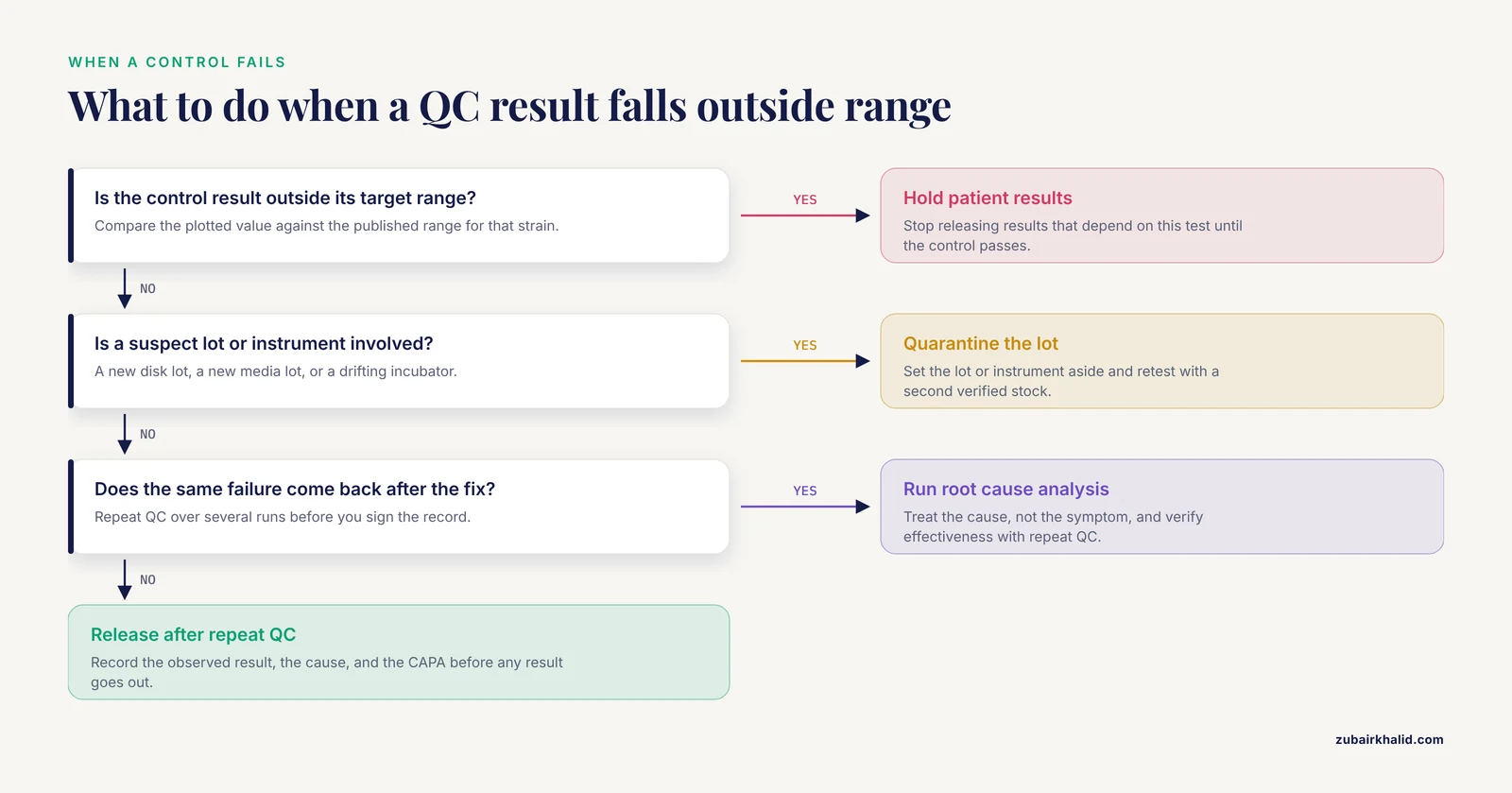
- Simulate a QC failure. Time, 2 to 3 hours. Give a scenario such as a QC zone outside its target range on a new disk lot. The trainee must hold affected results, quarantine the lot, investigate the root cause, write the CAPA record, and verify the fix with repeat QC. Reason. The response to failure is the hardest and least practiced skill, and it is the first thing an inspector probes.
- Assess competency formally. Time, 3 to 4 hours. Combine direct observation of routine work, blind retesting of specimens with known results, review of the trainee's own QC records, and a problem-solving exercise, then document sign-off by the QC lead. Reason. The CLIA competency framework uses several assessment methods together because no single test detects every weakness, and the signed record is what makes the training defensible.
- Release to independent work on a graduated schedule. Time, 2 weeks of 100% review, then a taper. Review every QC result the new technologist produces for the first two weeks, move to spot checks, then settle into the standing monthly cycle of about 2 hours, which covers the QC meeting, chart review, and log audit. Reason. Competency decays and methods change, so the program ends in a maintenance cycle rather than a final exam.
Controls the Team Runs and Reads
A control proves a test can detect both the positive and the negative state. A missing positive control leaves false negatives undetectable, and a missing negative control leaves false positives undetectable. Every trainee memorizes the control set below and the rule that follows it.
| System | Positive control | Negative control | When to run |
|---|---|---|---|
| Gram stain | S. aureus ATCC 25923, purple cocci | E. coli ATCC 25922, pink bacilli | Each new lot or batch of reagents, and weekly while in active use |
| Catalase | S. aureus, immediate bubbling | E. faecalis, no bubbling | Each new reagent lot and each day of use |
| Oxidase | P. aeruginosa, purple within seconds | E. coli, no color change | Each new reagent lot and each day of use |
| Indole | E. coli, red with Kovács reagent | Klebsiella pneumoniae, no color change | Each new reagent lot |
| Coagulase | S. aureus, clot formation | A coagulase-negative staphylococcus such as S. epidermidis, no clot | Each new lot of plasma or reagent |
| Disk diffusion or MIC AST | ATCC 25922, 25923, and 27853 within published target ranges | Ranges themselves define acceptability | Each new lot or shipment, plus a regular schedule, commonly weekly while in active use, with extended intervals only where validation and your accreditor allow |
| Culture media | Growth and typical morphology on blood and chocolate agar, correct selectivity on MacConkey | Sterility check on uninoculated plates | Each new lot before release |
| Autoclave | Biological indicator with no growth after incubation | Unprocessed indicator as the positive growth control | Every cycle or on the schedule your SOP sets |
The reading rule is simple. When a control fails, hold patient results that depend on that test, find the cause, fix it, and repeat the control before releasing anything. Record the observed result, not just a signature, because a log full of checkmarks with no values proves nothing to an inspector or to a court.
Expected Results and How to Read Them
A functioning program looks quiet. Control results sit inside their target ranges, charts show stable scatter with no drift, the rare failure is documented with a root cause and a CAPA record, competency files are current, and PT results come back acceptable. Silence in the QC log is the expected result, not a sign that nothing is happening.
The published evidence also shows what layered detection delivers. In the four-year KingMed review, cytology alone and HR-HPV testing alone performed similarly on the hardest cases, detecting CIN2/3 in 97.2% versus 95.4% of tested patients (P = 0.105) and ICC in 89.1% versus 92.7% (P = 0.185). Running both methods together raised detection to 99.8% for CIN2/3 and 99.6% for ICC (P < 0.001 for both comparisons) [1]. Read as a QC lesson, even a trained and supervised bench misses a small fraction of true findings with any single layer, and adding an independent layer closes most of that gap. The microbiology equivalent is to pair each check with a second, independent one, for example stain QC alongside culture-based media checks, instrument logs alongside biological indicators, and routine QC alongside periodic blind retesting of known specimens.
Judge your own program the same way the study did, against outcomes over time rather than a single audit. Track QC pass rates, error and contamination rates, and PT performance month over month, and review the trend at the monthly meeting.
Troubleshooting the Training Program
| Symptom | Likely cause | Fix |
|---|---|---|
| Trainee passes the written test but fails direct observation | Assessment relies on recall instead of skill | Add observed bench sessions and blind retests of known specimens to the competency file |
| A QC strain fails repeatedly on one media lot | Degraded lot or a degraded strain | Retest with a second verified stock, quarantine the lot pending results, replace the strain if the second stock passes |
| Zone sizes or MICs drift toward one side of the range over weeks | Incubator temperature or CO2 drift, or inoculum creep | Recalibrate the incubator, standardize inoculum with a densitometer, replot the chart after the fix |
| Gram stain controls look weak or variable between runs | Inconsistent decolorization time or aged reagents | Time the decolorizer step with a clock, replace the decolorizer, standardize smear thickness |
| Staff sign QC logs without reviewing results | QC scheduled away from workload with no review step | Move chart review into a daily huddle, audit signatures against the actual plotted data |
| The same QC failure recurs after each fix | Corrective action treats the symptom, not the root cause | Run a root cause analysis, write the CAPA record, verify effectiveness with repeat QC over several runs |
| Turnover wipes out trained coverage | No role-based training matrix or cross-training | Keep the matrix current and cross-train a backup for every critical QC task |
| A biological indicator shows growth after autoclaving | Overloaded chamber, wrong cycle, or poor indicator placement | Recall processed items, repeat with a standard load and correct placement, retrain loading before releasing the autoclave |
| Culture contamination rates creep upward | Aseptic technique drift on the bench | Run an observed bench audit, retrain aseptic technique, recheck current media lots in parallel |
| A new hire falls behind in the first week | Curriculum front-loads too much theory | Stagger the modules and pair each didactic block with its bench session in the same week |
Variations for Laboratory Size and Situation
Small clinic or community hospital laboratory
Compress the program to one QC lead plus a cross-trained backup. Combine steps 5 and 6 into a single bench day, keep every documentation step intact, and lean on the manufacturer's lot-verification materials for instruments you cannot duplicate. The 12-week timeline shortens to 6 to 8 weeks when the test menu is narrow, but the competency record stays just as complete.
Large reference or multi-site network
High-volume networks face the opposite problem, keeping dozens of benches consistent. The practical answer is a centralized curriculum with standardized QC targets and shared records, the model the KingMed program used to standardize training and QC across a high-volume diagnostic service [1]. If you manage multiple sites, write the curriculum once, deliver it locally, and audit the records centrally.
New method or instrument rollout
Treat each rollout as an event-triggered mini program. Verify the new lot or instrument with the QC strains before patient testing, train only the affected tasks from the matrix, and file a competency addendum for each operator. This keeps the standing program undisturbed while the new method comes online.
Annual refresh and targeted remediation
Schedule a short annual refresh for every trained staff member, built from the data drill in step 9 and a current-events review of the year's QC failures. Add targeted remediation whenever an error investigation points to a specific knowledge gap, and document both the gap and the fix.
Storage, Records, and Stability
QC organisms. Maintain a verified original stock frozen in glycerol broth at -20°C or colder, and grow working stocks on tryptic soy agar slants at 2 to 8°C for short-term use. Limit working cultures to about five passages from the original, discard any strain that turns sluggish or contaminated, and verify growth and typical reactions after each resuscitation from the frozen stock.
Reagents and stains. Date every bottle when opened and assign an in-use date per your SOP, which many laboratories set at a few months for opened stains based on documented in-house checks. Prepare oxidase reagent fresh and discard it once it darkens. Keep antimicrobial disks desiccated at 2 to 8°C and warm them to room temperature before opening.
Media. Store plates and tubed media per the manufacturer's labeled expiry, and treat the new-lot QC record as part of the lot's identity, filed with its lot number.
Records. Retain QC logs, competency files, training matrices, and CAPA records for at least as long as your accreditor requires, commonly several years, in a system where any record can be retrieved by specimen date and employee name. Store training materials under the same document control as SOPs, with version numbers and effective dates, so you can always show which version a trainee was taught.
Common Mistakes and Limitations
- Training from uncontrolled documents. A trainee who learns an obsolete SOP reproduces its errors perfectly. Pull superseded copies before the first session.
- Written test only. Recall is not skill. Pair every written assessment with observation and a blind retest.
- QC as a checkbox. Signatures on unread logs are the most common inspection finding in undertrained teams. Move chart review into the daily routine and audit signatures against the plotted data.
- Failures noted but never fixed. A QC log full of failures with no root cause analysis tells an inspector the team records problems without solving them. Every failure gets a CAPA record with a verification step.
- Ignoring the preanalytic and postanalytic phases. Specimen rejection criteria and result commentary are QC tasks too, and untrained staff reject good specimens or accept bad ones. Add both to the matrix.
- Single-layer reliance. One control type, one reviewer, one check. The outcome data above show why a second independent layer is worth the effort.
- No retraining triggers. Competency decays and methods change. Tie retraining to events, including new methods, new lots that behave differently, chart drift, and error investigations.
- A QC lead without authority. If the lead cannot hold results, the role is clerical. Grant the authority in writing at appointment.
- Undocumented training. If it is not documented, it does not exist for an inspector. File the matrix, the session records, and the signed competency assessments.
Limitations. This plan is a framework, not a substitute for local judgment. Your laboratory director and quality manager must adapt the curriculum, frequencies, and records to your test menu, staffing, and accreditor requirements, and individual competency decisions always rest with them.
Frequently Asked Questions
How long does it take to train a microbiology QC team member?
The core plan runs about 12 weeks of elapsed time, with roughly 70 hours of structured classroom and bench time per trainee, followed by a standing cycle of about 2 hours per month after release to independent work.
Which quality control organisms should a new trainee learn first?
Start with Escherichia coli ATCC 25922, Staphylococcus aureus ATCC 25923, and Pseudomonas aeruginosa ATCC 27853 for susceptibility and stain QC, plus Enterococcus faecalis ATCC 29212 for MIC work, medium suitability, and the catalase-negative control.
How often should microbiology QC be performed?
Test each new lot or shipment of media, stains, reagents, and disks before or when placed into use, run susceptibility QC on a regular schedule such as weekly while a method is in active use, and log incubator, refrigerator, and autoclave performance on every day of use, always following your SOP and accreditor.
What is the difference between quality control and competency assessment?
QC tests whether materials, instruments, and methods perform correctly, while competency assessment tests whether a specific person performs the work correctly, and a complete program requires both with separate records.
How do I know the training program worked?
Completed competency checklists, stable control charts, acceptable proficiency testing results, and error rates that stay low over months are the practical evidence, ideally confirmed by an outcome review that spans time rather than a single audit.
What should the team do when a QC result fails?
Hold affected patient results, quarantine the suspect lot or instrument, identify the root cause, document the corrective and preventive action, and verify the fix with repeat QC before releasing any results.
Can one person serve as the whole QC team in a small laboratory?
Yes, a designated QC lead can carry the role in a small laboratory, provided the director oversees the program and at least one cross-trained backup covers absences.
How often should QC staff be retrained?
Schedule an annual competency refresh for everyone, and add event-triggered retraining whenever a method changes, a new lot behaves differently, control charts drift, or an error investigation points to a knowledge gap.