Essential Logbooks for Microbiology Quality Control: What to Record
By Dr. Zubair Khalid, DVM, MS, PhD ·
By the end of this guide you will be able to name the essential logbooks for microbiology quality control, specify the fields every entry must contain, build a working template for your own bench, run a worked Levey-Jennings check on an antimicrobial susceptibility testing (AST) control, and audit your records against what assessors look for. You will need your current SOP manual, the accreditation checklist your laboratory answers to, the control materials and reference strains already on your bench, and either a paper logbook with ruled columns or a spreadsheet or laboratory information system (LIS) you can edit.
Why Logbooks Carry So Much Weight in Microbiology Quality Control
A quality control (QC) logbook is the written, dated, signed evidence that your media grew what they were supposed to grow, your instruments held the conditions they were supposed to hold, and your control organisms behaved within their expected ranges. When a result is questioned weeks or months later, the logbook is the only record that can show the system was in control on the day the result was produced.
Surveys of laboratory quality consistently identify documentation and adherence to standard operating procedures as the weak points that separate reliable laboratories from unreliable ones. A cross-sectional study of government comprehensive specialized hospitals in Northwest Ethiopia used observation checklists to assess technical and administrative determinants of laboratory quality and found that documentation practices, quality management, and SOP adherence sat squarely among the determinants of service quality [1]. Quality management system reviews across other laboratory disciplines say the same thing in different words. Reviews of assisted reproduction laboratories list documentation and traceability systems, supported by electronic platforms and witnessing systems, as core components of a functioning quality management system alongside equipment validation and environmental monitoring [2]. Standards bodies such as the Clinical and Laboratory Standards Institute (CLSI) and the International Organization for Standardization (ISO), through standards like ISO 15189, treat documented internal and external quality assurance and sample traceability as non-negotiable elements of a medical laboratory, which is why integrated field protocols for diagnostic testing are written to include them explicitly [3].
The practical takeaway for the bench scientist is simple. If a QC activity was not recorded, an assessor will treat it as not performed. If it was recorded without the identifying details, the record cannot be traced to a specific lot, instrument, or person, and it will not survive an audit.
Essential Logbooks for Microbiology Quality Control
Most microbiology laboratories need a core set of logbooks. Smaller laboratories combine several of these into one binder with tabbed sections. Larger laboratories split them by bench. The names vary, but the content requirements do not.
| Logbook | What to record | Typical frequency | Who signs |
|---|---|---|---|
| Media and reagent QC log | Lot number, receipt date, sterility check result, growth support check with control strains, expiration, disposition | Each new lot, before use | Preparer or verifier, supervisor review |
| Control organism log | Strain identity, ATCC or equivalent reference number, receipt date, storage location, passage history, purity and identity check dates, disposal date | Each passage and each QC use | Bench scientist |
| Instrument QC log (autoclave, incubator, biosafety cabinet, refrigerator, freezer) | Date, cycle or reading, set point versus measured value, indicator result, duration, corrective action | Each cycle for autoclaves, daily or per SOP for temperature-dependent equipment | Operator, supervisor review |
| AST QC log | Control strain used, lot and expiration of cards, panels, disks, or reagents, zone diameters or MIC values, acceptance decision, reviewer | Every day or week of patient testing, per method | Analyst, reviewer |
| Stain and reagent log | Stain lot, preparation date, positive and negative control slide results, expiration | Each new preparation or lot | Preparer |
| Temperature and environmental log | Location, reading, time, acceptable range, excursion and corrective action | Daily minimum, continuous monitoring with weekly verification | Assigned staff |
| Competency and training log | Staff name, competency event, date, assessor, result | At hire, annually, and after method changes | Assessor and employee |
| Proficiency testing (external quality assessment) log | Event ID, sample receipt condition, test performed, result submitted, returned assessment, follow-up action | Each event | Analyst, laboratory director |
| Deviation and corrective action log | Date detected, description, immediate action, root cause, corrective action, effectiveness check, closure date | As events occur, tracked to closure | Quality manager |
This table is the backbone of the microbiology qc logbook requirements format discussed below. Each logbook answers a different audit question. Media logs answer "was the agar good on that day." Instrument logs answer "did the incubator hold temperature." AST logs answer "did the method detect resistance the way it is supposed to."
Media and Reagent QC Logbook
Every new lot of medium, every batch of prepared agar, and every critical reagent needs three documented checks before clinical use.
- Sterility check. Incubate a representative plate or tube from the batch (for prepared media, commonly a percentage of the batch or a set number of units per batch, per your SOP) and confirm no growth after the incubation period.
- Growth support check. Inoculate the medium with known control organisms and confirm expected growth and, where applicable, expected colony morphology or biochemical reactions.
- Inhibition or selectivity check. For selective and differential media, confirm that non-target organisms are inhibited or produce the expected non-target appearance.
Record the lot number of every component, the preparation and sterilization dates, the pH where relevant, the storage conditions, and the expiration date. A plate of blood agar with no recorded lot traceability cannot be linked back to the manufacturer's lot if a field of patients' cultures fail to grow typical organisms.
Control Organism Logbook
Reference strains such as Staphylococcus aureus ATCC 25923, Escherichia coli ATCC 25922, and Pseudomonas aeruginosa ATCC 27853 are the workhorses of microbiology quality control. The logbook must track passage history because repeated subculture drifts the organism away from its reference characteristics. Your SOP should set a passage limit, commonly expressed as a maximum number of subcultures from the original stock, and every working culture must be traceable to a documented stock lot.
Record at minimum: strain name and reference number, lot or passage number, date received or subcultured, storage location (freezer, temperature), medium used, purity check result, identity confirmation result, and the date the working stock is discarded.
Instrument and Equipment Logs
Autoclave records belong in this family and deserve special attention. For each cycle record the date, load contents, temperature achieved, pressure, hold time, the result of the chemical indicator, and the result of the biological indicator (a spore strip, classically containing Geobacillus stearothermophilus spores) on the frequency your SOP requires. Any failed cycle needs a documented investigation, because media sterilized in an unverified cycle cannot be released for use.
Incubators, refrigerators, freezers, water baths, and biosafety cabinets each get their own line-item records. Documented management of equipment condition is a recognized quality assurance method across laboratory disciplines. A consensus report from the United States Environmental Protection Agency's 2023 air sensors workshop identified active management of the condition and state of health of deployed sensors, together with documentation of hardware and data handling, as core quality assurance practices, a principle that transfers directly to microbiology instrumentation [4].
AST QC Logbook
The AST QC logbook records the performance of the susceptibility testing system against control organisms. What to record:
- Control strain used and its passage level
- Antimicrobial agents tested, plus manufacturer, lot number, and expiration of disks, panels, cards, or broth
- Incubation atmosphere, duration, and temperature
- Every measured zone diameter or minimum inhibitory concentration (MIC)
- The accept or reject decision against the published QC range
- The name of the person who read the result and the name of the reviewer
If a control is out of range, the logbook continues into the deviation record: patient results for that antimicrobial agent are withheld or qualified, the cause is investigated, and corrective action is documented before patient reporting resumes.
Environmental and Temperature Monitoring
Temperature logs are the most-read records in any audit. Record the location, the reading, the time, and the acceptable range, and record every excursion together with the corrective action taken. Continuous monitoring systems do not remove the duty to verify: periodic manual readings confirm the electronic system itself is functioning.
Competency, Proficiency Testing, and Deviation Logs
Competency logs tie each analyst to each method with dated evidence of initial and ongoing assessment. External quality assessment (EQA), also called proficiency testing, gets a logbook that follows each event from receipt of the challenge samples through submission of results to receipt of the assessed outcome and any follow-up. A pilot external quality assurance program for COVID-19 antigen rapid diagnostic tests in Cambodia distributed 290 QC specimens and 60 EQA specimens across a tiered laboratory network and showed that even simple point-of-care tests need structured QC and EQA records, with results submitted through a portal using QR code scanning to keep the data traceable [5].
The deviation and corrective action log closes the loop. Every out-of-range control, failed indicator, or excursion gets an entry with the detection date, description, immediate action, root cause, corrective action, and an effectiveness check before closure.
Microbiology QC Logbook Requirements: The Minimum Fields
Whatever the logbook type, every entry needs the same skeleton of fields. Missing any one of these is the most common finding in logbook audits.
- Unique record identifier. A page and line number, or an auto-generated entry ID in an electronic system.
- Date and time of the QC activity, not just the date of transcription.
- Item under test. Lot number, instrument ID, or strain identity. "New blood agar" is not an entry, "Blood agar, BAP-2026-014, lot 88231, prepared 2026-11-09" is.
- Method or SOP reference. The SOP number and version in force.
- Observed result, in the units the SOP specifies.
- Acceptance criteria, so the reader can judge the result without leaving the page.
- Pass or fail decision, stated explicitly.
- Corrective action reference, if the result failed, pointing to the deviation log.
- Analyst signature or electronic identity and date.
- Independent review signature and date, by a second qualified person.
A good entry example, written the way a bench book should read:
2026-11-09, 09:15. Media QC. BAP-2026-014, Tryptic soy agar with 5 percent sheep blood, lot 88231, prepared per SOP-MB-004 rev 3. Sterility: no growth at 48 h, 35 C, CO2. Growth support: S. aureus ATCC 25923, beta-hemolysis present, morphology typical. Pass. Prepared by J. Rivera. Reviewed by M. Okafor, 2026-11-10.
A poor entry example, the kind that draws findings:
11/9. Blood agar OK. JR.
The second entry cannot be traced to a lot, has no acceptance criteria, no explicit pass decision, and no reviewer.
Building a Microbiology QC Logbook Requirements Template
Use this column structure as your starting template. It works identically as a paper book with ruled columns, a spreadsheet, or an LIS form. The example below shows a CSV header row and the first two entries for an AST QC log.
entry_id,date,time,analyst,method_sop,control_strain,passage,antimicrobial,reagent_lot,reagent_expiry,incubation,result_value,result_unit,qc_range_low,qc_range_high,z_score,decision,corrective_action_ref,reviewed_by,review_date
AST-2026-0341,2026-11-09,09:30,J. Rivera,SOP-AST-002 rev 5,E. coli ATCC 25922,F2,Gentamicin,DD-4417,2027-03-31,35C 18h,24.0,mm,19.0,26.0,-0.53,Accept,,M. Okafor,2026-11-10
AST-2026-0342,2026-11-09,09:30,J. Rivera,SOP-AST-002 rev 5,E. coli ATCC 25922,F2,Ciprofloxacin,DD-4417,2027-03-31,35C 18h,27.5,mm,22.0,30.0,0.94,Accept,,M. Okafor,2026-11-10
The z_score column is computed, not hand-written, and the next section shows exactly how. If you build the template in a spreadsheet, put the running mean and standard deviation of past results in fixed cells and compute the z-score with a formula:
=AVERAGE(P2:P21)        returns the mean of the last 20 results
=STDEV.S(P2:P21)        returns the sample standard deviation
=(Q22-$B$2)/$B$3        returns the z-score for today's result
Expected output for the formulas above with the worked dataset below: mean 30.3, standard deviation 0.58, and a z-score of -5.17 for a result of 27.3.
A Numbered Walkthrough: Recording and Reviewing an AST QC Result
This walkthrough uses illustrative numbers for one control organism and one antimicrobial agent. Replace the values with your own control material and the QC ranges published for your method by CLSI or the manufacturer.
Step 1. Establish the running statistics. You have recorded the last six zone diameters for the control organism against this antimicrobial agent: 29.5, 30.2, 30.8, 31.0, 29.8, and 30.5 mm.
Mean = (29.5 + 30.2 + 30.8 + 31.0 + 29.8 + 30.5) divided by 6 = 30.3 mm.
Sample standard deviation: the squared deviations are 0.64, 0.01, 0.25, 0.49, 0.25, and 0.04, which sum to 1.68. Dividing by n minus 1 gives 0.336, and the square root of 0.336 is about 0.58 mm.
mean     = 30.3 mm
SD       = 0.58 mm
±2 SD    = 29.1 to 31.5 mm
±3 SD    = 28.5 to 32.1 mm
Step 2. Plot on a Levey-Jennings chart. A Levey-Jennings chart is a run chart of QC results against time with horizontal lines at the mean and at plus and minus 1, 2, and 3 standard deviations. Whether you draw it on graph paper or generate it in software, the recorded values and the chart must match entry for entry.
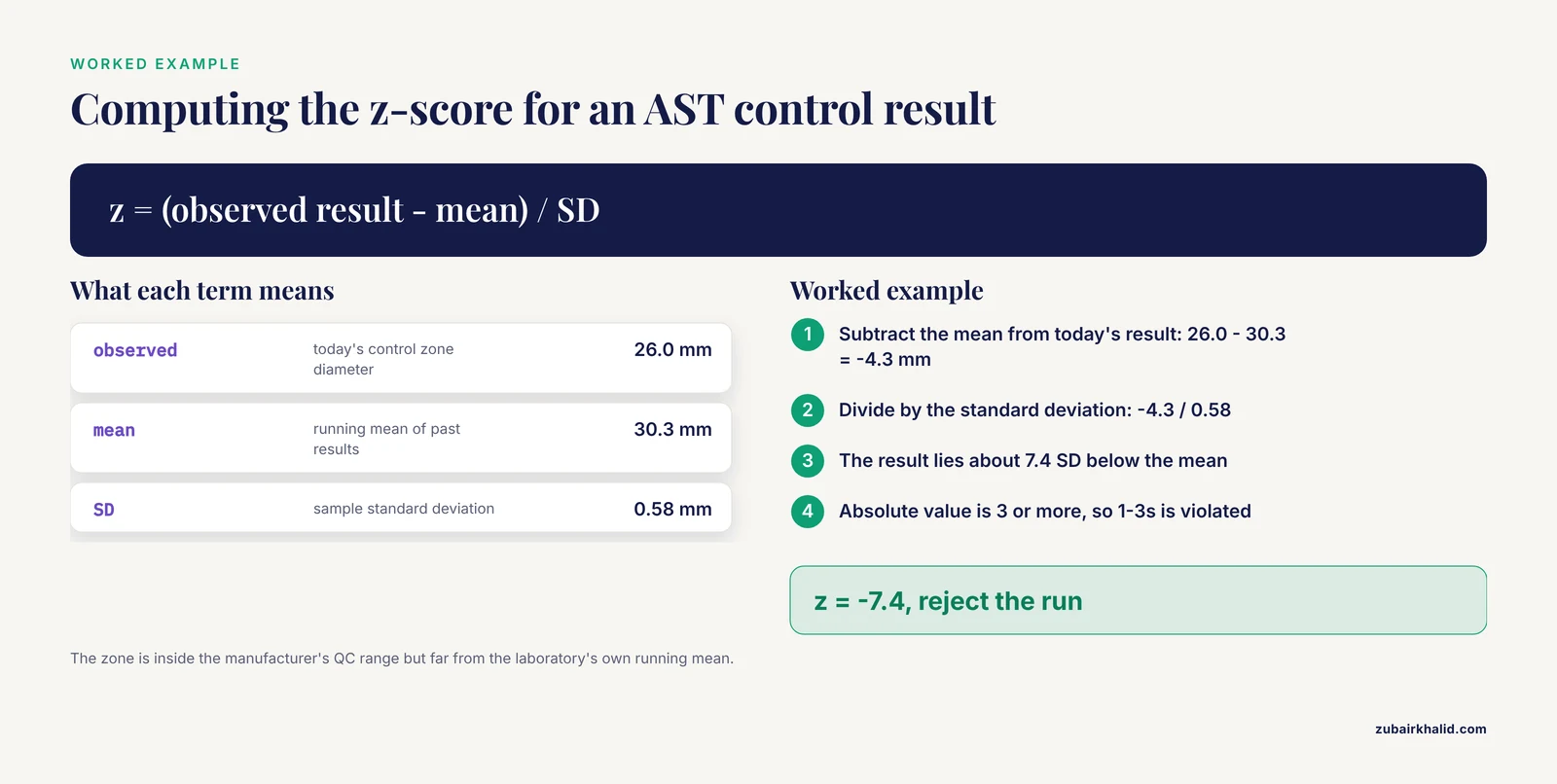
Step 3. Record today's result and compute the z-score. Today's control zone reads 26.0 mm, inside the manufacturer's QC range but far below your running mean. The z-score is the number of standard deviations a result lies from the mean:
z = (observed result minus mean) divided by SD = (26.0 minus 30.3) divided by 0.58 = negative 7.4.
You can automate the decision logic:
qc_results = [29.5, 30.2, 30.8, 31.0, 29.8, 30.5]
mean = sum(qc_results) / len(qc_results)
sd = (sum((x - mean) ** 2 for x in qc_results) / (len(qc_results) - 1)) ** 0.5

today = 26.0
z = (today - mean) / sd
print(f"mean: {mean:.2f} mm")
print(f"SD:   {sd:.2f} mm")
print(f"z-score: {z:.2f}")

if abs(z) >= 3:
    print("1-3s violated: REJECT run, document corrective action")
elif abs(z) >= 2:
    print("1-2s warning: review, accept if no other rule is violated")
else:
    print("In control: record and release")
Expected output:
mean: 30.30 mm
SD:   0.58 mm
z-score: -7.42
1-3s violated: REJECT run, document corrective action
Step 4. Apply the decision rules. The Westgard multirule procedure interprets control results using rules named for the number of observations and standard deviations involved. The rules you will use most at the microbiology bench:
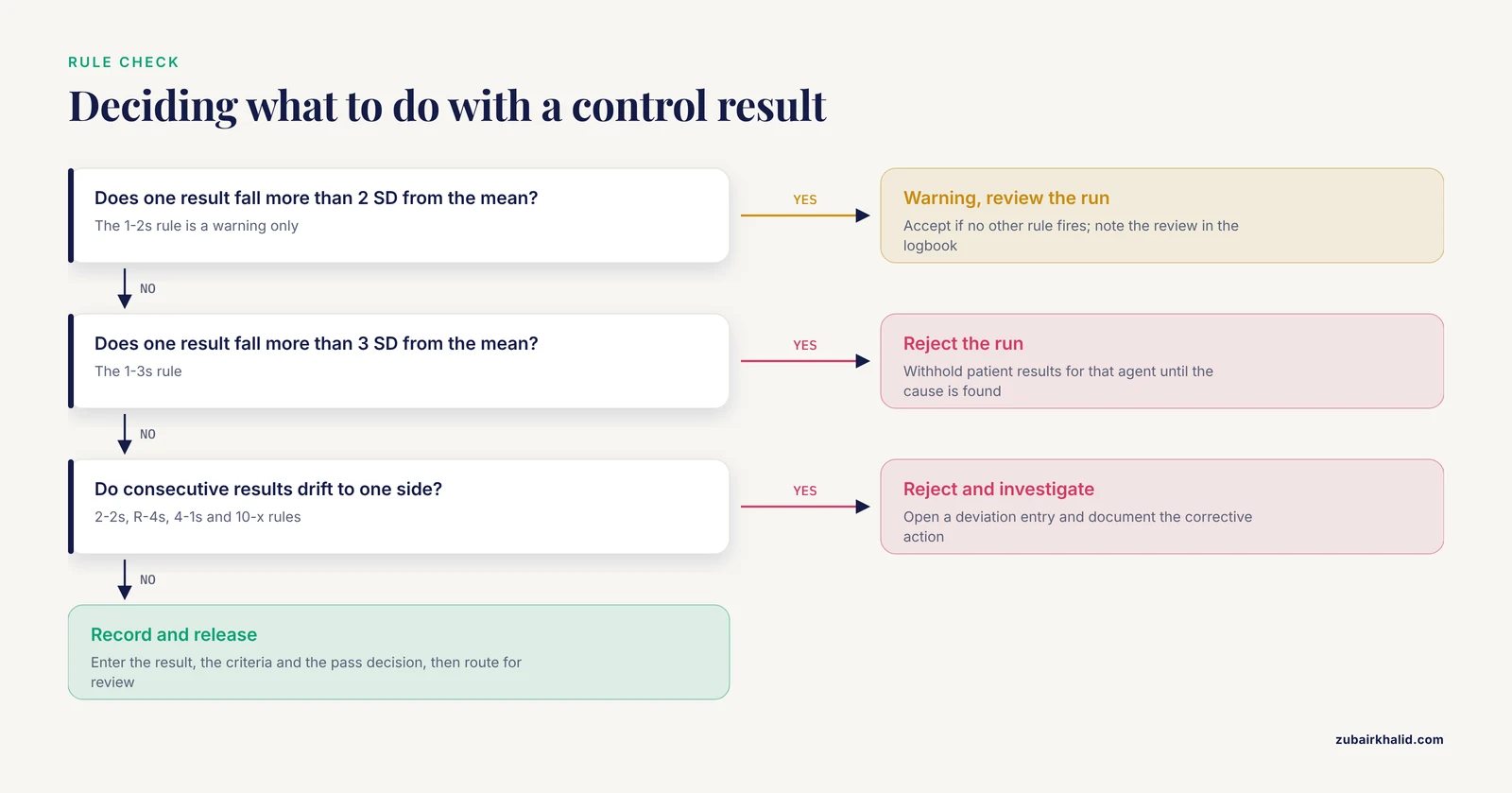
- 1-2s warning. One result falls more than 2 standard deviations from the mean. Warning only. Review the run, accept if no other rule fires.
- 1-3s rejection. One result falls more than 3 standard deviations from the mean. Reject the run. Do not report patient results for that analyte or agent until the cause is found.
- 2-2s rejection. Two consecutive results beyond 2 standard deviations on the same side of the mean. Reject.
- R-4s rejection. Two results in one run differ by more than 4 standard deviations. Reject.
- 4-1s and 10-x rules. Four consecutive results beyond 1 standard deviation on the same side, or ten consecutive results on one side of the mean, indicate drift. Reject and investigate.
Our worked z-score of negative 7.4 violates 1-3s. The run is rejected.
Step 5. Write the follow-through. The AST QC logbook entry now references the deviation log. A typical chain reads: control result out of range at 26.0 mm, patient results for gentamicin withheld, disk lot checked against remaining disks in the same lot, new lot tested, second control performed, results in range, patient results released with a comment. The deviation log carries the root cause (in this illustration, a suspected disk storage humidity problem) and an effectiveness check date.
Step 6. Have the reviewer sign. The run is not closed until a second qualified person reviews the entry, the chart, and the deviation link, and signs with a date.
Parameters That Matter
Several terms appear throughout every logbook format, and each needs to be used precisely.
Accuracy is how close a measured result lies to the true value. Precision is how repeatable repeated measurements are. A control organism run daily estimates both, which is why the running mean and standard deviation in the logbook matter more than any single day's pass or fail against a published range.
Acceptance criteria are the numeric boundaries a result must meet. For AST, these come from published QC ranges for each organism-antimicrobial combination. For instruments, they come from your SOP and the manufacturer's specification. The logbook should print the criteria next to the result column so the accept decision is visible without consulting another document.
Control charts (Levey-Jennings charts) turn a column of numbers into a picture of drift and shift. Trends that individual pass results hide, such as the 4-1s and 10-x rules, become visible on the chart.
Traceability is the unbroken documented chain from a result back to the lot, instrument, reagent, and person involved. Reviews of laboratory data standards emphasize that documentation must cover messaging, storage, retention, validation, and quality control as one connected system rather than scattered records [6]. An ART laboratory quality review makes the same point from a different field: documentation and traceability systems must track all laboratory stages, supported by electronic platforms and witnessing systems [2].
Troubleshooting: Common Errors, Exact Messages, and Fixes
Errors in logbook practice tend to repeat. The messages below are the ones spreadsheets and laboratory information systems typically display, and the fixes are the ones that hold up in audit.
| Message or symptom | What it means | Fix |
|---|---|---|
#DIV/0! in the z-score cell | The standard deviation cell is empty or zero because no history has been entered | Enter at least the minimum number of baseline results your SOP requires before computing statistics, or guard with =IF(B3=0,"",...) |
#REF! in a formula cell | A referenced row or sheet was deleted when pruning old entries | Restore the reference or re-point the formula, then re-verify one entry by hand |
#VALUE! in a calculation | A result cell contains text, usually a unit such as "24 mm" typed into the value column | Keep units in their own column, values numeric only |
| "QC not current" or equivalent LIS hold | The system has no in-date QC record for the test being ordered or released | Perform and record the required QC, then release the test. Never backdate |
| "Control result outside acceptable range" | The control value falls outside the printed acceptance criteria | Follow the deviation procedure, withhold affected patient results, investigate, repeat QC |
| Missing reviewer signature | Entry was recorded but never independently reviewed | Route for review immediately. Retrospective signature after weeks is an audit finding |
| Two different lot numbers for one day | Result was transcribed from the wrong bench sheet or the log was filled in late | Correct with a single-line-through and initial, never erasure, and investigate the timing gap |
For paper logbooks, the correction rule is absolute: draw a single line through the error, write the correct value, initial, and date. Correction fluid, overwriting, and erasure destroy the record's credibility, because the point of the logbook is to show what happened, including mistakes and their correction.
How to Verify Your Logbook System Is Working
Run this self-audit quarterly. Pull a random recent date and trace it forward and backward through the records.
- Pick one patient result date at random.
- Confirm the AST QC entry exists for that day, is in range or has a documented deviation, and carries two signatures.
- Confirm the media lot in use that day had completed sterility and growth checks recorded before use.
- Confirm the instrument logs for that day show in-range conditions or documented excursions with corrective action.
- Confirm the control organism used had a passage number within the SOP limit, traceable in the control organism log.
- Confirm any deviation opened that month was closed with an effectiveness check or is still within its documented timeline.
If any step fails, the fix goes into the deviation and corrective action log, not into a quiet edit of the historical record. Structured approaches to quality assurance, including modular checks from format validation through expert adjudication, are being adopted across laboratory disciplines precisely because unstructured records hide these failures until an external assessor finds them [7].
Common Mistakes and Limitations
- Recording QC days late from memory. Memory-written entries lack times, lots, and honest values. Record at the bench, in real time.
- Recording only passes. A logbook of perfect results is more suspicious than helpful. Excursions, deviations, and their resolutions are the evidence the system works.
- Missing the reviewer field. Self-review is not review. The second signature requirement exists to catch the first person's blind spots.
- Skipping media QC because "the manufacturer already tested it." Manufacturer testing covers the shipped lot under specified conditions. Your preparation, sterilization, and storage are unverified until you document your own checks.
- Letting passage numbers drift. If the logbook does not track subcultures, working stocks quietly exceed the passage limit and control performance degrades in ways the published QC range will eventually catch, after patient results have been affected.
- Confusing QC ranges with running statistics. A result can be inside the published QC range yet far from your laboratory's running mean, as the worked example above showed. Both checks matter, and the z-score against your own mean is the earlier warning.
- Uncontrolled spreadsheets. A spreadsheet on a shared drive with no version control, no access log, and no verification fails the same audit an uncontrolled paper book fails. Regulated electronic record systems are expected to meet requirements such as those aligned with United States FDA 21 CFR Part 11 and ISO/IEC 17025, which cover audit trails, access control, and record integrity [8].
- Individual patient results still need professional interpretation. Logbooks demonstrate that the system was in control. They do not replace the judgment of a qualified microbiologist or physician in interpreting any single patient's result.
Digital Logbooks and the Laboratory Quality Management System
Paper logbooks remain acceptable, and in many settings still preferred at the bench, but the direction of travel is clear. A regional medical laboratory center in Shenzhen deployed an integrated informatics platform for internal quality control and external quality assessment across a network of one central laboratory, five district hospitals, and four community health stations, centralizing QC data processing, documentation, analytics, and approval workflows in one system [9]. A theranostics laboratory platform built under a risk-based computer software assurance framework aligned with FDA 21 CFR Part 11 and ISO/IEC 17025 reported a pilot covering 187 laboratory requests with 1,456 quality-control checkpoints and 43 deviation-handling episodes, illustrating how electronic systems embed QC checkpoints directly into the workflow rather than bolting them on afterward [8]. In surgical pathology, a frozen section quality assurance program built on custom software increased documentation and structured the categorization of discrepancies as interpretive or technical, which is the same error taxonomy a microbiology deviation log should use [10].
Moving a logbook from paper to electronic form does not change the required fields. It changes what becomes possible: automatic date and time capture, forced completion of required fields, automatic flagging when a result breaches acceptance criteria, and searchable multi-year trends. It also raises new requirements. The SARS-CoV-2 Emergency Use Authorization diagnostics data experience showed how inconsistent naming conventions, unstable document identifiers, poor versioning, and unclear amendment trails make records hard to retrieve and maintain, which is exactly what happens inside a laboratory that adopts electronic logs without naming conventions and version control [11]. When you digitize, control the vocabulary (one name per instrument, one name per control strain), version every form and SOP reference, and keep an audit trail on every edit.
The same logic applies to the QC program itself. Documentation quality, workflow organization, and equipment reliability were assessed as technical and administrative determinants of laboratory service quality in the Northwest Ethiopia study, which found these factors measurable and consequential with a straightforward checklist approach [1]. Your quarterly self-audit is that checklist in miniature.
Next Steps
- Inventory your existing logbooks against the table of nine core logbooks and note the gaps.
- Standardize the minimum ten-field structure across all of them this week, even if the medium stays paper.
- Add computed z-scores and explicit rule decisions to your AST QC log.
- Schedule the quarterly traceability audit described above and assign it a named owner.
- When digitizing, choose a system with audit trails and access control from day one, and write your naming conventions before migrating a single entry.
Frequently Asked Questions
What are the essential logbooks for microbiology quality control?
The core set is nine: media and reagent QC, control organisms, instrument and equipment QC, antimicrobial susceptibility testing QC, stains and reagents, temperature and environmental monitoring, competency and training, proficiency testing or EQA, and deviation with corrective action. Small laboratories may combine them in one binder with tabbed sections.
What must every QC logbook entry contain?
Every entry needs a unique identifier, date and time, the item under test with its lot or ID, the SOP reference, the observed result, the acceptance criteria, an explicit pass or fail decision, a corrective action reference if it failed, the analyst signature, and an independent reviewer signature with dates.
How long must microbiology QC records be kept?
Retention periods are set by your accreditation body, regulator, and local policy, and they differ between record types, so check the specific checklist your laboratory answers to rather than assuming a single number. Plan storage so records stay retrievable and readable for the full retention period, whether paper or electronic.
What is the difference between internal quality control and external quality assessment?
Internal quality control is the routine, same-day checking of your own system with your own control materials, recorded in your own logbooks. External quality assessment sends blinded challenge samples from an outside provider and compares your results against a reference or peer group. You need both, and both need their own records.
How often should incubator and autoclave QC be recorded?
Autoclaves need a record for every cycle, including load contents and indicator results, with biological indicators on the frequency your SOP specifies. Incubators and refrigerators need readings at the frequency your SOP requires, commonly daily, plus verification of any continuous monitoring system.
Can electronic logbooks replace paper logbooks?
Yes, when the electronic system captures the same required fields and adds controlled access, an audit trail, and version control. Requirements aligned with FDA 21 CFR Part 11 and ISO/IEC 17025 govern electronic records in regulated laboratories, so choose and validate the system before migrating.
What do Westgard rules mean in a QC logbook?
They are named decision rules for interpreting control results. The 1-2s rule is a warning when one result exceeds plus or minus 2 standard deviations from the running mean. The 1-3s rule rejects a run when one result exceeds 3 standard deviations. Additional rules, such as 2-2s, R-4s, 4-1s, and 10-x, detect shifts and drift across consecutive results.
Who signs and reviews a QC logbook?
The analyst who performed the QC activity signs the entry with a date, and a second qualified person, typically a supervisor or quality manager, independently reviews and signs. Self-review does not satisfy the requirement, and retrospective signing weeks later is an audit finding.
Sources
- Determinants of quality laboratory service provision amongst government comprehensive specialized hospitals in Northwest Ethiopia.
- Quality Control in Assisted Reproduction Centers.
- Integrated laboratory protocol for the diagnosis of Sexually Transmitted Infections (STIs): Standardized pre-analytical procedures, rapid screening, hemagglutination, and ELISA methods for use in resource-limited settings.
- Air Quality Sensor Experts Convene: Current Quality Assurance Considerations for Credible Data.
- Piloting an external quality assurance program (QAP) for COVID-19 antigen rapid diagnostic tests (Ag-RDTs): findings and lessons learned from Cambodia.
- Recommendations for HLA Genotyping Data Standards and Clinical Laboratory Staffing Considerations.
- Semi-automated end-to-end quality control system for annotation data based on automated Cobb angle measurement.
- A cloud-enabled LIMS-QMS platform with large language model-assisted standard operating procedure generation for GLP/GMP-aligned theranostics laboratory operations.
- Development and Implementation of an Internal Quality Control and External Quality Assessment Information System for a Regional Medical Laboratory Center: Pilot Design and Implementation Study.
- Software solution for integration of frozen section quality assurance into daily practice.
- Challenges in Structuring SARS-CoV-2 Emergency Use Authorization Diagnostics Data: Leveraging Findable, Accessible, Interoperable, and Reusable Principles for the Next Era of Diagnostic Data Transparency.