Virtual Microbiology Lab Simulations
By Dr. Zubair Khalid, DVM, MS, PhD ·
A virtual microbiology lab simulation is software that reproduces the observations and the decision sequence of a microbiology bench, while a physical lab session builds the hand technique that software cannot. The rule of thumb for choosing one: buy simulation for scale, safety, and repetition, and spend physical lab hours on aseptic technique, streak-plate mechanics, and contamination control.
The phrase covers at least four different purchases. It can mean a replacement for a missed session, a pre-lab primer that students complete before entering the room, a full standalone lab course delivered online, or an informatics sandbox where learners run real analysis tools on real sequence data. Those four jobs need different software, different assessment, and different evidence. Most bad purchasing decisions come from comparing platforms on feature lists instead of deciding which job the platform has to do.
What a Virtual Microbiology Lab Simulation Replicates
A simulation is any model of a real system that a learner can manipulate and observe. A virtual lab is a simulation delivered through a browser or an application, usually inside a learning management system (LMS), which is the course platform that hosts content and records grades. Microbiology is unusually well suited to simulation because so much of the discipline is inferential. A Gram stain result, a colony on MacConkey agar, and a positive blood culture bottle are all signals that require interpretation before action.
Simulations vary in which layer of the bench they reproduce.
- Procedure. The order of operations: flame the loop, cool it, streak sectors one through four, subculture a single colony, place a slide in the correct spot on a target plate. Procedure is the easiest layer to model and the easiest to score automatically.
- Appearance. Colony morphology, hemolysis patterns, color changes in differential media, turbidity in broth, the purple and pink of a Gram stain. Appearance requires high-quality visual assets and careful calibration, because learners remember images and carry them into the real lab.
- Judgment. Whether a plate is contaminated, whether an isolate is pure enough to identify, whether an unexpected result should be repeated, whether a susceptibility result is plausible for the organism. Judgment is the hardest layer and the one that separates a genuine teaching tool from an animated textbook.
Most commercial products deliver layers one and two well. Layer three depends on branched scenarios, calibrated scoring rubrics, and deliberate inclusion of ambiguous cases. Instructors evaluating a demonstration should ask to see a case where the correct answer is "repeat the test" rather than "identify the organism."
Terminology matters here. Fidelity is how closely the simulation matches the real task, and higher fidelity is not automatically better. A high-fidelity simulation that costs three weeks of build time to teach one concept is a poor trade. Transfer is whether a skill practiced in the simulation shows up on the real bench, and transfer is the only outcome that ultimately matters for a microbiology course with a hands-on component.
Side-by-Side Comparison of Microbiology Lab Simulation Options
| Option | What the learner does | Best fit | Strengths | Main limits | Evidence anchor |
|---|---|---|---|---|---|
| Guided virtual bench simulation | Watches demonstrations, clicks through bench steps, answers prompts at decision points | Missed sessions, pre-lab preparation, large sections with limited bench seats | Scales cheaply, delivers a uniform sequence, replayable | Teaches no physical technique, weak contamination cues | [1] |
| AI-enhanced virtual laboratory | Runs simulated experiments with adaptive hints, automated scoring, and personalized pathways | Skill practice at scale, remediation, courses with high learner-to-instructor ratios | Immediate feedback, adapts to errors, frees instructor time | Build cost, opaque scoring, model bias | [2] |
| Hybrid kit plus virtual lab | Performs real bench work with shipped materials, guided by virtual modules | Remote or hybrid microbiology course, programs with no teaching lab | Real technique with structured guidance | Shipping logistics, home biosafety, waste disposal | [1] |
| Gamified scenario | Team solves puzzles using discipline concepts under time pressure or narrative constraints | Orientation, bioinformatics introduction, motivation and teamwork | High engagement, communication practice, low material cost | Narrow objectives, difficult to grade at scale | [3] |
| Bioinformatics and data sandbox | Runs pipelines, compares outputs, interprets discordance and uncertainty | Upper-level, graduate, and clinical microbiology informatics | Teaches real tools and real ambiguity | Computing setup, steep prerequisite curve | [4] [5] [6] |
| Multimedia module or spaced-repetition adjunct | Completes short targeted modules and flashcard review | Just-in-time review, pre-class preparation | Very short, cheap, easy to embed in any LMS | Does not teach procedure, perceived gains can exceed measured gains | [7] [8] |
How Each Option Works
Guided Virtual Bench Simulations
Guided simulations are the most common and the least ambitious. They combine video demonstration, interactive step sequencing, and short knowledge checks. Their evidence base is strongest as a complement rather than a replacement.
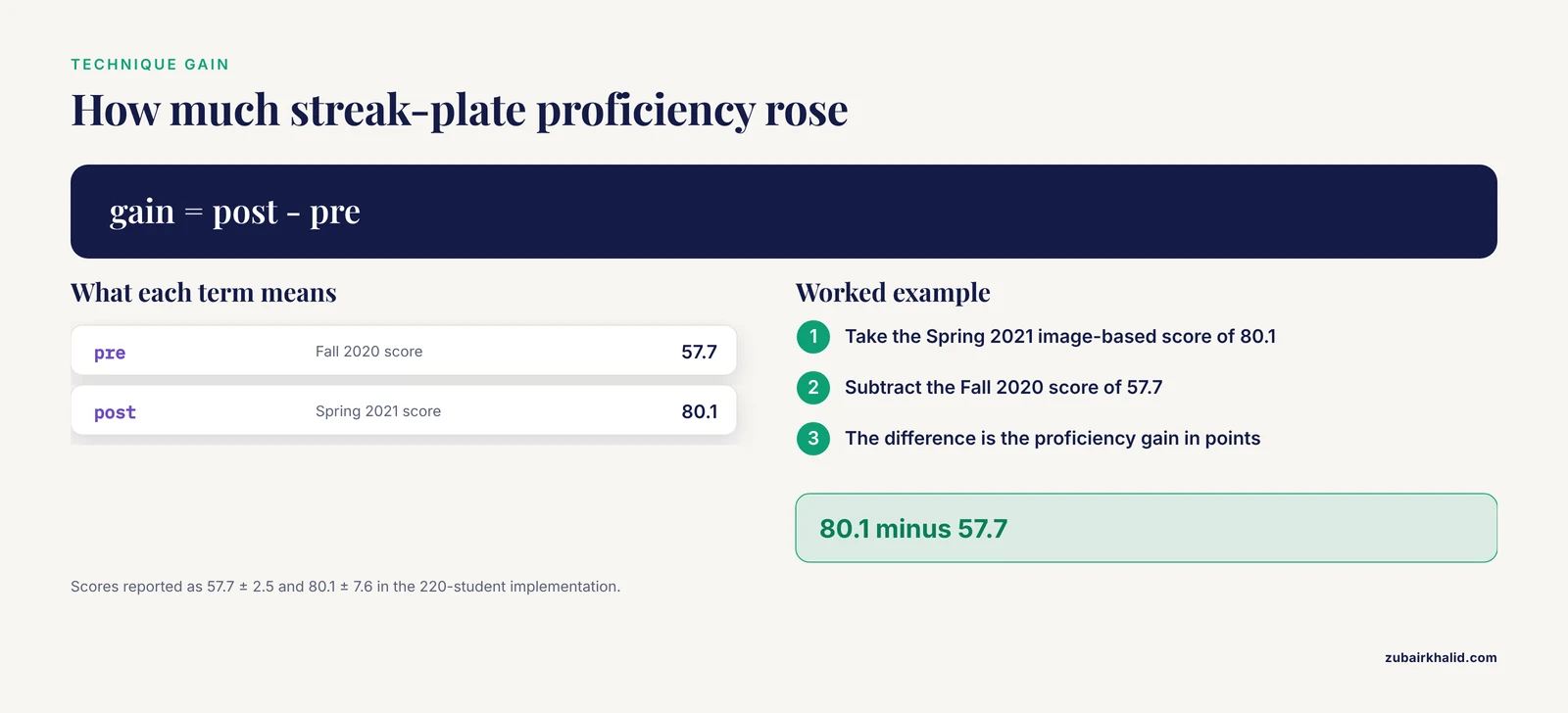
A 220-student microbiology implementation across 10 sections illustrates the sequencing problem. In Fall 2020, three sections (66 students) performed labs at home using lab videos. In Spring 2021, sections used McGraw-Hill Connect Virtual Biology (MHCVB) Labs alongside instructor demonstrations and at-home Carolina lab kits. Pre-lab quiz scores, post-lab quiz scores, and laboratory report scores did not differ significantly between the two semesters. Hands-on technical skill did improve in Spring 2021, and image-based scoring showed streak-plate proficiency rising from 57.7 ± 2.5 to 80.1 ± 7.6 [1].
The lesson is precise. The virtual component did not damage knowledge outcomes, and it did not by itself build technique. Technique improved when the virtual modules were paired with physical materials and instructor demonstration. A guided simulation placed before a physical session prepares the learner to use bench time well. The same simulation placed in front of a learner who never touches an inoculating loop produces a student who can describe a streak plate and cannot perform one.
Choose guided simulations when bench seats are the binding constraint, when sections must be standardized across instructors, or when a learner missed a session and needs the procedural content. Do not choose them as the sole lab experience in a program that certifies manual competency.
AI-Enhanced Virtual Laboratories
An AI-enhanced virtual lab adds an intelligent tutoring system, meaning software that models what the learner knows and chooses the next problem or hint accordingly. The typical feature set includes automated assessment, personalized learning pathways, and real-time feedback generated by machine learning and natural language processing.
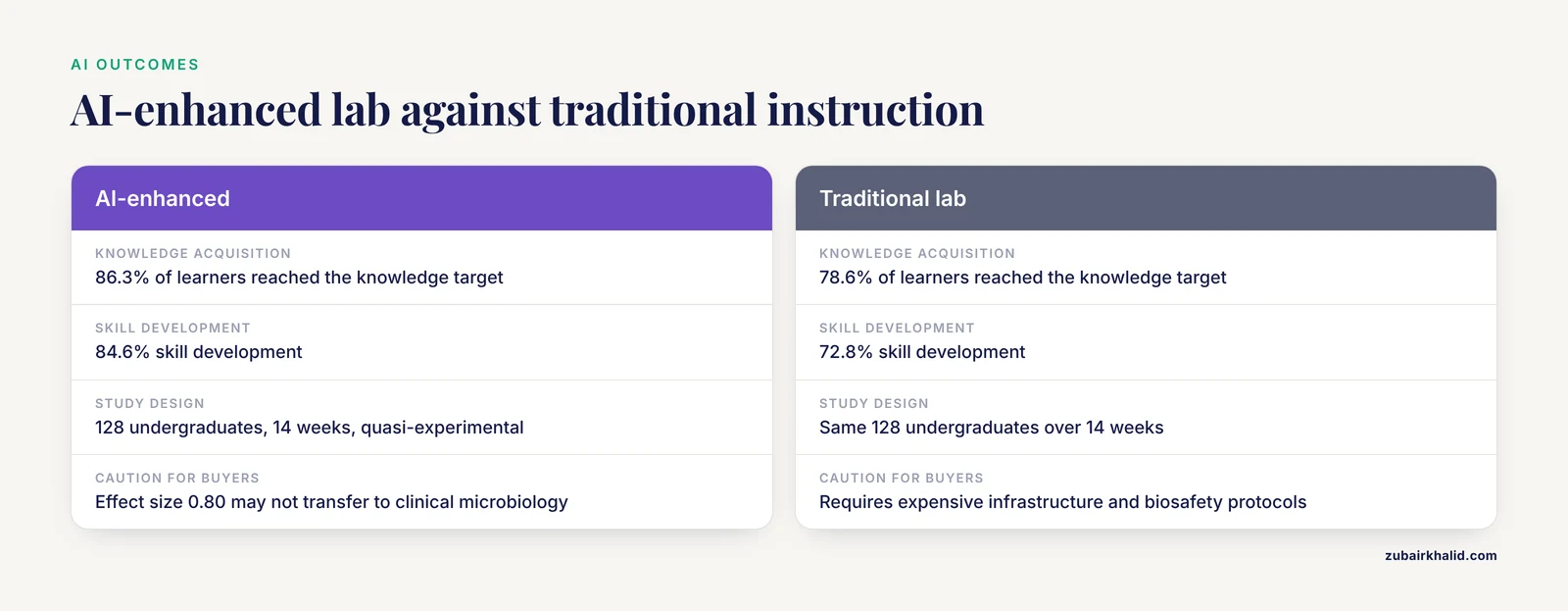
The strongest outcome data in this category come from food microbiology education, where 128 undergraduates completed a 14-week quasi-experimental study. Learners on the AI-enhanced platform reached 86.3% knowledge acquisition against 78.6% for traditional laboratory instruction (P < 0.001, d = 0.80) and 84.6% skill development against 72.8% [2]. The same study frames the underlying problem well: traditional laboratory instruction requires expensive infrastructure, specialized equipment, and stringent biosafety protocols, which creates disparities between institutions [2].
Two cautions apply. First, an effect size of 0.80 in one discipline does not transfer automatically to clinical microbiology, where the interpretive content is different and the safety stakes are higher. Second, the feedback loop is the active ingredient, not the word "AI." A well-written branching scenario with static hints can outperform a poorly configured adaptive engine.
Evidence from outside microbiology supports that reading. In a crossover pilot with 44 second-year medical students, a curriculum-aligned custom GPT used for one pathology case produced higher self-directed learning rubric scores (10.3 vs 9.4 out of 12, mean difference 0.9, 95% CI 0.5 to 1.3, d = 0.71) and higher small group discussion scores (14.9 vs 13.7 out of 16, d = 0.78) than conventional preparation. Delayed retention on end-of-block examination items did not differ [9]. Curriculum alignment and Socratic structure, not raw model capability, drove the gain.
The limits of AI in microbiology are documented. Deep learning models often lack transparency, which makes results hard to interpret. Overfitting and limited generalizability are persistent concerns, along with data privacy and other ethical and legal issues [10]. A simulation that generates free-text feedback should be validated on a fixed set of learner responses before it is used for summative grading.
Hybrid At-Home Kit Plus Virtual Lab
The hybrid model ships physical materials to the learner and uses virtual modules to structure the work. It is the only option in this list that produces genuine manual technique outside a teaching laboratory.
The biosafety load moves to the learner's kitchen, and that load is real. Standard teaching practice limits at-home work to BSL-1 organisms, meaning agents that pose minimal risk to healthy adults and are handled on an open bench with standard precautions. BSL-2 work, which covers most clinical specimens and organisms such as Salmonella and Staphylococcus aureus, requires restricted access, biological safety cabinets for procedures that generate aerosols, and regulated waste handling. A kit that ships a known BSL-1 organism and a sterile swab for environmental sampling keeps the risk predictable. A kit that asks students to culture from their own throat, skin, or household surfaces does not.
Practical safeguards for a hybrid microbiology course include sealing inoculated plates with tape, incubating at ambient room temperature rather than body temperature, never opening a plate for a smell test, disinfecting the work surface before and after with a freshly prepared bleach dilution, and decontaminating all plates and waste before household disposal. Instructors should build the decontamination step into the graded workflow, because a learner who skips it has not learned the most consequential habit on the bench.
Gamified Scenario Formats
Gamification means applying game mechanics (points, narrative, progression, time pressure, team roles) to a non-game task. A 2026 study describes BioDecryptors, a bioinformatics escape game for undergraduate and postgraduate learners in clinical microbiology. Fifty-five participants took part, 22 second-year medical students (40%) and 33 postgraduate MDs or PharmDs (60%), working in teams of 3 to 4 on versions adapted to their training level. Knowledge was measured before and immediately after the activity using two distinct 10-item tests mapped to predefined learning objectives, and motivation was measured with a 12-item, 5-point Likert instrument [3].
The design choices are the transferable part. Level-adapted versions let a second-year student and a practicing pharmacist play the same game without one being bored or lost. Two parallel test forms reduce recall of the pretest. Team sizes of three to four force every participant into an active role. Anyone building a gamified microbiology module should copy that structure rather than the theme.
Gamified formats work best for content that is normally delivered by lecture and rarely practiced: interpreting a phylogenetic tree, tracing an outbreak through metadata, choosing an empirical antibiotic regimen. They work poorly as the primary vehicle for technique. They are also difficult to grade at scale, because a team's escape-room success reflects coordination as much as individual knowledge.
Bioinformatics and Data Sandboxes
A data sandbox gives learners real tools and real data. In bacterial genomics, a variant caller is software that identifies differences between sequencing reads and a reference genome, and the raw read files are typically stored as FASTQ, the standard text format holding sequence and per-base quality scores.
The teaching value comes from disagreement. A benchmark across 14 bacterial species found that deep learning variant callers, particularly Clair3 and DeepVariant, outperformed traditional methods on Oxford Nanopore data and exceeded Illumina accuracy when applied to the super-high accuracy basecalling model. A depth of 10× on super-accurate Nanopore data achieved precision and recall comparable to, or better than, full-depth Illumina sequencing [4]. A learner who runs the same FASTQ file through two callers and inspects the discordant positions understands sequencing error far better than a learner who memorizes an error-rate table.
Prediction tools teach a different lesson. Antimicrobial susceptibility testing (AST) determines whether an isolate is inhibited by a panel of drugs, and the minimum inhibitory concentration (MIC) is the lowest drug concentration that inhibits visible growth. Surveillance-driven machine learning models built on isolate-level data from African sites in the Pfizer ATLAS program achieved test accuracies between 57% and 76% across seven antibiotic-specific XGBoost models [5]. A sandbox exercise in which students see a 57% accurate model and are asked whether it should guide therapy is a better stewardship lesson than any lecture on the subject.
Benchmarking hygiene is the third lesson. An evaluation of antimicrobial peptide (AMP) prediction tools found that heterogeneous datasets and inconsistent evaluation protocols produce data leakage and inflated performance estimates, which makes published tool comparisons unreliable [6]. Students who reproduce a leaked split and watch accuracy collapse learn why independent test sets matter.
Sandboxes require computing setup, and that setup cost is the main barrier. Containerized environments and preloaded notebooks reduce it. Prerequisites should include basic command-line comfort and a working understanding of the central dogma.
Multimedia Modules and Spaced-Repetition Adjuncts
Short modules and flashcards are not simulations, but they determine whether a simulation sticks. A study of supplemental multimedia modules in food biotechnology and food microbiology courses tracked 85 students in an introductory food microbiology course and 25 in an upper-level elective. Between 73% and 76% of students voluntarily accessed the modules, with average engagement times of 5 to 8 minutes per module, and exam performance on module-related items improved by 6% to 10% compared with overall exam averages [7]. The modules were built on cognitive load theory, meaning the principle that working memory is limited and that unnecessary visual or textual complexity reduces learning.
Spaced repetition is the deliberate scheduling of review at expanding intervals. A study in a bachelor's-level introductory microbiology course found that instructor-made spaced-repetition flashcards left overall exam performance unchanged (p = 0.2657) while improving students' confidence in their ability to succeed (p = 0.0066), their belief that the course made them think like a microbiologist (p = 0.0011), and their rating of the approach as effective (p = 0.0076) [8].
That divergence is the single most useful caution in this entire literature. Learners feel that a tool works and their measured performance may not move. Simulation vendors quote satisfaction scores for exactly this reason. Buyers should ask for outcome measures, not approval ratings.
Criteria That Decide Real Choices
Fidelity and Transfer
Ask what the learner does after the simulation that they could not do before. A guided simulation that teaches the order of a four-quadrant streak is valuable only if the learner then streaks a real plate and gets scored on isolation. Build the transfer check into the course, whether it is a plate photograph graded against a rubric or an instructor-observed practical.
Feedback Quality and Latency
Feedback should arrive while the error is still corrigible. Immediate, specific, and actionable feedback is the mechanism behind most reported gains in AI-enhanced platforms [2]. Vague encouragement ("good try") teaches nothing. A useful test is to submit three deliberately wrong answers during a demonstration and see whether the software explains the consequence.
Assessment Alignment
Simulation scores should map to stated learning objectives. Question quality is a known weak point in health professions education. An analysis of roughly 200 educator-written multiple-choice questions in pharmacology found that 98% received expert evaluation, nearly 80% addressed at least one core concept, and 52% used a context-dependent format, yet only 40% reached higher levels of Bloom's cognitive domain and only 10% adhered to all item-writing guidelines [11]. Bloom's taxonomy, for reference, ranks cognitive tasks from recall upward through application and analysis. A simulation that ends in recall questions has wasted its own capability.
Safety and Biosafety Level
Simulation is the correct venue for agents and procedures that cannot be handled safely in a teaching lab. That includes BSL-3 agents, high-containment procedures, and any workflow involving an aerosol-generating step. The cost and biosafety burden of traditional laboratory instruction is the explicit rationale for virtual substitutes in resource-constrained programs [2]. A simulation that shows a learner what happens when a bottle of broth is vortexed without a cap is doing work that no teaching lab can do safely.
Cost and Infrastructure
Do not accept a vendor's total cost of ownership figure without decomposing it. The costs that matter are per-seat licensing, build and maintenance time for custom scenarios, computing infrastructure for data sandboxes, shipping and disposal for kits, and instructor hours for grading and troubleshooting. Simulation reduces the marginal cost of running a section, and it can raise the fixed cost of getting started.
Accessibility and Device Requirements
Browser-based delivery with keyboard-only navigation and screen-reader support should be a baseline requirement. Drag-and-drop interfaces for pipetting and streaking are common and are frequently inaccessible. Check the product on a low-bandwidth connection and on a tablet before committing a whole section to it.
Instructor Workload
An adaptive platform that generates its own feedback can reduce grading time. A platform that requires the instructor to author every branch increases it. Estimate authoring hours per scenario before signing, and ask whether the vendor supplies validated scenarios or only an authoring tool.
Worked Scenarios
A Community College With One Teaching Lab and 120 Students Per Term
The lab holds 24 learners and runs six sections. Bench time is the scarce resource. The right configuration is a guided virtual pre-lab that each student completes within 48 hours of the session, covering reagent order, loop handling, and the interpretation of plate images. Physical time is reserved for streaking, Gram staining, and microscope work, with plate photographs graded against a rubric. The virtual module is not counted as lab attendance, and the practical exam is entirely physical. This mirrors the sequencing that produced technique gains in the hybrid implementation described above [1].
A Fully Online Program for Working Health Professionals
There is no teaching lab at all. The workable design is a kit plus virtual lab, restricted to BSL-1 organisms and non-clinical environmental sampling, with a graded decontamination step at the end of every exercise. Technique is assessed from learner-submitted photographs against a standardized rubric, which is the method that detected the streak-plate improvement in the hybrid study [1]. Any module requiring clinical isolates should be simulation only, and the course should state that plainly in the syllabus.
Clinical Microbiology Laboratory Onboarding
A new technologist must learn a MALDI-TOF identification workflow. MALDI-TOF is matrix-assisted laser desorption/ionization time-of-flight mass spectrometry, which identifies an isolate by comparing its protein spectral fingerprint against a reference library. Two systems compared on 927 isolates across 219 species produced identification rates of 91.1% and 95.5%, with agreement after retesting of 99.4% at genus level and 97.5% at species level [12].
The workflow numbers show why simulation has a ceiling. On a run of 16 slides holding 16 isolates each (256 isolates, roughly one technician's daily load), one system required 106 minutes of hands-on time and 191 minutes to result with 252 successful identifications (98%), while the other required 155 minutes of hands-on time and 155 minutes to result with 211 successful identifications (82%) [12]. A simulation can teach slide layout, target position, and the decision to apply formic acid. It cannot teach the physical pacing that separates 106 minutes from 155 minutes, and it cannot teach the judgment of whether a spectral result looks acceptable.
The formic acid data are a good example of why simulated cause and effect must be data-driven. On short-incubation cultures, one system identified 99.2% of isolates without formic acid and 95.0% with it, while the other identified 88.2% without and 92.4% with [12]. The direction of the formic acid effect reversed between instruments. A scenario built on intuition would have taught the wrong lesson.
A Self-Directed Learner Building a Microbiology Course
A learner working alone should start with short modules and spaced repetition to build vocabulary, then move to guided simulation for procedure, then to a sandbox for analysis. Content selection matters as much as format. A survey of 924 US college students found that learners viewed viruses more negatively than bacteria and struggled to give examples of beneficial microbial effects [13]. A course built entirely from pathogen case studies reinforces that gap. Include a fermentation module, a soil or rhizosphere module, and an industrial microbiology module alongside the disease content.
A Ten-Point Evaluation Checklist
- Does the demonstration include a case where the correct action is to repeat the test or reject the specimen?
- Are wrong answers explained in terms of consequence, not just marked incorrect?
- Can the instructor see item-level performance, or only a completion percentage?
- Do the assessment items reach application and analysis rather than recall [11]?
- Is the scoring rubric published and version-controlled?
- Does any AI-generated feedback pass a fixed validation set before summative use [10]?
- Are plate and stain images calibrated against real reference images the course already uses?
- Does the product run on the devices and connections your learners actually have?
- What is the authoring time per scenario, and who maintains it after year one?
- Is there a physical or image-based transfer check built into the course [1]?
Common Mistakes and Limitations
Treating completion as competence. A learner who finishes every module has demonstrated persistence. Competence requires a scored performance against a rubric. The spaced-repetition study is the clearest warning: exam scores were unchanged while confidence and perceived effectiveness rose significantly [8].
Replacing technique with clicking. Virtual loops do not resist, and virtual agar does not tear. Aseptic technique depends on small physical habits (holding a loop still, working close to a flame, not setting a lid down on the bench) that no browser interface reproduces. Programs that certify manual competency must keep a physical assessment.
Building scenarios from intuition instead of data. The formic acid reversal described above shows how plausible assumptions produce wrong teaching points [12]. Every causal rule in a scenario should trace to a published result or a validated reference.
Leaving the incivility of contamination out of the design. Contamination is the most important feedback signal on a real bench and the easiest thing to omit from a simulation. Include a scenario where the plate is overgrown with a non-target organism and the correct action is to restart.
Assuming adaptive means accurate. Deep learning tools lack transparency, overfit, and generalize poorly outside their training distribution [10]. Adaptive paths built on a narrow item bank converge on the same twenty questions for every learner.
Ignoring data leakage in sandbox exercises. A tool comparison built on overlapping training and test data will show inflated accuracy, and so will a student exercise built the same way [6]. Teach the split before teaching the model.
Presenting a single accuracy number as a clinical answer. A susceptibility model at 57% to 76% test accuracy is a teaching instrument, not a decision rule [5]. Framing matters, and learners should see the error rate.
Teaching only pathogens. Learners arrive with a negative bias toward microbes and leave with it intact if the course never shows a beneficial application [13]. Simulations of fermentation, bioremediation, or the vaginal lactobacillus community cost little to add.
Skipping the biosafety narrative. A home kit without a graded decontamination step teaches technique and omits the habit that protects the household. Build waste handling into the rubric.
Buying for features instead of for a job. A platform with forty scenarios that none of your objectives map to is more expensive than a platform with six.
These tools have real limitations. No simulation reproduces the tactile judgment of a pure colony, the smell of a Pseudomonas culture, or the time pressure of a stat call at 2 a.m. Individual learner needs and any decision about a specific training program require local judgment by the instructor or program director.
Frequently Asked Questions
Can virtual microbiology lab simulations replace hands-on lab work?
Partly, and only for certain outcomes. Knowledge scores and laboratory report scores were statistically indistinguishable between a video-only semester and a hybrid semester that added virtual labs, but hands-on technical skill improved only when physical materials and demonstration were added [1]. Simulation can carry the cognitive load. It cannot carry the manual one.
What is the best microbiology lab simulation for a beginner?
The best starting point is a guided virtual bench simulation paired with a physical or at-home kit, because that combination produced measurable technique gains. A beginner needs procedure and appearance first, and judgment scenarios second. AI-driven adaptivity is a refinement, not a prerequisite.
Do AI features in a virtual lab actually improve learning?
They can when the AI is embedded in structured tutoring rather than added as a chat layer. An AI-enhanced food microbiology platform produced higher knowledge and skill scores than traditional instruction [2]. The effect came from immediate, specific feedback and personalized sequencing, and those features can be built without a large language model.
How long should a simulation session run?
Short modules of 5 to 8 minutes were voluntarily completed at high rates and lifted performance on related exam items [7]. Full bench simulations typically need a longer block because the decision sequence has to play out. Use short modules for review and reserve longer blocks for assessment.
Can a simulation teach antimicrobial susceptibility testing?
It can teach the logic and the pitfalls. Learners can see how a model trained on surveillance data performs at 57% to 76% accuracy across antibiotic-specific predictions [5], and they can learn why the MIC is not the same thing as the clinical outcome. Actual disk diffusion, gradient strips, and broth microdilution require physical practice and reference standards.
What can a virtual lab never teach?
Contamination control, instrument pacing, and specimen quality judgment. A workflow comparison of two MALDI-TOF systems showed a 49-minute difference in hands-on time and a 36-minute difference in time to result on an identical 256-isolate load [12], and no simulation reproduces that difference in a learner's hands.
Sources
- Lessons learned from the integration of virtual labs and at-home lab kits to enhance microbiology education during the COVID-19 pandemic.
- AI-enhanced virtual laboratories improve learning outcomes and student engagement in food microbiology education.
- BioDecryptors, a Bioinformatics Escape Game for Undergraduate and Postgraduate Learners in Clinical Microbiology: Prospective Before-and-After Study.
- Benchmarking reveals superiority of deep learning variant callers on bacterial nanopore sequence data.
- Surveillance-Driven Machine Learning for Prediction of Antimicrobial Susceptibility: An Explainable Modeling Framework using the Pfizer ATLAS Dataset (2004 - 2023).
- Antimicrobial Peptide Databases and Prediction Tools: Toward a Standard Evaluation Framework.
- The development of supplemental multimedia learning modules and their impact on student learning in food biotechnology courses.
- Usage of Spaced Repetition Flashcards to Improve Educational Outcomes in Microbiology.
- Curriculum-Aligned Conversational AI to Support Pathology Self-Directed Learning in Preclinical Medical Students: Crossover Randomized Pilot Study.
- The benefits and biases of artificial intelligence in microbiology.
- Evaluating the quality of multiple-choice question pilot database: A global educator-created tool for concept-based pharmacology learning.
- Comparative evaluation of two MALDI-TOF MS systems for microbial identification: accuracy and workflow efficiency in a clinical microbiology laboratory.
- Positive microbiology: addressing students' knowledge gaps regarding the benefits of microorganisms.