How to Conduct a Management Review Meeting for Your Microbiology Lab
By Dr. Zubair Khalid, DVM, MS, PhD ·
By the end of this article you will be able to build a management review meeting microbiology lab agenda from scratch, assemble the data pack that supports each agenda item, run the meeting to a fixed time budget, and produce the minutes, action log, and decisions that an accreditation assessor will ask to see. You will also have a reusable agenda template and a worked example you can adapt to your own laboratory within one planning cycle.
Before you start, gather the following on your desk or in a shared folder: the minutes and action log from the previous review, internal audit reports for the period, external quality assessment (EQA) and proficiency testing results, quality control records, complaint and feedback summaries, the nonconformity and corrective action log, turnaround time (TAT) data, staffing and competency records, and any equipment calibration or maintenance summaries. Without the data pack, the meeting becomes an opinion session. With it, the meeting becomes the single most powerful steering tool in your laboratory quality management system.
What a Management Review Actually Is
A management review is a formal, planned, documented meeting in which laboratory leadership evaluates the laboratory quality management system as a whole, decides whether it remains suitable, adequate, and effective, and commits resources to improvement. It is not an internal audit, not a quality control meeting, and not a staff huddle. Accreditation standards such as ISO/IEC 17025 for testing laboratories and ISO 15189 for medical laboratories both require planned management reviews at defined intervals, and an assessor will check that the review covered a defined set of inputs, produced documented decisions, and led to tracked actions.
Two research strands explain why labs that skip or hollow out this meeting pay for it later. First, governance research on organizations generally finds that the characteristics of the governing group, including its size, composition, meeting frequency, and expertise, show a positive relationship with organizational performance in both the literature and theoretical models [1]. Translated to the bench, that means who sits in the review, how often it meets, and whether the members know the laboratory's actual work are not administrative details. They are performance variables.
Second, a systematic literature review of laboratories and organizations that lost their certification to management system standards found that decertification is driven by identifiable factors and that managers need guidance on adopting, managing, and, in some cases, abandoning management system standards, with regulatory and standards bodies seeking countermeasures to reverse the phenomenon [2]. The review is your early warning system. A laboratory that treats the management review as a paperwork exercise drifts toward exactly the pattern of disengagement that precedes decertification [2].
For a clinical microbiology laboratory the stakes are concrete. The European Society for Clinical Microbiology and Infectious Diseases convened a dedicated workshop to review European preparedness against the threats of spreading antimicrobial resistance, bioterrorism, and emerging infections [3]. That preparedness agenda is executed, lab by lab, through exactly the mechanisms a management review oversees: competent staff, validated methods, functioning quality control, surveillance data, and responsive leadership.
Building Your Management Review Meeting Microbiology Lab Agenda
The agenda format that satisfies accreditation standards and actually works follows a simple logic: each required input to the review becomes an agenda item, each item has a named presenter, a data pack page, a fixed time allocation, and an expected output (a decision, an action, or an explicit statement that no change is needed). An agenda item without an expected output is a report, and reports belong in the pre-read pack, not in the live meeting.
The standard inputs, mapped to microbiology practice, are listed here. Your accreditation standard may name slightly different categories, so cross-check your own clause list.
- Status of actions from the previous review. Always first. This closes the loop and sets the tone that decisions get executed.
- Changes in internal and external context. New test menus, referral laboratory changes, instrumentation changes, regulatory updates, antibiotic stewardship demands, and disease outbreaks that changed workload.
- Policy and quality objectives performance. Where the laboratory stands against its own stated objectives, with trend data.
- Internal audit results. Findings, themes, and their severity.
- External quality assessment and proficiency testing performance. Scores, unsatisfactory results, and root cause analyses for any failures.
- Microbiology quality control performance. Media sterility and growth checks, control organism results for identification and antimicrobial susceptibility testing (AST), instrument QC, and lot-to-lot variation issues.
- Feedback from customers, clinicians, and referring sites. Complaints, compliments, and clinician surveys, including requests for new tests.
- Nonconformities and corrective actions. Volume, categories, aging actions, and effectiveness checks.
- Resources: staff, equipment, facilities, and supplies. Vacancies, competency assessment status, equipment downtime, reagent or media supply problems, and facility issues such as biosafety cabinet certification.
- Risk and improvement opportunities. The laboratory risk register and proposed improvement projects.
- Monitoring and surveillance data. Post-analytical and epidemiological outputs such as organism trends and resistance patterns that the laboratory reports to stakeholders.
- Any other business and next review date.
Two items deserve microbiology-specific care. Pre-analytical quality belongs in your agenda even though many labs file it under customer feedback or nonconformities. A review of the sample's journey in orthopedic implant infections emphasized that accurate diagnosis depends on structured collection protocols, maintenance of the cold chain at 4 degrees Celsius, sterile hermetic containers, and validated pretreatments such as sonication of hardware and chemical elution with dithiothreitol to liberate biofilm-embedded bacteria, with quantitative thresholds typically at or above 50 CFU/mL used to distinguish infection from contamination and extended incubation of up to 14 days for fastidious organisms [4]. If your receiving staff cannot hold specimens at 4 degrees Celsius, or your culture protocols do not match the referral pathway's expectations, those failures surface in the review as pre-analytical nonconformities, not as vague "sample quality" complaints.
The second is the technology horizon. You do not need to buy anything, but the review should look forward. Artificial intelligence methods are moving rapidly into medical microbiology, with convolutional neural networks applied to Gram stain and MALDI-TOF mass spectrometry analysis for pathogen identification, Random Forests and Support Vector Machines used to predict antimicrobial resistance in support of susceptibility testing, and recurrent neural networks applied to early outbreak prediction from epidemiological data [5]. A short standing agenda item on emerging methods keeps your equipment and training plans ahead of the market instead of behind it.
The Agenda Template
Use the template below as your starting point. Fill every bracketed field before you circulate the agenda. Anything left blank when the pack goes out is a signal that the item will be a discussion with no evidence behind it.
MANAGEMENT REVIEW MEETING AGENDA
Laboratory: [name and site]
Meeting date and time: [date, start and end time]
Location or platform: [room / video link]
Chair: [laboratory director or quality manager]
Minutes: [name]
Required attendees: [names and roles]
Invited for specific items: [names and item numbers]

1. Welcome, attendance, and apologies ............... [ Chair, 5 min ]
   Output: confirmed attendance record
2. Previous action log and outstanding items ........ [ Owner, 10 min ]
   Output: closed, re-dated, or escalated actions
3. Context changes since last review ................ [ Quality manager, 10 min ]
   Output: updated context list, flagged risks
4. Quality policy and objectives performance ........ [ Quality manager, 15 min ]
   Output: objectives confirmed or revised
5. Internal audit results ........................... [ Lead auditor, 15 min ]
   Output: corrective actions assigned
6. EQA and proficiency testing performance .......... [ Section leads, 15 min ]
   Output: root cause analyses confirmed or assigned
7. Microbiology quality control performance ......... [ QC officer, 15 min ]
   Output: QC decisions, method or lot actions
8. Customer and clinician feedback .................. [ Operations lead, 10 min ]
   Output: complaint closures, service decisions
9. Nonconformities and corrective actions ........... [ Quality manager, 10 min ]
   Output: effectiveness checks scheduled
10. Resources, staffing, competency, equipment ...... [ Operations lead, 10 min ]
   Output: resource requests and training plan
11. Risk register and improvement projects .......... [ All, 10 min ]
   Output: prioritized project list
12. Surveillance and reporting outputs .............. [ Microbiology director, 5 min ]
   Output: confirmed reporting commitments
13. Any other business and next review date ......... [ Chair, 5 min ]
   Output: date set, inputs assigned for next review
Setting the Time Budget
Work the meeting backwards from the total time you have. A quarterly review of 90 to 120 minutes is realistic for most clinical microbiology laboratories. Assign minutes to each item, sum them, and cut before the meeting, not during it. A short script makes the arithmetic reproducible for every review cycle.
agenda = [
    ("Previous action log", 10),
    ("Context changes", 10),
    ("Policy and objectives", 15),
    ("Internal audit results", 15),
    ("EQA and proficiency testing", 15),
    ("Quality control performance", 15),
    ("Feedback and complaints", 10),
    ("Nonconformities and corrective actions", 10),
    ("Resources, staffing, competency", 10),
    ("Risk and improvement projects", 10),
    ("Surveillance and reporting", 5),
    ("Any other business, next date", 5),
]
total = sum(t for _, t in agenda)
for item, minutes in agenda:
    print(f"{item:<42}{minutes:>4} min")
print(f"{'TOTAL':<42}{total:>4} min")
Running the script prints the per-item budget and confirms whether the plan fits the slot.
Previous action log                         10 min
Context changes                             10 min
Policy and objectives                       15 min
Internal audit results                      15 min
EQA and proficiency testing                 15 min
Quality control performance                 15 min
Feedback and complaints                     10 min
Nonconformities and corrective actions      10 min
Resources, staffing, competency             10 min
Risk and improvement projects               10 min
Surveillance and reporting                   5 min
Any other business, next date                5 min
TOTAL                                      130 min
In this example the plan is 130 minutes against a 120-minute slot, so you cut ten minutes before circulation, typically from items where the pack answers most questions in advance, such as policy and objectives. Distributing the pack five to ten business days before the meeting is what makes the cuts painless, because attendees read the detail beforehand and the meeting handles decisions only.
Assembling the Data Pack: Microbiology Quality Control Metrics
The data pack is the evidence base for the review. Every page should carry a metric, its trend, its target, and a one-line interpretation. The table below summarizes the core metrics for microbiology quality control and laboratory quality management, the formulas behind them, and how labs typically present targets.
| Metric | Formula or basis | Typical presentation | Where it belongs on the agenda |
|---|---|---|---|
| , - | , - | , - | , - |
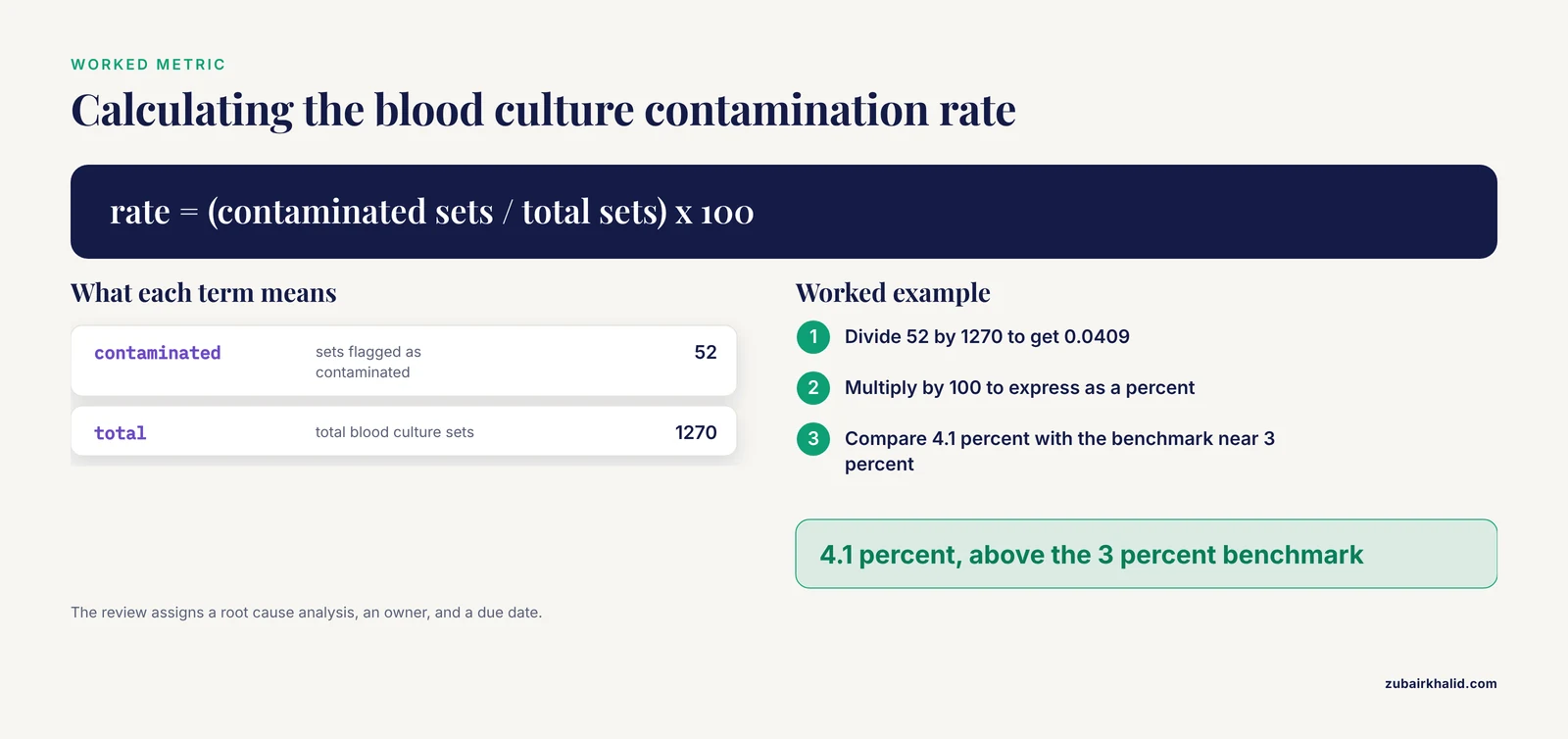
| Blood culture contamination rate | Contaminated sets divided by total sets, times 100 | Trend line against an internal target, commonly near 3 percent as a benchmark | QC performance |
| Control organism pass rate | Passing control results divided by total control results, times 100 | Per instrument and per method, monthly | QC performance |
| EQA score or z-score | Per your provider's scheme | Per analyte or organism, with unsatisfactory results flagged | EQA item |
| Specimen rejection rate | Rejected specimens divided by total received, times 100 | By rejection reason | Feedback and pre-analytics |
| TAT at the 95th percentile | Quantile of result reporting time | Per test, pre- and post-analytical phases separated | Objectives |
| Nonconformity closure time | Days from open to verified close | Median and oldest open item | Corrective actions |
| Competency assessment currency | Staff current divided by staff due, times 100 | By role and section | Resources |
| Audit finding closure | Closed findings divided by total findings, times 100 | By severity | Audit results |
Compute the metrics the same way every cycle. A short script keeps the calculation consistent and gives you a traceable record.
import pandas as pd

sets = pd.read_csv("blood_cultures_q4.csv")
flagged = sets[sets["contamination_flag"] == 1]
rate = len(flagged) / len(sets) * 100
print(f"Total sets: {len(sets)}")
print(f"Contaminated sets: {len(flagged)}")
print(f"Contamination rate: {rate:.1f} percent")
With an example quarter of 1,270 sets and 52 flagged as contaminated, the output reads:
Total sets: 1270
Contaminated sets: 52
Contamination rate: 4.1 percent
A rate of 4.1 percent against a benchmark near 3 percent is not a discussion topic. It is a decision trigger: the review should assign a root cause analysis, an owner, and a due date, typically looking at collection site, volume drawn, and training of new phlebotomy or nursing staff.
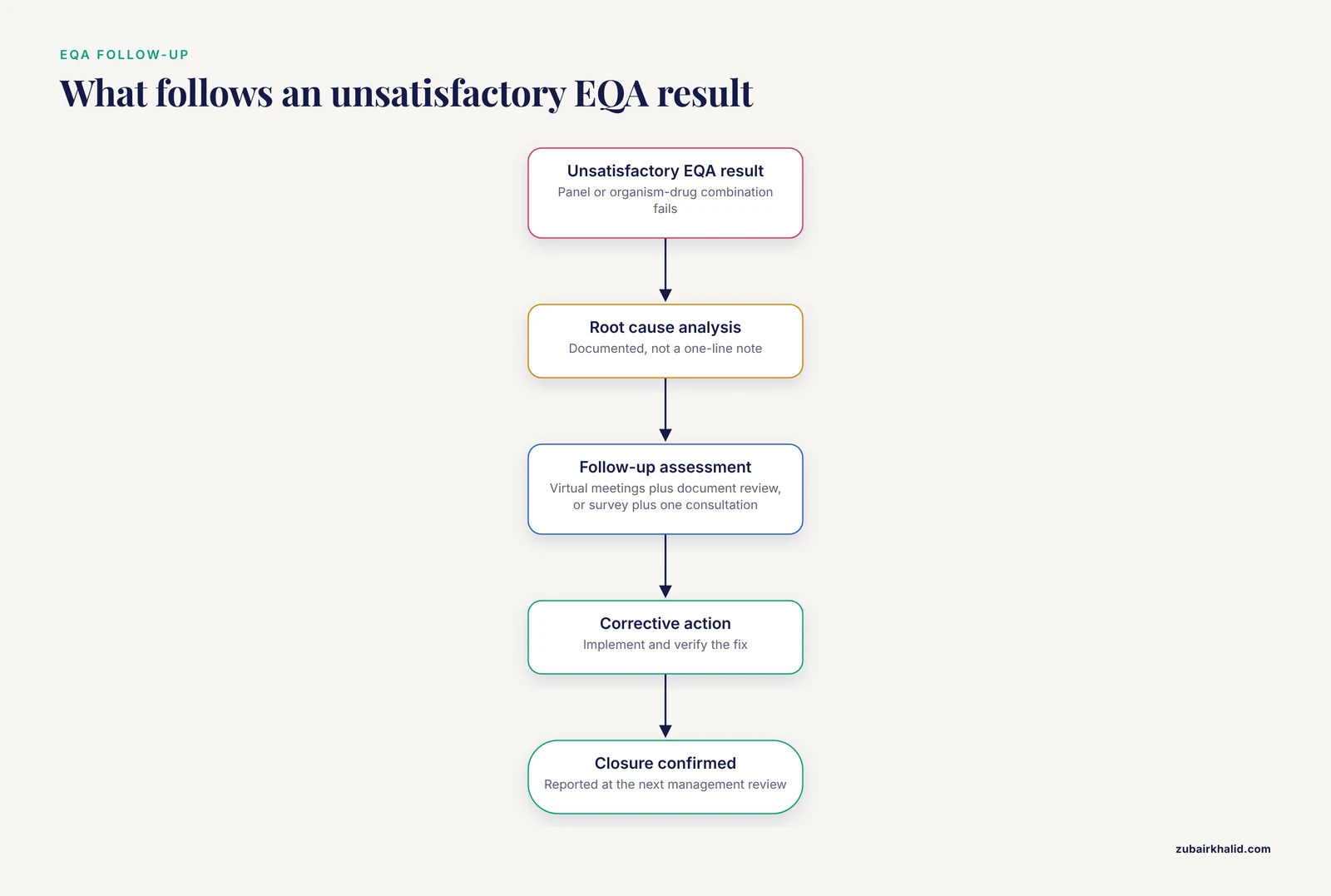
For the EQA section, bring the full period's results, not just the scores. The experience of an international EQA program serving One Health sector reference laboratories across Asia during the COVID-19 pandemic in 2021 and 2022 showed two distinct follow-up assessment approaches after EQA procedures: a virtual-based method using multiple online meetings plus document reviews for underperforming laboratories, and a survey-based method combining an online questionnaire with a single online consultation meeting for a broader group [6]. The practical lesson for your agenda is that an unsatisfactory EQA result should trigger a defined follow-up assessment pathway, and the management review is where you confirm that pathway ran and that it worked.
For internal audit data, present findings with a comparison baseline. A clinical audit of otitis externa referrals to NHS Tayside compared swab sampling rates and microbiology results against an earlier audit period, showing a marked improvement in patients being swabbed before referral, rising to 96.2 percent from under 65 percent, alongside shifts in the organisms recovered, with Candida and Pseudomonas among the most common [7]. Your laboratory audit findings work the same way: a finding rate means little without the previous cycle beside it, and apparent deterioration or improvement can reflect better detection rather than changed performance. Show both cycles on one slide.
A Worked Management Review Meeting Microbiology Lab Agenda Example
The following example shows the full agenda format in action for a fictional 120-minute quarterly review at Riverbend Regional Microbiology Laboratory. Attendees are the laboratory director (chair), quality manager, operations lead, QC officer, lead auditor, bacteriology section lead, mycology section lead, and the phlebotomy supervisor for item 8.
Items 1 and 2, first 15 minutes. The chair reads the action log. Eleven actions were open from the last review. Nine are verified closed with evidence attached in the pack. One, the replacement of an aging incubator data logger, is re-dated to next month with the purchase order number recorded. One, a revised urine culture protocol, is escalated because the medical director's sign-off is pending. Attendance and apologies are recorded on the minutes form.
Item 3, 10 minutes. The quality manager lists two context changes: the hospital's antibiotic stewardship committee has requested rapid AST reporting for blood cultures, and the referral agreement for mycobacterial cultures is under renegotiation. Each change is tagged to the risk register.
Item 4, 15 minutes. Policy and objectives. The laboratory's objective of 95th-percentile TAT at or under 48 hours for routine wound cultures was missed in two of three months. The operations lead presents the trend and proposes a change in batch release timing. The chair asks whether the missed objective requires amendment of the objective itself or of the process. The decision: keep the objective, change the batching process, and review at the next cycle.
Item 5, 15 minutes. Audit results. The lead auditor reports eight findings, six minor and two major, against three sections. The two majors both concern competency documentation after a staffing change. Corrective actions are assigned to the operations lead with a 30-day due date. Following the audit logic demonstrated in the Tayside example, where repeat comparison against a baseline audit revealed both real improvement and a possible detection artifact in candidal growth rates [7], the pack includes the previous cycle's findings for comparison.
Item 6, 15 minutes. EQA performance. All panels passed except one AST panel with an unsatisfatory result for a single organism-drug combination. The bacteriology section lead presents the completed root cause analysis: a transcription error at result entry, corrected by a double-check step and a retraining record. The review confirms the follow-up assessment pathway was executed, mirroring the virtual meeting and document review model used for underperforming laboratories in the international EQA program [6].
Item 7, 15 minutes. Quality control. The QC officer reports a 99.7 percent control organism pass rate, one media sterility failure for a lot of blood agar plates that was quarantined before use, and the blood culture contamination rate of 4.1 percent described above. The decision: commission the contamination root cause analysis involving the phlebotomy supervisor, report back in 60 days.
Item 8, 10 minutes. Feedback. Three clinician complaints about wound culture TAT, one complaint about specimen rejection communication, and a request for Legionella testing, which is deferred to the context and resource discussion. The pre-analytical review draws on the receiving log: 38 specimens rejected, the largest reason being unlabeled containers, with a corrective action on labeling education. The discussion echoes the point that specimen integrity depends on structured collection protocols and cold chain control, such as maintaining samples at 4 degrees Celsius in sterile hermetic containers before analysis [4].
Item 9, 10 minutes. Nonconformities. Fourteen nonconformities opened in the quarter, twelve closed, two aging past 60 days. Effectiveness checks are scheduled for the four actions closed more than 90 days ago.
Item 10, 10 minutes. Resources. One microbiologist vacancy, competency assessments current for 94 percent of staff. For competency structure, the review references the model demonstrated in a primary care training program where practitioners were observed in real consultations and their competence coded against a published rubric after structured skills training [8], and agrees to adopt direct observation with a checklist rubric for the new AST reporting workflow rather than paper-based knowledge tests alone. The director also notes that recruiting for defined competencies matters, since research on corporate expectations of management graduates shows a persistent gap between what organizations expect and what formal training delivers, which argues for explicit competency criteria in job postings [9].
Item 11, 10 minutes. Risk and improvement. The register is reviewed, one risk accepted (referral dependence for mycobacteriology), one risk retired (previously open data logger risk, closed by item 2 action), one improvement project approved: a pilot of direct-from-specimen rapid diagnostics, funded within existing budget.
Item 12, 5 minutes. Surveillance outputs confirmed: monthly resistance trend reports to the stewardship committee, in line with the kind of AMR preparedness agenda that bodies such as ESCMID have placed at the center of clinical microbiology planning [3]. The director also tables a five-minute horizon note on artificial intelligence tools for identification and resistance prediction, referencing the direction of travel described in recent reviews of the field [5], and asks the QC officer to follow vendor validation claims for any future procurement.
Item 13, 5 minutes. Next review set for the first Tuesday in three months. Inputs assigned. Meeting closed at 118 minutes.
Running the Meeting: The Numbered Walkthrough
- Circulate the pack five to ten business days ahead. Attach the agenda, all metric pages with trends, and the previous minutes. Record the circulation date on the minutes, because assessors check that review inputs were provided in advance.
- Confirm attendance and quorum. Record names, roles, and apologies. Chair and minutes-taker must be named in advance. Invited guests attend only for their items.
- Start with the previous action log. Every action gets one of three outcomes: closed with evidence, re-dated with a reason, or escalated. Do not move on until each line is resolved on the record.
- Take each agenda item in order with its fixed time. The presenter states the metric, the trend, and the proposed decision in under two minutes. Discussion follows only if a decision is contested.
- Convert every problem into a CAPA, an objective change, or an accepted risk. CAPA stands for corrective and preventive action. If an item produces none of the three, the chair states explicitly that the item is reviewed with no change required, and the minutes record that.
- Timebox strictly. If an item overruns, the chair parks it to any other business or to an interim meeting, and moves on. A review that runs long every cycle will lose attendance and then lose authority.
- Assign owners and due dates out loud. The minutes-taker reads back each action, owner, and date before the item closes. Ambiguity here is the most common cause of aging actions.
- Close with the next review date and assigned inputs. Set the date in the room. Assign who will prepare each input for the next cycle.
- Issue draft minutes within five business days. Circulate for comment, then finalize. File the final minutes with the attendance record, the pack, and the action log.
- Track actions between reviews. The quality manager reviews the action log monthly, chases owners at the halfway point of each due date, and brings the updated log to the next review.
Documenting Outputs and Follow-Up
The review's outputs are what an assessor inspects. Your minutes should record, for each item, the data presented, the discussion summary, the decision made, and the action assigned with owner and due date. The action log is a separate living document that survives between meetings.
ACTION LOG, Management Review 2026-Q3
ID: MR-2026-Q3-04
Item: Quality control performance
Issue: Blood culture contamination rate 4.1 percent vs target 3 percent
Decision: Root cause analysis commissioned
Action: RCA covering collection site, draw volume, and training
Owner: Bacteriology section lead
Due: 2026-12-15
Verification: Report to chair, effectiveness check at 2027-Q1 review
Status: OPEN
Three output documents should always exist after every review: the signed minutes, the updated action log, and, where objectives or the risk register changed, the revised versions of those documents with the review date noted. If the review decided to change a policy, a procedure, or the quality manual, a document control action is assigned in the same way, because un-updated documents after a management review are a standard audit finding.
Common Mistakes and Limitations
- Reading data aloud. If the presenter is narrating the pack, the pack went out too late or not at all. Circulate early and discuss decisions only.
- No previous action log review. Skipping item 1 teaches the room that actions are optional. Open with it, every time.
- Incomplete inputs. Arriving without EQA results, complaint summaries, or competency data is the most common accreditation finding against management reviews. Use a checklist against the input list and do not proceed with blank items.
- EQA failures closed too quickly. An unsatisfactory proficiency result deserves a root cause analysis and a documented follow-up assessment, on the model of the structured virtual and survey-based assessment pathways used in international EQA programs, not a one-line note in the minutes [6].
- Audit findings without a baseline. Presenting one cycle of findings in isolation invites wrong conclusions. Comparisons across audit cycles can reveal both real change and shifts in detection or sampling behavior, as the repeat otitis externa audit in Tayside demonstrated [7].
- Ignoring pre-analytics. Rejection rates, labeling errors, and transport conditions drive more microbiology errors than analytical failures. Give them a named slot, informed by the standards of specimen handling described in the pre-analytical literature, including cold chain control at 4 degrees Celsius [4].
- Treating certification as the goal. Research on decertification from management system standards shows that disengagement from the system, not paperwork failure alone, precedes loss of certification, and that managers should treat the standard as something to be actively managed over its whole life cycle [2]. The review is the instrument of that engagement.
- Wrong people in the room. Governance research links the composition and expertise of the governing group to performance [1]. A review attended only by quality staff, with no laboratory director and no bench section leads, cannot commit resources, which is its core function.
- Vague competency conclusions. "Staff are trained" is not an output. Structured, observed, rubric-based competency assessment, as demonstrated in formal clinical training programs [8], produces the evidence your review needs.
One limitation applies throughout. Individual laboratories operate under different accreditation schemes, service mixes, and local regulations, so the exact input list and frequency must be matched to your own accreditation standard and to advice from your qualified quality manager or accreditation body.
Frequently Asked Questions
How often should a microbiology lab hold a management review meeting?
At a planned interval defined in your quality manual, and at least annually under common accreditation standards. Most active microbiology laboratories do better with a quarterly or semiannual cycle.
Who should attend the management review meeting?
Laboratory leadership, the quality manager, section leads, and anyone who owns an input or a decision. Governance research supports including members with relevant expertise and adequate representation.
What is the difference between an internal audit and a management review?
An internal audit checks conformity of processes against requirements. The management review evaluates the whole quality management system and commits resources to improvement. Audits feed the review as an input.
What goes on a management review meeting microbiology lab agenda?
Each required review input, including previous actions, audit results, EQA performance, quality control data, feedback, nonconformities, resources, risks, and surveillance outputs, with a presenter, time allocation, and expected output for each.
How long should the meeting last?
Ninety to 120 minutes for a quarterly review in a mid-sized laboratory is realistic. Build a per-item time budget, sum it, and cut before circulation if it exceeds your slot.
What records must be kept after the meeting?
Minutes with attendance and decisions, the updated action log with owners and due dates, and any revised objectives, risk register entries, or policies that the review approved.
What should the lab do after an unsatisfactory EQA or proficiency testing result?
Complete a documented root cause analysis, run a defined follow-up assessment pathway, implement and verify corrective actions, and report the closure at the next management review.
Can the management review be held virtually?
Yes. Virtual meetings plus document reviews have been used successfully for laboratory assessments in international EQA programs, provided attendance, inputs, decisions, and records are captured with the same rigor as in person.
Sources
- Corporate Governance, Risk Management Disclosure, and Firm Performance: A Theoretical and Empirical Review Perspective
- Decertification from international management standards: a systematic literature review and research agenda
- ESCMID sets its agenda for meeting the European challenges in clinical microbiology
- The sample’s journey in orthopedic implant infections : from the operating room to the microbiology lab
- Artificial intelligence-driven advances in medical microbiology: a review on next-generation diagnosis, surveillance, and therapeutics
- Evaluating Quality Management and Diagnostics Microbiology Performance Within an International External Quality Assessment (EQA) Program Serving National One Health Sector Reference Laboratories Across Asia: Experience Amid the Coronavirus Disease 2019 (COVID-19) Pandemic
- 957 Otitis Externa (Oe) Management Review in Tayside
- Meeting the UK Government’s prevention agenda: primary care practitioners can be trained in skills to prevent disease and support self-management
- A Systematic Review and Research Agenda on Corporate Expectations from Management Graduates