Lyophilization vs Cryopreservation QC Strains: Step-by-Step Guide
By Dr. Zubair Khalid, DVM, MS, PhD ·
Quality control (QC) strains are the reference bacteria a clinical microbiology laboratory uses to prove that its media, stains, identification systems, and antimicrobial susceptibility testing (AST) work correctly every day. Common examples include Escherichia coli ATCC 25922, Staphylococcus aureus ATCC 25923, Pseudomonas aeruginosa ATCC 27853, and Enterococcus faecalis ATCC 29212. A strain bank built with lyophilization (freeze drying) or cryopreservation (deep frozen storage in a cryoprotectant) keeps those reference organisms stable, so the laboratory never depends on an endlessly subcultured plate that can drift, die, or pick up contaminants.
Lyophilization removes water from a frozen suspension by sublimation under vacuum, which lets sealed ampoules of most bacteria stay stable at refrigerated temperatures for years. Cryopreservation holds cells in a glycerol or dimethyl sulfoxide (DMSO) medium at -70°C or colder, which halts metabolism with no specialized drying equipment at all.
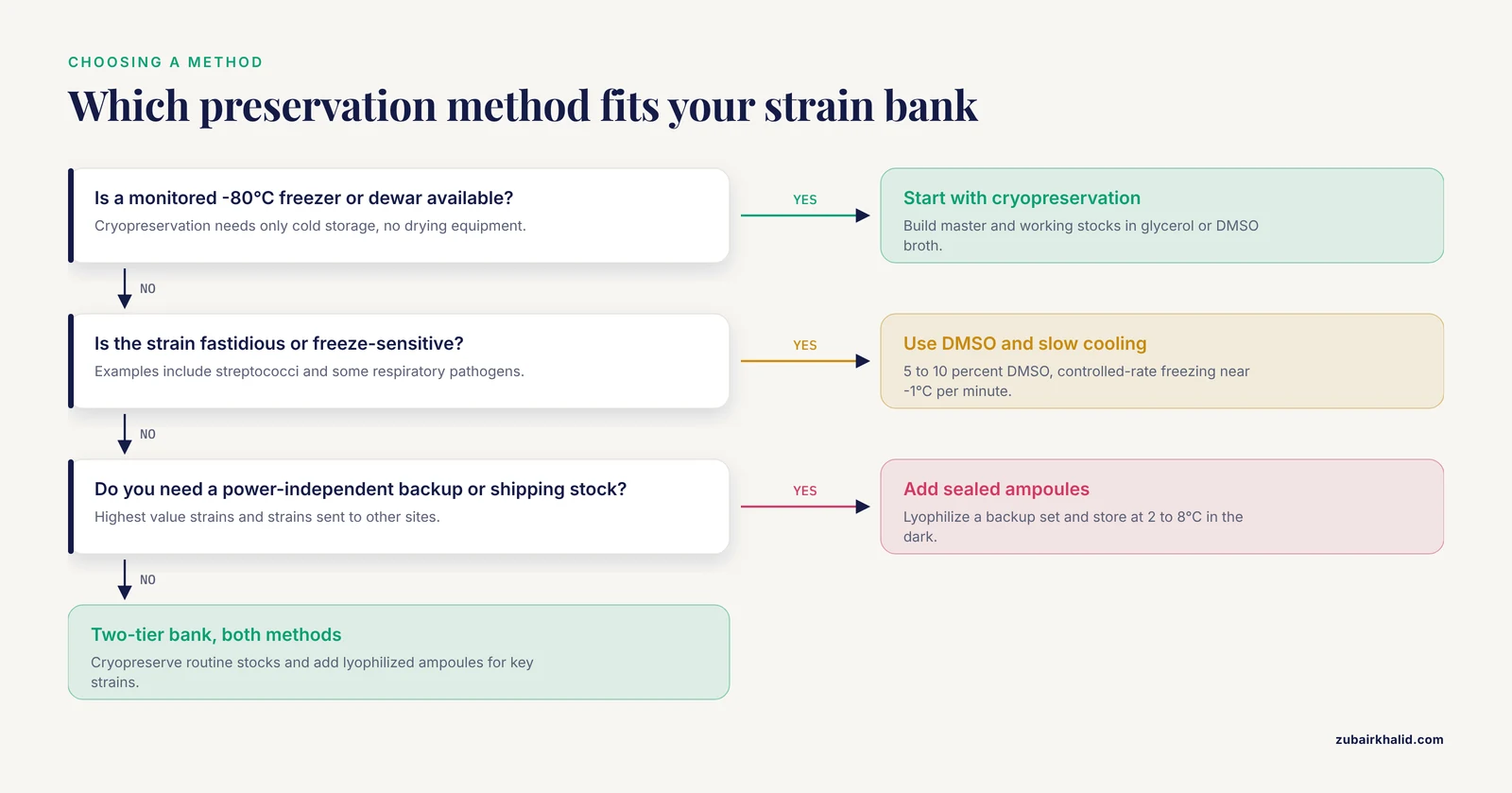
Choosing between lyophilization and cryopreservation for QC strains comes down to purpose. Cryopreservation is the default for building master and working stocks because it takes about 1 hour of bench work and needs only a -80°C freezer. Lyophilization is the better choice for long-term, power-independent backup stocks, for strains that lose viability in frozen storage, and for shipping strains to other sites. This guide covers both methods step by step, with the materials, controls, expected results, troubleshooting, and records that a sound laboratory quality management system expects.
Hands-on and elapsed time. Cryopreservation takes about 1 hour of hands-on work per batch, freezes overnight, and needs a 24 to 48 hour release test before the stock enters service. Lyophilization takes 1 to 2 hours of hands-on work, then 24 to 48 hours of unattended drying, followed by the same release test. Plan on two working days from starting the culture to releasing a verified stock either way.
Why QC Strain Preservation Matters in Microbiology Quality Control
Every AST result a laboratory reports is only as trustworthy as the QC strain behind it. The CLSI M100 tables define the acceptable zone diameter and minimum inhibitory concentration (MIC) ranges for each QC strain, and CLSI M40 governs QC of commercially prepared culture media. When the stock is healthy, an out-of-range result correctly points to a problem with the media lot, the antimicrobial discs, or the incubation conditions. When the stock itself has drifted or died, the laboratory either chases phantom failures or, worse, passes a genuinely failing system.
Strain-level identity is the other half of the problem. Clinical guidance on live microbial products makes the point clearly, since the Malaysian Society of Gastroenterology and Hepatology position statement on probiotics stresses that benefits and safety are strain specific and that quality control in manufacturing is a core criterion for selecting any live microbial product [1]. Vaccine seed programs run on the same logic, where selecting and managing suitable seed strains according to standard principles is described as a critical factor in manufacturing high-quality biological products [2]. A QC strain bank is a small version of the same system. If you cannot show where a stock came from, how many times it was handled, and how it was verified, the bank is not a control, it is a liability.
The Principle Behind Each Method
Lyophilization (Freeze Drying)
Lyophilization works in three stages. First the suspension is frozen solid. Then primary drying removes unbound water by sublimation, meaning ice passes directly from solid to vapor under vacuum without ever melting. Finally secondary drying removes the water bound to proteins and membranes, bringing the residual moisture (the water left in the finished cake) down to roughly 1 to 3 percent of the dry weight. A lyoprotectant such as skim milk, sucrose, or trehalose surrounds each cell during the process and stabilizes membranes and proteins that would otherwise be damaged as water leaves. With water activity that low, metabolism stops and most chemical degradation slows to a crawl, which is why a well sealed ampoule kept at 2 to 8°C in the dark can remain viable for years to decades.
Cryopreservation
Cryopreservation freezes cells together with a cryoprotectant, most often glycerol at a final concentration of 15 percent (v/v) in broth, or DMSO at 5 to 10 percent (v/v) for fastidious or freeze-sensitive strains. The protectant reduces the ice that forms inside cells and blunts the osmotic shock that concentrates solutes as ice forms outside them. At -70 to -80°C metabolism is nearly stopped, and below about -135°C, the glass transition temperature of water, molecular motion effectively ceases. That is why liquid nitrogen vapor phase storage, which sits far below that point, gives the longest stability of any option. The tradeoff is that a frozen stock depends completely on the freezer or dewar, and every thaw-and-refreeze cycle causes ice recrystallization that damages cells.
Master Stocks and Working Stocks
Sound banks use a two-tier structure. A master stock is made directly from the verified reference culture, stored in multiple aliquots, and opened only to prepare working stocks. Working stocks feed daily QC and are discarded after a set period (commonly about 1 month) or a set number of subcultures. Passage number, the count of subcultures since the original verified culture, is recorded for every vial. The structure matters because each subculture is a chance for drift, contamination, or transcription error, and the master stock limits how many times the strain is ever handled.
Lyophilization vs Cryopreservation QC Strains at a Glance
| Attribute | Lyophilization | Cryopreservation |
|---|---|---|
| What it does | Removes water by sublimation under vacuum after freezing | Halts metabolism by deep freezing with a cryoprotectant |
| Protectant | 10 percent (w/v) skim milk, or 5 to 10 percent (w/v) sucrose or trehalose | 15 percent (v/v) glycerol in broth, or 5 to 10 percent (v/v) DMSO |
| Hands-on time | 1 to 2 hours per batch | About 1 hour per batch |
| Elapsed time | 24 to 48 hours drying, plus release testing | Overnight freezing, plus release testing |
| Storage temperature | 2 to 8°C, dark | -70 to -80°C, or liquid nitrogen vapor phase |
| Typical shelf life | Years to decades for sealed ampoules | Years at -80°C, longest in nitrogen vapor |
| Equipment and skill | Freeze dryer, vacuum pump, ampoule sealing skill | -80°C freezer or dewar, minimal skill |
| Best suited for | Long-term backup, distribution, strains that fare poorly frozen | Routine master and working stocks, large strain panels |
| Main failure modes | Residual moisture too high, lost vacuum, collapsed cake | Freezer failure, repeated freeze-thaw, liquid ingress in nitrogen |
Most laboratories run cryopreservation for routine master and working stocks and add lyophilized ampoules as a disaster-proof backup for the highest value strains.
Materials and Reagents
| Material or reagent | Working concentration or specification | Purpose |
|---|---|---|
| Tryptic soy broth (TSB) | With 15 percent (v/v) sterile glycerol added | Standard cryoprotectant for non-fastidious bacteria |
| DMSO, sterile | 5 to 10 percent (v/v) in broth | Cryoprotectant for fastidious or freeze-sensitive strains |
| Skim milk powder | 10 percent (w/v) in distilled water, sterilized | Lyoprotectant for freeze drying |
| Sucrose or trehalose | 5 to 10 percent (w/v) | Alternative lyoprotectant, often combined with skim milk |
| Sterile distilled water | 0.5 to 1.0 mL per ampoule | Reconstitution of dried stocks |
| Polypropylene cryovials | 1 to 2 mL, screw cap with O-ring | Cryopreservation aliquots |
| Glass ampoules or lyophilization vials | Flame sealable glass, or vials with butyl stoppers | Lyophilization containers |
| Cryogenic labels | Solvent-resistant ink | Traceability at low temperature |
| Rich nonselective agar | Tryptic soy agar with 5 percent sheep blood, or chocolate agar | Purity plating and viability checks |
| McFarland standards | 0.5 standard as the turbidity reference | Matching suspension density |
| 70 percent (v/v) ethanol or laboratory disinfectant | Ready to use | Surface disinfection |
| Freeze dryer with condenser and vacuum pump | Condenser -60°C or colder, chamber below 0.1 mbar | Lyophilization |
| -80°C freezer with monitoring | Alarm set and tested | Cryopreservation |
| Liquid nitrogen dewar | Vapor phase storage | Long-term cryostorage |
Sterilize glycerol broth and skim milk by autoclaving, and sterilize DMSO solutions by membrane filtration. Use sterile, clean water for reconstitution.
Step-by-Step Procedure
Step 1. Prepare and Verify the Source Culture (Both Methods)
- Grow a young culture. Streak the reference strain for isolation on rich nonselective agar suited to the organism and incubate 18 to 24 hours, or the shortest time that gives heavy growth.
Reason: cells harvested in late log phase survive freezing and drying far better than stationary or overgrown cells, and short incubation leaves less time for drift.
- Confirm purity and identity. Inspect colony morphology, perform a Gram stain, and confirm identity by matrix-assisted laser desorption ionization time-of-flight mass spectrometry (MALDI-TOF) or a biochemical panel.
Reason: a master stock preserves whatever you give it, and a contaminant or a misidentified strain is locked in permanently.
- Assign a lot number and passage number, and plan the bank structure with one master set plus working aliquots.
Reason: traceability is what separates a strain bank from a pile of frozen tubes.
- Prepare labels with strain name, lot, passage, date, and method, and apply them before freezing.
Reason: ordinary labels fall off at -80°C and handwritten ink smears, and labeling failures are among the most common ways banks become unusable.
Safety: handle clinical QC strains using biosafety level 2 (BSL-2) practices, including gloves, lab coat, eye protection, and a certified biosafety cabinet for any aerosol-generating step.
Step 2. Lyophilization Protocol
- Suspend the growth in 10 percent (w/v) sterile skim milk to a dense suspension, aiming for at least 10⁹ CFU per mL (colony-forming units per milliliter), roughly a paste scraped from several plates.
Reason: the protectant stabilizes membranes and proteins during drying, and a high starting titer offsets the viability loss that drying always causes.
- Dispense 0.1 to 0.2 mL into each sterile ampoule or lyophilization vial.
Reason: a shallow, uniform layer freezes and dries evenly and leaves room for stoppering or sealing.
- Freeze rapidly at -40 to -80°C for 1 to 2 hours, or spin-freeze in a cold bath by rotating the ampoules to spread the liquid as a thin shell on the wall.
Reason: fast freezing forms small ice crystals that do less structural damage, and complete solidification prevents melt-back once vacuum is applied.
- Load the frozen ampoules onto precooled shelves, close the chamber, and pull the vacuum below 0.1 mbar with the condenser at -60°C or colder.
Reason: sublimation needs a vapor pressure gradient, the cold condenser creates it by trapping vapor, and precooled shelves keep the cake from slumping before the vacuum holds it in place.
- Hold primary drying for 12 to 24 hours, raising the shelf temperature gradually (for example from -30°C toward 0 to 20°C) once the cake holds its shape.
Reason: gentle heat speeds sublimation without collapsing the structure, and the product must stay frozen until the free water is gone.
- Run secondary drying for 2 to 6 hours with shelves at 20 to 25°C.
Reason: this strips the bound water down to the target residual moisture of about 1 to 3 percent, which is the single biggest determinant of long-term stability.
- Stopper vials under vacuum, or flame seal glass ampoules.
Safety: wear eye protection and work behind a shield when flame sealing, and discard any ampoule with a crack because heated glass under vacuum can implode. Reason: oxygen and moisture ingress are the main enemies of a dried stock, and a good seal is what turns a dried cake into a stable product.
- Test the vacuum in glass ampoules with a high-voltage spark tester. A good vacuum glows purple to pink inside the glass.
Reason: a lost vacuum predicts rapid loss of viability, and it is better to find out now than in two years.
- Release test one ampoule as described below, then store the sealed ampoules at 2 to 8°C in the dark and log their location.
Reason: a batch is not a stock until it is proven viable, pure, and phenotypically correct, and cool darkness slows the residual chemistry that continues even in a dried cake.
Step 3. Cryopreservation Protocol
- Prepare the cryoprotectant. Use tryptic soy broth with 15 percent (v/v) sterile glycerol for most bacteria, or broth with 5 to 10 percent (v/v) DMSO for fastidious or freeze-sensitive strains. Chill to 2 to 8°C before use.
Reason: glycerol and DMSO limit intracellular ice and osmotic shock, and a chilled solution reduces thermal stress during mixing. Safety: DMSO penetrates skin and can carry dissolved contaminants with it, so wear nitrile gloves and avoid skin contact.
- Suspend the culture in chilled cryoprotectant to at least 10⁸ CFU per mL (McFarland 3 or denser).
Reason: high titer offsets the cell loss that freezing and thawing always cause.
- Aliquot 0.5 to 1.0 mL into labeled cryovials and tighten the caps.
Reason: single-use aliquots are the only reliable way to prevent repeated freeze-thaw cycles.
- Freeze. For hardy non-fastidious bacteria, place vials directly at -80°C. For fastidious strains, use a controlled-rate freezing container (about -1°C per minute) or hold at -20°C for 1 to 2 hours before moving to -80°C.
Reason: slow cooling gives intracellular water time to leave the cell, which limits lethal ice formation, while hardy organisms tolerate the simple direct method.
- After 24 hours at -80°C, move master stock vials to liquid nitrogen vapor phase storage if available, and keep working stocks at -80°C.
Reason: below about -135°C molecular motion effectively stops, so vapor phase storage gives the longest and most stable preservation. Safety: liquid nitrogen causes cryogenic burns and can displace air in small rooms, so use a face shield, cryo gloves, and adequate ventilation. Store vials in the vapor phase, never submerged, because liquid can seep past threads and the vial can burst on warming. Thaw vials inside a sealed plastic bag or behind a shield.
- Never refreeze a thawed vial. Record the thaw date when a vial is opened.
Reason: each freeze-thaw cycle causes ice recrystallization and osmotic damage that compounds quickly.
- Release test one vial as described below.
Reason: the release test proves the batch before any vial is trusted.
Step 4. Release Testing (Both Methods)
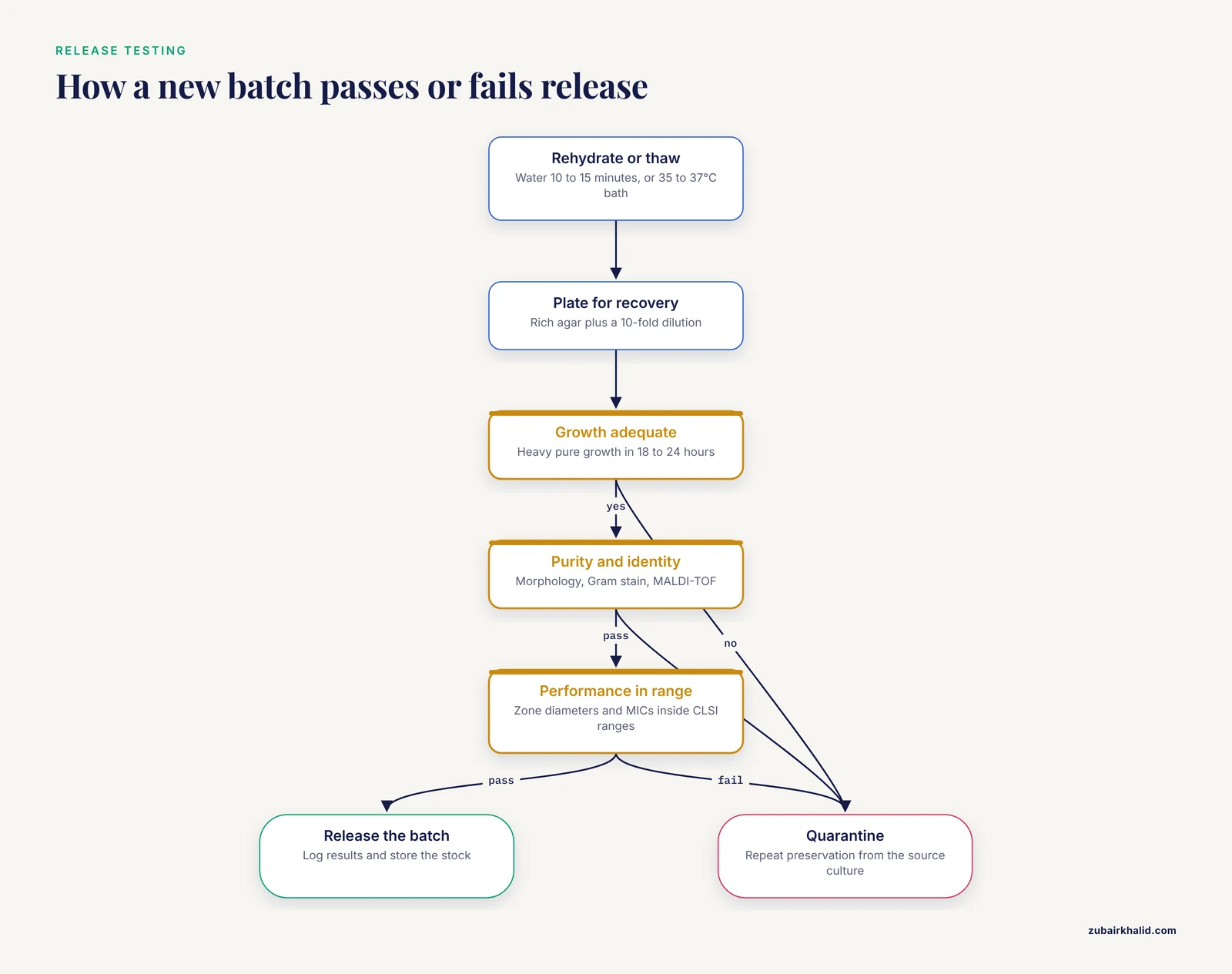
- Rehydrate or thaw. For a lyophilized ampoule, score the neck, crack it aseptically, add 0.5 to 1.0 mL of sterile distilled water, and let it stand 10 to 15 minutes without shaking (longer for fastidious strains). For a cryovial, thaw rapidly in a 35 to 37°C water bath for 2 to 5 minutes with gentle agitation.
Reason: slow rehydration lets damaged membranes reseal, and rapid thawing passes quickly through the temperature zone where ice recrystallizes.
- Plate for recovery. Inoculate rich nonselective agar (and broth for slow growers) with the suspension and with a 10-fold dilution, then incubate 18 to 48 hours as appropriate.
Reason: plating two densities distinguishes low recovery from heavy clumping.
- Check purity. Examine colony morphology, perform a Gram stain, and subculture representative colonies.
Reason: any mixed morphology disqualifies the batch.
- Confirm identity. Run MALDI-TOF or a biochemical identification panel, and sequence the genome for high-value master stocks as described below.
Reason: identity errors are rare but catastrophic, since every downstream QC result inherits them.
- Prove performance. Run the stock through its intended QC application. For AST QC strains, test against the standard panel and confirm that zone diameters and MIC values fall within the published CLSI ranges. For media QC, run the strain on the media lot in question.
Reason: viability alone does not guarantee the strain still performs as a control, and performance is the property the laboratory actually depends on.
Controls and Expected Results
Controls to run with every batch:
- Run control. Process a vial of a proven hardy strain (for example E. coli ATCC 25922) in the same lyophilization run or freezing batch. If the control recovers well and the new strain does not, the problem is the strain or its protectant, not the run.
- Sterility control. Incubate an uninoculated sample of each protectant solution batch.
- Purity control. The pre-preservation purity plate from Step 1.
- Vacuum control. The spark test for glass ampoules.
- Performance control. The published CLSI ranges for the strain.
Expected results and how to read them:
- A good lyophilized cake is a uniform, intact plug that sits away from the vial wall, not a collapsed, liquefied, or crystalline mass. A purple to pink glow on the spark test confirms vacuum.
- After reconstitution or thaw, expect heavy, pure growth of typical colonies within 18 to 24 hours for non-fastidious organisms, with recovery roughly within one log of the input titer. Scant or slow growth points to the protectant, the starting titer, or the drying run.
- AST QC values must fall inside the published CLSI ranges for the strain. Values near the edge of the range are acceptable but deserve a note in the stock record, since edge results can be the first sign of drift.
- If any release criterion fails, quarantine the batch and repeat preservation from the source culture.
Troubleshooting
| Symptom | Likely cause | Fix |
|---|---|---|
| No growth or very low recovery after drying | Starting suspension too dilute | Build the next suspension to at least 10⁹ CFU per mL |
| No growth or very low recovery after drying | Overgrown source culture | Preserve 18 to 24 hour cultures only |
| No growth or very low recovery after drying | Residual moisture outside the target range | Extend secondary drying and verify run parameters |
| Cake collapsed or melted during the run | Shelves warmed before the product froze completely, or chamber pressure too high | Freeze fully, confirm condenser temperature and vacuum before warming shelves |
| Ampoules fail the spark test | Poor flame seal or leaking stopper | Reseal with a fine flame, check stopper compression and vial finish |
| Mixed or atypical growth after reconstitution | Contamination during dispensing or opening | Work in a biosafety cabinet, verify protectant sterility, discard the batch |
| Cryovials crack or burst on thawing | Vials stored submerged in liquid nitrogen | Store in vapor phase and thaw behind a shield in a sealed bag |
| Recovery falls after months at -80°C | Freezer cycled above -60°C from door openings, defrost cycles, or power events | Review alarm logs, move masters to vapor phase, reduce door openings |
| AST QC values drift out of range over time | Working stock over-passaged | Discard the working stock, return to the master, enforce a passage limit |
| Clumping or chains after reconstitution | Osmotic shock or harsh rehydration | Add water gently down the wall, let the cake wet fully before plating |
| Vacuum pump runs hot or the oil turns cloudy | Condenser overloaded or a chamber leak | Confirm condenser temperature, locate leaks, change pump oil |
Variations and Alternatives
- Cryobeads. Sterile beads rolled in a dense suspension and stored in glycerol broth at -80°C make convenient working stocks, since a single bead drops onto an agar plate and the vial stays frozen.
- Serum-based protectants. Defibrinated blood or serum mixed with glycerol suits fastidious organisms such as streptococci and some respiratory pathogens.
- Controlled-rate freezing. A controlled-rate container or programmable freezer benefits fastidious strains, though hardy Enterobacterales tolerate direct placement at -80°C.
- Centrifugal (spin) freeze drying. Rotating ampoules in a cold bath at -40°C or colder spreads the suspension as a thin shell and works for small batches without a shelf dryer.
- Backfill gas. Some laboratories backfill vials with dry nitrogen instead of vacuum before stoppering, which reduces glass stress but requires verified dry gas and airtight stoppers.
- Anaerobes and strict organisms. Handle strict anaerobes in an anaerobic chamber with prereduced media, and validate protectant and recovery per strain.
Storage and Stability Notes
Lyophilized ampoules store at 2 to 8°C in the dark. Avoid temperature cycling, keep a sentinel ampoule from each lot, and open or spark test a sentinel annually to confirm the lot still recovers. Sealed ampoules of hardy genera can remain viable for years to decades, but the vacuum and the seal decide everything, so treat any ampoule that fails the spark test as expired.
Cryopreserved stocks store at -80°C with continuous monitoring, a tested alarm, and a documented backup plan, whether that is a second freezer or liquid nitrogen backup. Minimize door openings, keep an inventory with exact box and position locations, and verify one sentinel vial per lot annually. Master stocks of irreplaceable strains belong in liquid nitrogen vapor phase, and a duplicate set at a second site or at least in a separate failure domain is cheap insurance.
Discard criteria belong in the stock record. Discard working stocks after about 1 month or a defined passage limit. Retire a master stock only when a replacement master has passed release testing.
Verifying Identity and Genetic Stability
Routine identity checks with MALDI-TOF or a biochemical panel belong in every release test. For master stocks of high value, whole genome sequencing (WGS) is now a practical standard, and the vaccine seed literature shows why. Complete genomes of live animal vaccine bacterial seed strains in South Korea were assembled with a hybrid workflow combining Illumina NovaSeq 6000 short reads and Oxford Nanopore MinION long reads, producing gap-free genomes of 0.95 to 5.34 Mb for the five strains, data that let reviewers confirm at the strain level whether manufacturers are using the same seed stock over time and support consistent production and quality control [2]. A companion dataset for inactivated vaccine seed strains, including Pasteurella multocida, Actinobacillus pleuropneumoniae, Glaesserella parasuis, Mannheimia haemolytica, Avibacterium paragallinarum, and three Escherichia coli strains, used the same hybrid assembly approach and reported completeness above 99 percent with contamination below 1 percent, and genome sizes from 2.28 to 5.35 Mb [3]. Those completeness and contamination figures are sensible acceptance targets when a laboratory sequences its own master stock.
Sequencing at release also creates the reference for later drift checks. Phenotypic QC can miss small genomic changes, and molecular typing closes that gap. In a study of Brucella abortus S19 and RB51 vaccine strains, multiple-locus variable-number tandem repeat analysis (MLVA16, a typing method that measures repeat counts at 16 loci) across 63 commercial batches and 10 in vitro serial passages found the vaccine strains genetically stable and homogeneous, while a few batches from individual manufacturers differed from the reference genotype by a single repeat unit at locus Bruce07, and the authors concluded that MLVA16 can discriminate small genomic variations and deserves inclusion in official in vitro tests [4]. The practical takeaway for a strain bank is the same. Periodic molecular typing or WGS of a master stock catches drift that daily phenotypic QC cannot see.
Laboratory Quality Management for a Strain Bank
A strain bank is a quality system, not a freezer full of tubes. The records that matter are the lot number, the source and passage history of the strain, the protectant recipe, the dates of preparation and release, the lyophilization run parameters or freezer location, the release test results, and the discard criteria. Review the bank at least annually, verify one sentinel aliquot per lot, and re-verify immediately whenever routine QC results drift.
Equipment management is part of the same system. A -80°C freezer needs continuous temperature monitoring, alarms tested on a schedule, and a documented backup plan. A freeze dryer needs condenser temperature verification, vacuum pump oil changes, and door seal inspection. Each of these items fails silently without a schedule.
The broader quality literature shows why verification steps are non-negotiable. In pharmaceutical quality control, defined parameters such as packaging, uniformity, disintegration, dissolution, and assay are the checkpoints that catch defective product before it reaches users. A systematic review of antimalarial medicines in East Africa found that 36 of 226 samples (15.93 percent) failed dissolution testing, 15 of 300 (5.00 percent) failed assay, and 3 of 158 (1.90 percent) failed mass uniformity, and the review noted that poor quality medicines carry an extended hazard of growing drug-resistant strains [5]. A QC strain bank follows the same logic. Verification exists because silent defects propagate to every test the bank touches, and catching a defect at release costs far less than discovering it in patient results.
Common Mistakes and Limitations
The tips below prevent the failures that destroy strain banks most often.
- Preserving an old, overgrown plate. Cells from a 3 day old plate are stressed and die in large numbers during freezing or drying. Preserve 18 to 24 hour cultures.
- Skipping the release test. A stock that has never been proven is a hypothesis, not a control. Release test every batch.
- Refreezing thawed vials. Every cycle costs viability. Aliquot small and thaw once.
- No master and working separation. Endless subculture is how reference strains drift. Enforce the two-tier structure and a passage limit.
- Storing vials submerged in liquid nitrogen. Liquid seeps past threads and the vial can burst on warming. Use vapor phase.
- Thawing slowly. Slow thawing gives ice time to recrystallize. Thaw rapidly at 35 to 37°C.
- Ordinary labels. Paper labels and water-based ink fail at -80°C. Use cryogenic labels with solvent-resistant ink, applied before freezing.
- No freezer alarm or backup. A silent freezer failure over a weekend can erase a bank. Monitor continuously and keep a documented backup plan.
- Trusting identity without verification. Verify identity at release with MALDI-TOF or a biochemical panel, and sequence high-value masters.
- Ignoring the passage log. If you cannot say how many passages a vial represents, you cannot defend its performance. Record passage numbers on every vial and in the inventory.
- Overdrying or underdrying the cake. Residual moisture outside roughly 1 to 3 percent shortens shelf life. Follow validated run parameters and verify moisture when possible.
- Assuming one protocol fits every strain. Fastidious, anaerobic, and freeze-sensitive organisms need tailored protectants and handling. Validate recovery per strain before relying on a new bank.
Limitations. Some organisms, including strict anaerobes, mycoplasmas, and spirochetes, need specialized protectants, atmospheres, and recovery media beyond this guide. Each laboratory should validate recovery for its own strains, protectants, and equipment before putting a new bank into service, and decisions about a specific isolate or protocol belong with the laboratory director or a qualified clinical microbiologist. Clinical interpretation for an individual patient or animal belongs with the treating clinician or veterinarian.
Frequently Asked Questions
Which method preserves QC strains longer, lyophilization or cryopreservation?
Sealed lyophilized ampoules held at 2 to 8°C generally keep viability the longest, often for years to decades. Cryopreserved stocks last years at -80°C and last longest in liquid nitrogen vapor phase, so both methods are long term when the stock is sealed well and never mishandled.
Can I store cryopreserved QC strains at -20°C?
Only as a short holding point for a few months, and never for master stocks. At -20°C ice recrystallization and slow chemical damage continue, so move vials to -70°C or colder for anything beyond short-term working stocks.
What cryoprotectant should I use for my QC strains?
Use tryptic soy broth with 15 percent glycerol for most bacteria, and switch to broth with 5 to 10 percent DMSO for fastidious or freeze-sensitive strains. Chill the protectant before use and keep the final concentration consistent across a lot.
Do I need a freeze dryer to maintain a QC strain bank?
No. Cryopreservation needs only a -80°C freezer or liquid nitrogen storage, and it is enough for most laboratories. Lyophilization adds a power-independent backup layer for the highest value strains and for distribution.
How do I reconstitute a lyophilized QC strain ampoule?
Score the ampoule neck, crack it aseptically, add 0.5 to 1.0 mL of sterile distilled water, and let it stand 10 to 15 minutes without shaking before inoculating rich nonselective media. Slow rehydration gives damaged cells time to recover.
How many times can I thaw a cryovial?
Once. Each freeze-thaw cycle causes ice recrystallization and osmotic damage, so aliquot small volumes at the start and thaw a fresh vial whenever you need the strain again.
How often should I verify my QC strain stocks?
Verify at release, then at least annually with a sentinel aliquot from each lot, and immediately whenever routine QC results drift. Verification covers viability, purity, identity, and performance against the published ranges for the strain.
What is the difference between a master stock and a working stock?
A master stock is the verified reserve made directly from the reference culture and opened only to prepare working stocks. Working stocks feed daily QC and are discarded after a set period or passage limit, which keeps handling of the master to a minimum.
Sources
- Use of probiotics in clinical practice with special reference to diarrheal diseases: A position statement of the Malaysian Society of Gastroenterology and Hepatology.
- High-quality genome assembly and annotation of live animal vaccine bacteria strains in South Korea.
- High-quality genome assembly and annotation of inactivated animal vaccine bacteria strains in South Korea.
- Genetic stability of Brucella abortus S19 and RB51 vaccine strains by multiple locus variable number tandem repeat analysis (MLVA16).
- Quality of Antimalarial Drugs in East Africa: A Systematic Review.