How to Validate LIMS-to-Instrument Interfaces for QC Data Transfer
By Dr. Zubair Khalid, DVM, MS, PhD ·

Validating a LIMS-to-instrument interface proves, before go-live, that quality control (QC) data move between an analyzer and the laboratory information management system (LIMS) completely, accurately, and traceably. A LIMS is the software backbone that manages samples, results, and records across the total automation of a laboratory, and interfacing analytical instruments to it has been a core LIMS design concern since the earliest systems [1]. For a microbiology laboratory, the QC data at stake include media and reagent lot QC, control organism results, instrument calibration values, growth detection checks, and antimicrobial susceptibility panel controls. If any of these transfer incorrectly, laboratory quality management fails silently while reports continue to flow.
This guide gives a bench-level, step-by-step procedure for validating bidirectional QC data transfer between instruments and the LIMS. Expect roughly 30 to 50 hours of hands-on work spread across 6 to 10 weeks of elapsed time for a single interface, with most of the elapsed time consumed by change control, scheduling, and parallel-run periods. The procedure assumes a clinical or diagnostic microbiology laboratory operating under a formal laboratory quality management system, and it generalizes to research and biobanking environments with the same architecture, such as cloud-native LIMS platforms that synchronize assay outputs with clinical datasets through audit trails and electronic signatures [2].
Principle
An instrument-to-LIMS interface is a data pipeline with three segments: the instrument exports results in a defined format, a transport layer (direct connection, middleware, or file transfer) moves the data, and the LIMS parses, maps, and stores the values against the correct sample or QC record. Validation must demonstrate that each segment preserves data integrity, meaning the value that left the instrument is the value that appears in the LIMS, attached to the right record, with the right units, flags, timestamps, and operator identity.
The validation principle borrows from process validation: you do not test the happy path only. You define requirements, test normal operation, test boundaries and failure modes, then demonstrate sustained performance under real workload. Risk-based approaches such as failure mode and effects analysis (FMEA), a structured method for identifying and prioritizing workflow risks, are well suited to deciding which interface failure modes deserve the deepest testing, and this pairing of FMEA with quality management is an established framework in diagnostic laboratories [3]. Computer software assurance programs increasingly replace exhaustive test-everything protocols with risk-based coverage, an approach used in modern unified LIMS and quality management system platforms aligned with 21 CFR Part 11 and ISO/IEC 17025 [4].
For QC data specifically, the risk is asymmetric. A lost patient result usually triggers a rework alert. A lost or mis-mapped QC result often triggers nothing, which means the analyzer may keep reporting patient results while its control status is unknown. Microbiology quality control therefore deserves deliberate, documented interface testing even when the interface handles patient results flawlessly.
When This Validation Is Required
Perform a full validation whenever any of the following occurs.
- A new instrument is connected to the LIMS for the first time.
- The LIMS is upgraded, migrated, or replaced.
- Instrument firmware or middleware changes in a way that alters the export format.
- The laboratory changes QC workflows, for example moving manual media QC worksheets into the LIMS.
- An interface is re-pointed to a new server, database, or network path.
A configuration change that only edits a report template does not need this depth. Any change that can alter what bytes arrive in the LIMS does.
Materials and Tools
| Item | Specification or configuration | Purpose |
|---|---|---|
| LIMS validation sandbox | Isolated instance mirroring production, version-locked | Non-destructive test environment |
| Instrument or validated emulator | Instrument firmware version recorded, or simulator producing the export format | Source of test QC data |
| Middleware or interface engine | Version recorded, channel configuration exported | Transport layer under test |
| Test QC dataset | At minimum, in-control results, out-of-range results, and failure-injection records for each QC entity type | Test material |
| Traceability matrix | Spreadsheet or QMS module linking each requirement to one or more test scripts | Evidence of coverage |
| Packet capture or interface log access | Read access to raw transmitted messages | Root-cause analysis during debugging |
| Database query access | Read-only SQL access to the interface staging tables, the same access pattern used in production interfaces [5] | Direct verification of stored values |
| Test scripts and expected results | Pre-approved, with acceptance criteria written before execution | Objective pass or fail decisions |
| Change control and deviation forms | From the laboratory quality management system | Documented approval trail |
Step-by-Step Validation Procedure
Phase 1: Define requirements and assess risk
- Write the interface requirements. For each QC data element (lot number, expiry, control organism, measured value, expected range, result flag, instrument ID, operator ID, timestamp), state where it originates, where it must land in the LIMS, and its format. Reason: unprefaced requirements cannot be tested, and untested requirements are the root of most validation gaps.
- Run an FMEA on the interface. List failure modes such as truncated messages, duplicate transmission, mis-mapped control material, unit conversion errors, clock drift, and silent rejections. Score severity, occurrence, and detectability. Reason: prioritizing by risk focuses deep testing on the failure modes that would harm QC integrity, following the FMEA approach used to prioritize workflow risks in diagnostic laboratories [3].
- Define acceptance criteria before testing. For example, 100% of transmitted values must match the LIMS stored value exactly for QC numeric fields, and every out-of-range QC result must appear in the LIMS with the correct flag. Reason: criteria fixed after testing invite confirmation bias.
Phase 2: Design the test set
- Build a test QC dataset that spans the data space. Include at minimum: in-control values near the low, middle, and high ends of the QC range, values at the exact acceptance boundary, out-of-range values that must flag, expired lot numbers, invalid control material identifiers, and records with missing fields. Reason: boundary values expose rounding, truncation, and comparison logic errors that mid-range values hide.
- Include a Westgard-style Levey-Jennings challenge if the LIMS plots QC charts. Transmit a sequence that should trigger a rule violation, such as a 2-2s pattern across consecutive runs, and verify the LIMS chart and auto-flag behave identically to manual review. Deterministic QC flagging that is fully concordant with manual specialist review is an achievable and documented standard in automated QC evaluation systems [6].
Phase 3: Installation qualification
- Verify the environment. Record software versions, firmware versions, network addresses, and interface channel configurations. Confirm the sandbox is genuinely isolated from production data. Reason: a validation performed against a mismatched environment proves nothing about production.
- Confirm connectivity and credentials. Test that the interface authenticates, and that a test message traverses the full path. Reason: connectivity failures discovered during functional testing waste time and muddy the record.
Phase 4: Operational qualification, one-way transfer
- Send each test record and verify end-to-end mapping. For every record in the test set, compare the raw instrument output, the interface log, and the stored LIMS record field by field. Reason: comparing three points in the pipeline localizes any corruption to a specific segment, which is the single most valuable debugging habit in LIMS instrument interface validation.
- Test high-volume load. Transmit a realistic daily QC volume plus a stress burst, for example 10 times the daily count in one batch. Verify no records are dropped, duplicated, or reordered. Load testing under controlled scenarios is standard practice for enterprise-scale QC system deployments, where tens of thousands of QC records per month can flow through a single platform [7].
- Test timing and ordering. Confirm timestamps arrive in the correct time zone and that records transmitted out of sequence still attach to the correct QC entities. Reason: clock drift between instrument and LIMS is a classic silent failure that corrupts Levey-Jennings charts.
Phase 5: Operational qualification, return path and error handling
- Test downstream instructions if the interface is bidirectional. If the LIMS sends QC schedules, lot definitions, or acceptance ranges to the instrument or middleware, verify each arrives intact and that a rejected instruction generates an observable error. Reason: bidirectional interfaces fail in both directions, and outbound errors are often less visible than inbound ones.
- Test rejection and recovery. Send malformed messages, messages with unknown QC entity identifiers, and duplicates. Verify each is rejected with a legible error, that nothing partial is stored, and that a corrected resend succeeds. Reason: silent partial storage is the worst outcome, because it produces a plausible but wrong QC record.
- Test network interruption. Drop the connection mid-transmission and restore it. Verify either clean resumption or clean failure with no orphaned records. Reason: real networks fail, and the recovery behavior defines your operational downtime procedure.
Phase 6: Performance qualification under real conditions
- Run a parallel period. Operate the interface with live QC data while QC staff continue existing manual checks, then compare. For a routine production interface, 2 to 4 weeks typically suffices to cover weekly and monthly QC events. Long-running parallel evaluation is the model used in multi-year assessments of centralized QC platforms, where thousands of QC entries were tracked to demonstrate sustained tolerance compliance [8].
- Compare every QC record. Reconcile the instrument-side QC log against the LIMS record set daily during the parallel period. Target 100% agreement on record presence and identity, and exact numeric agreement on values. Where a comparator instrument or reference workflow exists, quantitative agreement measures are the standard currency, for example Cohen's kappa, which reached 0.973 when an automated QC categorization system was compared against expert ground truth across 472 cases [9], and repeated-measurement coefficients of variation near 2.86% when a new counting platform was compared against a reference flow cytometer [10]. Use the metric class appropriate to your comparison, and state it in the validation report.
- Verify audit trail and electronic signature behavior. Confirm that every QC record arriving through the interface carries an attributable, time-stamped audit entry in the LIMS and that any manual override of an interfaced value is captured separately. Audit trails and electronic signatures are baseline regulatory features of compliant LIMS deployments [4] [2].
Phase 7: Documentation and approval
- Complete the traceability matrix. Every requirement gets at least one executed test with a recorded result. Any failed test gets a deviation record describing root cause, fix, and retest. Reason: in laboratory quality management, an undocumented test did not happen, and a failed test without a documented disposition is an audit finding.
- Write the validation report and obtain approval. Summarize scope, methods, results, deviations, and residual risks, then obtain sign-off from the laboratory director or designee and, where applicable, information technology governance. Reason: approval transfers the system into controlled operational status under change management.
Phase 8: Ongoing monitoring
- Define routine interface monitoring. Set automated alerts for interface downtime, message rejection counts, and QC record volume anomalies. Automated alarming and trending of key variables, with reports routed to responsible staff, is a proven pattern for keeping instrument QC data trustworthy over time [5].
- Schedule periodic review. Re-verify the interface after every LIMS patch, middleware update, or firmware change, at a depth matched to the risk of the change, and review the whole validation at a defined interval such as annually. Reason: interfaces decay silently as surrounding systems change around them.
Controls in Interface Validation
Three control classes apply.
- Positive controls. Known-good QC records with expected storage outcomes. These prove the pipeline works.
- Negative controls. Malformed, out-of-range, and unknown-identifier records that must be rejected or flagged. These prove the pipeline refuses bad data. A validation that only contains positive controls is a demonstration, not a validation.
- Comparator controls. A parallel manual or legacy QC pathway against which interfaced records are reconciled during the performance qualification. This mirrors the ground-truth comparison design used in published evaluations of automated QC systems [9] [6].
Expected Results and How to Read Them
A passing validation shows the following pattern.
- Record presence. Every transmitted QC record appears in the LIMS exactly once. Duplicates and omissions both fail.
- Field fidelity. Numeric QC values, lot identifiers, control material names, units, and flags match the instrument source exactly. Any character-level mismatch in identifiers is a failure even if a human would recognize it.
- Flag concordance. Every value the instrument or the LIMS rules engine should flag is flagged, and no in-control value is flagged. Full concordance between automated flagging and expert review is the benchmark documented for deterministic QC flagging systems [6].
- Timing integrity. Timestamps reflect actual analytical events within the tolerance you defined, and time zones are consistent.
- Recovery behavior. Every injected failure produced a visible error, no corrupt record, and a successful recovery path.
If agreement metrics are used, report them with the number of records compared, for example agreement across 472 categorization decisions with a stated kappa value [9]. Absolute record-level agreement on QC identity is the norm, while small measurement disagreement in a parallel comparator is judged against your predefined acceptance criterion, not against perfection.
Troubleshooting
| Symptom | Likely cause | Fix |
|---|---|---|
| QC records appear in the LIMS with shifted timestamps | Instrument clock or time zone configuration differs from the LIMS | Synchronize both to a network time source and retest boundary records |
| Numeric QC values off by a constant factor | Unit or dilution mapping error in the interface channel | Correct the mapping table and retest the full numeric boundary set |
| Intermittent missing records under load | Receiver buffer overflow or message acknowledgment timeout | Increase timeouts, enable message queuing, and rerun the load test |
| Control material mapped to the wrong lot | Identifier truncation or whitespace mismatch in the lot field | Normalize the field in the parser, add a validation rule, and test with long and padded identifiers |
| Out-of-range results accepted without flag | Acceptance limits not synchronized between instrument, middleware, and LIMS | Establish one authoritative source for limits, retransmit limit definitions, and retest flagging |
| Duplicate records after a network drop | Resend without message-level deduplication | Enable unique message identifiers and verify deduplication logic with an interruption test |
| Interface works in the sandbox, fails in production | Configuration drift between environments | Export and diff both configurations, correct production, and document the configuration control step |
| QC data arrive but Levey-Jennings charts do not update | LIMS expecting a data element the instrument does not send | Add the element at the source or remap the chart feed, then retest chart behavior against a known rule-violation sequence |
Variations
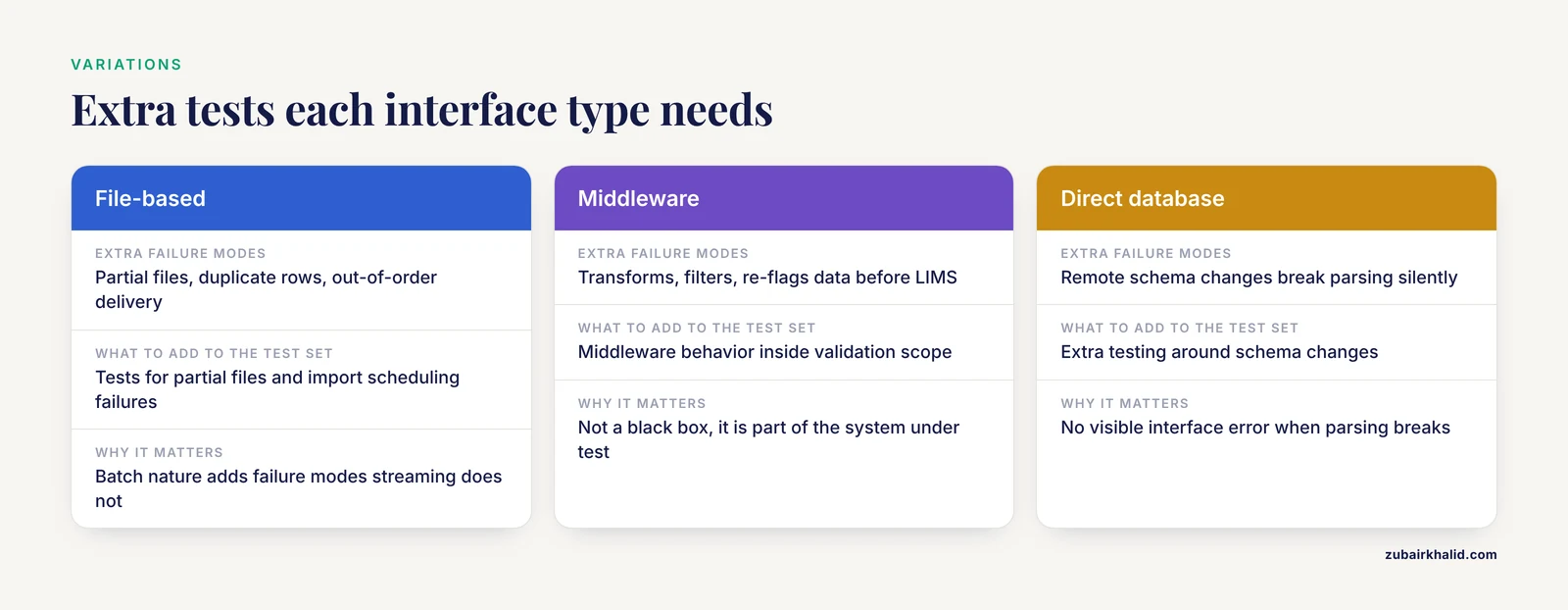
File-based interfaces. Some analyzers export QC data as flat files that the LIMS imports on a schedule. Validate the same elements, adding tests for partial files, files with duplicate rows, and files arriving out of order.
Middleware-mediated interfaces. In total laboratory automation, middleware sits between analyzers and the LIMS and performs data validation and QC tracking itself. Middleware in automated mass spectrometry and core laboratory workflows adds an intelligent validation layer, and middleware behavior must be in validation scope, not treated as a black box [11].
Direct database interfaces. Older integrations read instrument or process data through direct database connections using ODBC and SQL queries, a pattern documented in automated instrument quality assurance systems that collected spectra and laboratory data from LIMS sources [5]. These require extra testing around schema changes, because a remote schema update can break parsing without any visible interface error.
Cloud-hosted LIMS. Cloud deployments add authentication, encryption, and network path testing to the scope. Modern cloud-native LIMS platforms handle this with multifactor authentication, encryption, and web application firewalls over a structured core schema with study-specific extensions [2]. Validate that QC data traversing the cloud path preserve the same fidelity as local interfaces.
AI-assisted QC review layers. Some laboratories add automated QC categorization or flagging on top of interfaced data. These layers carry their own validation burden, including concordance against expert review and evaluation of misclassification causes, as demonstrated in cytopathology QC automation where most misclassifications traced to semantic ambiguity rather than data transfer faults [9].
Records, Retention, and System Stability
Treat validation records as permanent quality records. Retain the validation plan, traceability matrix, raw test outputs, deviation records, the signed report, and the configuration baseline for the life of the interface plus your record retention period. Long-term sustainability depends on this archive, as shown by a 60-month evaluation of a centralized QC platform in which thousands of test entries remained traceable and auditable over years of operation [8].
Configuration stability matters as much as paper stability. Pin the interface channel configuration, parser versions, and instrument firmware in your configuration baseline, and version-control any custom parsing or conversion scripts. Containerized, version-pinned processing environments are an established pattern for keeping analytical pipelines reproducible across updates and operators [12].
Safety Note
Interface validation work is low chemical hazard but not zero hazard. Test on instruments that are powered and connected, so follow lockout and electrical safety practices when touching cabling, and never route live patient specimens through an unvalidated interface path. In microbiology, any test that involves transmitting data from cultures or control organisms should be executed only after the physical specimen handling portion is complete and the work area has been managed under standard biosafety procedures for the organism risk group involved.
Common Mistakes and Limitations
These are the interface validation failures seen most often in practice.
- Testing only the happy path. A validation that never transmits an out-of-range value, a malformed message, or a duplicate proves the interface works when everything is right. Laboratory quality management depends on behavior when everything is wrong.
- Validating the pipeline but not the mapping. A message that arrives intact can still store a QC value against the wrong control material or lot. Field-level verification against the source is mandatory.
- Ignoring the outbound path. Teams exhaustively test results flowing into the LIMS and never test QC limits, schedules, or lot definitions flowing out. Bidirectional means bidirectional.
- Validating in an environment that drifts from production. If the sandbox configuration is not exported, diffed, and controlled, the validation evidence may not describe the live system. This configuration control step is a core element of risk-based computer software assurance [4].
- Skipping the parallel reconciliation. Simulated test messages confirm logic but not real-world timing, volume, and operator interaction. A live parallel period with daily reconciliation catches what test data cannot.
- Treating middleware as trustworthy by default. Any layer that transforms, filters, or re-flags data is part of the system under test, as automation-heavy core laboratory workflows make explicit [11].
- Letting the validation lapse. Interfaces validated once and never re-verified after middleware or LIMS upgrades are unvalidated systems wearing old paperwork.
- Under-documenting deviations. A failed test that was fixed and retested is normal. A failed test with no written root cause and disposition is a quality system failure.
One honest limitation: interface validation proves data integrity, not analytical performance. It does not tell you whether the control organisms were viable, whether the media lots were genuinely acceptable, or whether an individual patient result is clinically correct. Those judgments require the qualified professionals who own the analytical method and the clinical interpretation.
Tips That Pay for Themselves
- Freeze the acceptance criteria before the first test execution. Late criteria rewrite the standard to fit the result.
- Capture the raw message for every failure, not just the LIMS screen. The three-point comparison, raw message to interface log to stored record, resolves in minutes what screen-only debugging cannot resolve in days.
- Automate the reconciliation. A script that diffs instrument logs against LIMS records turns a two-week parallel period into a manageable daily check.
- Test with your worst identifier, not your typical one. The longest lot number, the control organism name with an unusual character, and the QC entity with the most fields are where parsers break.
- Schedule the load test during a quiet window and alert operations staff. An interface engine that slows other channels under stress is a real finding, not a nuisance.
Frequently Asked Questions
How long does a LIMS-to-instrument interface validation take?
Plan on 30 to 50 hours of hands-on work over 6 to 10 weeks of elapsed time for a single interface. The elapsed time is dominated by change control, environment setup, and the parallel-run period rather than by test execution itself.
Do I need to revalidate after every LIMS upgrade?
Revalidate at a depth matched to the risk of the change. A patch that touches the interface engine or result mapping requires at least a targeted retest of QC data transfer, while a major LIMS version change requires a full validation following the step-by-step procedure.
What acceptance criteria should I use for QC data transfer?
Set criteria before testing. Typical criteria are 100% exact match on record presence, identity, and numeric values, full concordance of QC flags with expected flagging behavior, and zero silent rejections. Agreement metrics such as kappa are appropriate when comparing against a manual or legacy QC pathway.
Is a vendor installation certificate enough evidence?
No. A vendor certificate covers the vendor's factory configuration, not your instruments, your middleware, your QC entity definitions, or your LIMS version. Use it as supporting documentation, and perform your own operational and performance qualification.
What is the biggest failure mode in QC data transfer?
Silent rejection or silent mis-mapping of QC records. Unlike a lost patient result, a lost QC result often produces no downstream alert, which means control status is unknown while reporting continues. Design negative tests specifically to prove the system refuses or flags bad QC data.
Do file-based interfaces need the same validation as real-time interfaces?
Yes, with additional tests. File-based transfers require extra testing of partial files, duplicate rows, out-of-order delivery, and import scheduling failures, because the batch nature adds failure modes a streaming interface does not have.
How do I validate an interface that only carries one-way instrument-to-LIMS data?
Follow the same phases, but scope Phase 5 to error handling on the receiving side only. You still need boundary values, malformed message tests, interruption recovery, and a live parallel reconciliation period.
Who approves the validation in a microbiology laboratory?
The laboratory director or designated qualified responsible person approves the validation report, with input from information technology governance where the interface crosses managed infrastructure. Approval is documented through your laboratory quality management system before the interface moves to controlled operational status.
Sources
- Laboratory Information Management Systems--part I. Concepts.
- ATRI LIMS: a cloud-native open-source laboratory information management system for biomarker-driven Alzheimer's disease clinical trials.
- A conceptual framework integrating artificial intelligence with failure mode and effects analysis for diagnostic error reduction in anatomical pathology.
- A cloud-enabled LIMS-QMS platform with large language model-assisted standard operating procedure generation for GLP/GMP-aligned theranostics laboratory operations.
- Automated Quality Assurance of Online NIR Analysers.
- Automated Post-Analytical Workflow for Newborn Screening Using a Hybrid Rule-Based and Retrieval-Augmented Large Language Model System.
- Deployment of AI-driven automated quality control of whole-slide images in a large tertiary cancer center.
- Long-term evaluation of a web-based quality control management system (QATrack+) in diagnostic radiology.
- Automating fine needle aspiration and non-gynecologic quality control using a large language model: A real-world evaluation of diagnostic accuracy and efficiency.
- Sample-to-answer on-farm raw milk quality evaluation via a portable chip-based high-accuracy somatic cell counting system.
- Integration of liquid chromatography-tandem mass spectrometry into total laboratory automation: technical challenges and clinical advantages.
- MStargetR: a reproducible, containerised workflow for end-to-end targeted (MRM/SRM) mass spectrometry data processing in R.