How to Choose a LIMS for Your Microbiology Lab
By Dr. Zubair Khalid, DVM, MS, PhD ·

A LIMS (laboratory information management system) for microbiology differs from a general laboratory system in one decisive way: it must manage living, evolving data such as organisms, culture steps, and susceptibility interpretations, not just numeric chemistry results attached to a specimen. The rule of thumb for LIMS for microbiology lab selection is simple. Choose the system whose underlying data model matches how your bench actually works, then verify that its quality control, traceability, and validation features hold up under the accreditation standard you answer to, whether that is ISO 15189 for a clinical laboratory or ISO/IEC 17025 for a testing laboratory.
This guide walks through the main system options with their pros and cons, the criteria that separate a good fit from an expensive mistake, worked scenarios for three common lab types, and the errors labs most often make during selection.
What a LIMS Must Do in a Microbiology Lab
Before comparing products, be precise about the work the system has to carry. In microbiology, a LIMS or LIS (laboratory information system, the hospital-facing term for largely the same class of software) has to handle several data types that chemistry and hematology systems rarely touch.
Specimen and accession management. Every specimen needs an accession record that captures source site, collector, collection time, and test requests. Microbiology adds pre-analytical detail that other disciplines do not need, such as transport conditions and time-to-inoculation. Integrated protocol work for sexually transmitted infection testing, written to align with ISO 15189 and CLSI recommendations, spells out how pre-analytical requirements for collection, transport, and storage must be standardized and documented alongside data management and sample traceability [1].
Stepwise culture workflow. A blood culture moves through flagging, gram stain, subculture, organism identification, and antimicrobial susceptibility testing (AST, the measurement of which antibiotics inhibit the isolate). Each step can produce a preliminary result, and clinicians act on those intermediate results. The system must support orders-in-progress, not just a single result per test.
Organism-level data. A chemistry analyzer returns one number. A wound culture may yield three organisms, each with an identification confidence, a colony count, and its own susceptibility panel. The data model must hold organism-level results as first-class records, with standardized nomenclature.
Interpretation and reporting. Susceptibility categories (susceptible, intermediate, resistant) depend on breakpoint tables that change over time. A useful system applies the correct breakpoint version for the date of testing and can produce cumulative antibiogram reports for stewardship programs.
Microbiology quality control. Media QC, reagent lot tracking, control organism (for example ATCC reference strains) results, instrument maintenance records, and temperature logs for incubators and freezers all belong in one auditable place. This is where the LIMS overlaps with laboratory quality management.
Epidemiology and surveillance. Searches by organism, site, ward, and resistance phenotype support infection prevention and outbreak response. A recent multinational trial of rapid AST for gram-negative bacteremia, comparing the VITEK REVEAL rapid phenotypic method against standard-of-care testing across nine hundred subjects, illustrates how instrument-generated AST data now flows into clinical trials and stewardship review, and your LIMS needs clean interfaces to capture that data [2].
Surveys of laboratory service quality in resource-constrained hospitals identify the underlying determinants that a LIMS either supports or fails to support: workflow organization, equipment reliability and maintenance, service continuity, quality management structures, adherence to standard operating procedures, and documentation practices [3]. Any system you buy should strengthen all six, because software alone cannot compensate for a weak quality culture, and a strong quality culture drowning in paper cannot scale.
The Main LIMS for Microbiology Lab Selection Options
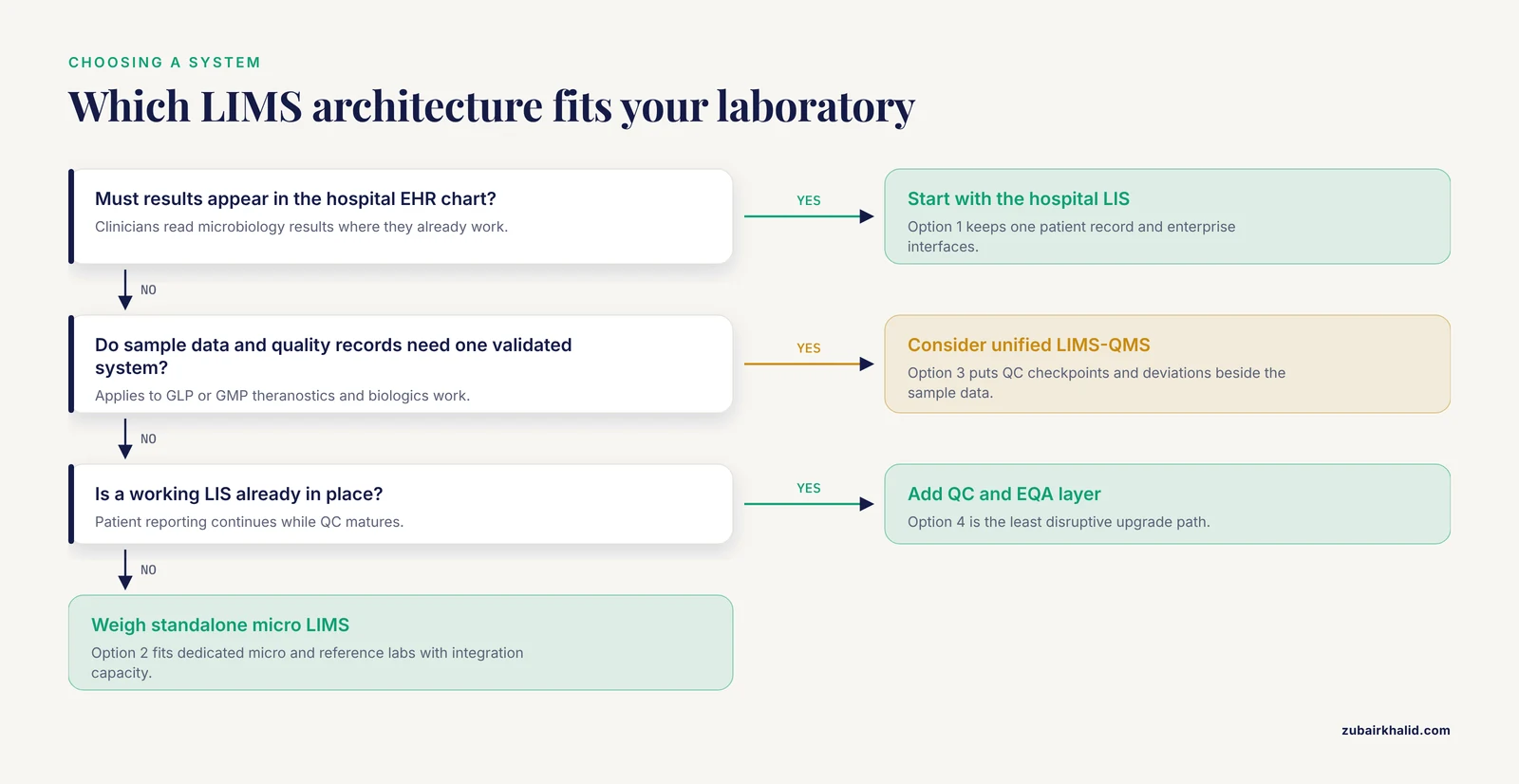
There are five realistic architectures. Each has a distinct profile of strengths and trade-offs, and the "best LIMS for microbiology lab selection" is the one that matches your lab's scale, regulatory posture, and existing infrastructure.
Option 1: Hospital LIS with a Microbiology Module
Large hospital information systems (the LIS modules sold alongside the enterprise EHR, from vendors such as Epic, Cerner, and Sunquest) include microbiology functionality. The microbiologist builds procedure codes, result schemas, and AST rules inside the vendor's framework.
Pros.
- Seamless demographic flow from the EHR, one patient record, results visible to clinicians in the chart where they already work.
- Billing, ordering, and interface management are handled at the enterprise level.
- One vendor relationship for the hospital.
Cons.
- Microbiology is often a bolt-on. Organism-level data structures, antibiogram logic, and culture workflow can feel rigid, and customization requires vendor change requests that take months.
- QC functions tend to be generic and chemistry-oriented. Media lots, control organism pass/fail trends, and environmental monitoring often need workarounds or a separate tool.
- Deep configuration work is usually done by the vendor or a small pool of consultants, which makes the lab dependent on scarce expertise.
This option fits labs embedded in a large health system where enterprise integration outweighs bench-level flexibility.
Option 2: Standalone Microbiology-Specific LIMS
These systems, purpose-built for microbiology workflows (in the clinical space, products such as Epic's Beaker Micro, Sysmex Astrego-class workflow systems, and vendor middleware from instrument makers, and in industrial space, platforms from LIMS vendors with strong micro modules), model the bench directly. Direct exam, culture, identification, AST, and typing are native workflow steps. Rules engines handle reflexive logic, for example "if gram-negative rod identified, then automatically order the panel matching the specimen source."
Pros.
- The data model matches the bench. Organism, source, and colony count are real fields, not free text.
- Strong rule-driven workflow reduces manual entry and supports consistent preliminary reports.
- Specialized surveillance and antibiogram functions are usually built in.
Cons.
- Integration burden falls on you. Interfaces to the EHR, the chemistry LIS, and instruments must be built and maintained.
- Smaller vendors carry vendor-viability risk. Contract terms should address data escrow and exit paths.
- Cost per site is higher because you are not sharing the platform with every other department.
This option fits dedicated microbiology labs with enough volume to justify the integration work, and it is the usual answer for public health and reference laboratories.
Option 3: Unified LIMS-QMS Platforms
A newer architecture merges the LIMS with a quality management system (QMS, the software layer that holds SOPs, deviations, CAPAs, training records, and risk assessments) in one platform. A published pilot of this approach, the Laboratory Tracking Software platform, described a cloud-ready, web-based system that unifies LIMS and QMS functions under a risk-based computer software assurance framework aligned with FDA 21 CFR Part 11 and ISO/IEC 17025, organized into nine governance modules with a deterministic request-and-service lifecycle. The platform also embedded a large language model-assisted module that, from a single service-name input, generated structured standard operating procedures, identified required consumables and instruments, performed operational risk assessment, and proposed an executable workflow [4].
Pros.
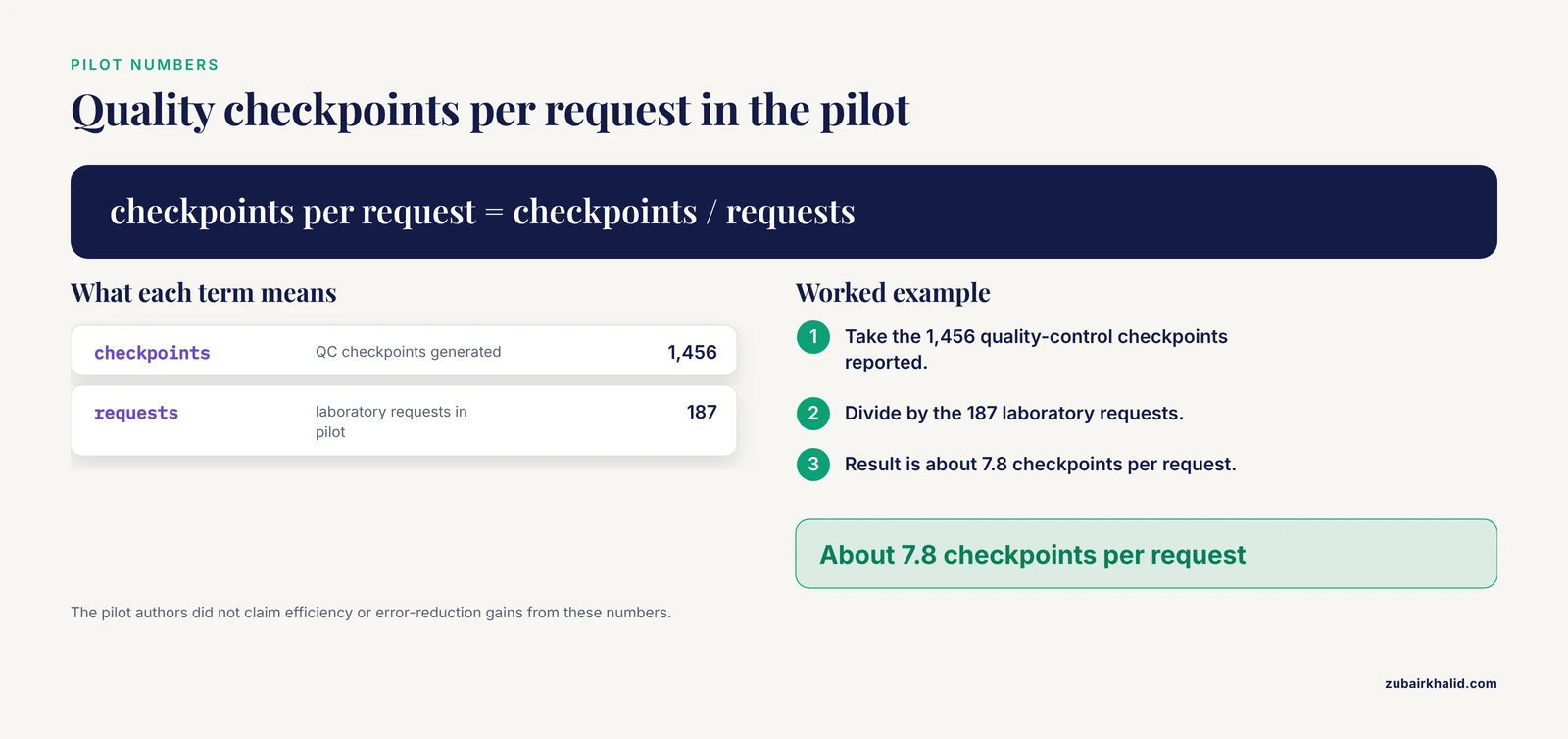
- QC checkpoints, deviations, and document control live next to the sample data. In the published pilot, 187 laboratory requests generated 1,456 quality-control checkpoints and 43 deviation-handling episodes within a single system of record [4].
- One validation effort covers both the data layer and the quality layer, which matters enormously in GLP and GMP settings.
- SOP generation and version control are automated rather than maintained as parallel paper or SharePoint files.
Cons.
- These platforms are young. The pilot's authors reported a 23-day mean turnaround time across those 187 requests and explicitly did not interpret the deployment numbers as efficiency or error-reduction gains, because no comparable pre-deployment dataset could be reconstructed [4]. You would be an early adopter.
- Unified platforms may be less deep on microbiology-specific bench features than standalone micro systems.
- Cloud-ready does not automatically mean validated for your specific regulatory scope. You still own the assurance work.
This option fits regulated development and manufacturing laboratories (theranostics, biologics, contract testing) where quality documentation and sample data must be inseparable.
Option 4: Keep Your LIS and Add Dedicated QC and EQA Software
Many labs, especially hospital-based ones, keep their existing LIS for patient results and add a dedicated layer for internal quality control (IQC, the routine running of control materials against acceptance limits) and external quality assessment (EQA, also called proficiency testing, where an outside body sends blinded samples and grades your results). A detailed implementation study from Shenzhen describes exactly this pattern. The Regional Medical Laboratory Center integrated four software programs: the hospital LIS supplied by one vendor, Bio-Rad's QCBOX and Quality Control EQA Center products handling IQC and EQA operational workflows, and an electronic recording system called iLab that oversaw documentation, analytics, and approval processes. The platform was deployed in August 2023 across a pilot network of five district hospitals, one central laboratory, and four community health stations [5].
Pros.
- Least disruptive path. Patient reporting continues uninterrupted while QC matures.
- Mature QC engines (Levey-Jennings charts, Westgard rules, lot-to-lot comparison) are stronger than what most LIS modules offer.
- Network-ready. The Shenzhen deployment showed that a hub laboratory could centralize QC data processing across sites with different equipment and staff expertise levels, which is the hardest QC problem in regional networks [5].
Cons.
- Two systems means two validation efforts, two user accounts, and interfaces that must be monitored.
- QC data is physically separated from specimen data, so an auditor may need to walk across systems to reconstruct a result's quality record.
- The approach manages QC chemistry-style data well, but microbiology-specific QC (control organism passages, media QC, AST QC ranges) still depends on how well the LIS handles it.
This option fits labs that already have a functioning LIS and need to upgrade QC and EQA discipline without replacing the reporting backbone. It is also the natural model for regional networks. A related Cambodian pilot for COVID-19 antigen rapid diagnostic tests ran an external quality assurance program across a tiered network, with a Tier 1 reference laboratory responsible for in-country receipt and distribution of QA material and Tier 2 facility-based laboratories submitting results through a portal using QR code scanning. The Tier 1 laboratory reported 100 percent concordance with EQA reference results, while some Tier 2 laboratories showed discordance, exactly the gap that structured, portal-based EQA is designed to detect and correct [6].
Option 5: Cloud SaaS Versus On-Premise Deployment
Deployment is a cross-cutting choice rather than a product category, but it changes the pros and cons of everything above.
Cloud (SaaS). The vendor hosts the system and you subscribe.
- Pros: lower upfront capital, automatic updates, access from any site, and easier multi-site rollout, which is why the unified LIMS-QMS pilot described above was designed as cloud-ready from the start [4].
- Cons: data residency and contracting work, dependence on internet reliability (a real constraint where power stability and service continuity already challenge laboratories [3]), and less control over update timing.
On-premise. Your institution hosts the servers.
- Pros: full control over data, versions, and downtime windows.
- Cons: capital cost, dedicated IT staffing, and you carry the patching and disaster-recovery burden yourself.
Side-by-Side Comparison
| Criterion | Hospital LIS with micro module | Standalone micro LIMS | Unified LIMS-QMS | LIS plus QC/EQA software |
|---|---|---|---|---|
| Micro workflow fit | Moderate, vendor-constrained | Strong, bench-native | Variable, check module depth | Depends on underlying LIS |
| QC depth | Generic | Good for micro QC | Strong, checkpoints embedded | Strongest, purpose-built engines |
| EQA management | Weak to moderate | Variable | Strong (QMS-side) | Strong (EQA products) |
| SOP and deviation control | Usually separate QMS | Usually separate QMS | Built in | Separate |
| EHR and billing integration | Excellent | Build it yourself | Variable | Inherited from LIS |
| Validation burden | Vendor-shared, still yours | Yours | One combined effort | Two systems |
| Multi-site capability | Enterprise-dependent | Possible, costly | Designed for it | Demonstrated in networks |
| Best fit | Large hospital inside an EHR ecosystem | Dedicated micro and reference labs | GLP/GMP regulated labs | Labs with a working LIS, regional networks |
Read the table by column when you already know your constraints, and by row when you are deciding which criterion matters most. The rows that most often decide real purchases are micro workflow fit and QC depth, because those are the features you cannot retrofit cheaply.
How to Compare Options: The Criteria That Decide Real Choices
Vendor demonstrations all look similar. These criteria, evaluated with your own data and workflows, are what separate systems three years after go-live.
Data Model and Workflow Fit
Ask the vendor to model your actual cases, not theirs. A good exercise is to walk through ten real recent cases: a polymicrobial blood culture, a mixed urine with a low-count contaminant, a mycobulture with a 6-week reporting arc, a stool culture with reflexive panel testing. If the demonstration requires workarounds, free-text fields, or "the lab would just record that differently," believe it. The way a system structures organism and result data will shape every downstream report, surveillance query, and antibiogram you ever produce.
Microbiology Quality Control and EQA Support
Quality management in microbiology is broader than most software demos suggest. Quality management system frameworks across laboratory disciplines converge on the same core components: standardized protocols, validation and maintenance of equipment, environmental monitoring, biosafety procedures, robust traceability, personnel qualification with structured competency assessments, and key performance indicators used as benchmarks for improvement, all supported by electronic platforms and witnessing systems [7]. A LIMS earns its cost by holding those components in one place.
Evaluate concretely:
- Can you track a medium lot from receipt through in-house QC (growth and inhibition checks with control strains) to expiry, and does the system block reporting on expired lots?
- Does the system trend AST QC results against CLSI-style acceptance ranges and flag drift, rather than just storing pass and fail?
- Can it schedule and log EQA events, capture participant results, and track corrective actions when performance is poor? The Cambodian Ag-RDT pilot showed that a structured EQA program with translated documentation, tiered site responsibilities, and portal-based submission can run across disparate facility types, and it also showed that discordance concentrated at the peripheral sites, which is precisely where software-enforced workflows help most [6].
- Can environmental monitoring (incubator and CO2 logs) be captured at the point of measurement, or must staff transcribe from paper?
Traceability and Accreditation Alignment
Whatever standard you answer to, the software must make traceability the default rather than a project. Integrated diagnostic protocols aligned with ISO 15189 and CLSI recommendations include internal and external quality assurance components, troubleshooting guidance, and recommendations for data management and sample traceability as part of the workflow itself, not as an afterthought [1]. During selection, ask the vendor to produce, for one demo specimen, the complete chain from accession through every QC event that touched the test to the final report and any amendments. If the chain requires manual stitching, keep looking.
For regulated non-clinical laboratories, verify the vendor's approach to 21 CFR Part 11 (the FDA rule governing electronic records and signatures) and, for testing labs, ISO/IEC 17025. The strongest signal is a vendor who presents a control matrix mapping their features to specific regulatory clauses, as the unified LIMS-QMS pilot did, rather than a generic compliance badge [4].
Data Standards and Interoperability
Structured data outlives any single vendor. The FAIR principles (Findable, Accessible, Interoperable, Reusable) were applied to FDA SARS-CoV-2 Emergency Use Authorization diagnostics data, and the analysis identified four failure modes that any laboratory data system can reproduce internally: test identification undermined by similar names and inconsistent naming conventions, document tracking undermined by inconsistent identifiers and versioning, data retrieval undermined by heterogeneous structure and formatting, and ongoing maintenance undermined by the lack of traceable communication around amendments [8]. Translate each failure into a selection question:
- Does the system enforce standardized organism nomenclature with a controlled vocabulary, rather than free text?
- Are documents and result sets versioned, with every amendment traceable?
- Can data be exported in structured, machine-readable formats with a stable schema, not only PDFs?
Professional societies in histocompatibility and immunogenetics reached the same conclusion when drafting data management recommendations: comprehensive guidance must cover messaging, storage and retention, documentation, reporting, validation, and quality control, and crucially, it must be feasible to apply without a substantial staff and cost burden, with publicly available tools where possible [9]. That feasibility clause is the most underweighted criterion in LIMS selection. A technically superior system that consumes two full-time equivalents in maintenance is the wrong system.
Validation and Computer Software Assurance
Every configuration change, upgrade, and interface revision needs documented assurance. Modern regulatory thinking favors computer software assurance (CSA), a risk-based approach in which testing effort is proportional to the risk the function carries, instead of exhaustive scripted testing of everything. The unified LIMS-QMS pilot was explicitly designed under a risk-based CSA framework [4], and that is the model to ask vendors about. Ask how upgrades are handled: are they regression-tested and documented by the vendor, or do you revalidate from scratch each time? The answer changes your long-term staffing more than the license price does.
Instrument Interfaces and Rapid Diagnostics
Your LIMS is a hub for instrument data. Walk through the interface list for the analyzers and rapid systems you run today and plan to run. For microbiology, the critical interfaces are blood culture instruments (bidirectional, so flagging and growth detection write back automatically), identification and AST instruments (so biocode and susceptibility data import without transcription), and rapid AST platforms. The FAST trial, a multicenter randomized controlled trial of the VITEK REVEAL rapid AST system for gram-negative bacteremia with a primary outcome built on Desirability of Outcome Ranking, plus secondary outcomes including categorical agreement between rapid and standard-of-care testing, shows where the field is heading. Rapid instrument data will need to reach clinicians quickly and be compared against standard results in parallel, and only a clean interface makes that workable [2].
Total Cost of Staff Time
License and hosting fees are visible. The hidden cost is staff burden: configuration hours, interface maintenance, QC documentation time, and training. When experts formulated laboratory data management recommendations, they weighed feasibility in a real laboratory setting against staff and cost burden as a first-order design constraint, not a footnote [9]. During selection, ask each reference site how many FTEs they devote to system upkeep per million specimens, and get the answer in numbers.
Worked Scenarios
Scenario 1: A 200-Bed Community Hospital Micro Bench Replacing Paper
Your lab runs about 15,000 microbiology specimens a year on one automated blood culture pair, one ID/AST instrument, and a lot of manual plates. Reports currently go to the EHR through the enterprise LIS, but internal workflow (bench tracking, QC logs, antibiograms) lives on paper and spreadsheets.
The determining criterion is EHR integration, because clinicians read results in the chart. Option 1 (deepen the LIS micro module) or Option 4 (keep the LIS, add a QC/EQA layer) both preserve that integration. Option 2 would give better bench ergonomics but forces you to build and defend interfaces alone, which a small IT team may not sustain. Reasonable choice: Option 1 if the enterprise LIS has a genuinely functional micro module and the hospital will fund configuration, otherwise Option 4 as the lower-risk upgrade. Either way, insist on lot-level media and reagent tracking in whatever system wins, because that is the QC function small labs lose first when things get busy.
Scenario 2: A Regional Network with a Hub Reference Laboratory
A public health or regional laboratory system has one hub and five to ten peripheral sites with different equipment, different staffing levels, and uneven QC maturity. The published Shenzhen model is your closest real-world template: an integrated platform combining the LIS, dedicated IQC software (QCBOX), an EQA center application (QCEC), and an electronic documentation layer (iLab) so that the hub centralizes QC data processing while the documentation layer handles analytics and approvals [5]. The design goal was explicit: consistent quality control across sites with diverse equipment, procedures, and staff expertise.
Your selection questions become network questions. Can peripheral sites submit results and QC through a lightweight interface such as a portal with QR-coded submissions, as the Cambodian EQA pilot demonstrated for rapid diagnostic testing across tiered sites [6]? Can the hub see QC performance for every site in one view and trigger review when a site drifts? Does the platform support the training and translated documentation that peripheral rollout requires? Reasonable choice: Option 4 (existing LIS at the hub plus integrated QC/EQA layer) or Option 3 if the network is being built fresh and quality documentation is a priority.
Scenario 3: A GLP or GMP Theranostics or Biologics Lab
Your laboratory operates under good laboratory practice or good manufacturing practice requirements, and fragmented, paper-based workflows have become the bottleneck. Sample data, SOPs, deviations, and QC checkpoints must sit in one validated system of record, and auditors expect a direct mapping to 21 CFR Part 11 and ISO/IEC 17025.
Here the unified LIMS-QMS architecture (Option 3) is purpose-built, and the published pilot gives you a concrete picture of what to expect: nine governance modules, a deterministic request-and-service lifecycle, embedded LLM-assisted SOP generation with risk assessment, and a pilot deployment whose 187 requests generated 1,456 quality-control checkpoints and 43 handled deviations [4]. Two cautions apply. First, treat the pilot's descriptive numbers as a picture of scale, not a promised efficiency gain, because the authors themselves declined to claim improvement without a comparable pre-deployment dataset [4]. Second, microbiology depth still needs verification. Reasonable choice: Option 3, with a deliberate gap analysis on micro-specific bench functions before contract signing.
Common Mistakes and Limitations
Selecting on demo breadth instead of data model. Vendors show polished checklists. The system that checks every box but stores organisms as free text will generate a decade of surveillance and antibiogram pain. Test with your own cases.
Deferring QC design until after go-live. QC workflows, lot tracking, and EQA scheduling should be configured during the project, not discovered afterward. The laboratories that struggle most with quality management tend to have weak SOP adherence and documentation practices as root causes, and a LIMS imposed on that culture without redesigning the workflows simply digitizes the disorder [3].
Treating the LIMS as a substitute for laboratory quality management. Software enforces structure, but it cannot substitute for qualified personnel, competency assessment, equipment maintenance, and management review. Quality management system frameworks list the human and infrastructural dimensions (personnel qualification, biosafety, continuing education) alongside the electronic platforms that support them [7]. Budget for both.
Ignoring naming, versioning, and amendment traceability. The four data usability failures documented in the SARS-CoV-2 EUA dataset analysis, including inconsistent naming conventions, unstable identifiers, heterogeneous formatting, and untraceable amendments, will reproduce themselves inside your LIMS unless the data standards are contractual requirements, not aspirations [8]. Put nomenclature control, versioning, and structured export into the contract.
Underestimating validation. The assurance burden does not end at go-live. Every upgrade reopens it. Choose vendors with a documented, risk-based CSA approach so that routine updates do not consume your quarter [4].
Measuring too many key performance indicators. Quality improvement work shows that a manageable set of validated indicators outperforms an exhaustive list. In a Delphi-based quality improvement framework across 31 facilities, 17 key performance indicators reached consensus and the subsequent audit revealed that high-performing indicators (laboratory-based measures near 82 percent adherence) coexisted with very low performers, and the improvement interventions were then prioritized through an analytic hierarchy process weighting clinical impact at 50 percent, feasibility at 30 percent, and urgency at 20 percent [10]. Select a handful of KPIs in your LIMS, weight them by impact and feasibility, and let the rest go.
The general limitation. Every lab's regulatory scope, volume, and existing infrastructure differ, so the scenarios above are templates rather than prescriptions, and a final decision should follow a structured evaluation with your own data, your own workflows, and your accreditation body's requirements.
Frequently Asked Questions
What is the difference between a LIS and a LIMS in microbiology?
In US hospital settings, LIS refers to patient-facing systems integrated with the electronic health record, while LIMS refers to systems managing laboratory operations and data, often in industrial, public health, and research settings. Functionally the categories overlap, and in microbiology both must handle organism-level, stepwise workflow data. The label matters less than the data model and the integration requirements of your environment.
Do I need a microbiology-specific LIMS or will a general LIMS work?
A general LIMS can work if its data model handles organism-level results, multi-step culture workflows, and breakpoint-driven AST interpretation as native structures rather than free text. Many general systems do not, which is why microbiology labs often either select a standalone micro-specific system or a hospital LIS whose micro module has been genuinely engineered rather than bolted on. Run your own polymicrobial and reflex-testing cases in a demo before deciding.
How does a LIMS support microbiology quality control?
A capable system tracks reagent and media lots with expiry-based reporting blocks, trends control organism and instrument QC results against acceptance ranges, schedules environmental monitoring, and manages EQA events with corrective action follow-up. Integrated platform studies show that centralizing QC data processing across multiple sites with different equipment and expertise is achievable when IQC, EQA, and documentation layers are coordinated rather than fragmented [5].
What is computer software assurance and why does it matter for LIMS validation?
Computer software assurance is a risk-based approach in which the depth of testing and documentation is proportional to the risk each software function carries to patients or products. It replaces exhaustive scripted validation of every feature. Vendors who design and document upgrades under a CSA framework let you adopt updates without full revalidation cycles, which directly controls your long-term staff burden [4].
Cloud-based or on-premise LIMS, which is better?
Cloud systems lower upfront cost, provide automatic updates, and simplify multi-site access, while on-premise systems give you full control over data, versions, and downtime. Choose cloud if your network connectivity is reliable and multi-site access matters. Choose on-premise if data residency demands dominate or if your institution already runs a robust data center. Either way, the validation and QC requirements are identical.
How long does LIMS implementation take?
Timelines scale with integration scope. A single-site QC/EQA overlay on an existing LIS is the fastest path because patient reporting never stops, while a full LIMS replacement with EHR and instrument interfaces typically takes a year or more of phased work including validation. Published deployments of integrated platforms describe pilot phases measured in months once integration design is complete, but planning should assume the longer end for anything touching the EHR [5].
Sources
- Integrated laboratory protocol for the diagnosis of Sexually Transmitted Infections (STIs): Standardized pre-analytical procedures, rapid screening, hemagglutination, and ELISA methods for use in resource-limited settings.
- Study protocol for a multicenter, multinational prospective randomized controlled trial comparing outcomes in subjects with Gram-negative bacteremia who have blood culture evaluation using Fast Antibiotic Susceptibility Testing vs. standard of care testing: the FAST trial.
- Determinants of quality laboratory service provision amongst government comprehensive specialized hospitals in Northwest Ethiopia.
- A cloud-enabled LIMS-QMS platform with large language model-assisted standard operating procedure generation for GLP/GMP-aligned theranostics laboratory operations.
- Development and Implementation of an Internal Quality Control and External Quality Assessment Information System for a Regional Medical Laboratory Center: Pilot Design and Implementation Study.
- Piloting an external quality assurance program (QAP) for COVID-19 antigen rapid diagnostic tests (Ag-RDTs): findings and lessons learned from Cambodia.
- Quality Control in Assisted Reproduction Centers.
- Challenges in Structuring SARS-CoV-2 Emergency Use Authorization Diagnostics Data: Leveraging Findable, Accessible, Interoperable, and Reusable Principles for the Next Era of Diagnostic Data Transparency.
- Recommendations for HLA Genotyping Data Standards and Clinical Laboratory Staffing Considerations.
- From Consensus Through Prioritization: A Delphi Method, Clinical Audit, and Analytic Hierarchy Process Framework for Quality Improvement in Primary Diabetes Care.