Lab Coat for Microbiology Lab: Options Compared
By Dr. Zubair Khalid, DVM, MS, PhD ·
The core difference between the main lab coat options in a microbiology lab is the trade between barrier performance and all-day wearability. A reusable snap-front cotton-polyester coat is the comfortable workhorse for routine bench work, disposable fluid-resistant gowns buy a fresh, verified barrier for splash-heavy tasks, and solid-front gowns or coveralls step up protection for aerosol-generating procedures and higher-hazard agents.
Rule of thumb: let your biosafety risk assessment choose the category of coat, then choose the most comfortable, best-fitting version of that category you can wear correctly for a full shift. A coat that is too hot, too stiff, or too awkward ends up unfastened, pushed off the shoulders, or left on a hook, and a coat worn wrong protects no one.
This guide walks through the five lab coat options that cover nearly every microbiology setting, compares them side by side, weighs the pros and cons of each, and shows how biosafety training and a written risk assessment turn the choice into a daily habit.
Why the Lab Coat Is a Biosafety Control
Personal protective equipment (PPE) is the clothing and gear that form the last barrier between a worker and a hazardous agent. In a microbiology lab the coat is the largest single piece of that barrier, and it does three jobs at once. It keeps splashes of cultures, blood, body fluids, stains, and disinfectants off skin and street clothes. It confines contamination to a garment that is laundered or discarded under controlled conditions instead of traveling home on a collar. It marks the boundary of the workspace, which is why a coat worn past the lab door is a biosafety failure even when nothing visible is on it.
An aerosol is a suspension of particles small enough to stay airborne and be inhaled, and it is the reason PPE escalates with containment level. In the United States, the Biosafety in Microbiological and Biomedical Laboratories (BMBL) manual, the reference framework most microbiology facilities follow, defines four biosafety levels (BSL-1 through BSL-4) that scale practices, containment equipment, and PPE to the hazard. At BSL-2, where most clinical and research microbiology sits, the standard ensemble is a lab coat, gloves, and eye protection, with a biological safety cabinet (BSC), a ventilated enclosure that protects the worker and the work from aerosols, used for anything likely to splash or aerosolize. At BSL-3 the coat changes character, from an open-front garment to solid-front or wraparound gowns and coveralls with dedicated clothing that is decontaminated before laundering.
The coat is also the PPE item worn longest, often eight hours a day, which makes comfort a safety property rather than a luxury. Microbiology teaching labs make the same point in miniature. A teaching lab is a restricted space, not a public room, and entry is conditioned on closed-toed shoes and PPE, a rule that was formally tested when a student brought a guide dog in training to class and the institution ruled that untrained animals could not enter a space where safe laboratory practice is essential [1]. The coat is part of that entry condition, not an accessory to it.
Lab Coat Options for the Microbiology Lab
Five categories cover nearly every lab coat decision in a microbiology lab. Each exists for a reason, and most bad choices are category errors, a barrier problem solved with a comfort garment, or the reverse.
Reusable Snap-Front Coat (Polyester-Cotton)
The classic microbiology coat is a knee-length or longer garment in a woven polyester-cotton blend, commonly a 65/35 or 80/20 poly-cotton weave, with long sleeves, press-stud (snap) closures down the front, a stand or lapel collar, and chest and hip pockets. Many versions add knitted rib cuffs so a glove can overlap the sleeve. This is the default coat for BSL-1 and BSL-2 bench work. The fabric survives years of institutional laundering, the snaps let a worker shed the garment in a second or two when a splash lands, and the cut allows easy movement at the bench. The weaknesses are the mirror image of the strengths. A woven fabric resists droplets but soaks through under a real splash, and the polyester fraction softens, melts, and drips when hit by flame or a hot loop.
Reusable 100% Cotton or Flame-Resistant Coat
Where open flame is part of the daily routine, Bunsen burners, alcohol lamps, flaming of loops and bottle mouths, fire behavior decides the fabric. Untreated 100% cotton chars and tends to self-extinguish rather than melting onto skin. Flame-resistant (FR) versions, cotton carrying a durable flame-retardant finish or fabric woven from aramid fibers, resist ignition outright. The trade is barrier and comfort. Cotton absorbs water and culture fluids readily, so a splash wets through fast, FR finishes add weight, and heavy FR fabric runs hot across a full shift. Many teaching labs split the difference by requiring cotton or high-cotton blends at the flame bench and keeping synthetic outerwear away from burners entirely.
Disposable Polypropylene Coat or Gown
Disposable coats and gowns are cut from lightweight nonwoven polypropylene, sometimes as SMS fabric, a three-layer sandwich of spunbond, meltblown, spunbond polypropylene in which the middle meltblown layer adds filtration. Thin grades breathe well, cost little per unit, and arrive clean, which makes them the standard visitor coat, the standard garment for short or occasional tasks, and the standard answer where many people share bench space and cross-contamination between wearers is a concern. Fluid resistance varies enormously by grade, from essentially none to gown-level barrier, so a disposable coat is not automatically a barrier coat. Disposables also tear more easily than woven fabric and melt readily near flame.
Fluid-Resistant Barrier Gown
Barrier gowns are single-use gowns graded by standardized tests for resistance to water, synthetic blood, and viral penetration, on a scale that runs from minimal fluid protection up to full barrier performance. In a microbiology lab they earn their place at splash-prone stations, specimen receipt and decanting, vortexing unsealed tubes, spill cleanup, large-volume culture or media work, and any task where the risk assessment predicts droplet or splash contact. They are worn over scrubs or a uniform, often with a disposable apron for gross soiling, and discarded into the contaminated waste stream after the task.
Solid-Front Gown, Coverall, or High-Containment Ensemble
At higher containment the coat stops being a coat. BSL-3 practice calls for solid-front or wraparound gowns, coveralls, or dedicated scrub suits, head and foot cover where specified, and clothing that is decontaminated before it ever leaves the lab for laundering. The design intent is full torso coverage with no open front, because at this level the garment is assumed to contact infectious aerosols and droplets. These ensembles are almost always disposable or lab-dedicated, and doffing happens in an anteroom with hand hygiene between steps.
Side-by-Side Comparison: Five Coats at a Glance
| Option | Typical fabric | Fluid barrier | Breathability | Near open flame | Typical role | Reuse model |
|---|---|---|---|---|---|---|
| Reusable snap-front coat | Woven polyester-cotton, 65/35 or 80/20 | Low to moderate, resists droplets, soaks through under splash | Good | Polyester fraction melts | Daily BSL-1 and BSL-2 bench work | Institutional laundering, years of use |
| Cotton or FR coat | Untreated cotton, FR-finished cotton, or aramid weave | Low, absorbs liquids | Moderate to good | Chars rather than melts, FR resists ignition | Flame-heavy teaching and culture benches | Laundering with FR care limits |
| Disposable polypropylene coat | Nonwoven polypropylene, sometimes SMS | Low unless graded | High in thin grades | Melts and burns | Visitor coats, short tasks, shared benches | Single use |
| Fluid-resistant barrier gown | SMS or film-backed nonwoven | Moderate to high, graded by standardized tests | Falls as barrier rises | Melts | Specimen processing, spill cleanup, splash-prone steps | Single use |
| Solid-front gown or coverall | Heavier SMS or laminated fabric | High | Lowest of the group | Melts | BSL-3 and aerosol-hazard work | Single use or dedicated reuse with decontamination |
Pros and Cons of Each Lab Coat Option
The same five options, judged against a full shift at a microbiology bench rather than a product photo.
Reusable Snap-Front Poly-Cotton Coat
Pros:
- Durable and economical across years of laundering
- Comfortable woven fabric for long bench shifts
- Snaps allow fast doffing the moment a splash lands
- No dependency on supply chains
Cons:
- Soaks through under a real splash
- Polyester content melts near flame or hot metal
- Hygiene depends on disciplined institutional laundry
- Not a barrier garment no matter how it looks
Cotton or Flame-Resistant Coat
Pros:
- Predictable fire behavior at the burner bench
- Natural fiber breathability
- FR versions resist ignition outright
Cons:
- Absorbs fluids and wets through fast
- Heavier and hotter, especially with FR finishes
- FR performance depends on careful laundering
Disposable Polypropylene Coat or Gown
Pros:
- Fresh, clean garment for every wearer
- No laundry logistics
- Low unit cost and good breathability in thin grades
- Ideal for visitors and shared bench space
Cons:
- Weak fluid barrier unless specifically graded
- Tears easily and melts near flame
- Supply dependent
- Adds to contaminated waste
Fluid-Resistant Barrier Gown
Pros:
- Verified splash protection matched to the task
- Fast doff and discard after messy work
- Protects underlying clothing at wet stations
Cons:
- Heat builds as barrier performance rises
- Single-use cost accumulates with daily use
- Supply dependent
- Fit is often poor in one-size cuts
Solid-Front Gown, Coverall, or Ensemble
Pros:
- Full torso coverage with no open front
- Designed for aerosol and droplet contact
- Integrates with respiratory protection and dedicated clothing
Cons:
- Significant heat stress
- Slower donning and doffing
- Highest cost and waste per wear
- Justified only where the risk assessment calls for it
How to Choose a Lab Coat for a Microbiology Lab
Four criteria decide real purchases. Work through them in order and the shortlist writes itself.
Barrier Performance Versus Breathability
The first criterion is also the hardest, because the two properties pull against each other. Barrier performance is measured with tests such as the synthetic blood penetration test (SBPT), which checks whether pressurized synthetic blood passes through the fabric. Breathability is predicted by air permeability (AP), how readily air moves through the fabric, and water vapor transmission rate (WVTR), how readily sweat vapor escapes. During the COVID-19 pandemic, PPE specifications leaned almost entirely on SBPT and capped non-woven fabric weight at 95 grams per square meter (g/m2) while staying silent on AP and WVTR, and the result was certified garments with extremely poor breathability [2].
For a microbiology lab the practical translation is simple. Ask for the numbers behind any barrier claim, including the comfort numbers, and treat a garment that documents only splash testing as a garment that will run hot. A coat worn eight hours a day needs to breathe, because heat stress drives exactly the shortcuts, unfastened fronts and rolled sleeves, that defeat the barrier.
Closure, Cuffs, and Coverage
Snaps beat buttons at a microbiology bench. A snap-front coat pulls open in a second when it is contaminated, one-handed, with gloves on, while buttons demand fine motor control at the worst possible moment and trap contamination in their stitching. Zippers are secure but slow under gloves. Knitted cuffs matter as much as the closure, because a glove overlapped over a ribbed cuff leaves no bare wrist between sleeve and glove, exactly where splashes land. A stand collar adds a little protection along the neck and chin splash line.
Coverage runs from waist to knee to shin, and the working minimum for microbiology is knee length, long enough that bending over the bench does not expose street clothes at the back. Side slits give access to trouser pockets and improve airflow, and they trade away coverage, a reasonable trade at BSL-1 and a poor one anywhere splash is expected.
Single-Use Versus Reusable
Reusable coats shift the burden from procurement to laundry and decontamination, and disposables shift it to the supply chain. The COVID-19 pandemic showed what happens when that supply chain snaps. A survey of 721 diagnostic laboratories documented the strain, including reuse of N95 respirators by an estimated 41.4% of laboratory professionals [3]. The lesson for coat planning is to know your fallback before you need it, which grades of disposable coat are interchangeable for which tasks, where the laundry turnaround sits, and how many spare coats live on the shelf.
Fit, Layering, and the Wear Test
Size the coat for the clothes under it, including winter layers, and check sleeve length with arms raised, because a sleeve that rides up above the glove defeats the cuff. Chest and hip pockets earn their place, pen and probe access without opening the front. Then run a wear test before buying in quantity, a full shift at the bench, with the tasks that matter. Comfort is a safety property, and the fastest way to find out whether a coat passes is to put it on the people who will wear it.
Matching the Coat to Your Biosafety Risk Assessment
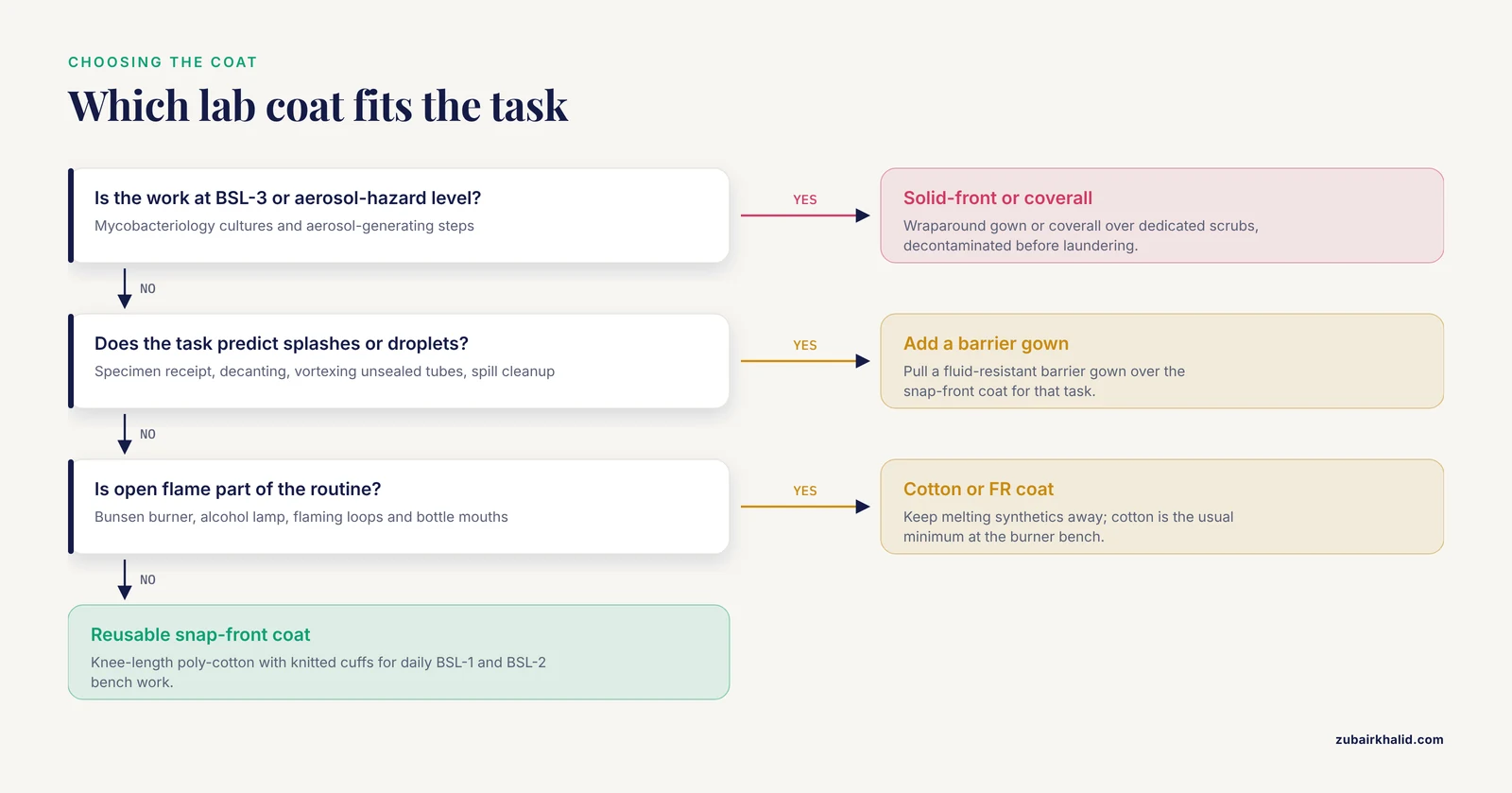
A biosafety risk assessment is the structured process of identifying what could go wrong when a specific agent meets a specific procedure, judging how likely and how severe that outcome would be, and selecting controls in proportion. Standard frameworks work through three questions. What is the hazard of the agent, its infectious dose, transmission route, disease severity, and the availability of treatment or prophylaxis. What does the procedure do, does it generate aerosols, splashes, or sharps waste, what volumes are handled, does it use a vortex mixer, an open centrifuge, a blender. Who is exposed, with what training, experience, and immune status. Controls then stack from most to least reliable, elimination and substitution, engineering controls such as the BSC, administrative controls and training, and PPE last, as the layer that catches what the others miss.
The coat maps onto that stack directly. At BSL-1, standard microbiological practices with nonpathogenic or attenuated strains, a comfortable reusable coat is the whole garment requirement, and comfort can lead because the hazard floor is low. At BSL-2, the coat is mandatory, the reusable snap-front coat is the daily default, and the risk assessment points to where a barrier gown replaces or overlays it, specimen receipt, spill cleanup, any splash-predicted step. At BSL-3, the assessment calls for solid-front or wraparound gowns or coveralls, dedicated clothing, and decontamination before laundering.
A written assessment line makes this concrete. An entry for primary stool culture plating might read, open-bench plating at BSL-2, splash risk moderate, aerosol risk low, controls, gloves, snap-front coat, barrier gown pulled on for decanting and spill cleanup. That single line tells any trained worker exactly what to wear and why.
Two habits keep the assessment honest. Write it down, because a risk assessment that lives in someone's head does not survive staff turnover. Revisit it whenever the agent list, the methods, or the facility changes, rather than waiting for the annual review. The biosafety officer or laboratory director signs off, and the signed version is what training and procurement should follow.
Microbiology Biosafety Training: Donning, Doffing, and Daily Coat Discipline
Microbiology biosafety training turns the risk assessment into habits that survive a busy Monday. The COVID-19 pandemic forced diagnostic laboratories to formalize infection control practice at speed [3], and the habits that stuck, written PPE rules, doffing checkpoints, spare stock, are now the baseline expectation. For the coat specifically, a complete program covers six things.
- Selection. Which coat for which task, decided by the written risk assessment rather than by habit or by what is clean on the rack.
- Inspection. A torn, stained, or threadbare coat is replaced before it is worn, not after it fails.
- Donning (putting on). Hand hygiene, then the coat, fastened fully down the front, then eye protection, then gloves pulled over the knitted cuffs so no wrist skin shows.
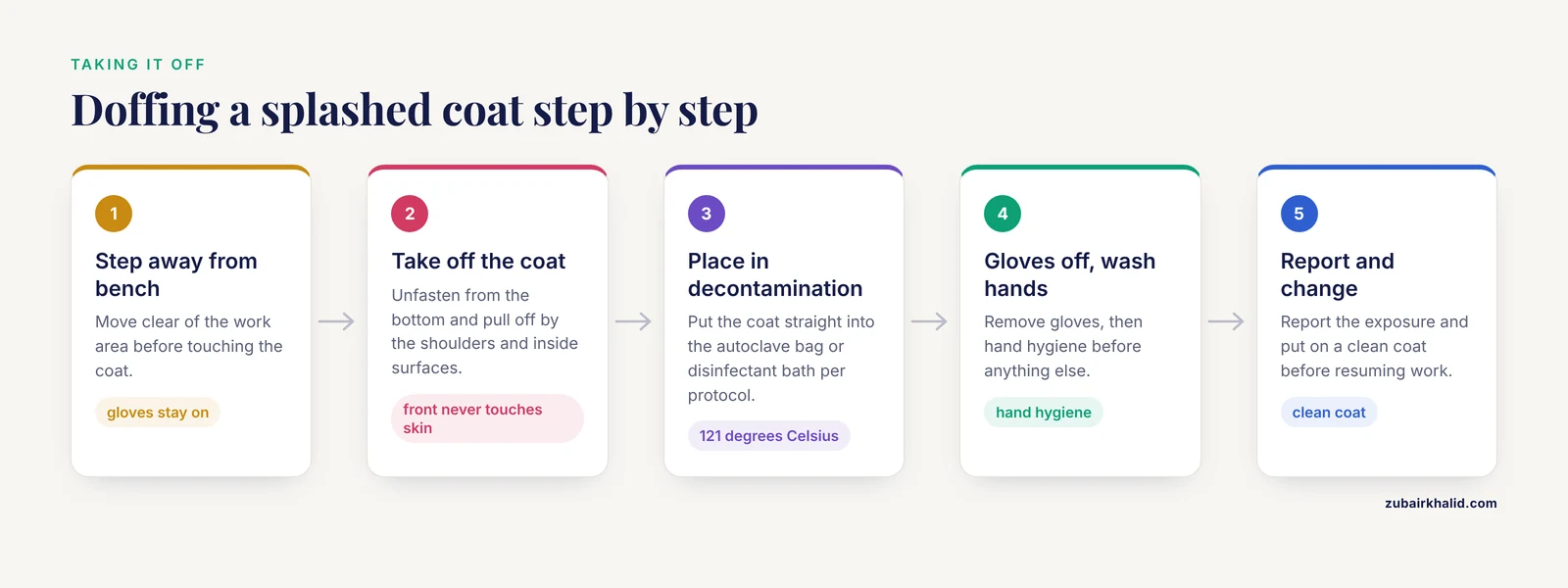
- Doffing (taking off). Gloves first with hand hygiene, then the coat, unfastened from the bottom and pulled off by the shoulders and inside surfaces so the front never touches skin or clothing, then hand hygiene again.
- Contamination response. If a coat is splashed, the wearer keeps gloves on, removes the coat away from the body, and places it directly into the designated decontamination route, an autoclave bag or a chemical disinfectant bath per institutional protocol, a standard autoclave cycle runs at 121 degrees Celsius. Gloves off, hand hygiene, report the exposure, clean coat, resume.
- Laundering and storage. Coats stay in the lab, on individual hooks, never draped on stools or door handles, never worn to break rooms, offices, or transit. Contaminated coats are decontaminated before laundering, always, and never taken home.
Training should also close the loop on comfort. PPE programs that invite end users to field-test garments for comfort before purchase see better day-long compliance, a point made forcefully in the critical care PPE literature and equally true at the microbiology bench [2]. A coat that staff helped choose is a coat that gets worn correctly.
Worked Scenarios from the Bench
These three scenarios cover the settings where most readers will work.
Scenario 1: University Teaching Lab (BSL-1)
An introductory microbiology teaching lab runs BSL-1 strains such as Escherichia coli K-12 and Bacillus subtilis. The coat is a knee-length, snap-front, cotton-polyester garment with knitted cuffs, issued at the start of term and kept on an assigned hook, paired with safety glasses and closed-toed shoes. Safe laboratory practice is treated as part of the skill set students are there to build, not as a rule sheet bolted on [1]. Comfort leads the purchase decision because the hazard floor is low and compliance is everything, a room of twenty students will wear a hot, stiff coat badly. Disposable visitor coats cover open houses and guests.
Scenario 2: Clinical Bacteriology Bench (BSL-2)
A clinical bacteriology bench receives specimens, plates them, and works up isolates with biochemical identification and antimicrobial susceptibility testing, all at BSL-2. The daily default is the reusable snap-front poly-cotton coat with knitted cuffs, gloves, and safety glasses. The risk assessment adds a disposable fluid-resistant barrier gown for the splash-predicted stations, specimen receipt and decanting, vortexing unsealed tubes, spill cleanup, and a face shield where splashes can reach the face. Aerosol-generating steps move into the BSC. Coats come off before breaks and go home with nobody, and the laundry contract, not the coat budget, is the line item that keeps the system honest.
Scenario 3: Mycobacteriology and Aerosol-Hazard Work (BSL-3)
Mycobacteriology work with Mycobacterium tuberculosis cultures sits at BSL-3, where aerosol hazard drives the ensemble. The garment is a solid-front or wraparound disposable gown, or a coverall, worn over dedicated scrubs, with gloves and respiratory protection as the assessment directs. Donning and doffing happen in the anteroom, hand hygiene between steps, and the gown is decontaminated before it leaves the suite. At this level the coat is one component of an integrated ensemble, not a standalone purchase, and the fit and heat-stress questions from the criteria section matter double, because shifts in full barrier garments are long.
Common Mistakes and Limitations
- Wearing the coat out of the workspace. The coat that rides the elevator, visits the cafeteria, or commutes home carries whatever the bench left on it. The coat comes off inside the lab, every time.
- Choosing buttons over snaps. Button-front coats look formal and perform badly in an emergency, slow to open one-handed with gloves on, and buttons trap contamination in their threads.
- Leaving bare wrists. Open cuffs plus short gloves leave a strip of skin exactly where splashes land. Knitted cuffs with gloves overlapped close the gap.
- Treating a woven coat as fluid-proof. Cloth repels droplets, not splashes. A real splash soaks through a poly-cotton coat in seconds, which is what barrier gowns are for.
- Wearing synthetics at the flame. Polyester melts and drips, and melt burns are deep burns. Cotton or FR fabric belongs at any bench with an open flame.
- Home laundering a contaminated coat. A household washing machine spreads what the autoclave was supposed to contain. Decontaminate first, launder institutionally, always.
- Running one coat policy forever. The risk assessment changes when agents or methods change, and the coat list changes with it. An annual review nobody updates is wallpaper.
- Buying without a wear test. A coat nobody wore for a full shift gets worn incorrectly, unfastened, sleeves rolled, or abandoned. End-user trials exist for exactly this reason.
This comparison is general guidance for common microbiology settings. The binding requirements for any specific lab come from its written biosafety manual, its current risk assessment, and its biosafety officer or supervisor, and individual cases, an unusual agent, an immunocompromised staff member, a nonstandard procedure, need that local review before PPE choices are finalized.
Frequently Asked Questions
What is the best lab coat for a microbiology lab?
For most BSL-1 and BSL-2 bench work, the best lab coat for a microbiology lab is a knee-length, snap-front, reusable coat in a cotton-polyester blend with knitted cuffs, backed by disposable fluid-resistant gowns for splash-heavy tasks and solid-front gowns for higher-containment work. The right coat is the one your biosafety risk assessment selects and your team will wear correctly all shift.
Are disposable lab coats better than reusable cloth coats?
Neither is better across the board. Disposables give every wearer a fresh garment and skip the laundry, while cloth coats breathe better, last for years, and behave predictably near open flame. Match the garment to the task instead of picking one winner.
Do I need a flame-resistant lab coat if I use a Bunsen burner?
You need to keep melting synthetics away from any open flame. A 100% cotton coat is the usual minimum at the burner bench, and flame-resistant fabric earns its keep where flaming is constant.
How often should a microbiology lab coat be laundered or replaced?
Change the coat immediately after visible soiling or any contamination, and otherwise follow the lab's written schedule, which for daily bench work is commonly weekly. Disposable garments are single use unless your institution states otherwise.
Can I take my lab coat home to wash it?
No. Coats used with infectious material stay in the lab and move through institutional decontamination and laundry, never a home washing machine.
What should I do if my lab coat gets splashed with a culture?
Step away from the bench, remove the coat with your gloves on, and place it in the designated decontamination container. Then remove gloves, wash your hands, report the exposure, and change into a clean coat before resuming work.
Further Reading
Sources
- Who Let the Dogs Out? A Plea for Official Guidelines on Service Animals in the Teaching Laboratory.
- Breathability and Safety Testing of Personal Protective Equipment: "Human-comfort" Factor Remains Undefined.
- Indian microbiology EQAS registered laboratory's capacity building and infection control practices during the COVID-19 pandemic in India: Lessons learnt and gaps identified.