Internal Audit in a Microbiology Lab: Step-by-Step Guide
By Dr. Zubair Khalid, DVM, MS, PhD ·

An internal audit is a planned, documented, first-party examination of a laboratory's own activities against its chosen quality standard, its standard operating procedures, and its actual daily practice. In a microbiology laboratory, the audit verifies that everything from specimen acceptance to culture workup, antimicrobial susceptibility testing, and result reporting is performed the way the laboratory says it is performed, and that the results the laboratory issues are reliable. A completed internal audit produces a written set of findings, a corrective action plan for every nonconformity, and objective evidence that management reviewed and closed those actions. It is the self-check mechanism of laboratory quality management, and it is a mandatory element of every major accreditation framework for medical laboratories.
Use an internal audit when you are preparing for an accreditation or recertification assessment, when a new test or workflow has been introduced and needs independent verification, when error trends or complaint patterns suggest a hidden process failure, or on the fixed cycle required by your quality management system (QMS). A QMS is the interacting set of policies, processes, and procedures a laboratory uses to monitor, control, and improve service quality [1]. Most laboratories audit each major process area at least once per year, with higher-risk areas audited more often.
Time commitment, expressed as realistic working figures for a medium-sized clinical microbiology section:
- Planning and preparation: 8 to 16 hours of auditor time spread over 2 to 3 weeks of elapsed time.
- On-site audit execution: 12 to 24 hours across 1 to 2 working days for a single-process audit, or 3 to 5 working days for a full-laboratory audit.
- Report writing: 4 to 8 hours within 1 week of the audit.
- Corrective action follow-up and closure: spread over 30 to 90 days of elapsed time, with roughly 2 to 4 hours of verification work per nonconformity.
Total hands-on effort for a typical annual audit of one microbiology section runs between 30 and 50 person-hours. Elapsed time from audit plan to closure of the last corrective action is usually 2 to 4 months.
Principle of the Internal Audit
The internal audit rests on a simple principle: quality cannot be claimed, it must be demonstrated with evidence. The auditor gathers objective evidence, which means records, observations, measurements, and interviews that can be verified, and compares that evidence against defined criteria, which are the laboratory's own procedures, the accreditation standard, and regulatory requirements. Any gap between evidence and criteria is a finding. Findings are classified, documented, assigned an owner and a deadline, and tracked to closure.
The audit is not an inspection of people. It is an examination of processes. This distinction matters because a well-run audit asks "does this process, as written and as practiced, consistently produce reliable results?" rather than "who made this mistake?" Laboratories that frame the audit as a search for culprits get defensive staff, concealed problems, and shallow corrective actions. Healthcare quality experts consistently identify poor implementation, rather than poor intent, as the main reason quality systems fail to deliver expected outcomes [2].
The audit also functions as the "Check" step of the Plan-Do-Check-Act (PDCA) cycle, the improvement loop that underpins most quality management approaches. In one detailed study of institutional quality strategy, PDCA applied across all work units, backed by leadership commitment and an integrated internal quality assurance system, was the mechanism that converted quality policy into measurable practice [3]. In the laboratory, the same loop looks like this: plan the audit and its criteria, perform the audit, check the findings against the criteria, and act through corrective actions and process changes.
Quality management principles apply across industries, but they behave the same way everywhere. A widely used management text makes the point that the first step toward quality is identifying an organization's critical processes, mapping them down to the subprocess level, defining indicators and goals for each, and then monitoring those indicators periodically against the goals [4]. A microbiology laboratory's critical processes are specimen receipt and rejection, culture and identification, antimicrobial susceptibility testing, result verification and reporting, and the quality control (QC) system that underlies all of them. The audit checks that each of these processes has defined criteria, that staff know the criteria, and that the criteria are actually met.
Microbiology has a specific reason to audit rigorously that chemistry and hematology do not: the analytical process is open-ended and interpretive. An organism can be identified correctly by one bench officer and misidentified by another using the same method, and a susceptibility panel can be read differently at the margins. The laboratory's QC program, which includes media sterility and performance checks, reagent and stain controls, and reference-strain QC for susceptibility testing, is the main defense against this variability, and the internal audit is the main defense against the QC program itself quietly degrading.
Risk-Based Scope: What to Audit
A full-laboratory audit examines every element of the QMS. A targeted audit examines one process, one bench, or one recent problem. Modern guidance favors prioritizing scope by risk. The Centers for Disease Control and Prevention (CDC) NGS Quality Workgroup, when building quality system guidance for laboratories adopting complex molecular methods, explicitly prioritized the quality system essentials of personnel, equipment, and process management on the basis of risk assessment gathered from participating laboratories [5]. That same logic transfers directly to conventional bacteriology, mycology, mycobacteriology, and virology sections: audit first where failure would hurt patients most.
A practical risk-ranked audit scope for a clinical microbiology laboratory, in descending order of typical priority:
- Antimicrobial susceptibility testing and reporting, because an erroneous result drives direct therapeutic decisions.
- Specimen acceptance, rejection, and preanalytical handling, because a poor specimen produces a misleading result no matter how well the culture is worked up.
- Identification systems, whether manual biochemical panels, automated instruments, or MALDI-TOF mass spectrometry, including reagent lot control and calibration.
- Media and reagent quality control, including in-house prepared and commercially purchased media.
- Equipment management: incubators, autoclaves, refrigerators, freezers, biosafety cabinets, and their monitoring records.
- Personnel competency, including initial training, competency assessment, and continuing education records.
- Result verification, amendment, critical result notification, and telecommunication of results.
- Proficiency testing and inter-laboratory comparison performance, including investigation of unsatisfactory results.
- Biosafety, waste handling, and incident records.
- Document control, including whether bench copies of procedures match the controlled master versions.
The first three items on this list deserve audit attention every cycle. The others can rotate on a defined multi-year schedule, provided the full QMS is covered across the rotation.
Materials and Documents for the Audit
| Item | Working detail or quantity | Purpose |
|---|---|---|
| Annual internal audit schedule | One page, listing each process area, assigned auditor, planned month, and criteria to be applied | Ensures complete QMS coverage across the cycle and prevents ad hoc audit selection |
| Audit plan for the specific audit | 1 to 2 pages, naming scope, criteria, auditor, auditees, date, and sampling plan | Sets expectations and prevents scope creep on audit day |
| Audit checklist | 20 to 60 questions per process area, each mapped to a specific procedure clause or standard requirement | Forces systematic coverage and creates a written record of what was examined |
| Controlled copies of SOPs | Current master versions, on the bench where used | The audit criterion for comparing actual practice |
| Sample selection log | Typically 5 to 20 records per element sampled, chosen at random from the previous 6 to 12 months | Prevents cherry-picking and supports statistical confidence in findings |
| Prior audit report and open CAPA list | Last report plus the corrective action register | Verifies that previous findings were actually closed |
| Nonconformity/CAPA forms | One form per finding, with fields for description, criterion, classification, root cause, action, owner, and due date | Standardizes follow-up and enables trending |
| Competency records, training files | As sampled | Evidence for the personnel quality system essential [5] |
| Equipment maintenance and calibration logs | As sampled, including incubator, refrigerator, freezer, and autoclave temperature records | Evidence for the equipment quality system essential [5] |
| Media and reagent QC records | Sterility checks, growth/inhibition performance checks, and lot records for every medium and stain in use | Evidence for microbiology quality control in process management [5] |
| Reference-strain QC records | QC results for ATCC-type control strains used in susceptibility testing, for example E. coli ATCC 25922 and S. aureus ATCC 25923 | Verifies analytical performance of the AST system |
| LIMS access and audit trail export | Sample of result amendments with usernames, timestamps, and reasons | Detects unverified changes and data integrity gaps |
A note on checklists: the questions should be answerable yes or no with objective evidence, and each should trace to a document. "Is the autoclave validated?" is weak. "Show me the last three monthly autoclave run records and the annual validation report, and confirm each run met the defined physical and biological indicator acceptance criteria" is strong.
Step-by-Step Procedure
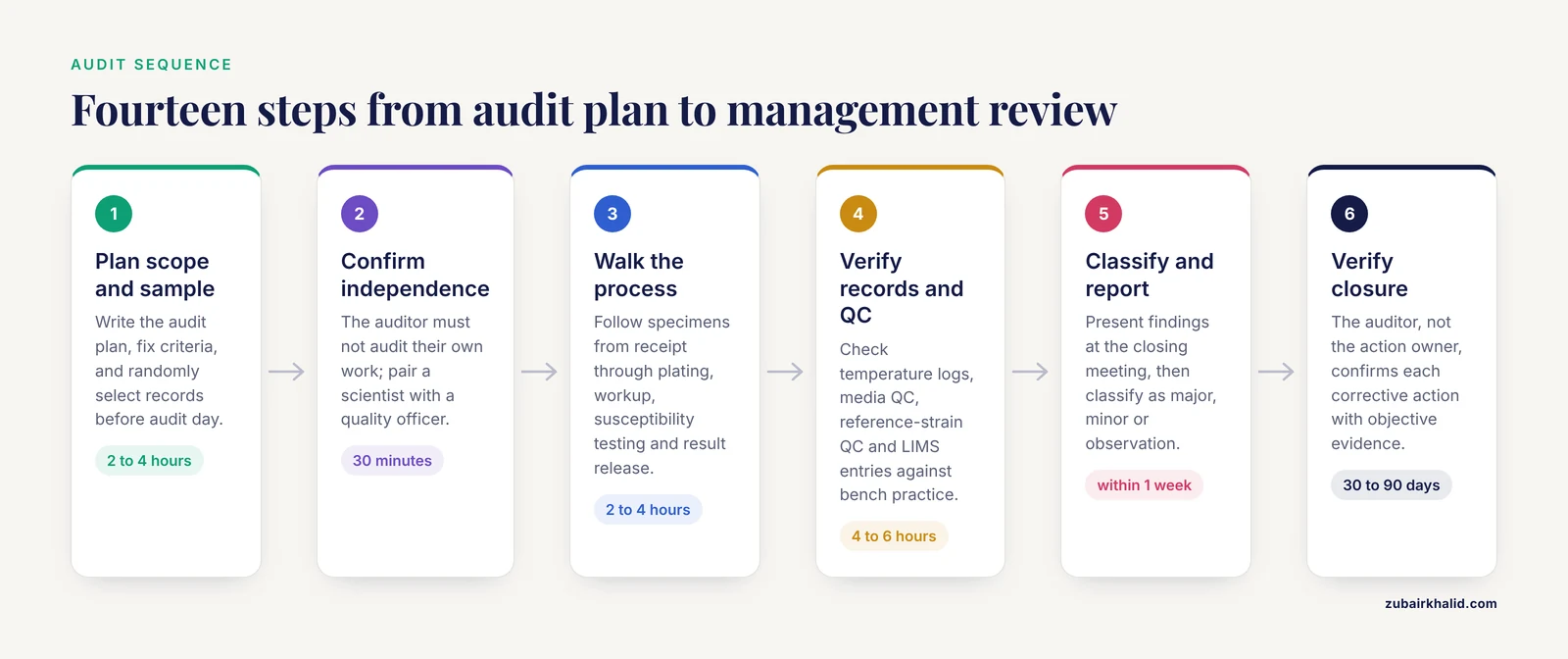
The following internal audit microbiology lab steps step by step sequence assumes a process-focused audit of one major area, such as the bacteriology bench, and scales up to a full-laboratory audit by repeating the cycle per process area.
Step 1. Define the scope, criteria, and sampling plan (2 to 4 hours, 2 to 3 weeks before audit day). Write the audit plan. State exactly which process is audited, against which documents and standard clauses, on which date, with which auditor and which auditees. Decide in advance how many records, observations, and interviews you will sample, and from what time period. Randomly select the record numbers before you arrive. The reason this step is critical: scope and sampling decided in advance prevent the audit from drifting into either a casual chat or an unplanned dragnet, and they protect the auditee from surprise.
Step 2. Confirm auditor independence (30 minutes, at plan approval). The auditor must not audit their own work. In a small laboratory this is the hardest constraint to satisfy, and the usual practical solution is to pair a microbiology scientist with a quality officer from another laboratory section, or to have the microbiology supervisor audit the preanalytical and reporting processes rather than the technical bench. The reason: self-audit reliably produces mild findings and missed problems, which defeats the purpose and is also a standard nonconformity in itself during external assessments.
Step 3. Assemble and review the checklist and prior findings (4 to 6 hours, 1 week before audit day). Map each checklist question to a specific clause in the relevant SOP or standard. Pull the previous audit report and the corrective action register, and mark every still-open item for re-verification during this audit. The reason: an audit that ignores open CAPAs lets failures persist indefinitely, and closure verification is one of the most valuable outputs an auditor can provide.
Step 4. Open the audit formally (20 minutes, audit day). Meet the auditee, restate the scope and criteria, confirm the schedule, and answer questions. Explain that findings address processes, not people, and that observations of unsafe or noncompliant practices will be discussed immediately rather than saved for the report. The reason: an opening meeting lowers defensiveness and sets the evidentiary ground rules.
Step 5. Walk the process end to end (2 to 4 hours). Follow one specimen, or a small series of specimens, from receipt through accessioning, plating, incubation, workup, identification, susceptibility testing, and result release, observing actual practice at each handoff. Note where practice matches the SOP and where it does not. The reason: process-walking exposes interface failures, the gaps between one bench's output and the next bench's assumptions, that no single-bench checklist question will find.
Step 6. Verify records against observations (4 to 6 hours). For each sampled record, check completeness, legibility, timeliness, and agreement with observed practice. In microbiology, this includes temperature logs for each incubator and refrigerator against the defined acceptance ranges, media sterility and performance QC for every lot in use, reference-strain QC results for the AST system against the defined acceptable ranges, and calibration or verification records for automated identification systems. Cross-check at least one sampled result in the LIMS back to the raw bench data, including the growth photographed or read on the plate and the panel read. The reason: a record that looks complete but disagrees with what actually happens on the bench is a more serious finding than a missing signature, because it means the documented process is fiction.
Step 7. Interview staff against their own procedures (2 to 3 hours). Ask bench officers to describe, in their own words, how they perform specific tasks, where the current controlled copy of the SOP is, how they record out-of-range QC, and whom they notify when a control fails. Do not quiz them like an exam. The reason: staff knowledge is the leading indicator of process health. A technician who cannot find the current SOP version is describing a document-control failure, which is a process finding, not a personal failing.
Step 8. Verify microbiology quality control in depth (2 to 3 hours). This is the audit element most specific to the discipline. Sample and check:
- Media QC: sterility checks for each in-house and purchased lot before use, growth performance checks for nonselective and selective media, and inhibition checks for selective and differential media, against defined acceptance criteria.
- Reagent and stain QC: performance checks for oxidase, catalase, coagulase reagents, and Gram stain with known positive and negative control organisms at the defined check frequency.
- AST QC: results for the reference control strains run at the defined frequency for each new lot or shipment of panels, disks, or cartridges, with documented corrective action for any out-of-range result.
- Instrument QC: calibration, maintenance, and control organism runs for automated identification and susceptibility instruments, and the verification records for any reagent lot change.
The reason: QC records are the only continuous, quantitative evidence that the analytical system is performing, and their absence, irregularity, or unexplained failure is the highest-weight finding in most microbiology audits.
Step 9. Hold the closing meeting (30 to 60 minutes, same day). Present every finding verbally, with the evidence and criterion stated for each, and let the auditee correct factual errors on the spot. Agree a preliminary classification for each finding and record any dispute for resolution in the report. The reason: no finding should reach a written report that the auditee has not already heard and had the chance to contextualize. This preserves trust and prevents report-stage arguments.
Step 10. Classify findings (1 to 2 hours, within 2 days). Use a three-tier classification, which is the near-universal convention:
- Major nonconformity: total absence or total breakdown of a required process element, or a failure that invalidates results already reported, for example a susceptibility QC failure that was not detected or not acted on before patient results were released.
- Minor nonconformity: an isolated lapse in an otherwise functioning process, for example one missed weekly sterility check among twelve.
- Observation or opportunity for improvement: a true conformity with room to improve, or an emerging risk.
The reason for consistent classification: it drives the depth of the required corrective action and allows trending across audits. A laboratory whose findings are all minimally classified by habit is performing an audit theater exercise.
Step 11. Write the audit report (4 to 8 hours, within 1 week). Structure the report as scope, criteria, audit team, summary of the auditee's performance, findings with evidence and classification, and required actions with owners and due dates. Distribute to the auditee, the laboratory director, and the quality manager. The reason: the report is the permanent objective evidence that the audit occurred and the basis for external assessors to judge whether the internal audit program functions.
Step 12. Launch corrective actions for each nonconformity (within 2 weeks of the report). For each finding, require a documented root cause analysis, a corrective action that addresses the cause rather than the symptom, an assigned owner, and a due date. The distinction matters: retraining the individual who missed a sterility check is a symptom fix. Redesigning the media QC log so that a missing check is visually impossible to overlook is a cause fix. Healthcare implementation research shows that quality initiatives deliver results when the implementation process itself is managed and internally motivated, not when actions are assigned perfunctorily [6].
Step 13. Verify closure with objective evidence (within 30 to 90 days). The auditor, not the action owner, confirms closure. Acceptable evidence includes a repeat record review after the action took effect, a targeted follow-up observation at the bench, or a retest of the failed control. Mark the CAPA closed in the register with the evidence referenced. The reason: unverified closure is the single most common failure mode of internal audit programs.
Step 14. Feed results back into the quality system (annual, at management review). Present audit findings, CAPA timeliness, and repeat-finding trends at management review, alongside QC performance indicators, proficiency testing outcomes, turnaround times, and complaint data. Quality management literature is consistent that improvement only happens when process indicators are defined, monitored, and compared against stated goals [4], and that audit is the mechanism that makes the improvement loop self-sustaining [3]. The reason: audits that never change anything erode staff willingness to cooperate with the next one.
Controls: How the Audit Itself Is Quality-Controlled
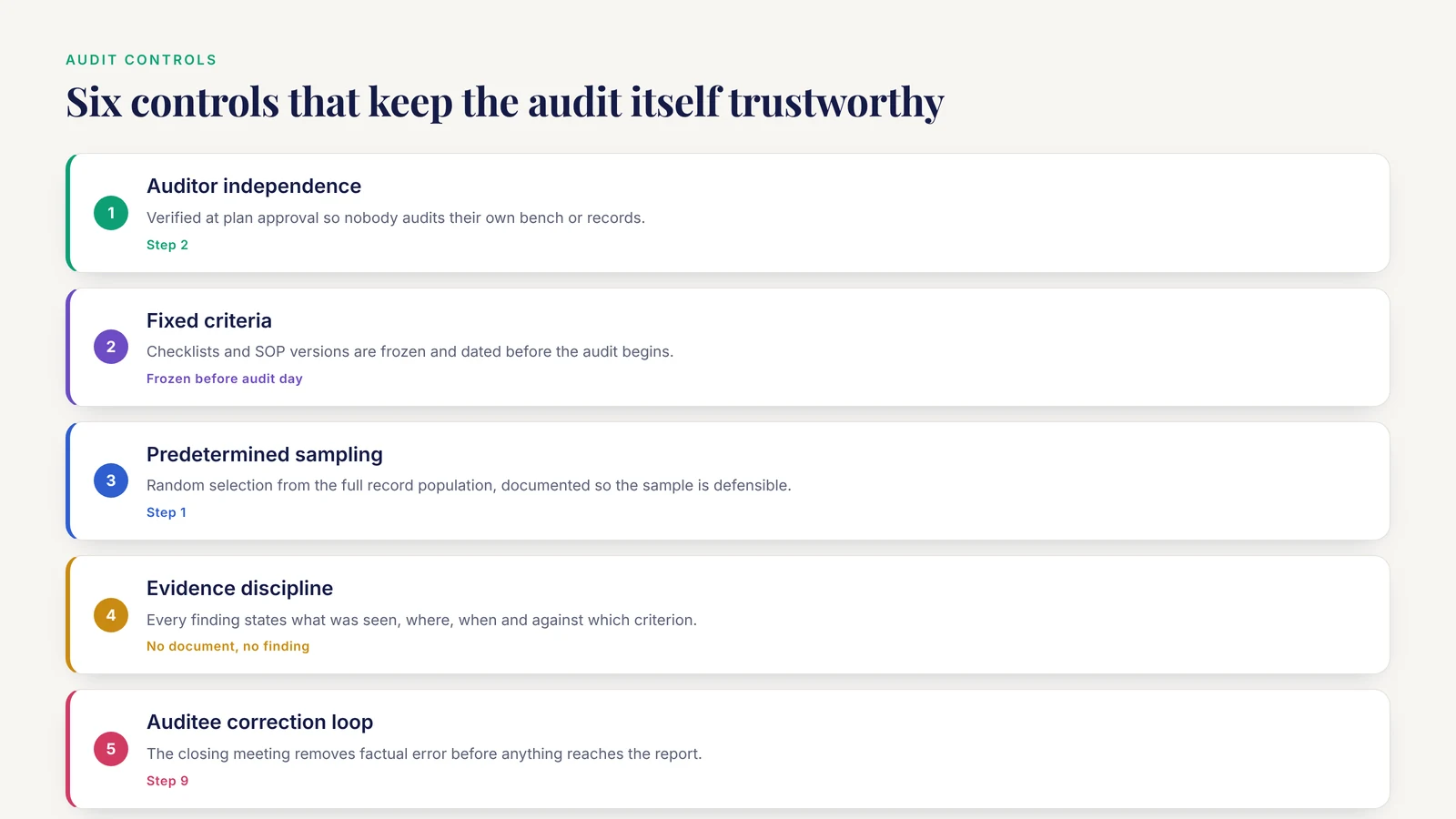
An audit is a measurement, and every measurement needs controls. The controls for an internal audit are:
- Independence of the auditor. Verified at plan approval, as in Step 2.
- Fixed criteria. The checklists and SOP versions are frozen before the audit and dated, so findings cannot shift against a moving target.
- Predetermined sampling. Random selection from the full record population, documented, so the sample is defensible.
- Evidence discipline. Every finding states what was seen, where, when, and against which criterion. A finding without a document reference is an opinion.
- Auditee correction loop. The closing meeting, as in Step 9, acts as the review step that removes factual error before reporting.
- Inter-audit consistency. The quality manager reviews reports for classification drift, checking that similar findings receive similar severity across auditors and across the year.
External assessment provides a periodic external check on the internal audit program itself. Assessors routinely ask to see the audit schedule, three completed reports, and the CAPA register, and a program that exists only on paper is one of the fastest routes to a major finding.
Expected Results and How to Read Them
A functioning internal audit in a competent laboratory typically produces, per full-cycle audit, a small number of findings: roughly 0 to 2 major nonconformities, 3 to 10 minor nonconformities, and a handful of observations. Read the pattern, not just the count:
- Zero findings at all usually indicates a shallow audit, not a perfect laboratory. If a full-day audit of an active bench raises nothing, the sampling was too light or the criteria too vague.
- Repeated findings across consecutive audits in the same element indicate that corrective actions treated symptoms. This is a management-level finding and should go to the laboratory director.
- Findings concentrated in one process area indicate a genuine systemic weakness in that area, and the next audit cycle should prioritize it.
- Findings spread evenly across all areas with all minor severity often indicates a documentation culture problem rather than technical failure.
Quantitatively, laboratories that genuinely implement a QMS see measurable benefits. A hospital QMS assessment tool used in 28 Iranian hospitals scored systems across nine dimensions and found quality policy documents and board-level quality monitoring to be the weakest and strongest dimensions respectively, which is the pattern many laboratories reproduce on their first audit: policy exists on paper, monitoring at leadership level is thin [1]. A university research laboratory that implemented and certified a quality management system reported high stakeholder satisfaction and a very small number of failures in subsequent operation, which is the practical outcome profile a mature audit program supports [7]. In healthcare settings broadly, organizational quality management structures, together with safety culture and leadership, have been examined for their association with patient-level outcomes such as waiting time and length of stay, supporting the view that quality system maturity is not merely administrative [8]. And in studies of ISO 9001 implementation, process orientation and consistently applied risk management emerged as the mechanisms through which a QMS strengthened organizational resilience, with the effect diminishing once units had already internalized those practices, a useful reminder that audit value is highest before habits fully form [9].
Troubleshooting the Audit Process
| Symptom | Likely cause | Fix |
|---|---|---|
| Auditee is defensive and withholds information | Audit framed as blame, or auditor from a competing hierarchy position | Reopen the meeting and restate the process-focused purpose. Assign a neutral auditor next cycle |
| Checklist finished in half the allotted time | Questions answerable from the couch, no bench observation | Redesign checklist so each item requires an artifact, a record, or an observation |
| Findings are all observations, no nonconformities | Auditor under-classifying to avoid conflict | Quality manager calibrates classification across auditors. Require at least a rationale for every "no finding" decision |
| CAPAs stay open past due date | No owner escalation mechanism, or actions too broad | Break each CAPA into one owner and one deliverable. Escalate overdue items to management review monthly |
| Same finding recurs every year | Root cause analysis absent or superficial | Mandate a documented root cause step. Require process redesign, not retraining alone, for repeat findings |
| Staff cannot locate current SOP versions at the bench | Document control failure or uncontrolled copies circulating | Audit the document control system itself. Remove uncontrolled copies and reissue controlled versions with receipt logs |
| QC records complete but staff cannot explain what a failed control means | QC performed as ritual, without interpretation competency | Target competency assessment on QC failure response scenarios |
| Records sampled were all from the most recent, best-run month | Sampling not randomized or preselected by the auditee | Return to Step 1 and re-sample randomly from the full period. Note the sampling bias as its own finding |
| Audit findings contradict external assessor findings | Internal criteria looser than the accreditation standard | Update checklists to mirror the current accreditation standard requirements |
| Audit program suspended during workload surges and outbreaks | No protected time, audit seen as optional | Fixed annual schedule approved by laboratory leadership, with audit hours treated as scheduled work |
Variations
Horizontal audit. Examines one quality system element, for example document control or equipment management, across every process area at once. Efficient for small laboratories and for elements that behave uniformly.
Vertical audit. Follows one specimen or one result type through the entire laboratory, as in Step 5. The strongest format for finding interface failures and the standard method for a targeted audit after a complaint or reported error.
Announced versus unannounced. Most internal audits are announced. A short-notice or unannounced spot audit of one element, perhaps one hour long, is a legitimate supplementary tool where a specific risk warrants it, but routine surprise auditing destroys the cooperative tone the program depends on.
Remote audit. Portions of a records-based audit can be performed over screen share of the LIMS and document system. Bench observation cannot be done remotely, so a remote audit must be labeled as a partial audit and completed on site.
Combined audit with inspection preparation. Where the laboratory faces regulatory inspections and licensing evaluations alongside its accreditation cycle, aligning the internal audit checklist with the inspection criteria avoids duplicate effort. Experience from hospital systems that must balance licensing, annual evaluation, external inspection, and internal QMS requirements shows that duplicating these mechanisms without alignment wastes resources and fatigues staff [10].
Small laboratory adaptation. A laboratory with five or fewer technical staff can run a credible audit program with rotating auditor pairs across sections and a quarterly rather than monthly meeting rhythm. Studies of quality system adoption in small organizations identify financial constraints, lack of support, and limited awareness of value as the dominant barriers, while also confirming a positive association between genuine QMS implementation and operational efficiency and service quality [11]. Determinants research in small enterprises similarly finds significant relationships between the breadth of quality tools actually used and achieved performance [12]. The practical translation: a small laboratory benefits most from a short, sharp, process-walk-based audit done four times a year, rather than one exhaustive annual event.
Records, Storage, and Stability
Audit records are permanent quality records. Retain the following, in the controlled document system:
- The annual audit schedule and every audit plan, version controlled and dated.
- Completed checklists with auditor signatures and dates.
- Every audit report, with distribution list recorded.
- The CAPA register, from entry to verified closure, including root cause analyses and closure evidence.
- Management review minutes that dispositioned the audit findings.
Retention periods follow the laboratory's record retention policy and its accreditation or regulatory requirements, which commonly require quality records to be retained for several years and often for at least the interval between accreditation cycles. The working rule: keep audit records at least until the audit program has completed two full cycles, so trends can be demonstrated to external assessors. Store records so that they are legible, retrievable, and protected from alteration, with any post-report correction made by a dated, initialed addendum rather than an edit.
Corrective actions have their own stability requirement: a CAPA is not stable until it has survived at least one subsequent verification cycle. An action verified at 30 days and rechecked at the next annual audit counts as stable. An action verified once and never rechecked does not.
Safety Notes
- Auditors entering technical areas must comply fully with the laboratory's biosafety requirements: laboratory coat, gloves when touching surfaces or equipment fronts, and eye protection where the local risk assessment requires it. An auditor is a visitor under the biosafety program and does not get an exemption.
- Do not handle cultures, plates, isolates, or primary specimens during an audit unless you are a trained, authorized, currently competency-assessed member of that laboratory's staff. Observation is done from outside the direct work zone.
- Never open an incubator or biosafety cabinet mid-procedure to inspect a record inside. Ask the bench officer to retrieve documents at a defined pause point.
- Follow the laboratory's rules on food, drink, personal items, and movement between clean and dirty zones, including during a walkthrough of specimen reception.
- Stop the audit if an immediate biosafety hazard is observed, address it with the bench officer at once, and record it as an urgent finding regardless of the audit's stated scope.
Common Mistakes and Limitations
The following are the internal audit microbiology lab steps common mistakes seen most often in real programs, listed with their fixes.
- Auditing paperwork instead of practice. A records-only audit confirms the filing system, not the laboratory. Every audit must include direct bench observation. The most damaging finding in any microbiology laboratory is a QC record that is complete but false.
- The supervisor audits their own bench. Independence is structural, not aspirational. If a two-person section cannot provide an independent auditor, borrow one from another section or from the quality office.
- Generic checklists copied from the internet. A checklist not mapped to the laboratory's own SOPs and current accreditation standard will miss discipline-specific exposures, particularly in microbiology QC, media lot control, and susceptibility testing.
- Findings without criteria or evidence. "The Gram stain bench was messy" is not a finding. "Three of five sampled Gram stain QC logs lacked the documented daily control organism result required by SOP MIC-QC-004, section 5.2" is a finding.
- Corrective actions limited to retraining. Retraining fixes a knowledge gap. It does not fix a log design that allows entries to be skipped, or a refrigerator whose alarm nobody can hear. Repeat findings are almost always evidence of this mistake.
- No root cause analysis. Assigning an action before understanding the cause guarantees recurrence.
- Sampling from a convenient period. Auditing only the most recent month, or only days the auditee chose, conceals seasonal and staffing-related variation.
- Audit as an annual paperwork event. A QMS only functions when quality activities are continuous and integrated into daily work, with visible leadership commitment and staff involvement, as shown repeatedly in quality management implementation studies [3]. An audit performed once a year and ignored the other eleven months does not protect results.
- Ignoring the preanalytical phase. Microbiology results depend enormously on specimen quality. An audit that starts at the culture plate has already skipped the highest-contamination-risk part of the process.
- Over-documentation. Building a 60-question checklist with four evidence attachments per question produces audits that take a week and get abandoned. Match audit depth to risk, as risk-based prioritization supports [5].
- Confusing internal audit with quality control. QC is a continuous technical check of the analytical system, such as running a control organism with each new susceptibility panel lot. Internal audit is a periodic management examination of whether the whole system, including QC, is designed and operating as intended. Doing one does not substitute for the other.
- Expecting audit to substitute for a quality culture. Implementation research in healthcare shows that failures to achieve expected outcomes from quality systems usually trace to problematic implementation rather than to the tools themselves [2]. An audit program installed on an unmotivated staff, without leadership follow-through, produces records but not reliability. Internal motivation of the team, not just external mandate, is a demonstrated predictor of realized benefit [6].
The limiting acknowledgment for any internal audit: it samples. A clean audit is strong evidence that processes were conforming on the days sampled, not a guarantee for every result ever issued. Individual patient results and clinical decisions always require professional judgment by the responsible clinicians and the laboratory director, and suspected result errors discovered during or after an audit must be handled through the laboratory's amendment and notification procedures, not merely corrected in silence.
Frequently Asked Questions
How often should a microbiology laboratory perform internal audits?
At minimum, every element of the quality management system should be audited once per accreditation cycle, and most laboratories divide the system so that each process area is audited annually. Higher-risk areas, especially antimicrobial susceptibility testing and specimen reception, should be audited every year without exception, and targeted audits should be added whenever a complaint, proficiency testing failure, or error trend points at a specific process.
Who can act as an internal auditor?
Any trained laboratory staff member who is independent of the activity being audited and has completed auditor training on the audit process, the standard, and finding classification. In practice this means pairing a technical scientist with a quality officer, or rotating auditors across sections so that nobody audits their own bench or their own records.
What is the difference between an internal audit and an external inspection?
An internal audit is a first-party examination the laboratory performs on itself, against its own procedures and its chosen standard, with findings handled internally as corrective actions. An external inspection or assessment is performed by an accreditation body or regulator, carries formal consequences such as certification or sanctions, and evaluates the laboratory partly by examining whether its internal audit program actually works.
How long does an internal audit take?
A targeted single-process audit needs about 1 to 2 audit days on site, plus 2 to 3 weeks of preparation and roughly a week for reporting. A full-laboratory audit typically spans 3 to 5 audit days. Total hands-on effort for one section's annual audit is usually 30 to 50 person-hours, and the full cycle from plan to corrective action closure runs 2 to 4 months.
What documents should I prepare before the audit?
Prepare the audit plan, a checklist mapped to your current controlled SOPs and the applicable standard, the previous audit report, the open corrective action register, a randomized list of records to sample, and access to equipment logs, media and reagent QC records, susceptibility testing control strain records, competency files, and LIMS audit trails.
What happens after a nonconformity is raised?
The finding is classified as major, minor, or observation, then assigned an owner who performs a documented root cause analysis and defines a corrective action with a due date. The auditor verifies closure with objective evidence, such as a repeat record review or bench observation, and the closed CAPA and its trend are presented at management review.
Can a small laboratory run an internal audit program without a dedicated quality manager?
Yes. A small laboratory can run a credible program by rotating auditor pairs between sections, using short process-walk audits every quarter instead of one exhaustive annual event, and keeping the CAPA register in a simple shared document. The barriers reported by small organizations are mainly limited resources and support, and the benefits of genuine implementation, including operational efficiency, remain demonstrable even at small scale.
How do I write an effective audit checklist?
Write each item as a question that can be answered yes or no with objective evidence, and map every item to a specific clause of a controlled SOP or standard requirement. Make the question demand an artifact, a record, or a direct observation rather than an opinion, and revise the checklist whenever the SOP or accreditation standard changes so the criteria never lag behind practice.
Sources
- Assessing hospital quality management systems: evidence from Iran.
- Facilitators, Barriers, and Benefits of Quality Management Systems Implementation: Healthcare Experts’ Perspectives
- Strategy for Implementing Total Quality Management to Achieve Quality Education in Higher Education
- Quality management systems
- Practical Guidance to Implementing Quality Management Systems in Public Health Laboratories Performing Next-Generation Sequencing: Personnel, Equipment, and Process Management (Phase 1)
- Motivations and benefits of quality management systems in social services: mediation of the implementation process
- Impact of implementing quality control systems in laboratories associated with teaching and research institutions - The case study of the laboratory for macromolecules and colloids in the petroleum industry
- The relationships between quality management systems, safety culture and leadership and patient outcomes in Australian Emergency Departments.
- The impact of quality management systems on organizational resilience
- Implementing hospital quality assurance policies in Iran: balancing licensing, annual evaluation, inspections and quality management systems.
- Examining the Barriers to Adaptation of Quality Management Systems in Small to Medium Sized Businesses in Guyana and the Resultant Impact on Performance and Competitiveness
- Determinants of the implementation of the quality management systems in SMEs