The Institutional Biosafety Committee (IBC)
By Dr. Zubair Khalid, DVM, MS, PhD ·
An Institutional Biosafety Committee (IBC) reviews, approves, and oversees work with biohazardous materials the way an Institutional Review Board (IRB) oversees human subjects research, except the hazard being governed is biological rather than human. A practical rule of thumb: if your institution cultures, modifies, stores, or ships recombinant DNA molecules, infectious agents, or biological select agents and toxins, an IBC needs to see that work before it starts, and again whenever the work changes.
This article explains the institutional biosafety committee roles and responsibilities that apply in real laboratories, compares the common oversight models institutions use, works through concrete scenarios from clinical microbiology and gene therapy, and identifies the mistakes that most often trigger findings during external audits.
What the Institutional Biosafety Committee (IBC) Is
The IBC is a standing institutional committee, mandated in the United States by the NIH Guidelines for Research Involving Recombinant or Synthetic Nucleic Acid Molecules, which apply to institutions that receive National Institutes of Health funding for recombinant DNA research. The committee's statutory origin lies in recombinant DNA oversight, but its practical scope at most institutions has expanded well beyond that mandate.
The scale of the responsibility is substantial. IBCs have been charged with oversight and review of biosafety at thousands of biocontainment laboratories nationwide, including hundreds of high-level BSL-3 and BSL-4 facilities, and the committee system has become the de facto governance layer for work spanning biodefense, select agents, recombinant DNA, synthetic biology, and dual-use research [1].
Membership is not optional or informal. A compliant IBC under the NIH Guidelines requires a minimum of five members with collective expertise sufficient to evaluate the safety of proposed work, including a biological safety officer when the institution conducts work at Biosafety Level (BSL) 3 or 4, expertise in recombinant DNA technology, and expertise in plant, plant pathogen, or animal pathogen containment when relevant. At least two members must be unaffiliated with the institution, and certain experiments, such as those involving the deliberate release of genetically modified organisms into the environment, require a nonvoting community representative. This composition requirement distinguishes the IBC from a purely administrative review office. The committee itself, not only the biosafety professional, is expected to deliberate.
Where IBCs sit within an institution varies, and this placement has measurable consequences. A national benchmarking survey of IBC and biosafety programs found that IBCs most commonly reside under the same administrative unit as the IACUC and IRB, while the majority of institutions' biosafety officers report to a different unit, a structural split that affects how committee decisions translate into day-to-day laboratory practice [2].
Institutional Biosafety Committee Roles and Responsibilities
The institutional biosafety committee roles and responsibilities fall into six recurring functions. Each is described below in the form the committee actually executes it, not as an abstract duty list.
Protocol registration and review
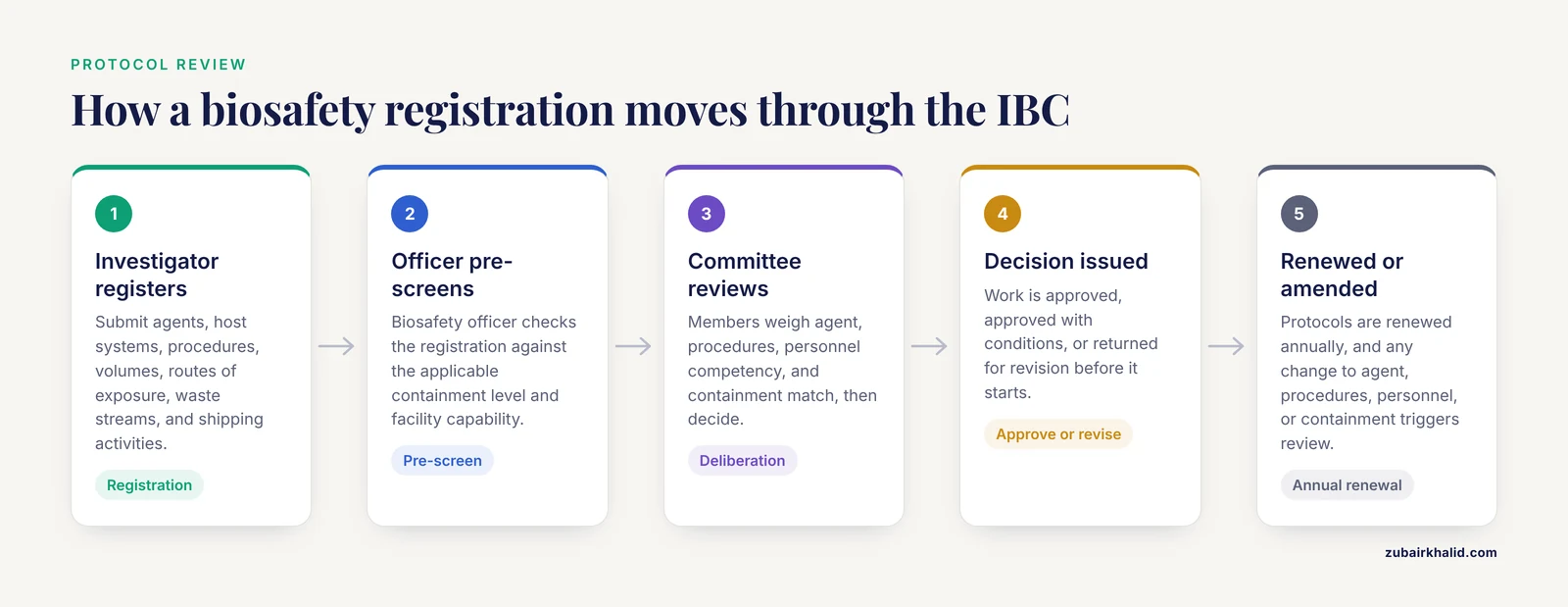
The core transaction of any IBC is protocol review. Investigators submit a biosafety registration describing the agents, host systems, procedures, volumes, routes of exposure, waste streams, and shipping activities involved. The committee reviews the registration against the applicable containment level, verifies that the facility and equipment can support it, and either approves the work, approves it with conditions, or returns it for revision. Under the NIH Guidelines, certain categories of work require IBC approval before initiation, including experiments that use risk group organisms at a containment level lower than recommended and experiments involving specific high-consequence agents. Most well-run committees apply an internal review threshold of "any recombinant or synthetic nucleic acid molecule, any agent handled at BSL-2 or above, any human source material, and any select agent," regardless of funding source.
Biosafety risk assessment
Every protocol review is, at its core, a biosafety risk assessment. The committee evaluates the agent's virulence and route of infection, the procedures that could generate aerosols or sharps injuries, the competency of the personnel, and the match between the proposed containment and the assessed risk. For gene therapy and clinical trials, this assessment extends to shedding, vector replication competence, and environmental release, and guidance for performing risk assessments on approved gene therapy products and the most utilized investigational product classes in oncology, infectious disease, and rare disease trials has been published specifically for biosafety professionals with responsibility over clinical research [3]. The risk assessment is a living document. It gets revisited when the agent, the procedure, or the personnel change, and after any incident.
Training oversight
The committee verifies, typically through the biosafety office, that personnel listed on an approved protocol have completed the required microbiology biosafety training before work begins, and that refresher requirements are tracked. Training oversight is where committee policy meets bench reality, and it is the function most often found deficient in external review.
Laboratory inspection and incident review
IBCs, usually through their biosafety officers, conduct periodic inspections of registered laboratories, review incident and exposure reports, and track corrective actions to closure. A well-structured biosafety program describes these activities systematically, reporting inputs such as staffing and budget, activities such as risk assessments, routine surveillance, training, and incident response, and outcomes such as reported exposures, injuries, compliance status, and client satisfaction, so that leadership can grasp the scope of the program and the resources it requires [4].
Policy development and special classes of work
The committee writes and maintains institutional biosafety policy, sets containment requirements for agent classes, reviews work involving biological select agents and toxins, and evaluates dual-use research concerns. For emerging technology, forward-leaning committees deliberately address both traditional pathogen-based risks and emerging risks from new technologies, integrated across the full project life cycle from design through potential future application [5].
Archival and reporting duties
The IBC maintains records of approvals, meeting minutes, and inspection findings, files the required annual report to the NIH Office of Science Policy for institutions subject to the NIH Guidelines, and produces documentation for grant applications, import permits, and accreditation surveys.
How the IBC Compares With the IRB, IACUC, and Biosafety Office
Confusion between the IBC and its neighboring committees is the most common source of protocol rejection for new investigators. The table below is the core of this article's comparison.
| Feature | IBC | IRB | IACUC | Biosafety Office |
|---|---|---|---|---|
| Primary hazard governed | Biological agents, recombinant and synthetic nucleic acids, select agents | Risks to human research subjects | Animal welfare | Operational execution of biosafety policy |
| Mandating framework | NIH Guidelines (for rDNA work at NIH-funded institutions), plus institutional policy and select agent regulations | Common Rule (45 CFR 46), FDA regulations | Animal Welfare Act, PHS Policy | Institutional policy, delegated by the IBC and leadership |
| Typical decision made | Approval, conditional approval, or deferral of biohazardous protocols | Approval or disapproval of human subjects protocols | Approval of animal use protocols | Verification, inspection, training delivery, incident response |
| Deliberative body | Yes, committee of at least five with required expertise and unaffiliated members | Yes, convened committee | Yes, convened committee | No, professional staff acting under committee authority |
| Typical trigger | Registering a protocol using recombinant DNA, infectious agents, or human specimens | Any intervention or interaction with human subjects | Any use of live vertebrate animals | Everyday lab operations, training, audits |
| Review cadence | At submission, on amendment, and on annual renewal | At submission and continuing review | At submission and semiannual program review | Continuous, with scheduled inspections |
The practical division of labor is this: the IBC decides whether the work may proceed and at what containment, while the biosafety office ensures the decision is implemented on the bench. The national survey data show this split clearly in the organizational charts, with the committee and the operational biosafety staff frequently reporting to different administrative units [2].
Institutional Biosafety Committee Roles and Responsibilities Options: Three Oversight Models
Institutions do not run IBCs identically, and the institutional biosafety committee roles and responsibilities options available to a given institution fall into three recognizable models. Each carries distinct pros and cons, and the right choice depends on the hazard portfolio, the volume of protocols, and the resources the institution commits.
Model 1: The minimal compliance IBC
The minimal model exists to satisfy the NIH Guidelines and nothing more. The committee reviews recombinant DNA registrations, meets quarterly, relies heavily on the biosafety officer's pre-screening, and keeps a narrow written scope.
The pros are simplicity and low administrative cost. A small college with a handful of BSL-2 cloning labs can maintain quorum with volunteer faculty and one part-time coordinator. Review turnaround can be fast because the protocol volume is low.
The cons are significant. The minimal model leaves entire hazard classes, such as clinical specimens, select agent work, and dual-use research, outside committee review, which becomes a liability the moment those activities appear. The evidence base also cautions against treating minimum compliance as sufficient. An analysis of IBC performance across hundreds of research institutions found serious ongoing problems with adherence to the NIH Guidelines, raising questions about whether the voluntary governance framework effectively monitors U.S. research facilities, including high-containment ones, and concluding that the system needed immediate improvement or replacement [1]. An institution that builds its IBC to the letter of the minimum inherits the failure mode this analysis documented.
Model 2: The omnibus or expanded IBC
The omnibus model expands committee review beyond the NIH Guidelines to cover all biohazardous work regardless of funding source, including clinical specimens, human and animal pathogens, biological toxins, arthropods, and, at some institutions, export-controlled biological materials. The national survey found that the majority of respondents reported their IBC reviews research utilizing biological hazards beyond what is required by the NIH Guidelines [2].
The pros are a single point of biosafety accountability, consistent risk decisions across the institution, and clean documentation for accreditors, funders, and collaborators. The omnibus model is the closest match to the "best institutional biosafety committee roles and responsibilities" standard that benchmarking surveys describe, because it closes the gaps that a funding-source-driven scope inevitably leaves.
The cons are resource intensity. Expanded scope requires professional staff to pre-review, full-time administrative support to track hundreds of registrations, and a committee with genuine expertise breadth. The survey quantified the disparity directly: 57 percent of institutions reported one or more full-time employees dedicated to supporting the IBC, compared with 86, 85, and 83 percent for the committees administering IACUC and IRB support respectively, meaning IBCs systematically carry comparable deliberative duties with materially less staff [2]. An omnibus IBC without adequate staffing becomes a rubber stamp, which is worse than a narrow IBC run well.
Model 3: The delegated or expedited review model
In the delegated model, the committee delegates routine low-hazard reviews to the biosafety officer or a designated reviewer, reserving full committee deliberation for high-consequence protocols, select agents, new agent classes, and incidents. Many large research universities adopt this hybrid to keep throughput manageable.
The pros are speed and focus. Registration-to-approval for a standard BSL-2 molecular clone can drop from a monthly committee cycle to days. Committee time concentrates on the protocols where deliberation genuinely changes the outcome.
The cons center on governance optics and consistency. Delegation must be defined in the committee's written procedures, the biosafety officer's determinations must be reported to the full committee for ratification, and the unaffiliated and community members can become peripheral if the committee never sees routine work. Left unmanaged, the delegated model recreates the adherence problems documented in the national analysis [1], because the informal review layer is invisible in the minutes that auditors read.
Side-by-side summary of the three models
| Criterion | Minimal compliance IBC | Omnibus IBC | Delegated review IBC |
|---|---|---|---|
| Review scope | rDNA registrations only | All biohazardous work | Full scope on paper, tiered execution |
| Typical staffing | Part-time coordinator, volunteer members | Dedicated IBC staff plus biosafety office | Biosafety officer as lead reviewer |
| Review speed | Moderate, committee-cycle dependent | Slowest at submission, most predictable | Fastest for routine work |
| Audit resilience | Weakest, gaps outside scope are easy to find | Strongest, single defensible standard | Strong if delegation is documented and ratified |
| Cost | Lowest | Highest | Moderate |
| Best fit | Small institutions, low hazard volume | Large academic medical centers, BSL-3 holders | High-volume research universities with mature biosafety offices |
How to Choose Among the Options: Criteria That Decide Real Choices
Four criteria separate the models in practice, and they should be weighed in this order.
First, the hazard portfolio. If the institution holds BSL-3 space, registered select agents, or gene therapy trials, the omnibus model is effectively mandatory, because external oversight expectations scale with containment level. An analysis comparing high- and maximum-containment laboratory oversight frameworks across countries found that decentralized governance with variable adherence to accepted compliance standards creates gaps that limit both governance and preparedness for emerging infectious disease challenges [6]. The same principle applies within a single institution. Fragmented internal oversight produces the same result at smaller scale.
Second, protocol volume. Volume determines whether the committee can survive without delegation. A committee handling fewer than fifty active registrations can plausibly deliberate on every one. A committee handling five hundred cannot, and the delegated model with documented ratification becomes the workable structure.
Third, resources committed by leadership. The staffing gap documented in the national survey, with IBC support at 57 percent of institutions versus 85 percent or above for the other bioethics committees [2], is a leadership choice, not a law of nature. Institutions that under-resource the IBC get slow reviews, frustrated investigators, and eventually a decision to route work around the committee, which is the failure pattern the performance analysis documented [1].
Fourth, the administrative placement. Placing the IBC in the same administrative unit as the IRB and IACUC gives it access to shared infrastructure, common software, and consistent policy escalation. Keeping the biosafety officer, who executes committee decisions, in a separate operational unit preserves independence between the deliberators and the implementers. The survey data showing exactly this split [2] suggest the split is a deliberate design in most institutions, not an accident, and it works when the two units communicate through shared reporting.
Worked Scenarios
Scenario 1: The clinical microbiology laboratory and an attenuated vaccine strain
A hospital laboratory wants to stock an attenuated live vaccine strain of a bacterium for quality control of diagnostic media. The strain is not a select agent, but it is a human pathogen, albeit attenuated. Under the minimal model, an IBC might never see this registration, because the work involves no recombinant DNA and no federal funding. Under the omnibus model, the laboratory registers the strain, the biosafety officer performs the biosafety risk assessment confirming BSL-2 containment with standard precautions, and the committee approves with a condition that transfer out of the department requires office sign-off. The omnibus review adds roughly a week and produces a defensible record showing the committee knew the agent was on site. The minimal model saves that week and produces nothing if an inspector asks who authorized the stock.
Scenario 2: A gene therapy clinical trial
An investigator proposes an early-phase trial of an adeno-associated virus (AAV) vector expressing a therapeutic transgene. The IBC review here is qualitatively different from a routine registration. The committee must assess vector replication competence, biodistribution and shedding pathways, the potential for horizontal transmission to household contacts, disposal of patient waste, and the biosafety implications for the clinical staff administering the product. Published guidance for biosafety professionals responsible over clinical research organizes this assessment around the three major gene therapy research areas, oncology, infectious diseases, and rare diseases, and notes that the pandemic drove large-scale testing of vaccines containing recombinant or synthetic nucleic acid molecules, increasing both the volume and the public visibility of this work [3]. The committee's output is a set of conditions, typically patient counseling on shedding precautions, defined containment for specimen handling, and a documented pathway for reporting unexpected exposures.
Scenario 3: A synthetic biology core facility
A university core facility offers prototyping services for engineered microbes using standardized genetic parts. The hazard portfolio spans organisms and parts whose risk profiles shift constantly as the technology advances. The governance pattern that has proven workable at scale is one in which safety and biosecurity review is integrated into the technical workflow itself, with clearly described roles for all members of the community, tools that help those planning and conducting the work recognize potential risks and match them with risk management approaches, and specialist review to identify gaps, operating across the project life cycle from design onward [5]. Translated to an IBC, this means the committee pre-approves part and organism categories rather than individual constructs where feasible, and audits the core's screening process rather than re-reviewing every construct.
Biosafety Risk Assessment: What the Committee Actually Evaluates
The biosafety risk assessment is the intellectual product of an IBC, and committees that fail usually fail here. The assessment runs through a standard sequence that every experienced committee member can apply without reference materials.
- Identify the agent. Its risk group, route of infection, infectious dose, host range, and availability of treatment or prophylaxis. For modified agents, the committee assesses whether the modification changes host range, virulence, or resistance profile.
- Identify the procedures. Which steps generate aerosols, sharps, splashes, or large volumes. Centrifugation, sonication, homogenization, and needle-based inoculation drive containment decisions more than the agent's risk group alone.
- Identify the host and the personnel. The susceptibility of the worker population, relevant immunization status, and demonstrated competency. Where surveillance is part of the safety program, compliance itself becomes a risk factor to monitor, since research in a highly endemic setting found non-compliance with recommended health surveillance above 40 percent even among individuals at higher risk, with unvaccinated individuals showing significantly elevated odds of non-compliance [7].
- Assign containment. The BSL, the required equipment, and the facility features, matched to the highest-risk procedure rather than to the agent's nominal classification.
- Document the residual risk and the conditions. What the committee cannot engineer away, and what training, signage, medical surveillance, or exposure response plan covers it.
This sequence maps directly onto the logic model framework used to describe biosafety programs programmatically, in which risk assessments appear as program activities, with staffing and budget as inputs and reported exposures, compliance, and satisfaction as outcomes [4]. The value of the mapping is that it gives the committee a vocabulary for reporting its own workload to leadership, which matters because on a routine day the program's success looks like nothing happening, and prevention is difficult to fund without data.
Microbiology Biosafety Training Under IBC Oversight
Training is the committee function with the widest gap between policy and bench practice, and the data on that gap are consistent across settings.
In a cross-sectional study of clinical laboratory professionals in government hospitals in Debre Berhan, Ethiopia, compliance with basic work habits was high, with 95.1 percent using mechanical pipettes, 96.3 percent handwashing after handling biohazardous material, and 98.8 percent handwashing after glove removal. Adherence to protective barriers was notably lower at 61.7 percent, formal biosafety training reached only 18.5 percent of participants, emergency preparedness was documented for 34.6 percent, appropriate immunization for 43.2 percent, and access to biological safety cabinets was limited to 18.5 percent of participants [8]. The pattern matters for committee design everywhere, not only in that setting. Workers reliably adopt visible, habitual practices such as handwashing. They unreliably adopt practices that depend on formal training, preparedness planning, and equipment investment. An IBC that measures only handwashing compliance will believe its training program is healthy when the actual training denominator is nearly empty.
Two countermeasures work, and both are committee-controllable.
Codified cross-training expectations. A health and safety program at an academic health institution used a focus group of safety specialists to develop a list of 50 basic health and safety items that any safety specialist should know, including core biosafety content, and used that list as the basis for formal cross-training. Staff responded positively, compliance with an array of health and safety expectations improved across the institution, and the question list was shared broadly with other organizations for their own use [9]. The transferable insight for an IBC is that training expectations should be written as a finite, testable list, not as a policy paragraph.
Personnel reliability as a complement to credentialing. At institutions working with biological select agents and toxins, a personnel reliability program implemented at the National Biodefense Analysis and Countermeasures Center was designed to enable staff participation in improving biosafety and biosecurity culture, maintain regulatory compliance, and address insider threat risk, supplementing the federal security risk assessment with a pre-access suitability assessment and ongoing evaluation [10]. The committee's role is to ensure that any such program, whether mandated by regulation or adopted voluntarily, is documented in institutional policy and reviewed for fairness and consistency.
Measuring IBC Performance
A committee that cannot demonstrate its own performance will eventually lose the resources it needs to function, and the published record offers both the warning and the remedy.
The warning is the multicenter evaluation that found serious ongoing problems with IBC adherence to the NIH Guidelines and questioned the effectiveness of the voluntary governance framework for monitoring U.S. research facilities, including high-containment laboratories [1]. The mechanism behind those findings is usually mundane. Committees without staff, without records, and without a defined scope drift toward approving what arrives and ignoring what does not.
The remedy is measurement. The logic model approach, in which the program reports monthly data on inputs, activities, and outcomes, gives the IBC and the biosafety office a systematic means of presenting activity volume to organizational leadership and associated safety committees, informing and educating upper management and other stakeholders about the resources needed to maintain compliance and prevent injuries and illnesses [4]. Useful metrics for a typical IBC include registrations submitted and approved per period, median review turnaround, percentage of laboratories inspected on schedule, incident and exposure counts with corrective action closure rates, and training completion at the moment of protocol approval rather than at the moment of convenience.
Pandemic conditions stress-test this measurement infrastructure. When COVID-19 arrived, the biosafety program at a major academic health center cataloged its tasks into three categories: services that were temporarily diminished, services that had to continue despite shutdowns for safety or compliance purposes, and services that dramatically increased in volume, frequency, and novelty. That cataloging, made in situ as the pandemic evolved, was explicitly intended to serve as a template for biosafety programs planning for the next pandemic [11]. An IBC that maintains an activity dataset of this kind enters the next disruption knowing which functions can pause and which cannot, instead of improvising the triage list under pressure.
Common Mistakes and Limitations
The following points account for most of the failures observed in IBC programs, in audits, and in the published evaluations.
Defining scope by funding source. An IBC that reviews only NIH-funded recombinant DNA work leaves industry-sponsored trials, departmental research, diagnostic development, and clinical specimen banking unreviewed. The majority of mature programs have already expanded beyond the NIH Guidelines minimum [2], and institutions that have not should treat that gap as the first finding a site visitor will raise.
Treating the biosafety officer as the committee. Delegation is legitimate when it is documented, reported, and ratified. Delegation is a failure when the committee's minutes contain no evidence of what the biosafety officer decided and why. The multicenter analysis of IBC adherence [1] is, in effect, an audit of what happens when informal review replaces documented governance.
Understaffing the committee relative to its siblings. The staffing disparity is documented and quantified, with IBC support at roughly two-thirds the rate of IACUC and IRB support [2]. Investigators experience this as slow reviews and drift toward unregistered work. Leadership experiences it later as a compliance finding.
Approving containment for the agent instead of the procedure. A BSL-2 organism handled in open-bench sonication is a higher-consequence activity than a BSL-3 organism handled in a closed, validated system. Committees that assign containment by agent name alone make errors that inspection then has to catch.
Assuming training compliance from work-habit compliance. As the clinical laboratory data show, high handwashing and pipetting compliance coexist with training rates below one in five [8]. The committee should require training completion records tied to protocol personnel lists, not attestation letters.
Ignoring the operational split between the committee and the biosafety office. Where the IBC and the biosafety officer report to different administrative units, which is the majority configuration [2], the failure mode is divergent policy. The fix is a shared annual report and a standing agenda item connecting committee decisions to operational inspection findings.
Reviewing incidents as personnel matters instead of systems matters. Exposure investigations should terminate in containment or procedure changes tracked by the committee, not only in individual retraining. Programs that frame biosafety program activities, outcomes, and resource needs in the public health logic model format [4] find this conversation easier to sustain with leadership.
Expecting committee review to substitute for occupational health surveillance. The compliance data on health surveillance, with non-compliance above 40 percent even among higher-risk individuals [7], indicate that enrollment in surveillance programs needs its own tracking, separate from protocol approval.
One limitation applies to every decision in this article. Individual institutional situations vary in governance history, hazard portfolio, and legal obligations, and a qualified biosafety professional or the institution's responsible official should be consulted before adopting any specific committee structure.
Frequently Asked Questions
What does the institutional biosafety committee actually review?
The IBC reviews registrations and protocols involving recombinant or synthetic nucleic acid molecules, infectious agents, biological toxins, human and animal source materials, select agents, and any other biohazardous work the institution places in its written scope. It assigns or confirms containment levels, sets conditions on the work, and re-reviews protocols when they change.
Does a clinical microbiology laboratory need IBC approval if it only handles diagnostic specimens?
It depends on the institution's written IBC scope. NIH Guidelines obligations are triggered by recombinant DNA work and NIH funding, but most mature committees have expanded review beyond that minimum to cover all biohazardous work, and a laboratory storing or propagating organisms under an expanded-scope IBC registers and obtains approval even without any recombinant DNA involvement.
Who must serve on an IBC?
Federal requirements set a minimum of five members with collective expertise sufficient to evaluate biosafety, at least two unaffiliated with the institution, a biological safety officer where BSL-3 or BSL-4 work is conducted, expertise in relevant plant or animal pathogen work when applicable, and a nonvoting community representative for experiments involving environmental release of genetically modified organisms.
How does the IBC differ from the IRB and the IACUC?
The IBC governs biological hazards, the IRB governs risks to human research subjects, and the IACUC governs animal welfare. A single research project can require all three approvals in parallel, and the committees most commonly share the same administrative unit even though they answer different regulatory frameworks.
What happens when the IBC identifies a training gap?
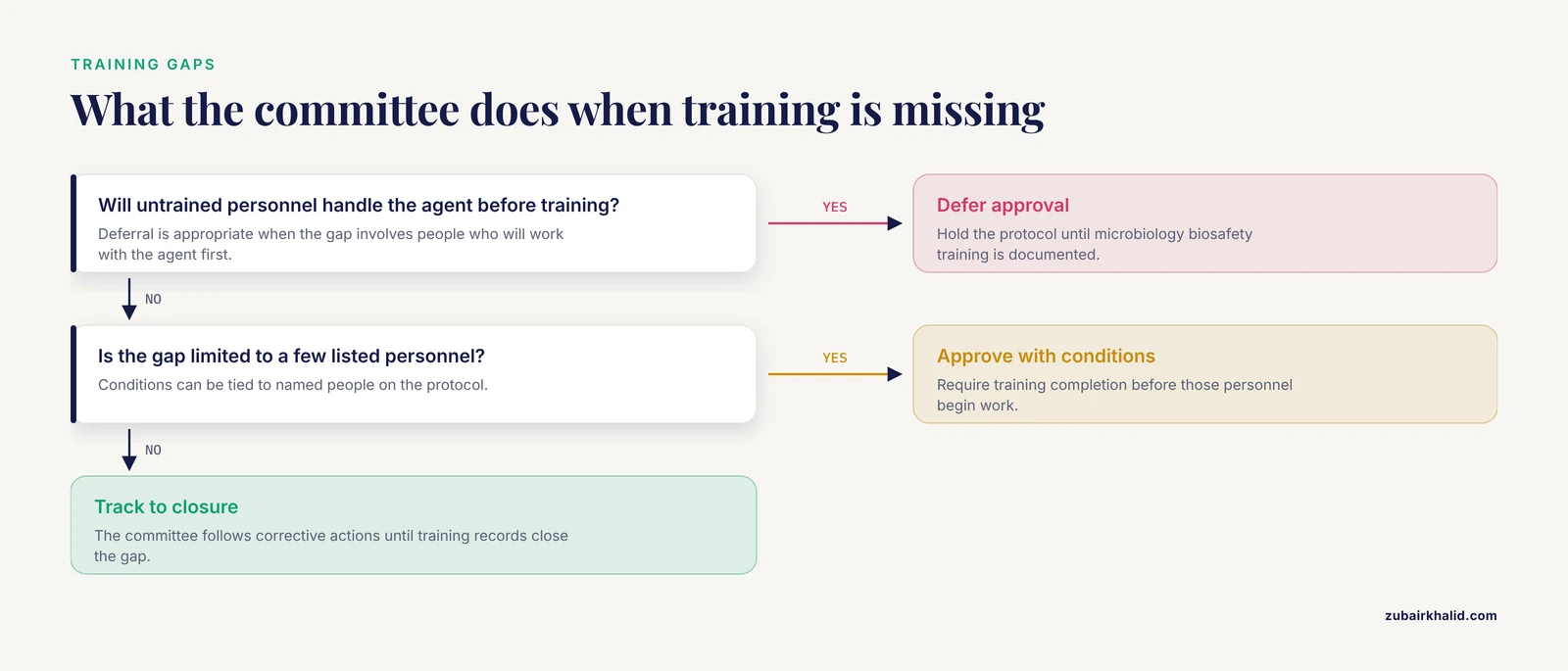
The committee can approve with training conditions, defer approval until required microbiology biosafety training is documented, or require corrective actions through the biosafety office with a closure deadline. Deferral is the appropriate response when the gap involves personnel who will handle the agent before any training occurs.
How often does an IBC re-review an approved protocol?
Approved protocols are typically renewed annually, and any amendment changing the agent, the procedures, the personnel, or the containment triggers review before the change takes effect. Incidents and inspection findings can also prompt ad hoc re-review regardless of the renewal date.
Sources
- An evaluation of the role and effectiveness of institutional biosafety committees in providing oversight and security at biocontainment laboratories.
- The Evolving Landscape of Institutional Biosafety Committees and Biosafety Programs: Results from a National Survey on Organizational Structure, Resources, and Practices.
- A Changing World in Gene Therapy Research: Exciting Opportunities for Medical Advancement and Biosafety Challenges.
- Articulating Biosafety Program Activities in the Context of a Simplified Public Health Logic Model.
- Developing a Comprehensive, Adaptive, and International Biosafety and Biosecurity Program for Advanced Biotechnology: The iGEM Experience.
- Comparison of Brazilian High- and Maximum-Containment Laboratories Biosafety and Biosecurity Regulations to Legal Frameworks in the United States and Other Countries: Gaps and Opportunities.
- Non-compliance with health surveillance is a matter of Biosafety: a survey of latent tuberculosis infection in a highly endemic setting.
- Biosafety Management Practices Among Clinical Laboratory Professionals in Debre Berhan Town Governmental Hospitals, Ethiopia: A Cross-Sectional Study.
- A Means of Codifying Safety Cross-Training Knowledge Expectations for Biosafety Professionals.
- Implementation of a personnel reliability program as a facilitator of biosafety and biosecurity culture in BSL-3 and BSL-4 laboratories.
- Pivoting the Biosafety Program in Response to COVID-19: Recommendations of Key Services and Tasks to Consider for the Next Pandemic.