How to Handle Proficiency Testing Samples Microbiology
By Dr. Zubair Khalid, DVM, MS, PhD ·
Proficiency testing (PT) samples are unknown specimens that an external provider ships to your laboratory to measure whether the entire testing process, from opening the package to submitting the report, produces correct results. In microbiology, a single panel can contain lyophilized bacteria for culture and identification, isolates for antimicrobial susceptibility testing (AST), sera for serology, fixed smears for microscopy, or extracted nucleic acid for molecular assays. Handled correctly, a PT round verifies that your microbiology quality control system works end to end and finds weaknesses before they reach a patient report.
The case for disciplined handling comes from provider data. Across 7 years of food microbiology PT schemes involving 48 laboratories, laboratories failed to detect or enumerate foodborne pathogens in 3.0% of tests, and the causes of those outliers could be identified in 74% of cases. The dominant causes were pre-analytical (sample handling and timing of analysis), analytical (unsuitable methods, sample confusion, colony counting and confirmation errors), and post-analytical (calculation and encoding of results) [1]. Most PT failures are process failures, not failures of microbiologic knowledge.
This guide walks through how to handle proficiency testing samples in a microbiology laboratory, step by step, from the moment the courier arrives to the corrective action you file after the feedback report. A typical bacteriology panel of three isolates takes about 4 to 6 hours of hands-on bench time spread across the provider's testing window. Elapsed time from receipt to submission is commonly 1 to 2 weeks. Quantitative food or water panels add dilution and plating time. Molecular and sequencing panels add extraction and instrument runs. The provider's window, not your workflow, sets the schedule.
What Proficiency Testing Samples Are and How They Are Built
Proficiency testing, also called external quality assessment (EQA) or interlaboratory comparison, is the periodic testing of unknown samples supplied by an independent provider, with your results graded against assigned values and the performance of peer laboratories. Accreditation bodies require it because internal quality control alone cannot detect errors shared by your entire system, such as a wrong incubation temperature, an outdated breakpoint table, or a mislabeled worksheet template.
Providers manufacture PT material in formats that survive shipping and behave like real specimens. Common formats include:
- Lyophilized (freeze-dried) bacteria and viruses, reconstituted before testing.
- Quantitated cell suspensions for colony counts.
- Serum panels for serology. In a German Lyme disease PT program, each survey distributed two serum samples characterized by six reference laboratories, with 226 to 337 laboratories participating per survey, and laboratories reported both antibody results and interpretive statements [2].
- Fixed smear slides for acid-fast bacillus (AFB) microscopy, prepared from pooled sputum of known smear status [3].
- Dried tube specimens (DTS), in which a small volume of serum is dried inside a vial and rehydrated before testing.
- Cryopreserved cells. External PT programs supporting clinical trial laboratories use peripheral blood mononuclear cells collected by leukapheresis and processed and cryopreserved within 8 hours to preserve cell function across sites [4]. Good clinical laboratory practice (GCLP) guidelines call for both assay validation and PT in that setting [4].
- Naturally contaminated food matrices, which behave more like real samples than artificially spiked material [5].
Panel size varies by program. Antimicrobial resistance (AMR) surveillance EQA in Cambodia shipped panels of three isolates three times per year, each requiring identification to the species level, verification of AST results, and answers to a case study question [6].
Grading follows the provider's scheme. For quantitative results, most providers calculate a z-score, which expresses how far your result sits from the assigned value in units of the standard deviation for proficiency assessment. The common convention is an absolute z-score of 2 or less as satisfactory, between 2 and 3 as a warning signal, and greater than 3 as unsatisfactory. Qualitative results are graded as correct, partially correct, or incorrect against the reference characterization.
Before the Panel Arrives: Laboratory Quality Management Preparation
PT performance is decided mostly before the vial arrives. Laboratory quality management puts the following in place for every round.
Designate a PT coordinator. One person owns the calendar, the provider portal, the receipt log, and the file of raw records. The coordinator does not perform all the testing. They make sure the right people do.
Match the panel to your accredited scope. Enroll for the tests your laboratory actually reports. Testing an analyte you never offer wastes effort, and skipping one you do offer creates an accreditation gap.
Use routine methods only. The purpose is to measure the service you provide. Running the panel on a research-grade sequencer when routine work uses a commercial platform, or adding a confirmation step your standard operating procedure (SOP) does not require, produces a result that does not represent your laboratory.
Schedule the normal staff. All qualified technologists should share PT work across rounds. A systematic review of laboratory workforce studies concluded that continuous professional development and competency training of technicians directly support diagnostic accuracy and quality control standards [7]. Rotating PT work through the trained roster is how a laboratory tests that training rather than one person's skill.
Run a pre-arrival readiness check about a week before the expected ship date:
- Media and reagents in date, including AST disks, cards, and panels.
- Internal quality control current for every instrument and assay in the panel.
- Preventive maintenance up to date and calibration checks passed.
- Incubator temperatures and CO2 concentrations logged within limits.
- Provider portal login working and the deadline entered in two calendars.
- Biosafety review completed for the organism types the panel may contain.
Plan the feedback loop in advance. Programs that treat PT as a closed loop of participation, feedback, root cause analysis, and corrective action are the ones that improve. The Cambodian AMR surveillance EQA program reviewed feedback results and corrective actions after every round to identify root causes of nonconformity [6]. Decide now who reviews the feedback report and where corrective actions are recorded.
Review biosafety before opening anything. PT panels have historically contained viable organisms of real consequence, a point covered in the Safety Notes section below.
Materials and Reagents
Everything needed should already be on the bench, because PT is run with routine materials. The table lists typical items and specifications for a bacteriology panel. Substitute your routine equivalents for other test types.
| Item | Typical specification or working concentration | Purpose |
|---|---|---|
| PT panel as supplied | Stored per provider instructions, commonly 2 to 8 °C for lyophilized panels | Challenge material |
| Routine culture media | Blood agar, chocolate agar, MacConkey agar, in date | Recovery and isolation |
| Incubation conditions | 35 ± 2 °C, ambient air or 5% CO2 as your routine requires | Standardized growth |
| Sterile saline or broth | 0.85% NaCl or the provider's specified diluent | Reconstitution and suspension |
| Oxidase reagent | 1% tetramethyl-p-phenylenediamine, prepared fresh | Presumptive identification |
| Catalase reagent | 3% hydrogen peroxide, prepared fresh | Presumptive identification |
| McFarland standard | 0.5, approximately 1.5 × 10^8 CFU/mL | AST inoculum standardization |
| Mueller-Hinton agar | Standard depth of 4 to 6 mm | Disk diffusion AST |
| Antimicrobial disks, cards, or panels | In date, stored per manufacturer | AST |
| MALDI-TOF reagents | Formic acid extraction reagent, alpha-cyano-4-hydroxycinnamic acid matrix | Identification, if routine |
| Personal protective equipment | Fluid-resistant lab coat, gloves, eye protection | Barrier protection |
| Disinfectant | Intermediate-level hospital disinfectant or freshly prepared 10% dilution of household bleach | Bench decontamination |
| Biohazard waste containers | At the bench | Waste segregation |
Safety note: formic acid and oxidase reagent are corrosive or irritating. Handle them with gloves and eye protection in the biosafety cabinet or at a ventilated bench, exactly as you do in routine work.
Step-by-Step: How to Handle Proficiency Testing Samples in Microbiology
- Plan before the shipment arrives. Confirm the panel schedule, the tests covered, the submission deadline, and who will test. Assign routine technologists on the normal roster. Reason: PT measures the laboratory, not an individual. Scheduling your single most experienced technologist, extra repeats, or special reagents produces a result your routine service cannot reproduce, which is exactly what PT exists to detect.
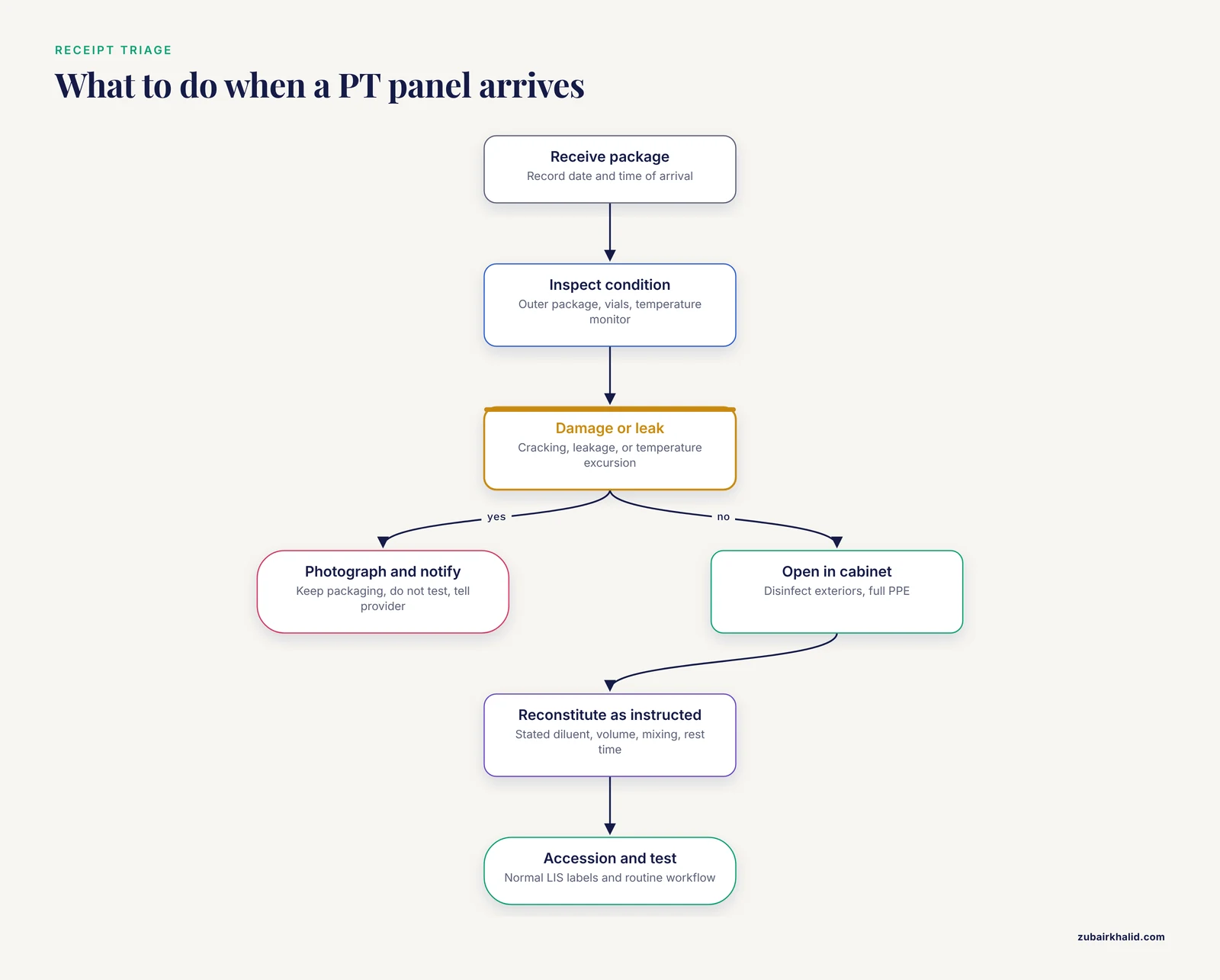
- Receive and document the package. Record the date and time of arrival, the condition of the outer package and inner containers, any temperature monitor reading, and whether any vial shows cracking or leakage. Photograph damage before discarding packaging. Notify the provider immediately if the panel is compromised. Reason: pre-analytical events are a leading documented cause of PT failure, and a documented receipt protects you when a poor result traces back to shipping.
- Open under biosafety conditions. Treat every vial, swab, and smear as potentially infectious. Open containers inside a certified biosafety cabinet with a fluid-resistant lab coat, gloves, and eye protection, and wipe container exteriors with disinfectant before handling. Reason: PT panels can contain viable human pathogens, including attenuated strains that have caused documented laboratory exposures (see Safety Notes).
- Reconstitute or revive exactly as instructed. Use the stated diluent, volume, temperature, mixing method, and rest time. For lyophilized bacteria, that usually means adding the specified volume of sterile broth or saline down the side of the vial, mixing by gentle inversion or a low-speed vortex, and allowing the stated rehydration time before use. Reason: the provider sets expected counts, inocula, and stability around the stated reconstitution. An extra half milliliter of diluent can halve the concentration and turn a satisfactory count into an unsatisfactory one. Excessive vortexing can damage fastidious organisms.
- Accession the samples through your normal laboratory information system (LIS). Use your normal labels and workflow. Reason: a parallel paper system invites the transcription and encoding errors that PT data identify as leading post-analytical causes of failure [1].
- Process as routine, in routine order. Plate to the media you normally use, incubate under your normal conditions, and read at your normal times. Do not create a special fast track. Reason: timing of analysis is a documented pre-analytical error source [1]. If routine specimens wait overnight before plating, the PT sample should experience the same wait, because that is the service you actually provide.
- Identify isolates through your routine identification pathway. Whether that is MALDI-TOF mass spectrometry, a biochemical panel, or sequencing, run it as usual and resolve ambiguous results the way you would for patient care. AMR surveillance EQA requires identification to the species level together with verification of the AST result [6]. Reason: stopping at genus level when your routine reports species, or skipping a confirmatory test your SOP requires, gives away points your service would normally earn.
- Perform AST with your routine method and current interpretive criteria. For disk diffusion, prepare a direct colony suspension matched to a 0.5 McFarland standard, swab the full Mueller-Hinton surface, apply disks within 15 minutes, incubate at 35 ± 2 °C for the period your standard specifies (commonly 16 to 18 hours for nonfastidious organisms), and measure zones to the nearest millimeter with calipers. Read MIC (minimum inhibitory concentration) panels per the manufacturer and the current CLSI M100 breakpoints. Reason: inoculum density, agar depth, disk potency, incubation atmosphere, and outdated breakpoints are the classic sources of AST error, and AST verification is a core element of AMR surveillance EQA [6].
- For quantitative panels, run the full dilution series with care. Prepare serial dilutions with calibrated pipettes, mix each dilution thoroughly before transfer, plate the dilutions your routine uses, and count plates within the valid range for the method (25 to 250 colonies for standard spread plates). Write the dilution factor on each plate as you go. Reason: colony counting and dilution errors are documented analytical causes of failed PT results [1].
- Run confirmation tests exactly as your SOP requires for patient isolates. Reason: confirmation mistakes, reporting the wrong confirmed identity or skipping a required confirmation, appear repeatedly in PT root cause analyses [1].
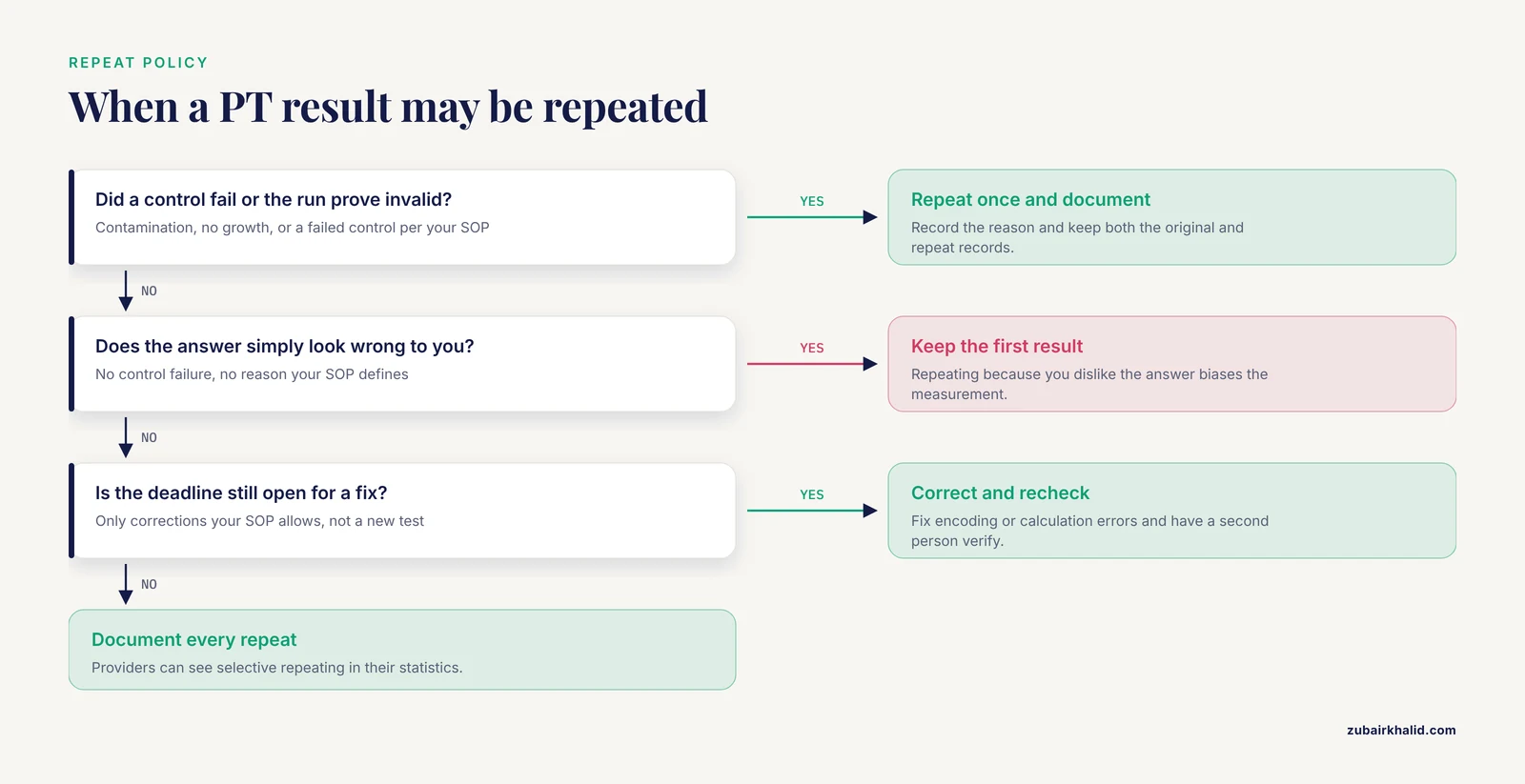
- Apply your normal repeat policy and document it. If a run is invalid by your SOP (contamination, no growth, failed control), repeat it once, record the reason, and keep both records. Do not repeat simply because the answer looks wrong. Reason: selective repeating biases the measurement, and the pattern is visible to the provider.
- Calculate, transcribe, and verify. Do the dilution arithmetic on the worksheet, enter results into the provider portal or result form from the validated source, and have a second qualified person check counts, units, and every transcribed value against the raw record. Reason: calculation and encoding mistakes are documented post-analytical causes of failed PT rounds [1], and they are the cheapest errors to catch.
- Review by the microbiology director or designated supervisor before submission. Confirm the report is internally consistent: the reported organism matches the workup, the AST pattern fits the organism, and the units are correct. Reason: internal inconsistencies are still fixable before the deadline and embarrassing after it.
- Submit before the deadline and archive the raw data. Keep worksheets, instrument printouts, images, and the submitted result set in the PT file. Reason: corrective action after an unsatisfactory result depends on reconstructing exactly what happened, which is the approach AMR surveillance EQA programs take when they review feedback and corrective actions for root causes [6].
- Close the loop after feedback. When the provider report arrives, review every analyte, not only the failures. For each unsatisfactory or questionable result, perform root cause analysis, implement corrective action, verify effectiveness, and record the closure. Reason: PT improves laboratories when participation is followed by feedback and appropriate corrective action, the pattern documented across years of PT results [1].
Practical Tips That Prevent Most PT Errors
- Open the panel on the day it arrives, even if testing starts later, so any damage claim is timely.
- Never let the PT panel jump the routine queue.
- Label every plate, tube, and slide with the PT accession number at the moment of inoculation.
- Do the dilution arithmetic on paper before touching a pipette.
- Photograph key endpoints such as plates, zones, and gels if the provider allows, and file them with the raw record.
- Read the provider's instructions the day the panel ships, not the day of testing.
- Book the feedback review meeting when you book the receipt, so the loop actually closes.
Controls
PT does not replace internal quality control. It sits on top of it. Before you touch a PT sample, your microbiology quality control must be current and acceptable.
Media and reagent QC. Check each new lot or shipment of media with control organisms per your SOP, and test reagents such as oxidase, catalase, coagulase, and latex agglutination with positive and negative controls on the day of use or per your routine schedule.
AST QC. Reference strains with defined zone diameters and MICs anchor susceptibility testing. Standard strains include Escherichia coli ATCC 25922, Staphylococcus aureus ATCC 25923, Pseudomonas aeruginosa ATCC 27853, and, for beta-lactam and beta-lactamase inhibitor combinations, E. coli ATCC 35218. If routine AST QC is out of range, fix it before testing the panel.
Instrument QC. Incubator temperature logs, CO2 levels, autoclave cycle records, and molecular instrument checks must be within limits.
Do not add special controls for the PT round. Extra controls change the process you are trying to measure. If a control fails during the round, handle it exactly as you would for patient care, document it, and repeat the affected test under your SOP.
The two layers ask different questions. Internal QC asks whether the assay worked today. PT asks whether the whole laboratory, including people, timing, calculations, and data entry, produces the right answer. Both belong to the same laboratory quality management system, and neither substitutes for the other.
Expected Results and How to Read Them
A well-run round ends with every qualitative analyte correct and every quantitative result inside the acceptance limits. That outcome is normal. Across 48 laboratories in food microbiology PT, the average failure rate was 3.0% of tests [1], so most laboratories pass most analytes in most rounds, and a single miss in a difficult analyte is a data point rather than a crisis.
Read the feedback report in layers:
- Your result versus the assigned value.
- Your result versus the peer group, especially the group using your method or platform.
- Your trend for that analyte across rounds.
Method matters. In the German Lyme serology PT program, results varied clearly with the manufacturer and the test methodology, IgM assays were harder to handle than IgG assays, and ELISA formats were more reproducible [2]. A borderline result inside a method group with wide scatter calls for method-level review, not for blaming the technologist.
For sequencing panels, read the metrics the provider actually scores. A SARS-CoV-2 whole genome sequencing (WGS) PT program assessed participants on genome coverage, Pango lineage assignment (the standard nomenclature for naming viral lineages), and sequence quality, and it tightened those metrics between the 2021 and 2022 rounds [8]. Check which metric version your round used before judging your own performance.
Troubleshooting
| Symptom | Likely cause | Fix |
|---|---|---|
| No growth or weak growth from a vial | Reconstitution with the wrong diluent or volume, expired media, extreme transit temperatures | Recheck the reconstitution record, repeat once under your SOP with fresh media, report transport damage to the provider |
| Mixed or contaminated culture | Bench or diluent contamination, a cracked vial | Repeat with a fresh aliquot if supplied, review aseptic technique, notify the provider |
| AST zones or MICs outside consensus | Inoculum too heavy or too light, agar too deep or too thin, expired disks, wrong atmosphere | Verify the 0.5 McFarland match and agar depth, repeat with fresh disks, confirm the breakpoint table version |
| Colony count far from the assigned value | Dilution arithmetic error, poor mixing between dilutions, counting outside the valid range | Recalculate from the worksheet, replate remaining dilutions within the window, recount saved plates |
| Results swapped between panel members | Labeling failure at accession or plating | Trace the labels, correct before submission if possible, tighten the labeling step in the SOP |
| Correct result, wrong code or spelling in the portal | Encoding error at entry | Verify every portal entry against the worksheet with a second person |
| Molecular target missed that should be present | Extraction failure, inhibition, or a sample map error | Check extraction and inhibition controls, verify the plate or sample map, repeat per SOP |
| Submission missed | Calendar failure with no backup | Enter the deadline in two calendars and submit 48 hours early |
Variations by Test Type
Molecular and nucleic acid amplification panels
PT in diagnostic molecular microbiology must exercise the whole workflow: extraction, amplification, detection, and interpretation [9]. Process molecular panels with your routine extraction batch, keep pre- and post-amplification areas physically separate, never open amplified product near the pre-amplification area, and record kit lot numbers and instrument run identifiers. Treat an unexpected positive in a negative panel member as a contamination event and investigate before reporting.
Serology panels
Serology panels usually ask for quantitative results and interpretive statements, such as whether the antibody pattern suggests early or late infection [2]. Run your routine screening algorithm and report the interpretation your routine would report for a patient, because interpretive statements are graded alongside titers.
Smear microscopy panels
AFB microscopy panels arrive as fixed smears prepared from pooled specimens of known grade [3]. Read them blinded, once, in the normal reading session, and report the graded scale your routine uses. Re-reading a smear because the first grade looked risky is selective repetition.
Whole genome sequencing panels
WGS is entering routine diagnostic microbiology, and PT is part of the quality control framework for implementing it [10]. Use the library preparation and bioinformatics pipeline versions your service actually runs, record software versions with the submission, and be ready to submit raw data if the provider requests it.
Food, water, and environmental panels
These panels often use naturally contaminated matrices rather than spiked material, which makes sample behavior closer to real-world testing [5]. Run the full dilution series, treat pathogen detection and enumeration as separate exercises when the panel asks for both, and complete confirmations on presumptive colonies before the deadline.
Storage and Stability
Store PT material exactly as the provider instructs, and test within the assigned window. Typical storage is 2 to 8 °C for lyophilized bacterial panels, frozen storage for sera and many molecular panels, and room temperature for dried tube specimens. DTS panels for HIV antibody testing remained stable for 4 weeks at 4 °C and at 25 °C, with only marginal decline at 37 °C and 45 °C [11], which shows why both the storage temperature you choose and the delay you accept matter.
Timing is part of the measurement. Delays between receipt and analysis are documented contributors to unsatisfactory results [1]. Transit itself can degrade material. In a multicenter PT of flow cytometry samples, prolonged transit times affected sample quality for some participating laboratories [12]. Plan to receive the panel at the laboratory dock in person, check temperature monitors immediately, and start testing early in the window rather than at the end.
Never freeze and thaw a PT sample repeatedly, never pool leftovers, and never subculture PT isolates for later use unless the provider explicitly permits retention.
Safety Notes
Treat every PT sample as potentially infectious. Work at biosafety level 2, which means controlled access, a biosafety cabinet for aerosol-generating steps, a fluid-resistant lab coat, gloves, and eye protection, and decontamination of the bench before and after work. Never open a PT vial on an open bench, never sniff culture plates, and discard all waste as infectious waste per your institutional procedure.
The reason for this discipline is documented. In early 2017, a PT panel distributed to clinical and public health microbiology laboratories included Brucella abortus RB51, an attenuated vaccine strain. Although attenuated, the isolate still posed risk to personnel, the event produced exposures that required medical interventions, and the published review urged laboratories to strengthen their culture of safety. Brucella species are recognized causes of laboratory-acquired infection, and a PT label is not a biosafety guarantee.
Chemical hazards in the panel workflow are the routine ones. Oxidase reagent and formic acid are irritating or corrosive, and fixatives used for smear preparation require ventilation and gloves. Apply the same precautions you use in daily work.
Common Mistakes and Limitations
- Special treatment. Rolling out the best instrument, the most senior technologist, and extra repeats for PT measures a laboratory you do not run. Test as you work.
- Ignoring reconstitution instructions. Estimating the diluent volume or skipping the rest time shifts counts and inocula away from the values the provider calculated.
- Testing outside the window. Late testing degrades analytes and can void the result entirely.
- No second-person check. Calculation, transcription, and portal entry errors are among the most common and most preventable PT failures [1].
- Confusing panel members. Unlabeled tubes and plates produce swapped results. Label at the moment of inoculation.
- Selective repeating. Repeating only the results you dislike biases the round, and providers can see the pattern.
- Treating an unsatisfactory result as a fluke. Without root cause analysis and corrective action, the same error recurs in patient care, which is the real risk PT exists to reduce [1], [6].
- Losing the raw record. Without worksheets and printouts, corrective action after feedback is guesswork.
- Changing methods mid-round. Switching platforms because the first result looks odd destroys the measurement.
- Assuming PT material behaves like a clinical specimen. PT matrices are manufactured for stability and may be more forgiving than real samples, so a pass is reassurance rather than proof of perfection.
A PT round is a snapshot. Panels are small, often a handful of isolates or sera, so a perfect round does not prove every analyte on every day, and a single failure does not prove a broken laboratory. PT matrices are built for stability and may not capture the full variability of patient specimens. PT results measure laboratory process quality. They do not guide care for an individual patient, which rests with the treating clinician using the laboratory director's interpretation of routine results. Within a laboratory quality management system, PT works alongside internal QC, competency assessment, and audits as one layer of assurance rather than the whole structure.
Frequently Asked Questions
What are proficiency testing samples in microbiology?
They are unknown specimens sent by an external provider to measure whether your laboratory's complete testing process produces correct results. Panels can contain bacteria for culture and identification, isolates for antimicrobial susceptibility testing, sera, smears, or molecular material.
How often should a microbiology laboratory participate in proficiency testing?
Participation follows the schedule set by your accreditation body, and most programs ship panels several times per year. Enroll for the tests within your accredited scope so every reported analyte is covered by at least one round.
Should only senior technologists handle PT samples?
No. Use the normal rotation of qualified technologists so the result reflects your routine service. Concentrating PT work in your most experienced hands hides the weaknesses the round is designed to find.
Can I repeat a PT test if the result looks wrong?
Only when your standard operating procedure defines the original run as invalid, such as a contaminated plate or a failed control, and you must document the reason. Repeating because you dislike the answer biases the measurement and is detectable in provider statistics.
What should I do if a PT sample arrives damaged or leaking?
Document the condition with photographs, keep the packaging, do not test the panel, and notify the provider immediately. Most providers issue a replacement or exclude the affected sample from grading when damage is reported on receipt.
How are PT results graded?
Quantitative results are usually graded with a z-score, where an absolute value of 2 or less is satisfactory, 2 to 3 is a warning, and greater than 3 is unsatisfactory. Qualitative results are graded as correct, partially correct, or incorrect against the assigned value.
Can laboratories discuss PT samples or results with each other before submission?
No. Comparing answers before submission defeats the purpose of the round and may violate provider rules. After the feedback report is released, sharing experiences and corrective actions with peers is encouraged.
Are PT samples dangerous to handle?
Treat every PT sample as potentially infectious and process it under biosafety level 2 practices with a biosafety cabinet and full personal protective equipment. Panels have contained viable pathogens, including attenuated strains that still caused laboratory exposures and required medical follow-up.
Sources
- Analytical performances of food microbiology laboratories - critical analysis of 7 years of proficiency testing results.
- Quality of Lyme disease serology. Lessons from the German Proficiency Testing Program 1999-2001. A preliminary report.
- Assessment of panel slides prepared by phenol ammonium sulphate and NALC methods for proficiency testing.
- Leukopak PBMC sample processing for preparing quality control material to support proficiency testing programs.
- Food microbiology proficiency testing unsing naturally contaminated matrices.
- Proficiency Testing Performances Analysis of Microbiology Laboratories Participating in Cambodia Antimicrobial Resistance (AMR) Surveillance System
- Investigating the Pivotal Roles of Laboratory Technicians and Specialists in Enhancing Diagnostic Accuracy, Microbiology Testing, and Patient Care in Healthcare Facilities: A Systematic Review
- Continued improvement in the development of the SARS-CoV-2 whole genome sequencing proficiency testing program.
- External Quality Assessment and Proficiency Testing in Diagnostic Molecular Microbiology
- Practical issues in implementing whole-genome-sequencing in routine diagnostic microbiology.
- Dried tube specimens: a simple and cost-effective method for preparation of HIV proficiency testing panels and quality control materials for use in resource-limited settings.
- Multicenter flow cytometry proficiency testing of canine blood and lymph node samples.