Eye Protection in the Microbiology Lab
By Dr. Zubair Khalid, DVM, MS, PhD ·
The difference between the three main types of eye protection in the microbiology lab is the direction from which they block fluid: safety glasses stop impacts coming straight at the front of the eye, splash goggles seal against the face to stop liquids running around the edges, and face shields extend that splash defense to the rest of the face. The rule of thumb for choosing is simple: pick the eyewear that protects against the worst procedure you will run that day, not the most common one. If your bench day is routine subculture and staining, impact-rated safety glasses may suffice. If the day includes vortexing, pour plates, blender homogenization, or any manipulation that can put a droplet in the air, sealed splash goggles are the floor, and a face shield goes on top when volumes are large.
This article walks through the options, the criteria that actually decide between them, worked bench scenarios, decontamination practice, and the training habits that keep eye protection in use rather than hanging on a hook.
Why Eye Protection in the Microbiology Lab Is Non-Negotiable
The eye is a mucocutaneous surface, meaning a moist membrane that pathogens can cross directly, the same category of entry point as the mouth and the nasal lining. In a microbiology laboratory, the front of the eye sits within reach of three distinct exposure routes:
- Splashes and droplets. Decanting broths, snapping off pipette tips, flicking inoculation loops, spilling a supernatant during centrifugation breakdown, or squeezing a serological pipette filler can all launch a droplet stream. A conjunctival splash with a patient isolate is a reportable exposure event in most institutional exposure plans precisely because mucosal absorption bypasses the skin barrier entirely.
- Aerosols and airborne particulate. Procedures that energize liquid, such as vortexing, sonication, grinding, flaming a contaminated loop, or opening a blender jar, generate aerosols, which are particles small enough to remain suspended and to travel around loosely fitted eyewear.
- Chemical and physical hazards. Stains, fixatives, acids used in decolorization, and cleaning agents can injure the cornea independent of any infectious risk. In settings where formalin-fixed material is handled, ocular symptoms dominate the exposure profile. A survey of 349 students working with formalin-treated cadavers found that the most commonly reported symptoms were eye-related, specifically tearing, itching, and redness, ahead of nasal and respiratory complaints [1].
The case for routine eye protection is not hypothetical. A web-based survey of 282 healthcare professionals involved in COVID-19 response in Tamil Nadu, India, which included 24 laboratory technicians among the respondents, found that 62.76% experienced at least one adverse health event attributable to the personal protective equipment they wore, a finding that underscores how much time staff spend in gear and how poorly tolerated badly chosen gear becomes [2]. Protection that is uncomfortable gets pushed up onto the forehead, and eyewear on the forehead protects nothing. That trade between protection and tolerability runs through every section below.
Start With a Biosafety Risk Assessment, Not With a Catalog
A biosafety risk assessment is the structured process of asking, before work begins, what agent you are handling, what route of infection concerns you, what quantity you will manipulate, and which procedures can release it. In a biosafety risk assessment, eye protection selection falls out of two questions: can this procedure generate droplets or aerosols, and can a splash reach my face from the volumes and angles I am working with?
Biosafety levels (BSL) frame this decision. BSL-1 covers work with well-characterized agents not known to consistently cause disease in healthy adults, such as many environmental organisms used in teaching. BSL-2 covers the majority of clinical microbiology work, including agents of moderate potential hazard such as Staphylococcus aureus, Salmonella species, and bloodborne pathogens. At BSL-2, eye or face protection is expected whenever there is a reasonable chance of splash, and that includes most manipulations outside a biosafety cabinet. BSL-3 adds respiratory protection and more stringent engineering controls, and eye protection requirements scale accordingly.
The risk assessment should also grade procedure, not just agent. Broth culture in a capped tube and a sealed centrifuge rotor carrying the same organism present very different splash geometries. Written procedure-level assessments, reviewed whenever a new assay or instrument enters the lab, prevent the common failure mode in which eyewear rules exist on paper but default to "glasses for everything" at the bench.
The evidence base for some high-consequence PPE decisions is thinner than most laboratorians assume. A rapid review conducted for the Public Health Agency of Canada after the 2022 Sudan virus outbreak in Uganda searched four databases, identified 29 eligible studies, and included 20 in narrative synthesis, concluding that the comparative effectiveness evidence for personal protective equipment choices against viral hemorrhagic fevers was limited [3]. For everyday microbiology, the practical reading of that review is that no single device configuration is proven superior for every high-consequence setting, so labs should follow risk-assessment-driven, layered protection rather than assume one product solves every scenario.
Eye Protection Microbiology Lab Options at a Glance
The table below is the core of this guide. Each option is then explained on its own terms, followed by the head-to-head criteria that decide real purchases and real daily habits.
| Option | What it is | Typical microbiology use | Splash protection | Aerosol/edge protection | Key trade-off |
|---|---|---|---|---|---|
| Standard safety glasses | Impact-rated plano (nonprescription) or prescription eyewear with side shields | Routine open-bench work with minimal splash potential, media prep, microscopy, stain prep | Front and side impact, limited top and bottom gaps sealed | Weak, gaps at top, bottom, and ventilation points | Comfortable and cheap but not a splash seal |
| Indirect-vent splash goggles | Goggles with hooded vents that block direct liquid paths while allowing some airflow | Daily BSL-2 bench work, staining, subculture, plate reading, vortexing | Good seal against droplets and running liquids | Good, better than glasses but not airtight | Fogging under exertion or with masks |
| Non-vented goggles | Fully sealed goggles with no openings | High splash or aerosol risk tasks, suspected high-consequence agents, extended aerosol-generating work | Best seal available in goggles | Best seal in goggles | Maximum fogging and thermal load, shortest comfortable wear time |
| Face shield (worn over glasses or goggles) | Transparent curved visor, often full-face-length, worn with a headband or cap mount | Pouring, large-volume transfers, homogenization, necropsy or gross pathology, splash-prone instrument work | Excellent for the whole face, deflects volume splashes | Moderate, droplets can wrap or enter from below | Protects eyes only in combination, never a substitute for sealed eyewear underneath |
| Prescription safety eyewear | Impact-rated lenses ground to the wearer's prescription, often with side shields | Staff who cannot tolerate over-the-glasses goggles for long periods | Same class as plano safety glasses | Same limitation as plano glasses | Cost and lead time, still not splash-sealed |
| Goggles sized to fit over prescription glasses | Larger-framed indirect-vent goggles with extended facial seal | The practical solution for most glasses wearers | Good seal if the frame accommodates the spectacles without gap | Good | Bulky, more fogging, fit varies by spectacle frame |
Safety Glasses
Safety glasses are the baseline device in most laboratories. Impact-rated lenses, usually plano but available ground to prescription, resist shattering and include side shields that block particles approaching laterally. For microbiology work, their legitimate niche is tasks where the risk assessment shows minimal splash and aerosol potential: reading plates, operating a microscope, preparing reagents, handling sealed specimens, and general lab traffic.
Their pros are real. They are inexpensive, tolerated for full shifts, compatible with most hairstyles and corrective lenses, and easy to disinfect between users. Their cons define their limits. Gaps at the top, bottom, and around side shields give a liquid a direct path to the conjunctiva. A droplet does not need to strike the lens, it needs only to find an edge. Anyone who has decanted a buffer and felt the trickle travel under a chin has experienced the failure mode.
A useful discipline is to treat safety glasses as default wear that establishes a floor, and to escalate by task. The escalation trigger is any procedure that can put liquid or particulate in motion: opening centrifuge rotors after a possible tube failure, snap-cap manipulation, homogenization, splash-prone staining, or anything performed outside a biosafety cabinet with an open culture.
Splash Goggles
Splash goggles, almost always indirect-vent in laboratory settings, are the workhorse answer to the question of eye protection in the microbiology lab. Indirect vents are openings covered by a hooded channel that lets air move and heat escape while forcing any liquid to travel a bent path that it cannot follow. This single design feature is why indirect-vent goggles, unlike ordinary safety glasses, actually resist a splash reaching the eye from an angle.
The pros: a facial seal, reasonable comfort for multi-hour wear, compatibility with most eyeglass prescriptions when sized correctly, and reusable construction that tolerates routine disinfection. The cons: fogging, which is the leading reason bench staff loosen or lift goggles mid-procedure, and pressure dermatitis along the seal line with long wear.
On that second point, dermatological findings from prolonged PPE use deserve attention. In a survey of healthcare workers at a tertiary care hospital in Pakistan, conducted through the Department of Pathology (Microbiology) at Army Medical College, the most common personal protective equipment-related skin finding was acneiform eruption at 41%, followed by ulcerating lesions at 21% and erythema with vesicular lesions at 9.6% [4]. Goggles and face masks contribute to this picture by trapping humidity and friction against occluded facial skin. Rotation between goggle frames, scheduled breaks outside the laboratory, and attention to early skin changes are practical countermeasures, not luxuries.
Non-Vented Goggles
Non-vented goggles seal completely against the face with no airflow path. In a biosafety context they earn their place when the risk assessment identifies aerosol-generating procedures with high-consequence agents, or when disinfectant and fixative vapors would otherwise ride an indirect-vent channel toward the eye.
The pros are unambiguous: they provide the strongest ocular barrier available in a goggle format. The cons are equally unambiguous: fogging and heat. Completely sealed goggles trap exhaled and radiant heat, and tolerance drops quickly. Workers asked to perform simulated professional activity while wearing fully protective equipment against pathogenic biological agents showed measurable physiological stress, with skin and body temperature, heart rate, blood pressure, and oxygen saturation all shifting during simulated microbiology laboratory work in a study conducted at the Izmerov Research Institute of Occupational Health [5]. Fully sealed eye protection contributes to that load at its most sensitive interface. Reserve non-vented goggles for the tasks that justify them, cap the continuous wear time, and pair them with scheduled recovery periods.
Face Shields
A face shield is a curved transparent visor covering the face from roughly forehead to chin. Its function in the microbiology lab is to convert a localized ocular hazard into a whole-face hazard managed with one device: it blocks volume splashes, deflects droplet streams, and shields skin that goggles leave exposed.
The pros: coverage of eyes, nose, and mouth simultaneously, excellent tolerance of large-volume procedures, easy donning and doffing, and good communication because the whole face remains visible. The cons: face shields do not seal. Air and droplets can enter from the bottom edge, the sides, or the crown, and a droplet that reflects off the visor's inner surface can still reach the conjunctiva. This is why every competent biosafety program treats a face shield as an addition to safety glasses or goggles, never a replacement for them.
Face shields belong on the task list for pouring molten agar, operating a stomacher or blender, handling large open volumes of culture, working at a necropsy or gross pathology station, and any procedure where the risk assessment rates a splash as reasonably foreseeable rather than merely possible.
Prescription Eyewear and Over-the-Glasses Options
Two solutions serve staff who wear corrective lenses. Prescription safety eyewear, ground to the individual's refraction in impact-rated lenses, solves comfort but does not solve splash, because it inherits every gap of standard safety glasses. Goggles sized to fit over prescription glasses solve splash while keeping the personal prescription, at the cost of bulk and additional fogging. Labs that ignore this compatibility problem get predictable behavior, glasses wearers who quietly skip goggles. Fit-testing goggle frames against common spectacle shapes during procurement, and stocking at least two frame sizes, removes that excuse.
Comparing the Options: Pros and Cons on the Criteria That Decide Real Choices
Catalog comparisons list features. Working labs choose on five criteria.
Splash geometry. Only sealed or hooded-vent designs stop lateral and inferior splash paths. Ranking from strongest to weakest on splash: non-vented goggles, indirect-vent goggles, face shield over goggles, face shield alone, safety glasses with side shields, unprotected prescription glasses.
Fogging and airflow. Fogging rises as sealing improves. Indirect vents are the compromise point that most BSL-2 bench work can live with. Anti-fog coatings, correctly seated frames, and freeing the nose bridge reduce the problem more reliably than repeatedly lifting the device, which is itself an exposure behavior.
Thermal and physiological load. All occlusive PPE adds heat stress, and the microbiology-specific evidence confirms it. In the Izmerov Institute study of 12 healthy medical workers simulating laboratory work in PPE against pathogenic biological agents, a number of thermal state indicators exceeded values permitted by current regulatory documents, driven largely by low air and vapor permeability of the equipment [5]. This connects to a broader finding in critical care PPE evaluation, where reviewers noted that certification schemes focused on barrier properties while remaining silent on air permeability and moisture vapor transmission, leaving the human-comfort factor undefined and unacceptable to end users [6]. Choose the least occlusive device the risk assessment allows, because comfortable protection gets worn and uncomfortable protection gets lifted.
Compatibility with other PPE. Goggle seals interact badly with respirator nose bridges and mask straps. Sequencing matters: eyewear seats against the face before or after respiratory protection depending on the design, and awkward sequences breed shortcuts. A study of surgeons performing laparoscopic tasks while wearing none, one, or two pairs of gloves found that task times lengthened and cutting errors increased with added layers, from 14.4 to 20.4 mm² of error area with double gloving, demonstrating how layered PPE measurably degrades fine motor performance [7]. The analogous lesson for eye protection is that every added device must justify itself in the risk assessment, because each one costs dexterity, time, and tolerance.
Donning, doffing, and decontamination practicality. Reusable indirect-vent goggles and face shields that survive repeated disinfection cycles beat single-use devices on availability, which drives compliance. A cross-sectional study of 225 healthcare workers at a tertiary government hospital in South Gujarat during COVID-19 management found generally good knowledge, attitude, and practice around PPE, but statistically significant gaps specifically in donning procedure knowledge (p = 0.0075) and in respirator-related knowledge (p = 0.01) [8]. Eye protection sits squarely inside that donning problem, because it is the device most often handled with contaminated gloves during doffing.
Choosing by Task: Worked Scenarios
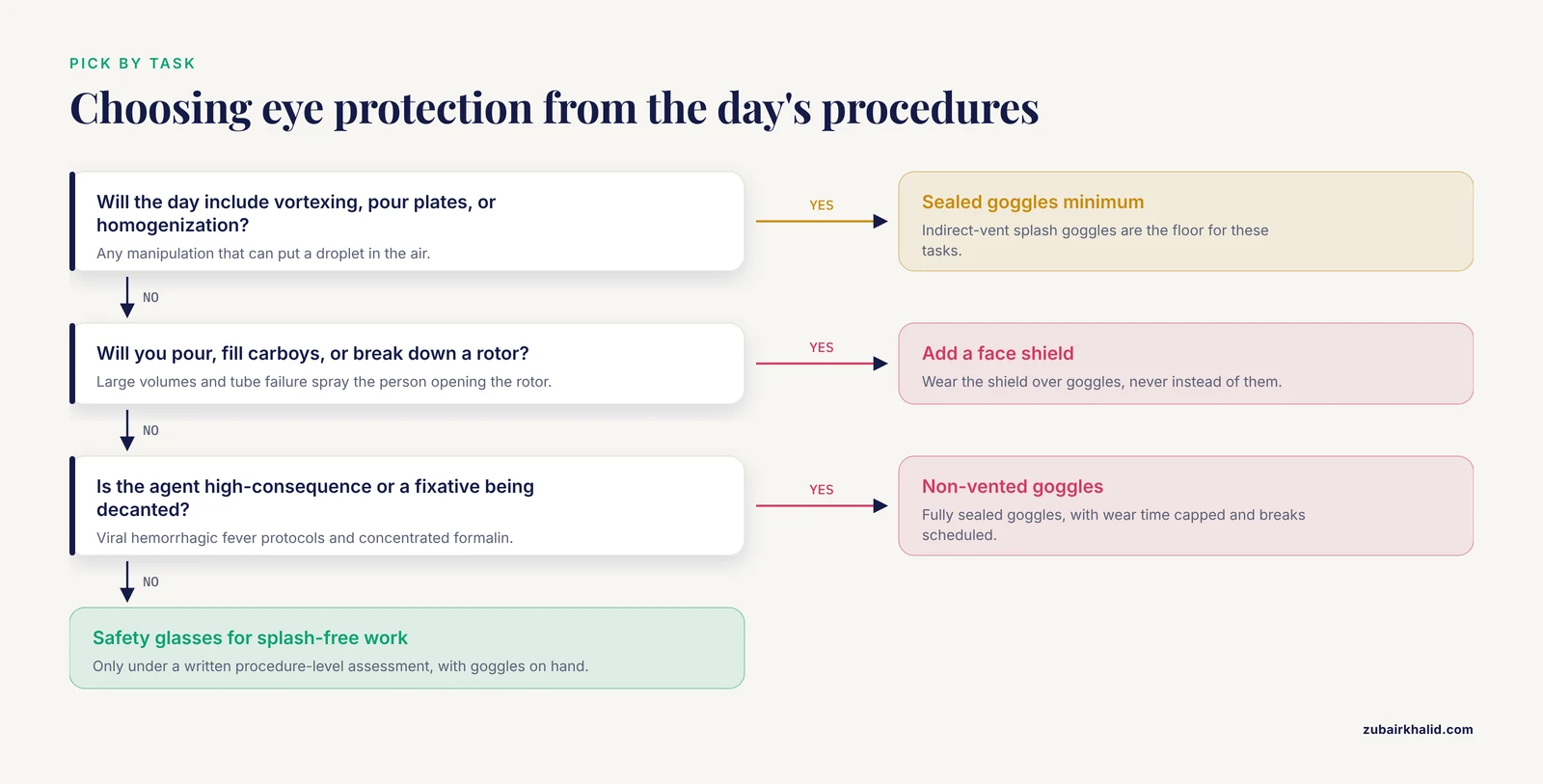
Scenario 1, routine BSL-2 bench work. Subculturing isolates, reading plates, setting up identification panels, performing Gram stains with careful technique. Risk assessment: closed containers, small volumes, low aerosol potential. Selection: indirect-vent splash goggles as the standing choice for anyone working with cultures, or impact-rated safety glasses for clearly splash-free subtasks under a written, procedure-level assessment. A face shield stays on the hook for the day something goes wrong and a tube breaks.
Scenario 2, vortexing and centrifuge interaction. Resuspending pellets, vortex- mixing specimens, opening rotors after an unexpected noise. Risk assessment: aerosol and droplet generation is plausible, tube failure is a recognized event. Selection: indirect-vent goggles minimum, face shield when breaking down a rotor, because a failed tube sprays the person opening it, not the centrifuge.
Scenario 3, media and large-volume transfers. Pouring plates from molten agar, filling carboys, dumping biohazard waste into processing. Risk assessment: hot liquid and volume splashes to face and neck. Selection: face shield over indirect-vent goggles, with the thermal burn hazard handled by the same shield. Eye protection alone is not enough here, the point is facial coverage.
Scenario 4, high-consequence agent or viral hemorrhagic fever protocol. Risk assessment: agent severity makes any mucosal exposure unacceptable. Selection: non-vented goggles or a sealed goggle-face shield combination integrated into the full ensemble, with doffing sequence rehearsed. The Canadian rapid review found the comparative evidence base limited, which supports conservative layered choices and rigorous training rather than device brand loyalty [3].
Scenario 5, formalin and fixative exposure. Grossing stations, tissue fixation, anywhere formaldehyde vapor or liquid can contact the eye. The cadaver-lab survey showing eye symptoms as the leading complaints under formalin exposure translates directly to any lab using formalin [1]. Selection: indirect-vent goggles plus adequate room ventilation, with chemical splash goggles replacing vented styles if concentrated fixative is decanted.
Scenario 6, spore and aerosol-generating research work. Homogenized tissue, sonication, grinding, aerosolized inoculation. Selection: non-vented goggles within a biosafety cabinet or containment envelope, face shield for open-bench steps, and a written procedure identifying exactly which steps trigger the escalation.
Decontamination, Reuse, and Disposal
Eye protection in a microbiology lab is shared, splashed, and handled with gloves that just touched cultures, so its decontamination schedule is a biosafety control, not housekeeping trivia. Standard practice: dedicated reusable goggles and shields are disinfected with an approved hospital-grade disinfectant wipe or immersion per the manufacturer's instructions between users and after any visible contamination, rinsed if the product label requires it, and air dried before reuse. Heavily contaminated or cracked devices are discarded.
Research on PPE decontamination methods gives useful context for what is achievable. In a Brazilian evaluation of a spray decontamination chamber using sodium hypochlorite as the biocidal agent, seven test microorganisms were inoculated onto seven PPE types, including safety glasses and face shields, and in 96.93% of the experimental conditions the reduction exceeded 99%, with results obtainable at exposure times as short as 10 seconds [9]. The lowest performance in that study came from Enterococcus faecalis on glove surfaces, a reminder that organism and material both matter.
Ultraviolet germicidal irradiation (UVGI), the use of short-wavelength ultraviolet light to inactivate microorganisms, has been examined for reuse extension. In a Philippine study built on Department of Medical Microbiology data from the University of the Philippines Manila, N95 respirators and coverall suits inoculated with Bacillus subtilis were treated at 30- and 40-minute UVGI exposures to compare reductions in colony-forming units [10]. UVGI cabinets are line-of-sight devices, so shielded surfaces under goggle hinges and headbands remain a known limitation.
Several emerging approaches are worth knowing by name even if they have not reached the typical microbiology lab. A portable system using high-voltage pulsed electric fields (PEF) was developed for respirator decontamination during the COVID-19 pandemic, and testing confirmed that treatment did not compromise N95 filtration efficiency by bacterial filtration efficiency and differential pressure testing, while achieving significant but incomplete reduction of SARS-CoV-2 inoculated onto respirator fabric [11]. Photocatalytic coatings, in which micrometer-sized titanium dioxide applied to a mask surface is activated by light to generate antimicrobial reactive species, produced over 90% reduction of both E. coli and S. aureus within 15 minutes of irradiation from UV, sunlight, or artificial sources [12]. Thermal sanitization of non-woven PPE at 95 degrees Celsius for one hour destroyed bovine coronavirus without compromising the equipment's main properties in a re-engineered oven study [13]. None of these replaces a disinfectant wipe at the bench today, but they define where PPE reprocessing is heading, and labs building reuse programs for high-cost sealed eyewear should watch this space.
One boundary deserves a plain statement. Decontamination extends reusable eye protection for routine contamination, it does not rehabilitate eye protection after a known exposure to a high-consequence agent. Post-exposure devices in those settings follow the institutional protocol, which typically means careful removal and disposal.
Fogging, Heat, and Comfort as Safety Variables
Fogging is not a comfort issue, it is a safety issue, because the standard response to a fogged lens is to pull the device away from the face with contaminated gloves. Countermeasures in order of effectiveness: select indirect-vent goggles sized to the wearer's face, apply anti-fog treatment compatible with the lens material, ensure respirator exhalation is not directed upward into the goggle seal, take scheduled breaks in a designated area rather than in-the-moment lifts, and rotate between two goggle frames so one dries and cools.
The heat load point bears repeating with the microbiology-specific evidence attached. The Izmerov Institute experiment specifically modeled professional activity under sanitary and epidemiological requirements for a microbiology laboratory, and found thermal state indicators among its 12 subjects that breached permitted regulatory values, tying the physiological strain directly to low air and vapor permeability of the protective equipment [5]. Where workload is heavy, tools that predict physiological strain exist, and a validated enhancement of the Heat Strain Decision Aid achieved a mean absolute error of 0.151 degrees Celsius in predicting core temperature during simulated work in chemical, biological, radiological, and nuclear PPE [14]. Most diagnostic microbiology labs will never need predictive modeling, but every lab should treat a worker who is visibly overheated in sealed goggles as a procedure-interruption event, not as a personal toughness problem.
Skin reactions at the goggle seal line fall in the same category of tolerated-but-reportable harm. The tertiary care hospital survey cited above came specifically from a pathology and microbiology department, and its top findings, acneiform eruptions at 41% and ulcerating lesions at 21%, are consistent with prolonged occlusion and friction of the kind goggle seals produce [4]. Report early skin changes the way you would report a needlestick, because progressive dermatitis at a PPE interface erodes compliance before anyone admits it.
Microbiology Biosafety Training and Compliance
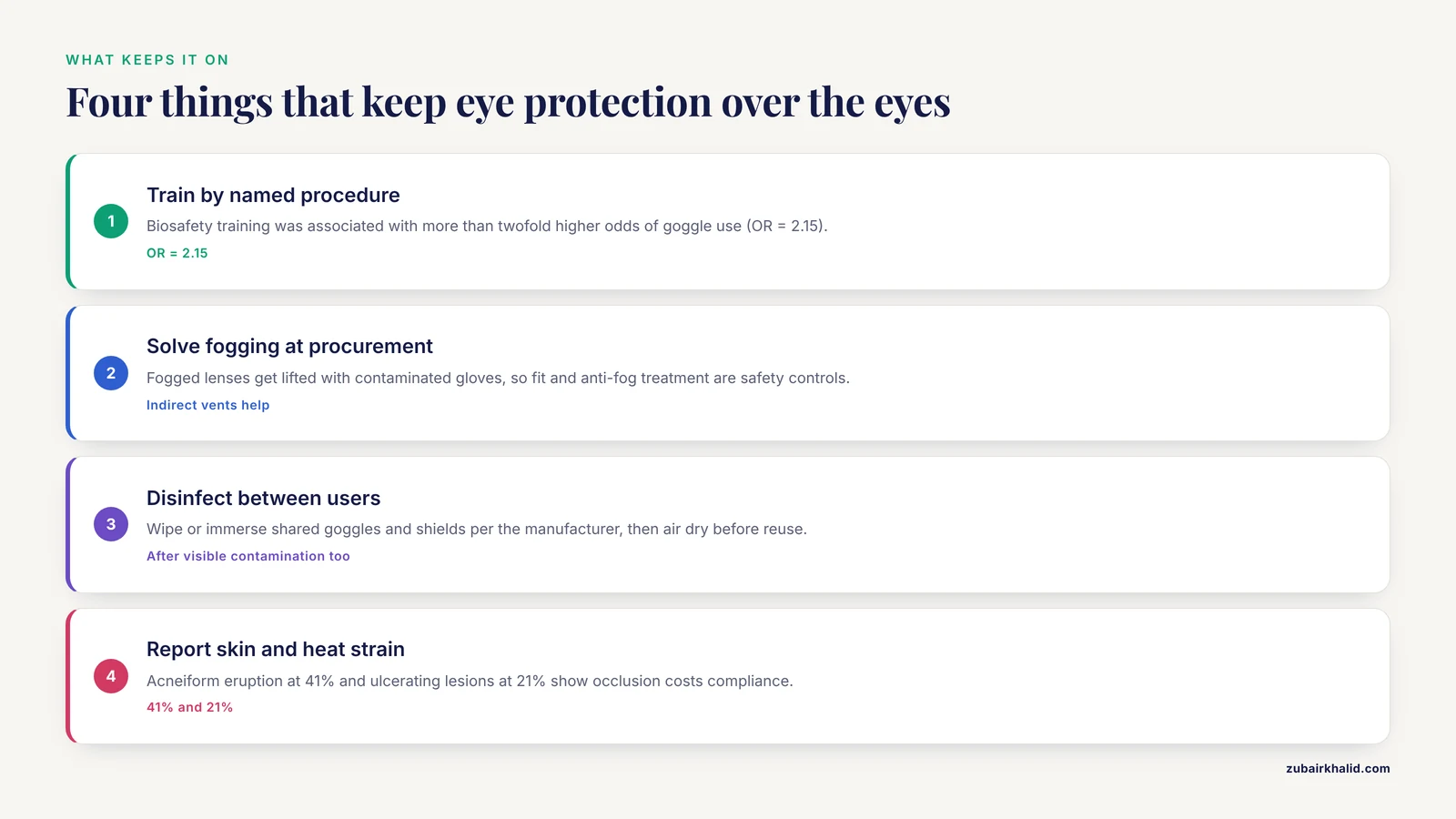
Eye protection only protects when it is on, over the eyes, at the right moment, and removed correctly. This is where microbiology biosafety training earns its budget. The observational evidence is direct: among Brazilian physical therapists surveyed during the COVID-19 pandemic, biosafety training was independently associated with a more than twofold increase in the odds of using safety goggles (OR = 2.15, 95% CI = 1.21 to 3.84) [15]. Workers with recent training reached for the goggle, workers without it reached for whatever was closest. The association between training and specific PPE items, including isolation gowns and medical aprons, held across the same analysis.
Effective training for eye protection is short, task-anchored, and hands-on:
- Tie every eyewear rule to a named procedure, not to a biosafety level alone, so the trigger is visible at the bench.
- Demonstrate donning and doffing with gloves, including the moment of doffing where the goggle strap crosses a contaminated glove.
- Practice the post-exposure sequence, including locating and using the eyewash station before an emergency makes it unfamiliar.
- Re-run the training when assays, instruments, or agents change, and audit quietly by observation rather than by form-filling.
Common Mistakes and Limitations
Wearing safety glasses on the forehead. The most common failure in every lab. If eyewear comes up, the task stops or the task changes, and a supervisor asks why.
Treating a face shield as sealed eye protection. Shields deflect volume splashes but do not seal, and droplets enter from below and the sides. A shield goes over glasses or goggles, in that order of reasoning every time.
Substituting contact lenses or ordinary prescription glasses. Neither provides impact protection or a splash seal. Prescription wearers need either safety prescription eyewear or correctly sized over-the-glasses goggles.
Ignoring fogging until it causes a violation. Fogging drives mid-task eyewear lifting, which converts a protected worker into an unprotected one during the most hazardous moments. Solve fogging at procurement and fit, not by scolding.
Handling eyewear with contaminated gloves during doffing. The strap and frame are contaminated surfaces by the end of any bench session. The doffing sequence, glove removal first or eyewear removal first depending on the written protocol, exists because that contact transmits agents to the face.
Skipping eye protection behind the biosafety cabinet. A biosafety cabinet protects the product and reduces exposure to the worker, it does not eliminate every splash vector, and work continues outside the cabinet. The cabinet's sash and airflow are engineering controls layered with, not substituted for, personal protection.
Reusing eye protection after known high-consequence exposure. Disinfection is for routine recontamination, not remediation of a defined exposure event.
Underestimating skin and comfort costs. The dermatoses data [4] and the thermal strain data [5] both came from workers doing exactly what microbiology staff do, wearing PPE for long shifts. Comfort is a compliance input, and compliance is a safety output.
On limitations generally. The comparative effectiveness literature on PPE, even for the highest-consequence agents, is limited in scope and quality [3], and survey-based studies measure reported behavior rather than measured exposure. Individual decisions about fit, skin reactions, and prescription needs need occupational health input, and this guide sets bench-level defaults rather than replacing your institution's written exposure control plan.
Frequently Asked Questions
Can prescription glasses substitute for safety glasses in the microbiology lab?
No. Ordinary prescription lenses are not impact rated and have no side shields or splash seal. Wear impact-rated prescription safety eyewear or indirect-vent goggles sized to fit over your spectacles.
Is a face shield enough eye protection by itself?
No. Face shields deflect large splashes but allow droplets to enter from the sides, the bottom, and reflective paths off the visor's inner surface. Wear a shield over safety glasses or goggles, never instead of them.
Which eye protection is best for a BSL-2 teaching or diagnostic lab?
Indirect-vent splash goggles are the default answer for anyone handling cultures or specimens, because they stop the lateral and inferior splash paths that safety glasses leave open, while remaining wearable for a full shift. Escalate to a face shield for pouring, homogenization, and rotor breakdown.
How often should lab eye protection be cleaned or replaced?
Disinfect shared reusable goggles and face shields between users and after any visible contamination, following the manufacturer's disinfectant instructions. Discard devices that are cracked, crazed, fogged permanently, or contaminated by a known high-consequence exposure.
Do I need eye protection when working in a biosafety cabinet?
The cabinet reduces exposure but does not cover every task in the room, and bench work continues outside it. Your lab's biosafety risk assessment should name which cabinet procedures still require goggles, and most programs keep goggles on for all culture manipulation regardless of location.
What should I do immediately after a splash to the eye?
Go to the emergency eyewash station and flush, generally for a full 15 minutes, holding the eyelids open so water reaches the conjunctival sac. Remove contact lenses if present during flushing, then report the exposure and get medical evaluation the same day.
Sources
- Formalin exposure associated symptoms and adherence to personal protective equipment correlation in anatomy laboratory
- Prevalence of Adverse Events in Healthcare Professionals Using Personal Protective Equipment to Treat COVID-19: A Web-based Survey
- Is there sufficient evidence to inform personal protective equipment choices for healthcare workers caring for patients with viral hemorrhagic fevers?
- Personal protective equipment related dermatoses among health care workers of a tertiary care hospital
- Thermal and functional condition of microbiological laboratory workers when using personal protective equipment against biological factors
- Breathability and Safety Testing of Personal Protective Equipment: “Human-comfort” Factor Remains Undefined
- Force application of laparoscopic surgeons under the impact of heavy personal protective equipment during COVID-19 pandemic
- Practices and Barriers for Personal Protective Equipment among Health Care Workers during COVID-19 Pandemic Management at Tertiary Care Government Hospital of South Gujarat, India
- Potential application of novel technology developed for instant decontamination of personal protective equipment before the doffing step
- Comparing the bactericidal effect of ultraviolet germicidal irradiation between two time exposures against Bacillus subtilis on personal protective equipment
- Rapid Point-of-Care Sterilization of Personal Protective Equipment for Frontline Healthcare Workers*
- Photocatalytic Treatments for Personal Protective Equipment: Experimental Microbiological Investigations and Perspectives for the Enhancement of Antimicrobial Activity by Micrometric TiO2
- “Re-engineering of a food oven for thermal sanitization of Personal Protective Equipment against Sars-CoV-2 virus”
- Validation and enhancement of two predictive models evaluating physiological strain during physical work while wearing personal protective equipment
- Personal protective equipment use and hand hygiene among physical therapists during the COVID-19 pandemic: an observational study