How to Document the Preparation and Use of In-House QC Materials
By Dr. Zubair Khalid, DVM, MS, PhD ·
By the end of this article you will be able to build a complete documentation system for in-house quality control (QC) materials in a clinical or research microbiology laboratory. You will have a reusable SOP template, a lot record format, a worked acceptance-criteria calculation, a lot genealogy scheme, and a review cadence that ties QC results back into laboratory quality management. Everything here is designed to be copied into a word processor or a free text editor and adapted to your own bench.
To follow along you need a few things on hand. A text editor or word processor for the templates. A spreadsheet application such as Excel, LibreOffice Calc, or Google Sheets for control charts and acceptance calculations. A dedicated QC binder or a shared network folder with version control. A current list of the reference strains your laboratory uses, with their storage locations. And a calendar entry for the recurring QC review, which in most laboratories is monthly.
What Counts as an In-House QC Material in Microbiology
An in-house QC material is any control material prepared by the laboratory itself rather than purchased with a manufacturer's certificate of analysis. This distinction matters because purchased QC products arrive with documented performance claims, while in-house materials carry only the performance the laboratory has demonstrated and recorded itself.
Common in-house QC materials in a microbiology laboratory include the following.
- Plated and tubed media prepared from dehydrated base media, such as blood agar, MacConkey agar, chocolate agar, and thioglycollate broth.
- Pooled or single-strain bacterial suspensions adjusted to a defined turbidity for inoculum preparation and for daily instrument checks.
- Heat-killed or chemically inactivated organism suspensions used as positive controls in agglutination tests and molecular assays.
- Stained control slides, such as a Gram stain slide with known gram-positive and gram-negative organisms fixed on the same slide.
- Extracted nucleic acid controls prepared from characterized cultures and stored in aliquots at minus 70 degrees Celsius.
- Pooled patient or animal specimens that are negative or positive for a target analyte, where permitted by policy and consent.
Three terms recur throughout this article, so define them now. A lot is a batch of material prepared at one time, under one set of conditions, and accepted or rejected as a unit. Acceptance criteria are the measurable pass or fail requirements a lot must meet before release for use. Lot genealogy is the documented chain linking a working material back to its parent stock, so that a QC failure can be traced to a specific tier of the chain.
The Four Records That Make a Complete QC File
A laboratory quality management system for in-house QC materials rests on four linked records. Missing any one of them is the most common audit finding in this area.
- The preparation SOP. A standing procedure that describes how the material is made, independent of any particular batch. It changes only through formal revision.
- The lot record. A batch sheet filled in at the bench, in real time, every time a lot is prepared. It captures who made it, what went into it, and what happened at each step.
- The acceptance record. The test results that show the lot met its criteria, plus the release or rejection decision and the signature of the person authorized to make it.
- The usage and stability log. Ongoing evidence that the material continues to perform as expected through its assigned expiry date, with dates opened, dates used, and any deviations.
These four records are connected by the lot ID. Every incubator readout, zone measurement, and stain check for that lot carries the same identifier, so an auditor or a troubleshooter can assemble the full history of a single batch in minutes.
A Documentation Template Format You Can Copy Today
The template format below works in plain text, in a word processor, or in an electronic document system. The value of a fixed format is that every lot record in the laboratory looks the same, which makes review fast and omissions obvious. A study of guideline documents in a hospital setting described written procedures as mediating devices that translate between management intent and daily practice, and found that the ongoing writing and rewriting of those documents was central to how the organization handled disruption [1]. A QC template behaves the same way. Its fixed structure carries the laboratory's expectations to the bench, and its revision history carries bench experience back into the document.
Save the following block as your master SOP template. Fill in the bracketed fields for each material type.
# QC MATERIAL PREPARATION SOP

Material name: [for example, 5 percent sheep blood agar, 100 mm plate]
Material ID: [QC-BA]
Version: [v3.0]        Effective date: [2026-03-01]
Author: [name, title]  Approved by: [laboratory director name and date]

1. INTENDED USE
   [Which assays and organisms this material controls, and where it
   sits in the testing workflow]

2. STARTING MATERIAL AND TRACEABILITY
   [Base medium, manufacturer, catalog number if applicable]
   [Additive, for example defibrinated sheep blood, source, lot]
   [Reference strains used, and the stock lot IDs they come from]

3. FORMULA PER BATCH
   [Volumes, masses, and final concentrations, for example
   38 g agar base per liter, 50 mL sheep blood per liter]

4. EQUIPMENT AND CALIBRATION STATUS
   [Autoclave ID and last validation date]
   [Pipette IDs and last calibration dates]
   [pH meter ID and last calibration date]

5. PREPARATION STEPS
   [Numbered steps with times, temperatures, and volumes.
   Include hold times and maximum time from start to plating]

6. STERILIZATION OR INACTIVATION STEP
   [Method, cycle parameters, cycle record file name]

7. DISPENSING, LABELING, AND STORAGE
   [Units per batch, label content, storage temperature, position]

8. ACCEPTANCE CRITERIA
   [Sterility check, exact conditions and passing result]
   [Performance check, organisms, expected observations or ranges]
   [Physical checks, for example pH, hemolysis pattern, moisture]

9. RELEASE AND REJECTION
   [Who may release the lot, signature line, rejection routing]

10. STABILITY AND EXPIRY
    [Assigned expiry and the evidence that supports it]
    [Conditions that shorten expiry, for example opened sleeve]

11. REVISION HISTORY
    [Version, date, change, reason, approver]
The lot record is a one-page batch sheet derived from the SOP. Here is a filled example for a blood agar lot, which doubles as a documentation in-house qc materials microbiology templates example you can adapt directly.
LOT RECORD, QC MATERIAL

Lot ID: QC-BA-2026-014
Material: 5 percent sheep blood agar, 100 mm plate
SOP reference: QC-BA_SOP_v3.0, effective 2026-03-01
Preparation date: 2026-03-09        Start time: 08:20
Prepared by: J. Rivera, MT(ASCP)

Batch size: 120 plates
Agar base: 38 g, lot AB-4471, expiry 2027-06-30
Distilled water: 950 mL
Autoclave cycle: 121 C, 15 min, cycle record AC-2026-0311
Cooling: water bath 50 C, 25 min
Sheep blood: 50 mL, lot SB-882, expiry 2026-05-15, received 2026-02-28
Final pH: 7.3 (spec 7.2 to 7.4), meter pH-02, calibrated 2026-03-02
Time from blood addition to pouring: 12 min (limit 30 min)
Plates poured: 118 (target 120, 2 lost to bubbles, noted)

STERILITY CHECK
5 plates sampled, incubated 35 C, 48 h, read 2026-03-11
Result: zero colonies on all 5 plates. PASS

PERFORMANCE CHECK
S. aureus ATCC 25923, stock lot QC-REF-SA001-W2
Growth at 24 h: confluent, smooth, beta hemolysis visible. PASS
S. pneumoniae ATCC 49619, optochin disk applied
Zone 21.5 mm on 24 h read. Within lot history. PASS

PHYSICAL CHECKS
Color and surface: uniform, no cracks, no condensation pooling. PASS

RELEASE DECISION: RELEASED
Released by: M. Chen, Microbiology Supervisor, 2026-03-11
Expiry assigned: 2026-05-08 (8 weeks per SOP v3.0)
Step-by-Step Walkthrough, From Blank Template to Released Lot
This walkthrough takes one material, blood agar, from an empty template to a released lot with ongoing monitoring. The same sequence applies to any in-house QC material. The folder names and file conventions below are a working convention, not a software requirement.
Step 1. Create a controlled document folder. Set up one folder per material, with the SOP, the lot records, and the monitoring workbook together. Keep the folder on a network drive with daily backup, or in a binder if your laboratory is paper based. Expected result:
$ ls QC_Documents/QC-BA
QC-BA_SOP_v3.md
QC-BA_SOP_v3.pdf
QC-BA_lot-2026-013.pdf
QC-BA_lot-2026-014.pdf
QC-BA_monitoring.xlsx
Step 2. Write the SOP against the template. Fill every numbered field. Where you cannot fill a field, for example the stability statement, write "not established, first stability study scheduled" rather than leaving it blank. A blank field hides from review. A written gap does not.
Step 3. Assign a lot numbering scheme. Use the pattern QC-[material code]-[year]-[serial]. For blood agar in 2026, the fourteenth lot is QC-BA-2026-014. The code is short enough to write on a plate label and unique enough to trace. If you prepare sublots, for example plates poured on two days from one autoclave batch, append a suffix such as QC-BA-2026-014A.
Step 4. Record the preparation at the bench, as it happens. Fill the lot record during preparation, not at the end of the day. Capture actual values, not target values. If the water bath held at 49 degrees Celsius instead of 50, write 49. If two plates were lost to bubble artifacts, write the number and the reason. The lot record is a factual diary of one batch, and retroactive reconstruction is where transcription errors enter the system.
Step 5. Perform the acceptance tests defined in the SOP. For plated media the standard package is a sterility check and a growth performance check. The sterility check incubates a sample of uninoculated plates alongside the routine incubator and requires zero colonies. The performance check inoculates defined reference strains and requires the expected growth and reaction pattern. For blood agar, the classic pair is a robust grower that must show characteristic hemolysis and a fastidious organism that must grow on the enriched surface.
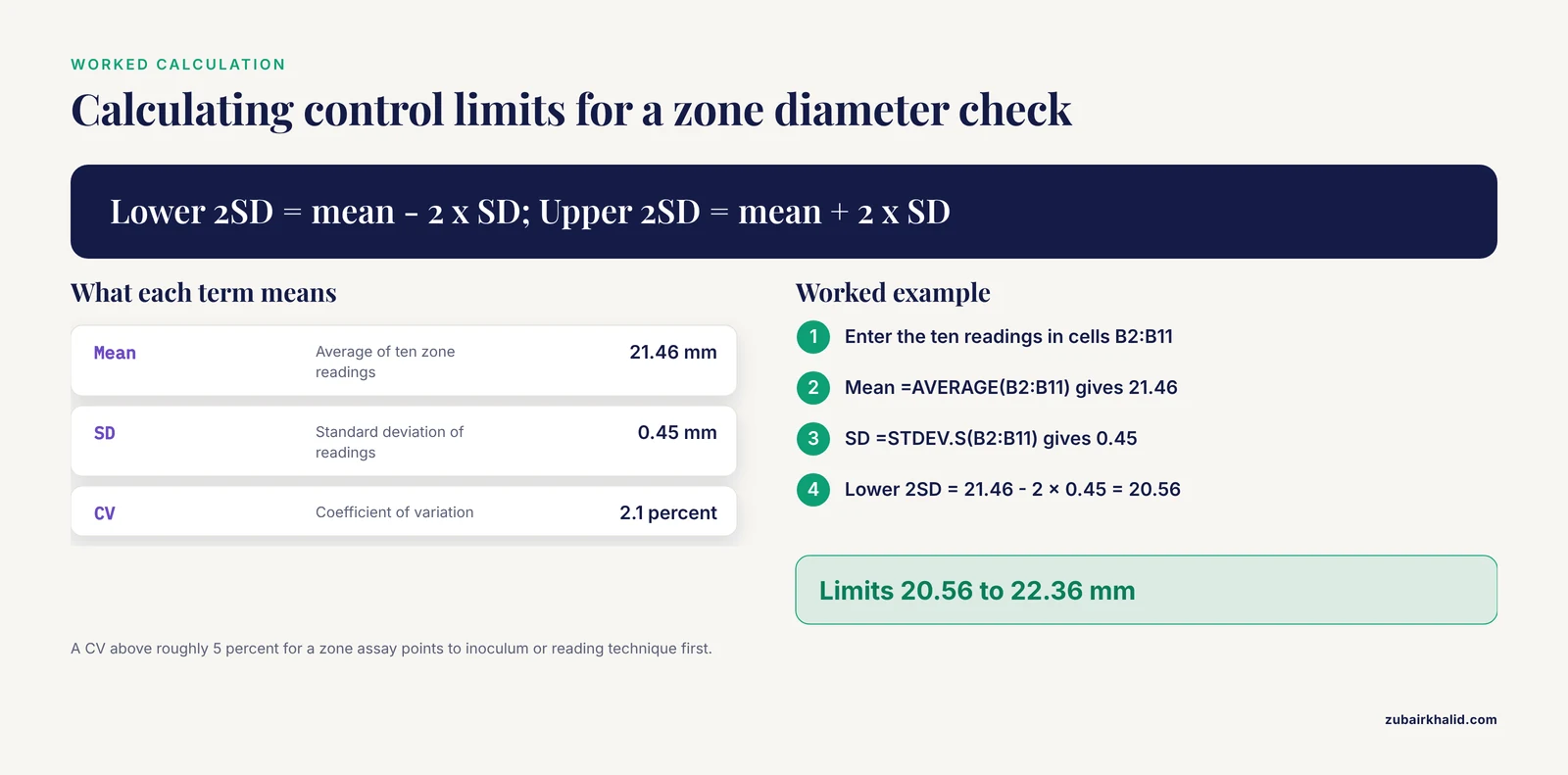
Step 6. Quantify the performance check where the assay produces numbers. For materials used in disk diffusion or similar quantitative work, log the measured values into the monitoring workbook and compare them against the established lot history. The following worked calculation uses the standard control-chart limits, the mean plus and minus two standard deviations.
Zone diameters for S. pneumoniae ATCC 49619 on the new lot,
10 replicate readings (mm), entered in cells B2:B11:

21.5  20.8  22.0  21.1  21.9  20.9  21.6  21.3  22.1  21.4

Spreadsheet formulas and expected output:

Mean        =AVERAGE(B2:B11)                    -> 21.46
SD          =STDEV.S(B2:B11)                    -> 0.45
Lower 2SD   =AVERAGE(B2:B11)-2*STDEV.S(B2:B11)  -> 20.56
Upper 2SD   =AVERAGE(B2:B11)+2*STDEV.S(B2:B11)  -> 22.36
CV          =STDEV.S(B2:B11)/AVERAGE(B2:B11)    -> 0.021 (2.1 percent)
A mean of 21.46 mm with a coefficient of variation of 2.1 percent is a typical, well-behaved result for a zone measurement on solid media. If your first lots produce a CV above roughly 5 percent for a zone assay, look for inconsistency in inoculum turbidity or in reading technique before you suspect the medium. These limits come from your own data, not from any external table, which is exactly why the monitoring workbook must start on day one.
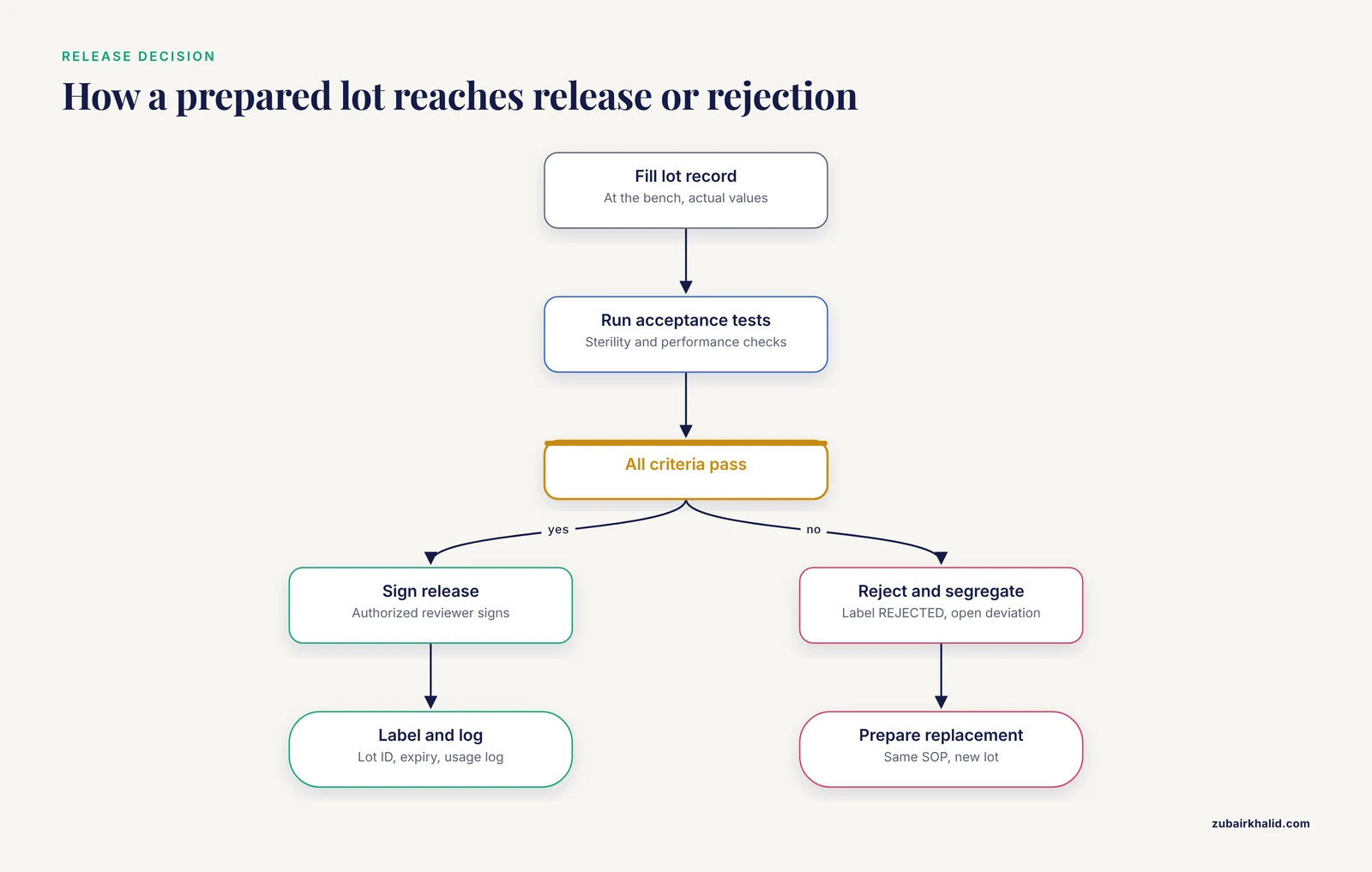
Step 7. Make and sign the release decision. The releasing reviewer signs the acceptance record only when every criterion has a recorded PASS. If any criterion fails, the lot is rejected, labeled REJECTED, physically segregated, and the failure is investigated on a deviation form before a replacement batch is prepared. Never release a lot "provisionally" while tests are pending. Provisional release is the single most damaging shortcut in microbiology quality control, because patient results generated on an unreleased lot are difficult to defend after the fact.
Step 8. Label every unit with the lot ID and expiry. Labels carry at minimum the material ID, the lot ID, the preparation date, and the expiry date. For example: QC-BA-2026-014, prep 2026-03-09, exp 2026-05-08. In-use units opened from a sleeve get a second date, the date opened, written beside the printed expiry.
Step 9. Log usage and monitor stability. Each time a control is run with clinical testing, the lot ID goes into the run record. Periodic performance checks across the life of the lot feed the monitoring workbook. For a plated medium with an eight-week expiry, a practical schedule is a performance check at release, at the midpoint, and in the final week, plus every routine patient run that uses the lot as its control surface.
Step 10. Close the loop with a monthly review. Once a month, review all lot records opened that month, all control-chart points, all deviations, and all expiring lots. Document the review with a dated signature. This cadence mirrors published quality improvement work in clinical settings, where monthly structured review with direct feedback to the people doing the work measurably improved adherence to facility guidelines [2]. The feedback loop matters more than the paperwork. When a bench technologist sees their own acceptance results summarized and discussed each month, the records stop being an audit chore and become part of how the bench manages itself.
Acceptance Criteria by Material Type
The exact checks differ by material. The table below summarizes the minimum documentation package for the most common in-house materials. Adapt the organisms and conditions to your laboratory's own validated expectations.
| In-house QC material | Sterility or purity check | Performance check | Stability evidence | Trigger for retest |
|---|---|---|---|---|
| Nonselective plated media | Sample plates, incubate, zero colonies | Reference strains show expected growth and reactions | Periodic growth checks to expiry | New blood or base lot, autoclave repair |
| Selective or differential media | Sample plates, incubate, zero colonies | Positive and negative strains, growth plus inhibition or color reaction | Periodic checks to expiry | New base or supplement lot |
| Turbidity standards | Visual clarity, no contamination culture | Optical density or cell count matches target | Check against reference standard monthly | Storage disruption, visible change |
| Inactivated antigen suspensions | Purity plate from aliquot, no viable growth | Positive reaction with known antiserum, negative with unrelated | Periodic reactivity check | Freeze-thaw event, new antiserum lot |
| Nucleic acid controls | Absence of viable organism documented post-inactivation | Amplification of target, no amplification of nontarget | Thaw-and-test of one aliquot per quarter | New extraction reagent lot, instrument service |
| Stained control slides | Not applicable | Gram reaction and morphology correct on each use batch | Visualize at each staining run start | New stain lot, new lot of fixative |
Traceability and Lot Genealogy for Reference Strains
Most in-house QC materials ultimately descend from a reference strain, and the passage chain is where traceability quietly fails. Keep a genealogy record that links every tier. A working pattern uses three tiers, a frozen stock at minus 70 degrees Celsius, a working stock derived from the frozen stock, and an in-use culture derived from the working stock. Passage limits prevent the cumulative drift that eventually shows up as an unexpected QC result.
tier,material_id,parent_lot,date_prepared,passages_from_stock,storage,expiry
stock,QC-REF-SA001,none,2025-06-12,0,-70 C,2028-06-11
working,QC-REF-SA001-W,QC-REF-SA001,2026-01-20,1,2-8 C,2026-04-20
in_use,QC-REF-SA001-W2,QC-REF-SA001-W,2026-02-03,2,2-8 C,2026-03-03
The rules this table enforces are simple and standard. Stock cultures are opened rarely and only to make a new working stock. Working stocks have a defined passage limit. In-use cultures are dated and discarded at expiry, not subcultured forward indefinitely. When a QC material starts behaving oddly, the genealogy table tells you within minutes whether the problem sits at the stock tier, the working tier, or the material itself.
When a preparation step involves killing or inactivating the organism, document that step as rigorously as the growth steps. A published hygiene evaluation of a hospital device-processing workflow illustrates the standard here, recording each processing stage from initial disinfection through a fractionated vacuum steam cycle, so that the final safety conclusion could be traced step by step to documented process parameters [3]. An in-house inactivated control deserves the same treatment. Record the inactivation method, the time and temperature or chemical concentration, the validation evidence that the method kills the organism under your conditions, and the post-inactivation purity plate that proves no viable organisms remain.
Version Control and the Living Document
A QC template that never changes is usually a template nobody uses. Workarounds at the bench, a shortened hold time, a substituted reagent, a skipped physical check, are signals that the document and the practice have separated. Research on infection prevention during the COVID-19 pandemic found that teams continuously rewrote their guidelines in response to emerging constraints, and that this rewriting was a core practice of a resilient organization rather than a sign of failure [1]. Treat your QC SOPs the same way. When a workaround appears, either fix the practice or fix the document, then record the change in the revision history with the reason.
Practical version control needs only three habits. Give every version a number and an effective date. Retire, rather than delete, superseded versions, moving them to an archive folder. And print or export the version actually used for each lot, so that a lot record prepared under v2.0 of the SOP is not later audited against v3.0 with different acceptance criteria.
Training New Staff With a QC Material Library
New technologists learn QC documentation fastest from worked examples, and those examples accumulate naturally if you keep them. A teaching approach in medical immunology built a curated material library of landmark cases and used it for case-based instruction, with measurable improvement in students' critical thinking dispositions [4]. The microbiology equivalent is a training folder holding two or three fully worked lot records per material type, one clean pass, one rejected lot with its deviation form, and one deviation that turned out to be a documentation error rather than a product failure. New staff read the real records, attempt a supervised preparation, and are assessed against the SOP before they sign lot records independently. The assessment itself becomes part of the competency documentation file.
Using QC Records for Laboratory Improvement
QC records earn their cost only when someone reads them. Two reading techniques convert a pile of lot records into laboratory quality management intelligence.
The first is structured monthly review with feedback. Summarize each month the number of lots prepared, released, rejected, and the deviations raised, and post the summary where the bench can see it. Published quality improvement work in an emergency department used exactly this pattern, monthly structured chart review with report cards shared among the clinicians involved, and demonstrated improved guideline adherence without adding new resources [2]. A microbiology bench responds to the same mechanism. A one-page monthly QC summary, with rejections and near-misses named plainly, changes bench behavior faster than any policy memo.
The second is periodic analysis of free-text notes. Lot records accumulate short free-text comments, "slight bubbling," "slow hemolysis development," "condensation in sleeve." Every few months, run a simple word-frequency count over those comments to find recurring terms. A published analysis of thousands of free-text injury descriptions used word frequency and co-occurrence analysis to extract the dominant mechanisms behind the events [5]. The same method on QC comments will typically surface a small number of repeated causes, a particular incubator position, a specific reagent lot, one pouring technique, that were individually too small to trigger a deviation but together explain most of your drift.
Verification and Independent Review of In-House QC
An in-house QC system should not verify only itself. Build in a periodic independent check that compares your in-house material against an outside reference. A report on in-house fabricated patient-specific aortic models described exactly this structure, routine in-house quality control for each model, including deformation checks, combined with periodic evaluation by an external materials laboratory using independent measurement technology [6]. The microbiology parallel is straightforward. Each quarter, or on a schedule your accreditation body sets, challenge an in-house material alongside a purchased control or a strain obtained from an external culture collection, and document the agreement. If the in-house material and the external reference disagree, the investigation starts that day, not at the next annual audit.
Common Mistakes and Limitations
- Recording target values instead of actual values. Writing "50 C" because the SOP says 50 C, when the bath read 49, destroys the record's diagnostic value. Actual values are the point.
- Retrospective completion of lot records. A lot record reconstructed at the end of the day mixes memory with measurement. Fill it in as you work.
- Acceptance criteria with no numbers. "Growth should be good" is not a criterion. "Confluent growth of the reference strain within 24 hours at 35 degrees Celsius" is.
- No assigned expiry before release. Expiry must be set before the lot enters service, based on documented stability evidence or on a defined default the laboratory has justified. Assigning expiry retroactively, after seeing how the lot performed, is circular.
- Releasing before all acceptance tests are complete. Provisional release converts every downstream patient result into a contingent result.
- Genealogy gaps after a QC failure. If the in-use culture has no documented link to the frozen stock, a failing control cannot be attributed to the organism, the passage history, or the material.
- Templates that outrun the bench. A 14-page lot record will be filled in shorthand or not at all. Keep the batch sheet to one or two pages and reserve the depth for the SOP.
- Review that never produces action. A monthly review that ends with no deviation, no revision, and no documented conclusion teaches the bench that review is theater. Even a clean month gets a dated, signed "reviewed, no action" entry.
- Individual case limits. This article describes a documentation framework, and specific decisions about any particular material, organism, or assay in your laboratory require judgment by qualified laboratory staff and your accreditation body's actual requirements.
Frequently Asked Questions
What is an in-house QC material in microbiology?
It is any quality control material the laboratory prepares itself rather than purchasing with a manufacturer's certificate of analysis, including prepared media, turbidity standards, inactivated antigen suspensions, stained control slides, and extracted nucleic acid controls. Because no manufacturer vouches for it, the laboratory's own documented acceptance testing carries the full weight of proof.
What fields must a QC preparation lot record contain?
At minimum, the lot ID, material name and SOP version, preparation date and preparer, lot numbers of every component, actual process values such as times and temperatures, the acceptance test results, and the release or rejection decision with a signature. The worked blood agar lot record in this article is a complete example.
How do I assign lot numbers to in-house QC materials?
Use a fixed pattern such as QC-[material code]-[year]-[serial], for example QC-BA-2026-014 for the fourteenth blood agar lot of 2026. Append a letter suffix for sublots prepared under different conditions. The scheme needs to be short enough for a plate label and unique enough for full traceability.
How long must QC documentation be retained?
Retention periods are set by your accreditation body and institutional policy, and they generally exceed the expiry of the material itself so that any patient result generated with that lot can still be traced. Confirm the required period with your own accreditor and record it in your document control procedure rather than relying on habit.
Can reference strains from culture collections serve as QC organisms?
Yes, well-characterized reference strains from established culture collections are the standard basis for performance checks of in-house media and reagents. Document the strain identity, the source, and the lot genealogy from frozen stock to in-use culture, exactly as described in the traceability section above.
What happens when an in-house QC lot fails acceptance?
Reject and segregate the lot, label it REJECTED, open a deviation record, investigate the cause, and prepare a replacement lot under the same SOP. Patient testing does not proceed on a rejected lot, and any results already generated with it are reviewed for impact before reporting.
What is the difference between verification and validation for QC materials?
Validation establishes, before first use, that the preparation method produces a material fit for its intended purpose. Verification is the ongoing, lot-by-lot confirmation that each new batch performs within the criteria established during validation. A new material needs both, and every subsequent lot needs verification only.
Where can I find free documentation templates for in-house QC materials?
The SOP template, lot record, genealogy table, and acceptance-criteria table in this article are free to copy and adapt in any text editor or spreadsheet application, and they deliberately avoid dependence on specific software. Build your first template set from these structures, then revise them through your own document control process as bench experience accumulates.
Sources
- Mediating scarcity in pandemic times: an ethnographic study on the prevention and control of SARS-CoV-2 infections during the emergence of the corona crisis in the Netherlands.
- Peer Comparison Improves Guideline Adherence for Urinary Tract Infection in a Military Emergency Department: A Quality Improvement Project.
- Hygienic evaluation of the Resourcify GmbH concept for recovering raw materials from recyclable medical devices after surgery.
- Using Nobel Prize case-based learning in Medical Immunology to cultivate critical thinking dispositions for medical undergraduates.
- Quantitative text analysis of the mechanisms of tooth injury: Analysis of accidents in five sports that occurred in 15 years under school control.
- Accuracy and Sterilizability of In-House Printed Patient-Specific Aortic Model for Surgeon-Modified Stent Grafts-A Workflow Description for Emergency Aortic Endovascular Procedures.