Document Control in the Microbiology Lab: SOP Management
By Dr. Zubair Khalid, DVM, MS, PhD ·

Document control in the microbiology lab is the system that guarantees every bench procedure is written down, reviewed, approved, version-numbered, distributed, trained on, periodically rechecked, and retired in a traceable way. Done well, it converts a folder of dusty Word files into a functioning nervous system for the laboratory. Every Gram stain, every blood culture workup, every antimicrobial susceptibility panel, and every molecular assay ultimately traces back to a controlled standard operating procedure (SOP), and inspectors, assessors, and external quality assessment programs judge the laboratory on whether the SOP on the bench matches the SOP in the master list.
This guide covers document control and SOP management step by step, from drafting a new procedure through archiving its final revision. It is written for the working microbiology supervisor or quality officer who needs a system that survives real bench conditions, not a theoretical model.
Time investment to expect:
- Drafting a new SOP: 4 to 8 hours of hands-on writing and technical verification, depending on complexity. A simple stain procedure sits at the low end, a validated molecular assay workflow sits at the high end.
- Review and approval cycle: 1 to 3 weeks elapsed time in a typical lab, driven by reviewer availability rather than workload.
- Periodic review of an existing SOP: 1 to 2 hours per document.
- Building a complete document control system from scratch: 3 to 6 months of elapsed time for a mid-sized clinical microbiology laboratory, with the master list and top-priority SOPs functional within the first month.
The Principle of Document Control in the Microbiology Lab
A microbiology result is only trustworthy if the process that produced it was defined before the sample arrived. Document control rests on four principles.
Single source of truth. For any procedure, exactly one approved version exists and is in use. Every other copy is either a controlled duplicate or obsolete. If two versions of a blood culture protocol can be found on the bench, the lab has no procedure, only two opinions.
Defined authority. Each document has a named author, a named reviewer with technical competence, and a named approver with the authority to bind the laboratory. Nobody can quietly edit a procedure, and nobody can quietly invent one.
Traceability. Every change from one version to the next is recorded, dated, justified, and attributable to a person. Six months after an incident, the lab can reconstruct exactly which version of which SOP was in force on the date in question.
Alignment of practice and paper. The version on the bench is the version that was used. Training records tie each analyst to each version they were trained on. If practice and paper drift apart, either the document is revised or the practice is corrected, and the system makes you choose.
These principles are the foundation of laboratory quality management. Without them, microbiology quality control activities such as media sterility checks, stain control slides, and proficiency testing become isolated data points with no procedural framework underneath them.
Which Documents Need Control
Document control applies to far more than bench SOPs. A complete controlled document inventory for a clinical microbiology lab includes:
- Procedures: stain protocols (Gram, acid-fast, calcofluor), culture methods by specimen type, organism identification workflows, antimicrobial susceptibility testing methods, molecular extraction and amplification procedures, serology workflows, and blood culture handling.
- Policies: specimen acceptance and rejection criteria, critical result escalation, test referral and send-out, biosafety and exposure response, competency assessment, and data retention.
- Forms and worksheets: bench worksheets, media lot records, instrument maintenance logs, temperature logs, control result logs, and corrective action forms.
- External documents under control: package inserts, instrument operator manuals, Clinical and Laboratory Standards Institute breakpoints if used, reagent kit inserts, and published reference methods. These need a verification step so the lab knows it holds the current edition.
- Quality documents: the quality manual, the document control SOP itself (yes, document control must be documented), internal audit schedules, and training curricula.
Classify every document by type and risk. A change to the acid-fast staining procedure affects patient results directly and needs full technical review. A change to the shredder policy does not. Risk-based classification lets you spend review effort where it protects patients.
Materials and Tools for a Controlled Document System
| Item | Specification | Purpose | Practical notes |
|---|---|---|---|
| Master document list (register) | Spreadsheet or QMS table with columns for document number, title, type, current version, effective date, next review date, owner, approver, and location | Single index of every controlled document | The first thing an assessor asks to see. Keep it current weekly |
| SOP template | Pre-formatted file with fixed header, footer, section headings, version block, and approval signature block | Forces uniform structure so staff can find critical information fast | Include purpose, scope, responsibilities, definitions, materials, procedure, controls, expected results, limitations, references, and revision history |
| Document numbering scheme | Convention such as MIC-BACT-014 (department, subsection, sequence) | Unique identification and instant classification | Assign each document its number at registration, before drafting begins |
| Version control convention | Whole-number increments for revisions (v2.0, v3.0), date-coded effective dates | Distinguishes a minor clarification from a changed procedure | Never reuse a version number, even after a withdrawn revision |
| Approval signatures | Wet or validated electronic signature from reviewer and approver with dates | Demonstrates technical review and management authority | Electronic signature systems must be access-controlled and attributable to the individual |
| Controlled copy system | Stamped or watermarked copies, or read-only electronic distribution | Ensures bench copies match the approved version | Mark controlled copies with a copy number and effective date |
| Change request form | Short form capturing the change, justification, impacted documents, and risk assessment | Makes revision deliberate rather than casual | Cross-reference every change to impacted SOPs so linked documents get updated together |
| Training record system | Per-person, per-document records with version number and date of training and competency assessment | Ties staff qualification to document versions | Re-train on any version change that alters a critical step |
| Periodic review tracker | Due-date column in the master list with escalation for overdue reviews | Prevents silent document decay | Filter monthly and report overdue counts at quality meetings |
| Archiving location | Secure, access-limited physical or electronic archive | Retains superseded versions for traceability | Superseded versions must remain retrievable for the full retention period |
Electronic options range from a locked shared drive with read-only permissions to commercial quality management system (QMS) software with built-in routing, e-signature, and audit trails. The software matters less than the discipline. A disciplined spreadsheet system outperforms an undisciplined QMS installation every time.
SOP Management Step by Step: The Full Document Control Workflow
The following numbered workflow covers the entire life of a controlled document. The reason for each critical step is stated so the step survives budget cuts and staff turnover.
Step 1: Register the document. Enter the proposed document on the master list, assign its unique number, and record the author and target completion date. Reason: registration prevents duplicate SOPs for the same procedure, a problem that appears whenever two benches run similar methods. One procedure, one number, forever.
Step 2: Draft using the approved template. Write the procedure in the template so that header fields, revision history, and section structure are complete from the first draft. Reason: retrofitting structure onto a finished free-form document wastes time and produces inconsistent documents that staff cannot navigate under bench pressure. An SOP is consulted mid-task with gloves on, so headings and steps must be findable in seconds.
Step 3: Verify the draft at the bench. Walk the draft procedure physically at the bench with the current reagents, instruments, and forms. Check every volume, incubation condition, timeout, control requirement, and acceptance criterion against actual practice and manufacturer instructions. Reason: the single largest source of failed inspections is a document that describes an idealized procedure nobody performs. Verification at the bench closes that gap before the document is approved.
Step 4: Route for technical review. Send the draft to a named reviewer with demonstrated competence in the method, typically a senior technologist or section lead. The reviewer checks scientific accuracy, completeness, biosafety content, and consistency with related SOPs. Reason: the author is the person most likely to be blind to the draft's gaps. Independent technical review is the lab's cheapest error-catching step.
Step 5: Resolve review comments and re-verify changes. Incorporate reviewer comments, document significant resolutions, and confirm any changed steps still work at the bench. Reason: unresolved or silently deleted comments destroy the integrity of the review step and are a common audit finding.
Step 6: Obtain management approval. The laboratory director or designated quality approver signs and dates the final version. Approval is only valid on the version reviewed, not on later edits. Reason: approval transfers ownership of the procedure's content to the organization. An unsigned document is a draft, no matter how polished.
Step 7: Assign the version number and effective date. First issue is version 1.0. Set the effective date, which may follow the approval date by a short interval to allow training. Reason: the effective date defines the moment the old practice ends. Without it, staff claim (honestly or otherwise) they were following the prior practice.
Step 8: Train affected staff and record it. Before the effective date, train every person who performs the procedure on the new version and record each person, the version trained, and the date. Assess competency for any change affecting a critical step, using direct observation, a knowledge check, or a supervised run as appropriate to the risk. Reason: a procedure nobody has been trained on is not in force in any meaningful sense. Training records are what connect documents to qualified people, and assessors sample them against staff rosters.
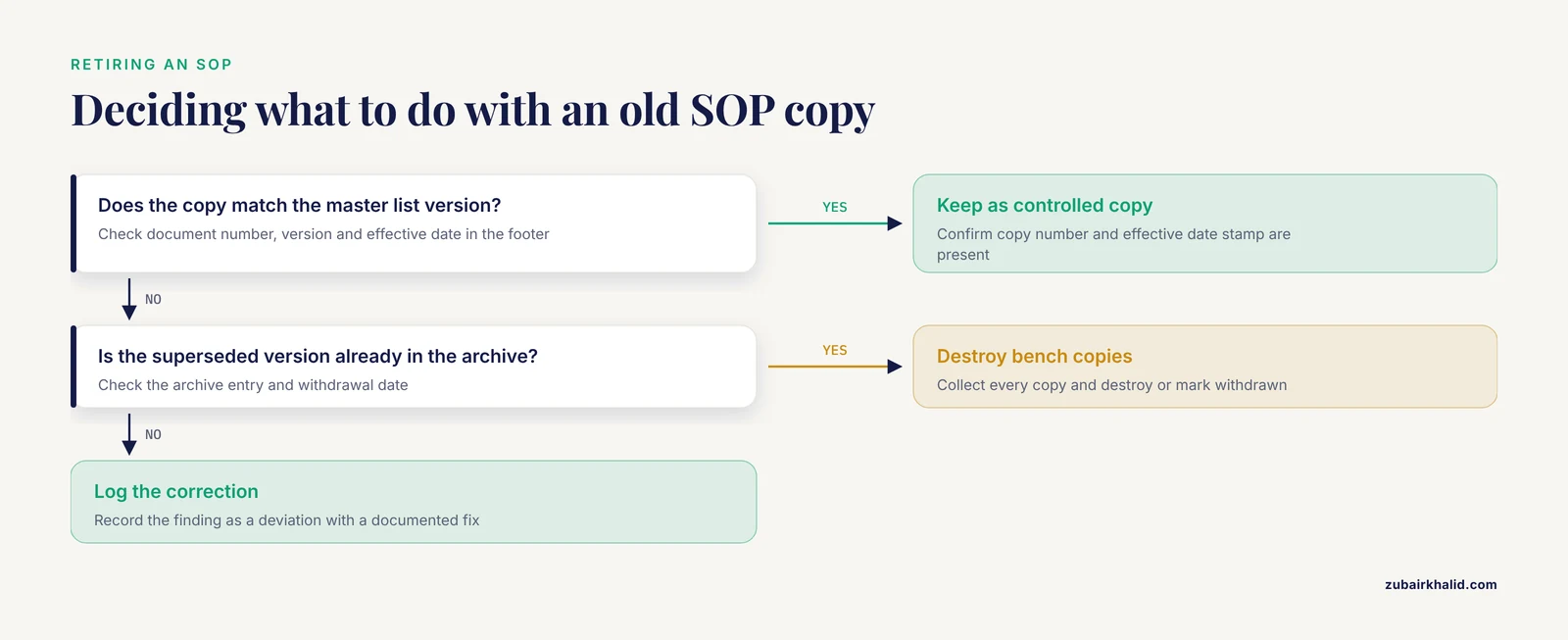
Step 9: Distribute controlled copies and withdraw uncontrolled ones. Issue the new version to the bench locations where it is used, marked as a controlled copy with copy number and effective date. Collect and destroy or clearly mark every copy of the superseded version. Reason: an obsolete copy left in a bench binder is the classic route to a wrong procedure being performed. Physical removal beats warnings.
Step 10: Record the change in revision history. Log the version number, date, author, approver, and a one-line summary of what changed and why, inside the document itself and on the master list. Reason: the revision history is the timeline an assessor, incident investigator, or incoming supervisor uses to reconstruct what happened. Six lines of history can resolve a dispute about a patient result from three years ago.
Step 11: File the superseded version in the archive. Move the withdrawn version to secure archive with a withdrawn date and retention status, keeping it retrievable. Reason: traceability requires the ability to show exactly which words were in force on a past date. Archive copies must never be usable at the bench, so mark them clearly as withdrawn.
Step 12: Perform periodic review. On the schedule recorded in the master list, commonly every two years for stable procedures and more often for rapidly changing methods, a qualified reviewer re-reads the SOP against current practice, current reagents, and current reference materials. Three outcomes are possible: re-approve unchanged (with the review documented), revise, or withdraw. Reason: laboratories change quietly. Instruments are replaced, kits are reformulated, and staff improvise. Scheduled review is the only mechanism that forces practice and paper back into alignment before an incident forces the question.
Step 13: Manage changes through the change control process. Any proposed change, whether from a review finding, an incident, a new kit lot, or a regulatory update, enters through a change request that documents what is changing, why, the risk, and which other documents are impacted. Reason: linked documents drift when changes happen piecemeal. If the specimen rejection policy changes, the rejection criteria listed inside a dozen SOPs must change with it, and only a cross-referenced change process makes that reliable.
Step 14: Audit the system itself. Include document control in the internal audit program. Sample bench copies against the master list, sample training records against current versions, and check for uncontrolled documents in the field. Reason: document control systems decay by erosion, not collapse. Small audits detect small erosions while they are cheap to fix.
Document Identification, Numbering, and Version Control
A workable identification scheme has three elements.
Document number. Use a structured code that identifies the department and category, for example MIC-MOL-007 for the seventh controlled document in the molecular section of microbiology. Add a zero-padded sequence so sorting works. Never change a document's number on revision. The number is the document's identity for its entire life.
Version number. Increment the whole number for each approved revision (1.0, 2.0, 3.0). Some labs add a draft suffix during development, for example "Draft v2.0, 2026-03-15," and strip the suffix at approval. Draft documents must be visually distinguishable from approved ones at a glance, through a watermark, a colored banner, or a DRAFT stamp. Staff must never have to read fine print to know whether a document is in force.
Effective date and review date. Every page footer should carry the document number, version, effective date, page number in "page X of Y" format, and the next scheduled review date. Page-level footers matter because bench copies get separated, and a lone page must still identify its parent document and version.
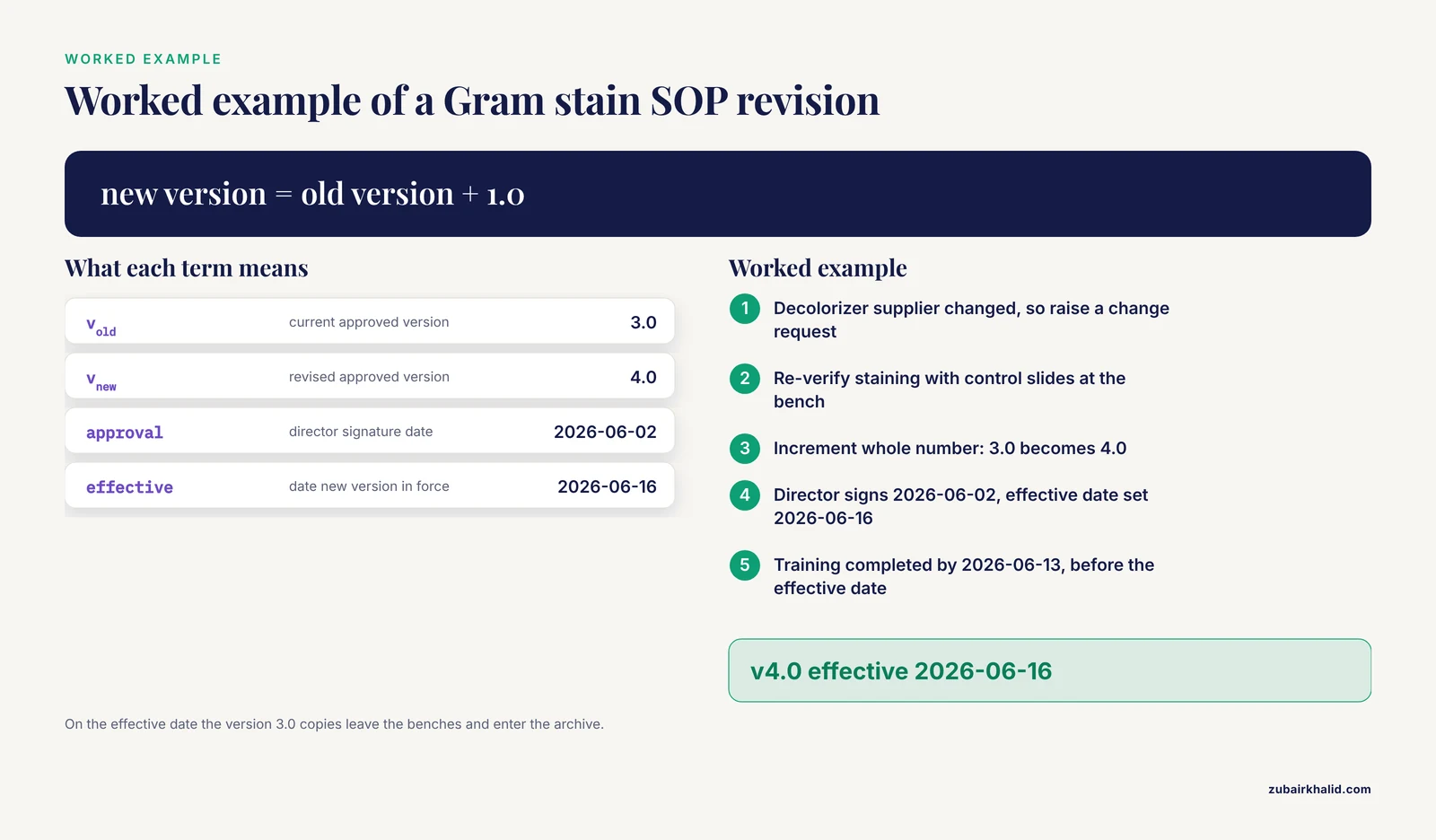
A practical worked example. Suppose the lab revises the Gram stain SOP from version 3.0 to 4.0 because the kit supplier changed the decolorizer formulation. The change request documents the supplier change and the re-verification of staining performance with control slides. The reviewer confirms the revised timing of decolorization, the director signs on 2026-06-02, the effective date is set as 2026-06-16, training is completed by 2026-06-13, and on the effective date the version 3.0 copies leave the benches and enter the archive. The revision history line reads: "v4.0, 2026-06-02, decolorizer source changed, timing re-verified, J. Rivera approved."
Controls: How Document Control Mirrors Quality Control
In analytical work, a control is a known sample run alongside unknowns to prove the system is behaving. Document control has direct analogs, and framing them this way helps bench staff accept the system as part of microbiology quality control rather than paperwork imposed from outside.
- Positive control analog: a known-good reference, the master list, against which every bench copy is checked. If the bench copy disagrees with the master list, the copy is the failure.
- Negative control analog: the search for documents that should not exist, meaning uncontrolled photocopies, screenshots taped to instruments, and personal notebooks. Finding one is a positive system result, not a personal failing, and the response is removal plus a look at why staff needed a workaround.
- Reagent lot control analog: version control. A new SOP version entering service is treated like a new reagent lot, with training and verification before use and the old version withdrawn on schedule.
- Proficiency testing analog: internal audits and management review, which test whether the document system as a whole detects and corrects its own defects.
The payoff for this rigor is measurable in external assessment. In a World Health Organization-coordinated external quality assessment of laboratories supporting invasive bacterial vaccine-preventable disease surveillance, administered through UK NEQAS for Microbiology between 2014 and 2019, participating sentinel and national laboratories were scored against defined passing thresholds on Gram stain reading, organism identification, serotyping and serogrouping, and molecular detection from simulated cerebrospinal fluid [1]. Panels of that kind test whether laboratories perform procedures consistently and correctly, which is only possible when every participating site follows the same controlled written methods. External assessment of this type is described as a core expectation for laboratories in surveillance networks [1].
Expected Results and How to Read Them
A functioning document control system produces observable, countable outputs. Read them the way you read QC charts, as trend data.
Master list currency. Every controlled document on the list matches reality. Zero documents with an overdue review date at the monthly check. An occasional overdue item caught within the month is normal. A climbing overdue count signals the system is failing and precedes an inspection finding.
Bench copy concordance. In an audit sample of bench locations, 100 percent of copies present are the current controlled version. Any uncontrolled or superseded copy found is a deviation with a documented correction.
Training linkage. For any sampled staff member and any sampled SOP the person performs, a training record exists for the current version. Gaps here are among the most common findings in laboratory assessments because training quietly lags version changes.
Traceability drill. Pick any date in the past two years. Within minutes, the system identifies which version of the relevant SOP was in effect, who was trained on it, and where the superseded version is archived. If this drill takes hours or fails, the archive and master list need work.
Assessment outcomes. Laboratories with disciplined document systems answer assessor questions about who, what, when, and which version without leaving the room. Laboratories without them spend the assessment apologizing and printing documents under observation, which assessors note.
Troubleshooting Table
| Symptom | Likely cause | Fix |
|---|---|---|
| Two different versions of the same SOP found at the bench | Superseded copies not collected at distribution, or staff printing their own | Collect obsolete copies physically, restrict print permissions, add controlled copy numbering, audit bench binders quarterly |
| SOP on the bench does not match actual practice | Document written from memory, never verified at the bench, or practice drifted after a quiet change | Re-verify at the bench, revise the SOP through change control, retrain, and add the item to periodic review focus |
| Staff report the SOP is "wrong" and work from memory | SOP outdated relative to current kit or instrument, and change control too slow or intimidating | Fast-track change requests for method-affecting supplier changes, and make raising a change request easy and blame-free |
| Training records missing for current version | Version changed without a training trigger, or records kept per document rather than per person | Build training into the release checklist so no version goes effective without completed training entries, and audit the linkage |
| Review dates lapse across the whole list | Review tracker not maintained, or reviews scheduled in a single annual crunch | Distribute review due dates across the year, filter monthly, and report overdue counts at quality meetings |
| Master list disagrees with the archive | Archive entries not updated at withdrawal, or multiple unofficial lists in circulation | Designate the master list as the only authoritative index, reconcile it against the archive, and delete unofficial copies |
| Assessors cannot trace a document's history | Revision history incomplete, approval signatures undated, or superseded versions not retained | Require dated signatures and complete revision blocks at approval, and rebuild the archive from email and file system history |
| New staff perform procedures before training records exist | Onboarding pressure overrides the training step | Make verification of training records a formal release-to-bench step in onboarding, with the supervisor signing the release |
Variations for Different Laboratory Settings
Paper-based systems. Fully paper document control remains legitimate and is the reality in many settings. It depends on physical controlled copy stamps, a signature approval workflow, a paper master list, and disciplined collection of obsolete copies. The failure mode is distribution, so invest effort there.
Hybrid systems. The most common configuration: documents authored and stored electronically, printed controlled copies at the bench. Add a footer statement that printed copies are controlled only when bearing the effective date stamp, and pair it with an explicitly uncontrolled warning on any printout lacking the stamp.
Electronic QMS. Software-managed systems automate routing, e-signatures, effective-date activation, and obsolescence, and they produce audit trails automatically. Their failure mode is different: labs buy the software and assume it enforces discipline. Review still requires a human who knows the method, and training still requires a human who watches the technique.
Multi-site and network laboratories. Networks of laboratories that share methods, such as public health surveillance networks, benefit from harmonized documents, but each site must still control, train, and review locally, because local instruments, reagents, and staff differ. Local verification of a shared procedure is what makes the shared document valid at each site.
Small laboratories. A two-person lab still needs every element: a master list, version numbers, dated approval, training records, periodic review, and an archive. Scale the formality down, not the functions. The lab director may be both reviewer and approver for many documents, but the review must still happen and be dated.
Record Retention, Storage, and Stability
Treat controlled records the way you treat reagents, with defined storage conditions and shelf lives.
Storage conditions. Electronic documents require access control, backup, and protection against silent corruption. A controlled document system on a single unbacked-up drive is a single point of failure for the entire lab. Paper archives require a dry, secure, access-limited location, protected against water, pests, and casual disposal.
Stability and retention. Define a retention period for superseded SOPs and quality records in the document control SOP itself, and set it to satisfy the longest applicable requirement among accreditation, client, and institutional obligations. Common practice retains superseded controlled documents for several years past withdrawal and retains certain records, such as validation files and instrument histories, for the life of the data they support. What matters operationally is that retention is written down, consistent, and actually enforced, since archives that nobody is allowed to prune become unusable, and archives pruned without a rule become indefensible.
Degradation checks. Audit the archive annually. Confirm electronic files open, that scanned documents are legible, that version stamps are present, and that withdrawn markers are intact. A record that cannot be read on demand has the same value as a missing one.
Building the System Where Resources Are Limited
Documentation is a frequent weak point when laboratories are formally assessed. A characterization of molecular testing capacity across Colombian laboratories, based on structured surveys of a selected subset drawn from an inventory of 311 laboratories, found that quality and documentation were among the leading limitations reported, alongside infrastructure, biosafety, and human talent constraints [2]. The same survey work documented that laboratory capacity is concentrated in major urban centers and that private laboratories make up the largest share of the sector, which means smaller and more remote facilities carry a disproportionate share of the quality gaps [2].
For a lab in exactly that position, the sequence matters more than the toolkit.
- Start with the master list and inventory what exists, even if the existing documents are inconsistent. You cannot control what you have not listed.
- Write or upgrade SOPs for the highest-risk procedures first, meaning those where an error harms patients directly, such as specimen rejection, critical results, and contamination prevention.
- Use a single simple template and a single simple numbering scheme from day one so you never renumber later.
- Make training records and periodic review non-negotiable even when everything else is improvised, because these two elements carry most of the traceability value.
- Seek external reference points. Participation in structured external assessment programs, where available, gives an objective read on whether the documented procedures actually produce correct results [1].
Linking Document Control to Overall Laboratory Quality Management
Document control is one subsystem inside laboratory quality management, but it is the subsystem the others depend on. Competency assessment is impossible without controlled SOPs defining what competent means. Equipment maintenance is impossible without controlled schedules and forms. Incident investigation stalls without version-traceable procedures. Corrective action loops close by revising documents, and if document revision is slow or untrusted, corrective actions die on paper.
Conversely, document control failures surface as quality control failures. A stain performed from a superseded SOP produces unacceptable control slides. A media lot record on an uncontrolled form version cannot be compared across months. A molecular assay run from an edited, unapproved protocol produces results the lab cannot defend. This is why assessors sample controlled documents first and follow the thread from document to training record to bench practice to QC results.
The external evidence base reinforces the point. Laboratories in the WHO-coordinated external quality assessment for invasive bacterial vaccine-preventable disease surveillance were expected to demonstrate specific, defined competencies, including correct Gram stain interpretation and phenotypic identification of the principal pediatric bacterial meningitis pathogens, with full-panel participants additionally performing molecular detection and typing from simulated cerebrospinal fluid samples [1]. In the 2019 round, 63 percent of sentinel and national laboratories correctly identified the targeted pathogens, against passing thresholds of at least 75 percent for sentinel and national laboratories and at least 90 percent for regional reference laboratories and full-panel participants [1]. Programs of this kind measure the output of a quality system, and the quality system runs on documents. A lab that cannot control its documents cannot standardize its competencies, and standardized competencies are precisely what external assessment measures.
Common Mistakes and Limitations
These are the mistakes that appear repeatedly in real microbiology labs, phrased so you can audit for them directly.
Writing SOPs from memory. An SOP drafted away from the bench describes an imagined procedure. Write it at the bench, with the reagents in hand, and verify it by walking through it before review.
Approving documents nobody verified. A signature on an unverified draft transfers no real authority, only liability. Verification before approval is the load-bearing step.
Skipping training on "minor" revisions. A change to incubation time or acceptance criteria is not minor to the result. Any change to a step affecting a result or a control decision requires documented training, even if the revision number moved only slightly.
Leaving obsolete copies at the bench. Collection of superseded copies is the step labs skip under time pressure, and it is the step assessors test first because it is easy to test. Treat withdrawal as a physical task with a completion check, not a memo.
Letting review dates lapse silently. Overdue reviews accumulate because nothing escalates. Add overdue-review counts to the standing quality meeting agenda and make the number visible.
Treating document control as clerical. When document control is assigned to whoever has spare time and no technical review authority, documents become decorative. The reviewer must be competent in the method and the approver must hold real authority, or the system produces signatures instead of control.
Over-engineering early. Labs that begin with a twenty-field template and five approval tiers produce three SOPs a year and a backlog of thirty. Start lean, cover the highest-risk procedures, and add formality only where a gap actually caused a problem.
Ignoring external documents. Package inserts, instrument manuals, and breakpoint tables change on the manufacturer's and publisher's schedule, not yours. A current-edition check for controlled external documents belongs in periodic review, or the lab runs on expired criteria with full confidence.
The honest limitation. Document control prevents procedural drift. It does not make a bad procedure good, it does not replace analytical quality control, and it does not substitute for staff judgment. A perfectly controlled document system executing a poorly designed assay produces well-documented wrong answers. Individual patient results always require interpretation by a qualified professional in the context of the whole case.
Safety note. SOPs used at the microbiology bench describe work with infectious agents, and the documents themselves become part of the safety system. Keep bench copies out of biosafety cabinets, where airflow and contamination control matter more than convenience, and never take paper SOPs into areas designated for handling of viable organisms without a defined decontamination policy for reusable copies. Every SOP covering work with infectious material must state the required containment level, required personal protective equipment, and the exposure response procedure, and the document control system must verify that these sections exist during technical review. Similarly, chemical hazards in stains and reagents, such as the fixatives and solvents used in staining protocols, must appear in the materials section of the SOP with handling precautions, so that the controlled document is also a controlled safety reference.
Document Control Tips That Survive Real Bench Conditions
- Laminate nothing critical. Lamination makes updates impossible, so laminated pages breed uncontrolled workarounds written in marker on the surface. If a bench needs a quick-reference card, make the card a controlled derivative document with its own number, derived from and cross-referenced to the parent SOP.
- Put the acceptance criteria where the eyes are. Control organism expectations, incubation conditions, and hold times belong in the step text, not buried three sections down. A technologist mid-task reads the step, not the philosophy.
- Write for the newest trained staff member. Define every abbreviation at first use and state the obvious. What is obvious to the author is a guess to the reader.
- Date-stamp at the moment of printing. If your system allows controlled printing, the stamp goes on at print time, not in advance, so the printed copy carries the version current that day.
- Keep a "changes at a glance" summary page at the front of each revised SOP listing what changed from the prior version. Staff retraining time drops sharply when they can read five bullets instead of thirty pages.
- Cross-reference deliberately. Every SOP should list the documents it depends on and the documents that depend on it. This map is what makes change control fast and complete.
- Audit with a stopwatch. Time how long it takes a bench technologist to find the current version of a randomly chosen SOP. If the answer exceeds a minute, the distribution system needs redesign regardless of what the master list says.
Frequently Asked Questions
What is document control in the microbiology lab?
It is the managed system that governs every written procedure, form, and policy in the laboratory through a defined lifecycle of drafting, review, approval, distribution, training, periodic review, revision, and retirement. Its purpose is to guarantee that the procedure in use at the bench is the current approved version and that past versions remain traceable.
How often should SOPs be reviewed in a microbiology laboratory?
Follow the schedule defined in your own document control SOP, which for most labs is every one to two years for active documents, with shorter intervals for methods that change frequently. Any SOP affected by a new instrument, new reagent formulation, incident finding, or audit finding must be reviewed immediately, regardless of the schedule.
What is the difference between a revision number and an effective date?
The revision number identifies which approved iteration of the document you hold, while the effective date identifies the date that iteration became the version in force. Both belong in the footer of every page. A document can be approved on one date and become effective on a later date to allow training to finish first.
Can SOPs be stored electronically instead of on paper?
Yes, electronic storage is fully acceptable and increasingly standard, provided the system controls access, preserves version history, applies attributable electronic signatures, and makes the current version clearly distinguishable from drafts and superseded versions. Many labs use a hybrid, with electronic authoring and controlled printed copies at the bench.
Do small microbiology labs really need formal document control?
Yes, because the functions, not the paperwork volume, are what protect results. A small lab needs a master list, unique numbering, dated approval, training records, periodic review, and an archive. It can run these on a spreadsheet and a locked cabinet, but it cannot skip them.
How do I properly retire an obsolete SOP?
Mark the document as superseded, record the withdrawal date, remove every bench copy physically, move the withdrawn version to a secure archive where it remains retrievable for the retention period, and update the master list. Retired documents must be clearly marked so they can never be returned to active use by accident.
What must appear in an SOP header and footer?
The header should carry the document number, title, department, and version, plus the author, reviewer, and approver with dates. The footer should carry the document number, version, effective date, page number in page X of Y format, and the next review date, so that any single detached page remains identifiable and traceable.
How does document control support microbiology quality control results?
Controlled documents define which controls to run, what acceptance criteria apply, and what to do when controls fail, so the quality of your QC data depends directly on the currency of your documents. When a control fails, the investigation begins by establishing which SOP version was in force, which is only possible when document control is functioning.
Sources
- Evaluation of Laboratories Supporting Invasive Bacterial Vaccine-Preventable Disease (IB-VPD) Surveillance in the World Health Organization African Region, through the Performance of Coordinated External Quality Assessment.
- Strengthening molecular testing capacity in Colombia: Challenges and opportunities.