Disposable vs. Reusable PPE in Microbiology Labs
By Dr. Zubair Khalid, DVM, MS, PhD ·
Disposable PPE is engineered to protect one wearer for one task or shift and then leave the laboratory in the biohazard or general waste stream, while reusable PPE is engineered to be cleaned, inspected, fit checked, and worn again over months or years. The practical rule of thumb for a microbiology bench is this: use disposable items wherever contamination or chemical exposure will ruin the item anyway and the waste stream can absorb it, and use reusable items wherever fit, durability, or engineered respiratory protection matters more than throwaway convenience. Getting the difference between disposable and reusable lab PPE right is not a purchasing question. It is a biosafety question, and it starts with a written biosafety risk assessment for the specific procedure, agent, and route of exposure.
This guide walks through what each category contains, how the two compare on the criteria that actually decide purchases and protocols, and how the choice plays out at real benches, from a BSL-1 teaching lab to a mycobacteriology suite running aerosol-generating procedures.
The Short Answer for Busy Bench Technologists
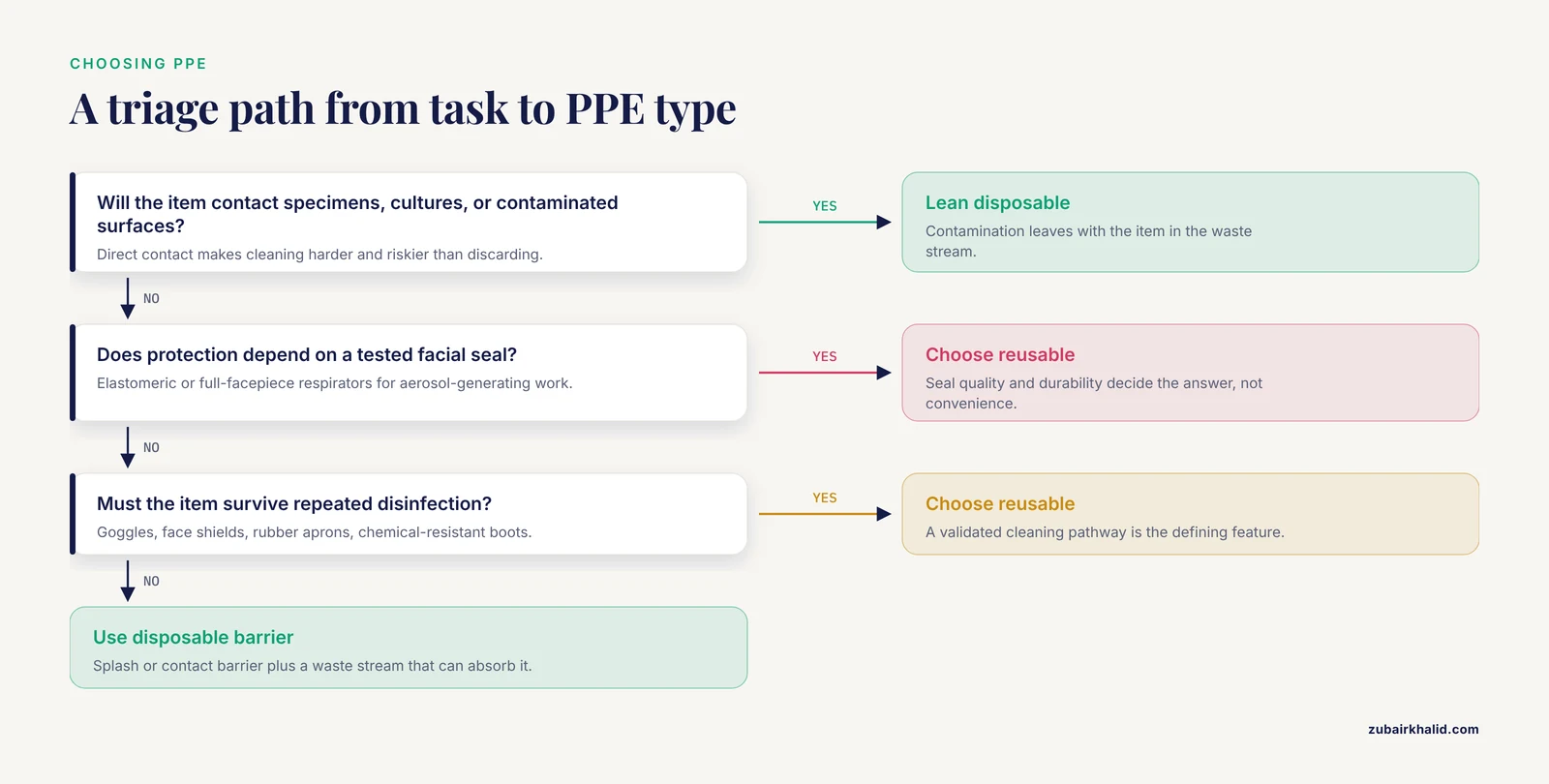
If you need a decision in the next ten minutes, use this logic.
Choose disposable PPE when all three statements are true:
- The item contacts the agent, specimen, or contaminated surface directly, so cleaning it would be harder and riskier than discarding it.
- The protection required is a barrier (splash, contact, droplet) rather than a calibrated, face-sealing respirator seal.
- The waste stream can legally and practically handle the discarded item as contaminated solid waste or regulated medical waste.
Choose reusable PPE when any one of these statements is true:
- The protection depends on a tested facial seal, such as an elastomeric respirator or full-facepiece respirator used for aerosol-generating work.
- The item must survive repeated disinfection, such as goggles, face shields, rubber aprons, and chemical-resistant boots used across many sessions.
- Supply interruptions would compromise critical work, and a durable, locally maintained stock of respirators or washable gowns provides resilience that single-use stock cannot.
Most microbiology labs use a mix. A diagnostic bacteriology technologist might wear a disposable fluid-resistant gown and nitrile gloves at the open bench, then don reusable goggles and a reusable half-face respirator for centrifugation or vortexing. The mix is not a compromise. It is the output of a proper risk assessment.
What Counts as Disposable PPE in a Microbiology Lab
Disposable PPE (also called single-use PPE) means any protective item the manufacturer intends for one wearing, or in some cases one patient interaction or one procedure, after which the item is discarded. The defining feature is that the manufacturer provides no validated cleaning or reprocessing method. Once the item is soiled, stretched, or wet, its barrier performance can no longer be assured.
Common disposable items at a microbiology bench include:
- Examination gloves, most often nitrile, chosen over latex for chemical resistance and allergy considerations. Gloves are changed between tasks, between specimens, and whenever torn or grossly contaminated.
- Fluid-resistant gowns and lab coats with knitted cuffs or no cuffs, worn open-bench when splashes or Aerosol-Generating Procedures are possible.
- Surgical-style masks, which protect mucous membranes from droplets but do not seal to the face and are not respirators.
- Shoe covers, head covers, and sleeve covers, used in cleanroom-adjacent work, specimen reception, or during deep cleaning.
- Chemical splash aprons rated for single use, common in staining benches and media preparation where grams-level spills of Gram stain reagents or phenolics occur.
The strength of disposable PPE is that cross-contamination cannot survive disposal. A gown drenched in a Brucella culture splash goes into the biohazard bin, and whatever it carried goes with it. The weakness is that every barrier property depends on the item staying intact and dry for the task, and many low-cost single-use garments are not tested for anything beyond basic fluid resistance. Regulatory specifications during the COVID-19 pandemic focused largely on synthetic blood penetration testing and capped non-woven fabric weight at 95 g/m2, while remaining silent on air permeability and moisture vapor transmission rate. The result was a market full of certified coveralls that performed poorly in real-world wear because the wearer overheated and moisture built up inside [1]. A gown or coverall that meets a penetration test but fails the human-comfort factor gets doffed early, worn loose, or modified by the wearer, and every one of those workarounds degrades protection.
What Counts as Reusable PPE
Reusable PPE means any protective item designed, tested, and documented by the manufacturer for repeated use after cleaning and disinfection according to a defined protocol. The defining feature is a validated decontamination pathway: the manufacturer states what the item tolerates, how many cycles it tolerates, and when it must be retired.
Common reusable items in microbiology include:
- Safety glasses and chemical splash goggles with indirect vents, cleaned with a laboratory-approved disinfectant between users and inspected for lens crazing and strap degradation.
- Face shields, which cover the forehead and chin and pair with masks or respirators for full mucous-membrane coverage during spill cleanup or splash-prone work.
- Elastomeric half-mask and full-facepiece respirators with replaceable filter cartridges. An elastomeric respirator is a rubber or silicone facepiece that seals mechanically against the face and accepts standardized filters (for example, N95-grade or P100-grade particulate filters). Unlike a disposable N95, the facepiece itself can be cleaned and disinfected, and only the filter media is replaced.
- Rubber or chemical-resistant aprons and boots, standard in media autoclave rooms, glassware wash areas, and spill response kits.
- Washable laboratory coats and gowns made of fluid-resistant woven fabric, common in European and academic settings, laundered by an institutional contract service and exchanged on a schedule.
Reusable respiratory protection deserves special attention because its entire value depends on fit. A respirator that does not seal is a decoration. Quantitative fit testing measures how well a sealed facepiece excludes ambient particles and produces a fit factor, the ratio of contaminant concentration outside the mask to concentration inside the mask. In one development program for a reusable silicone half-face respirator built during the COVID-19 pandemic, prototypes were evaluated by user seal checks and quantitative fit testing under the CSA Z94.4-18 standard. After the design moved to standard heat-moisture-exchange filter media, all tested iterations passed user seal checks and 87.5 percent of subjects passed quantitative fit testing, with a median fit factor of 1662 against a pass threshold of 100 [2]. That performance gap between "just filtering media" and "sealed, tested facepiece" is exactly why respirators, disposable or reusable, live or die on fit.
Reusable gear also has an often-overlooked logistics advantage. The same program estimated a production cost of CAD $15 in materials and 20 minutes of labor per respirator for a distributed manufacturing run of 1,000 units [2]. A durable respirator stock, properly stored and maintained, is an asset the laboratory owns rather than a consumable it must repurchase weekly.
Disposable vs. Reusable Lab PPE: Side-by-Side Comparison
| Criterion | Disposable PPE | Reusable PPE |
|---|---|---|
| Typical items | Nitrile gloves, fluid-resistant gowns, surgical masks, shoe and head covers, single-use aprons | Goggles, face shields, elastomeric half- and full-face respirators, rubber aprons and boots, washable coats |
| Primary protection mode | Physical barrier against splash, contact, and droplets | Durable barrier plus engineered, tested facial seal for respiratory protection |
| End of useful life | After one task, one shift, or first significant soiling, whichever comes first | Manufacturer-defined cleaning cycle count or physical degradation (cracked straps, crazed lenses, hardened elastomer) |
| Fit assurance | Minimal. Sizing (small/medium/large gloves, gown sizes) only | Quantitative or qualitative fit testing for respirators, plus user seal check every donning |
| Decontamination | None. Contaminated items are discarded into the correct waste stream | Manufacturer-validated cleaning and disinfection between uses, with documented inspection |
| Failure mode to watch | Permeation, tearing, wicking at cuffs, poor breathability leading to wearer noncompliance | Seal loss from facial hair, strap wear, filter saturation, or storage damage |
| Supply-chain behavior | Consumable. Depletes continuously and fails fast during shortages | Capital item. Degrades slowly, can be stockpiled and repaired |
| Waste burden | High volume of contaminated solid waste, mostly plastic | Low volume per year of use, but generates filter and cartridge waste |
| Comfort levers | Fabric weight, breathability, and design quality vary widely between brands | Adjustable straps, elastomer softness, and interchangeable cartridges |
| Best-fit roles | Open-bench specimen handling, routine culturing, staining, specimen reception, most BSL-1 and BSL-2 contact work | Aerosol-generating procedures, spill response, prolonged procedures where comfort matters, any task requiring certified respiratory protection |
The table condenses the real difference between disposable and reusable lab PPE: disposables buy certainty of exit (contamination leaves with the item) at the cost of continuous consumption, while reusables buy durability and performance at the cost of a cleaning, inspection, and fit-testing program that must actually run.
How to Choose: The Criteria That Decide Real Choices
Start With the Biosafety Risk Assessment
A biosafety risk assessment is the structured process of identifying the agent, the procedures that generate exposure risk, the routes of exposure (inhalation, ingestion, mucous membrane, percutaneous), and the competency of the people performing the work, then selecting controls that match the assessed risk. In microbiology, the risk assessment precedes PPE selection rather than following it. The assessment determines the biosafety level (BSL-1 through BSL-4), and the biosafety level sets the PPE floor, but the procedure-specific assessment sets the ceiling.
Two teams working with the same organism can legitimately reach different PPE decisions. Routine streaking of Escherichia coli K-12 on agar is a low-aerosol, low-volume contact task covered by gown and gloves. Sonicating the same organism, or working with a respiratory pathogen, converts the task into an inhalation-hazard procedure, and the assessment moves the answer from barrier PPE to sealed respiratory protection inside a biosafety cabinet or ventilated enclosure. Anyone writing "disposable or reusable lab PPE" into a standard operating procedure without tying that choice to a documented assessment is guessing.
Fit and Seal Favors Reusable Respirators
If the hazard reaches the wearer through inhalation, the difference between disposable and reusable lab PPE becomes a question of which option achieves and maintains a seal. Disposable N95 respirators seal adequately for many wearers when fit tested, but they cannot be adjusted across the wide range of face shapes the way a multi-point elastomeric facepiece can, and they cannot be shared, cleaned, or stored between users without dedicated protocols. Reusable elastomeric respirators accept standardized filter media, tolerate disinfection of the facepiece, and can be individually assigned and fit tested once per user.
The caveat is maintenance. Elastomeric facepieces need inspection of exhalation valves, headgear tension, and elastomer condition. Filters have a service life governed by breathing resistance and saturation, not by calendar alone. A reusable respirator program without an inspection log is worse than a disposable program, because the wearer trusts equipment that may have silently failed.
Breathability and Comfort Are Safety Variables, Not Luxury Variables
A recurring lesson from the pandemic-era PPE supply is that protection testing and wearability testing are different things. When specifications emphasized synthetic blood penetration and fabric weight while ignoring air permeability and moisture vapor transmission, certified garments reached users with severe breathability problems, and healthcare workers documented the human-comfort factor as an overlooked dimension of protection [1]. The mechanism is simple: an uncomfortable garment gets doffed sooner, worn with gaps, or altered. Both disposable and reusable PPE lines now span a huge quality range, and end-user field trials, in which wearers don the item and perform real bench tasks before procurement, are the most direct way to avoid buying equipment people will refuse to wear correctly [1]. Involve the technologists who will wear the item for a six-hour staining session before the purchase order is signed.
Reuse and Decontamination: Where Most Errors Live
The most frequent dangerous practice in this space is extending the life of disposable PPE beyond its design. Disposable gowns and masks have no validated reprocessing method. Wiping a disposable gown with disinfectant does not restore its barrier performance, because the fluid-resistant treatment and fabric integrity are not tested against disinfectant chemistry or repeated wet-dry cycles. The pandemic made this failure visible at scale. In a survey of 721 diagnostic laboratories, 41.4 percent of laboratory professionals reported reusing N95 masks, a practice driven by supply collapse rather than by evidence of safe reprocessing [3]. Understand that statistic for what it documents: a crisis adaptation, not a protocol.
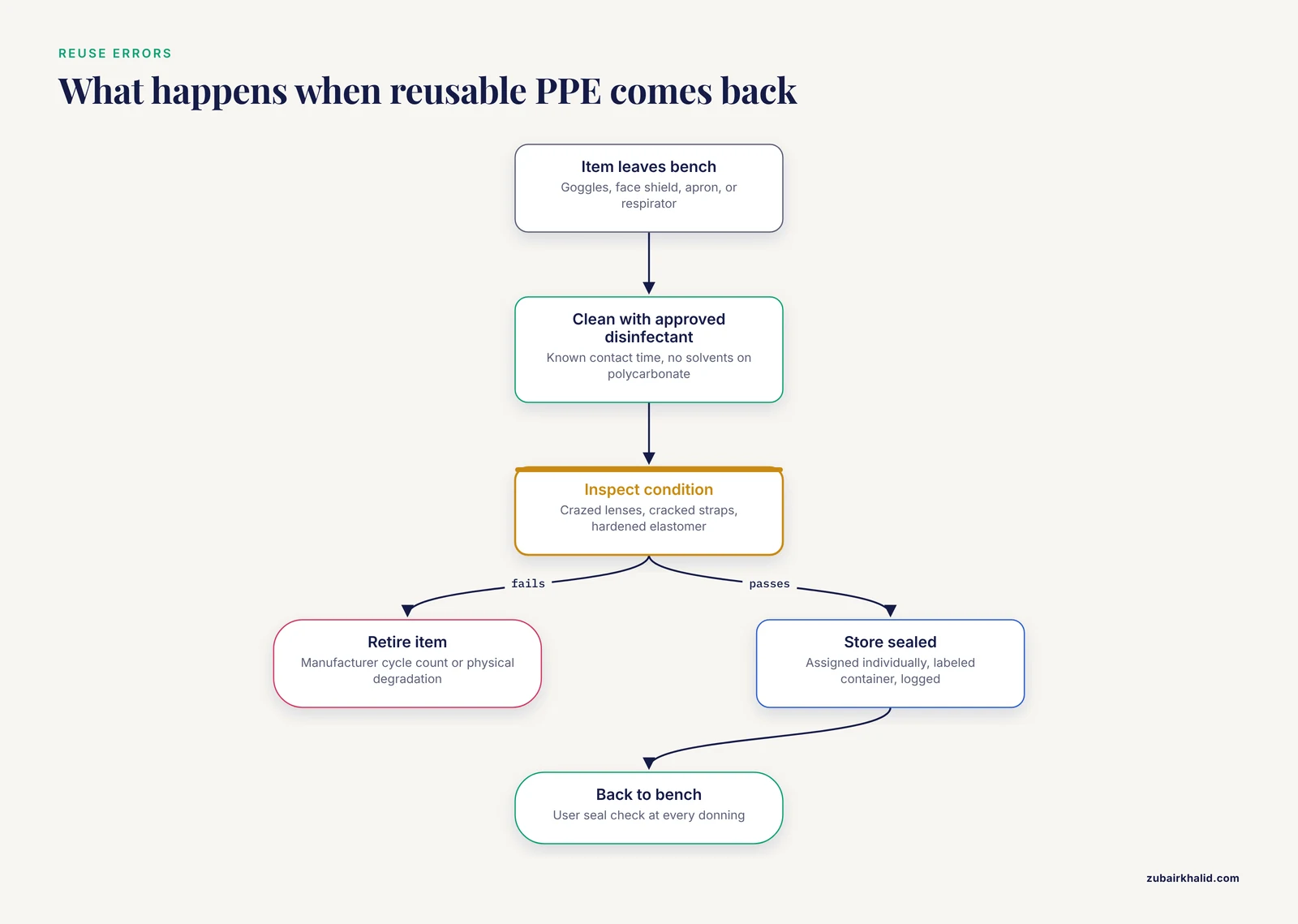
Reusable PPE, in contrast, comes with a cleaning pathway by definition. The correct behaviors are boring and non-negotiable: clean goggles and face shields with a laboratory-approved disinfectant of known contact time, never with solvents that craze polycarbonate. Launder washable coats through an institutional service, never a home washing machine. Retire elastomeric facepieces when the elastomer takes a set, the valve sticks, or the headgear no longer holds tension.
Supply Chain and Shortage Resilience
Disposable PPE depends on continuous manufacture and delivery. When global demand spikes, as it did in 2020, single-use stock evaporates and laboratories improvise, sometimes dangerously. The shortage drove parallel responses that show both sides of the ledger. Some laboratories stretched existing stock through reuse practices that no risk assessment would have endorsed in normal times [3]. Others invested in locally manufactured reusable equipment, including open-hardware reusable respirators that could be produced with 3D printing and silicone casting and validated against established fit-testing standards [2]. A laboratory holding a maintained stock of reusable respirators, washable gowns, and disinfectable face shields can keep critical functions running through a supply interruption that would shut down a purely disposable operation.
Waste Burden and Environmental Footprint
Single-use PPE is mostly plastic, and mismanaged items leave the waste stream and enter the environment. Monitoring of PPE debris in a metropolitan area during the pandemic documented 1,306 items across surveyed sites, with disposable gloves the most common at 44 percent, face masks at 31 percent, and disinfecting wipes at 25 percent, and 97 percent of collected masks designed for single use [4]. The highest daily debris densities appeared around hospital districts and large retail parking areas, including 0.00133 items per square meter in the hospital district surveyed [4]. For a laboratory, the practical translation is that every disposable item leaving the bench as regulated waste carries a disposal cost and an environmental externality, and volume reduction through reusable options where the risk assessment permits is a legitimate sustainability lever, provided it never overrides the biosafety decision.
Training Makes Both Options Work
Neither category protects an untrained wearer. Formal microbiology biosafety training should cover, at minimum, the order of donning and doffing, glove integrity checks, hand hygiene between glove changes, the difference between a surgical mask and a respirator, how to perform a user seal check, and where each item is stored and discarded. Even in teaching settings, the principle holds that a microbiology laboratory is a restricted space, not a public space, and entry requires closed-toed shoes and appropriate PPE as a condition of presence, not a suggestion [5]. Trainees who learn PPE discipline in a BSL-1 teaching lab carry those habits into diagnostic and research settings where the consequences of error are greater.
Worked Scenarios
Scenario 1: BSL-1 Undergraduate Teaching Lab
Risk assessment outcome: nonpathogenic organisms, minimal aerosol generation, novice users, high turnover. Choice: disposable gloves and disposable or launderable coats, with reusable safety glasses assigned per student and disinfected between sessions. Disposables dominate because contamination is certain, cleaning novice-used items is impractical at class scale, and the waste is minimal per session. The reusable component (safety glasses) exists because eyewear must fit individual faces and survive a semester. Teaching emphasis: doff gloves by peeling from the cuff inward, discard before removing the coat, and wash hands last.
Scenario 2: BSL-2 Diagnostic Bacteriology Bench
Risk assessment outcome: moderate-risk agents, splash potential from vortexing, pipetting, and plate handling, work performed within a certified biosafety cabinet for open manipulations. Choice: disposable fluid-resistant gown and nitrile gloves at the open bench, reusable goggles or face shield whenever splash is foreseeable, and a reusable half-face respirator with particulate filters for any task the assessment flags as aerosol-generating outside containment. The disposables absorb routine contamination and leave daily with the waste stream. The reusable eyewear and respirator exist because facial fit, disinfection cycles, and seal testing are requirements no disposable item satisfies.
Scenario 3: Mycobacteriology or Aerosol-Generating Procedure
Risk assessment outcome: airborne infection risk, procedures such as sonication, centrifugation without sealed rotors, or vortexing that defeat ordinary barriers. Choice: certified respiratory protection is mandatory, engineering controls (biosafety cabinet, sealed rotors) come first, and the respirator is reusable elastomeric with assigned fit testing, or disposable N95 where individual assignment is not feasible. Disposable gowns and gloves still cover the contact and splash layers. This is the scenario where asking "disposable or reusable lab PPE" has the clearest answer: respiratory protection goes reusable whenever the program can support fit testing and maintenance, because seal quality and durability are the whole game.
Scenario 4: Spill Response
Risk assessment outcome: concentrated splash exposure, contaminated floor surfaces, potential aerosolization during cleanup. Choice: reusable rubber apron and boots over disposable gloves and gown, plus face shield over mask or respirator. The logic is layered. Reusable outer barriers survive flooding with disinfectant, which would destroy a disposable gown's function within minutes. Disposable inner layers absorb contamination and exit with the waste. After the spill, the reusable items are disinfected per protocol and inspected before restocking the spill kit.
Scenario 5: Supply Disruption
Risk assessment outcome: unchanged workload, absent consumable supply. Choice: shift every task the risk assessment permits from disposable to reusable stock, reserve remaining disposables for tasks with no reusable substitute, and escalate procurement immediately. If respirator supplies run short, reusable elastomeric facepieces with replaceable filters keep qualified, fit-tested staff protected when disposable N95s are unavailable, which is precisely the resilience demonstrated by locally produced reusable respirator programs during recent shortages [2]. Any improvised reuse of disposable items should be documented as a declared deviation with an end date, never normalized into the protocol.
Common Mistakes and Limitations
Wearing the same disposable gloves across tasks. Gloves are the fastest-crossing contamination vector in a microbiology lab. Change them between specimens, after touching shared equipment (incubator handles, keyboards, microscope stages), and before touching clean surfaces such as door handles.
Treating a surgical mask as a respirator. A surgical mask blocks droplets from the wearer and protects mucous membranes from splashes. It does not seal to the face and provides no inhalation protection against airborne particles. Confusing these two is among the most common and consequential mix-ups in lab PPE.
Extending disposable item life without a validated method. Disinfectant wiping, UV exposure, and drying are not validated reprocessing for single-use gowns or masks. Any reuse of disposables is a documented emergency deviation, not a cost-saving measure.
Fit testing once, then assuming the seal persists. Facial shape changes with weight change, dental work, and facial hair. Respirators require repeat fit testing on a defined schedule and a user seal check at every donning. A day of stubble can defeat a seal that passed testing a month earlier.
Ignoring breathability during procurement. An item that passes a penetration test but fails breathability gets worn incorrectly. Run a field trial with real bench tasks before committing to a garment across a department.
Cleaning reusable eyewear with the wrong chemistry. Solvents and abrasive cleaners craze polycarbonate lenses and degrade anti-fog coatings. Use only manufacturer-approved disinfectants and respect the stated contact time.
Storing reusable respirators unsealed in bench drawers. Contaminated or damaged facepieces handed out from a drawer create a false sense of protection. Assign respirators individually, store them in labeled sealed containers, and log filter changes.
Treating the biosafety risk assessment as annual paperwork. The assessment is the document that decides disposable vs. reusable PPE for every procedure in the lab. If it does not name the PPE for each task, the PPE choices in the lab are habits, not decisions.
Assuming more PPE is always safer. Over-layering increases heat stress, doffing complexity, and self-contamination risk. Match PPE to assessed risk. Two correct layers outperform four sloppy ones.
Limitations. This guide covers general principles for common microbiology settings. Individual laboratories operate under institutional biosafety committees, occupational health programs, and specific agent or chemical hazards that can change every conclusion above. Consult your biosafety officer and your institution's written exposure control plan for decisions that bind your own bench.
Frequently Asked Questions
Which is safer, disposable or reusable lab PPE?
Neither category is inherently safer. Safety depends on whether the item matches the assessed risk, fits the wearer, and is used and maintained correctly. Disposables excel as contamination barriers that leave with the waste, and reusables excel where tested facial seals and durable disinfectable barriers are required.
When to use disposable PPE in a microbiology lab?
Use disposable PPE whenever the item contacts specimens, cultures, or contaminated surfaces, whenever the required protection is splash or contact barrier rather than a sealed respirator, and whenever the waste stream can absorb the discarded item. Routine bench culturing, staining, and specimen reception are typical disposable-PPE tasks.
Can disposable masks or gowns be disinfected and reused?
No, not under standard practice. Manufacturers provide no validated reprocessing method for single-use items, so disinfection cannot restore their tested barrier or filtration performance. Reuse of disposables is an emergency deviation to be documented and time-limited, not a protocol.
How often should reusable PPE be cleaned or inspected?
Clean goggles, face shields, and rubber barriers with an approved disinfectant between uses or between users. Inspect elastomeric respirators before every use for valve, strap, and elastomer condition, change filters per manufacturer guidance and breathing resistance, and repeat formal fit testing on your institution's defined schedule.
What does a biosafety risk assessment decide about PPE?
The risk assessment identifies the agent, the exposure routes generated by each procedure, and the competency of staff, then sets the biosafety level and the PPE floor for the work. It is the document that determines whether a task requires a disposable barrier, a fitted respirator, or both.
How does microbiology biosafety training cover PPE selection?
Good training covers donning and doffing order, glove changes and hand hygiene, the difference between masks and respirators, user seal checks, correct disposal routes, and storage of reusable items. It also establishes the principle that the lab is a restricted space where PPE and closed-toed shoes are conditions of entry.
Sources
- Breathability and Safety Testing of Personal Protective Equipment: "Human-comfort" Factor Remains Undefined.
- Development, manufacturing, and preliminary validation of a reusable half-face respirator during the COVID-19 pandemic.
- Indian microbiology EQAS registered laboratory's capacity building and infection control practices during the COVID-19 pandemic in India: Lessons learnt and gaps identified.
- An emerging source of plastic pollution: Environmental presence of plastic personal protective equipment (PPE) debris related to COVID-19 in a metropolitan city.
- Who Let the Dogs Out? A Plea for Official Guidelines on Service Animals in the Teaching Laboratory.