How to Design a Microbiology Quality Control Program
By Dr. Zubair Khalid, DVM, MS, PhD ·
A microbiology quality control program is the documented set of checks that proves your media, stains, reagents, instruments, control organisms, and staff produce dependable results on every shift, not only when an assessor visits. A working program catches a failing lot of Mueller-Hinton agar (the standard medium for susceptibility testing), a drifting CO2 sensor, or a degrading molecular control before any of them corrupt a patient report. This guide explains how to design a microbiology quality control program step by step, with the control materials, acceptance criteria, records, and troubleshooting logic a bench microbiologist needs.
When to use it. Build a program when a laboratory opens, when a new test or instrument joins the menu, when accreditation or licensure is approaching, or when recurring QC failures show that the current approach is improvised. Redesign an existing program after a major error, a change in test volume, or a move to new facilities.
Time commitment. Plan on roughly 40 to 60 hours of hands-on work to inventory the laboratory, write the documents, select controls, and train staff, spread over 3 to 6 months of elapsed time. The elapsed time matters because control lots must cycle, competency assessments must be scheduled, and at least one external quality assessment round should finish before you call the program operational.
What a Microbiology Quality Control Program Achieves
Quality control (QC) consists of the routine operational checks that verify a test performed correctly on a specific day with a specific lot of materials. Quality assurance (QA) is the broader system of policies, training, documentation, and review that keeps the whole laboratory dependable. Laboratory quality management is the umbrella term for the governance that ties QC and QA together with document control, corrective action, and management review. A microbiology quality control program is the QC layer made explicit: every medium, reagent, instrument, and competency gets a defined check, a defined frequency, and a defined acceptance criterion.
Programs rest on two pillars. Internal quality control (IQC) uses materials you control, such as reference strains and molecular controls, run on your own schedule. External quality assessment (EQA), also called proficiency testing (PT), uses blinded samples from an outside provider to compare your results with those of other laboratories. EQA is periodic, so it complements IQC rather than replacing it.
The design principle underneath both pillars is risk-based frequency. A daily gram stain check makes sense because the stain is used constantly and fails gradually. A lot-by-lot sterility check on media makes sense because a contaminated lot fails completely. An annual review of the QC plan makes sense because test menus and instruments change. Frequency follows how a failure would propagate, not convenience.
Scope, Governance, and the Quality Manual
Start with governance, because a program without an owner decays. Name a quality manager (or a designated senior technologist in a small laboratory) who owns the QC plan, reviews failures, and reports to the laboratory director. Give each bench section a QC lead who executes the daily checks. Write a one page quality policy stating that no patient result leaves the laboratory on a failed control, and have the director sign it.
The quality manual is the program's backbone. It collects the QC plan, standard operating procedures (SOPs), forms, acceptance criteria tables, corrective action records, and training files. Apply document control: every SOP carries a version number, an effective date, an author, and an approver, and superseded copies leave the bench. Uncontrolled documents are among the most common audit findings, and they are cheap to prevent.
Define the scope before writing anything else. List every test the laboratory offers, every instrument, every critical reagent and consumable, and every result pathway that leaves the building. Include the preanalytical phase (specimen labeling, transport, rejection criteria) and the postanalytical phase (result verification, critical result callback, amended reports), because QC that ignores specimen quality protects the assay but not the patient. A laboratory reporting antimicrobial susceptibility results depends on the specimen coming from a real infection rather than a contaminant, and that judgment is a quality process, not a machine setting.
Materials and Resources
| Item | Specification or working condition | Purpose |
|---|---|---|
| Reference QC strains | Escherichia coli ATCC 25922, Staphylococcus aureus ATCC 25923, Pseudomonas aeruginosa ATCC 27853, Enterococcus faecalis ATCC 29212, Streptococcus pneumoniae ATCC 49619 (ATCC, American Type Culture Collection) | Antimicrobial susceptibility testing (AST) and media QC |
| Cryopreservation medium | Tryptic soy broth with 10 to 15 percent glycerol, aliquots held at -70 °C (or -20 °C) | Long-term master stock of each QC strain |
| 0.5 McFarland standard | Turbidity benchmark corresponding to roughly 1.5 × 10^8 colony-forming units (CFU) per mL | Inoculum standardization for diffusion and minimum inhibitory concentration (MIC) methods |
| Mueller-Hinton agar | Poured to a uniform 4 mm depth, pH within the manufacturer's lot specification | Disk diffusion QC and antimicrobial potency checks |
| Gram stain reagent set | Crystal violet, Gram iodine, alcohol or acetone-alcohol decolorizer, safranin | Daily stain performance check |
| Uninoculated media samples | A defined sample from each lot, incubated at 35 ± 2 °C alongside routine plates | Lot sterility verification |
| Armored RNA process control | MS2 bacteriophage capsid particles about 25 nm in diameter, stock quantified by digital PCR (dPCR) at 3.48 × 10^10 copies per mL [1] | Full-process molecular QC covering extraction, reverse transcription, and amplification |
| Extraction negative control | Nuclease-free water or buffer carried through extraction | Detection of carryover contamination |
| No-template control (NTC) | PCR-grade water added at amplification setup | Detection of reagent contamination |
| NIST-traceable data loggers | Continuous logging for refrigerators (2 to 8 °C), freezers (-20 °C and below), incubators (35 ± 2 °C), and CO2 incubators (5 percent CO2) | Environmental monitoring |
| Autoclave biological indicators | Geobacillus stearothermophilus spore strips, run per load or on a fixed weekly schedule | Sterilization verification |
| pH buffer standards | pH 4.00, 7.00, and 10.00 buffers for electrode calibration | Media pH verification |
| EQA or PT enrollment | Provider panel matched to the test menu, per the provider's calendar | External performance comparison |
| QC records system | Controlled logbooks or a laboratory information management system (LIMS) module with trend plots and lot-tracking views | Trend analysis and audit trail |
Safety note. Viable reference strains and any human-source EQA material are handled at biosafety level 2 (BSL-2). Wear gloves and a lab coat, reconstitute lyophilized strains inside a biosafety cabinet because vials can aerosolize on opening, and treat frozen blood panels as potentially infectious. Gram stain decolorizer is flammable and extraction kit lysis buffers are corrosive, so keep them away from open flames and wear eye protection.
How to Design a Microbiology Quality Control Program Step by Step
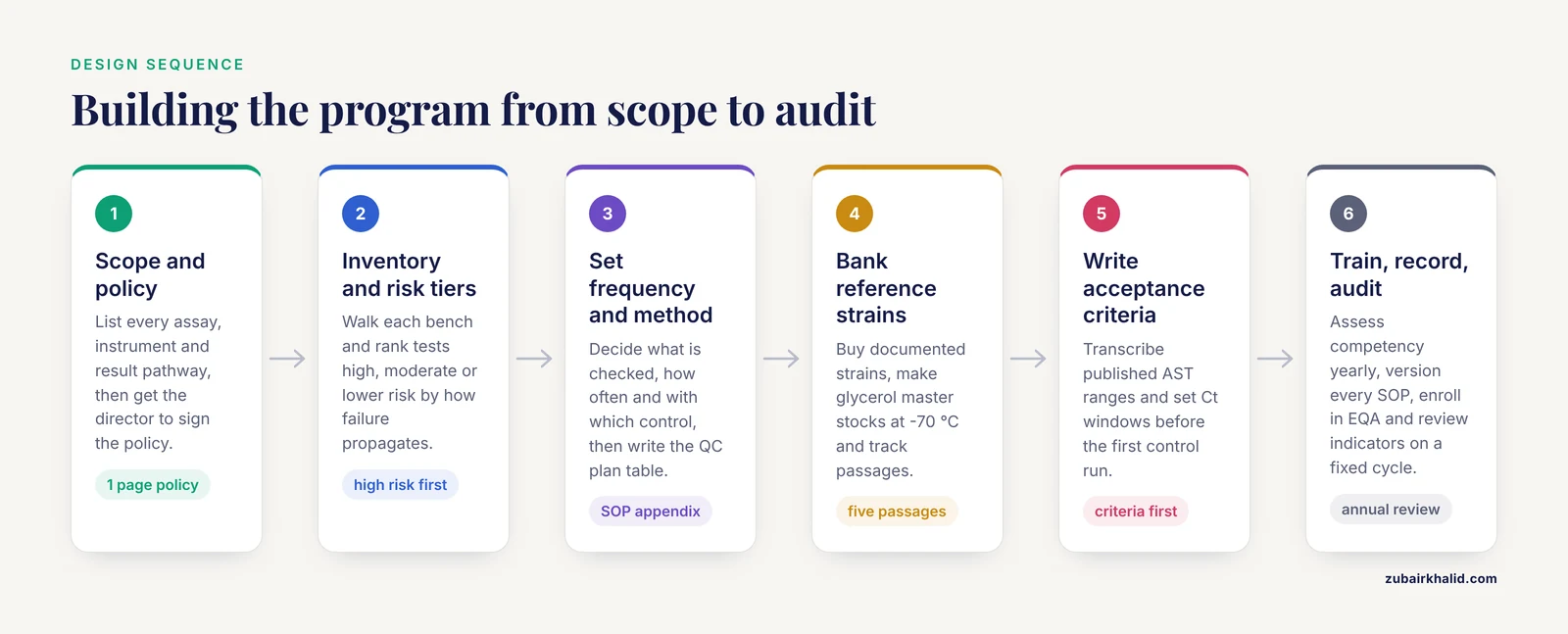
- Define the scope and write the quality policy. List every assay, instrument, and result pathway the program must cover, then write the one page policy described above and have the director sign it. Reason: a program without a defined boundary grows until nobody maintains it, and a signed policy gives every technologist the authority to stop reporting without negotiating.
- Inventory and risk-classify the laboratory. Walk every bench and list each test, instrument, critical reagent, and consumable. Assign each item a risk tier: high risk covers tests that directly drive therapy (blood culture, AST, molecular pathogen panels), moderate risk covers routine identification and staining, lower risk covers tests with robust built-in redundancy. Reason: risk tiers set how often and how deeply you check each element, so the heaviest QC burden lands where failure hurts most.
- Assign a QC frequency and method to every element. For each inventory line, decide what is checked (sterility, growth, inhibition, staining, amplification), how often (each new lot, each day of use, weekly, monthly), and with which control material. Write the decisions into a QC plan table that becomes an SOP appendix. Reason: failures propagate differently. A contaminated media lot fails absolutely while a fading stain fails gradually, and the schedule should match that behavior.
- Select and bank reference strains and control materials. Purchase documented strains from a recognized culture collection, reconstitute them in a biosafety cabinet, and prepare master stocks in glycerol broth at -70 °C. Make working stocks from a master and track passages, retiring a working stock at the conventional limit of five passages from the original. For molecular assays, add a process control that travels through extraction with the samples. Reason: traceable, genetically stable controls are the only fair judges of your system, and a clinical isolate can change its properties without telling you.
- Write acceptance criteria before the first control run. For AST, transcribe the published acceptable ranges for every drug-organism pair you will check into the SOP. For molecular assays, set cycle threshold (Ct) windows for controls from your own validation data. For media, state growth, inhibition, and biochemical expectations per organism. Reason: criteria written after results invite rationalization. Defined criteria also make judgments reproducible across people, a pattern demonstrated in a peer-review pilot where 162 reviews scored against explicit quality criteria agreed between reviewers better than open-ended impact judgments did [2].
- Build the personnel competency program. Define required competencies per role, assess them at hire and annually, and include direct observation plus blind rechecking of a sample of results. A scoping review of infection prevention and control (IPC) nursing roles mapped nine core competency domains into three clusters, one covering microbiology and surveillance, and found the structure aligned with the World Health Organization competency framework, a useful scaffold for defining what laboratory staff must demonstrate [3]. Reason: controls test the system, competency assessment tests the person running it, and both are needed.
- Establish document control and records. Version every SOP, form, and criteria table, mark effective dates, and remove superseded copies from the bench. Choose where QC records live (controlled logbooks or a LIMS module) and set retention periods. Reason: an auditor's first question is whether the document in use is the document approved, and untraceable records cannot support trend analysis.
- Schedule instrument and environmental checks. Put continuous temperature logging on refrigerators, freezers, incubators, and CO2 incubators with daily review, verify CO2 with an independent analyzer on a fixed schedule, run autoclave biological indicators per load or weekly, and calibrate pipettes and thermometers on a defined cycle. Safety note: autoclaves and freshly poured agar cause burns, so use heat-resistant gloves and let plates solidify away from walkways. Reason: environmental failures are silent, because cultures incubated at the wrong temperature or CO2 concentration can look normal and still shift susceptibility results.
- Enroll in EQA, or build an in-house network. Join a provider whose panels match your menu. Where no provider covers a niche assay, organize a blinded exchange among peer laboratories using their routine methods. The Italian HLA-B*57:01 network (a pharmacogenetic test required before abacavir prescription) shows the design: a panel of 25 frozen blood samples, 9 positive and 16 negative, was distributed blind to 10 units that each used their own routine extraction and PCR methods, and all 10 units identified all 25 samples correctly [4]. Reason: internal controls share your reagents and habits, so only an external comparison exposes systematic bias your own materials cannot reveal.
- Create corrective action and nonconformity procedures. Define what happens on a failure: quarantine affected results, retest to isolate the cause, perform root cause analysis, assess whether reported patient results were compromised, and document corrective and preventive action (CAPA) through to verified closure. Reason: a recorded failure with no response is data collection, not quality control, and assessors look for closed loops.
- Define quality indicators and run feedback cycles. Choose indicators that reflect the whole pathway: specimen rejection rate, blood culture contamination rate, turnaround time, positive culture rate, and QC failure rate. Review them on a fixed schedule with the people who can act, then plan and follow up. A multisite quality improvement initiative in Viet Nam used exactly this cycle, baseline assessment followed by feedback, multidisciplinary action planning, and targeted capacity building with follow-up 2 to 5 months later, and assessment scores rose at all four hospitals, with the largest absolute gains where baselines were lowest [5]. The evidence base for structured improvement is substantial: a systematic review reported to PRISMA 2020 standards (the standard framework for systematic review reporting) searched five major databases from 2010 to 2026 for structured quality improvement interventions against healthcare-associated infections (HAIs) in neurosurgical intensive care unit (ICU) patients, measuring infection incidence, ICU length of stay, device utilization, and bundle compliance [6]. Reason: indicators turn QC from a pass or fail ritual into a feedback loop that changes practice.
- Audit and revise on a fixed cycle. Perform an internal audit against your own QC plan at least annually, hold a management review that examines failures, indicators, EQA results, and competency records, and update acceptance criteria whenever methods or standards change. Reason: test menus, instruments, and staff turn over, and a program frozen at its first version drifts out of alignment with the laboratory it serves.
Controls: What to Run and Why
Every control in the program answers one question: is the system working today? Group them by what they prove.
Reference strains prove the AST system. Inoculum preparation, agar depth and pH, disk potency, incubation conditions, and reading technique all must be right for a QC strain to land in range. Run the relevant strains with each new lot of media, disks, or cards and on the recurring schedule from step 3.
Stain controls prove the optics. Slide controls with a known Gram-positive organism and a known Gram-negative organism, stained with each day-of-use batch of reagents, catch faded crystal violet, exhausted iodine, and over-decolorization before they misclassify a clinical smear.
Media controls prove the platform. Each lot gets a sterility check on uninoculated samples and a performance check with organisms that demonstrate growth support, selective inhibition where applicable, and expected biochemical reactions.
Molecular controls prove the whole process. A positive amplification control proves the chemistry, an NTC proves the reagents are clean, and an extraction control proves the sample preparation. An armored RNA control goes further, because the MS2 capsid protects the RNA through extraction and reverse transcription, giving a true full-process signal rather than an amplification-only signal [1]. Characterization matters when you select such a control: the developers verified resistance to RNase A degradation, which would destroy a naked RNA control [1].
External panels prove comparability. EQA samples, handled exactly like patient specimens, tell you whether your system agrees with the outside world. Handle human-source panels under BSL-2 precautions.
Sterilization indicators prove the equipment. Geobacillus stearothermophilus spores survive boiling and most chemical disinfectants, so a negative result after a cycle is meaningful evidence of sterilization.
Expected Results and How to Read Them
AST controls. Each drug-organism pair has a published acceptable range of zone diameters or MIC values. A result inside the range passes. A single drug out of range with the rest in range usually points at that disk or card well, so retest with fresh material before condemning the lot. Every drug out of range points at inoculum, medium, incubation, or the strain itself, so work through the system rather than blaming one reagent.
Molecular controls. Read controls against the Ct window set during validation, not against an arbitrary number. Matrix matters. In the armored RNA characterization, the control in a serum matrix amplified at Ct 26.57 while a degraded naked RNA control in the same matrix amplified 4.89 cycles later at Ct 31.46, and the armored control in serum sat only 2.17 cycles behind the same material in aqueous buffer, which amplified at Ct 24.40 [1]. Those few cycles are the matrix effect, and they are why your control should be carried in a matrix that resembles your samples.
Media and sterility checks. Uninoculated samples stay clear after the defined incubation period. Performance organisms grow, and selective media inhibit the defined negative-control organism.
Environmental logs. Read for excursion, duration, and impact. A 30 minute refrigerator excursion to 9 °C with prompt correction is documented and closed. A weekend at 15 °C requires an impact assessment on stored reagents before anything on those shelves is used.
Trend analysis. Plot quantitative QC results over time and read for drift and shift, for example six consecutive zone diameters stepping downward in one direction even though each stays in range. Investigate trends before they become failures, because a trend is the earliest visible signature of an aging disk lot, a failing incubator sensor, or an inoculum technique drifting between staff.
EQA scoring. Score each panel member against the reference answer, investigate every discordant result, and file corrective action even when the cause is a transcription slip, because a transcription slip that reaches an EQA report can reach a patient report.
Troubleshooting a Microbiology Quality Control Program
| Symptom | Likely cause | Fix |
|---|---|---|
| QC strain zone below range for one antimicrobial only | Expired or humidity-damaged disks, or inoculum too heavy | Retest with a fresh disk lot stored with desiccant and an inoculum matched to 0.5 McFarland |
| All antimicrobials on a panel fail at once | Inoculum error, wrong medium, wrong incubation atmosphere, or strain identity problem | Verify strain identity, remake the inoculum, confirm medium and incubation conditions, then retest |
| QC strain grows poorly on subculture | Excessive passages, cold shock from freezer-to-bench transfer, or aged working agar | Restore a working stock from the -70 °C master and restart the passage count |
| Molecular positive control drifts to higher Ct over weeks | Control degradation, evaporation in storage, or pipetting inconsistency | Aliquot to single-use volumes, re-quantify by dPCR, and replace the lot if drift persists |
| No-template control amplifies | Amplicon or reagent contamination | Physically separate pre- and post-amplification areas, replace opened reagents, decontaminate surfaces |
| Extraction negative control yields a signal | Carryover nucleic acid or contaminated extraction reagents | Change extraction lot, clean work surfaces, repeat extraction with fresh consumables |
| Uninoculated medium shows colonies at sterility check | Contaminated manufacturing lot or post-pour contamination in the laboratory | Reject the lot, notify the manufacturer, and review pouring and cooling technique |
| Gram stain control smears read weakly or inconsistently | Aged iodine or decolorizer, variable decolorization timing, or old control slides | Prepare fresh iodine daily from stock, standardize decolorization timing, remake control slides |
| CO2 incubator reads out of range on the external analyzer | Sensor drift or failed calibration | Recalibrate or replace the sensor and verify with an independent gas analyzer before releasing cultures |
| Autoclave biological indicator positive | Overloaded chamber, wrong cycle parameters, or chamber fault | Repeat with a reduced load and verified cycle parameters, service the chamber if it fails again |
| EQA result discordant with the consensus | Transcription error, method-specific limitation, or genuine performance gap | Check the raw record first, investigate the method, document corrective action with the provider |
Variations by Laboratory Type and Setting
Small laboratories. A defensible minimum program uses the core strain set, a daily gram stain control, lot sterility checks, continuous temperature logs, one EQA provider, and controlled paper or spreadsheet records. Small scale means a shorter table, not an exemption.
Molecular and point-of-care testing. Weight the program toward process controls. Run NTCs more frequently, verify every new lot of primers, probes, and master mix before patient testing, and use armored RNA style controls to close the extraction gap, because naked nucleic acid controls cannot detect a failed extraction [1].
Multisite networks. Where laboratories share a system, an in-house EQA modeled on blinded exchange works well. The Italian network design, frozen panels, routine methods preserved, centralized scoring, can be copied by any network with a coordinator and a freezer [4].
Surveillance and public health laboratories. Standardized case definitions and data linkage are the QC layer for surveillance. The Queensland Bloodstream Infections study built population-based surveillance on standardized definitions for incident bloodstream infection episodes, processed more than 3.7 million blood cultures across Queensland from 2000 to 2023, classified 444,279 positive cultures, and linked laboratory data to hospital admissions and vital statistics to measure case fatality at 30, 90, and 365 days [7]. Without the definitions, that denominator work would not survive audit.
Resource-constrained settings. Phase the rollout, starting with governance and environmental monitoring, then lot controls, then EQA. The Viet Nam initiative followed a structured sequence of baseline assessment, feedback, action planning, targeted training, and scheduled follow-up, guided by the Global Antibiotic Stewardship Evaluation Tool (G-ASET) and the Infection Control Assessment and Response (ICAR) tool developed by the US Centers for Disease Control and Prevention [5].
Storage and Stability of Control Materials
Reference strains. Master stocks in 10 to 15 percent glycerol broth at -70 °C remain the source of truth. Working stocks on agar slants or stabs serve daily use and are replaced from the master on a defined schedule. Make aliquots at the start so masters never thaw repeatedly.
Armored RNA and molecular controls. Aliquot on arrival to single-use volumes. The MS2 capsid gives real thermal tolerance, and the characterized control remained stable at 37 °C for more than 30 days [1], but routine storage still follows the manufacturer's conditions, and aliquoting prevents the evaporation and contamination that come from repeatedly entering a stock vial.
Antimicrobial disks and cards. Store at 2 to 8 °C with desiccant unless the manufacturer specifies freezing for particular drugs. Let unopened containers reach room temperature before opening so condensation does not wet the disks, and respect the printed expiration date.
Culture media. Store per the label, typically 2 to 8 °C for plated media. Protect plates from light and drying, and reject plates that are dehydrated, cracked, or past expiration regardless of QC history.
EQA panels. Keep frozen until the testing window, thaw per provider instructions, and run within the stated window, because a panel tested late is no longer a fair comparison.
Biological indicators and pH buffers. Store per label and watch expiration. Never calibrate the electrode that certifies your media with an expired buffer standard.
Practical Tips That Prevent Rework
- Buy the strain set before you write the acceptance criteria tables, so every criterion points at a material you actually hold.
- Put acceptance criteria in tables inside the SOP, not in prose, because a technologist checking a zone diameter needs a number in a cell, not a sentence.
- Design QC records to be read at a glance. One page per instrument per month beats a binder nobody opens.
- Write the stop-testing rule into the QC SOP, the exact conditions under which patient reporting pauses, so nobody improvises at 3 a.m.
- Calendar every recurring task in the LIMS or a shared calendar, with an owner named for each task.
- Complete one full EQA round before your accreditation window, because first rounds surface logistics problems that are embarrassing only under observation.
- Keep a failure log even for excursions you corrected in minutes, because patterns across months are where the program earns its keep.
Common Mistakes and Limitations
- QC on convenience, not schedule. Checks drift to quiet days and skip busy ones, exactly when failures are most likely to slip through. The schedule in the QC plan is the schedule.
- Clinical isolates as QC strains. Uncharacterized isolates can lose plasmids or change expression without warning, so a passing result proves nothing. Use documented reference strains.
- Silent over-passaging. A working stock subcultured for months quietly leaves the passage limit behind. Track passages on the vial label and retire on schedule.
- Criteria written after the data. If the range is chosen once the result is seen, the control cannot fail, which defeats its purpose. Write criteria first.
- Records without readers. Logs that are filed but never trended catch nothing. Schedule the review as part of the QC plan.
- QC as paperwork. Filing results without feedback, planning, and follow-up produces binders, not improvement. The Viet Nam initiative worked because assessment led to feedback, planning, training, and follow-up in a loop [5].
- Ignoring the preanalytical phase. A perfect assay on a mislabeled specimen still produces a wrong report, so rejection criteria and labeling checks belong inside the program.
- No competency assessment. Staff who were never formally assessed are an uncontrolled variable, which is why structured competency frameworks exist for infection-related roles [3].
- EQA as the whole program. EQA runs a few times a year. It detects broad systematic problems, not tomorrow's failing media lot. IQC carries the daily load.
- Unclosed corrective actions. A failure logged, a fix planned, and no verification of closure leaves the loop open. Assessors and incidents both find it.
Limitations. A QC program detects the failure modes it was designed to detect. It cannot rescue a mislabeled specimen, distinguish colonization from infection, or replace professional judgment on an unusual isolate. Individual unexpected results always need review by a qualified microbiologist or the laboratory director, and the program should route those cases to human review rather than to a checkbox. Design the program honestly about that boundary and it will hold.
Frequently Asked Questions
What is the difference between quality control and quality assurance in a microbiology laboratory?
Quality control is the day-to-day testing of controls, media, and instruments against written acceptance criteria, while quality assurance is the broader system of policies, training, documentation, and review that keeps the whole laboratory dependable. A failed control stops reporting. A QA review asks whether the program itself is adequate.
How often should antimicrobial susceptibility QC be performed?
Run QC with every new lot or shipment of media, disks, or cards, whenever an instrument or software version changes, after any repair that could affect results, and on the recurring schedule your method standard or accreditation body sets. Many laboratories add a weekly or monthly routine check per test system.
Which reference strains should a new program start with?
Start with Escherichia coli ATCC 25922, Staphylococcus aureus ATCC 25923, and Pseudomonas aeruginosa ATCC 27853 for diffusion methods, and add Enterococcus faecalis ATCC 29212 and Streptococcus pneumoniae ATCC 49619 as your menu requires. Grow the set only as fast as the test menu grows.
What is an armored RNA control and when is one needed?
An armored RNA control is RNA packaged inside a protective protein capsid, usually from a bacteriophage, so it resists nuclease degradation. It is needed whenever molecular controls must cover extraction and reverse transcription, not just the amplification chemistry.
How do I choose an external quality assessment program?
Pick a provider whose panels match your test menu, ships on a schedule you can meet, scores against defined criteria, and returns reports you can act on. If no provider covers a niche assay, a blinded exchange among peer laboratories using their routine methods is a recognized alternative.
How many passages can a quality control strain tolerate?
Keep every QC strain within the conventional passage limit from the original frozen stock, because repeated transfer allows mutation, plasmid loss, and drifting antimicrobial responses. When the limit is reached, restore a fresh working stock from the master.
What should I do when a QC result fails acceptance criteria?
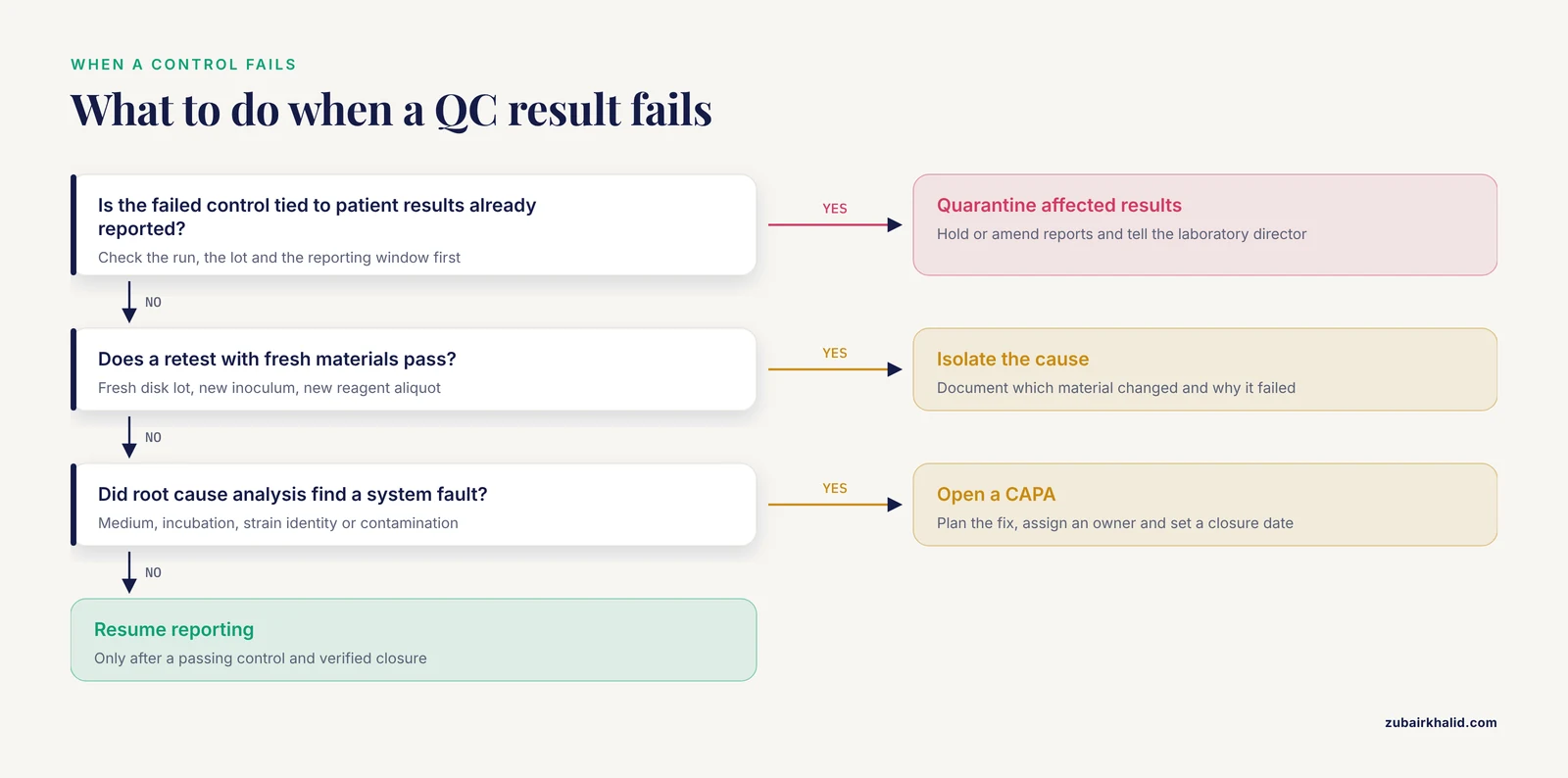 Quarantine affected patient results immediately, retest with fresh materials to isolate the cause, document root cause and corrective action, and assess whether any already reported results were compromised. Resume reporting only after a passing control.
How long does it take to design and implement a microbiology quality control program?
Most clinical laboratories need a few months from first draft to a functioning program. Hands-on work (inventory, documents, control selection, training) is the smaller share, while lot cycling, competency scheduling, and finishing an external quality assessment round set the pace.
Sources
- Development, Characterization, and Validation of an MS2 Phage-Based Armored RNA Control for Schmallenberg Virus Detection.
- Discovery Stack Pilot demonstrates the feasibility and outcomes of a scientist-designed peer-review model that separates quality and impact.
- Core Competencies of Nurses Working in Hospital Infection Prevention and Control: A Scoping Review and Cluster Analysis.
- First external quality assurance program of the Italian HLA-B*57:01 Network assessing the performance of clinical virology laboratories in HLA-B*57:01 testing.
- Aligning Antimicrobial Stewardship and Infection Prevention Through Repeated Assessment and Feedback: A Multisite Quality Improvement Initiative in Viet Nam.
- Effectiveness of Quality Improvement Strategies in Preventing Healthcare-Associated Infections Among Neurosurgical Patients Admitted to Intensive Care Units: A Systematic Review.
- The Queensland Bloodstream Infections (QBSI) study: rationale, protocol development and future directions.