Biosafety Level 3 Facility Requirements: A Checklist
By Dr. Zubair Khalid, DVM, MS, PhD ·
By the end of this guide you will be able to (1) determine whether your work actually requires Biosafety Level 3 containment, (2) build a defensible biosafety risk assessment for your agent and procedures, (3) audit or commission a BSL-3 facility against concrete engineering and operational requirements, and (4) produce a working checklist template that your institutional biosafety committee can review and approve.
You will need access to your institution's biosafety manual, your agent risk group determinations, facility drawings or HVAC schematics (if you are building or auditing), and your institutional biosafety committee's terms of reference. If you are writing a protocol rather than building a facility, you can complete most of this checklist with pen and paper.
What BSL-3 Means and When You Need It
Biosafety Level 3 (BSL-3) is a containment level applied to laboratories that work with indigenous or exotic agents that can cause serious or potentially lethal disease through inhalation exposure. The term "Risk Group 3" describes the hazard classification of the organism itself, while "BSL-3" describes the containment level of the facility and practices. The two are related but not identical, because the required containment level depends on what you are doing with the agent, not just what the agent is.
A clear example of this distinction comes from the laboratory response to SARS-CoV-2. Kaufer and colleagues classified SARS-CoV-2 as a Risk Group 3 biological agent based on epidemiologic and clinical data available in mid-2020, and discussed the corresponding establishment of BSL-3 regulations for laboratory manipulation of the virus [1]. Yet the same pathogen can be handled at lower containment when the specific activity reduces risk. Zou and colleagues developed a single-round infection fluorescent SARS-CoV-2 virus for neutralization testing that can be used safely at BSL-2, avoiding the need for BSL-3 facilities while maintaining 100% sensitivity and specificity compared with the conventional plaque reduction neutralization test [2]. Similarly, Grossegesse and colleagues established an inactivation method for mpox virus in viremic sera that removes up to five log-steps of infectious virus particles without compromising antibody detection, enabling MPXV serology outside BSL-3 facilities [3].
Conversely, some activities push an agent into BSL-3 territory regardless of how routine the organism seems. Cultivation of Coxiella burnetii, the causative agent of Q fever, is restricted to BSL-3 facilities due to biosafety concerns, even though serologic diagnosis by immunofluorescence assay and PCR for early detection can proceed at lower containment [4].
The strategic case for BSL-3 capacity is well documented. Vinhas and colleagues reviewed the global distribution of BSL-3 facilities and observed that the COVID-19 pandemic exposed limitations in laboratory capacity, leading many countries to operate in suboptimal environments and underscoring the need for strict biosafety standards and preparedness infrastructure [5]. Souza and Morel argued that BSL-3 facilities should be considered an integral part of any public health response to emerging infectious disease prevention, control, and management, noting that BSL-3 units vary considerably between industrialized and least developed countries [6].
The Biosafety Risk Assessment: Your Starting Point
Before you write a single facility requirement, you need a biosafety risk assessment. This is a structured evaluation that answers five questions:
- What is the agent? (identity, risk group, route of exposure, infectious dose)
- What are you doing with it? (in vitro culture, in vivo work, aerosol generation, scale)
- Who is exposed? (trained personnel, support staff, custodial workers, animal handlers)
- What can contain it? (primary barriers, secondary barriers, procedural controls)
- What happens if containment fails? (consequence analysis, emergency response)
A biosafety risk assessment is not a one-time document. It should be revisited whenever you change agents, procedures, equipment, or personnel. Roberts and colleagues, in their evaluation of a benchtop cell sorter for use at BSL-3, emphasized that potential users should consult with their Institutional Biosafety Committees (IBCs) to perform in-house risk assessments of new equipment before deployment [7]. The IBC review is not a formality. It is the mechanism by which your institution decides whether a specific instrument, procedure, or agent combination fits inside your existing containment envelope.
For a practical biosafety risk assessment format, structure your document as follows:
BIOSAFETY RISK ASSESSMENT TEMPLATE

Section 1: Agent Identification
  Agent name: ______________________
  Risk Group: RG-2 / RG-3 / RG-4
  Routes of exposure: inhalation / percutaneous / mucosal / ingestion
  Infectious dose (if known): ______________________
  Availability of prophylaxis or treatment: yes / no / limited

Section 2: Proposed Activities
  Activity type: in vitro / in vivo / both
  Scale: research / diagnostic / production
  Volumes or animal numbers: ______________________
  Aerosol-generating procedures: list each one
  Sharps use: yes / no (justify if yes)
  Shedding or environmental release potential: low / medium / high

Section 3: Containment Level Determination
  Required containment: BSL-2 / BSL-3 / BSL-3-Ag / ABSL-3
  Justification: ______________________
  Alternatives considered (inactivation, surrogate organism,
  closed-system equipment): ______________________

Section 4: Risk Mitigation Measures
  Primary barriers: ______________________
  Secondary barriers: ______________________
  PPE: ______________________
  Procedural controls: ______________________

Section 5: Emergency Response
  Spill procedure reference: ______________________
  Exposure protocol reference: ______________________
  Medical surveillance linkage: ______________________

Prepared by: __________ Date: __________
Reviewed by IBC: __________ Date: __________
This is a bsl-3 facility requirements template in miniature. When completed for your specific agent and procedures, it drives every downstream decision about facility design, equipment, and training.
BSL-3 Facility Requirements Checklist
The following checklist consolidates the core biosafety level 3 facility requirements drawn from established containment laboratory standards, European and international guidance on containment level 3 laboratories [8], and descriptions of purpose-built BSL-3 facilities for high-consequence pathology work [9].
Architectural and Structural Requirements
CHECKLIST SECTION A: FACILITY SHELL AND STRUCTURE

[ ] Located away from general building traffic flow
[ ] Separate from public or administrative areas
[ ] Entry through a controlled anteroom or airlock
[ ] Self-closing, locking doors at entry and exit
[ ] Double-door access (ante-room to lab, lab to exit)
[ ] Windows sealed and breakage-resistant
[ ] Walls, floors, and ceilings sealed for decontamination
    (monolithic or sealed seams, coved corners)
[ ] Penetrations in walls, floors, ceilings sealed
[ ] Surfaces resistant to water, chemical disinfectants,
    and repeated cleaning
[ ] No open recirculation between BSL-3 zone and adjacent
    spaces
[ ] Hand-washing sink available (hands-free operation
    preferred)
[ ] Eyewash station accessible
[ ] Emergency shower accessible or nearby
[ ] Utilities (electrical, gas, water) protected or
    shielded
[ ] Plumbing penetrations sealed and accessible for
    decontamination
Loibner and colleagues, in their description of a BSL-3 autopsy facility designed for highly pathogenic agents, emphasized that the facility must provide enhanced protection of personnel and the environment while supporting the full workflow from autopsy through biobanking and pathogen culture [9]. That principle applies to any BSL-3 build. The facility shell is not just a container. It is an engineering control that actively prevents release.
HVAC and Airflow Requirements
Ventilation is the defining engineering control that separates BSL-3 from BSL-2. Pastorino and colleagues highlighted that international, European, and French standards related to containment laboratory planning and operation describe optimal biosafety requirements for airflow management, and that essential requirements must be preserved to maintain efficient biosafety when manipulating risk group 3 biological agents [8].
CHECKLIST SECTION B: HVAC AND DIRECTIONAL AIRFLOW

[ ] Negative pressure relative to adjacent spaces
    (facility remains negative under all operating modes)
[ ] Directional airflow from clean to dirty zones
[ ] Dedicated exhaust air system (no recirculation to
    other building areas)
[ ] Exhaust air discharged away from occupied spaces
    and building air intakes
[ ] HEPA filtration of exhaust air (where required by
    agent, procedure, or local regulation)
[ ] Redundant exhaust fans or fail-safe design
[ ] Alarm or indicator for loss of negative pressure
[ ] Room pressure monitoring device visible at entry
    or in the room
[ ] Supply and exhaust interlocked (supply shuts down
    or reduces if exhaust fails)
[ ] Air change rate documented and verified
[ ] Filter housing designed for safe filter change
    (bag-in/bag-out, decontamination port)
[ ] Backdraft dampers on supply to prevent reverse
    flow
[ ] Commissioning report documenting airflow tests
The specific pressure differential and air change rate are not single universal numbers across all standards. Different regulatory frameworks and national implementations specify different values. Your facility designer and commissioning agent should identify which standard set applies to your jurisdiction and institution, and then document the values your facility achieves. What matters for the checklist is that the values are specified, verified during commissioning, and continuously monitored during operation.
Primary Containment Equipment
Primary containment refers to the equipment and devices that physically separate the agent from the worker. In a BSL-3 laboratory, the expectation is that all manipulations of infectious materials are performed inside a biological safety cabinet (BSC) or other contained equipment, not on the open bench.
CHECKLIST SECTION C: PRIMARY CONTAINMENT EQUIPMENT

[ ] Class II biological safety cabinet(s) installed,
    certified at installation and annually thereafter
[ ] BSC located away from doors, supply diffusers,
    and high-traffic zones
[ ] Centrifuge with sealed rotors or safety cups
    available
[ ] Vacuum lines protected with HEPA filters and
    liquid disinfectant traps
[ ] Autoclave available (in room, anteroom, or
    adjacent space preferred)
[ ] Equipment with aerosol-generating potential
    (sorters, homogenizers, sonicators) evaluated
    for containment or fitted with enclosures
[ ] Closed-system alternatives documented where used
[ ] All equipment certified for the specific
    containment level
Roberts and colleagues provided a concrete example of how new equipment enters a BSL-3 setting. Their team performed aerosol testing as part of the biosafety evaluation of a closed, cartridge-based cell sorter intended for use with risk group 3 pathogens including Francisella tularensis, Mycobacterium tuberculosis, Yersinia pestis, and SARS-CoV-2. They demonstrated that the instrument did not produce aerosols as part of the sort procedure, enabling safe benchtop use at BSL-3 [7]. The lesson for any facility is that equipment evaluation is agent-specific and procedure-specific. A device that is safe for one application may not be safe for another.
Klessing and colleagues described an analogous approach for virus production. They propagated SARS-CoV-2 in an automated, closed cell culture device within a common BSL-3 laboratory, achieving approximately 300-fold amplification under serum-free conditions with high lot-to-lot consistency in infectious titers [10]. The closed-system design reduced operator exposure while maintaining BSL-3 containment as a secondary barrier. This illustrates that BSL-3 facility requirements and closed-system engineering are complementary, not substitutes.
Operational Procedures
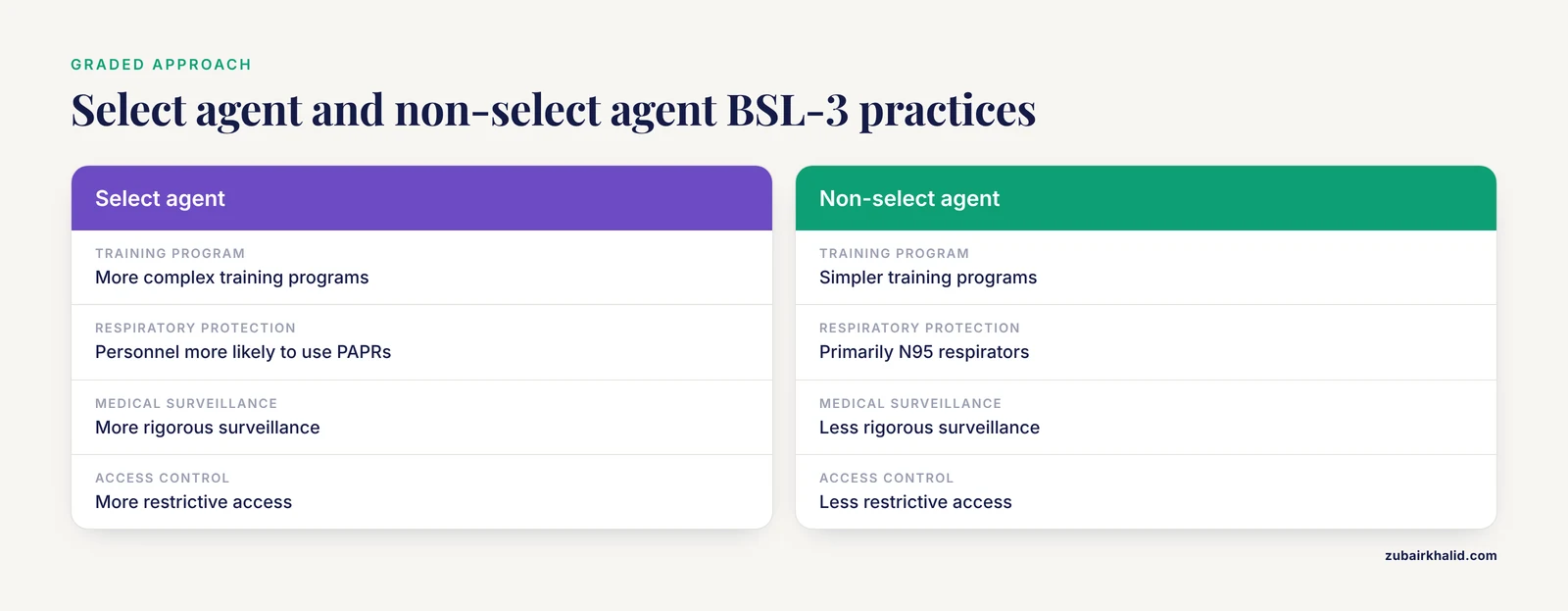
Operational procedures translate the physical facility into daily practice. Richards and colleagues compared BSL-3 laboratory practices across select agent and non-select agent facilities in the United States and found that facilities working with select agents had more complex training programs and decontamination procedures, that personnel in select agent laboratories were more likely to use powered air-purifying respirators (PAPRs) while non-select agent laboratories primarily used N95 respirators, and that more rigorous medical surveillance and more restrictive access were applied in select agent settings [11]. These differences reflect a graded approach. Your operational requirements scale with the consequence of exposure.
CHECKLIST SECTION D: OPERATIONAL PROCEDURES AND SOPs

[ ] Written biosafety manual specific to the facility
[ ] SOPs for every agent-specific procedure
[ ] SOPs reviewed and approved by IBC
[ ] Entry log maintained (name, date, agent in use)
[ ] Exit procedure includes PPE removal and hand
    hygiene
[ ] Street clothing separated from laboratory
    clothing (dedicated footwear, coats, or full
    change)
[ ] Respiratory protection program in place (N95
    fit-testing or PAPR maintenance per SOP)
[ ] No open-bench manipulation of RG-3 agents
    (all work in BSC or contained equipment)
[ ] Sharps use minimized and justified in writing
[ ] Biohazard signage at entry (agent name,
    responsible person, entry requirements,
    emergency contacts)
[ ] Decontamination of all waste before removal
    from facility
[ ] Decontamination of work surfaces after
    completion of work and after any spill
[ ] Decontamination of equipment before repair,
    relocation, or removal
[ ] Spill response procedure posted and practiced
[ ] Pest management program in place
Personnel Training and Competency
Microbiology biosafety training is a defined requirement for every person who enters a BSL-3 laboratory. Training is not a single event. It is a competency framework that includes initial qualification, supervised practice, annual review, and retraining after procedural changes or incidents.
Richards and colleagues found that select agent facilities had more complex training programs than non-select agent facilities [11]. The specific elements of a training program include:
CHECKLIST SECTION E: MICROBIOLOGY BIOSAFETY TRAINING

[ ] Initial classroom training on biosafety principles
[ ] Agent-specific training (transmission, infectious
    dose, disease presentation, treatment availability)
[ ] Facility-specific orientation (HVAC alarms, entry
    and exit, emergency procedures)
[ ] Equipment-specific training (BSC use, centrifuge
    safety, closed-system devices)
[ ] Hands-on competency assessment (observed
    performance of key procedures)
[ ] Annual refresher training documented
[ ] Retraining after SOP changes, incidents, or
    prolonged absence
[ ] Training records maintained and auditable
[ ] Visitor and maintenance personnel training or
    escort policy defined
[ ] Emergency response drill (spill, injury,
    equipment failure) conducted and documented
Medical Surveillance
Medical surveillance for BSL-3 workers includes baseline assessment, ongoing monitoring relevant to the agents handled, and a defined response protocol for exposures. The rigor of medical surveillance varies with agent consequence. Richards and colleagues reported that more rigorous medical surveillance was carried out in select agent workers compared with non-select agent workers, even though enhanced surveillance was not required by the select agent program itself [11].
CHECKLIST SECTION F: MEDICAL SURVEILLANCE

[ ] Baseline health assessment for all BSL-3
    personnel
[ ] Agent-specific immunization where available and
    recommended
[ ] Serum banking (baseline sample stored for
    comparison in case of exposure)
[ ] Occupational health linkage for exposure
    evaluation
[ ] Clear protocol for reporting exposures,
    symptoms, or potential releases
[ ] Annual review of surveillance program adequacy
[ ] Records confidential and compliant with
    applicable privacy regulations
Decontamination and Waste Management
Every solid and liquid waste stream leaving a BSL-3 must be decontaminated. This is a non-negotiable requirement across all containment standards. The method depends on the waste type.
CHECKLIST SECTION G: DECONTAMINATION AND WASTE

[ ] Autoclave validated for the load types used
    (cycle parameters documented)
[ ] Chemical disinfectant(s) selected with
    documented efficacy against the agent
[ ] Disinfectant contact time and concentration
    specified in SOPs
[ ] Liquid waste chemical decontamination procedure
    defined
[ ] Sharp and sharps container management defined
[ ] Animal carcass decontamination pathway defined
    (incineration, alkaline hydrolysis, or other
    validated method)
[ ] Transport of waste from facility to autoclave
    or incinerator via closed, leak-proof containers
[ ] Periodic verification of decontamination
    efficacy (biological indicators, chemical
    indicators, or equivalent)
Security and Access Control
Biosecurity, as distinct from biosafety, addresses the prevention of unauthorized access, loss, theft, misuse, or intentional release of biological agents. Pastorino and colleagues noted that biosecurity is a relatively new concept and that few EU Member States had introduced national laboratory biosecurity legislation at the time of their review, with France being one exception that reinforced biosafety and biosecurity in containment level 3 laboratories through recent regulations [8].
CHECKLIST SECTION H: SECURITY AND ACCESS

[ ] Physical access control (card reader, biometric,
    or key with documented accountability)
[ ] Access list maintained and reviewed periodically
[ ] Visitor policy (authorization, escort,
    sign-in/log)
[ ] Agent inventory maintained (agent, amount,
    date, responsible person)
[ ] Inventory reconciliation performed at defined
    intervals
[ ] Reportable loss or theft protocol in place
[ ] Background review or trust determination for
    personnel where required
[ ] Cybersecurity for agent-related data and
    equipment controllers addressed
[ ] Chain-of-custody documentation for agent
    transfer into or out of the facility
For agents of extreme consequence, such as variola virus, the security dimension becomes even more significant. Bülbül and Kara analyzed the convergence of technical feasibility for de novo orthopoxvirus synthesis with the expanding population-level immunity gap following cessation of routine vaccination, and proposed a multidimensional framework integrated with One Health principles and transnational coordination to mitigate threats from high-consequence agents [12]. While most BSL-3 laboratories will never handle variola virus, the principle that security measures should be proportional to the strategic risk of the agent applies broadly.
Animal Containment (ABSL-3 and BSL-3-Ag)
If your program includes in vivo work with risk group 3 agents in animals, additional requirements apply. Olsen described the regulatory requirement in the United States for animal biosafety level 3 (ABSL-3) or biosafety level 3 agriculture (BSL-3-Ag) containment for many endemic zoonotic pathogens and etiologic agents of foreign animal diseases, including Brucella and Mycobacterium bovis [13]. Frasier and Talka discussed design considerations for select agent animal research facilities and the special requirements associated with BSL-3-Ag agricultural research [14].
CHECKLIST SECTION I: ANIMAL CONTAINMENT (if applicable)

[ ] ABSL-3 or BSL-3-Ag designation confirmed by IBC
[ ] Animal rooms sealed and directional airflow
    maintained
[ ] Cage-change and bedding-dump procedures inside
    BSC or ventilated enclosures
[ ] Species-specific risk factors evaluated
    (flight distance, aggression, social needs,
    predictability per Olsen [13])
[ ] PPE appropriate for species and procedure
    (respiratory protection, cutaneous protection)
[ ] Waste (bedding, carcasses, fluids) decontaminated
    before removal
[ ] Vents, drains, and penetration sealed in animal
    rooms
[] Feed, water, and bedding entering facility
    decontaminated or from verified clean sources
[ ] Emergency animal care procedure defined
[ ] BSL-3-Ag considerations addressed (if agricultural
    agents used, including barrier walls, dedicated
    air handling, and shower-out capability per
    Frasier and Talka [14])
Dennis and colleagues at the UK Health Security Agency described strategies for high containment of species including mice, ferrets, hamsters, rabbits, and macaques infected with high-consequence pathogens, using directional flow containment systems, aerosol challenge routes, and sampling methods including lung lavage and medical imaging to inform pathogenesis assessment while providing refinement in application of early humane endpoints [15]. Their approach illustrates that ABSL-3 facility requirements extend beyond the physical barrier to include operational refinements that reduce risk to both animals and personnel.
Commissioning and Verification
A facility that looks correct on paper is not the same as a facility that performs correctly under operating conditions. Commissioning is the documented process of testing and verifying that all engineering controls, HVAC systems, alarms, and interlocks function as designed.
CHECKLIST SECTION J: COMMISSIONING AND VERIFICATION

[ ] Pre-commissioning review of design documents
    against applicable standards
[ ] Duct leakage testing completed
[ ] Room pressurization tested under all operating
    modes (normal, maintenance, emergency)
[ ] Airflow visualization (smoke pencil or particle
    tracer) at doorways and anteroom
[ ] HEPA filter integrity tested (DOP/PAO or
    equivalent)
[ ] Alarms tested (pressure, airflow, door position)
[ ] Interlocks tested (supply-exhaust, door
    interlock)
[ ] BSC certification at installation documented
[ ] Autoclave validated (temperature, pressure,
    time, biological indicators)
[ ] Emergency power tested for critical systems
[ ] Commissioning report compiled and signed
[ ] Annual re-verification scheduled and documented
Richards and colleagues noted that the CDC inspects BSL-3 facilities and reviews commissioning documentation in the United States, but no single agency has oversight over all BSL-3 facilities [11]. This means that the burden of demonstrating adequate commissioning falls on the institution. Your commissioning report should be thorough enough to withstand external audit.
Worked Example: Building a BSL-3 Checklist from Scratch
Suppose you are establishing a diagnostic microbiology laboratory that will culture Mycobacterium tuberculosis complex isolates from clinical specimens. Here is how you would apply the checklist framework step by step.
Step 1: Define the agent. M. tuberculosis is a Risk Group 3 organism transmitted by the airborne route. The infectious dose for humans is not precisely defined but is generally considered low, on the order of a few bacilli for sensitive individuals. No licensed human vaccine with reliable efficacy against pulmonary disease is available in most settings.
Step 2: Define the activities. You will perform (a) digestion and decontamination of clinical specimens, (b) culture on solid and liquid media, (c) identification by molecular methods, and (d) drug susceptibility testing. Digestion and decontamination involve centrifugation and vortexing, both of which generate aerosols if containment fails.
Step 3: Determine containment level. Culture of M. tuberculosis requires BSL-3. However, staining and molecular detection of smear-negative, heat-inactivated, or chemically inactivated specimens may proceed at BSL-2 with appropriate procedures. Your risk assessment should specify which activities occur at which containment level and document the justification.
Step 4: Select engineering controls. You will need a BSL-3 laboratory with negative pressure, dedicated exhaust, HEPA filtration of room exhaust (where required), Class II BSC for all open manipulations, sealed centrifuge rotors or safety cups, and an autoclave accessible without leaving containment.
Step 5: Select PPE. Respiratory protection (N95 fit-tested or PAPR, per your institutional program) is required for all entry into the BSL-3. The choice between N95 and PAPR depends on the agent, procedure, and your institutional assessment. Richards and colleagues found that select agent BSL-3 laboratories were more likely to use PAPRs while non-select agent laboratories primarily used N95s [11].
Step 6: Write SOPs and train personnel. Each activity (digestion, centrifugation, culture, DST) gets its own SOP. Personnel complete agent-specific and facility-specific training, pass a hands-on competency assessment, and are documented in the training record.
Step 7: Commission the facility. Before bringing the agent on site, verify all engineering controls through the commissioning process. Do not accept a verbal assurance that airflow is correct. Test it, document it, and file the report.
Step 8: Apply for IBC approval. Submit your completed risk assessment, SOPs, facility description, and training plan to your IBC. Address all questions before bringing agent into the facility.
Summary Table of Key BSL-3 Facility Requirements
| Category | Requirement | Verification Method |
|---|---|---|
| Facility shell | Sealed penetrations, coved corners, breakage-resistant windows | Visual inspection, smoke test |
| Entry | Two sets of self-closing, locking doors (anteroom) | Physical inspection |
| Airflow | Negative pressure, directional flow clean-to-dirty | Pressure monitor, smoke visualization |
| Exhaust | Dedicated, non-recirculated, HEPA-filtered where required | Filter integrity test, airflow measurement |
| Primary containment | Class II BSC for all open manipulations | Annual NSF/ANSI certification |
| Centrifugation | Sealed rotors or safety cups | Equipment specification review |
| Decontamination | Validated autoclave for all waste | Biological indicator testing |
| PPE | Respiratory protection (N95 or PAPR) with fit-testing or maintenance program | Fit-test record, PAPR maintenance log |
| Training | Agent-specific, facility-specific, annual refresher | Training record audit |
| Medical surveillance | Baseline assessment, serum banking where indicated | Occupational health record |
| Access control | Locking doors, access log, visitor policy | Access list audit |
| Security | Agent inventory, reconciliation, loss report protocol | Inventory count |
| Commissioning | Documented performance verification of all systems | Commissioning report |
Common Mistakes and Limitations
Underestimating the risk assessment. Many facilities treat the biosafety risk assessment as a formality to satisfy the IBC. The assessment is the document that drives every other decision. If you get it wrong, every downstream control is built on a false premise.
Confusing risk group with biosafety level. Risk group classifies the organism. Biosafety level classifies the facility and practices. A risk group 3 organism handled in a closed system may be manageable at a lower containment level, while a risk group 2 organism processed in a way that generates high-concentration aerosols may require elevated containment. Always assess the activity, not just the agent.
Treating training as a checkbox. A signature on a training record is not the same as demonstrated competency. Hands-on assessment matters, especially for high-risk procedures.
Neglecting the commissioning file. A facility without a commissioning report has no objective evidence that its engineering controls work. When an inspector or reviewer asks for evidence, you need documentation, not reassurance.
Skipping annual re-verification. Engineering controls degrade. HEPA filters develop leaks. Fans drift. Door seals age. Annual re-verification is the minimum acceptable interval for most engineering control testing.
Failing to address animal containment distinctly. ABSL-3 is not simply BSL-3 with animals inside. Olsen emphasized that factors including flight distance, herd orientation, social needs, aggressiveness, and predictability must be considered on a species-by-species basis when designing containment for large ruminants and wildlife [13]. Applying a standard BSL-3 checklist to an animal facility will miss critical requirements.
Inadequate emergency preparedness. Spills, equipment failures, and personnel injuries will occur eventually. A facility that has not drilled its emergency response will make poor decisions under pressure. Practice spill response, evacuation, and equipment failure scenarios before they happen.
Inconsistent PPE programs. If some personnel wear N95s and others wear PAPRs in the same space, your respiratory protection program is inconsistent. Choose one approach, document the justification, and enforce it uniformly.
Ignoring the consequences of renovation or maintenance. Any work that breaks the containment envelope (ceiling tile removal, ductwork repair, plumbing work) must be treated as a containment breach event with defined procedures for re-verification before resuming agent work.
Individual diagnostic or research decisions about containment level always require evaluation by a qualified biosafety professional working with your IBC. This checklist is a framework for organizing that evaluation, not a substitute for it.
Frequently Asked Questions
What is the difference between BSL-2 and BSL-3 facility requirements?
BSL-3 adds directional airflow, negative pressure, dedicated non-recirculated exhaust, sealed room construction, controlled access through an anteroom, respiratory protection, and restricted access compared to BSL-2. BSL-2 relies primarily on BSCs and standard microbiological practices, while BSL-3 makes the room itself an engineering control.
Can I do BSL-3 work in a BSL-2 laboratory if I only process inactivated samples?
Yes, if you can document that the inactivation method is validated and effective for your specific agent and sample matrix. Grossegesse and colleagues demonstrated an inactivation method for mpox virus in viremic sera that removed up to five log-steps of infectious virus without compromising antibody detection, enabling testing outside BSL-3 [3]. The burden is on the laboratory to prove inactivation, not assume it.
What respiratory protection is required in a BSL-3 laboratory?
Either a fit-tested N95 respirator or a powered air-purifying respirator (PAPR), depending on your institutional risk assessment and agent. Richards and colleagues found that select agent BSL-3 laboratories primarily used PAPRs while non-select agent laboratories primarily used N95s [11]. Your biosafety risk assessment determines which is appropriate.
How often should a BSL-3 facility be re-certified or re-commissioned?
Engineering controls including HEPA filters, BSCs, and pressure monitoring devices should be verified at least annually. BSCs require annual certification per NSF/ANSI standards. Full facility re-commissioning should occur after any significant renovation, HVAC modification, or containment breach event.
What is the difference between BSL-3 and BSL-3-Ag?
BSL-3-Ag adds requirements for containment of agricultural pathogens that may affect livestock or the environment, including more robust physical barriers, dedicated air handling, and shower-out capability. Frasier and Talka described the special requirements associated with BSL-3-Ag agricultural research, which go beyond standard BSL-3 laboratory requirements [14].
Do all BSL-3 laboratories need HEPA filtration of exhaust air?
Not universally. The requirement depends on the agent, the procedures performed, and the applicable regulatory framework. Pastorino and colleagues described how international, European, and French standards related to containment laboratory planning specify optimal biosafety requirements, with HEPA filtration of exhaust air required in many but not all BSL-3 applications [8]. Your applicable standard determines the requirement.
Who approves a BSL-3 facility to begin operation?
Your Institutional Biosafety Committee (IBC) reviews the risk assessment, SOPs, and facility documentation. In the United States, the CDC inspects BSL-3 facilities that work with select agents and reviews commissioning documentation, but no single agency has oversight over all BSL-3 facilities [11]. Your institution is responsible for demonstrating compliance with all applicable standards before bringing agent into the space.
How do I determine what containment level my specific agent requires?
Start with the agent's assigned risk group, then adjust for your specific activities. Consider route of exposure, quantity, concentration, aerosol generation potential, availability of prophylaxis, and consequence of release. A biosafety risk assessment reviewed by your IBC is the definitive determination. If cultivation of your agent is explicitly restricted to BSL-3, as with Coxiella burnetii [4], that requirement is non-negotiable regardless of other mitigations.
Sources
- Laboratory biosafety measures involving SARS-CoV-2 and the classification as a Risk Group 3 biological agent.
- A Single-Round Infection Fluorescent SARS-CoV-2 Neutralization Test for COVID-19 Serological Testing at a Biosafety Level-2 Laboratory.
- Serological methods for the detection of antibodies against monkeypox virus applicable for laboratories with different biosafety levels.
- Global epidemiology and molecular typing of Coxiella burnetii: A systematic review of Q fever in humans and animals.
- The Role of BSL-3 Laboratories in Pandemic Preparedness: A Focus on Brazil's Infrastructure for Biosafety and Disease Control.
- The COVID-19 pandemics and the relevance of biosafety facilities for metagenomics surveillance, structured disease prevention and control.
- Validation and Application of a Benchtop Cell Sorter in a Biosafety Level 3 Containment Setting.
- Biosafety and Biosecurity in European Containment Level 3 Laboratories: Focus on French Recent Progress and Essential Requirements.
- Biosafety Requirements for Autopsies of Patients with COVID-19: Example of a BSL-3 Autopsy Facility Designed for Highly Pathogenic Agents.
- Propagation of SARS-CoV-2 in a Closed Cell Culture Device: Potential GMP Compatible Production Platform for Live-Attenuated Vaccine Candidates under BSL-3 Conditions?
- BSL-3 laboratory practices in the United States: comparison of select agent and non-select agent facilities.
- Global health security and smallpox: A strategic review of post-eradication biosafety and preparedness.
- Biosafety considerations for in vivo work with risk group 3 pathogens in large animals and wildlife in North America.
- Facility design considerations for select agent animal research.
- Facility design and management. Strategies for high level biocontainment.