Biosafety Training for BSL-3 Labs
By Dr. Zubair Khalid, DVM, MS, PhD ·
BSL-3 biosafety training differs from ordinary laboratory safety instruction because it must end in demonstrated, task-specific competency inside containment rather than a certificate of attendance. The rule of thumb for choosing among the available options is simple: pick the format whose final assessment observes the exact procedures your facility's biosafety risk assessment identifies as highest risk, then layer the other formats around it.
This article is written for the people who build and run those programs: laboratory directors, biosafety officers, and senior bench scientists in clinical and research microbiology. It covers what BSL-3 training must contain, the main training options with their pros and cons, a worked sequence for onboarding and refresh, and the assessment methods that separate verified competency from paperwork.
What BSL-3 Biosafety Training Must Cover
A Biosafety Level 3 (BSL-3) laboratory is a containment facility designed for work with indigenous or exotic agents that can cause serious or potentially lethal disease through inhalation. In clinical and research microbiology the usual examples are culture of SARS-CoV-2, Mycobacterium tuberculosis, and viruses such as Crimean-Congo hemorrhagic fever virus. The engineering hallmarks are directional airflow with negative pressure, meaning the room is held at lower pressure than adjacent spaces so air flows inward, controlled access through self-closing doors, dedicated equipment, and exhaust air that is filtered or treated before release.
Because the agents inside are hazardous when inhaled, everything in the room is treated as potentially infectious: the air, the surfaces, and every procedure that can generate an aerosol, a suspension of droplets or particles small enough to stay airborne and be inhaled. An error that is a nuisance at Biosafety Level 2 (BSL-2), such as a dropped tube, becomes a potential exposure at BSL-3.
That difference sets the curriculum. Microbiology biosafety training at lower levels centers on aseptic technique, the practices that keep cultures and the environment free of contamination, along with standard precautions and sharps discipline. BSL-3 biosafety training adds containment-specific skills, and every one of them must be practiced and observed rather than merely described:
- Entry and exit choreography, including gowning order, doffing order, and hand hygiene between steps.
- Personal protective equipment (PPE), the barrier clothing and respiratory protection specified by the risk assessment, including selection, fit and seal checks, and doffing without self-contamination.
- Safe execution of aerosol-generating procedures inside a biosafety cabinet, a ventilated enclosure that protects both the worker and the work.
- Spill response inside containment, including evacuation decisions, disinfectant contact times, and re-entry criteria.
- Waste movement and inactivation, from the bench through validated autoclave or chemical treatment cycles.
- Facility system awareness, including airflow indicators, alarms, and interlocks, devices that prevent door or equipment operation unless a safety condition is met.
- Emergency response, including exposure pathways, medical follow-up, and incident reporting.
The procedural load scales with containment. At the BSL-4 suit laboratory of the NIH/NIAID Integrated Research Facility at Fort Detrick, entry and exit are considerably more complex and time-consuming than at BSL-2 and BSL-3, and researchers perform most of their work at lower levels and move up only when a high-consequence agent requires it [1]. The same gradient applies one level down. A BSL-2 course does not prepare anyone for BSL-3, and BSL-3 competency does not transfer automatically to a BSL-4 suit laboratory.
Access to training is now close to universal in many national systems. A nationwide cross-sectional survey of Chinese CDC microbiology laboratories collected 990 valid responses between 2021 and 2023 and documented biosafety training coverage of 98.69 percent, near-universal BSL-2 presence, and a varied BSL-3 footprint across provincial, city, and county levels [2]. Coverage is not the same as verified competency, and that gap is where program design and assessment decide outcomes. The verification problem grows with capacity. Rapid expansion of BSL-3 laboratories in India under the National One Health Mission prompted development of a standard assessment tool precisely because no uniform method existed to evaluate compliance and staff competencies across the network [3].
Start With a Biosafety Risk Assessment
A biosafety risk assessment is the systematic evaluation of two questions, how hazardous the agent is and how risky the planned procedures are, followed by selection of containment, practices, PPE, and training that bring residual risk to an acceptable level. Agent factors include aerosol transmissibility, infectious dose, disease severity, and the availability of prophylaxis or treatment. Procedure factors include aerosol generation, volumes and concentrations handled, sharps use, and equipment that can spray, splash, or fail.
Biorisk management (BRM) is the umbrella system that runs biosafety, which protects people from the agent, together with biosecurity, which protects the agent from theft, loss, or misuse. A BSL-3 core facility at the Yong Loo Lin School of Medicine of the National University of Singapore implemented a BRM system for SARS-CoV-2 research that prioritizes risk assessments before work processes are implemented, reassesses the facility's risk portfolio over time, determines root causes of failures, and invests in awareness raising and education of laboratory users [4]. The direct consequence for training is that the syllabus is an output of the risk assessment, not a fixed course.
Containment level itself is a risk-based decision. For Crimean-Congo hemorrhagic fever virus (CCHFV), countries where the virus is absent classify it as a hazard group 4 agent handled at containment level 4, while endemic countries have processed diagnostic samples under BSL-2 or BSL-3 conditions for years, including more than 100,000 samples handled safely in BSL-2 laboratories in Turkey and several Balkan countries. On that evidence the authors argue for enhanced BSL-2 diagnostics under standardized protocols, with consideration of BSL-3 for research work [5]. Training programs should be built around the tasks actually performed at the chosen level, not around a generic idea of high containment.
The most underrated training decision happens before training starts: removing work from BSL-3 through validated alternatives. Three examples from the SARS-CoV-2 literature show the pattern.
- A single-cycle virus replicon particle (VRP) system, in which particles enter cells and replicate their RNA once but cannot generate new infectious progeny, carries a SARS-CoV-2 genome with the spike gene replaced by a firefly luciferase reporter and is pseudotyped, meaning surfaced, with vesicular stomatitis virus glycoprotein. Intranasal delivery into mouse lungs reproduces key features of infection and supports antiviral evaluation, all at BSL-2 [6].
- A cellular assay built around a tagged SARS-CoV-2 main protease (Mpro) construct, the viral enzyme that processes viral polyproteins and a validated drug target, screens candidate inhibitors such as GC376 and boceprevir at Biosafety Level 1 by monitoring autodigestion of the tagged protein [7].
- Beta-propiolactone (BPL) inactivation, validated for SARS-CoV-2 in saliva and in bicarbonate-buffered culture medium, used 0.1 percent BPL held at 2 to 8 degrees Celsius for 1 hour or 71 hours, followed by hydrolysis at 37 degrees Celsius that converts residual BPL into non-toxic beta-hydroxypropionic acid. The validated cycle achieved titre reductions of up to 10^4 TCID50/ml, where TCID50 is the dilution of virus that infects 50 percent of inoculated cell cultures, and allowed material to leave containment for downstream use [8].
Each validated downgrade removes a block of staff from the BSL-3 training pipeline. The validation protocol itself becomes a training module for the smaller group that performs it, because an inactivation cycle is only as safe as the discipline of the people running it.
Method design inside containment matters as well. A human airway organ-on-a-chip, a microfluidic device carrying living human airway cells that reproduce barrier function and immune signaling, was engineered to run in BSL-3 space with high throughput and minimal manipulation while preserving readouts such as barrier permeability, cytokine production, and viral load [9]. Fewer manipulations mean fewer high-risk steps to train, assess, and audit.
BSL-3 Biosafety Training Options
Biosafety training for BSL-3 labs comes in five practical formats, plus the procedure-level standard operating procedure (SOP) training that binds them to daily work. A SOP is a written, step-by-step protocol for a specific task. Most durable programs blend several formats. The table compares the options on the criteria that decide real choices.
| Training option | Format and evidence | Best for | Strengths | Limitations |
|---|---|---|---|---|
| In-house mentorship with hands-on practice | Curriculum built on WHO biosafety guidelines, local standards, and the facility's live research, delivered through hands-on sessions and mentorship [10] | New BSL-3 users at a single facility | Facility-specific content, immediate correction, transfers tacit doffing and spill skills | Throughput limited by mentor time, consistency varies between mentors, weak standardization across sites |
| Modularized theory with standardized practical assessment | Theory modules combined by role and skill level, paired with a standardized practical assessment [11] | Mixed cohorts, multi-role staffing, national networks | Scalable, role-tailored, objective baseline and exit criteria, extends to support staff | Requires curriculum development and calibrated assessors, theory alone builds no motor skills |
| Virtual simulation operation (VSO) | Interactive simulation of BSL-3 SARS-CoV-2 work combined with offline teaching [12] | Pre-arrival preparation, large classes, refreshers | Unlimited repetition, consumes no containment time, safe to fail | No PPE heat load or real consequences, cannot certify hands-on skill alone |
| Networked or partner-led training | Shared curricula and lessons across high-containment institutions and countries [11], as in the NUITM-KEMRI partnership [10] | Institutions without mature in-house programs | Pooled expertise, external benchmarking, shared scenarios | Logistics and scheduling costs, imported content must be localized |
| AI-assisted compliance monitoring | Camera-based deep learning verification of PPE and alert-zone compliance [13] | Sustaining trained behavior after certification | Continuous and objective, catches drift between refreshers, creates auditable records | Verifies compliance rather than building skill, bounded by camera coverage and trained classes, needs image governance |
| Procedure-specific SOP training | Stepwise documented protocols for entry and exit [1], platform workflows such as BSL-3 cryo-electron tomography [14], zone-based PPE assignment [15] | Task certification for specific roles | Precise, auditable, directly tied to the task | Narrow scope, must be updated with every protocol or equipment change |
Pros and Cons of Each BSL-3 Biosafety Training Option
In-house mentorship with hands-on practice
The NUITM-KEMRI biosafety training model was built for capacity building of new BSL-3 laboratory users. Its curriculum rests on WHO biosafety guidelines, where WHO is the World Health Organization, together with local biosafety standards and the ongoing BSL-3 research activities of the facility, updated as public health issues evolve. The approach pairs theory with hands-on practice sessions and mentorship so that trainees integrate the knowledge and good practices into their routine laboratory procedures [10].
The strengths are facility specificity and feedback. Your doors, alarms, airflow patterns, and SOPs are not generic, and a mentor standing next to a trainee catches the doffing error that a video never would. The weaknesses are throughput and consistency. Mentor time caps cohort size, quality varies between mentors, and a small program may lack the calibrated assessors needed for objective sign-off.
Modularized theory with standardized practical assessment
The training program developed for Level 3/4 staff at China's first BSL-4 laboratory, in Wuhan, comprises 14 modularized theoretical topics so that staff with different backgrounds take different topic combinations according to their knowledge and skill level. It pairs the modules with a standardized practical training assessment designed for use before, during, and after training [11].
The strengths are scalability and role-tailoring without rewriting the course. The same architecture covers a bench scientist, an engineer, and an emergency responder with different module combinations, and the before-during-after assessment structure produces an objective baseline, catches bad habits early, and gates independent work. The weaknesses are the upfront investment in curriculum development and the need for assessors who are themselves trained and calibrated. Modular theory alone also builds no muscle memory, so it must connect to hands-on practice.
Virtual simulation operation
A study in undergraduate medical laboratory technology students compared a virtual simulation operation (VSO) platform for BSL-3 SARS-CoV-2 isolation and culture, combined with offline practical teaching, against offline teaching supplemented by standard video review. The VSO group scored significantly better on comprehensive practical performance, operational skills, and laboratory biosafety awareness [12].
The strengths are repetition without cost or risk. A trainee can walk through entry, spill decisions, and exit dozens of times before touching a door handle, no containment time or mentor hour is consumed, and failure carries no consequence. The weaknesses are physical. No simulation reproduces respirator comfort limits, glove and gown dexterity under heat, or the stakes of a real room, so hands-on verification remains mandatory.
Networked and partner-led training
High-containment laboratories increasingly coordinate to share experiences and lessons, on the reasoning that trained and experienced staff are the most important factor contributing to safety and security and that a standard training program can be built from the policies and practices of BSL-3 and BSL-4 laboratories in other countries [11]. Partnership models such as NUITM-KEMRI apply the same principle to capacity building across institutions [10].
The strengths are access to scarce expertise and benchmarking against peers, which matters most for institutions without a mature in-house program. The weaknesses are logistics and localization. Scheduling across institutions is slow, and imported content must be adapted to your facility's systems and applicable regulations before any of it reaches a trainee.
AI-assisted compliance monitoring
An AI-empowered system for BSL-3 facilities uses an external camera and a deep learning model trained on 4,112 images across 15 PPE compliance classes to verify clothing, masks, hoods, double-layer gloves, shoe covers, and respirators against WHO standards, achieving 97.52 percent accuracy and 97.03 percent recall, with results displayed in real time and stored on an administrator dashboard. An internal management system trained on 3,347 images reached 90 percent accuracy for alert-zone delineation and protocol compliance [13].
The strength is persistence. Human oversight relaxes between refreshers, and a camera system does not, so trained behavior is reinforced continuously and converted into an auditable record. The weaknesses are clear. Monitoring verifies compliance rather than building skill, it is bounded by camera coverage and by the classes the model was trained on, and image capture inside or outside containment raises governance and privacy questions that need institutional policy.
Procedure-specific SOP training
Documented, stepwise protocols are the backbone of task certification. Entry and exit procedures for a BSL-4 suit laboratory have been published as verifiable step sequences covering external system checks through the full exit pathway [1], and the same format works at BSL-3 for gowning, doffing, spill response, and waste movement. Platform-specific add-ons follow the same pattern, for example a validated BSL-3 cryo-electron tomography workflow, which images frozen, unstained specimens in three dimensions close to their native state, integrating facility design, containment measures, sample handling, cryo-transfer systems, and decontamination protocols into a single blueprint [14].
The strengths are precision and auditability. A stepwise SOP maps directly to an assessment checklist and to a version-controlled document trail. The weaknesses are narrow scope and staleness. Each SOP certifies one task, and every protocol or equipment change triggers review and retraining.
Choosing the Best BSL-3 Biosafety Training for Your Program
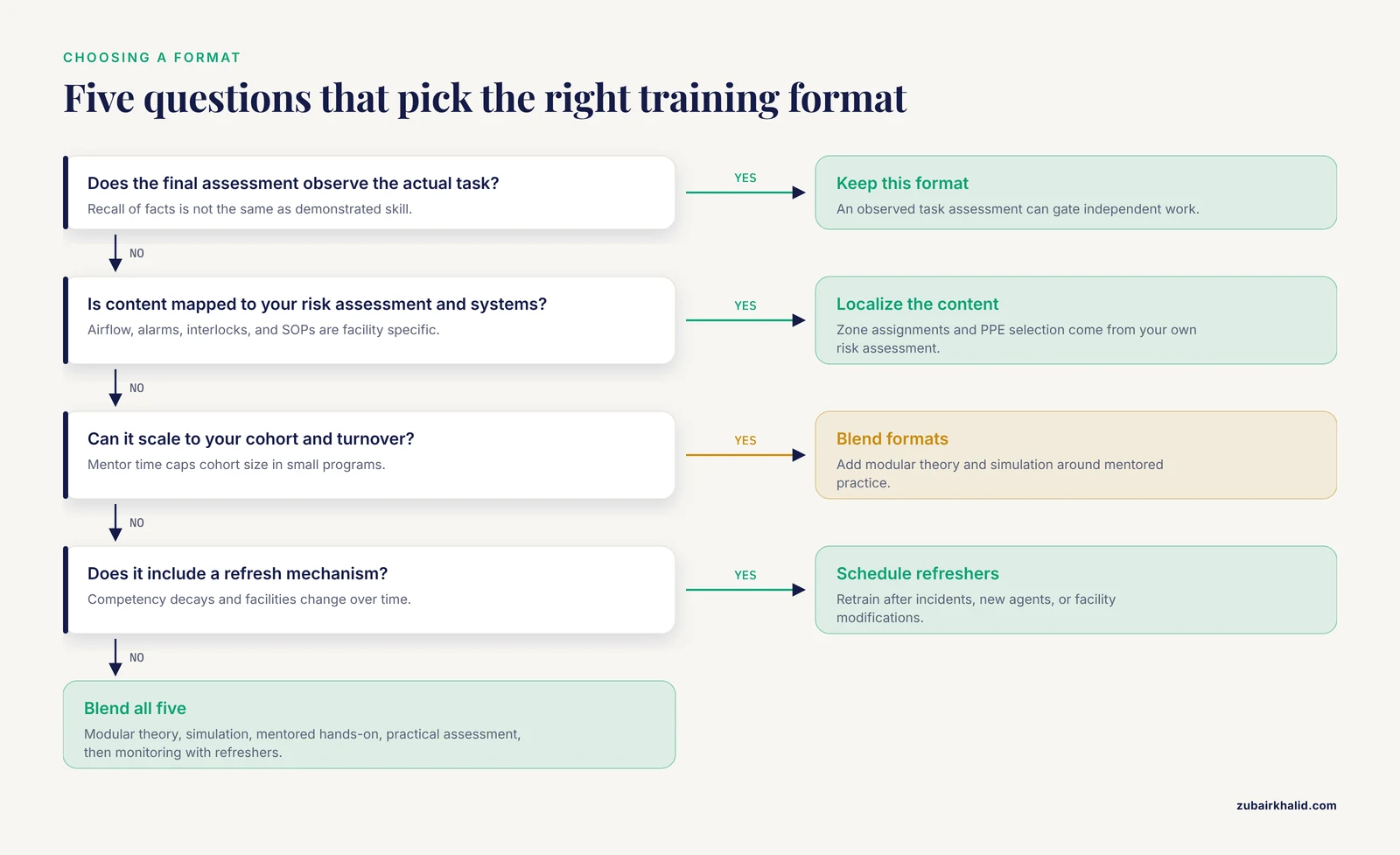
Choosing the best BSL-3 biosafety training for a program comes down to five questions, asked in order.
- Does the final assessment observe the actual task, or only recall of facts?
- Is the content mapped to your biosafety risk assessment and your facility's own systems?
- Can the format scale to your cohort, turnover, and language needs?
- Does it generate records a reviewer can audit, in the spirit of the scoring checklists now used to evaluate national BSL-3 networks [3]?
- Does it include a refresh mechanism rather than a one-time event?
A program that answers yes to all five is almost always a blend: modular theory first, simulation second, mentored hands-on third, standardized practical assessment fourth, and monitoring with scheduled refreshers fifth.
Scenario 1: Onboarding a researcher to a university SARS-CoV-2 core facility
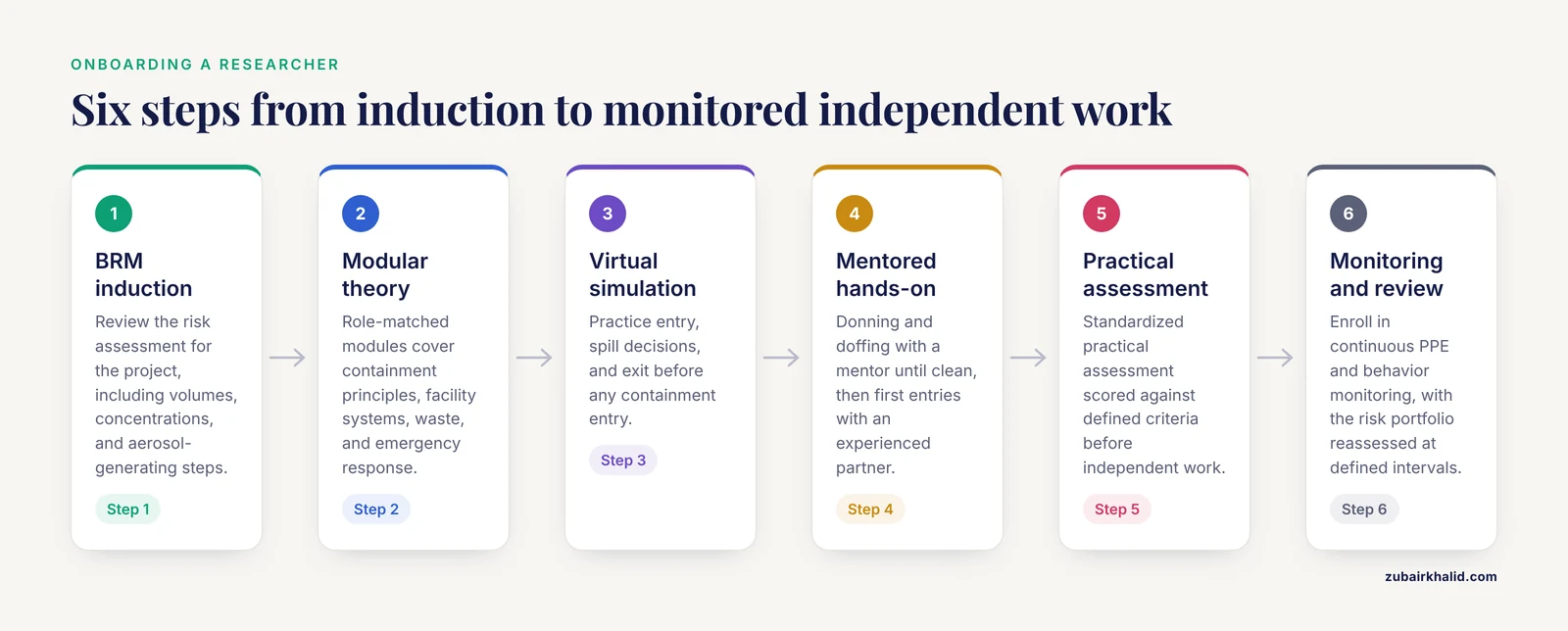
Consider a new postdoc joining a BSL-3 core facility that handles SARS-CoV-2, modeled on the BRM system at NUS Medicine [4]. A workable sequence runs as follows.
- BRM induction and review of the risk assessment for the specific project, including volumes, concentrations, and aerosol-generating steps.
- Modular theory matched to role, covering containment principles, facility systems, waste, and emergency response [11].
- VSO practice of entry, spill decisions, and exit before any containment entry [12].
- Hands-on donning and doffing with a mentor, repeated until clean, then mentored first entries with an experienced partner [10].
- Standardized practical assessment before independent work, scored against defined criteria [11].
- Enrollment in continuous PPE and behavior monitoring [13], with reassessment of the risk portfolio at defined intervals [4].
Scenario 2: Standing up outbreak response capacity in a national network
Consider a public health network expanding BSL-3 capacity during an outbreak. The Sierra Leone-China Friendship Biosafety Laboratory, a fixed BSL-3 facility active in Ebola virus detection from March 2015, zoned its space by risk assessment, assigned PPE by zone, and paired that structure with good preparedness, comprehensive risk assessment and operation documents, effective monitoring, and intensive training [15]. A network can then audit each laboratory periodically with a national scoring tool built on DBT-ICMR guidelines, the International Health Regulations, and the Global Health Security Agenda [3].
Scenario 3: Adding a specialized platform to an existing BSL-3
Consider a facility adding cryo-electron tomography of active virions or airway-on-a-chip infection studies. Existing staff hold current BSL-3 competency, but the new platform introduces new manipulations. The cryo-EM case required integrating containment measures, sample handling, cryo-transfer, and decontamination into a validated workflow [14], which translates into an add-on module with its own assessment. The organ chip case shows the complementary move, redesigning the method for high throughput and minimal manipulation in BSL-3 space [9], which shrinks the add-on curriculum. Either way, the facility reassesses the risk portfolio before the platform goes live [4].
Zoning, PPE, and Entry and Exit as Core Curriculum
Zone-based structure gives trainees a mental map that survives stress. A fixed BSL-3 laboratory in Sierra Leone divided its space into green, yellow, brown, and red zones based on risk assessment, assigned different types of PPE to different zones, and met WHO BSL-3 standards [15]. Training maps each task to its zone, each zone to its PPE, and each PPE item to its donning and doffing sequence.
Entry and exit are taught as choreography with checkpoints, in the same stepwise, verifiable style used for the far more demanding BSL-4 suit laboratory procedures [1]. For BSL-3 this typically covers the gowning order, respiratory protection fit and seal checks, the doffing order with hand hygiene between steps, and the exit pathway, with each step observed and signed off. The reason for the rigor is mechanical rather than theoretical. Self-contamination risk concentrates during doffing, when gloves can touch masks and gowns can touch skin, at the exact moment the worker is tired. A rehearsed sequence, observed by a mentor or a camera, is the countermeasure.
Assessment and Competency Verification
Assessment is where training programs succeed or fail, because attendance is easy to log and competency is not. Three complementary instruments exist.
- Standardized practical assessment used before, during, and after training, as developed in the Wuhan Level 3/4 program. A baseline shows what the trainee actually brings, a mid-course check catches bad habits early, and a final assessment gates independent work [11].
- Scoring checklists at the facility or network level. The Indian framework's tool scores sections on staff and training, sample handling and transportation, sample processing and testing procedures, data management and reporting, biomedical waste management, emergency preparedness and response, and general biosafety [3].
- Continuous objective monitoring. The AI PPE verification system converts daily behavior into a real-time, auditable record on an administrator dashboard [13].
A defensible pass standard is behavioral. The trainee completes the task in sequence without prompting, recovers correctly from an injected error, and doffs without self-contamination. Written tests support this standard. They do not replace it.
Sustaining Competency Over Time
Competency decays, and facilities change. The NUS Medicine BRM model treats reassessment and improvement as ongoing program elements rather than one-time projects [4]. Practical refresh triggers include a spill or exposure event, a new agent or new procedure, a facility modification, an extended absence from containment, and the periodic cycle set by the biosafety program. The Wuhan program's before-during-after assessment structure doubles as a longitudinal record, showing whether competency holds between cycles [11].
Common Mistakes and Limitations
These are the errors that recur when laboratories build BSL-3 training programs, with the practical fix for each.
- Treating a certificate as competency. Attendance records prove exposure to content, not ability. Gate independent work behind an observed practical assessment [11].
- Buying generic content and skipping localization. Your airflow directions, alarm behaviors, interlocks, and SOPs are unique. Zone assignments and PPE selection must come from your own risk assessment, as they do in facilities that divide space into risk-based zones [15].
- Running training once. Competency decays and facilities change. Schedule refreshers and trigger retraining after incidents, new agents, or modifications.
- Substituting simulation for hands-on verification. Virtual simulation belongs before hands-on work, not instead of it. Use it to build sequence knowledge, then verify physical skill in the laboratory.
- Forgetting people who do not pipette. Engineers, maintenance and custodial staff, and emergency responders enter or support containment. Modular course design exists precisely so their topic combinations differ from a bench scientist's [11].
- Confusing biosafety with biosecurity. Biosafety protects people from the agent, biosecurity protects the agent from misuse, and a biorisk management system runs both together [4].
- Defaulting to the highest level, or to the lowest. Containment follows assessed risk, and the CCHFV experience shows that level selection is evidence-based rather than automatic [5]. Where validated inactivation or surrogate systems exist, use them to move work down and shrink the training burden,, [8].
- Monitoring without feedback, or training without monitoring. A camera system with high measured accuracy improves safety only when its alerts feed coaching and corrective action [13].
Limitations of the evidence: most published program descriptions come from single institutions or single national networks, and outcome measures vary between them, so transfer requires local adaptation and local validation of assessment tools. Decisions about a specific facility, agent, or trainee belong with that facility's biosafety officer and its institutional biosafety committee, the body that reviews and approves work with biological agents, within the applicable regulatory framework.
Frequently Asked Questions
What is BSL-3 biosafety training?
BSL-3 biosafety training is structured instruction plus assessed practice that prepares staff to work safely inside Biosafety Level 3 containment. It covers biosafety risk assessment, entry and exit choreography, PPE use, spill and waste response, and facility systems, and it ends in an observed competency check rather than a certificate of attendance.
What are the main BSL-3 biosafety training options?
The main options are in-house mentorship with hands-on practice, modularized theory with standardized practical assessment, virtual simulation, networked or partner-led programs, AI-assisted compliance monitoring, and procedure-specific SOP training. Mature programs blend several formats rather than choosing one.
What is the best BSL-3 biosafety training?
The best BSL-3 biosafety training is the format whose final assessment observes the exact tasks your facility's biosafety risk assessment identifies as highest risk. In practice, a blend of modular theory, simulation, mentored hands-on work, and standardized practical assessment outperforms any single format.
Can virtual simulation replace hands-on BSL-3 training?
No. Virtual simulation is a strong preparation and refresher tool that works best combined with offline teaching, but physical PPE demands and real consequences require hands-on verification.
Who needs BSL-3 biosafety training?
Everyone who enters or supports the laboratory needs training, including scientists, technicians, maintenance and engineering staff, and emergency responders, with depth and topic mix set by role.
How often should BSL-3 training be refreshed?
Refresh on the schedule your biosafety program sets, and immediately after triggers such as a spill or exposure, a new agent or procedure, a facility modification, or an extended absence. Periodic reassessment of both people and the facility's risk portfolio keeps the program current.
Sources
- Safety Precautions and Operating Procedures in an (A)BSL-4 Laboratory: 1. Biosafety Level 4 Suit Laboratory Suite Entry and Exit Procedures.
- The state of biosafety across China's CDC microbiology laboratories: insights from a nationwide survey (2021-2023).
- A framework for evaluating biosafety and biosecurity in national network of biosafety level-3 laboratories in India: an initiative under national one health mission.
- Biorisk Management for SARS-CoV-2 Research in a Biosafety Level-3 Core Facility.
- Biosafety standards for working with Crimean-Congo hemorrhagic fever virus.
- A BSL-2 compliant mouse model of SARS-CoV-2 infection for efficient and convenient antiviral evaluation.
- Development of a Biosafety Level 1 Cellular Assay for Identifying Small-Molecule Antivirals Targeting the Main Protease of SARS-CoV-2: Evaluation of Cellular Activity of GC376, Boceprevir, Carmofur, Ebselen, and Selenoneine.
- β-Propiolactone (BPL)-inactivation of SARS-Co-V-2: In vitro validation with focus on saliva from COVID-19 patients for scent dog training.
- Gravity-perfused airway-on-a-chip optimized for quantitative BSL-3 studies of SARS-CoV-2 infection: barrier permeability, cytokine production, immunohistochemistry, and viral load assays.
- Biosafety and biosecurity capacity building: insights from implementation of the NUITM-KEMRI biosafety training model.
- Networking for training Level 3/4 biosafety laboratory staff.
- Application of virtual simulations in the practical teaching of clinical microbiology laboratory courses.
- Enhancing safety with an AI-empowered assessment and monitoring system for BSL-3 facilities.
- Biosafety level-3 cryo-electron tomography of active severe acute respiratory syndrome coronavirus 2 virions.
- Good laboratory practices guarantee biosafety in the Sierra Leone-China friendship biosafety laboratory.