Biosafety Training vs. General Lab Safety: What’s Different
By Dr. Zubair Khalid, DVM, MS, PhD ·
General lab safety training protects workers from every hazard a laboratory contains, including chemicals, fire, electricity, compressed gases, and sharp objects. Biosafety training protects workers, the community, and the environment from one specific hazard class, agents that can replicate inside a host, and it is built on a formal biosafety risk assessment rather than a generic hazard list. The rule of thumb is simple. If your work involves material that may contain microorganisms, from a routine wound culture to a vial of serum, general lab safety training alone is not enough. You need biosafety training layered on top of it, and the more the agent can cause disease, the more the biosafety component dominates.
This article explains the difference between biosafety and general lab safety training in concrete terms, shows where they overlap, and walks through the decision points that matter in real microbiology laboratories, from sample collection to shipping to outbreak response.
The One-Sentence Difference
General lab safety answers the question, "how do I work safely around hazardous materials of any kind in this building," while biosafety answers the question, "how do I contain this specific organism so that I, my colleagues, and people outside the laboratory never get exposed to it." That second question requires a different way of thinking, because biological agents are invisible, they multiply, they can travel in aerosols you cannot see or smell, and the consequences of a small mistake may not appear for days or weeks. The biological safety profession grew directly out of the effort to prevent laboratory-acquired infections, and its core focus remains the safe handling of infectious material through sound microbiological practices, containment equipment, and facility design [1].
What General Lab Safety Training Covers
General laboratory safety training, sometimes called chemical hygiene or laboratory safety orientation, is the baseline course that nearly every employer requires before anyone works at a bench. Its content is standardized across scientific disciplines, and a chemistry lab, a materials science lab, and a molecular biology lab receive largely the same curriculum.
Core topics include:
- Chemical hazards. Reading safety data sheets, understanding corrosives, flammables, oxidizers, and incompatibles, and storing chemicals by hazard class rather than alphabetically.
- Physical hazards. Electrical safety, compressed gas cylinders, cryogenic liquids, hot equipment, trip hazards, and glassware handling.
- Fire and emergency response. Extinguisher classes, evacuation routes, alarm response, and assembly points.
- Engineering controls. Fume hoods, ventilation, eyewash stations, and safety showers, including how to test and when to use them.
- Generic personal protective equipment. Safety glasses, lab coats, gloves selected against chemical permeability, and closed shoes.
- Chemical waste. Segregation, labeling, and disposal streams.
- Non-biological spill response. Absorbents, neutralizers, and chemical spill kits.
A well-run general safety course will also mention bloodborne pathogens and sharps, often because universal precautions are a regulatory expectation in clinical settings. But the treatment is usually brief, and the course is not designed around the questions that matter in microbiology, such as which activities generate aerosols, when an open bench is acceptable, how a Class II biosafety cabinet differs from a chemical fume hood, or how to decide that a specimen should not even be opened outside containment.
What Biosafety Training Covers
Biosafety training, also called biological safety or microbiology biosafety training, starts from a different premise. The hazard is alive. It grows, it can be present at concentrations you cannot estimate, and standard chemical hazard logic, such as reading a concentration on a label, does not apply. Biosafety curricula therefore build around containment and risk.
Core biosafety content
A complete biosafety course for laboratory personnel covers the following.
- Routes of laboratory exposure. Inhalation of aerosols, percutaneous inoculation through needlesticks and cuts, ingestion through hand-to-mouth transfer, and mucocutaneous contact through splashes to eyes, nose, and mouth. Each route maps to specific practices and controls.
- Risk groups and agent classification. Understanding how microorganisms are grouped by relative hazard, from low-risk agents unlikely to cause disease in healthy adults through agents that cause serious or lethal disease and may be transmissible.
- Biosafety levels. BSL-1 through BSL-4, the escalating combinations of laboratory practices, safety equipment, and facility design matched to agent hazard and activity. Most clinical and teaching microbiology operates at BSL-2, where work with potentially infectious human or animal material is performed with defined practices, such as restricting access, using biosafety cabinets for aerosol-generating tasks, and wearing dedicated protective clothing.
- Containment equipment. Correct use of Class I and Class II biosafety cabinets, including airflow principles, working at the correct sash height, avoiding disruption of the air curtain, and the difference between a biosafety cabinet, which protects product, person, and environment, and a chemical fume hood, which protects neither product nor worker from biological aerosols.
- Microbiological practices. Aseptic technique, minimizing aerosol generation during vortexing, centrifugation, and pipetting, decontamination of work surfaces before and after work, and safe handling of sharps.
- Disinfection and sterilization. Selecting the right agent for the organism, understanding contact time, organic load, and why some agents resist common disinfectants, such as mycobacteria and non-enveloped viruses.
- Biological spill and exposure response. Immediate first aid for exposures, post-exposure reporting, and organism-specific spill cleanup with appropriate disinfectant contact times.
- Waste decontamination. Autoclave use and validation, biohazard sharps containers, and regulated medical waste streams.
- Packaging and shipping. Classification, packaging, and documentation requirements for infectious substances and diagnostic specimens, a specialized competency because mispackaged infectious material endangers couriers and the public.
- Biosecurity. Protecting valuable or dangerous biological materials from theft, loss, or misuse through inventory control, access control, and personnel reliability, a topic distinct from biosafety and covered in more detail below.
- Emergency and outbreak operations. How biosafety practice changes during public health responses, including field and mobile settings.
Biosafety instruction also extends beyond the walls of the laboratory. The biological safety profession has historically centered on safe handling of specimens inside the lab, yet surveys of practicing biosafety professionals show that field collection of specimens is common, with 61 percent of respondents reporting that biological specimen collection occurs at their institutions, and most of those activities concentrated at academic sites [2]. Field work introduces exposure considerations that laboratory controls cannot reach, such as animal contact, weather, remote locations, and transport of infectious material before it ever reaches containment. Training programs that ignore the collection step leave a gap at the front end of the workflow.
Biosafety Risk Assessment: The Engine That Decides What Training You Need
The single most important concept separating biosafety from general lab safety is the biosafety risk assessment. A general hazard assessment asks what dangerous things are in the room. A biosafety risk assessment asks five questions in sequence:
- What is the agent? Its ability to cause disease, its route of transmission, its infectious dose, and its susceptibility to treatment and disinfection.
- Who is the host? The susceptibility of the worker population, including immunocompromised staff, pregnancy, and vaccination status where relevant.
- What is the activity? The procedures performed, the volumes handled, the concentration of the agent, and whether the work generates aerosols, sharps injuries, or animal contact.
- What is the environment? The facility, its containment features, its proximity to susceptible populations, and its location, including whether work happens outside a fixed laboratory.
- What mitigations are available? The hierarchy of controls, from elimination and substitution through engineering controls, administrative practices, and personal protective equipment, matched to reduce residual risk to an acceptable level.
The output of that assessment is the assigned biosafety level and the corresponding training plan. Field studies of working laboratories underline how much this judgment depends on trained personnel. At one industrial microbiology facility, 74 percent of staff demonstrated the competence needed to participate in biosafety level determination, supported by a planned biosafety program in which biological risk assessment and laboratory readiness scored at roughly 73 percent [3]. Those numbers are reasonable but leave clear room for improvement, which is why risk assessment is not a one-time exercise for a document binder. It is a recurring activity that should be revisited whenever a new agent, new assay, new equipment, or new staffing pattern appears.
Risk assessment also has a human vulnerability. Training cannot simply transfer knowledge, because people assess risk poorly under familiar conditions. A narrative review of biosafety in microbiology teaching laboratories identified three recurring cognitive biases that undermine safety: comparative optimism, in which trainees overestimate their own competence and underestimate their vulnerability, normalization of deviance, in which small rule-breaking gradually becomes routine, and alarm fatigue, in which repeated warnings dull vigilance [4]. Good biosafety training is therefore designed against these biases, using error-based learning and realistic scenarios rather than passive slide review.
Side-by-Side Comparison
The table below is the core of the biosafety vs general lab safety training comparison. Use it to decide which course applies to a role, or whether both are needed.
| Criterion | General lab safety training | Biosafety training |
|---|---|---|
| Primary purpose | Protect workers from physical, chemical, electrical, and fire hazards | Protect workers, the public, and the environment from exposure to biological agents |
| Hazard scope | All laboratory hazards, treated generically | Infectious and potentially infectious material specifically |
| Underlying logic | Hazard identification and exposure control for static hazards | Risk assessment of a replicating hazard, since organisms multiply, disperse invisibly, and may have delayed effects |
| Central framework | Hierarchy of controls applied to a hazard inventory | Biosafety risk assessment feeding biosafety level assignment (BSL-1 through BSL-4) |
| Core practices taught | Chemical handling, fire response, fume hood and eyewash use, waste segregation, generic PPE | Aseptic technique, biosafety cabinet use, aerosol control, disinfection and sterilization, biological spill response, sharps handling, medical waste decontamination |
| Equipment focus | Fume hoods, safety showers, eyewash, extinguishers | Biosafety cabinets, sealed centrifuge rotors, autoclaves, sharps containers, negative-pressure rooms at higher levels |
| Regulated by | Occupational and chemical safety rules that apply to all workplaces | Biosafety and biosecurity rules tied to handling of pathogens and clinical material, plus transport regulations for infectious substances |
| Who typically needs it | Everyone entering a laboratory | Everyone handling or potentially exposed to biological material, including collection, courier, and support staff |
| Typical assessment | Knowledge quiz on hazard classes | Written assessment plus observed competency, such as mock spill cleanup or cabinet technique sign-off |
| Renewal trigger | Usually annual or upon major hazard change | Usually annual plus event-driven renewal after new agents, procedures, incidents, or guideline updates |
| Distinct failure mode | Chemical exposure, fire, acute injury | Silent exposure, laboratory-acquired infection, secondary transmission to household or community, release outside containment |
Where the Two Trainings Overlap
Biosafety and general lab safety share more than their names suggest, and understanding the overlap prevents duplicated effort and confusing messaging to staff.
The hierarchy of controls is common ground. Both disciplines teach elimination, substitution, engineering controls, administrative controls, and personal protective equipment in the same order of preference. A biosafety cabinet and a fume hood are siblings under the same control philosophy. What differs is the engineering details and the failure modes. A fume hood protects the worker from chemical vapor by pulling air away from the face. A biosafety cabinet protects the worker, the work, and the environment by filtering air through HEPA filtration in a carefully maintained airflow pattern that rough handling can disrupt.
PPE principles transfer, PPE selection does not. General safety teaches glove selection by chemical compatibility. Biosafety adds considerations such as double gloving for higher-risk work, fluid-resistant gowns for splash-generating procedures, and respiratory protection decisions based on airborne transmission risk. Gaps in exactly this area surfaced during the COVID-19 pandemic. In a large Brazilian survey of 1,410 healthcare workers across 526 cities, 78 percent reported reusing N95 respirators during the pandemic, and lack of PPE training was associated with profession and with never having had a respirator fit test [5]. The lesson generalizes to microbiology laboratories. Respiratory protection is a biosafety competency with a fit-testing and training component that generic PPE orientation rarely provides.
Sharps, waste, and spill response appear in both courses but with different content. General safety treats sharps as laceration hazards. Biosafety treats sharps as percutaneous exposure routes for infectious material and adds exposure management steps, such as immediate washing, reporting, and medical evaluation, that have no chemical equivalent in most curricula.
A related but distinct boundary line runs between biosafety and infection prevention. Biosafety professionals traditionally focus on protecting laboratory workers from exposure to infectious agents through safe practices, containment equipment, and facilities. Infection preventionists focus on patient safety, using epidemiology and clinical microbiology to stop disease spread in healthcare settings. Both professions need a common foundation in disease transmission, risk assessment, and sterilization, and outbreaks such as Ebola in West Africa exposed how much each field needed the other's skills. For training decisions, the practical takeaway is that a microbiology laboratory worker needs biosafety training, while a nurse caring for a patient under investigation needs infection prevention training, and during high-consequence outbreaks the two curricula must be coordinated rather than substituted for one another.
When to Use Biosafety: Decision Points by Role and Setting
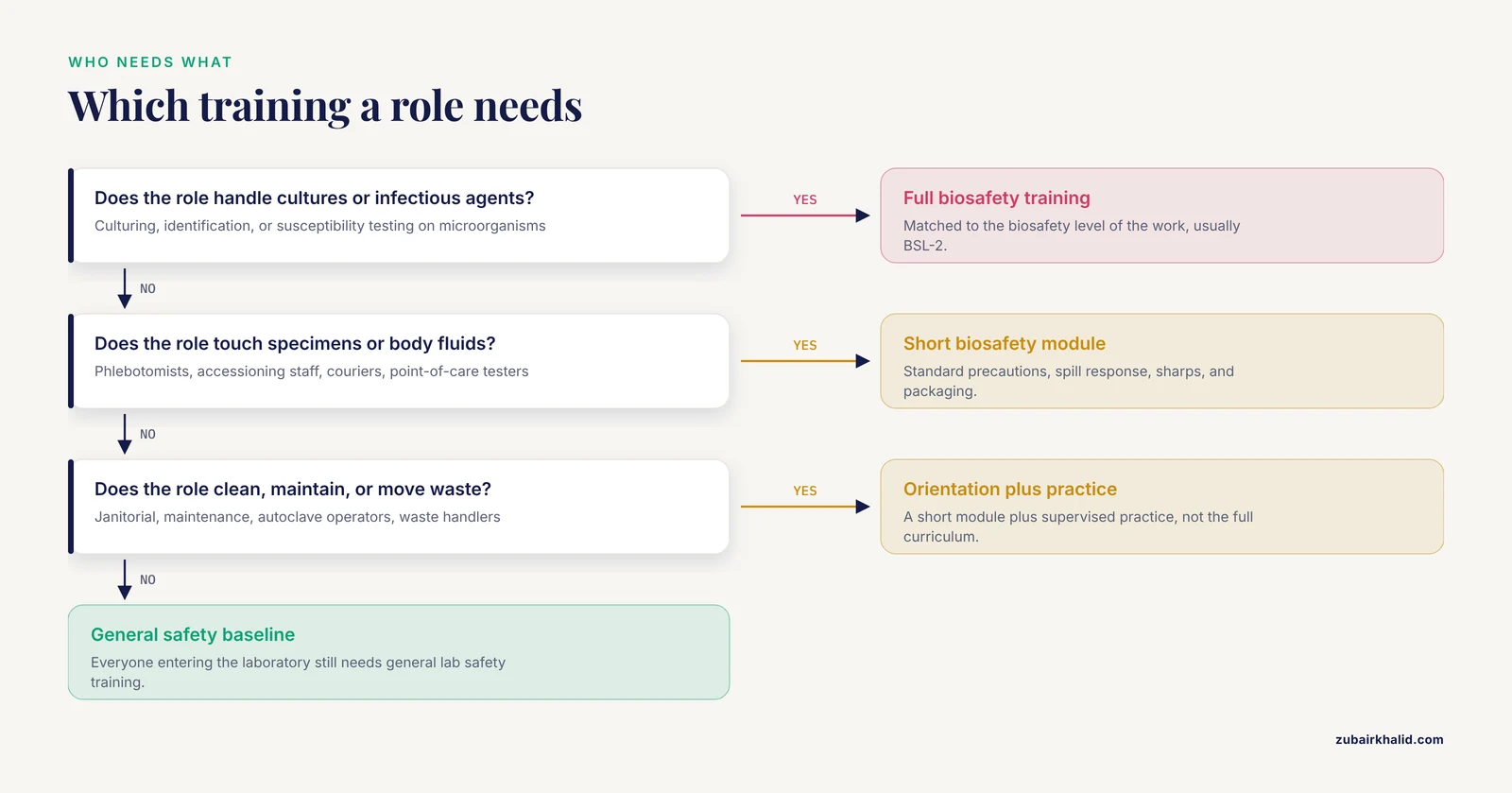
The question "when to use biosafety" training, rather than general safety alone, resolves into a series of role-based and setting-based decisions.
Clinical and diagnostic microbiology staff. Anyone who cultures, identifies, or performs susceptibility testing on microorganisms needs full biosafety training matched to the biosafety level of the work. Almost all routine clinical bacteriology and mycology occurs at BSL-2. Work with agents such as Mycobacterium tuberculosis or certain viral cultures requires higher containment and additional, agent-specific instruction.
Personnel who never open cultures but touch specimens. Phlebotomists, specimen accessioning staff, couriers, and point-of-care testers routinely handle material that may contain infectious agents. They need a biosafety module covering standard precautions, spill response, sharps, and packaging, even though they will never see a biosafety cabinet. Training gaps at the pre-analytical stage are measurable. Among healthcare workers in a tertiary hospital study, significant knowledge gaps were found before training in proper sample collection, handling, transport, storage, blood spillage response, and general disinfection, and after a focused orientation session knowledge of how and when to collect samples roughly doubled, reaching 63 percent and 54 percent respectively [6]. The pre-analytical phase is where most laboratory errors occur, and it is also where biosafety training is most often skipped.
Research and teaching laboratory personnel. Student laboratories carry their own risk profile, combining inexperienced workers with live organisms. Evidence from health science undergraduates shows that knowledge of biosafety correlates with perception of biological risk, but only modestly, and students with higher knowledge still showed variable risk perception, supporting periodic evaluations and reinforcement training rather than a single course [7]. For teaching faculty, error-based instructional methods drawn from error management training are an emerging approach to counter the cognitive biases that produce silent cross-contamination [4].
Field and point-of-care teams. Any program that collects or tests specimens outside a fixed laboratory must extend biosafety training to the field environment. This includes environmental sampling, agricultural investigations, and outbreak response. The mobile biosafety laboratory, or MBS-Lab, concept illustrates the point. These high-mobility units, first deployed during a melioidosis outbreak in northern Australia in 1997, can perform on-site molecular testing, and during a SARS-CoV-2 screening operation in Tonghua City, China, in January 2021, a mobile laboratory with a trained diagnostic team processed 93,952 oropharyngeal swabs from high-risk groups and the general population [8]. That throughput was possible only because the entire workflow, from swab collection to waste disposal in a non-laboratory setting, had trained personnel and pre-established biosafety procedures behind it.
Frontline outbreak testing sites. During the 2015 Ebola response in Guinea, rapid diagnostic tests were deployed at 34 sentinel sites. Technician knowledge scores averaged 6.6 out of 8, showing that focused training could build competence quickly, yet 69.8 percent of technicians still expressed concern for their own safety while performing the tests, and evaluators documented deficits in basic infrastructure, equipment, supplies, and quality assurance [9]. The lesson for training planners is that knowledge is necessary but not sufficient. Biosafety training must be paired with the supplies, facilities, and supervision that let people apply what they learned.
Support and infrastructure staff. Janitorial, maintenance, autoclave operators, and waste handlers need biosafety orientation proportionate to their potential exposure, often a short module plus supervised practice, rather than the full curriculum designed for bench scientists.
Anyone whose work involves valuable or dangerous pathogen stocks. Here biosecurity joins biosafety. At a Turkish institute dedicated to foot-and-mouth disease diagnosis and vaccine production, all 173 staff were divided into three groups by their direct or indirect contact with the virus, and each group received training covering biosafety, biosecurity, biorisk awareness, and insider threat, with length tailored to role. Three-quarters of staff completed the training, and post-training surveys showed improved awareness above baseline in all three groups [10]. Role-stratified training like this, rather than a single uniform course, is the model that scales well.
How Biosafety Training Is Delivered, and What Actually Works
Because the difference between biosafety and general lab safety training extends to pedagogy, choosing a delivery format matters as much as choosing content.
In-person instruction currently has the strongest evidence for behavior change. A systematic review of 13 empirical studies published between 2020 and 2025 found that although all training modalities improved knowledge, in-person teaching stood out for generating greater engagement and self-efficacy among staff, and that trained personnel showed enhanced technical competence during emergencies along with a tangible reduction in occupational accidents, including fewer accidental punctures, splashes, and aerosol exposures [11]. Ongoing, repeated training outperformed one-time orientation in that evidence base.
Simulation is closing the gap for high-risk, low-frequency skills. Biosafety skills such as responding to a spill of a dangerous agent are hard to practice live and expensive to rehearse with real materials. Web-based virtual simulation addressed this in a large randomized controlled trial of 1,282 medical students across 9 specialties, in which the group that received virtual simulation training before traditional laboratory practice significantly outperformed controls in every specialty, with clinical medicine students scoring 89.88 versus 68.34 on identification of BSL-2 pathogenic cocci [12]. Simulation also reduces the biosafety burden of the teaching laboratory itself, because students arrive already competent at basic workflows.
Institutional capacity building matters for surge response. The COVID-19 pandemic revealed that many workplaces had no existing plan or training for infectious disease exposure control, and the NIEHS Worker Training Program was able to respond immediately with health and safety curricula precisely because it had spent decades building capacity for disaster and infectious disease response [13]. For a laboratory, the parallel is maintaining a trained core of biosafety personnel and current curricula before a crisis, not drafting them during one.
Supervision sustains what training starts. District-level biosafety supervision of pathogenic microbiology laboratories in Shanghai between 2009 and 2011 demonstrated an institutional model in which regulators conducted periodic evaluation of laboratory biosafety practices [14]. Within a single institution, the internal equivalent is the biosafety officer who observes technique, reviews incident reports, and triggers refresher training when performance drifts.
Training the trainers multiplies reach. The foot-and-mouth disease institute program succeeded partly because staff previously trained in biorisk management then delivered instruction to their colleagues, stratified by role [10]. A similar layered approach works in clinical laboratories, where a small biosafety core trains unit-level champions.
Common Mistakes and Limitations
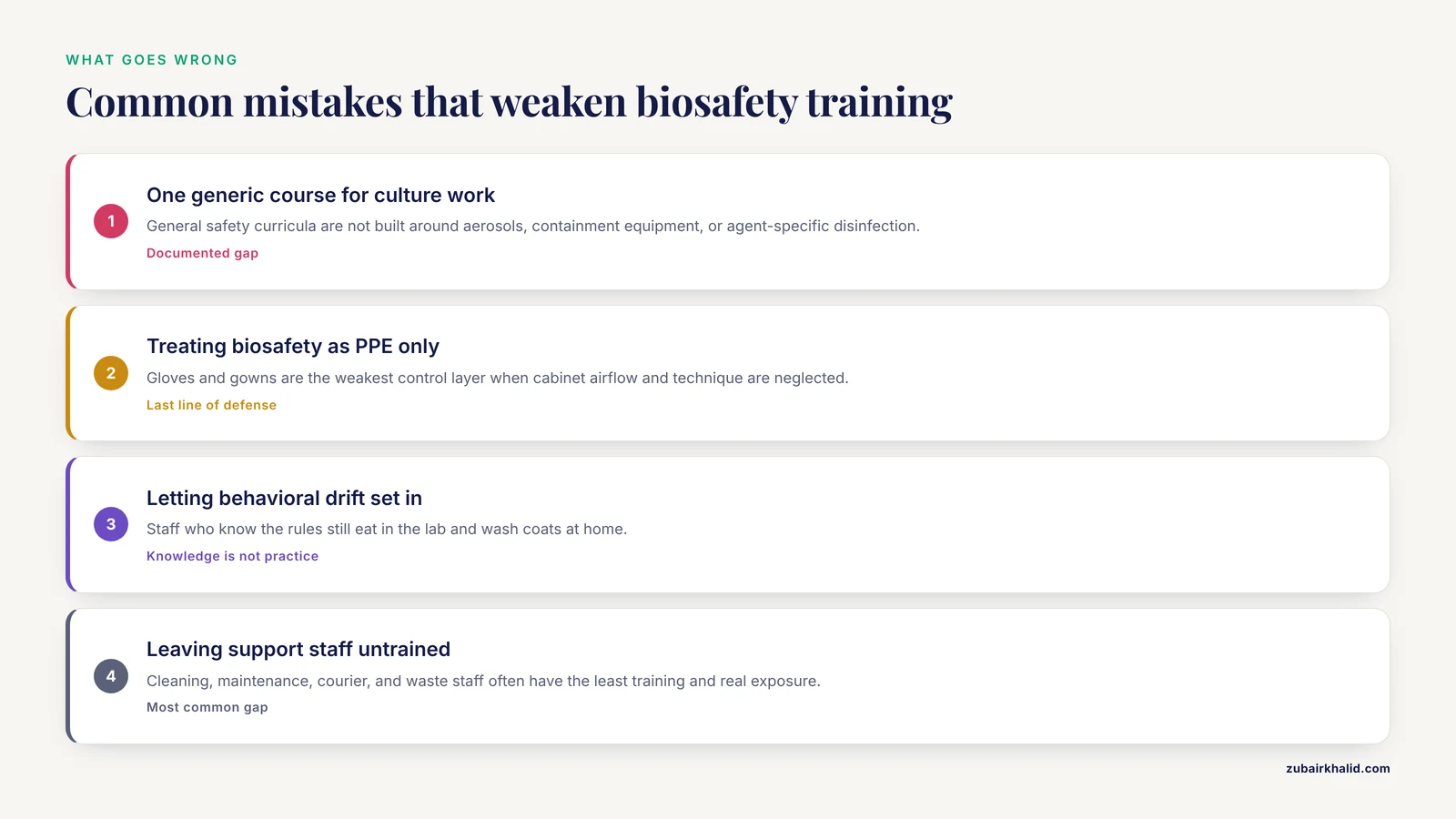
The following mistakes appear repeatedly in surveys of real laboratories and in the biosafety literature. Each is preventable.
- Treating a single annual general safety course as sufficient for microbiology work. General safety curricula are not built around aerosol generation, containment equipment, or agent-specific disinfection. A laboratory that relies on one generic course for staff who handle cultures is accepting a documented gap, not a minor paperwork shortfall.
- Assuming biosafety equals PPE. PPE is the last and weakest layer of the hierarchy of controls. Training that emphasizes gloves and gowns while neglecting biosafety cabinet airflow, centrifuge sealing, and aerosol-minimizing technique produces workers who feel protected while practicing unsafely.
- Letting behavioral drift undermine training. In a multicenter survey of 1,072 medical microbiology laboratory personnel across 23 Turkish hospitals, roughly half of personnel at university and training-and-research hospitals and two-thirds at state hospitals admitted consuming food and beverages in the laboratory, and 95 percent of state hospital personnel reported washing laboratory coats at home [15]. These behaviors violate basic biosafety principles, and they persisted despite staff being aware of the rules, which shows that knowledge alone does not guarantee practice. State hospital staff were also more likely to report inadequate knowledge and practices and to lack a separate resting room, an environmental factor that drives eating in work areas.
- Stopping training at the laboratory door. Field collection, transport, and point-of-care testing are part of the specimen lifecycle, and failure to control risk at the collection step can lead to illness or injury and compromise laboratory safety if infectious specimens are packaged or transported inappropriately [2]. Biosafety training programs should explicitly cover the pre-laboratory stages.
- Ignoring the psychological side of risk. Comparative optimism, normalization of deviance, and alarm fatigue operate together to erode risk perception in experienced staff as much as in students [4]. Training that assumes informed people behave safely will underperform. Periodic drills, real incident case reviews, and observed competency checks counteract drift better than repeated slide decks.
- Confusing biosafety with biosecurity. Biosafety prevents unintentional exposure. Biosecurity prevents theft, loss, diversion, or deliberate misuse of dangerous pathogens and materials. They require overlapping but distinct training content, including inventory control and access management, as the foot-and-mouth disease institute curriculum recognized by teaching both alongside insider threat awareness [10].
- Skipping competency assessment. A completion certificate is not a competency measure. Programs that test only recall, rather than observed performance of critical tasks such as cabinet work, spill cleanup, or packaging, miss the failures that matter most.
- Underinvesting in refresher and scenario-based renewal. Biosafety skills decay, and guideline updates change practice. Annual renewal tied to real drills, plus event-triggered retraining after incidents or new procedures, reflects the direction of the current evidence.
- Equating high training rates with safety. A nationwide survey of CDC microbiology laboratories in China from 2021 to 2023 found high reported rates of biosafety training, at 98.69 percent, and near-universal BSL-2 laboratory presence, at 98.69 percent, yet the survey also documented varied presence of BSL-3 capacity and differences in biosafety practices across administrative levels [16]. Training coverage on paper does not guarantee uniform practice, and audit programs should verify both.
- Leaving support staff untrained. Cleaning, maintenance, courier, and waste personnel often have the least biosafety education and meaningful exposure potential. Role-based modules for these groups close one of the most common real-world gaps.
Limitations. The evidence comparing biosafety training with general lab safety training comes from heterogeneous settings, including clinical laboratories, teaching programs, public health networks, and veterinary institutes, with variable outcome measures. Survey-based studies measure self-reported knowledge and behavior, which can differ from observed practice. Delivery-mode comparisons, such as the advantage of in-person instruction, rest on a limited number of studies and may shift as simulation technology matures. Every institution ultimately needs its own biosafety risk assessment, performed or reviewed by a qualified biosafety professional, and its own role-based training matrix. For individual exposure events or agent-specific questions, consult your institution's biosafety officer and occupational health service.
Frequently Asked Questions
Can general lab safety training substitute for biosafety training?
No. General lab safety covers chemicals, fire, electrical, and physical hazards for everyone in a laboratory, but it does not teach containment levels, aerosol control, biosafety cabinet use, biological spill management, or biosecurity. Anyone handling material that may contain microorganisms needs biosafety training in addition to general safety.
Do I need biosafety training if I never culture organisms?
Yes, if you touch specimens, blood, body fluids, or environmental samples, because unprocessed material can contain viable pathogens at unknown concentrations. Collection, accessioning, courier, and cleaning staff need a shorter role-specific biosafety module rather than the full bench curriculum, but they are not exempt.
How often should biosafety training be renewed?
Annual renewal is the common institutional standard, with additional event-driven retraining whenever a new agent, new procedure, new equipment, or an exposure incident changes the risk profile. Evidence supports ongoing and repeated training over one-time courses for reducing occupational accidents [11].
What is the difference between biosafety and biosecurity?
Biosafety prevents accidental exposure to biological agents through practices, containment equipment, and facilities. Biosecurity prevents intentional or unauthorized access, theft, loss, or misuse of dangerous biological materials through inventory control, access control, and personnel measures. Comprehensive programs train both.
What is a biosafety risk assessment and who performs it?
A biosafety risk assessment is a structured evaluation of the agent, the host, the activity, the environment, and available mitigations, and its output is the assigned biosafety level and required controls. It should be led by the laboratory supervisor with the institution's biosafety officer, and reviewed whenever the work changes.
Is online biosafety training effective?
It can be, especially for knowledge transfer and for practicing rare high-risk scenarios through simulation, and a large randomized trial showed virtual simulation improved student performance across all specialties tested [12]. Current evidence still favors in-person instruction for building engagement, self-efficacy, and durable behavior change, so a blended format, combining online knowledge modules with hands-on competency checks, is the most defensible approach [11].
Sources
- Comparing the established competency categories of the biosafety and infection prevention professions: a possible roadmap for addressing professional development training needs for a new era
- Assessing the Biological Safety Profession's Evaluation and Control of Risks Associated with the Field Collection of Potentially Infectious Specimens.
- Biosafety Level at the Microbiology Laboratory of PT SCI
- The Invisible Microorganism on the Bench: A Narrative Review of Cognitive Biases, Cross-Contamination, and Error-Based Learning for Biosafety in Microbiology Teaching Laboratories
- Cross-sectional study of personal protective equipment use, training and biosafety preparedness among healthcare workers during the first months of the SARS-CoV-2 pandemic in Brazil
- The Impact and Outcome of Training Programme of Health Care Workers with Reference to Sample Collection in Microbiology Laboratory
- SDG 3 Health and Well-Being: Biosafety Knowledge and Perception of Biological Risk in Clinical Practice in Health Science Undergraduates
- Screening High-Risk Groups and the General Population for SARS-CoV-2 Nucleic Acids in a Mobile Biosafety Laboratory.
- Operational evaluation of rapid diagnostic testing for Ebola Virus Disease in Guinean laboratories.
- Implementing an Organizational Culture of Biosafety and Biosecurity in the ŞAP Institute
- Impact of biosafety training on the reduction of occupational risks in clinical laboratories
- A Large-Scale Multispecialty Evaluation of Web-Based Simulation in Medical Microbiology Laboratory Education: Randomized Controlled Trial
- Biosafety and Infectious Disease Occupational Health Training from the NIEHS Worker Training Program: A Historical Look at Capacity Building that Supported a COVID-19 Response
- Effectiveness of biosafety supervision of pathogenic microbiology laboratory between 2009 and 2011 in a district of Shanghai
- [[Employee Safety and Biosafety Applications in Microbiology Laboratories; A Multicenter Evaluation in Turkey].](https://pubmed.ncbi.nlm.nih.gov/32755513/)
- The state of biosafety across China's CDC microbiology laboratories: insights from a nationwide survey (2021-2023)