How Often Should Biosafety Training Be Repeated?
By Dr. Zubair Khalid, DVM, MS, PhD ·
Initial biosafety training builds competence, while repeated training preserves it, and the interval between sessions is a risk decision rather than a calendar habit. For most microbiology laboratories the practical rule of thumb is a full refresher every twelve months, shortened for high-hazard work, high staff turnover, or a recent incident, and supplemented by short drills whenever procedures, agents, or equipment change. The right answer for any specific laboratory comes from a written biosafety risk assessment, not from a universal schedule copied from another facility.
This guide walks through the biosafety training frequency options available to a microbiology laboratory, the pros and cons of each, the criteria that actually decide the choice, and worked scenarios from teaching, diagnostic, and research settings. It ends with the mistakes that most often undermine refresher programs and short answers to the questions laboratory managers ask most.
How Often Should Biosafety Training Be Repeated? The Short Answer
Biosafety is the set of practices, containment measures, and behaviors that keep infectious agents, toxic materials, and contaminated equipment away from people and the environment. Training in biosafety has two distinct jobs. The first job, done at hire or before a worker first touches a hazard, is to establish baseline knowledge. The second job, done repeatedly, is to counter the natural decay of that knowledge and to update it as the laboratory changes.
How often should biosafety training be repeated in practice? Three honest answers coexist, and they fit different laboratories.
Annual refresher as the default. A full refresher every twelve months is the most common interval in microbiology biosafety training programs, and it works well for most BSL-1 and BSL-2 laboratories with stable staff. It is long enough to be efficient and short enough to catch most skill decay before it becomes dangerous.
Shorter intervals for higher risk. Laboratories working with aerosol-generating procedures, large culture volumes, high-consequence agents, or heavy staff turnover benefit from semiannual or quarterly sessions. In these settings, a full year between structured reviews is simply too long a window for an uncorrected bad habit.
Event-driven retraining on top of the schedule. Regardless of the standing interval, defined events such as a new agent, a new procedure, a spill, an exposure, new equipment, or a failed competency check should trigger retraining immediately. A fixed calendar is a floor, not a ceiling.
There is no single mandated interval that fits every microbiology laboratory, because the hazard profile of a teaching laboratory handling food-associated organisms at biosafety level 1 has almost nothing in common with a diagnostic laboratory sequencing viral genomes from patient plasma. The interval is an output of the biosafety risk assessment, which is the next topic.
What Microbiology Biosafety Training Must Cover
Before comparing intervals, it helps to be precise about what is being repeated. Microbiology biosafety training covers a defined body of knowledge and skill, and repetition matters because every element of that body decays or changes over time.
Risk groups and biosafety levels. Risk group describes the inherent hazard of an organism, combining pathogenicity, transmissibility, availability of treatment, and route of exposure. Biosafety level, abbreviated BSL, describes the containment practices a laboratory applies in response. BSL-1 covers work with well-characterized agents not known to consistently cause disease in healthy adults, such as the food-associated organisms used in school and undergraduate teaching. BSL-2 covers agents of moderate hazard present in clinical and diagnostic specimens, where percutaneous injury and mucous membrane exposure are the primary concerns. Training must make the mapping between organism and containment level explicit, because the mapping is where most bench-level confusion starts.
Standard content. A complete microbiology biosafety training curriculum includes routes of exposure, selection and use of personal protective equipment, engineering controls such as biosafety cabinets and centrifuge safety cups, sharps handling, spill response, decontamination and waste streams, transport of specimens within and between facilities, and exposure and incident reporting. Each of these is a skill as much as a fact, which is why reading a policy is not equivalent to being trained.
Content that changes. Procedures evolve, reagents are replaced, equipment is relocated, and agents enter or leave the laboratory's inventory. A training program written once and repeated verbatim grows stale. Good refresher programs update content each cycle, which is one of the strongest arguments for repeating training rather than merely certifying it once.
Teaching environments illustrate how context-specific the content must be. A framework for frugal, low-cost practical microbiology in secondary education positions hands-on work carefully inside biosafety level 1, restricting activities to food-associated microbial sources such as fermented foods and probiotics, and applying the precautionary rule that unknown isolates are treated as potentially pathogenic [1]. The same framework provides protocols for sterilization, disinfection, and waste management, including an end-of-session workflow for reliable culture inactivation before disposal [1]. Those workflows are exactly the content that a brief recurring refresher should rehearse, because the safe behavior at the bench, such as sealing plates and completing the inactivation step before leaving, is a habit that decays without reinforcement.
The Biosafety Risk Assessment Sets the Interval
A biosafety risk assessment is the structured process of identifying the hazards in a laboratory, evaluating the likelihood and severity of exposure, and selecting controls to reduce residual risk. It is the engine that should drive the biosafety training frequency decision, and running it well requires honest answers to a short list of questions.
What is the agent? Hazard, transmissibility, route of exposure, and the consequences of infection or exposure. An organism that infects via the inhalation route, or one with no effective treatment, raises the stakes of every procedural slip.
What is the manipulation? Opening plates, vortexing, centrifuging, sonicating, inoculating animals, and handling preserved tissue carry very different exposure potentials. The same agent can justify different intervals depending on what is done with it.
What is the volume and concentration? Routine diagnostic specimens arrive at unknown and often high titers. Preparative-scale culture concentrates risk.
Who is doing the work? Experience, turnover, and language barriers all matter. A bench with three new hires a year needs more frequent structured training than a bench with the same two technologists for a decade.
What controls exist? A laboratory with well-maintained engineering controls, current standard operating procedures, and validated decontamination workflows can manage the same agent at lower residual risk than one relying on habit and memory.
What has happened before? Incident and near-miss history is the single most direct evidence about whether the current interval is adequate. Repeated minor events are the signature of an interval that is too long.
The assessment produces a training matrix, a document that lists each role, the training modules required, the initial deadline, the refresher interval, and the triggers that shorten that interval. The interval itself is then revisited whenever the risk assessment is revisited. Changing the preservation method for cadaver material, switching to a new chemical fixative, introducing a new culture system, or adopting a novel material with an uncharacterized hazard profile each changes the risk landscape, and each should prompt both a reassessment and targeted retraining rather than a quiet wait for the next annual cycle.
Biosafety Training Frequency Options
Six practical options cover essentially every laboratory. The table below is the core comparison, and each option is then explained on its own terms.
| Option | Typical interval | Best fit | Main drawback |
|---|---|---|---|
| , - | , - | , - | , - |
| One-time initial training | At hire only | Very low-risk, stable BSL-1 benches | No verification that knowledge persists |
| Fixed annual refresher | Every 12 months | Most BSL-1 and BSL-2 microbiology labs | Treats all roles and risks as equal |
| Semiannual or quarterly refresher | Every 3 to 6 months | High-hazard manipulations, high turnover | Time cost and diminishing engagement |
| Event-triggered retraining | After defined triggers | Universal supplement to any schedule | Long gaps if no trigger occurs |
| Competency-based scheduling | When observation shows decay | Experienced, stable, well-supervised staff | Requires a real direct-observation program |
| Layered schedule | Brief recurring plus annual full | Busy diagnostic and teaching labs | More scheduling and tracking work |
One-time initial training only
The initial course, delivered before a worker touches a hazard, remains non-negotiable in every setting. The question is whether anything follows it. A one-time-only approach is defensible only in the lowest-risk corners of microbiology, such as a stable BSL-1 bench with fixed staff and no changing procedures.
The advantages are low cost and minimal disruption. The disadvantages are severe. Knowledge decays, procedures drift, documentation of current competence never exists, and the laboratory has no mechanism to deliver updates. Almost no contemporary program recommends this option alone, and its main real-world role is as the starting point that every other interval builds upon.
Fixed annual refresher
The annual refresher is the workhorse of microbiology biosafety training. Every staff member completes a structured session each year, covering updates, incident lessons from the past year, and hands-on verification of core skills such as donning and doffing personal protective equipment and responding to a simulated spill.
The pros are predictability, simple documentation, easy audit responses, and coverage of annual procedural updates. The cons are that a fixed year treats a sharp technologist who handles low-risk material and a new hire performing aerosol-generating work identically, and that twelve months is long enough for significant skill decay in rarely performed tasks such as spill cleanup. The annual model works best when it is paired with event-triggered retraining, so the calendar handles the baseline and events handle the exceptions.
Semiannual or quarterly refresher
Shortening the cycle to every three or six months suits laboratories where the consequence of error is high, the procedure mix changes often, or turnover is constant. High-consequence agent work, large-scale culture, animal work with infectious agents, and laboratories training many students or rotating staff in short blocks all fit here.
The pros are tighter feedback loops, faster correction of bad habits, and shorter gaps between hands-on verification. The cons are real: session fatigue, reduced attendance quality, and meaningful time cost in laboratories already stretched for bench hours. The usual fix is to vary content across cycles so each short session covers one focused module rather than repeating the full curriculum every time.
Event-triggered retraining
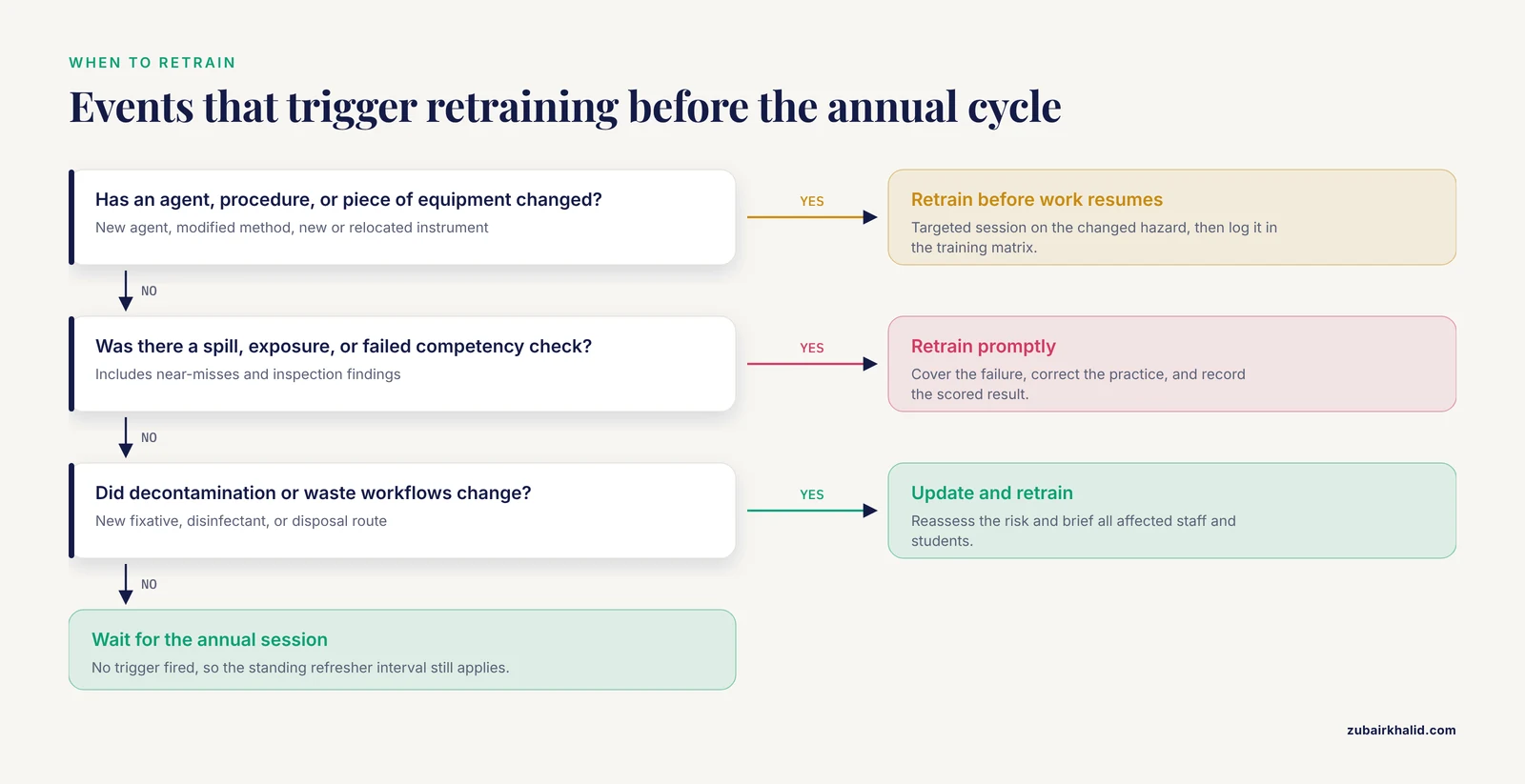
Event-triggered retraining means defined occurrences immediately require targeted training before work resumes or within a fixed short window. Standard triggers include introduction of a new agent or risk group, a new or modified procedure, new or relocated equipment, a spill or exposure, a failed competency assessment, a change in decontamination or waste workflows, and findings from an internal inspection.
The pros are precision and efficiency, because training lands exactly where the risk changed. The cons are that triggers must actually be detected, which requires an incident reporting culture and change-control discipline, and that a quiet year with no triggers leaves a long gap unless a standing interval also exists. For this reason event-triggered retraining works as a supplement, not a standalone frequency.
Competency-based scheduling
Competency-based scheduling replaces or modifies the calendar with direct evidence. A supervisor or biosafety officer observes performance against defined checkpoints, and the observed level of competence, rather than the calendar, determines whether refresher training is required. A technologist who demonstrates flawless spill response and correct biosafety cabinet technique year after year may keep a longer interval, while one who shows drift is retrained immediately regardless of the calendar.
The pros are that resources concentrate on actual need and that observation itself reinforces safe behavior. The cons are that the system only functions with genuine direct observation, defined scoring criteria, and someone accountable for acting on the results. Without those, competency-based scheduling collapses into self-attestation, which is the weakest form of documentation that exists.
Layered schedule
The layered model combines brief recurring sessions with an annual full refresher. Short monthly or biweekly toolbox talks of a few minutes cover one topic at a time, such as centrifuge sealing, sharps disposal, or the current decontamination workflow, while the annual session covers the full curriculum with hands-on verification.
The pros are continuous reinforcement at modest cost, which directly targets the decay problem, and the natural slot it creates for reviewing recent incidents. The cons are the tracking burden and the risk of toolbox talks degrading into unread email summaries. The teaching-laboratory framework referenced earlier translates its biosafety principles into practical checklists and an implementation guide for exactly this reason, because short, structured, repeatable checks are more durable than rare long lectures [1].
Choosing the Best Biosafety Training Frequency
The best biosafety training frequency for a given laboratory is the one that matches its risk assessment outputs, and five criteria do most of the deciding.
Agent and procedure hazard. Higher hazard and higher exposure potential push the interval shorter. Work that generates aerosols, manipulates concentrates, or involves agents with severe consequences justifies semiannual review at minimum, while a sealed-observation BSL-1 teaching bench can run longer intervals supported by brief recurring checks.
Staff turnover and experience. High turnover effectively shortens the interval, because every new cohort restarts the decay clock. Seasonal intakes of students or rotating trainees should anchor training to the intake schedule rather than to an arbitrary calendar date.
Change frequency. A laboratory that adopts new methods, agents, or equipment several times a year is effectively an event-driven environment regardless of its nominal interval. Change control and retraining should be welded together administratively.
Incident and near-miss history. Any pattern of repeat minor events indicates the interval is too long for that specific hazard, even if the nominal schedule is being met. Near-misses are cheaper teachers than exposures.
Verification infrastructure. A laboratory able to run genuine direct observation can safely use competency-based or layered models. A laboratory that can only track attendance signatures should stay on fixed intervals, because fixed intervals at least guarantee that everyone is seen regularly.
In practice, most microbiology laboratories converge on a hybrid: annual full refresher, brief recurring reinforcement, event triggers, and competency checks layered on top. The fixed interval provides the guarantee, the triggers provide the responsiveness, and the observation provides the evidence.
Worked Scenarios
Concrete settings show how these options resolve differently.
Scenario 1: A secondary school or undergraduate BSL-1 teaching laboratory
A teaching laboratory uses domestic equipment and food-associated microbial sources to keep costs low while staying within biosafety level 1, and it operates under the rule that any unknown isolate is treated as potentially pathogenic [1]. The cohort changes every term, which is the dominant scheduling fact. The best biosafety training frequency here is event-driven by enrollment: every student receives initial safety instruction before the first practical session, every session opens with a two-minute reinforcement of the day's specific hazards, and every session closes with the standardized end-of-session workflow for culture inactivation and waste handling before disposal [1]. Teacher confidence is itself a documented constraint on practical microbiology education, so the instructor also needs periodic refresher exposure, ideally annually, to keep the sterilization, disinfection, and waste protocols current [1]. A fixed annual full course fits the instructor, and a per-cohort initial-plus-per-session model fits the students.
Scenario 2: A clinical diagnostic bacteriology bench
A hospital microbiology laboratory receives unknown specimens at unknown titers, works primarily at BSL-2, and has moderate turnover. The standard resolution is an annual full refresher for all staff, quarterly short modules rotating through spill response, sharps safety, biosafety cabinet technique, and exposure reporting, and hard triggers for any exposure event, new instrument, or failed competency check. New hires receive full initial training before their first unsupervised bench shift, not at the next annual cycle. Incident lessons from the previous year are a standing agenda item in each annual session.
Scenario 3: A molecular diagnostics laboratory performing viral genome sequencing
A laboratory that sequences near-full-length viral genomes from patient plasma sits at the intersection of classical specimen handling and complex bioinformatics. In one published surveillance program, next-generation sequencing of plasma specimens from 495 antiretroviral treatment-naive individuals yielded 495 near-full-length HIV-1 genome sequences, with 16.77 percent of individuals infected with unique recombinant forms and 4.44 percent of sequences carrying capsid inhibitor resistance mutations detected at a 5 percent variant-calling threshold [2]. The biosafety lesson is not the virology, it is the workflow: handling patient plasma, operating sequencing instrumentation, and validating analysis pipelines each carry distinct training needs, and the analytical side changes far faster than the wet-lab side. For such a laboratory, an annual biosafety refresher covers specimen handling, while new pipeline and instrument procedures trigger targeted retraining on adoption, because waiting for the annual cycle to cover a newly installed instrument would leave a months-long window of untrained operation.
Scenario 4: A veterinary anatomy laboratory using preserved cadavers
A veterinary anatomy teaching facility faces a training frequency question that is easy to overlook because the hazard comes from the preservation method rather than from a cultured agent. Preservation methods directly affect occupational health for students, instructors, and staff, laboratory biosafety, and regulatory compliance [3]. Traditional formaldehyde fixation effectively prevents tissue degradation and microbial growth but is toxic and potentially carcinogenic, while saturated saline solutions are low-cost, accessible, and preserve tissue texture, color, and joint mobility better, yet they do not sterilize cadavers and raise concerns about persistence of halotolerant microorganisms and occupational exposure [3]. If such a facility switches fixative, the change alters the chemical hazard profile and the microbial exposure profile simultaneously. This is a textbook trigger: the preservation change should prompt an updated biosafety risk assessment and immediate targeted retraining of all faculty, technicians, and students on the new chemical handling requirements and the residual microbial precautions, rather than waiting for the standing annual session.
Scenario 5: A research laboratory introducing a novel material
A laboratory adopting a new compound or formulation with an incompletely characterized hazard profile needs targeted retraining before first use. A study of a new FT derivative formulated in a thermosensitive poloxamer liposomal gel, built from Poloxamer F127 and Poloxamer F68 carriers and evaluated with systematic in vitro and in vivo biosafety assessments, illustrates the pattern: the material itself was new, its handling properties were new, and its biosafety characterization was performed deliberately as part of development [4]. The laboratory-side equivalent is that adoption of any novel material, nanomaterial, or formulation should include a biosafety review and a short handler training session before the first experiment, independent of where the annual cycle falls.
Designing the Refresher Session Itself
Frequency only matters if the session is worth repeating. A well-built refresher for a microbiology laboratory has four components.
Content update. New procedures, new agents, new equipment, changes to decontamination or waste workflows, and lessons learned from the past year's incidents and near-misses. The update component is what makes repetition additive rather than redundant.
Knowledge verification. A short written or oral check covering core concepts, agent-to-containment mapping, and reporting requirements. Verification results feed the competency record.
Hands-on verification. Direct observation of critical skills. Donning and doffing personal protective equipment, correct biosafety cabinet airflow and work practices, sharps handling, and a timed spill response drill using a noninfectious surrogate. Reading about a spill is not the same as cleaning one, and only the hands-on component builds the motor memory that holds up under stress.
Scenario rehearsal. A realistic tabletop or bench scenario, such as a centrifuge tube failure, a needlestick during plate inoculation, or discovery of an unlabeled culture, walked through as a group. Scenarios surface the gaps that individual modules miss.
For teaching settings, a printed session checklist that walks the instructor through pre-session setup, in-session boundaries, and the end-of-session inactivation workflow is the most reliable reinforcement tool, and the published frugal-microbiology framework provides exactly this kind of checklist structure [1]. For diagnostic settings, the same principle applies: short, structured, repeatable checklists anchored to real bench workflows outperform long slide decks.
Documentation and Records
Every completed session should generate a record with the date, the content covered, the trainer, the attendees, and the verification result. A training matrix summarizing each person's status, their next due date, and any pending event-triggered requirements gives the laboratory a single view of its exposure. Two documentation practices separate serious programs from paper exercises. First, record competency results, not just attendance, because a signature proves presence while a scored check proves capability. Second, treat the training matrix as a living document that updates whenever the risk assessment updates, so the documented interval and the actual risk never drift apart. During any external inspection or accreditation review, the matrix and the underlying records are the evidence, and gaps in either are findings regardless of how good the actual bench practices are.
Common Mistakes and Limitations
Mistake: treating the signed attendance sheet as training. The most common failure in laboratory biosafety is documenting presence while assuming competence. Verification, ideally hands-on, is what makes a record mean something.
Mistake: applying one interval to every role. A dishwashing technician, a student intern, and a technologist performing aerosol-generating concentration steps do not carry equal risk, and a single fixed interval either overtrains one group or undertrains another. The training matrix solves this by assigning intervals per role.
Mistake: initial training without a scheduled refresher. Some laboratories complete onboarding thoroughly and then let repetition lapse until an incident forces it. Knowledge decay is predictable, and so is procedural drift, which makes the absence of a standing interval a foreseeable hazard.
Mistake: event triggers that nobody detects. A trigger system only works if changes in agents, procedures, and equipment are actually reported and logged. Laboratories that lack change control discover their trigger failures during incident investigations, which is the most expensive possible moment.
Mistake: repeating the same slides every year. Identical annual content trains staff to stop listening. Each cycle should carry updated material, current incident lessons, and rotating hands-on emphasis.
Mistake: ignoring turnover rhythms. A laboratory that hires most of its staff in one seasonal block should anchor training to that block rather than to a calendar date inherited from a previous program.
Mistake: assuming the interval replaces the controls. Refresher training reduces human error, it does not substitute for engineering controls, current standard operating procedures, or functioning decontamination workflows. If the risk assessment shows unacceptable residual risk, the fix is containment and procedure, not a shorter training cycle.
Limitation. The intervals described here are general patterns drawn from standard laboratory practice and published frameworks, and they are not a substitute for an institution-specific assessment. Every facility should set its final schedule with its biosafety officer, institutional biosafety committee, or equivalent oversight body, informed by its own agents, procedures, and incident history, and individual cases involving actual exposures need prompt medical evaluation.
Frequently Asked Questions
How often should biosafety training be repeated?
For most microbiology laboratories, once a year as a full refresher, supplemented by event-triggered retraining whenever agents, procedures, equipment, or staff change, and by short recurring reinforcement sessions. Higher-hazard work justifies semiannual or quarterly cycles.
Is annual biosafety training enough for a BSL-2 laboratory?
Usually yes, provided the annual session includes hands-on verification and the laboratory also operates event triggers for new procedures, incidents, and failed competency checks. A BSL-2 laboratory with high turnover, aerosol-generating work, or a recent exposure history should shorten the interval.
What events should trigger biosafety retraining before the scheduled date?
The standard triggers are a new or changed agent, a new or modified procedure, new or relocated equipment, a spill or exposure, a failed competency assessment, a change in decontamination or waste workflows, and inspection findings. Any of these should prompt targeted training promptly rather than waiting for the annual cycle.
What is the difference between refresher training and competency assessment?
Refresher training is scheduled instruction delivered to everyone on a cycle, while competency assessment is direct observation and verification of an individual's actual performance against defined criteria. Strong programs use both, with assessment results determining who needs retraining sooner.
Do teaching laboratories need the same biosafety training frequency as diagnostic laboratories?
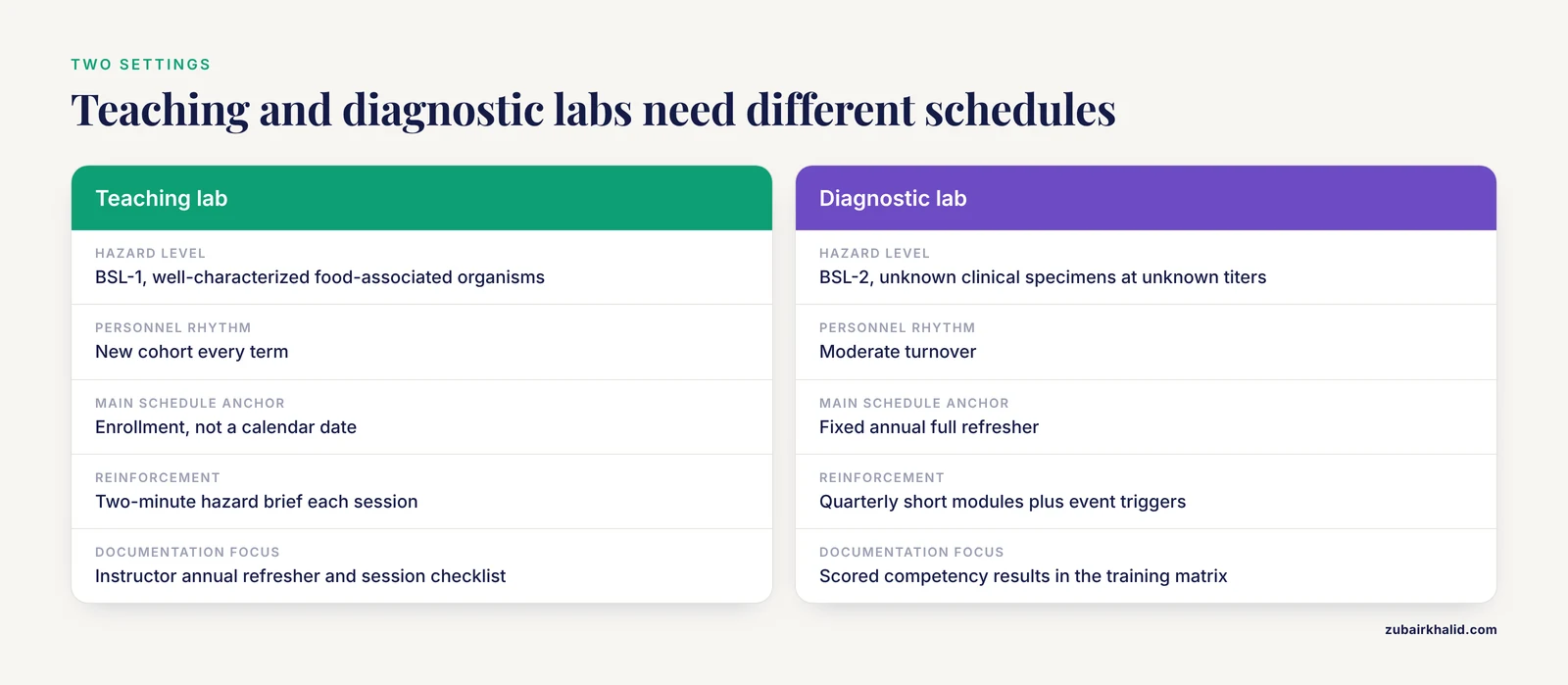
No. Teaching laboratories handle lower-risk, well-characterized organisms at biosafety level 1 and change personnel every term, so their frequency should anchor to enrollment, with initial training before first practical sessions and reinforcement at the start and end of each session. Diagnostic laboratories handle unknown clinical specimens and need the fixed annual-plus-trigger model instead.
How should a laboratory document that refresher training was completed?
Record the date, content, trainer, attendees, and verification results for every session, and maintain a training matrix showing each person's status and next due date. Recording scored competency results rather than attendance alone is what makes the documentation defensible during an audit.
Sources
- Eco-Microbiology: A Frugal-Circular Framework for Biosafe, Low-Cost Practical Microbiology in Secondary Education.
- Evaluation of capsid inhibitor resistance profiles and HIV-1 subtype distribution via near-full-length genome NGS in ART-naive HIV-1 patients in Guangxi, China.
- Biosafety implications of cadaver preservation methods in veterinary anatomy education.
- Thermosensitive Poloxamer Liposomal Gel for Sustained FTA Delivery Enhances Anti-Breast Cancer Efficacy and Biosafety.