Biosafety Training Documentation: What Records to Keep
By Dr. Zubair Khalid, DVM, MS, PhD ·

By the end of this guide you will be able to build a complete biosafety training documentation file for a microbiology laboratory and defend it in an audit. You will know the ten record types that make up the file, what each one must contain, who signs it, how the records link to each other, and how to store and version them so nothing goes missing. A numbered walkthrough gives you a working folder structure, a roster schema, a compliance calculation, and filled-in records you can adapt to your own bench the same week.
Have these on hand before you start: your current safety manual, the procedure manual with its embedded safety statements, an up-to-date staff roster with job roles, the hazard information for each bench, and a spreadsheet program or the training module of your laboratory information system. Keep signed paper originals where your institution requires them, and scan everything into the electronic file as well.
Biosafety is the discipline that protects laboratory personnel, the public, and the environment from infectious agents and other laboratory hazards through containment, work practices, and equipment. Biosafety training documentation is the written proof behind that protection: who was trained, on what content, when, by whom, and with what evidence of skill. The same record set serves a clinical microbiology bench, a research laboratory, a veterinary diagnostic laboratory, and a teaching laboratory, scaled to the risks each one handles.
Why Documentation Carries the Weight in a Biosafety Program
Training that is not documented does not exist from the perspective of an inspector, an accreditor (the body that certifies a laboratory against quality standards), or a claims reviewer. The record set is the program's memory, and it outlives the people who wrote it. The classic formulation comes from clinical laboratory medicine: the safety manual, supplemented by explicit safety statements in the laboratory procedure manual, should specify the hazards and containment methods for personnel, covering fire, biohazards, chemicals, waste management, and radionuclides, and safety training should be built into the laboratory's continuing education program [1]. Read that as an instruction about records. The manual, the safety statements inside each procedure, and the continuing education log are the documents that make the program real.
Good documentation does four jobs.
- Proof. It shows a regulator or accreditor that required training happened, on defined content, for named people, on definable dates.
- Continuity. It lets a new supervisor know exactly what the evening shift was taught and what they were never taught.
- Improvement. It turns audits, incidents, and near misses (events that could have caused harm but did not) into corrective actions with owners and close-out dates.
- Reconstruction. When an exposure occurs, the record chain answers the hard questions about what the person knew, was trained on, and was equipped with at the time.
Ownership follows the record. The biosafety officer owns the system and the master documents. Supervisors own the records for their benches. The occupational health clinic owns medical information. Every trainee signs their own record. When ownership is vague, the file decays within a year.
A program that trains well but files poorly fails audits it should pass. A program that documents well can show an inspector precisely where its gaps are and what it is doing about them, which is a far stronger position.
The Core Biosafety Training Documentation Set
Ten record types make up a defensible file. Small laboratories can merge some of them into single documents, but every element must exist somewhere. Each is described below, and the table at the end of this section summarizes all ten.
1. The Safety Manual and Procedure-Level Safety Statements
Keep the current, approved safety manual with its version number and approval page, and keep the safety statements embedded in every standard operating procedure (SOP), the written step-by-step instruction for a laboratory method. The safety manual states program-wide rules. The SOP safety statements state the hazards and containment methods for that specific procedure, from specimen receipt through disposal [1]. File superseded versions rather than deleting them, because an incident from two years ago is judged against the manual that was in force then. Each staff member's signed acknowledgment of the current manual belongs in this folder.
2. Biosafety Risk Assessment Records
A biosafety risk assessment is the structured process of identifying hazards, judging the likelihood and consequences of exposure, selecting controls, documenting the residual risk that remains, and setting a review date. The assessment record names the agent or material, the procedure, the location, the controls (engineering controls, work practices, and personal protective equipment (PPE)), the residual risk, the assessor, and the review date. This is the master document for everything else in the file, and it has its own section below.
3. Curriculum, Lesson Plans, and Versioned Materials
Microbiology biosafety training needs a written curriculum, not a stack of slides. The core module covers routes of laboratory exposure, PPE selection and removal, biological safety cabinet (BSC) use, decontamination and spill response, waste handling, and incident reporting. A BSC is the ventilated enclosure that protects the worker, the work, and the environment during manipulation of infectious material. Procedure-specific modules then cover whatever the risk assessments identify as hazardous on each bench. Keep the exact version of every lesson plan, handout, and slide deck that was taught, labeled with a version number and date. When an auditor asks what a technologist was told about aerosol-generating steps in a given year, the answer must be a file, not a recollection.
4. Attendance Rosters and Completion Records
A signed sign-in sheet is the raw evidence, and the roster is the usable record. Transcribe every sheet into a roster that lists the employee, the event, the date, the duration, the trainer, the content version, and the completion status. Untranscribed paper sheets are the most common failure point in otherwise good programs, because the sheet that proves a training from three years ago is useless while it sits folded inside a binder nobody indexes.
5. Competency Assessment Records
A competency assessment verifies that a person can perform a task safely, not merely that they were present when it was described. Methods include direct observation of the actual procedure against a checklist, a written test, a practical demonstration such as cleaning up a mock spill, and processing of a challenge specimen such as a mock culture requiring correct handling decisions. Document the method, the checklist items, the result for each item, the assessor, and the date. Schedule competency assessment at onboarding, after any significant procedure change, after any incident or near miss, and at the periodic interval your policy sets.
6. Certificates and Training-of-Trainers Records
External courses and internal cascade programs both generate certificates, and both need filing. A training-of-trainers (TOT) model, in which a small group is trained first and then trains others, is a documented and effective way to reach large laboratory networks. In one national program in Kenya, a biosafety technical working group held five sensitization meetings (orientation briefings) for 264 health managers, trained 48 trainers, and reached 1,044 laboratory workers across 216 facilities in 44 counties, roughly 22 workers per trainer, with mentorship and monitoring after the courses [2]. Every tier of that cascade generated its own paperwork: sensitization attendance, TOT completion, cascade rosters, and trainer qualification records. Keep the same tiers in miniature for any internal program where senior technologists train their benches, and keep proof that the trainer was qualified to teach the topic.
7. Mentorship, Monitoring, and Audit Records
Training changes knowledge. Mentorship (on-site coaching after formal courses) and monitoring show whether knowledge became practice, and the audit record is the only way to demonstrate that conversion. The Kenya program followed its courses with mentorship and site visits to 51 facilities, then measured what changed in the 21 facilities assessed (41% of those visited): 16 (76%) had improvised eye wash stations, 17 (81%) had biological spill kits, 15 (71%) had buckets of sand for fire response, 12 (57%) had fire extinguishers, 14 (66%) had documented hepatitis B vaccination, 18 (85%) had established phlebotomy (blood collection) areas, and 18 (85%) had material safety data sheets, now called safety data sheets (SDS), available [2]. Those percentages are what an audit record looks like when it is done well: a dated visit, a checklist of concrete items, and a measured result. Your own audit log should record the visit date, the auditor, each item checked, the result, any corrective action, and the date the action closed.
8. Incident, Spill, and Exposure Records
Record every spill, exposure, and near miss, including the ones that seemed trivial. The record captures the date and time, the people involved, the agent or material, the procedure in progress, the PPE worn, the immediate response steps, medical follow-up, the root cause, corrective actions with owners, and completion dates. Link any retraining to the incident record so the corrective loop is visible in one place. Near-miss records are disproportionately valuable, because they document the hazard before it found a victim.
9. Occupational Health Records
Keep the hepatitis B vaccination offer, the acceptance record or the signed declination (the form on which an employee documents a choice to decline vaccination), and any post-exposure evaluation records. In the United States, employers must offer hepatitis B vaccination to workers whose duties involve reasonably anticipated exposure to blood or body fluids, and a signed declination is required when the worker declines. The Kenya program treated vaccination documentation as a measurable program outcome, which is the right instinct, because an offer and a declination protect no one unless they exist on paper [2]. File these records separately from training records with restricted access, since they contain medical information.
10. Facility and Equipment Readiness Records
Eyewash station flush checks, spill kit inventories, fire extinguisher service tags, BSC certification records, and SDS availability checks are training-adjacent records that auditors read together with training files. A competency record saying a technologist can respond to a spill means little if the spill kit log shows the kit has been incomplete since spring. Keep dated inspection logs for each item, and treat a failed check as a corrective action with a close-out date.
The ten records at a glance
| Record | What it proves | Typical owner | Create or update when |
|---|---|---|---|
| Safety manual and SOP safety statements | Hazards and containment are specified in writing | Biosafety officer | At each review cycle and after any change |
| Risk assessment | Hazards, controls, and residual risk are judged and signed | Biosafety officer with bench lead | New agent or procedure, after incidents, at the review date |
| Curriculum and lesson plans | Staff were taught defined, versioned content | Trainer | When content changes |
| Attendance roster | Named staff attended a dated event | Trainer | Every training event |
| Competency assessment | Staff can perform the work safely | Assessor | Onboarding, after changes, after incidents, at the set interval |
| Certificates and TOT records | Trainers and trainees completed defined courses | Training coordinator | On course completion |
| Mentorship and audit log | Training converted into working practice | Biosafety officer | At scheduled visits and after corrective actions |
| Incident and exposure records | Events were managed and corrected | Supervisor with biosafety officer | After any spill, exposure, or near miss |
| Occupational health records | Vaccination offer, acceptance, or declination is on file | Occupational health clinic | At hire and after exposures |
| Facility and equipment readiness logs | Eyewash, spill kits, extinguishers, and SDS are present and checked | Laboratory manager | Per the inspection schedule |
The Biosafety Risk Assessment as the Master Document
Every strong training file hangs from risk assessments. The connection is simple: the risk assessment defines the hazards and the controls, and the training records prove each person learned and demonstrated those controls. An auditor tracing a single thread should be able to walk from hazard, to control, to curriculum item, to attendance, to demonstrated competency, without leaving the file.
A workable assessment has five steps.
- Identify the hazards. List the agent or material, its route of exposure, the procedures that manipulate it, and anything that concentrates or aerosolizes it.
- Evaluate the risk. Judge likelihood and consequence for each hazard, before controls are applied.
- Select controls. Apply the hierarchy: eliminate or substitute first, then engineering controls such as the BSC, then work practices, then PPE.
- Document residual risk. State what risk remains after the controls and why it is acceptable.
- Set the review. Date the assessment and set a review trigger, such as a new agent, a new procedure, an incident, or a fixed interval.
Two examples show how the assessment drives training content at opposite ends of the containment scale.
At the high-containment end, animal work at Animal Biosafety Level 3 (ABSL-3) and ABSL-4, the containment tiers for animal studies involving infectious agents, depends on documented protocol review before any work begins. The review brings the attending veterinarian, the principal investigator, the sponsor, and the institution's environmental health and safety, biosafety, medical, and facilities staff into a documented, collegial process, with the Institutional Animal Care and Use Committee (IACUC), the committee that reviews and approves animal research protocols, as the review body [3]. The documentation lesson transfers to any laboratory: high-risk work needs documented multi-role sign-off, and the sign-off record belongs in the training file, because it defines exactly who must be trained on what before the protocol starts.
At the teaching end, a veterinary anatomy or general microbiology teaching lab faces a different documentation problem: the hazard is the material itself and how it is preserved. Preservation method changes the risk. Traditional formaldehyde fixation prevents tissue degradation and microbial growth but brings toxicity and carcinogenicity concerns, while saturated saline preservation is low cost and preserves tissue quality but does not sterilize the cadaver, so halotolerant microorganisms may persist and pose exposure risks [4]. A risk assessment for such a lab must record the preservation method in use and its limitations, and the training must teach those limitations, because a student who believes saline-preserved means sterile will handle the material wrong.
Teaching laboratories working at Biosafety Level 1 (BSL-1), the lowest containment tier, suited to well-characterized agents not known to cause disease in healthy adults, should write the boundaries into the session protocol itself. A frugal-teaching framework for school microbiology makes the pattern explicit: use safer, food-associated microbial sources, restrict environmental sampling to teacher-led sealed observation, apply the precautionary rule that unknown equals potentially pathogenic, and run a documented end-of-session inactivation step before anything is discarded [5]. The documentation set for a BSL-1 teaching session is therefore short but non-negotiable: the written session protocol with its biosafety boundaries, the safety briefing acknowledgment, the attendance list, and the inactivation record.
A Biosafety Training Documentation Format You Can Reuse
A consistent format is what turns individual records into a system. Use a three-part structure for every training record.
Header. Record ID, title, version, date, author, approver, review date, and the linked risk assessment ID.
Body. Objectives, content outline, teaching method, duration, materials used, and the assessment method.
Footer. Trainee name and ID, trainee signature and date, assessor name and role, assessor signature and date, and the result.
The blank structure is your biosafety training documentation template. The filled version is your example. Here is a filled example for a core microbiology module.
| Field | Entry |
|---|---|
| Record ID | TR-2025-118 |
| Title | Safe handling of BSL-2 bacterial cultures |
| Version | v3, approved 2025-01-15 |
| Linked risk assessment | RA-2025-007 |
| Date and duration | 2025-03-18, 90 minutes |
| Trainer | J. Ruiz, Biosafety Officer |
| Method | Lecture plus supervised bench practice |
| Assessment | Direct observation against a 10-item checklist |
| Trainee | EMP-0148, D. Okafor, signature on file |
| Result | Pass, 10 of 10 items observed |
The header fields do the audit work. The linked risk assessment ID lets a reviewer trace why this training exists. The version number lets you prove what content was taught on that date. The footer converts the event from something that happened into something that can be shown.
Paper and electronic copies serve different purposes. Paper originals carry wet signatures where your institution requires them, and the electronic copy carries the searchability. Scan within a week of the event, file by both employee and event ID, and that dual index is what makes retrieval take seconds instead of an afternoon.
Building the File: A Numbered Walkthrough
These steps build an electronic filing system with plain text files and a spreadsheet-compatible roster. The same logic works in a document management system or a laboratory information system, and the field names carry over.
Step 1: Create the folder structure
mkdir -p biosafety_records/{policy,risk_assessments,curricula,rosters,competency,certificates,incidents,occupational_health,audits}
find biosafety_records -type d | sort
Expected output:
biosafety_records/audits
biosafety_records/certificates
biosafety_records/competency
biosafety_records/curricula
biosafety_records/incidents
biosafety_records/occupational_health
biosafety_records/policy
biosafety_records/risk_assessments
biosafety_records/rosters
Each folder maps to one of the record types. The policy folder holds the safety manual and its signed acknowledgments.
Step 2: Define the roster schema
Create biosafety_records/rosters/roster_2025.csv with this header row.
employee_id,last_name,first_name,role,bsl_level,start_date,hbv_offer_date,hbv_declination,initial_training_date,refresh_due,competency_method,competency_date,assessorThe fields that matter most: bsl_level records the highest containment level the person works at, which drives the required curriculum. refresh_due is the date the next refresher is required, set by your written policy. competency_method and competency_date record the most recent verified skill assessment. hbv_offer_date and hbv_declination pair the vaccination offer with the response, where Y in hbv_declination means a signed declination is on file.
Step 3: Add filled rows
EMP-0148,Okafor,Dana,Medical laboratory scientist,BSL-2,2024-03-11,2024-03-11,N,2024-03-18,2025-11-02,direct observation,2024-03-22,J. Ruiz
EMP-0093,Alvarez,Marco,Phlebotomist,BSL-2,2023-06-05,2023-06-05,N,2023-06-12,2025-10-04,practical demonstration,2023-06-12,J. Ruiz
EMP-0201,Chen,Priya,Laboratory assistant,BSL-1,2025-08-04,2025-08-04,Y,2025-08-11,2026-08-11,written test,2025-08-11,J. Ruiz
Step 4: Flag overdue refreshers
Save this as check_refreshers.py and run it with python3 check_refreshers.py.
import csv
from datetime import date

TODAY = date(2025, 11, 11)

overdue, current = [], []
with open("biosafety_records/rosters/roster_2025.csv", newline="") as f:
    for row in csv.DictReader(f):
        due = date.fromisoformat(row["refresh_due"])
        (current if due >= TODAY else overdue).append(
            (row["employee_id"], row["last_name"], due)
        )

print(f"Current: {len(current)}  Overdue: {len(overdue)}")
for emp, name, due in sorted(overdue, key=lambda x: x[3]):
    print(f"  {emp}  {name}  refresher due {due.isoformat()}")
Expected output:
Current: 23  Overdue: 2
  EMP-0093  Alvarez  refresher due 2025-10-04
  EMP-0148  Okafor  refresher due 2025-11-02
Common errors and fixes. If you see KeyError: 'refresh_due', the header row is misspelled or a column was added without updating the script, so compare the header line to the script string exactly. If you see FileNotFoundError: [Errno 2] No such file or directory, run the script from the directory that contains biosafety_records, or fix the path inside the open() call. If date.fromisoformat raises ValueError, a date was typed in a non-ISO format such as 3/18/2024, so rewrite it as 2024-03-18.
Step 5: Calculate training coverage
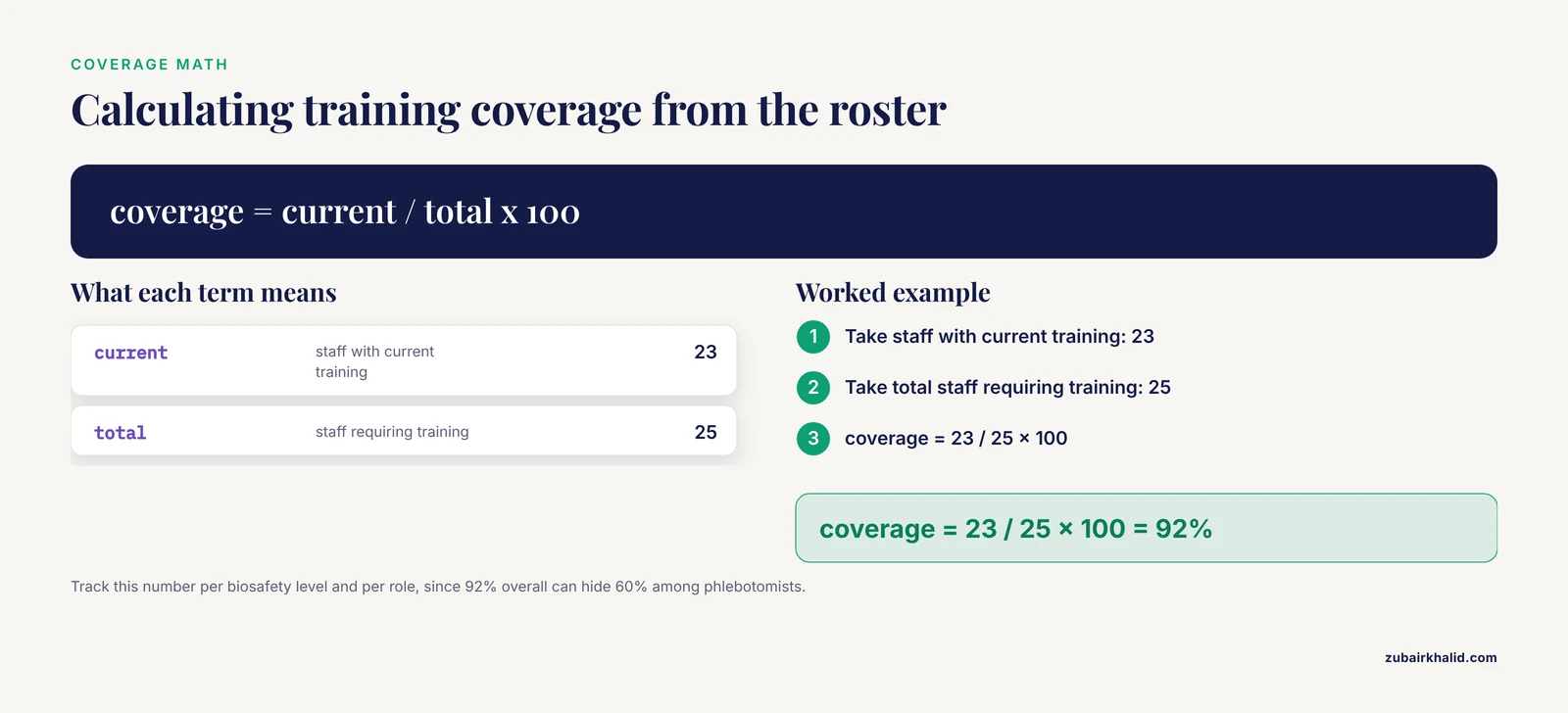
Coverage is the share of staff whose training is current.
coverage = staff with current training / total staff requiring training x 100Worked example with the roster above, 23 staff current out of 25 total:
coverage = 23 / 25 x 100 = 92%Track this number per biosafety level and per role. A 92% overall figure can hide a 60% figure among phlebotomists, which is where the exposure risk actually sits.
Step 6: Write the risk assessment record
Save one YAML file per assessment in risk_assessments. YAML is a plain text format that stays readable in any editor.
risk_assessment_id: RA-2025-007
date: 2025-06-30
assessor: J. Ruiz, Biosafety Officer
location: Bacteriology bench 2, Room 118
agent_or_material: Clinical isolates, suspected Salmonella enterica
procedure: Culture, identification, antimicrobial susceptibility testing
risk_group: Risk group 2 (moderate individual risk, low community risk)
controls:
  - Class II biological safety cabinet for aerosol-generating steps
  - Laboratory coats and gloves, hand hygiene on exit
  - Restricted bench access, no food or drink stored in the room
  - Bench disinfection with the agent and contact time named in the SOP
residual_risk: Low with controls in place
review_date: 2026-06-30
linked_training: TR-2025-118
Salmonella species are standardly handled at BSL-2, and Risk group 2 means an agent associated with human disease that is unlikely to spread in the community and for which effective prevention and treatment usually exist. Change the agent and controls to match your bench, and never leave the example agent in a real record.
Step 7: Write the competency record
competency_id: COMP-2025-041
employee: EMP-0148
procedure: Handling BSL-2 bacterial cultures in the biological safety cabinet
method: direct observation
date: 2025-03-22
assessor: J. Ruiz, Biosafety Officer
items:
  - task: Performs hand hygiene and dons dedicated laboratory coat and gloves before work
    result: pass
  - task: Verifies the BSC certification sticker is current before starting
    result: pass
  - task: Works deep in the cabinet and minimizes arm movements that disturb airflow
    result: pass
  - task: Segregates and disinfects waste correctly at the bench
    result: pass
  - task: States the spill response steps and locates the spill kit unaided
    result: pass
overall_result: pass
linked_training: TR-2025-118
linked_risk_assessment: RA-2025-007
Five items is a floor, not a ceiling. Write one item per control named in the risk assessment, so the checklist proves the controls were learned rather than merely listed.
Step 8: Log the monitoring visit
audit_id,date,area,auditor,item_checked,result,corrective_action,close_date
AUD-2025-021,2025-09-12,Microbiology laboratory,J. Ruiz,Eyewash station flush test,pass,,,
AUD-2025-022,2025-09-12,Microbiology laboratory,J. Ruiz,Spill kit inventory complete,fail,Restock absorbent and disinfectant,2025-09-19
AUD-2025-023,2025-09-12,Microbiology laboratory,J. Ruiz,SDS file matches current chemical inventory,pass,,,
Empty corrective_action and close_date fields are the visual signature of a passed item. A failed item is not closed until the close_date is filled, and the log should be reviewed at every scheduled visit.
Step 9: Version and name the files
Use a naming convention that sorts chronologically and identifies the version.
biosafety_training_<topic>_v<version>_<YYYY-MM-DD>.pdfExamples:
biosafety_training_bsl2_core_v3_2025-01-15.pdf
biosafety_training_spill_response_v2_2025-04-02.pdf
biosafety_training_shipping_dry_ice_v1_2025-07-21.pdf
Never overwrite a taught version. When v4 of the core module is approved, v3 moves to an archive subfolder and stays there, because trainees assessed under v3 must remain traceable to v3.
Step 10: Close the loop from incident to retraining
incident_id,date,type,agent_or_material,people_involved,response,root_cause,corrective_action,retraining_id,status
INC-2025-006,2025-10-30,spill,Salmonella culture,EMP-0148,Absorbed and disinfected per SOP,Overfilled waste flask at bench,Add fill line marking to waste flasks,TR-2025-131,closed 2025-11-07
The retraining_id column is the loop. An auditor can now read the incident, the fix, and the retraining in one row, and the retraining record TR-2025-131 points back to INC-2025-006 in its header.
How to verify the file is right
Pull three random employees and reconstruct their full training history from the file alone, without asking anyone. For each person you should be able to produce the curriculum version they were taught, their last competency date and assessor, their vaccination documentation status, and their incident history if any. Then reconcile the roster headcount against the human resources staff list, because the most common silent failure is a roster that no longer includes recent hires.
Sensible next steps after the file exists: schedule the first monitoring visit and put the date on the calendar, set the refresher dates for every employee from the roster, and review the file against the ten-record table once per quarter.
Common Mistakes and Limitations
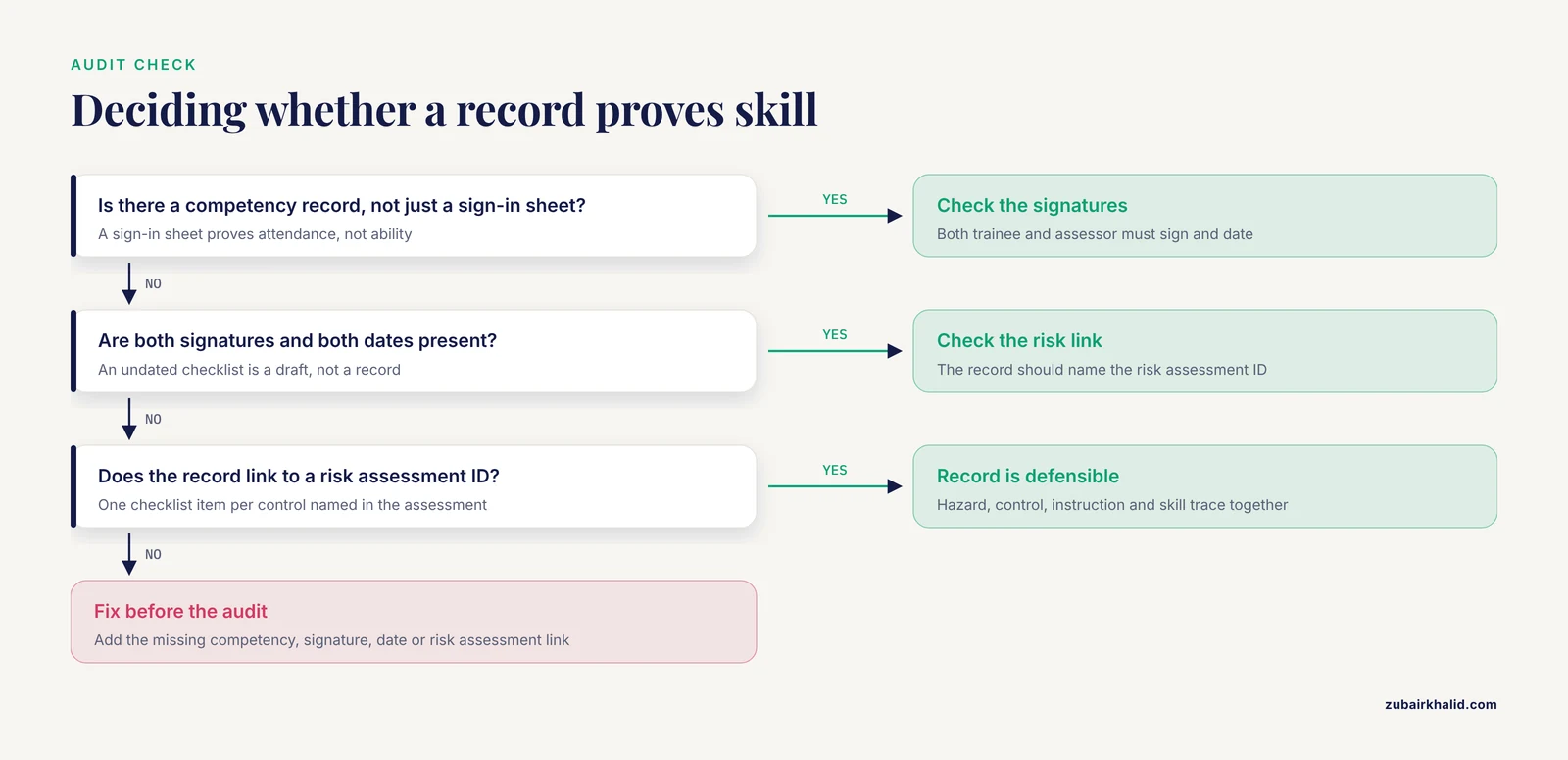
These failures show up again and again in laboratory audits.
- Counting attendance as competency. A sign-in sheet proves presence. Without a documented skills check, the file cannot answer the question an accreditor actually asks, which is whether the person can work safely.
- Training content disconnected from risk assessment. If nobody can name the risk assessment that justified a training module, the module is decoration. Link every module to an assessment ID.
- No version control. A slide deck edited in place destroys the ability to prove what was taught. Freeze and archive each taught version.
- Paper sheets that never become records. Sign-in sheets inside a binder are not queryable, not backed up, and not linked to anything. Transcribe them.
- Missing signatures or dates. An undated competency checklist is a draft, not a record. Both the trainee and the assessor sign, and both dates are recorded.
- No refresher triggers beyond the calendar. The calendar matters, but incidents, procedure changes, and new equipment also trigger retraining, and those triggers must be written into the policy.
- Audit logs without close-out. A failed check with no corrective action and no close date is an open liability, and auditors read open items as program failure.
- Over-collecting trivia while missing exposures. A file with immaculate eyewash logs and no near-miss records is optimized for the wrong thing.
- Assuming training alone converts to readiness. The Kenya program needed mentorship and site visits after its courses to produce measurable physical readiness, and even then some readiness items lagged others, which is exactly why the audit record exists [2]. Document the follow-up, not just the course.
A note on limits. This guide describes the record system. The judgments inside it, especially for unusual agents, high-containment work, or animal protocols, belong to your biosafety officer, your institutional review committees, and, for animal work, the attending veterinarian.
Frequently Asked Questions
How long should biosafety training records be kept?
Keep them for the period set by your institution's records retention schedule and your accreditor, which in many laboratories means the duration of employment plus several additional years. Write the interval into your documentation policy, and apply it to paper originals and electronic copies alike so a purge of one does not orphan the other.
Is a sign-in sheet enough to document biosafety training?
No. A sign-in sheet proves attendance, not ability. Pair it with a competency assessment such as direct observation or a written test, and file both under the same training event ID so they travel together.
What should a biosafety training documentation template contain?
A usable template has three parts: a header with record ID, version, date, approver, and the linked risk assessment, a body with objectives, content, method, and assessment approach, and a footer with trainee and assessor signatures and dates. Keep the blank template under version control and fill one copy per event.
Who can sign off as the assessor on a competency record?
A qualified person who actually observed the work, typically the direct supervisor, a designated senior technologist, or the biosafety officer. Record the assessor's name, role, and signature so the observation traces to an individual rather than a job title.
How does a biosafety risk assessment connect to training records?
The risk assessment defines the hazards and controls, and the training record proves each person learned and demonstrated those controls. Link every module to a risk assessment ID so an auditor can walk from hazard to control to instruction to demonstrated skill without leaving the file.
What records do teaching laboratories need for BSL-1 student work?
Teaching labs need the core set in miniature: a written session protocol with the biosafety boundaries, a safety briefing acknowledgment, an attendance list, and a documented inactivation step before cultures are discarded. Include the precautionary rule that unknown environmental isolates are treated as potentially pathogenic.
What should be documented after a spill or exposure?
Record the date and time, the people involved, the agent or material, the procedure in progress, the PPE worn, the response steps, medical follow-up, root cause, and corrective actions with completion dates. Link any retraining to the incident ID so the corrective loop reads in one place.
Do animal work and ABSL-3 protocols need separate training documentation?
Yes. Higher-containment animal work needs its own documented protocol review and approvals, plus procedure-specific training records on top of the core set. The review file should show sign-off from the animal care committee, the attending veterinarian, and the institution's biosafety and safety staff.
Sources
- Documentation of safe work practices in the clinical laboratory.
- Strengthening Medical Laboratory Systems in Kenya: An Innovative Biosafety Training Model.
- IACUC and Veterinary Considerations for Review of ABSL3 and ABSL4 Research Protocols.
- Biosafety implications of cadaver preservation methods in veterinary anatomy education.
- Eco-Microbiology: A Frugal-Circular Framework for Biosafe, Low-Cost Practical Microbiology in Secondary Education.